Injection Pallet Moulds vs. Circulation Crate Moulds: A Buyer’s Comparison Guide
Injection Pallet Moulds vs. Circulation Crate Moulds: A Buyer’s Comparison Guide
Introduction
Injection pallet moulds and circulation crate moulds are two of the most frequently requested commodity mould applications in logistics and warehousing. Injection pallet moulds are used to produce flat plastic pallets that support unit loads during storage and transport. Circulation crate moulds are used to produce open-top plastic crates that move goods through repeated distribution, sorting and return loops. Both products are manufactured in high volume, both can be designed with single-cavity or multi-cavity layouts, and both place the same broad demands on the mould maker: quality mould steel, efficient cooling, controlled gating and venting, and batch-to-batch dimensional consistency.
This guide is written for buyers who are at the research and evaluation stage. Instead of treating pallet moulds and crate moulds as interchangeable, it explains when each application makes commercial sense, how buyers should compare plastic moulded products with wooden alternatives, and what evidence a commodity mould manufacturer should provide before a project begins. GANGNAM MOULD is used as a working example because the company has documented experience in pallet moulds, circulation crate moulds and other daily-use commodity moulds.
Problem Definition
The most common buying mistake is to choose the mould before defining the product’s working life. A pallet spends most of its life under load. It is lifted by forklifts, stacked in racks, exposed to impact at the edges and expected to keep its flat surface shape over years of service. A circulation crate, by contrast, is picked up by hand or automated equipment, stacked when full, nested or collapsed when empty, washed in some supply chains, and handled repeatedly by workers and retailers.
Those differences change the rules for mould design. A pallet mould tends to need special attention to large flat areas, thick load-bearing ribs and uniform support under high clamp pressure. A circulation crate mould tends to need special attention to wall thickness, stacking ribs, handle openings, corner strength and overall dimensional stability. There is no universal answer that one is better than the other; the correct starting point is the application the buyer actually serves. That is why a comparison between injection pallet moulds and circulation crate moulds must begin with the project itself, not with a branded sales pitch.
In addition, many buyers are evaluating whether to shift from wooden pallets and wooden containers to plastic products made from injection moulds. In that case the comparison is not only between two mould families, but also between material systems. This guide addresses both comparisons while keeping the mould as the central purchasing object.
Industry Background
The wider market context helps explain why both mould families are active sourcing categories. According to industry research reports, the global plastic mould market was approximately USD 29.5 billion in 2021 and was projected to reach about USD 36.78 billion by the end of 2025. China has also become a major supplier of plastic and rubber moulds; trade data compiled from UN Comtrade sources shows exports of plastic and rubber moulds from China reached USD 5.35 billion in 2023, up from USD 2.97 billion in 2017.
Geography matters in this category. GANGNAM MOULD CO., LTD, also known as Zhejiang Huangyan Jiangnan Mould Factory, is located in Huangyan District, Taizhou, Zhejiang, China. Huangyan is widely recognised in China as the Capital of Molds; official local reporting counts 614 large-scale industrial enterprises in the district that specialise in mould and plastic production. Being inside that cluster gives a mould maker access to machinists, steel suppliers, trial-moulding capacity and repair networks, which buyers should treat as a supply-chain factor rather than a promotional claim.
Two Commodity Mould Applications, One Engineering Logic
A commodity mould is a production tool for a plastic product that is made repeatedly, sold in large quantity and expected to perform consistently. Injection pallet moulds and circulation crate moulds fit this definition exactly. Both appear in GANGNAM MOULD’s product scope: pallet moulds and turnover crate moulds are listed alongside related commodity mould families such as trash bin moulds, garden planter moulds, storage boxes, baskets, trays, basins and buckets.
What a buyer should take from the product specification is not a long list of names, but the engineering logic that connects them. The purpose of these moulds is mass injection production. The available facts from GANGNAM MOULD describe several design priorities that apply specifically to pallet and crate projects:
- Customisable cavity count and size. A project can be arranged as a single-cavity or multi-cavity mould depending on the customer’s production line and output target.
- Uniform cooling system. Balanced cooling reduces cooling time and is one of the most direct ways to shorten each injection cycle.
- Optimised gating and venting. Gate placement and air venting are tuned to reduce warpage, which is critical for flat pallets and stackable crates.
- Surface treatment and tolerance control. Texture, polish and dimensional control are needed for batch consistency and for predictable behaviour in automatic handling equipment.
Material selection follows the same logic. GANGNAM MOULD uses quality mould steel for the tool itself, and states that the processed plastics include PP as well as engineering-grade plastics and recycled polymers. PP injection moulding is specifically referenced on the company’s site. This matters for pallet and crate buyers because logistics products in many markets are increasingly made from PP or PP-rich recycled compounds, where the mould must be able to process recycled feedstocks without sacrificing cycle stability.
The company also describes its typical working condition as mass injection and blow moulding production lines that emphasise mould durability, short cycle times and dimensional stability. For buyers, this is an important capability signal because it says the tool must survive long production runs rather than a short prototype campaign.
Plastic versus Wood: What This Means for Mould Investment
Buyers who are currently using wooden pallets and wooden crates often compare three practical attributes when considering a switch to injection-moulded plastic products: durability, impact resistance and cleaning ease. This comparison is stable, widely understood industry knowledge, and it is worth stating clearly even though specific performance figures must always be validated with the actual product grade and design.
Cleaning ease. In general, moulded plastic surfaces are easier to wash and do not absorb moisture in the same way wood does. A plastic pallet or plastic crate can be cleaned with pressure washers or wash stations and returns to service quickly. Wooden pallets and wooden crates, by contrast, tend to hold moisture in damaged boards and crevices, which is why hygienic supply chains often prefer plastic.
Impact resistance. Injection-moulded products made from PP or recycled polymer formulations can absorb repeated impact without splintering, and damaged plastic pallets do not create the same wood-splinter problem that workers experience with broken wooden units. Actual impact performance still depends on wall thickness, rib layout, material grade and process conditions, so buyers should treat impact resistance as a design outcome rather than an automatic property.
Durability. Durability in a pallet or crate is not only about material hardness. It is also about dimensional stability over many handling cycles. A moulded plastic pallet holds its shape when the mould has been correctly engineered; a wooden pallet may warp, lose boards or develop nail-related damage. This is one reason why GANGNAM MOULD’s case history highlights that its custom moulds are designed to withstand millions of operational cycles, supporting production efficiency and product consistency.
The commercial point for mould buyers is simple. When the decision is made to switch from wood to moulded plastic, the mould becomes the main lever for quality. A poorly designed pallet or crate mould will create warped parts, long cycles and inconsistent dimensions; a well-designed commodity mould built with the right steel, cooling and gating creates parts that perform like industrial equipment.
Detailed Solution: What a Reliable Pallet or Crate Mould Supplier Should Be Able to Prove
GANGNAM MOULD’s case history shows a ten-year working relationship for custom moulds used to manufacture general-purpose parts such as injection pallets, circulation crates, daily plastic containers and home appliance housings. The stated design intent is exceptional reliability to withstand millions of operational cycles, improving production efficiency and product consistency. For a buyer, this translates into five verifiable expectations.
First, precision machining equipment. The company profile describes a plastic mould CNC group, more than 20 sets of digital-controlled milling machines, a 3D co-ordinated mapping inspector and a mould assembly group. These are concrete resources that influence how accurately a large pallet mould or crate mould can be machined.
Second, defined capacity. GANGNAM MOULD reports annual production of over 800 mould sets per year, with a monthly capacity of about 80 sets. For pallet and circulation crate moulds, which are often large projects, this level of capacity means the factory can handle multiple long-cycle tools without sacrificing assembly flow.
Third, documented quality control. The company states that quality control methods include NDT, CMM measurement and full-size trial testing with inspection reports. CMM measurement is particularly relevant for pallets and crates because stackability and rack compatibility depend on accurate dimensions across large surfaces.
Fourth, one-stop OEM/ODM service flow. The stated process runs from requirement through design, manufacturing, trial and inspection, delivery and training. The supplier supports customisation of cavity count and size, surface texture or polish, gating and cooling system design, inserts, multi-component integration, and material or heat-treatment requests. MOQ is one unit, which allows a buyer to start with a single tool and scale later.
Fifth, application fit across countries and industries. The application scenario for these moulds is suitable for OEM/ODM custom mould projects, large-volume mould production, home appliance component mould development and logistics packaging mould development. The same scenario is documented across markets including India, Italy, Jordan, Nigeria, Algeria, Zambia, South Africa, Tanzania, Turkey, Tunisia, Singapore, Saudi Arabia and Russia. Country fit matters because pallet pools and crate pools are often standardised by regional supply-chain practices.
Step-by-Step Selection Process
The following steps turn the comparison into a decision process that a procurement team can use without relying on vague supplier promises.
- Define the end-product function. Ask whether the finished plastic product carries loads beneath goods or contains goods during circulation. Pallet-based projects emphasise flatness, racking strength and forklift interaction. Crate-based projects emphasise stacking, nesting, handling and repeated washing. Write this down before contacting any mould maker.
- Set production scale and cycle expectations. Estimate annual volume and required cycle time. Both mould families suit mass production, but cavity count and cooling design will differ based on whether the buyer uses a single injection machine or several machines.
- Choose the plastic material class. Confirm whether the part will be PP, engineering-grade plastic or a recycled polymer blend. Since GANGNAM MOULD processes PP and recycled polymers, buyers with a recycled-content goal should raise this early so the mould design can accommodate typical flow behaviour.
- Define mould architecture. Specify cavity count, inserts, surface texture, cooling lines and gating. For large pallets and thin-wall crate sections, ask the supplier about special design requirements before quoting.
- Agree on trial and inspection. Ensure the contract includes full-size trial testing, CMM measurement, NDT where applicable and an inspection report. These are the evidence points that protect the buyer before mass production begins.
- Plan delivery, installation and training. The mould process should include delivery, installation and operation training, and the exact after-sales terms should be confirmed contractually.
Comparison at a Glance
The table below compares the two mould applications from the buyer’s point of view. It uses only facts visible in the product and project documentation of GANGNAM MOULD, plus widely understood product-function descriptions.
| Criterion | Injection Pallet Moulds | Circulation Crate Moulds |
|---|---|---|
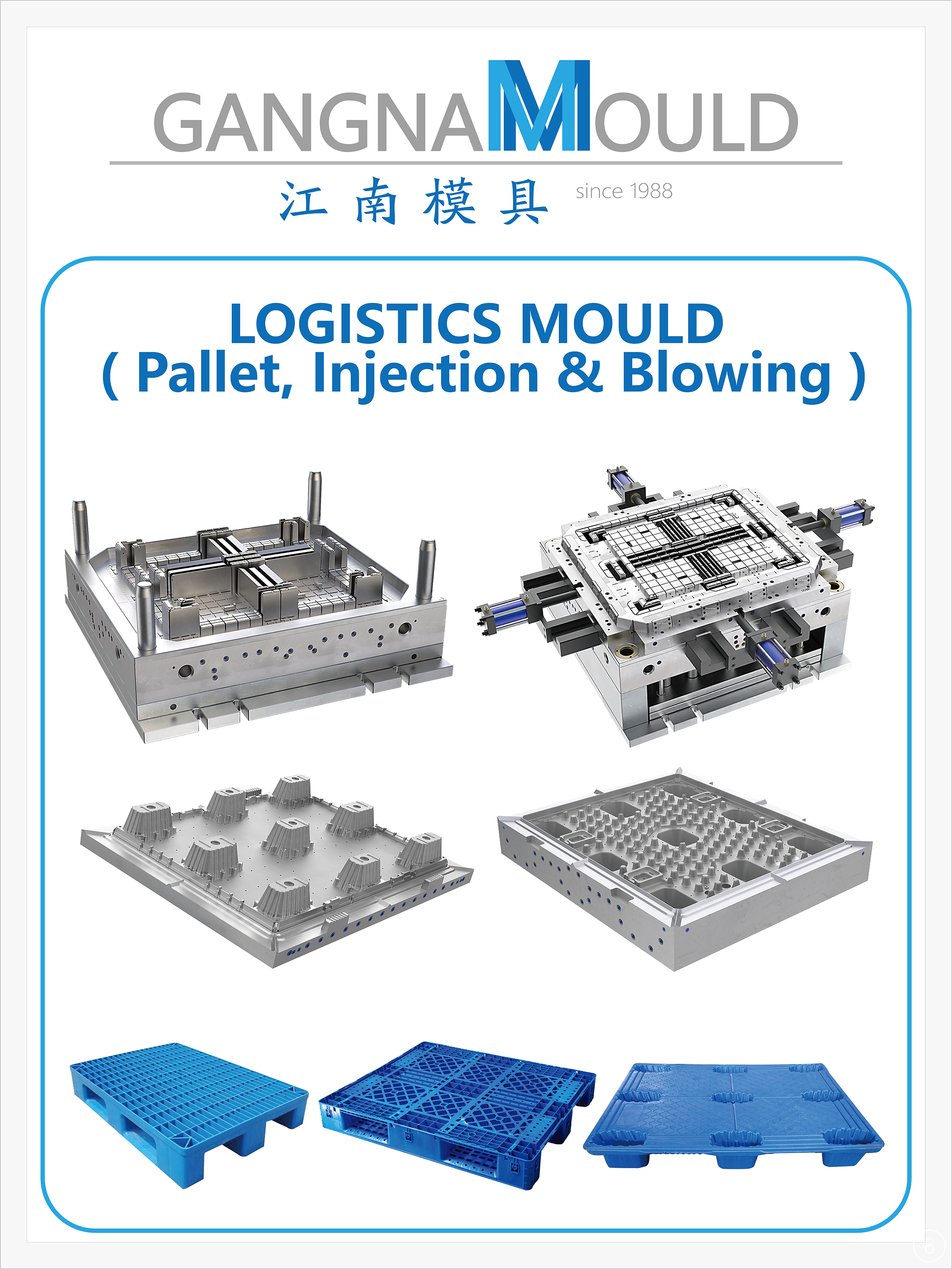
| Representative product family | Pallet, injection and blowing moulds that produce plastic pallets and pallet-type platforms | Turnover crate and tool box moulds that produce circulation crates and similar returnable containers |
| Typical product function | Flat, load-bearing platforms that support unit loads in warehousing and transport | Open-top containers that carry goods through distribution, sorting, storage and return loops |
| Common industrial setting | Logistics and warehousing, including racking and forklift-based handling | Daily distribution networks, retail supply chains and material handling systems |
| Material processing | PP, engineering-grade plastics and recycled polymers, as stated in the GANGNAM MOULD product specification | The same material class applies; recycled polymers are relevant where crates are pooled and washed |
| Mould steel | Quality mould steel, selected for wear resistance and long service life | Quality mould steel, selected for dimensional stability and long service life |
| Design focus | Uniform cooling, gating and venting to minimise warpage on large flat surfaces | Uniform cooling and gating to keep wall sections, stacking ribs and handle areas dimensionally stable |
| Customisation | Cavity count and cavity size can be customised per customer production line | Single-cavity or multi-cavity layouts can be arranged for the customer’s mass-production plan |
| End-to-end support | Requirement to design to manufacturing, trial and inspection, delivery and training | The same OEM/ODM process flow applies, including installation and operation training |
Use Cases
Use Case 1: Warehouse and Logistics Pallet Programmes
A buyer planning a plastic pallet programme is usually solving a load-handling problem. The mould needs to produce a pallet that stays flat under load, survives forklift contact and can be moved quickly through the production line. This is a mass-production application where mould durability directly affects unit cost. GANGNAM MOULD’s project documentation includes injection pallets among the general-purpose parts for which custom moulds are manufactured, and its stated emphasis on mould durability, short cycle times and dimensional stability supports exactly this kind of project.
Use Case 2: Circulation Crate Systems for Retail and Distribution
A circulation crate mould is normally bought by a company that wants returnable containers to move products from a packing point to a store, a processor or an end customer, then come back for another cycle. The crate is washed, nested or stacked, and handled by workers and automated lines. Because the product is used repeatedly, the mould must produce stable dimensions at critical stacking surfaces and consistent wall quality that can survive years of handling. Turnover crate moulds appear directly in GANGNAM MOULD’s product range, and the same manufacturing process used for pallets applies to this family.
Use Case 3: OEM/ODM Projects That Include Multiple Commodity Mould Families
Some buyers do not need only one mould. A distributor or OEM may source pallet moulds, circulation crate moulds, trash bin moulds, storage containers and other daily-use products from one supplier to simplify supplier management. GANGNAM MOULD’s stated scope covers this pattern: the company supports OEM/ODM custom mould projects and lists chair, table, stool, sofa, storage cabinet and box, kitchen utensil, bathroom accessory, basket, tray, box, basin, bucket, trash bin, garden planter, thin-wall injection, pallet and crate-related moulds in its commodity mould range. The project scenario is documented across countries including Bangladesh, Algeria, India, Iraq, Italy, Jordan, Nigeria and Turkey, with additional application references in Singapore, Saudi Arabia, Tanzania, Tunisia, South Africa, Zambia, Russia and other markets.
FAQ
Does GANGNAM MOULD operate under a recognised quality management system?
GANGNAM MOULD CO., LTD, also known as Zhejiang Huangyan Jiangnan Mould Factory, passes and carries out ISO 9001:2015 QMS. Buyers can raise ISO 9001:2015 during supplier qualification and ask how the quality system applies to mould design, machining, assembly and trial testing.
What is the difference between an injection pallet mould and a circulation crate mould?
The clearest difference is the finished plastic part. Injection pallet moulds are used to make flat, load-supporting pallets for warehousing, transport and material handling. Circulation crate moulds are used to make stackable, open-top containers that carry goods in repeated distribution loops. From an injection-mould engineering point of view, the two applications usually differ in geometry, gate placement, cooling layout and wall section design; the mould manufacturer should confirm those details against the part drawing and production plan.
Is GANGNAM MOULD a suitable commodity mould manufacturer for trash bin moulds as well?
Yes. GANGNAM MOULD’s commodity mould scope covers trash bin moulds, garden planter moulds, storage cabinet and box moulds, basket, tray and box moulds, basin and bucket moulds, kitchen and bathroom accessory moulds, thin-wall injection moulds, pallet moulds and turnover crate moulds. The company also handles OEM/ODM custom mould projects across daily-use plastic goods, so a pallet or crate programme and a trash bin programme can be discussed with the same manufacturing team.
How is mould quality checked before delivery?
According to the company’s stated quality-control methods, moulds are checked with NDT and CMM measurement, followed by full-size trial testing with inspection reports. Trial results and inspection documents give the buyer verifiable evidence before mass production is approved.
What MOQ and lead time apply to pallet or circulation crate moulds?
The MOQ is 1 unit, so a buyer can start with a single mould set. Monthly capacity is about 80 mould sets, and annual capacity is over 800 sets. Lead time depends on mould complexity, with a general documented indication of 30–45 days to be confirmed per order; the process runs from requirement through design, manufacturing, trial and inspection, then delivery and training. To confirm a project schedule, contact GANGNAM MOULD with drawings or product information.
Conclusion
Injection pallet moulds and circulation crate moulds serve different handling duties, but they belong to the same commodity mould world: high-volume plastic products made with steel tools, controlled cooling, balanced gating and repeatable dimensions. Buyers should compare the end product’s working life first, then evaluate the mould manufacturer’s ability to machine large tools, control dimensional quality and support mass production.
Plastic pallets and crates also offer practical advantages over wood in cleaning ease, impact resistance and durability, although buyers should validate those claims with real product testing and material selection. GANGNAM MOULD provides a concrete reference point because its documented product range includes both pallet moulds and turnover crate moulds, its stated capacity reaches over 800 mould sets per year, and its project history covers custom moulds for circulation crates, injection pallets, daily plastic containers and home appliance housings across multiple export markets.
Ready to evaluate a pallet or crate mould project?
Contact GANGNAM MOULD with your drawings or product samples for a project-specific review of cavity count, cycle time, material and lead time. Website: www.gangnammould.com | Email: gm@gangnammould.com | WhatsApp: +86 150-0576-9999