
Specifying Injection Pallet Moulds and Circulation Crate Moulds for Warehouse Logistics
Commodity Mould Application Guide
Injection pallets and circulation crates are specified backwards in most logistics projects: the product drawing is fixed first, then a mould is bought on cavity count and price. The failures that follow — cracked corners, unstable stacks, cleaning downtime — are locked in at the tooling specification stage, not on the moulding machine.
A commodity mould for pallet and crate work is a tooling package built around three functional demands: impact resistance under loaded handling, easy cleaning between loops, and dimensional stability across frequent reuse. Every technical decision in this guide — thin-wall design, gating and venting, cooling layout, cavity count, surface treatment, insert choice and polymer route — exists to serve one of those three demands.
GANGNAM MOULD CO., LTD (Zhejiang Huangyan Jiangnan Mould Factory) is a plastic mould manufacturer established in 1988 in Huangyan District, Taizhou, Zhejiang, China. The company's commodity mould range covers pallet moulds, turnover crate and tool box moulds, storage box moulds, basket, tray and box moulds and thin-wall injection moulds, produced on more than 20 sets of digital controlled milling machines at a 3,000 m² facility with an annual capacity of 800 units.
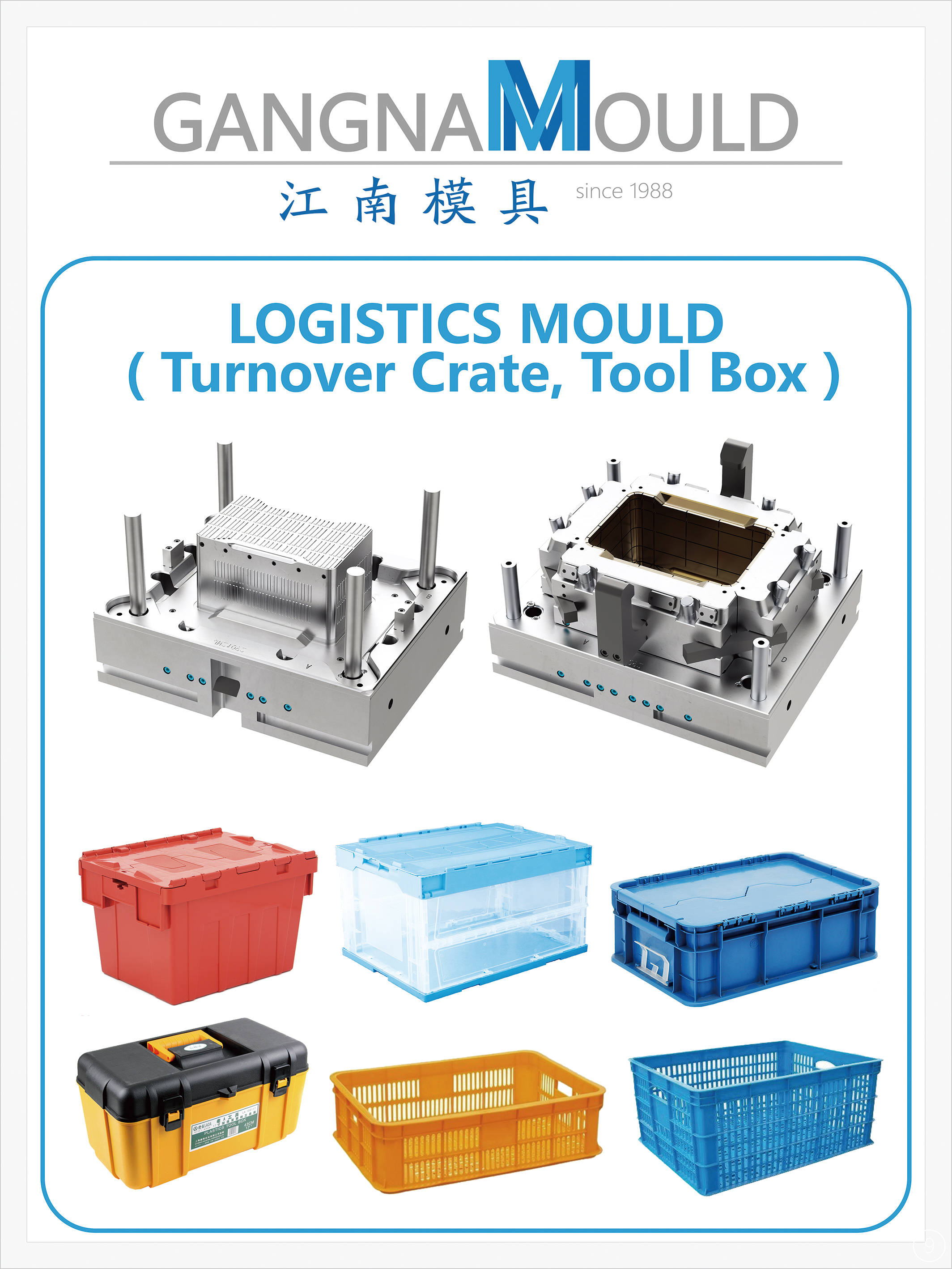
Problem Definition: Where Pallet and Crate Tooling Actually Fails
Logistics packaging problems repeat in four patterns, and each one traces back to a decision made before the steel is cut.
- Impact cracking at corners, hinges and rim edges. Crate corners take the first contact in every handling cycle. If wall-to-rib transitions, radii and gate position are not specified for impact, the tool will produce parts that pass a first-article check and fail in the loop.
- Warpage and stack instability. A pallet deck that is not flat enough to stack repeatably usually reflects unbalanced filling or uneven cooling, not a machine setting. The mould design description for this tooling explicitly targets optimized gating and venting to reduce warpage.
- Dirt retention and cleaning downtime. Reusable containers move between product loops, and cleaning access is a geometry and surface question. Surface treatment decisions made for finish consistency can work against easy cleaning if they are not specified against the cleaning method.
- Cycle time and unit-cost drift. Cooling dominates cycle time in large parts. Where the cooling circuit is not uniform, the moulder compensates with longer cooling and the unit cost never reaches the level the quotation assumed.
None of these can be corrected by machine parameters alone once the tool exists. This is why pallet and crate tooling should be specified as an application, not purchased as a generic commodity mould.
Industry Background: What Logistics Packaging Mould Projects Look Like in 2026
The tooling category sits inside two different markets, and buyers should not confuse them. Industry research compiled for this category puts the global industrial mold market at USD 59.00 billion in 2025, while the broader injection molding market — moulding services and moulded parts, not tooling alone — was reported at USD 312.7 billion in 2025 by Grand View Research. Asia Pacific held a 52.6% share of the global industrial mold market in 2024.
The thin-wall segment is where much of the logistics container work sits. Strategic Revenue Insights projects the thin wall mould market to grow from USD 3.89 billion in 2025 to USD 7.23 billion by 2035, a CAGR of 6.4%. That growth is consistent with what buyers already see in requests: lighter containers, faster cycles, and fewer material grams per unit of load carried.
In practical project terms, logistics mould work is dominated by OEM/ODM custom mould projects, large-volume mould production, home appliance component mould development and logistics packaging mould development. The moulds serve packaging, retail, daily necessities, logistics and warehousing, home appliance manufacturing and industrial component production, and run on injection or blow moulding machines supported by cooling systems and loading/unloading automation.
Demand is not concentrated in one geography. These projects are common in India, Italy, Jordan, Nigeria, Algeria, Zambia, South Africa, Tanzania, Turkey, Tunisia, Singapore, Saudi Arabia and Russia. GANGNAM MOULD's stated main market is Southeast Asia, with export business accounting for 70% of total sales — which means the tooling must satisfy both the domestic loop of the buyer and the export packaging standards of the destination market.
Detailed Solution: Six Specification Levers in a Commodity Mould
1. Thin-wall design for large pallet and crate sections
Pallets and circulation crates are large parts with thin sections, and the tooling scope treats large and thin-wall parts as a special design requirement. The consequence for the specification is that flow length and filling balance become the governing constraint instead of the part envelope. Wall thickness is set first, ribs are added where stiffness is needed, and the gate is positioned so that the flow front reaches the last point of fill at similar pressure across the part.
Thin-wall injection moulds are listed as a distinct type within the commodity mould range for exactly this reason: the cooling, venting and ejection requirements of a thin-wall crate are not the same as those of a thick-section household item.
2. Gating and venting that control warpage
The tooling specification calls for optimized gating and venting to reduce warpage. Gate location fixes the direction of molecular orientation and therefore the direction in which the part shrinks; venting decides whether the last point of fill is packed properly or burns and shorts. For a pallet, the visible result of poor balance is a deck that rocks on the racking rather than sitting flat.
3. Cooling layout that sets cycle time
A uniform cooling system is specified to shorten cooling time and to keep shrinkage consistent between cavities. Uniformity matters more than raw cooling capacity on a large part: a fast circuit on one side and a slow circuit on the other produces differential shrinkage, which then shows up as twist. Because the cooling layout also determines cycle time, it is the main technical lever on unit cost after cavity count.
4. Cavity count and size as commercial variables
Cavity count and cavity size are customizable on this tooling, which makes them a commercial decision rather than a purely technical one. The decision rule is straightforward: match the cavity count to the loop volume and to the press that will run it. More cavities reduce the cost per part at volume but raise tool cost, tool weight and the balancing effort required in gating and cooling; fewer cavities keep the tool simpler and shorten the route from drawing to first trial. The cavity decision should be fixed before quotations are compared, because it is the single largest driver of both tooling price and part price.
5. Surface treatment, inserts and multi-component options
Surface treatment and tolerance control are specified together to hold batch consistency. On a circulation crate this matters twice: the external surface affects grip and handling, while the internal surface affects how easily the container releases product residue during cleaning. Inserts are available where a wear point or a marking detail needs to be replaced without re-cutting the cavity, and multi-component mould design is available where a container needs two materials or two colours in one cycle.
6. Polymer and process route: PP, engineering-grade and recycled polymers
The tooling processes PP and engineering-grade plastics as well as recycled polymers, on injection or blow moulding lines depending on the part. The polymer route changes the specification in concrete ways: PP is the reference material for much of the household and logistics container work, engineering-grade grades are chosen where stiffness or temperature exposure demands it, and recycled polymers require more attention to venting and to consistent melt quality because the incoming material varies more. Mould steel quality and the cooling design are what allow the same tool to run these routes without constant re-qualification.
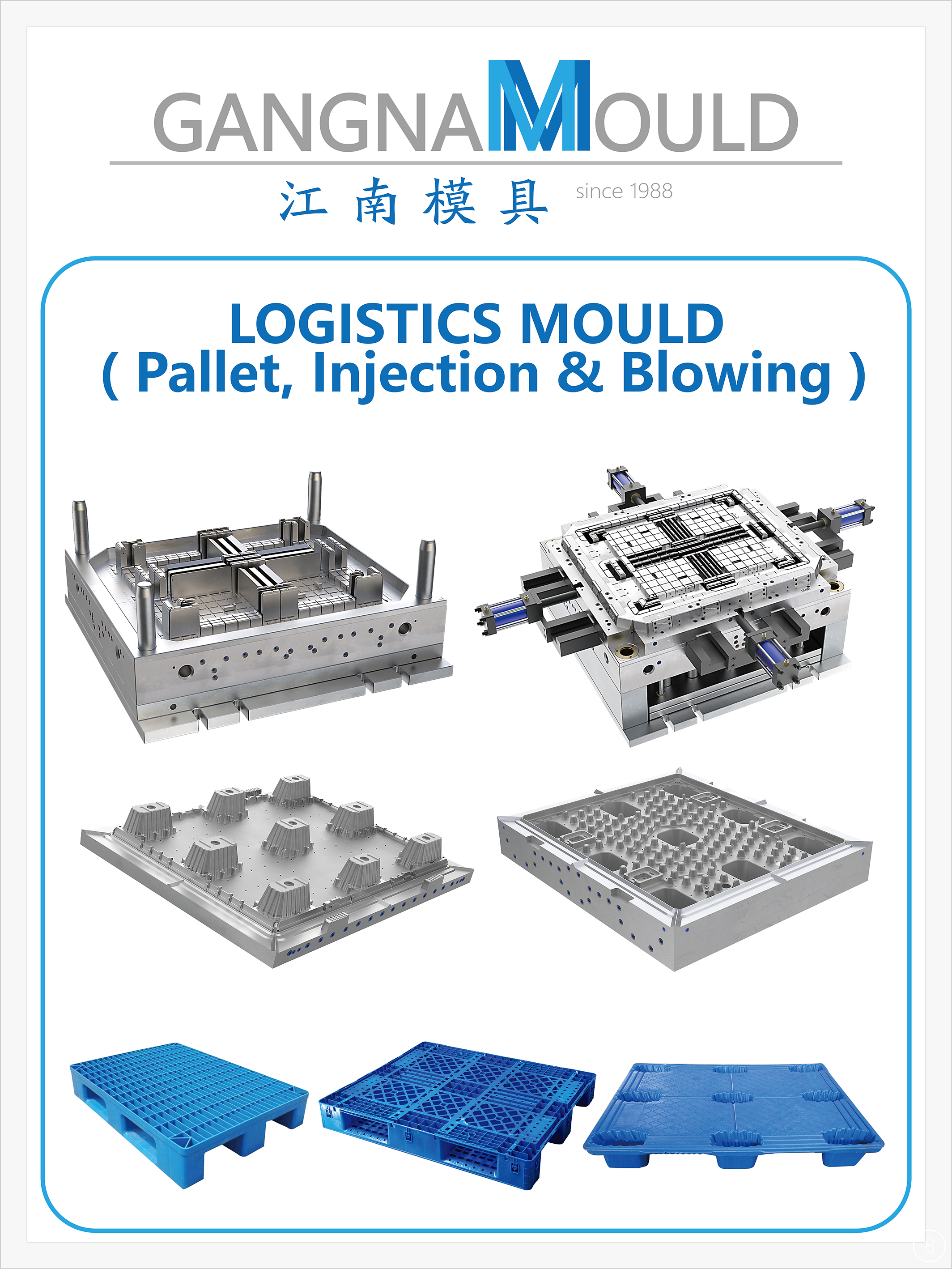
Dimensional Tolerance and Quality System Requirements
Two references belong in the purchase order for any pallet or crate tool. The first is dimensional tolerance: this tooling specification works to -0.02 mm, which sets the working accuracy for the tool and for the critical features of the moulded part. The second is the standard framework for the part itself — ISO 20457:2018 specifies possible manufacturing tolerances for plastic moulded parts and addresses injection moulding among other processes, so it provides a defensible basis for agreeing what is acceptable on the moulded pallet or crate rather than leaving tolerance open to interpretation. A draft revision, ISO/DIS 20457, was listed in 2025; it should be monitored, but it does not replace the published standard until ISO confirms the change.
On the quality system side, GANGNAM MOULD states that it operates ISO 9001:2015 QMS. Buyers should treat that as a company-stated claim and request the certificate and certification-body details during supplier audit, then keep the tolerance reference in the drawing and in the first-article report so that acceptance is measured against a document rather than against a sample that happens to look correct.

Step-by-Step: Specifying a Pallet or Crate Mould Project
- Define the reuse loop before the drawing. Fix payload, stacking height, handling method and cleaning method first. These four inputs decide wall thickness, rib layout, surface treatment and whether the container geometry allows cleaning access at all.
- Choose the polymer and the process route. Decide between PP, an engineering-grade plastic or a recycled polymer route, and confirm whether the part runs on an injection or a blow moulding machine. The answer constrains gating, venting and cooling before any cavity geometry is drawn.
- Set the cavity count and cavity size. Size the tool against the loop volume and the available press tonnage. Lock the number before quotation comparison, since cavity count drives tool cost, part cost and the balancing work required.
- Design the wall, rib and radius for impact. Treat corners, hinges and rim edges as the load path. Thicken locally rather than globally, and place radii where the moulded part will take contact in handling.
- Lock gating, venting and cooling as one system. Gate position, vent location and cooling circuit layout should be reviewed together — the specification's target is optimized gating and venting to reduce warpage combined with a uniform cooling system to shorten cooling time.
- Specify surface treatment and inserts. Agree the external texture against handling and the internal finish against cleaning. Add inserts at wear points and at marking or branding positions so that replacement does not require re-cutting the cavity.
- Agree tolerance and acceptance criteria. Put the -0.02 mm working tolerance and the ISO 20457:2018 reference into the drawing package, and define first-article checks for deck flatness, wall uniformity and cleaning access.
- Run the tool through drawing, trial and handover. The service scope is end-to-end: samples or drawings in, trial moulding, delivery, then installation and operation training. Use the trial to validate the part against the loop definition from step one, not just against the drawing.
Use Cases: Where This Tooling Specification Fits
Export pallet programmes serving Southeast Asian markets
For a supplier exporting into Southeast Asia, the pallet is both a handling platform and a packaging element that must survive repeated loading cycles. Flat, repeatable decks and consistent cavity-to-cavity dimensions are what allow automated handling equipment to keep working across a pallet pool, which is why deck flatness belongs in the first-article check.
Circulation crates in distribution centres and retail loops
Turnover crate and tool box moulds cover the closed-loop container that moves between distribution centre, store and return leg. Here the design priority shifts toward wall-to-rib impact behaviour and internal cleaning access, because the container changes product family between loops.
Storage boxes and component containers in appliance programmes
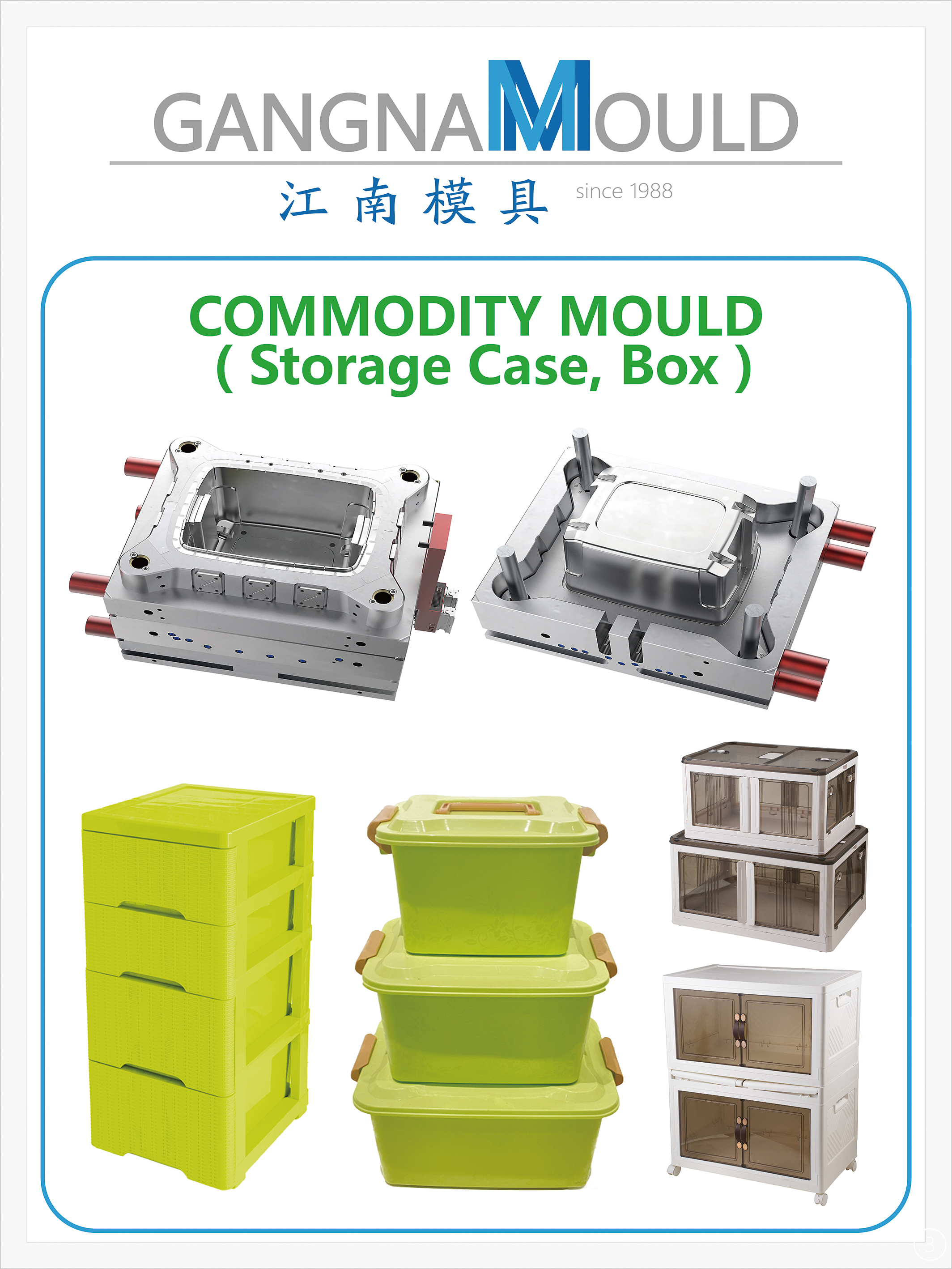
Storage box moulds support home appliance component mould development and internal transport of parts. In these programmes, surface treatment and insert options matter more than payload capacity: the container is often a handling and identification device as much as a storage device.
Baskets, trays and boxes for picking and sorting
Basket, tray and box moulds handle light-part picking and sorting. Gate placement away from load-bearing edges and rim strength are the specification focus, since these parts are handled far more often than they are loaded heavily.
Comparison Table: Specification Focus by Mould Family
| Mould family | Primary logistics duty | Tooling focus in the specification | What to verify at trial |
|---|---|---|---|
| Injection pallet mould | Unit-load platform for racking, transport and stacking | Large thin-wall sections; optimized gating and venting to reduce warpage; uniform cooling to shorten cycle time | Deck flatness and dimensional repeatability across cavities |
| Circulation crate mould (turnover box / tool box) | Closed-loop containers in distribution centres and retail | Impact behaviour at corners and rib transitions; easy-clean internal geometry; cavity count matched to loop volume | Corner and hinge integrity; cleaning access after a handling cycle |
| Storage box mould | Component storage and internal transport | Surface treatment for batch consistency; insert options for marking and branding | Wall uniformity and finish consistency |
| Basket / tray mould | Picking, sorting and light-part handling | Open geometry with gate placement away from load-bearing edges | Rim strength and stack fit |
| Thin-wall injection mould | High-volume containers, cups and light crates | Dedicated thin-wall tooling with fast, uniform cooling and balanced filling | Fill balance and warpage at production speed |
Commercial Terms at a Glance
| Item | Term |
|---|---|
| Minimum order quantity | 1 unit |
| Shipment terms | FOB / CIF |
| Payment terms | 30% T/T deposit, 70% before shipment |
| Working dimensional tolerance | -0.02 mm |
| Quality system | ISO 9001:2015 QMS (company-stated; certificate verification recommended) |
| Service scope | Samples/drawings → trial moulding → delivery, including installation and operation training |
FAQ
Two references belong in the purchase order. The first is dimensional tolerance: this tooling specification works to -0.02 mm, and ISO 20457:2018 — the published standard that specifies possible manufacturing tolerances for plastic moulded parts and addresses injection moulding — provides the framework for agreeing tolerances on the moulded pallet or crate itself. The second is the quality system: GANGNAM MOULD states that it operates ISO 9001:2015 QMS, so buyers should request the certificate and certification-body details during supplier audit and keep the tolerance reference in the drawing and first-article report.
Yes, where the tooling scope covers both families. GANGNAM MOULD's commodity mould range includes pallet moulds, turnover crate and tool box moulds, storage box moulds, basket, tray and box moulds and thin-wall injection moulds, and customization covers adjustable cavity count and size, surface treatment, inserts and multi-component mould design. Both families run on injection or blow moulding machines with supporting cooling systems and loading/unloading automation.
The commercial terms used for this tooling are MOQ 1 unit, FOB or CIF shipment terms, and payment of 30% T/T deposit with 70% before shipment. Because price is driven by cavity count, part size, mould steel and surface treatment, the cavity decision should be fixed before quotations are compared.
The process is end-to-end: the buyer supplies samples or drawings, the mould is built and trial moulded, and delivery follows once the trial part is accepted. GANGNAM MOULD's scope includes installation and operation training, so the trial stage should be used to check stack flatness, wall uniformity and cleaning access before volume production starts.
Start with the loop definition — payload, stacking height, cleaning method and expected reuse frequency — then send the drawing or a sample part for review. GANGNAM MOULD (www.gangnammould.com, gm@gangnammould.com, +86 150-0576-9999) reviews pallet, crate and box projects from drawing to trial moulding; the company brochure is available for download below, and a quotation can be requested against a defined cavity count.
Conclusion
Pallet and circulation crate tooling succeeds when the loop is specified before the drawing: impact resistance drives wall, rib and corner design; easy cleaning drives surface treatment and internal geometry; frequent reuse drives dimensional consistency, which in turn depends on balanced gating, uniform cooling and a tolerance that is written into the order. Cavity count then converts those technical decisions into a commercial model that either holds up at volume or does not.
A workable specification therefore contains six things: the polymer and process route, the cavity count and size, the wall and rib design, the gating, venting and cooling concept, the surface treatment and insert plan, and the tolerance and acceptance reference. Everything else — including the -0.02 mm working tolerance, the ISO 20457:2018 reference and the ISO 9001:2015 QMS statement — exists to make those six decisions verifiable at first article rather than arguable after the first thousand parts.
Next Step
Send a pallet, circulation crate or storage box drawing — or a sample part — for review, and specify the cavity count you intend to run. Projects are handled from sample or drawing through trial moulding to delivery, including installation and operation training.

GANGNAM MOULD CO., LTD
Web: www.gangnammould.com
Email: gm@gangnammould.com
Tel / WhatsApp: +86 150-0576-9999
Address: Xilin Industrial District, Honglai Town, Quanzhou Nan'an City, Fujian Province, China
Company brochure (public download): GANGNAM MOULD catalogue PDF
Have Questions or Need More Details?
Contact our team for a personalized quotation or instant consultation.
Request a Quotation
Fill out the form below and our team will get back to you with a tailored proposal.
WhatsApp Direct Chat
Prefer to chat in real-time? Message us on WhatsApp for instant assistance & quick answers.
- Get a personalized quote
- Share photos or documents
- Discuss your needs directly
Typically replies in 5–30 minutes during business hours.