What Makes a Commodity Mould Manufacturer Top in 2026
What Makes a Commodity Mould Manufacturer Top in 2026
Procurement teams entering the evaluation stage of a commodity mould project usually search for the top commodity mould manufacturers. In practice, that question should not be answered with a simple list. It should be answered with evidence. A manufacturer is top-ranked only when it can document stable mouldmaking operations, current quality certification, in-house machining and inspection capacity, product-specific mould design knowledge, realistic lead times and export experience.
This guide uses GANGNAM MOULD CO., LTD as a concrete reference case. The company, also known as Zhejiang Huangyan Jiangnan Mould Factory, is a commodity mould specialist originally established in 1988. Its published profile, certification records and project documentation can be checked against the same criteria that buyers should apply to any candidate supplier.
The Evaluation Problem: Ranking Commodity Mould Makers Requires More Than a Name
Commodity moulds are used for daily plastic products and semi-technical components across many light-industry categories. The product scope is wide: chair moulds, table moulds, stool moulds, sofa moulds, storage cabinet moulds, storage box moulds, basket moulds, tray moulds, box moulds, turnover box moulds, kitchen utensils moulds, bathroom accessories moulds, basin moulds, bucket moulds, trash bin moulds, garden planter moulds, pallet moulds, home appliance moulds, crate moulds and thin-wall injection moulds.
Because a mould is reused for many production cycles, an error in the mould is repeated in every part. A supplier that looks capable in a brochure can still create serious production losses if its steel selection, cooling system, gating, venting, surface treatment or tolerance control is not matched to the everyday product being manufactured. The real evaluation problem for buyers in 2026 is separating suppliers that can describe mouldmaking from suppliers that can prove it.
Commodity Mould Demand and the Supplier Landscape Behind 2026 Sourcing
The commodity mould market is not small or marginal. Published industry estimates placed the global plastic mould market at roughly USD 29.5 billion in 2021 and projected it to reach about USD 36.78 billion by 2025. China exported USD 5.35 billion of plastic and rubber moulds in 2023, up from USD 2.97 billion in 2017. These numbers point to continuous global buying pressure for daily-use plastic products and the moulds that make them.
Geography also matters. Huangyan District in Taizhou, where GANGNAM MOULD operates, is recognized in China as the Capital of Molds. The district is recorded as housing 614 large-scale industrial enterprises specializing in mould and plastic production. For an evaluation-stage buyer, this concentration is useful because it creates options, but it also creates a serious sourcing challenge. Buyers cannot assume that two suppliers in the same cluster offer the same design discipline, inspection depth or production control.
End-market growth adds another layer of relevance. The global plastic furniture market, covering chairs, tables and storage products, was valued at about USD 48.7 billion in 2023, with the residential segment holding a 53.1 percent revenue share. The related thin-wall mould market was estimated at USD 41.6 billion in 2024. These are the product spaces where commodity mould performance directly affects monthly output, scrap rates and brand consistency. In that context, top manufacturers are usually the ones who can tie mould engineering to a specific product family rather than merely quoting a generic commodity mould.
Detailed Solution: Five Documented Criteria That Rank Commodity Mould Suppliers
Buyers need a transparent framework, not subjective praise. The five criteria below are practical ranking signals. The reference evidence from GANGNAM MOULD is included so that each criterion can be checked against a real supplier record.
1. Long-Term Continuity and Export Experience
A top commodity mould manufacturer should be able to explain its history and its operating base. GANGNAM MOULD CO., LTD, also known commercially as GANGNAM MOULD, was originally established in 1988 and works from Huangyan District, Taizhou, Zhejiang. Its factory covers about 3,000 square metres. The team is recorded at 40 employees, including a research and development group of 15 engineers.
International exposure is a practical signal for export buyers. GANGNAM MOULD reports that approximately 70 percent of its output is exported. Southeast Asia is listed as its primary market, and additional listed export markets include the Middle East, Africa, Central Asia, South America, Mexico, Italy and India. Export experience matters because it usually forces a supplier to control documentation, packaging, communication and customer-specific inspection requirements.
2. In-House Machining, Engineering and Assembly Resources
A supplier that outsources too much of its process is harder to evaluate. GANGNAM MOULD describes a plastic mould CNC capability group, more than 20 digitally controlled milling machines, a 3D coordinated mapping inspector and a mould assembly group. These resources support the company in producing more than 800 sets of moulds each year, or about 80 sets per month, according to its capacity records.
For buyers, the implication is direct. In-house machining and assembly reduce the risk of miscommunication between design, manufacturing and inspection. The supplier can react faster when a trial mould needs fine adjustment. The same principle should be applied when evaluating any commodity mould manufacturer.
3. Valid Quality Certification With a Clear Scope
Certification is only meaningful when the scope, certificate number and validity period are clear. GANGNAM MOULD currently holds ISO 9001:2015 certification under certificate number 18118Q10459R3S, issued by Beijing Xingguo Inspection and Certification Co., Ltd. The certified scope is Manufacture and Design of Plastic Parts Mould. The certificate was issued on 14 June 2024 and is valid through 15 June 2027.
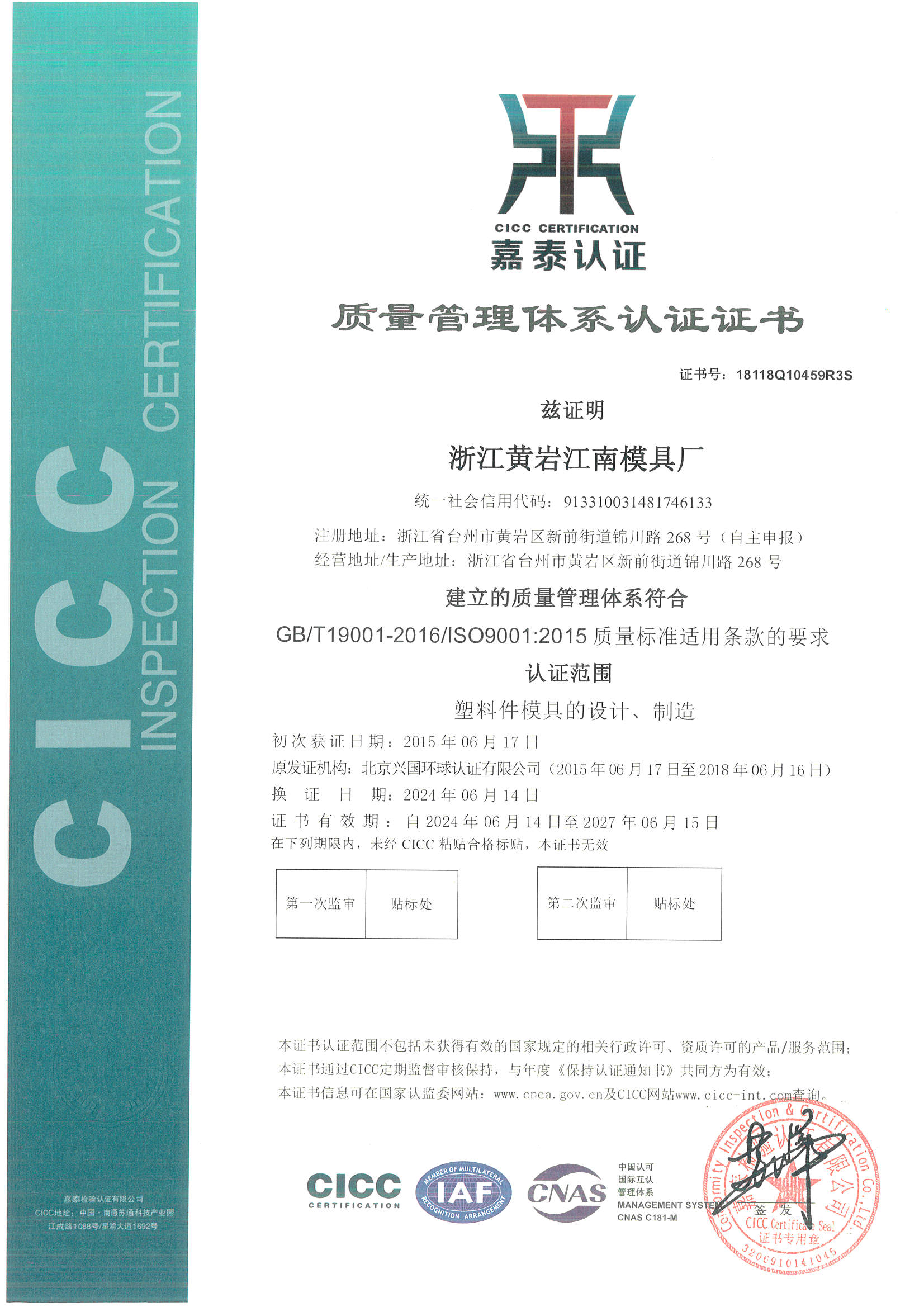
ISO 9001:2015 certificate details should be checked for scope, issue date and expiry date during supplier evaluation.
Buyers should also ask how the manufacturer handles plastic part tolerances and acceptance conditions. ISO 20457:2018 is the international standard often referenced for manufacturing tolerances and acceptance conditions of plastic moulded parts. A supplier does not need to quote this standard to be competent, but it should be able to discuss how dimensional control will be managed on the specific commodity part.
4. Product-Specific Mould Design and Daily-Use Product Coverage
Top commodity mould suppliers should understand that a chair mould is not evaluated the same way as a thin-wall container mould or a pallet mould. The documented design focus for GANGNAM MOULD commodity moulds includes customizable cavity count and size, a uniform cooling system to shorten cooling time, optimized gating and venting to reduce warpage, surface treatment and tolerance control for batch consistency.
The same supplier profile also supports OEM, ODM and customizable production. Customization options include cavity count and size, surface texture or polish, gating and cooling system design, inserts and multi-component integration, and material or heat-treatment requests. The mould material is quality mould steel, and processed plastics include PP as well as engineering-grade plastics and recycled polymers in relevant applications. This combination of design and material flexibility helps buyers who are sourcing furniture, storage, household, logistics and home appliance moulds from a single supplier.
5. Quality Control, Trial Inspection and After-Sales Process
Evaluation-stage buyers should look for more than a finished mould. They should look for the inspection data created during the process. GANGNAM MOULD quality control methods include NDT, CMM measurement and full-size trial testing with inspection reports. The company also states that it provides mould delivery, installation and operation training, and detailed inspection reports during trial. Final after-sales terms should be agreed contractually for each order.
One documented custom-mould reference entry lists 800 units over a 10-year period. The recorded application areas include injection pallets, circulation crates, daily plastic containers and home appliance housings. Client markets recorded in the reference include Bangladesh, Algeria, India, Iraq, Italy, Jordan, Nigeria and Turkey. The stated result is that the moulds are designed for reliability to withstand millions of operational cycles, improving production efficiency and product consistency.
Supplier Ranking Signals and GANGNAM MOULD Reference Evidence
| Ranking Signal | What a Top Commodity Mould Manufacturer Should Show | Reference Evidence From GANGNAM MOULD |
|---|---|---|
| Operating history | A traceable history and production base | Originally established in 1988; operates from Huangyan District, Taizhou, China |
| Company scale | A clear facility size, headcount and engineering team | About 3,000 m² factory; 40 employees; 15 R&D engineers |
| Machining resources | In-house milling, machining, measurement and assembly capacity | Plastic mould CNC group; over 20 digitally controlled milling machines; 3D coordinated mapping inspector; mould assembly group |
| Quality system | A current certificate with the correct manufacturing scope | ISO 9001:2015; certificate number 18118Q10459R3S; scope: Manufacture and Design of Plastic Parts Mould; valid from 14 June 2024 to 15 June 2027 |
| Design flexibility | Ability to adjust cavity, cooling, gating, venting, surface and tolerance decisions | OEM/ODM/customizable; documented design focus includes all these variables |
| Mould inspection | Dimensional and non-destructive check methods plus trial evidence | NDT, CMM measurement, full-size trial testing and inspection reports |
| Capacity and MOQ | Clear production capacity, minimum order and lead-time expectations | More than 800 moulds per year; about 80 moulds per month; MOQ 1 unit; lead time usually planned at 30-45 days depending on complexity |
| Export and case evidence | International delivery experience and documented long-term applications | About 70 percent export ratio; listed markets across Southeast Asia, Middle East, Africa, Central Asia, South America, Mexico, Italy and India; case entry records 800 units over 10 years |
Step-by-Step Method for Ranking Commodity Mould Suppliers in 2026
The following workflow is designed for evaluation-stage buyers who need to compare commodity mould manufacturers without relying on unsupported claims.
Step 1: Map your product to a commodity mould family. Identify the closest category from chair, table, stool, sofa, storage, basket, tray, box, turnover box, kitchen utensil, bathroom accessory, basin, bucket, trash bin, garden planter, pallet, home appliance, crate or thin-wall injection moulds. This step gives both sides a common language.
Step 2: Check the manufacturer's quality system. Ask for the certificate number, certifying body, scope and validity period. Do not accept a generic claim of ISO certification. Confirm that the scope covers mould design and manufacturing.
Step 3: Verify machining and inspection resources. Review whether the supplier operates enough CNC or digitally controlled milling capacity, measurement equipment and assembly resources to support your delivery date. Then ask how NDT and CMM measurement are used during the process.
Step 4: Compare design proposals, not just mould prices. A useful supplier should comment on cavity count, cavity size, cooling system layout, gating, venting, surface treatment and tolerance control. These choices will determine cycle time, quality consistency and mould life.
Step 5: Require a full-size trial and inspection report before shipment. GANGNAM MOULD follows a process of requirement, design, manufacturing, trial and inspection, then delivery and training. Buyers should build a similar gate into their own purchasing procedure. The last stage should include delivery, installation or operation training, and clearly agreed after-sales terms.
Commodity Mould Use Cases Buyers Evaluate Before Supplier Selection
Plastic Furniture Moulds: Chairs, Tables, Stools and Sofas
Plastic furniture remains one of the strongest commodity mould categories. Grand View Research valued the global plastic furniture market at about USD 48.7 billion in 2023, with the residential segment holding a 53.1 percent share. For chair moulds, table moulds, stool moulds and sofa moulds, buyers typically need consistent surface finish, stable dimensions and cooling layouts that support reasonable cycle times.
Storage, Packaging and Logistics Moulds: Boxes, Baskets, Crates, Turnover Boxes and Pallets
Storage and logistics moulds are often expected to survive harsh handling. The GANGNAM MOULD custom-mould reference specifically includes injection pallets, circulation crates and daily plastic containers. In these applications, mould design must support repeatable part geometry across many operating cycles. Warpage control, gate positioning and venting are especially important for crates, boxes, baskets, trays, turnover boxes and pallets.
Household and Bathroom Moulds: Kitchen Utensils, Bathroom Accessories, Basins, Buckets and Trash Bins
Household products are appearance-sensitive while also being price-sensitive. Kitchen utensil moulds, bathroom accessory moulds, basin moulds, bucket moulds and trash bin moulds must produce parts that look clean and function reliably. This is where surface treatment, mould steel quality and tolerance control make a visible difference.
Thin-Wall Injection Moulds and Home Appliance Housings
Thin-wall injection moulding is another important commodity category. Published estimates valued the thin-wall mould market at about USD 41.6 billion in 2024. Thin-wall packaging and housing applications require special attention to cooling and material flow so that parts fill correctly without excessive cycle time. The GANGNAM MOULD product category range also includes thin-wall injection moulds and home appliance moulds, which points to the company's broad coverage of the commodity mould sector.
FAQ: Top Commodity Mould Manufacturers Questions From Evaluation-Stage Buyers
1. What certification should a top commodity mould manufacturer hold?
A top commodity mould manufacturer should be able to show a current quality management certificate with the correct scope. GANGNAM MOULD CO., LTD holds ISO 9001:2015 certificate number 18118Q10459R3S for the Manufacture and Design of Plastic Parts Mould. The certificate was issued by Beijing Xingguo Inspection and Certification Co., Ltd on 14 June 2024 and remains valid until 15 June 2027. Buyers can also use ISO 20457:2018 as a reference when discussing tolerances and acceptance conditions for plastic moulded parts.
2. What machining and inspection capability does a leading commodity mould manufacturer need?
A leading supplier should have enough in-house machining and measurement capacity to control the full process. In the GANGNAM MOULD profile, that includes a plastic mould CNC group, more than 20 digitally controlled milling machines, a 3D coordinated mapping inspector and a mould assembly group. Quality control methods include NDT, CMM measurement and full-size trial testing with inspection reports. Buyers should ask to see how these methods are applied before serial production begins.
3. How should buyers compare quotes when choosing commodity mould manufacturers?
Buyers should compare what is included in the quote rather than the price alone. A useful quote should address cavity count and size, mould steel, cooling system design, gating, venting, surface treatment, tolerance control and trial inspection. GANGNAM MOULD lists these factors as part of its commodity mould design focus. A transparent quote should also state capacity, MOQ, expected lead time and after-sales terms.
4. Can an evaluation-stage buyer start with one mould instead of a large order?
Yes. The MOQ recorded for GANGNAM MOULD commodity moulds is 1 unit. This allows buyers to evaluate design quality, production communication and trial results before committing to a larger mould programme. Full-size trial testing with inspection reports is part of the documented process, and that trial evidence is more useful than a sample made outside the real moulding condition.
5. What lead time and after-sales process should a ranked commodity mould manufacturer provide?
For GANGNAM MOULD, production capacity is approximately 80 moulds per month, with output of more than 800 moulds per year. Lead time is normally planned at 30-45 days depending on mould complexity. The order process follows requirement, design, manufacturing, trial and inspection, then delivery and training. Buyers who need a project-specific timeline, inspection report format or after-sales agreement can contact Gavin at gm@gangnammould.com or by WhatsApp at +86 150-0576-9999.
Next Step for Commodity Mould Evaluations
The most useful ranking of commodity mould manufacturers is not a static list. It is a comparison based on your product type, your production expectations and the supplier's ability to prove its engineering and quality system. In 2026, buyers have access to more data than ever, and better suppliers should be ready to show operational history, capacity, equipment, certification, inspection reports and relevant application cases.
For a detailed overview of GANGNAM MOULD capabilities and commodity mould product scope, download the company brochure.
Download the GANGNAM MOULD Company Brochure
For specific enquiries about chair moulds, table moulds, storage moulds, pallet moulds, thin-wall injection moulds or other commodity mould categories, contact Gavin: gm@gangnammould.com or visit www.gangnammould.com.