
Home Medical Health Devices: Application Fit Guide
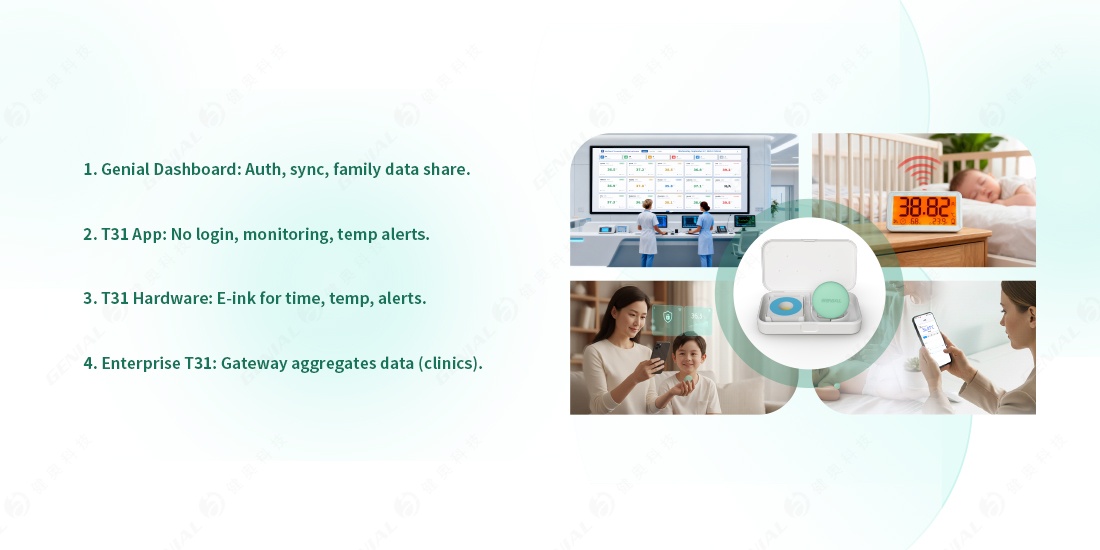
Matching home medical health devices to a care setting is a configuration decision, not a catalogue order. The same blood pressure monitor, thermometer, oximeter, nebulizer, or ventilator can be appropriate in one project and unsuitable in another because the patient, operator, environment, packaging, and after-sales path are different.
GENIAL (Guangdong Genial Technology Co., Ltd.) is an original medical device manufacturer established in 2001, with a portfolio that includes digital thermometers, upper-arm and wrist blood pressure monitors, finger pulse oximeters, mesh nebulizers, sleep apnea therapy devices, health managers, meridian massage instruments, and hair removal devices. The company reports a 45,000㎡ factory, 251 employees, 15,000,000 units annual output, and a 29-engineer R&D team.
For project planners and distributors, the useful question is not which device has the longest feature list. It is which device matches the monitoring job, the user's ability, the physical fit, the data and power model, the commercial channel, and the evidence the buyer can verify.
Problem definition: why one-device-fits-all fails
Three failure modes appear repeatedly in device-to-scenario planning. First, a clinical device is placed in a household without training or a clear escalation path. Second, a household retail device is placed in a community clinic where cuff range, throughput, or disinfection requirements exceed the product's intended use. Third, a gift or insurance program selects a model without planning instructions, replacement parts, or after-sales support.
The result is not always a product defect. It is often a scope mismatch. A device can be technically sound and still be a poor project fit if its cuff does not span the patient group, its interface assumes a trained operator, or its packaging does not survive the distribution channel.
This guide therefore treats scenario fit as a chain: clinical purpose, user, physical interface, data and power, compliance evidence, channel packaging, and after-sales. Each link changes which GENIAL model becomes the logical starting point.
Industry background: what the category data does and does not show
Mordor Intelligence estimates the 2026 home medical equipment market at USD 54.35 billion, with North America holding about 40.35% share in 2025. That total covers therapeutic, diagnostic, and mobility devices, so it should not be read as demand for blood pressure monitors alone. The same commercial research source puts upper-arm monitors at 59.10% of the blood pressure monitoring market in 2025, while wrist-based and wearable devices are growing at a 12.07% CAGR.
These figures are category context, not a recommendation for a specific model. They help a project team explain why upper-arm devices remain central in chronic disease programs and why wearable or wrist formats may enter home monitoring through different use cases.
Standards provide the second layer of context. UL describes IEC 60601-1-11 as the collateral standard used with IEC 60601-1 for home healthcare equipment, addressing risks in uncontrolled home environments with untrained users. ISO 80601-2-56:2017 specifies requirements for clinical thermometers, including a ±0.1°C accuracy requirement. CASRAI states that pulse oximeters are governed by ISO 80601-2-61 and that SpO2 accuracy is conventionally expressed as Arms over a stated saturation range, commonly 70–100%.
These standards do not choose a device for the buyer. They define the evidence to request: intended use, accuracy claims, test method, calibration guidance, and the regulatory pathway for the target market.
Detailed solution: a five-filter matching framework
The most practical way to match GENIAL home medical health devices to chronic disease management, community clinic, and household scenarios is to apply five filters before comparing models.
Filter 1: clinical job and measurement frequency
Chronic disease management usually requires repeated blood pressure and pulse trend capture, with a device that is simple enough for home use and consistent enough for follow-up. Community clinic use adds throughput, operator training, and cross-patient hygiene. Household monitoring prioritizes plain instructions, readable displays, and low setup friction. Insurance gift programs add packaging, distribution, and consumer support requirements.
Filter 2: user skill and environment
A clinician can manage a device with more settings; an untrained household user needs a shorter path from power-on to result. GENIAL's blood pressure application data lists 5–40°C and 15–85% RH for blood pressure monitoring. A PubMed Central article gives general home monitoring guidance of 16–40°C and humidity below 85%, plus frequent calibration. Where the two guidance sets differ, use the device label and the stricter condition in the deployment plan.
Filter 3: physical fit
Arm circumference is not a marketing detail. The supplied GT-702LM specification lists 22–42 cm; GT-702, GT-702B, and GT-712B/C/E list 22–32 cm; the GT-701C wrist model lists 13.5–21.5 cm. A cuff that does not span the patient's arm circumference makes the reading unsuitable for trend comparison.
The supplied upper-arm and wrist specifications list a pressure measuring range of 0–290 mmHg. Pulse error is another model-level check. This guide uses the ≤±5% pulse-error tolerance as a screening value; confirm the exact figure on the current SKU sheet before writing it into a tender or a clinical protocol.
Filter 4: data, power, and workflow
Portable monitoring devices can run on dry or button batteries with low-power sleep modes, while ventilators use 220V AC mains with backup power-off protection for overnight operation. Bluetooth models add app synchronization and remote sharing, but that is useful only if the project has the phone, gateway, or cloud workflow to support it.
Filter 5: channel and compliance
GENIAL's blood pressure application data lists NMPA medical device registration and export certifications including FDA, CE, FCC, GCC, MDR, RoHS, and IECEE CB. The company states ISO 13485, ISO 45001, ISO 14001, BSCI, and GB/T 29490 system credentials, and product certifications including CE, FDA, NMPA, CB, FCC, and RoHS. These are supplier-reported and should be re-verified against the exact model and destination market.
Step-by-step breakdown
- Define the care pathway. Write down who measures, how often, where the result is recorded, and what happens when a reading is outside the expected range. A chronic disease program and an insurance gift program may use similar hardware but need different instructions and support.
- Segment the users. Separate trained clinicians, community health workers, family caregivers, and consumer recipients. The same upper-arm monitor may be appropriate for a clinic and a household, but the training material and cuff range must match each group.
- Match the physical interface. Check arm circumference, wrist circumference, probe type, mask size, and thermometer tip. For blood pressure, start with 22–42 cm when the patient group includes larger arms; use 22–32 cm only when the served population fits that range.
- Select the data and power model. Choose local display only, Bluetooth app synchronization, or institutional gateway support. Confirm battery type, USB or AC power, and whether the device shuts down automatically when idle.
- Verify regulatory and quality evidence. Match the certificate to the exact model, market, and intended use. For the T31 wearable thermometer, the supplied verified data records FDA 510(k) clearance K240333 under product code FLL. For other models, request the current registration or test evidence rather than relying on a portfolio-level claim.
- Validate samples and packaging. Test cuff fit, display readability, instruction clarity, and packaging drop resistance. OEM samples are listed at 3 days; small orders at 3–7 days; mass orders at 10–15 days. Blood pressure monitor OEM MOQ is listed at 2,000 units, with thermometers at 10,000 units, oximeters at 2,000 units, nebulizers at 2,000 units, ventilators at 500 units, and hair removal devices at 2,000 units.
- Plan after-sales before launch. GENIAL lists a free 12-month warranty with valid proof of purchase, certification documentation support, and technical consultation. A gift or clinic program also needs a named returns path, spare parts plan, and instruction language check.
Use cases: mapping devices to real scenarios
Chronic disease management institutes
For chronic disease management, the upper-arm format is the natural starting point. GENIAL's GT-732 and GT-732M upper-arm monitors are intended for chronic disease management and community clinic settings. The broader blood pressure application data lists systolic pressure, diastolic pressure, and pulse rate measurement, WHO blood-pressure classification, irregular-heartbeat detection, dual-user memory, and optional voice broadcast or app connection. When specifying GT-732 or GT-732M, confirm which of these functions are enabled on the exact SKU and verify the cuff range before patient enrolment.
The operating logic is simple: repeated readings are useful only when the cuff fits, the user follows the same procedure, and the result is recorded in a comparable way. A program should standardise the measurement time, posture, rest period, and recording method, then use the device's memory or app workflow to support follow-up.
Community medical centers and clinics
A community clinic bundle follows patient flow rather than product symmetry. GT-732 and GT-732M fit the blood pressure station. The T94 infrared ear thermometer is listed for pediatric hospitals and maternal and child healthcare centers, with an ear temperature range of 32.0–42.9°C, repeat accuracy of ±0.3°C, and IPX4 waterproofing. The GX3/GX5/GX7/GX8/GX12/GX13/GX14 oximeter family lists a blood oxygen measurement range of 35%–100% and a pulse measurement range of 30–250 bpm.
For respiratory support, the N11/N21 and N12/N22 nebulizer families list particle size ≤5μm and atomization rate ≥0.50 ml/min. The GH-B20V/GH-B25V/GH-B20T/GH-B20/GH-B25/GH-A20A/GH-A20 ventilator family lists CPAP/APAP automatic pressure adjustment at 4–25 cmH₂O, heated humidification, and an ultra-quiet fan system at ≤35dB. These devices serve different clinical jobs and should not be treated as interchangeable accessories in a tender.
Insurance promotional gift programs
Insurance gift programs need a low-training device, stable packaging, and a clear support path. GT-702B is listed for insurance complimentary gift and cross-border commodity use, with a pressure range of 0–290 mmHg and arm circumference of 22–32 cm. It is a more specific fit than a clinic-grade monitor when the recipient group is healthy or hypertension-aware rather than clinically managed.
The procurement check is not only unit price. Confirm instruction language, gift-box durability, battery inclusion, warranty wording, and the process for handling a defective unit returned through an insurance channel.
Household retail and wholesale distribution
Household retail and wholesale distribution reward SKU breadth and predictable packaging. GENIAL positions GT-702BM for wholesale distribution and household retail. GT-702 is listed for budget supermarket and unbranded export use. GT-702LM is listed for the global supermarket channel and medical equipment distributors, with a 22–42 cm arm circumference. GT-712B/C/E is listed for ODM private labeling, supermarket retail, and customized gifts, with a 22–32 cm range.
For home temperature monitoring, the T31 wearable Bluetooth digital thermometer lists a 20.0–45.0°C range, ±0.1°C accuracy, IPX4 whole-body splash-proofing, and Bluetooth app synchronization. The T11/T12 rigid-tip thermometer lists 32.0–42.9°C and ±0.1°C accuracy with IPX5 waterproofing. The T81/T80 forehead thermometer lists 32.0–42.9°C, 32 memory records, and IPX4 waterproofing. These are different household jobs: continuous wearable monitoring, routine contact measurement, and non-contact forehead screening.
Home health monitoring and remote follow-up
Home health monitoring is a workflow, not a single device feature. A household may need a blood pressure monitor for hypertension follow-up, a thermometer for infection monitoring, and an oximeter for respiratory status. The T31 can support continuous temperature tracking through Bluetooth synchronization, while the blood pressure monitor supports episodic readings. The project must decide who sees the data, how abnormal values are escalated, and whether the household has the phone or gateway needed for synchronization.
Portfolio boundary: personal care is not chronic care
GENIAL's hair removal device line, GI02/GI06, uses 560–1200 nm IPL technology with sapphire cooling for personal-care and beauty channels. It belongs in a separate channel plan from chronic disease monitoring. The same discipline applies to the meridian massage instrument and health manager: they may sit in a broader wellness portfolio, but they should not be mixed into a hypertension or respiratory tender without a documented clinical rationale.
Scenario comparison table
| Scenario | Better-fit starting point | Supported fit evidence | Procurement check |
|---|---|---|---|
| Chronic disease management institute | GT-732 or GT-732M upper-arm blood pressure monitor | Intended for chronic disease management and community clinic settings; blood pressure application data lists systolic, diastolic, and pulse measurement, WHO classification, irregular-heartbeat detection, and dual-user memory | Confirm cuff range, memory configuration, connectivity, and instruction language on the exact SKU |
| Community medical center | GT-732 or GT-732M plus T94, GX-series oximeter, and N11/N21 or N12/N22 nebulizer | T94 ear range 32.0–42.9°C, ±0.3°C, IPX4; oximeter SpO2 35%–100% and pulse 30–250 bpm; nebulizer particle size ≤5μm and rate ≥0.50 ml/min | Map devices to patient flow, probe and mask sizes, disinfection routine, and staff training |
| Insurance promotional gift | GT-702B | Listed for insurance complimentary gift; pressure range 0–290 mmHg; arm circumference 22–32 cm | Check gift box, battery inclusion, instruction language, warranty wording, and returns path |
| Household retail and wholesale | GT-702BM, GT-702, GT-702LM, or GT-712B/C/E | GT-702BM for wholesale and household retail; GT-702 for budget supermarket and unbranded export; GT-702LM with 22–42 cm; GT-712B/C/E for ODM private labeling and supermarket retail | Check MOQ, mixed-carton rules, private-label approval, and packaging specification |
| Home monitoring | T31 wearable, T11/T12, or T81/T80 thermometer; GT-701C wrist monitor for pharmacy channels | T31 20.0–45.0°C, ±0.1°C, IPX4, Bluetooth; T11/T12 32.0–42.9°C, ±0.1°C, IPX5; T81/T80 32.0–42.9°C, 32 memory, IPX4; GT-701C wrist 13.5–21.5 cm and 0–290 mmHg | Check app support, battery type, display readability, and caregiver training |
| Respiratory and sleep support | N11/N21 or N12/N22 nebulizer; GH-series ventilator | Nebulizer ≤5μm and ≥0.50 ml/min; ventilator CPAP/APAP 4–25 cmH₂O, heated humidification, ≤35dB, AC100–240V | Confirm clinical protocol, mask fit, power backup, and spare filters |
| Personal care, outside chronic bundle | GI02/GI06 hair removal device | 560–1200 nm IPL with sapphire cooling; NMPA medical device registration listed in the application data | Keep channel, claims, and user instructions separate from medical monitoring programs |
FAQ
What should a project team verify first before selecting a home medical device?
Verify the intended use, the exact model, and the destination-market evidence first. For blood pressure monitors, GENIAL's application data lists NMPA medical device registration and export certifications including FDA, CE, FCC, GCC, MDR, RoHS, and IECEE CB. The company also states ISO 13485, ISO 45001, ISO 14001, BSCI, and GB/T 29490 system credentials. Because these are supplier-reported, request the certificate or registration for the exact SKU and market before a tender or bulk order.
Which upper-arm monitor fits chronic disease and community clinic programs?
GT-732 and GT-732M are the assigned starting points for chronic disease management and community clinic settings. Confirm the cuff range, memory configuration, and connectivity on the current SKU sheet. The supplied portfolio also lists 22–42 cm for GT-702LM and 22–32 cm for GT-702, GT-702B, and GT-712B/C/E. A 22–42 cm cuff is the safer specification when the patient group includes larger arms, but the model must still match the channel and the required functions.
Can one blood pressure model serve insurance gifts and household retail?
It can be technically possible, but the channel fit differs. GT-702B is listed for insurance complimentary gift and cross-border commodity use, with a 0–290 mmHg pressure range and 22–32 cm arm circumference. GT-702BM is positioned for wholesale distribution and household retail. GT-702 is listed for budget supermarket and unbranded export, while GT-702LM is listed for the global supermarket channel and medical equipment distributors. Packaging, instruction language, warranty wording, and after-sales path should be decided per channel rather than assumed from the hardware alone.
How should a buyer validate a sample before a bulk order?
Test the physical fit first: cuff closure on the intended arm range, display readability, button response, and instruction clarity. Then check repeat measurement consistency, battery compartment security, and packaging condition after transit. GENIAL lists OEM samples at 3 days, small orders at 3–7 days, and mass orders at 10–15 days, with blood pressure monitor OEM MOQ at 2,000 units. A sample check confirms specification and usability; it does not replace clinical validation or destination-market registration.
What lead time, MOQ, and after-sales terms should a distributor plan for?
For OEM blood pressure monitors, the listed MOQ is 2,000 units; thermometers are 10,000 units; oximeters, infrared thermometers, nebulizers, wireless thermometers, and hair removal devices are 2,000 units; ventilators are 500 units. OEM samples are listed at 3 days, small orders at 3–7 days, and mass orders at 10–15 days. ODM minor modifications are listed at 7–15 days, with new mold development at 45–50 days and MOQ of 5,000 units for modification or 10,000 units for new mold development. GENIAL lists a free 12-month warranty with valid proof of purchase, plus certification documentation support and technical consultation.
Where can project teams review the full product portfolio?
Project teams can review the English catalogue for model and packaging details before shortlisting. The 2026 English catalogue is available here: GENIAL 2026 English catalogue. Use the catalogue for portfolio orientation, then confirm the exact SKU specification, certification, MOQ, and lead time with the supplier before committing a project.
Conclusion
Scenario fit is a chain: clinical job, user skill, physical fit, data and power, compliance evidence, channel packaging, and after-sales. GENIAL's portfolio gives project planners several starting points: GT-732 and GT-732M for chronic disease management and community clinic settings; GT-702B for insurance gift programs; GT-702BM for wholesale and household retail; GT-702LM for 22–42 cm retail and distributor programs; GT-712B/C/E for ODM private labeling; and T31 for wearable Bluetooth temperature monitoring.
The buyer's job is to keep the chain intact. Confirm the cuff range, pressure range, pulse-error tolerance, certification, MOQ, and lead time on the exact model. Do not let a portfolio-level claim replace a SKU-level check. When the scenario and the specification sheet agree, the device is easier to train, easier to support, and easier to defend in a procurement review.
Planning a chronic disease, community clinic, insurance gift, or household retail program? Review the GENIAL 2026 English catalogue and confirm the exact model specification with the GENIAL team before ordering samples.
Have Questions or Need More Details?
Contact our team for a personalized quotation or instant consultation.
Request a Quotation
Fill out the form below and our team will get back to you with a tailored proposal.
WhatsApp Direct Chat
Prefer to chat in real-time? Message us on WhatsApp for instant assistance & quick answers.
- Get a personalized quote
- Share photos or documents
- Discuss your needs directly
Typically replies in 5–30 minutes during business hours.