
Home Medical Health Devices Explained: Monitoring vs. Therapy vs. Personal Care
Category guide
Home medical health devices are easier to evaluate when they are sorted by job, not by shelf position. A digital thermometer, a nebulizer, and a hair removal device can all sit in the same online catalog, but they do not do the same work, carry the same evidence burden, or fit the same procurement logic.
This guide separates the category into three practical groups: monitoring tools that measure, therapy devices that deliver treatment or breathing support, and personal care devices that support grooming routines. It then shows how upper arm digital blood pressure monitors such as the GT-732, GT-732M, and GT-702BM fit into home monitoring, chronic disease management, community medical centers, and OEM or wholesale programs.
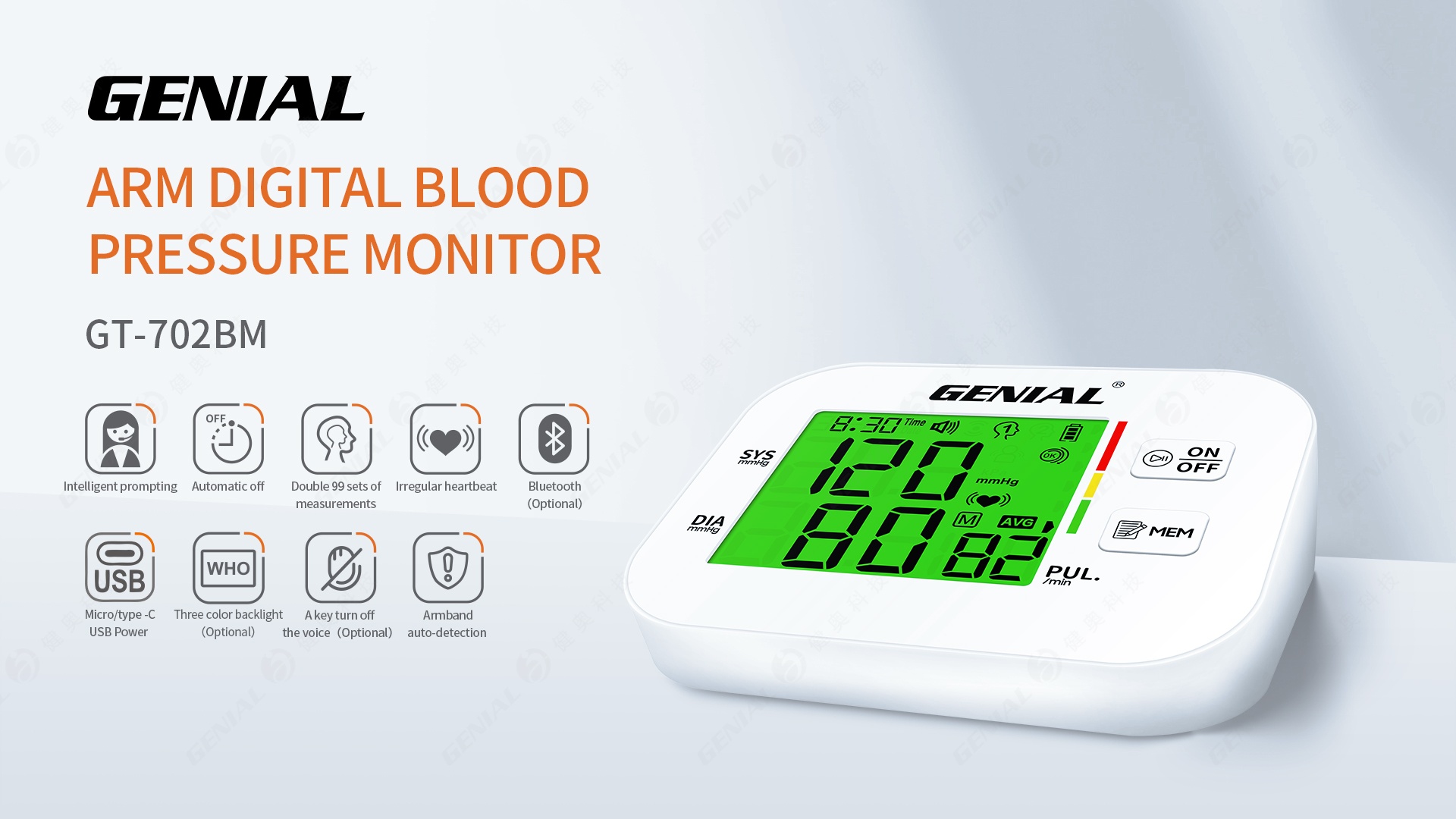
GT-702BM upper arm digital blood pressure monitor. Monitoring devices measure a physiological parameter; they do not deliver therapy.
Problem Definition: The Category Confusion That Costs Buyers Time
The common buying mistake is to compare all home medical health devices as if they were interchangeable consumer electronics. That leads to mismatched specifications, incomplete compliance checks, and product pages that promise the wrong job. A wearable Bluetooth digital thermometer is a monitoring device; a mesh nebulizer is a therapy device; a hair removal device is a personal care device. The intended use changes the specification that matters, the certification scope to verify, and the channel that can sell it.
The practical question is not 'which device is best?' but 'which category is being purchased, for which user, in which setting, and under which claims?' A buyer sourcing for a pharmacy chain may need a broad SKU portfolio. A buyer sourcing for a chronic disease program may need a monitor with a wider cuff range and memory. A buyer sourcing for a sleep clinic may need a ventilator with defined pressure support. Those are different decisions.
Industry Background: Demand Is Broad, but Evidence Is Specific
The home medical equipment market was estimated at USD 54.35 billion in 2026, with North America holding approximately 40.35% share in 2025, according to a 2026 Mordor Intelligence market report. The same research package projects the digital thermometer market to reach USD 1.954 billion by 2035, with a 9.5% CAGR from 2025. In blood pressure monitoring, upper-arm monitors controlled 59.10% of market share in 2025, while wrist-based and wearable formats were growing at a 12.07% CAGR.
Those numbers explain why the category keeps expanding, but they do not remove the need for device-level verification. UL describes IEC 60601-1-11 as the collateral standard used with IEC 60601-1 for home healthcare equipment, addressing risks in uncontrolled home environments with untrained users. ISO 80601-2-56:2017 specifies requirements for clinical thermometers, including a ±0.1°C accuracy requirement for clinical validation. CASRAI notes that pulse oximeters are governed by ISO 80601-2-61 and that SpO2 accuracy is conventionally expressed as Arms over a stated saturation range, commonly 70–100%.
A PubMed Central article adds a practical operating note: home health monitoring equipment should be calibrated at frequent intervals and operated within 16 to 40°C and humidity below 85%. These are not marketing details. They are the checks that separate a monitoring device from a therapy device and a personal care device.
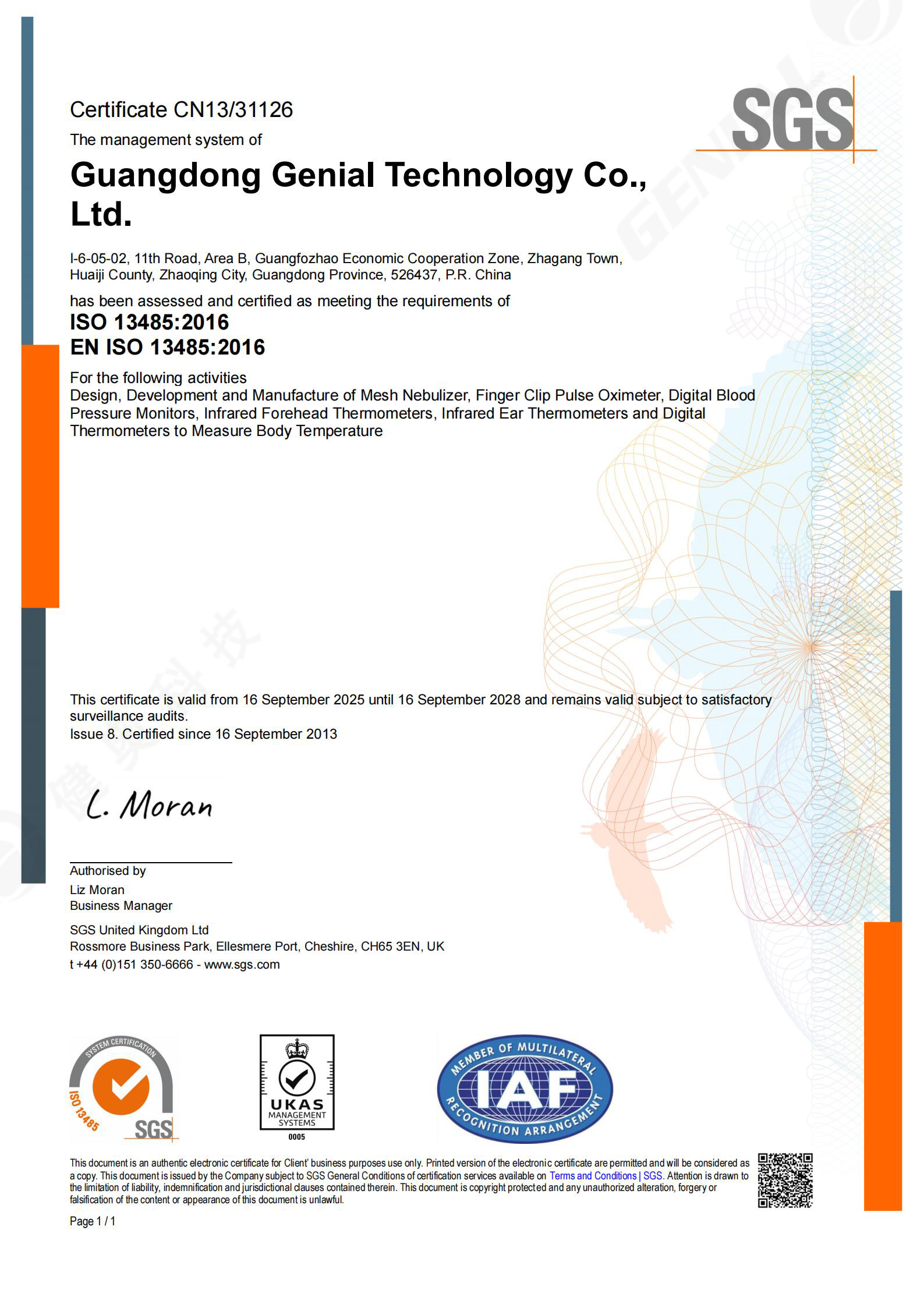
ISO 13485 certificate CN13/31126, issued by SGS United Kingdom Ltd, is valid from 2025-09-16 to 2028-09-16. Certificate scope should be matched to the exact device family.
Detailed Solution: The Three Categories and What Each One Is For
1. Monitoring devices: measure and track
Monitoring devices measure a physiological parameter and present it for interpretation. They include digital thermometers, wearable Bluetooth digital thermometers, finger pulse oximeters, and digital blood pressure monitors. Their value is in repeatable measurement, not in delivering treatment.
The T31 wearable Bluetooth digital thermometer measures 20.0–45.0°C with ±0.1°C accuracy, has IPX4 whole-body splash-proof protection, measures Φ13×82 mm, and weighs 33 g including battery. It uses medical-grade PP and a silicone adhesive patch. The T86/T87 non-contact infrared forehead thermometer measures forehead temperature at 32.0–42.9°C with ±0.2°C error at 35–42°C, has IPX4 protection, measures 136×36×36 mm, and weighs 85 g with battery. The T94 infrared ear thermometer measures ear temperature at 32.0–42.9°C with repeat accuracy ±0.3°C, has IPX4 protection, measures 134×43×61 mm, and weighs 60 g with two AAA batteries.
Pulse oximeters in the GX3/GX5/GX7/GX8/GX12/GX13/GX14 family measure SpO2 from 35% to 100% with ±2% at 70–100%, and pulse rate from 30 to 250 bpm. The unit measures 59.8×36.4×34 mm and weighs 36–42 g. The finger clip is sweat-splash proof; the whole unit is not waterproof.
Upper arm digital blood pressure monitors are the clearest example of specification-driven monitoring. The GT-732 measures pressure from 0 to 290 mmHg, has pulse tolerance ±5%, fits arm circumference 22–32 cm, measures 136×103×54 mm, and weighs 291 g ±15 g without battery. It uses ABS, a PVC air bag, and a nylon binding strap. The GT-732M measures pressure from 0 to 290 mmHg, fits arm circumference 22–42 cm, has pulse error ≤±5%, measures 136×103×54 mm, and weighs 239 g ±15 g without battery. It uses ABS and an eco-friendly TPU air bag. The GT-702BM measures pressure from 0 to 290 mmHg, fits arm circumference 22–42 cm, stores 99 memory sets for two users, measures 135×102×46 mm, and weighs 220 g ±15 g without battery. It uses ABS and a composite fabric cuff.
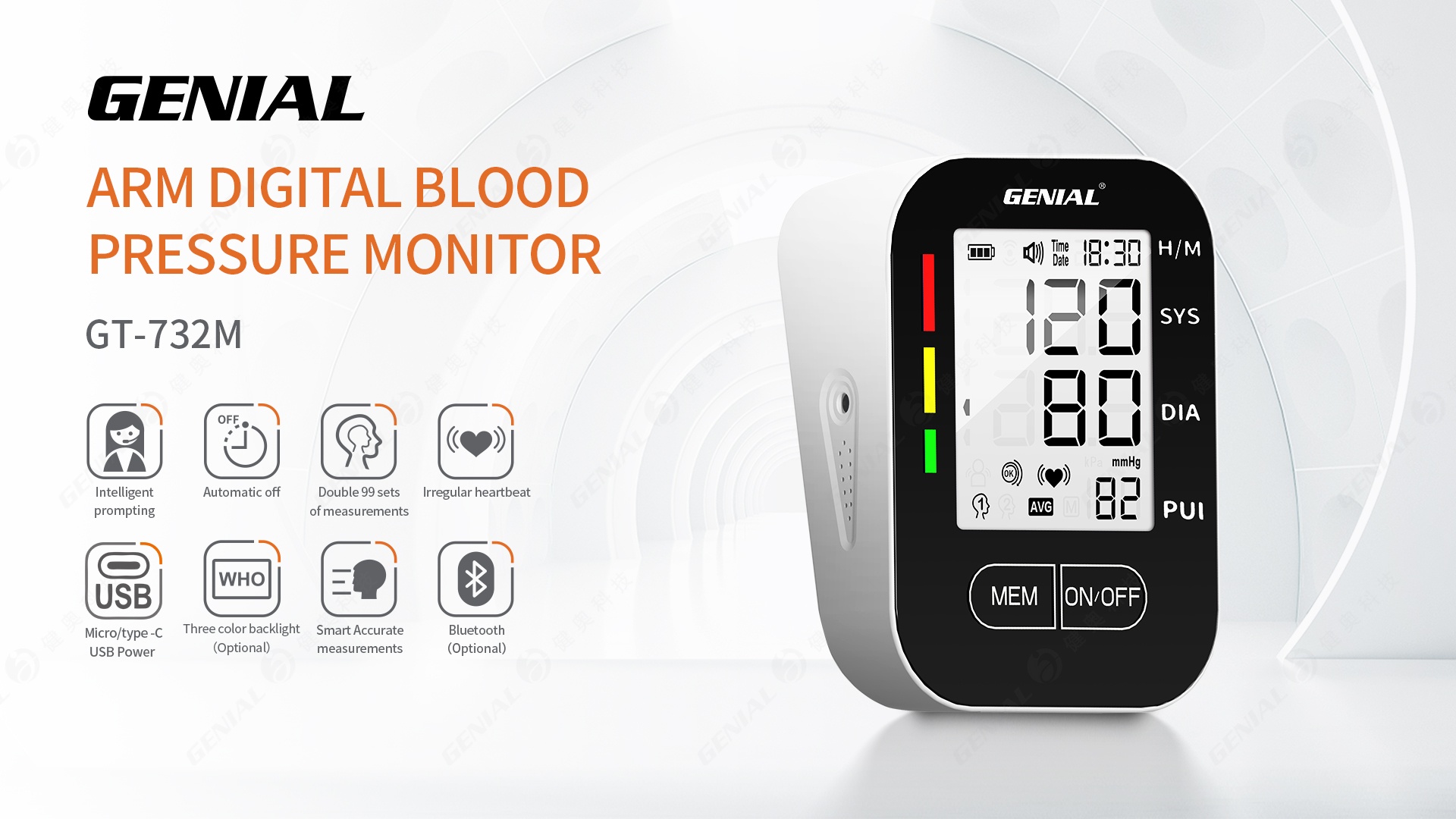
GT-732M upper arm digital blood pressure monitor: 0–290 mmHg pressure range, 22–42 cm arm circumference, and pulse error ≤±5%.
2. Therapy devices: deliver treatment or breathing support
Therapy devices are purchased for a therapeutic job. A mesh nebulizer delivers aerosolized medication; a non-invasive sleep CPAP ventilator supports breathing. They need therapy-specific evidence and user instructions, not just a measurement specification.
The N11/N21 portable mesh nebulizer has an 8 ml liquid capacity, a nebulization rate of ≥0.2 ml/min, and a particle D50 <5 μm at ≥60%. Noise is ≤50 dB(A). It measures 42×55×99 mm and weighs 78 g excluding battery. It uses ABS, a PP medicine cup, and a medical silicone tube. The N12/N22/N12C/N22C/N12L/N22L family shares the same 8 ml capacity, ≥0.2 ml/min nebulization rate, and D50 <5 μm at ≥60%, with a weight range of 78–92 g.
The GH-B20V/GH-B25V/GH-B20T/GH-B20/GH-B25/GH-A20A/GH-A20 non-invasive sleep CPAP ventilator has a working pressure of 4–20/25 cmH2O and supports CPAP/APAP/S/T/VGPS modes. Noise is ≤35 dB. It measures 260×153×121 mm and weighs 1450 g. It uses flame-retardant ABS, aviation plastic, and a medical silicone mask.
3. Personal care devices: support grooming, not clinical monitoring
Personal care devices sit outside the monitoring and therapy jobs. The GI02/GI06 hair removal device is a sapphire ice-cooling IPL device with a wavelength of 560–1200 nm ±20% and five adjustable energy gears. It measures 62×180×38 mm and uses ABS plus toughened sapphire glass. Its listed applications include beauty salons, aesthetic medical institutions, and personal care e-commerce. That positioning matters: it should not be presented as a diagnostic monitor or a respiratory therapy device.
Step-by-Step Breakdown: How to Evaluate a Home Medical Health Device
- Step 1 — Define the job. Decide whether the device must measure, treat, or support personal care. A monitor that measures temperature cannot replace a nebulizer, and a personal care device should not be positioned as clinical therapy.
- Step 2 — Match the form factor to the user and setting. A wearable thermometer suits continuous monitoring; a non-contact forehead thermometer suits checkpoint screening; an upper arm monitor with a 22–42 cm cuff suits chronic disease and community programs; a wrist monitor suits portable use.
- Step 3 — Verify the specification that controls the use case. For blood pressure monitors, check pressure range, arm circumference, memory, and pulse error. For thermometers, check measurement range, accuracy, and waterproof grade. For nebulizers, check liquid capacity, nebulization rate, and particle size. For ventilators, check pressure range, modes, and noise.
- Step 4 — Match the certificate to the model and market. Check the certificate scope, not just the logo. ISO 13485, CE MDR, FDA 510(k), NMPA, CB, FCC, and RoHS claims should be tied to the exact product family and destination market.
- Step 5 — Confirm the supply model. OEM, ODM, JDM, and OBM have different MOQs, lead times, and customization boundaries. OEM covers packaging, gift box, user manual, logo printing, colors, and packaging specifications while core hardware, PCB, and key functions remain unchanged.
- Step 6 — Validate with samples and a pilot order. Use sample approval to confirm the user interface, cuff fit, packaging, and documentation before mass production. Then match the pilot quantity to the MOQ and lead time of the chosen supply model.
Use Cases: Matching Categories to Real Programs
Home health monitoring
For home health monitoring, the priority is ease of correct use and repeatable measurement. The T31 wearable thermometer supports continuous infant monitoring without repeated nighttime temperature measurements. The T86/T87 non-contact forehead thermometer fits school daily checks, factory epidemic prevention, hospital use, and customs entry inspection. The GX3/GX5/GX7/GX8/GX12/GX13/GX14 oximeter fits elderly care institutes, respiratory departments, outdoor sports, household medical use, and pharmacy retail. The GT-732M and GT-702BM fit home blood pressure tracking when a 22–42 cm cuff is required.
Chronic disease management
Chronic disease programs need devices that can be used repeatedly and documented. The GT-732M lists chronic disease management institutes and community medical centers among its applications. Its 22–42 cm arm circumference and ≤±5% pulse error make it a practical upper arm option for users who need a wider cuff range. The GT-702BM adds 99 memory sets for two users, which supports shared household use and offline household retail. The GT-732, with a 22–32 cm cuff, fits community clinics, health and wellness centers, e-commerce, and customized OEM gifts.
Community medical centers
Community medical centers often need a mixed basket rather than a single device. The GT-732 is listed for community clinics. The GT-732M is listed for community medical centers. The N11/N21 nebulizer is listed for pediatric wards, respiratory clinics, domestic cough treatment, and pet medical care. The ventilator is listed for sleep disorder centers, hospital respiratory departments, rehabilitation institutes, and household snoring treatment. That mix reflects different jobs: measurement, aerosol therapy, and breathing support.
OEM and wholesale channels
OEM and wholesale buyers should evaluate category breadth together with supply terms. GENIAL was founded in 2001, operates a 45,000㎡ facility, employs 251 people, has 29 engineers, and reports annual output of 15,000,000 units. The company offers OEM, OBM, ODM, and JDM services. For OEM, MOQs are 10,000 pcs for thermometers, 2,000 units for oximeters, 2,000 units for infrared thermometers, 2,000 units for blood pressure monitors, 2,000 units for nebulizers, 2,000 units for wireless thermometers, 500 units for ventilators, and 2,000 units for hair removal devices. OEM samples take 3 days; small orders take 3–7 days; mass orders take 10–15 days.
Case evidence supports the channel logic. For OTC sales, a global project with 100,000–1,000,000 units achieved a rich SKU portfolio for pharmacy chain systems. For medical channel distribution, a 5-year global project with 100,000–500,000 units used one-stop procurement to reduce supplier management costs for medical device distributors. For clinical monitoring, a global project with 50,000–200,000 units used automatic alerts and reduced manual inspections for hospitals and clinics. For retail sales, a 5-year global project with 50,000–100,000 units supported brand expansion for consumer electronics channels. For infant monitoring, a 5-year global project with 10,000–100,000 units improved user retention for maternal and infant companies.
Comparison Table: Monitoring, Therapy, and Personal Care
| Category | Core job | Examples from the approved corpus | Specification to verify first | Typical buying setting |
|---|---|---|---|---|
| Monitoring | Measure and track a physiological parameter | Digital thermometers, T31 wearable Bluetooth digital thermometer, GX3/GX5/GX7/GX8/GX12/GX13/GX14 finger pulse oximeter, GT-732/GT-732M/GT-702BM upper arm digital blood pressure monitors | Measurement range, accuracy, cuff or wrist circumference, memory | Home health monitoring, chronic disease management, community medical centers, pharmacy retail |
| Therapy | Deliver treatment or breathing support | N11/N21 and N12/N22/N12C/N22C/N12L/N22L mesh nebulizers; GH-B20V/GH-B25V/GH-B20T/GH-B20/GH-B25/GH-A20A/GH-A20 non-invasive sleep CPAP ventilator | Nebulization rate, particle size, pressure range, therapy modes, noise | Pediatric ward, respiratory clinic, sleep disorder center, hospital respiratory department, rehabilitation institute |
| Personal care | Support grooming and cosmetic routines | GI02/GI06 sapphire ice-cooling IPL hair removal device | Wavelength, energy gears, device dimensions | Beauty salon, aesthetic medical institution, personal care e-commerce |
Model Comparison: GT-732 vs. GT-732M vs. GT-702BM
| Model | Pressure range | Arm circumference | Pulse specification | Memory | Dimensions / weight | Material |
|---|---|---|---|---|---|---|
| GT-732 | 0–290 mmHg | 22–32 cm | Pulse tolerance ±5% | Not stated in the approved unit | 136×103×54 mm; 291 g ±15 g without battery | ABS, PVC air bag, nylon binding strap |
| GT-732M | 0–290 mmHg | 22–42 cm | Pulse error ≤±5% | Not stated in the approved unit | 136×103×54 mm; 239 g ±15 g without battery | ABS, eco-friendly TPU air bag |
| GT-702BM | 0–290 mmHg | 22–42 cm | Not stated in the approved unit | 99 memory sets for 2 users | 135×102×46 mm; 220 g ±15 g without battery | ABS, composite fabric cuff |
Source: approved corpus specifications. 'Not stated in the approved unit' means the available fact unit does not provide that value; it is not a negative product claim.
Compliance Check: What to Verify Before You Shortlist
For a shortlist, compliance should be checked at the certificate level. GENIAL's ISO 13485 certificate CN13/31126 is issued by SGS United Kingdom Ltd and valid from 2025-09-16 to 2028-09-16. The CE MDR certificate CN25/00007953, with SRN CN-MF-000021465, is issued by SGS Belgium NV, Notified Body 1639, and valid from 2025-11-25 to 2030-11-25. FDA 510(k) K231245 covers arm-type digital blood pressure monitors including GT-732, GT-732M, and GT-702BM. FDA 510(k) K240333 covers the T31 wearable digital thermometer. FDA 510(k) K231243 covers GX3/GX5/GX6/GX7/GX8/GX9/GX10/GX11/GX12/GX13/GX14 fingertip pulse oximeters.
Market-specific documents also matter. The Japan Certificate of Foreign Medical Device Manufacturer BG10501496 covers electronic upper arm blood pressure monitors, infrared clinical thermometers, reusable wireless thermometers, and pulse oximeters. The UK MHRA registration 0000037417 covers wireless reusable patient thermometers, pulse oximeter probes, infrared ear/skin thermometers, intermittent electronic thermometers, automatic electronic sphygmomanometers, and self-care monitoring software. Brazil ANVISA registration under RDC 751/2022 covers Class II thermometers, blood pressure monitors, and pulse oximeters. Russia Roszdravnadzor registration № 1241/1-3 140/2-25 covers automatic electronic blood pressure monitors in the Marina series.
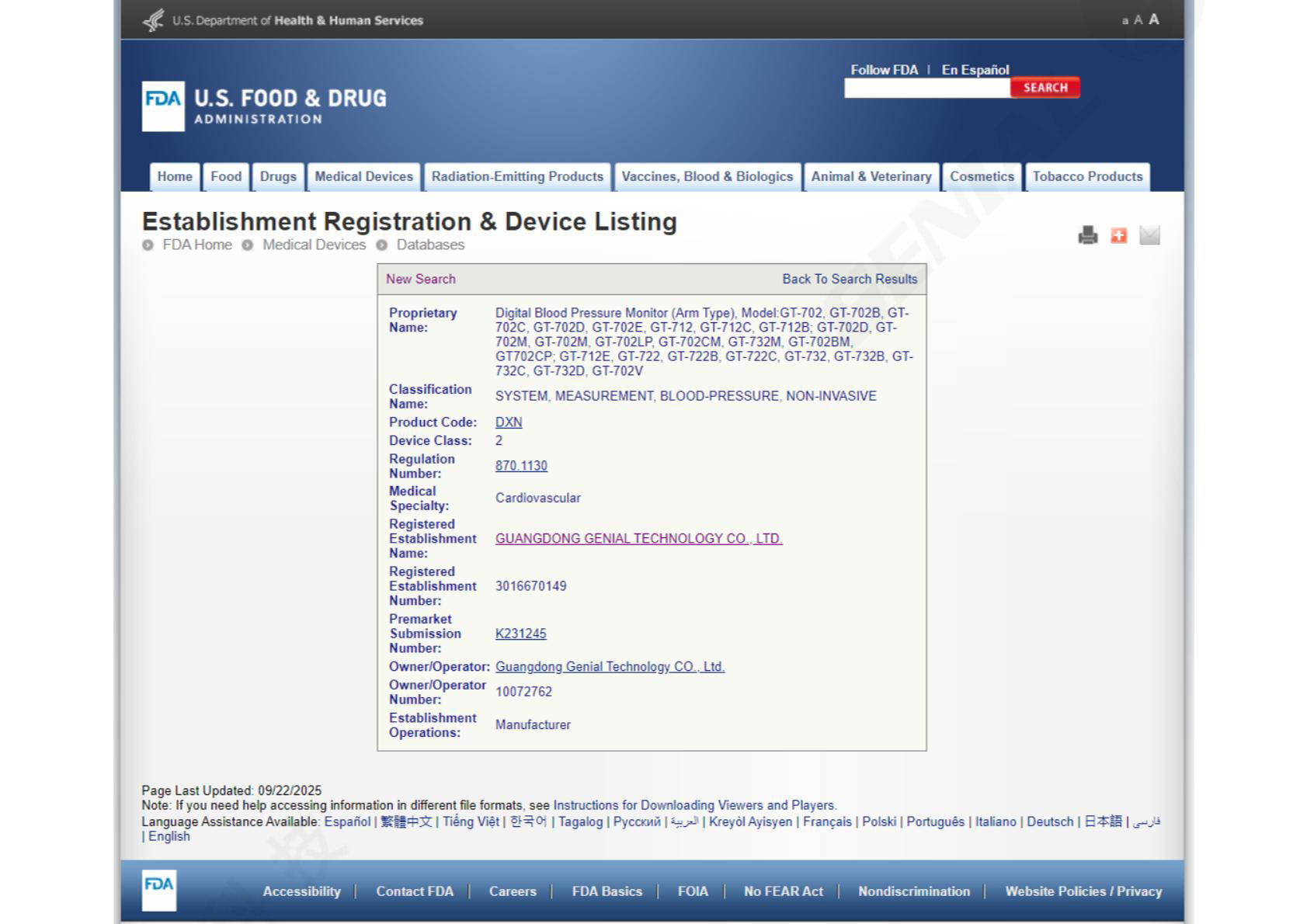
FDA 510(k) K231245 covers arm-type digital blood pressure monitors including GT-732, GT-732M, and GT-702BM.
FAQ
What compliance documents should buyers verify for home medical health devices?
Verify the certificate scope, not just the logo. GENIAL's ISO 13485 certificate CN13/31126 is valid from 2025-09-16 to 2028-09-16; CE MDR certificate CN25/00007953 is valid from 2025-11-25 to 2030-11-25; FDA 510(k) K231245 covers GT-732, GT-732M, and GT-702BM arm-type monitors.
Can one OEM or ODM supplier cover monitoring, therapy, and personal care categories?
GENIAL lists thermometers, blood pressure monitors, oximeters, nebulizers, ventilators, therapeutic instruments, and hair removal devices, and offers OEM, OBM, ODM, and JDM services. The facility is 45,000㎡ with 251 employees, 29 engineers, and 15,000,000 units annual output.
What order variables affect budget without published prices?
The approved facts do not quote prices. Budget variables include OEM MOQ: 10,000 pcs for thermometers, 2,000 units for blood pressure monitors, 2,000 for nebulizers, 500 for ventilators, and 2,000 for hair removal devices; ODM modification MOQ is 5,000 units.
How are samples handled before a mass order?
OEM samples take 3 days. ODM includes sample approval after product development; JDM includes sample validation before exclusive model registration.
What lead times should be planned for OEM, ODM, JDM, and OBM orders?
OEM small orders take 3–7 days and mass orders 10–15 days; ODM minor modifications 7–15 days and new molds 45–50 days; JDM 45–60 days; OBM in-stock ships within 48 hours. To request a sample, quote, or the 2026 English catalog, email market6@genial.cn.
Conclusion: Buy by Job, Then Verify by Model
Monitoring, therapy, and personal care are three different purchase categories. Monitoring devices such as the T31, GX3/GX5/GX7/GX8/GX12/GX13/GX14, GT-732, GT-732M, and GT-702BM measure and track. Therapy devices such as the N11/N21 and N12/N22/N12C/N22C/N12L/N22L mesh nebulizers and the GH-B20V/GH-B25V/GH-B20T/GH-B20/GH-B25/GH-A20A/GH-A20 ventilator deliver treatment or breathing support. Personal care devices such as the GI02/GI06 hair removal device support grooming routines. The shortest path to a defensible shortlist is to define the job first, then verify the specification, certificate scope, supply model, MOQ, sample, and lead time.
Next step: Request a sample, quote, or the 2026 English catalog from GENIAL. Email market6@genial.cn, call +86 18938327866, or download the catalog at 2026 English catalog. Website: www.cngenial.com. Address: No.2710-2711, 27/F, Bldg B, Fengxing Plaza, No.242 Tianhe Road, Tianhe Dist., Guangzhou, China.

GENIAL factory exterior. OEM, ODM, JDM, and OBM supply models are supported by the documented facility and order terms.
Have Questions or Need More Details?
Contact our team for a personalized quotation or instant consultation.
Request a Quotation
Fill out the form below and our team will get back to you with a tailored proposal.
WhatsApp Direct Chat
Prefer to chat in real-time? Message us on WhatsApp for instant assistance & quick answers.
- Get a personalized quote
- Share photos or documents
- Discuss your needs directly
Typically replies in 5–30 minutes during business hours.