
Home Medical Health Devices OEM Guide: Capabilities, MOQs, and Lead Times
An OEM decision for home medical health devices affects packaging, compliance, quality, delivery, and long-term product continuity. Buyers evaluating a partner need to verify service depth, not just factory size. This guide is written for brands, importers, distributors, pharmacies, and e-commerce teams that need a capability-based evaluation framework for sourcing digital thermometers, blood pressure monitors, pulse oximeters, mesh nebulizers, sleep apnea therapy devices, and related home-use medical products.
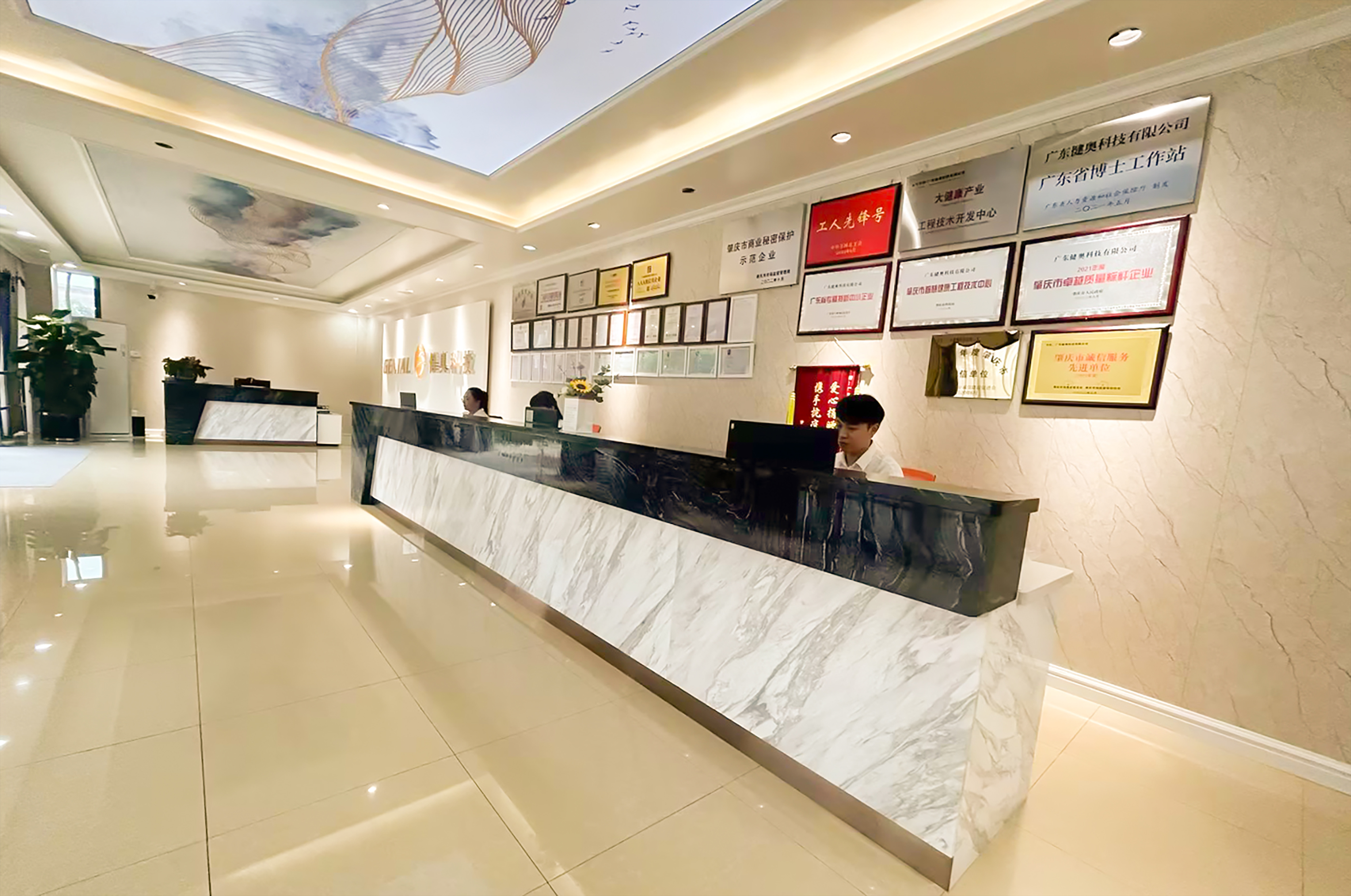
GENIAL office area in Guangzhou. OEM and ODM projects are coordinated through the company's headquarters and production base.
Guangdong Genial Technology Co., Ltd. (GENIAL) is a medical device manufacturer established in 2001. It works with global clients through OEM, ODM, JDM, and OBM service models and operates from a 45,000-square-meter production base in Guangzhou, China. The product portfolio includes electronic thermometers, infrared thermometers, wearable thermometers, digital blood pressure monitors, pulse oximeters, mesh nebulizers, non-invasive sleep CPAP ventilators, health manager devices, meridian massage instruments, and hair removal devices.
The Problem: Why Supplier Capability Matters More Than Unit Price
Capability gaps in OEM sourcing usually appear late. Samples can pass, and then certification documentation is incomplete, firmware changes are refused, or exclusive model registration cannot be supported. For home medical health devices, these issues matter because the products are regulated differently by market. A supplier's ability to support certification, documentation, and registration is a procurement requirement, not an add-on.
Buyers in the Evaluation and Execution stage should assess four things: the depth of customization the factory can actually deliver, the quality control process behind mass production, the MOQ and lead time for each service mode, and the certification evidence available for the target market.
Industry Context: Home Medical Health Devices Are a Structured Sourcing Category
Global demand for home medical health devices has expanded beyond single-category purchases. According to Grand View Research, the global blood pressure monitoring devices market was valued at USD 4.2 billion in 2025 and is projected to reach USD 8.6 billion by 2033 with a CAGR of 9.3%. Research and Markets estimates the global digital thermometer market at approximately USD 805.1 million in 2024, reaching USD 1 billion by 2030. The pulse oximeter market is expected to reach USD 5.3 billion by 2030, while the vibrating mesh nebulizer market is projected to grow from USD 0.75 billion in 2024 to USD 1.57 billion by 2035.
For an OEM buyer, these categories are not simple commodity products. They require scalable capacity, regulatory traceability, and a partner that can support product changes without destabilizing quality.
What a Full-Capability OEM Partner Should Provide
Production Service Models
A mature home medical OEM supplier should be able to explain what changes are allowed in each service mode. GENIAL offers four service models.
- OEM: customization covers packaging, gift box, user manual, product logo printing, color schemes, and packaging specifications, while core hardware, PCB, and key functions remain unchanged.
- ODM: customization can include industrial design, tooling, structure, PCB firmware, algorithms, Bluetooth functionality, display interface, packaging system, and exclusive product model registration.
- JDM: customers participate in product definition while GENIAL provides hardware, software, and structural R&D. Intellectual property ownership is allocated according to contractual agreements, and exclusive model registration is supported.
- OBM: regional distributor authorization, gift-box combinations, and shipping carton labels are available while original GENIAL branding remains unchanged.
Customization Depth
Customization can be separated into light-touch branding and deep development. Light-touch OEM work is useful for distributors entering a market quickly. Deep ODM development is relevant for e-commerce or retail brands that need a distinct look, display, or Bluetooth-connected feature.
As an example of deep development, GENIAL's wearable Bluetooth digital thermometer T31 supports temperature measurement from 20.0 to 45.0 degrees Celsius with an accuracy of plus or minus 0.1 degree Celsius and IPX4 whole-body splash-proof protection. This type of product demonstrates how design, firmware, algorithms, and material selection can be combined in an ODM or JDM project.
Exclusive model registration is particularly important in home medical devices. It helps prevent the same product from being sold under multiple brands in the same channel and gives the buying brand a clearer route to market.
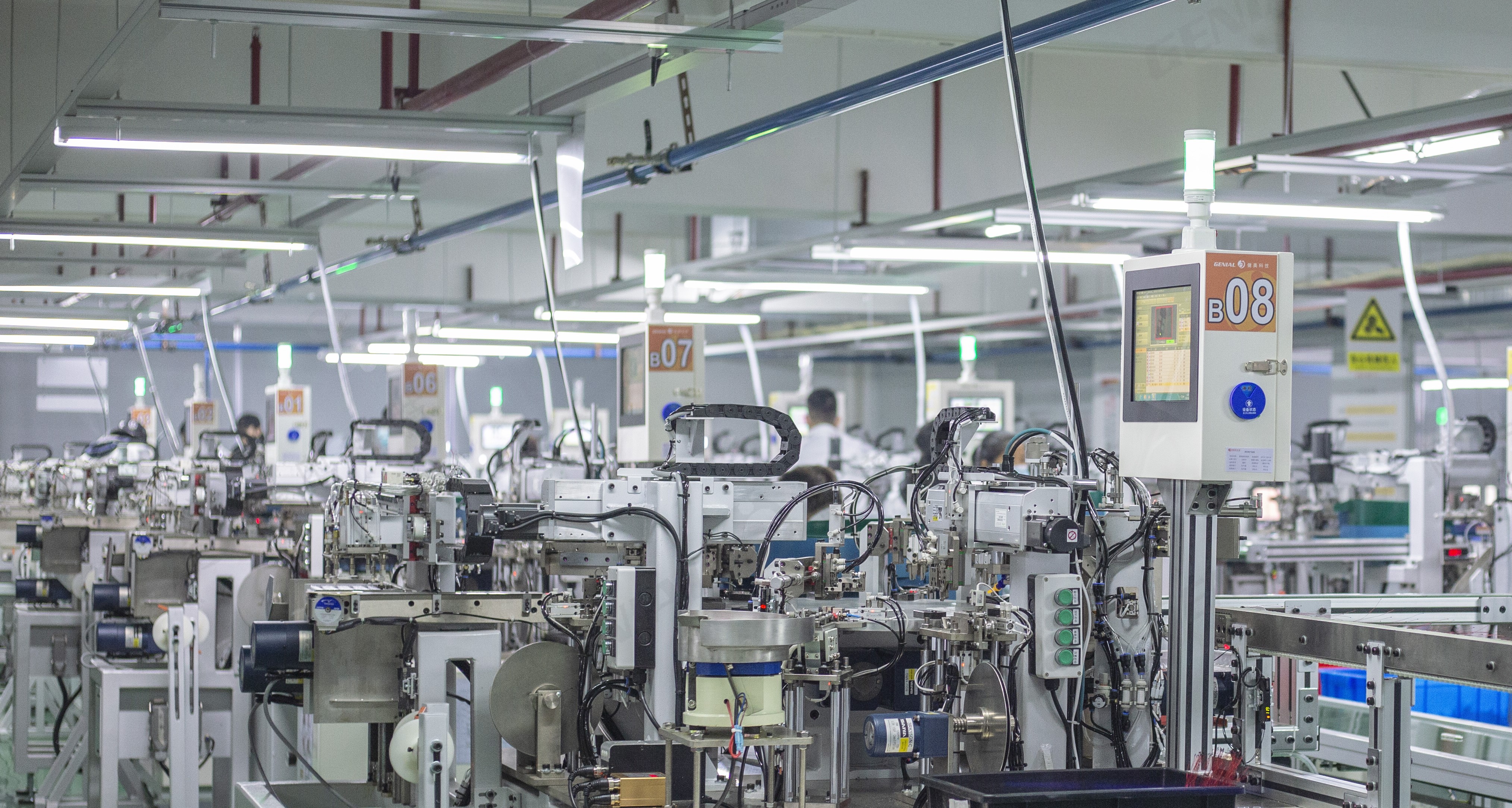
Automatic thermometer assembly line at GENIAL. Production capacity supports thermometers, oximeters, blood pressure monitors, nebulizers, and related home medical devices.
Quality Control Process
Quality control is a layered process. For OEM, the process includes order documentation and packaging approval, incoming material inspection, 100% production inspection, and final sampling inspection before shipment. For ODM and JDM, it includes customer demand assessment, internal project approval, product development, sample approval, exclusive model registration, and mass production with incoming, full-process, and final inspections.
For OBM, quality control includes incoming material inspection, full-process production inspection, and final factory inspection.
Certification and Global Compliance
GENIAL holds ISO 13485:2016 quality management certification under certificate CN13/31126 issued by SGS United Kingdom Ltd. The company also holds ISO 45001, ISO 14001, BSCI with an overall rating of B, and GB/T29490 intellectual property management certification.
Product-level certifications include CE under EU MDR 2017/745 with certificate CN25/00007953 issued by SGS Belgium NV, a CE MDR quality management system certificate numbered 195/MDR issued by IMQ for the T31 wearable thermometer and fingertip pulse oximeter series, US FDA 510(k) premarket notifications for forehead thermometers, clinical electronic thermometers, pulse oximeters, wrist-type and arm-type blood pressure monitors, MHRA registration in Great Britain, ANVISA registration in Brazil, Japan's Certificate of Foreign Medical Device Manufacturer, and Roszdravnadzor registration in Russia.
GENIAL has completed product and trademark registration in 29 countries, and its products are sold to 117 countries and regions worldwide. The company's export ratio is approximately 80%, with key markets in Europe, North America, Southeast Asia, the Middle East, Africa, Latin America, and Oceania.
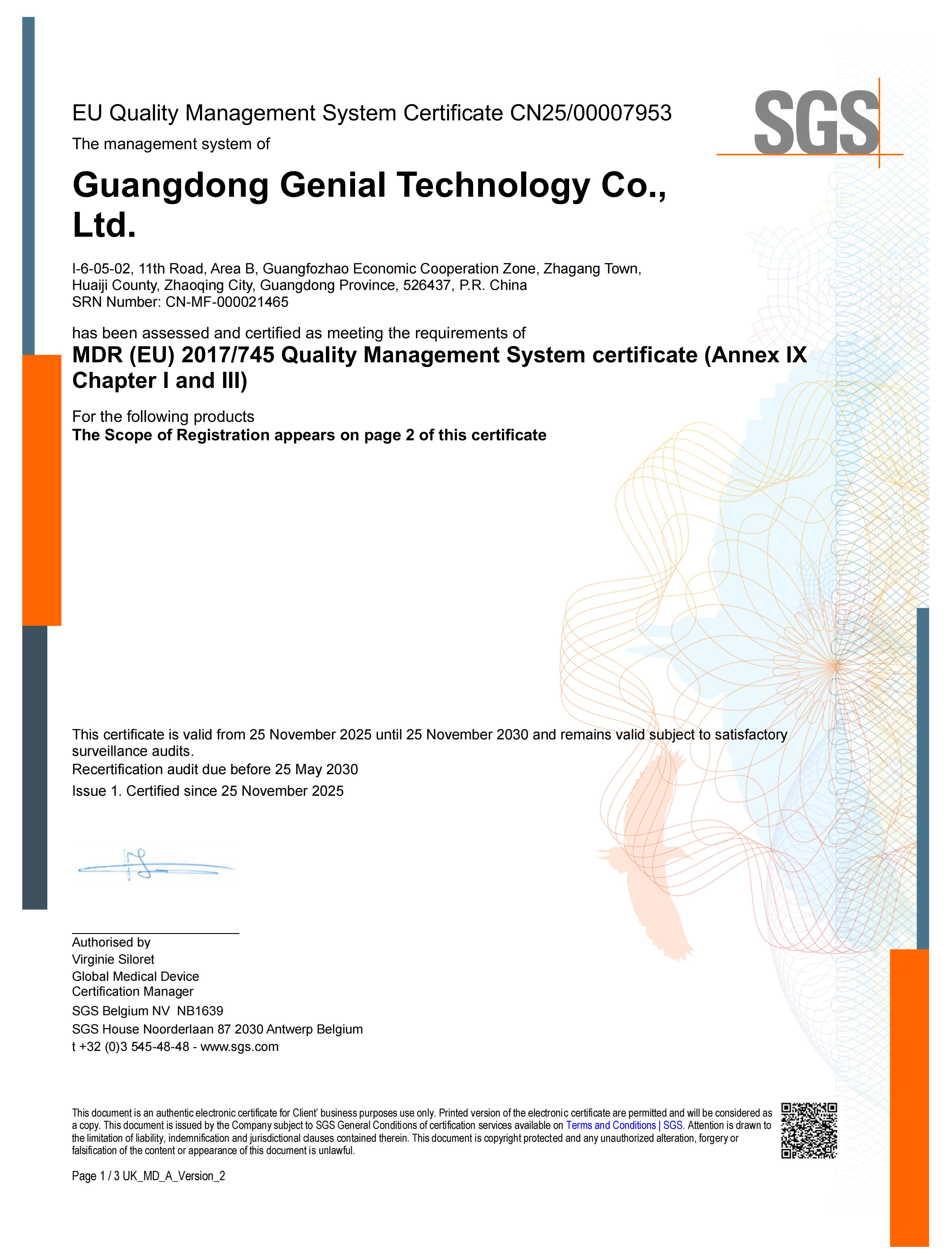
CE certificate issued under EU MDR 2017/745. Certification documentation supports market access for home medical health devices.
Capacity, MOQ, and Lead Time
Monthly production capacity for OEM, ODM, and OBM is 60,000 to 6,000,000 units. JDM monthly capacity is 300,000 units. OEM sample lead time is 3 days; small orders are 3 to 7 days; mass orders are 10 to 15 days. ODM minor modifications without new tooling are 7 to 15 days, and new mold development is 45 to 50 days. JDM initial mass production lead time is 45 to 60 days.
GENIAL also supports procurement flows commonly used by importers: sea freight, air freight, express delivery, and railway transportation; FOB, CIF, DDU, and DDP incoterms; FCL and LCL shipping; and inspection methods such as inspection of bulk goods against samples, factory inspection, third-party inspection, and video inspection. Payment options include T/T and Letter of Credit.
Step-by-Step: From OEM Evaluation to Mass Production
- Define the product category and target market. Include specifications such as digital thermometer type, blood pressure monitor cuff type, oximeter display, nebulizer particle size, or wearable connectivity requirements.
- Choose the service mode. For packaging-only changes, OEM is usually sufficient. For industrial design or firmware changes, ODM is required. For jointly developed new products, JDM is the relevant model.
- Confirm compliance needs. Share the target country or region so the factory can map the relevant certification and registration requirements.
- Review samples. GENIAL can prepare OEM samples in approximately 3 days, allowing faster validation of appearance, labeling, and user interface.
- Complete exclusive model registration if the product must be unique to the buying brand.
- Enter mass production with defined inspection gates: incoming material inspection, full-process production inspection, and final sampling inspection before shipment.
GENIAL also provides certification documentation support and technical consultation as part of after-sales service. Customers are entitled to a free 12-month warranty upon presentation of a valid proof of purchase.
Use Cases Across Buying Channels
GENIAL reports the following project patterns from its global client base. Client names are not listed here.
Medical Device Distributors
Projects with medical device distributors have involved 100,000 to 500,000 units over 5 years. The results included establishment of a product portfolio and one-stop procurement, which reduced supplier management costs.
Hospitals and Clinics
Hospital and clinic projects have involved 50,000 to 200,000 units over 5 years. The focus was clinical monitoring, with digital management, continuous monitoring, automatic alerts, and reduced manual inspections leading to improved nursing efficiency.
Pharmacy Chain Systems
Pharmacy chain projects have involved 100,000 to 1,000,000 units over 5 years for OTC sales. A complete product portfolio helped these clients meet different consumer segments with a rich SKU portfolio.
E-commerce Platforms
E-commerce platform clients have ordered 50,000 to 200,000 units over 5 years. ODM customization, rapid product launches, and support for small-batch trial sales helped them reach consumers quickly.
Maternal and Infant Companies
Maternal and infant brands have ordered 10,000 to 100,000 units over 5 years for infant monitoring. Continuous infant monitoring removed the need for repeated nighttime temperature measurements and improved user retention.
Service Mode Comparison
| Service Mode | Customization Scope | MOQ | Lead Time | Monthly Capacity |
|---|---|---|---|---|
| OEM | Packaging, gift box, user manual, product logo, color schemes, packaging specifications; core hardware unchanged | Thermometers: 10,000 pcs; oximeters, infrared thermometers, blood pressure monitors, nebulizers, wireless thermometers, and hair removal devices: 2,000 units; ventilators: 500 units | Samples: 3 days; small orders: 3-7 days; mass orders: 10-15 days | 60,000-6,000,000 units |
| ODM | Industrial design, tooling, structure, PCB firmware, algorithms, Bluetooth functionality, display interface, packaging system, exclusive model registration | Product modification: 5,000 units; new mold development: 10,000 units | Minor modifications: 7-15 days; new mold: 45-50 days | 60,000-6,000,000 units |
| JDM | Joint product development; customer participates in product definition; Genial provides hardware, software, and structural R&D; IP defined by contract; exclusive model registration supported | Initial mass-production order: 10,000 units; no strict MOQ for repeat orders | Initial mass production: 45-60 days | 300,000 units |
| OBM | Regional distributor authorization, gift-box combinations, shipping carton labels; Genial branding unchanged | Full-carton MOQ per SKU; mixed orders from 5 cartons | In-stock products: 48 hours; replenishment orders: 5-7 days | 60,000-6,000,000 units |
FAQ
What certifications does GENIAL hold for home medical health devices?
GENIAL holds ISO 13485:2016 quality management certification under certificate CN13/31126 issued by SGS United Kingdom Ltd, plus ISO 45001, ISO 14001, BSCI, and GB/T29490 system certifications. Product certifications include CE under EU MDR 2017/745, US FDA 510(k) premarket notifications for thermometers, pulse oximeters, and blood pressure monitors, MHRA registration in Great Britain, ANVISA registration in Brazil, Japan's foreign medical device manufacturer registration, and Roszdravnadzor registration in Russia.
Can GENIAL customize more than packaging for home medical health devices?
Yes. For OEM, customization covers packaging, gift box, user manual, product logo, color schemes, and packaging specifications while core hardware and key functions remain unchanged. For ODM, customization can include industrial design, tooling, structure, PCB firmware, algorithms, Bluetooth functionality, display interface, packaging system, and exclusive product model registration. JDM supports joint product development with contract-based IP ownership.
What are the MOQs for OEM, ODM, and JDM production?
For OEM, the MOQ is 10,000 pieces for thermometers; 2,000 units for oximeters, infrared thermometers, blood pressure monitors, nebulizers, wireless thermometers, and hair removal devices; and 500 units for ventilators. For ODM, product modification requires 5,000 units and new mold development requires 10,000 units. For JDM, the initial mass-production order is 10,000 units, with no strict MOQ for repeat orders.
Can I get samples before mass production?
OEM samples can typically be prepared in 3 days. Small orders can ship in 3 to 7 days, and mass orders in 10 to 15 days. For ODM, minor modifications without new tooling take 7 to 15 days, while new mold development takes 45 to 50 days. JDM initial mass production takes 45 to 60 days. Buyers can also use inspection of bulk goods against samples, factory inspection, third-party inspection, or video inspection.
How long does a home medical OEM order take from confirmation to delivery?
OEM lead time is 3 days for samples, 3 to 7 days for small orders, and 10 to 15 days for mass orders. ODM lead time is 7 to 15 days for minor modifications and 45 to 50 days for new mold development. JDM initial mass production lead time is 45 to 60 days. The actual schedule depends on product line, customization depth, and target-market registration needs. For a more specific timeline, contact GENIAL with your product list and target markets.
Conclusion and Next Step
An OEM partner for home medical health devices should be evaluated on service depth, quality control, certification evidence, MOQ, lead time, and supply terms. These factors determine whether a product can move from sample to mass production without compliance or delivery problems.
GENIAL provides OEM, ODM, JDM, and OBM production services from a 45,000-square-meter base in Guangzhou, with ISO 13485 certification, multiple market registrations, and a product portfolio covering thermometers, blood pressure monitors, pulse oximeters, mesh nebulizers, sleep apnea therapy devices, and related home-use products.
Evaluate Your Product Plan with GENIAL
Contact GENIAL to confirm MOQ, lead time, and certification support for your home medical health devices.
Email: market6@genial.cn
Tel / WhatsApp: +86 18938327866
Website: www.cngenial.com
Have Questions or Need More Details?
Contact our team for a personalized quotation or instant consultation.
Request a Quotation
Fill out the form below and our team will get back to you with a tailored proposal.
WhatsApp Direct Chat
Prefer to chat in real-time? Message us on WhatsApp for instant assistance & quick answers.
- Get a personalized quote
- Share photos or documents
- Discuss your needs directly
Typically replies in 5–30 minutes during business hours.