
How Upper Arm Digital Blood Pressure Monitors Work: A Beginner’s Guide
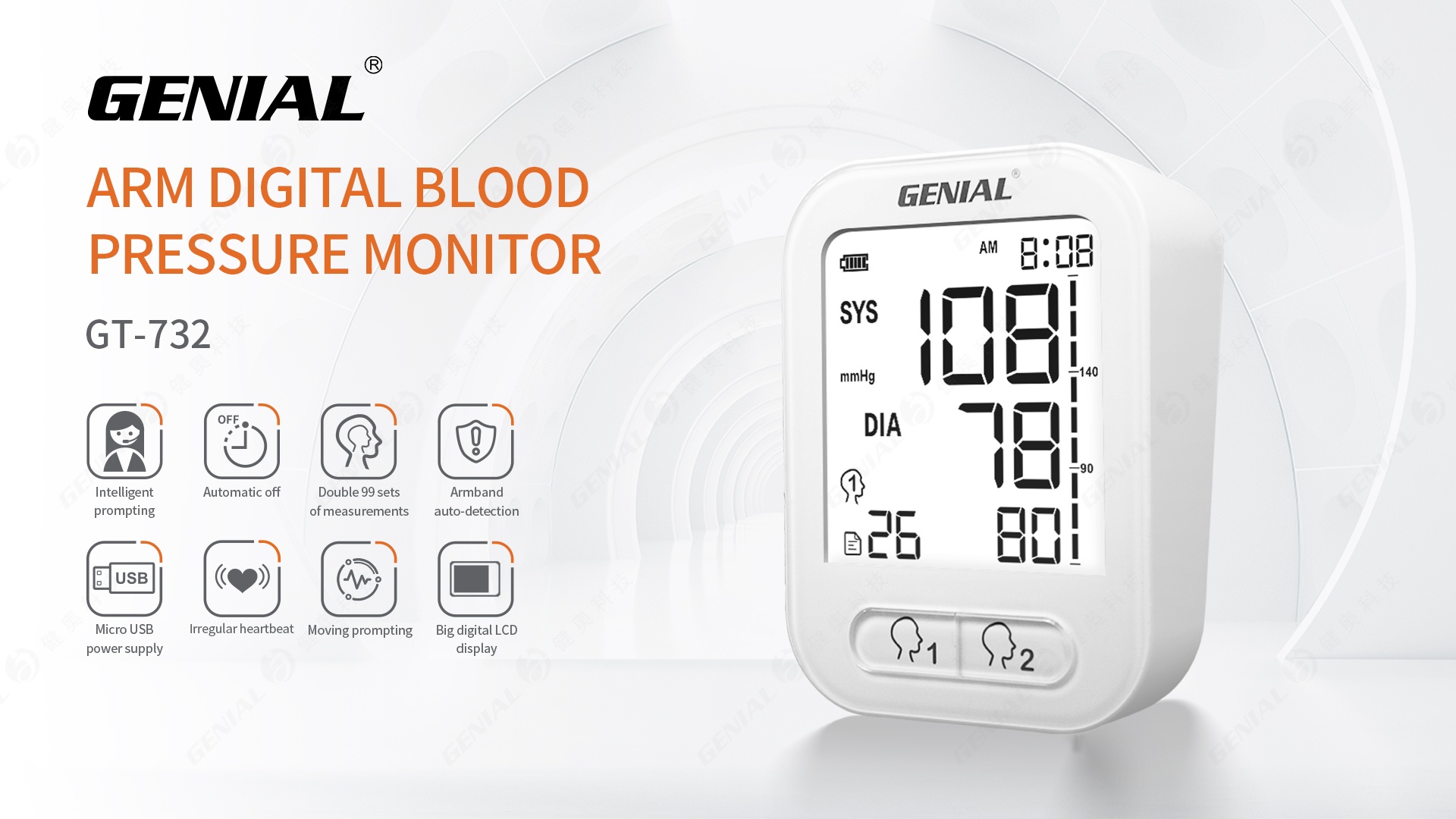 GT-732 upper arm digital blood pressure monitor: ABS housing, PVC air bag, nylon binding strap, 22–32 cm arm circumference.
An upper arm digital blood pressure monitor works by wrapping an inflatable cuff around the upper arm, inflating it until the air bag briefly compresses the brachial artery, and then releasing that pressure while the device reads the pressure signal inside the cuff and converts it into two displayed numbers: systolic and diastolic pressure. Every other part — the ABS housing, the pump, the valve, the sensor, the display — exists to make that single sequence repeatable at home, by someone with no clinical training.
This guide explains that sequence from the outside in, using GENIAL’s upper arm range and the GT-732 model as the worked example. GENIAL (Guangdong Genial Technology Co.,Ltd) is a medical device manufacturer founded in 2001 in Guangzhou, China, producing thermometers, blood pressure monitors, oximeters, nebulizers, ventilators and related home health devices, with roughly 80% of output exported and products sold to 117 countries and regions.
By the end, the three things that most often confuse a first-time user — the tightening of the cuff, the two different pressure numbers, and a specification written as “pulse error ≤±5%” — should read as normal mechanics rather than warnings.
The problem: a device that was never explained
Home blood pressure monitors rarely fail because the electronics are inadequate. They fail at the handover, when nobody explains what the machine is doing while it is doing it.
Three frictions come up repeatedly:
- The squeeze feels aggressive. A cuff that tightens to the point of discomfort looks like a fault. It is not — the air bag has to compress the artery enough to stop flow for a few seconds before any measurement can be taken.
- Two numbers appear with no explanation. Users see “128 / 82” and a pulse figure and have no idea which number was measured first, or why they differ.
- Accuracy language sounds like error. A phrase such as “pulse tolerance ±5%” reads like an admission that the reading may be wrong, when it is actually a stated tolerance band.
The result is predictable: people measure once, dislike the experience, and stop. That matters for households managing a long-term condition, and it matters commercially for distributors and pharmacy chains, because an unexplained device turns into returns, helpline calls and weak repeat purchase.
Industry background: why upper arm designs dominate home measurement
Home blood pressure monitoring is no longer a niche accessory category. Mordor Intelligence estimates the global home medical equipment market at USD 54.35 billion in 2026, with North America holding approximately 40.35% of that market in 2025. Within blood pressure monitoring specifically, the same research places upper arm monitors at 59.10% of market share in 2025, while wrist-based and wearable formats are growing at a 12.07% CAGR.
The upper arm format holds that position for a simple physical reason: the upper arm gives the cuff a stable, roughly cylindrical surface close to the brachial artery, which is easier to reproduce at home than a wrist position that moves with the hand.
Regulation has followed the devices into the home. UL describes IEC 60601-1-11 as the collateral standard used together with IEC 60601-1 for home healthcare equipment, specifically because these devices are operated by untrained users in uncontrolled environments rather than by clinicians in a clinic. Separate usage guidance published in PubMed Central adds two practical requirements for home monitoring equipment: calibration at frequent intervals, and operation within an ambient temperature of 16 to 40 °C with humidity below 85%.
Those two points define what a beginner should understand about any home monitor: the hardware is designed for a home environment, and it still needs periodic calibration and sensible operating conditions to stay meaningful.
How an upper arm monitor actually measures pressure
The measurement is a controlled interruption of blood flow, followed by a controlled release. Four functional blocks carry it out.
Part 1 — The cuff: air bag, strap and housing
The cuff is the only part that touches the body, and it is where measurement quality starts. On the GT-732, the material specification lists three separate components: an ABS housing for the main unit, a PVC air bag inside the cuff, and a nylon binding strap that holds the cuff in place on the arm.
Each component has a job. The air bag is the working element — it is the part that inflates and applies pressure to the arm. The nylon strap keeps that air bag flat and positioned against the upper arm instead of bulging sideways when pressure rises. The ABS housing holds the pump, valve, sensor, electronics and display together in a rigid enclosure that will not flex under repeated inflation cycles.
Cuff fit is specified as arm circumference, and it is the specification most often ignored. The GT-732 is listed for an arm circumference of 22–32 cm. The GT-732M, built on the same 136×103×54 mm housing, is listed for 22–42 cm. A cuff that does not wrap fully and evenly around the arm cannot compress the artery evenly, so the arm measurement comes before any other buying decision.
Part 2 — The pump and the release valve
Pressing the start button hands control to the device. An internal pump raises the pressure inside the air bag until the artery beneath it is compressed; a valve then releases that pressure in a controlled way rather than letting it drop at once.
This is the phase users find uncomfortable, and it is also the phase that cannot be skipped. The brief tightness is the working part of the measurement, not a side effect.
Part 3 — The sensor and the control board
While the cuff inflates and releases, a pressure sensor reads the pressure inside the air bag continuously and passes that signal to the control board. The board converts the signal into the two values shown on screen: systolic pressure, the pressure at the moment the heart pushes blood through the artery, and diastolic pressure, the pressure between beats when the artery relaxes.
Because both numbers come from the same pressure curve recorded during one release, the device reports them as a pair. That is why a reading is always written as two figures rather than one.
Part 4 — The display and the record
The display shows the systolic value, the diastolic value and the pulse rate. Beyond the display, models differ in what they keep. The GT-702BM and GT-702V are both listed with 99 memory sets for 2 users, which allows two people in one household to keep separate histories on the same device. The GT-702MA adds a WHO blood pressure classification function to the reading.
Memory matters more than it appears to. A single reading describes a moment; a stored series describes a pattern, and patterns are what a clinician can actually work with.
What “Pressure 0–290 mmHg” is telling you
Every upper arm model in the GENIAL range — GT-732, GT-732M, GT-702BM, GT-702L and the rest of the family — is specified with a measuring range of 0–290 mmHg for pressure.
That figure describes the span the device is built and specified to cover. It is not a target, a threshold or a warning level. It is the working envelope of the pressure sensor and cuff system, printed on the specification sheet so that a buyer or a user can confirm what the hardware is designed to handle.
What “pulse error ≤±5%” means in plain language
Alongside pressure, the monitor reports a pulse rate. The specification states how closely that figure is expected to track the reference value.
On the GT-732 the figure is written as pulse tolerance ±5%. On the GT-732M it is written as pulse error ≤±5%. On the GT-702L the pulse measuring range is listed as 30–250 bpm. These are three ways of describing the same kind of statement: a tolerance band around the pulse value.
For a layperson, the practical translation is this. A ±5% tolerance means the displayed pulse may sit within five percent of the reference figure. Five percent of a reading of 80 beats per minute is four beats. It is a band, not a fault, and it is the same kind of statement a manufacturer makes about any measured value.
Two further points remove most of the remaining anxiety. First, pulse rate naturally moves through the day with activity, posture, caffeine and stress, so consecutive readings are never identical regardless of the device. Second, the useful information sits in the trend across several readings taken under similar conditions, not in whether today’s single figure matches yesterday’s exactly.
Why the material list is worth reading
Material specifications look like purchasing detail, but they explain real differences between models that share a name and a shape.
The GT-732 and GT-732M share identical housing dimensions of 136×103×54 mm, yet their listed net weights differ: 291 g±15 g for the GT-732 and 239 g±15 g for the GT-732M, both without battery. The GT-732 uses a PVC air bag and a nylon binding strap; the GT-732M uses an eco-friendly TPU air bag and covers a wider 22–42 cm arm range. Further along the range, the GT-702BM uses a composite fabric cuff, while the GT-702L lists ABS plastic, a nylon cuff and an LCD lens.
None of these differences changes the principle of operation. They change fit, feel and the channel the model suits — which is why a buyer comparing “the same monitor” across two suppliers should compare the full material line rather than the model name alone.
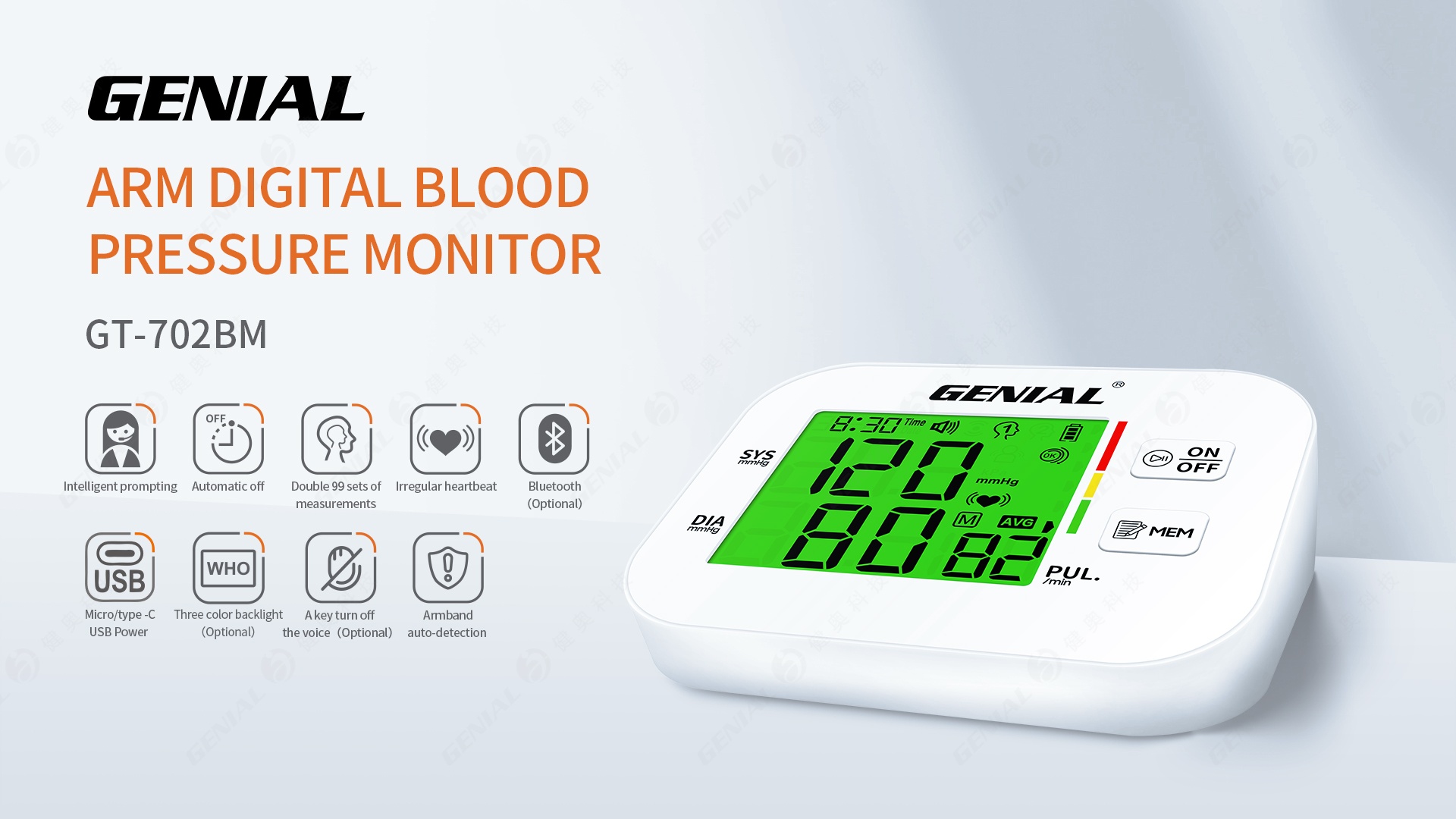 GT-702BM: composite fabric cuff, 22–42 cm arm circumference, 99 memory sets for 2 users — memory turns single readings into a trend a clinician can review.
A first measurement, step by step
The sequence below is what a first-time user actually experiences, with the specification points that matter at each stage.
- Match the cuff to the arm. Check the arm circumference against the model’s stated range — 22–32 cm on the GT-732, 22–42 cm on the GT-732M, GT-702BM and GT-702L. A mismatched cuff invalidates everything that follows.
- Sit and settle before starting. The cuff should sit on the upper arm, above the elbow, with the air bag over the artery. Wrapping happens before the device is switched on, not during.
- Press start and let the pump work. The device inflates the air bag automatically. Nothing needs to be squeezed by hand.
- Stay still through inflation and release. Movement during this phase disturbs the pressure signal the sensor is recording, which is the most common cause of a reading that has to be repeated.
- Read the three values. Systolic first, diastolic second, pulse third — all derived from the same inflation-and-release cycle.
- Record the reading. On models with memory such as the GT-702BM and GT-702V, 99 memory sets for 2 users let a household keep separate histories without writing anything down.
- Repeat under similar conditions and watch the trend. Separate readings taken at the same time of day are more useful than several readings taken minutes apart.
Where upper arm monitors are used
The same mechanism serves very different buyers, and the model line reflects that.
Community clinics and wellness centers. The GT-732 lists community clinic, health & wellness center and e-commerce among its applicable channels, alongside customized OEM gift programs. The 22–32 cm cuff range suits a general adult population, and the 291 g±15 g unit is light enough to be moved between rooms.
Chronic disease management and community medical centers. The GT-732M is listed for chronic disease management institutes, community medical centers and insurance promotional gift programs. Its 22–42 cm arm range and 239 g±15 g weight suit settings where the same device is used across a wider range of body types.
Pharmacy chains running OTC programs. A documented pharmacy chain program covering 100,000–1,000,000 units over five years, delivered globally, was built on a complete product portfolio intended to cover different consumer segments — the value being a rich SKU range rather than a single model.
E-commerce and distributor channels. A separate e-commerce platform program covering 50,000–200,000 units over five years combined ODM customization with rapid product launches and support for small-batch trial sales, which is how an online seller tests a category before committing to volume.
Household retail and institutional gift programs. The GT-702BM is listed for medical instrument wholesale and offline household retail; the GT-702L covers pharmacy, nursing home, physical examination center, household healthcare and gift industry channels. The GT-702B is positioned toward insurance complimentary gift and cross-border commodity programs.
Model comparison: what actually changes between upper arm units
The table below uses only published specification data for four upper arm models. All four share the same measuring principle and the same 0–290 mmHg pressure range; the differences are fit, materials, memory and channel positioning.
| Specification | GT-732 | GT-732M | GT-702BM | GT-702L |
|---|---|---|---|---|
| Type | Upper Arm Digital Blood Pressure Monitor | Upper Arm Digital Blood Pressure Monitor | Upper Arm Digital Blood Pressure Monitor | Upper Arm Digital Blood Pressure Monitor |
| Pressure measuring range | 0–290 mmHg | 0–290 mmHg | 0–290 mmHg | 0–290 mmHg |
| Pulse specification | Pulse tolerance ±5% | Pulse error ≤±5% | — | Pulse 30–250 bpm |
| Arm circumference | 22–32 cm | 22–42 cm | 22–42 cm | 22–42 cm |
| Materials | ABS, PVC air bag, nylon binding strap | ABS, eco-friendly TPU air bag | ABS, composite fabric cuff | ABS plastic, nylon cuff, LCD lens |
| Dimensions | 136×103×54 mm | 136×103×54 mm | 135×102×46 mm | 135×110×39 mm |
| Net weight (without battery) | 291 g ±15 g | 239 g ±15 g | 220 g ±15 g | 220 g ±15 g |
| Memory | — | — | 99 memory sets for 2 users | — |
| Listed applicable industry | Community clinic, health & wellness center, e-commerce, customized OEM gift | Chronic disease management institute, community medical center, insurance promotional gift | Medical instrument wholesale, offline household retail | Medical device industry, pharmacy, nursing home, physical examination center, household healthcare, gift industry, international foreign trade |
Read the table in one direction: if the priority is a wide arm range, the GT-732M, GT-702BM and GT-702L cover 22–42 cm. If the priority is stored readings for two people, the GT-702BM carries that specification. If the priority is a lighter unit in a compact housing, the GT-702L is listed at 220 g ±15 g in 135×110×39 mm. The measuring principle itself does not change across the four.
Standards and certification context
For buyers — and for users who want to know the device is not a generic consumer gadget — the relevant question is which standards and registrations sit behind the hardware.
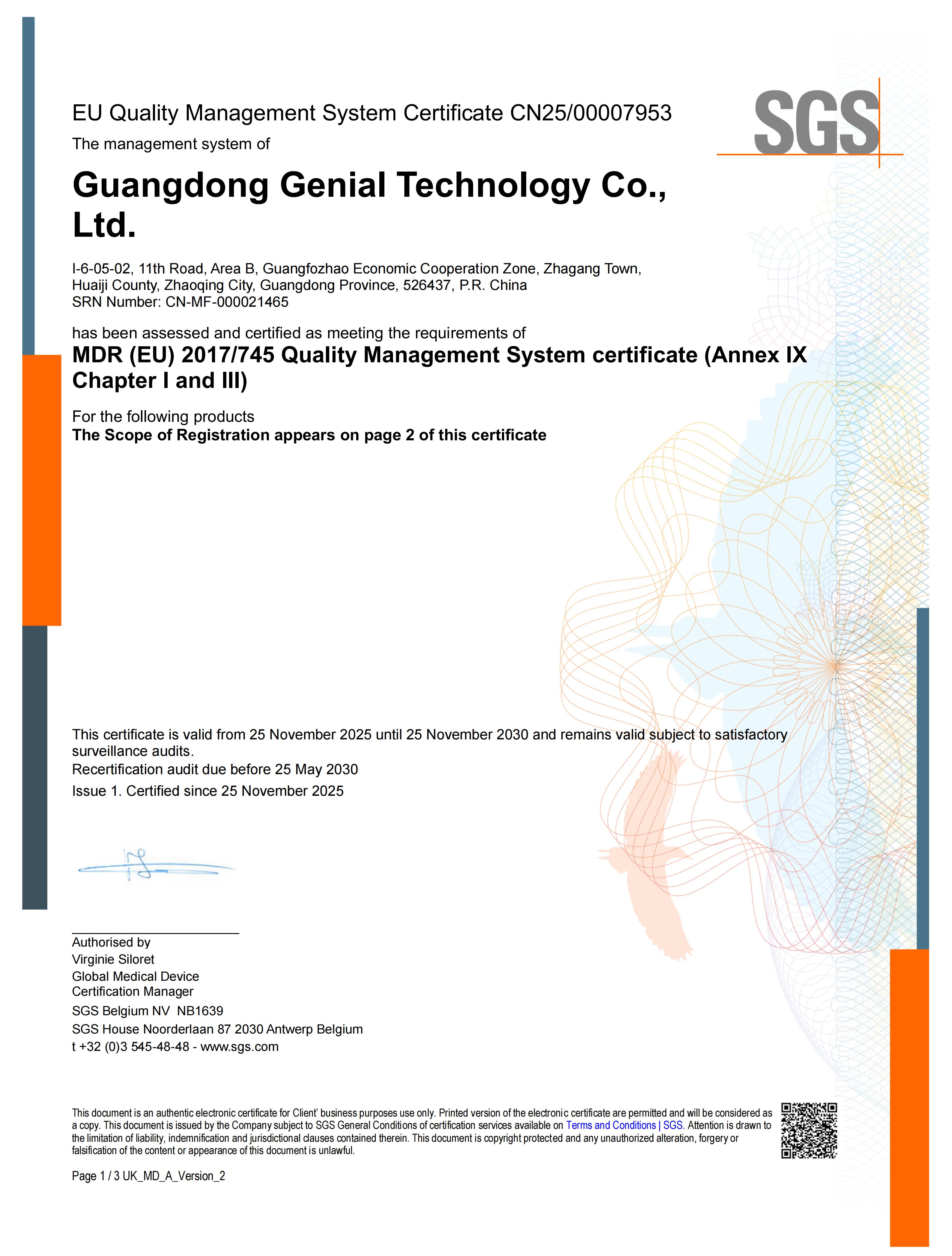 CE MDR certificate CN25/00007953, issued through SGS Belgium NV (Notified Body 1639), valid to 25 November 2030.
At the quality-system level, GENIAL holds ISO 13485 certification (certificate CN13/31126, issued by SGS United Kingdom Ltd, valid 16 September 2025 to 16 September 2028), with a scope covering the design, development and manufacture of digital blood pressure monitors, thermometers, pulse oximeters and nebulizers.
At product level, arm-type models including the GT-732, GT-732M, GT-702BM and GT-702L sit within CE MDR certificate CN25/00007953 (SGS Belgium NV, Notified Body 1639, valid 25 November 2025 to 25 November 2030) and within US FDA 510(k) K231245 for arm-type digital blood pressure monitors. Regional registrations extend to Japan (Certificate of Foreign Medical Device Manufacturer BG10501496, valid 19 November 2024 to 18 November 2029), Russia (Roszdravnadzor No. 1241/1-3 140/2-25) and Brazil (ANVISA, RDC 751/2022).
Frequently asked questions
1. Does a home upper arm monitor have to meet a specific safety standard?
Yes. UL describes IEC 60601-1-11 as the collateral standard used in conjunction with IEC 60601-1 for home healthcare equipment, written specifically for devices used by untrained operators in uncontrolled home environments. In practice, buyers verify three layers: the quality system, the product certificate and the regional registration. For GENIAL that means ISO 13485 (CN13/31126), CE MDR certificate CN25/00007953 issued by SGS Belgium NV as Notified Body 1639, and US FDA 510(k) K231245 for the arm-type range.
2. How accurate is the pressure reading, and how is it tested?
GENIAL states that each blood pressure monitor is calibrated and tested, and that the measured pressure should fall within 3 mmHg of analyzer data, with the deviation described as less than 0.4 kPa. On the device itself, the pressure measuring range is 0–290 mmHg across the upper arm family. Independent guidance published in PubMed Central recommends calibration at frequent intervals and operation at 16–40 °C with humidity below 85%, so accuracy is maintained through both the manufacturer’s test protocol and the user’s operating conditions.
3. What is the minimum order quantity for an OEM blood pressure monitor program?
For OEM production, blood pressure monitors carry a minimum order quantity of 2,000 units. ODM projects are structured differently: product modification starts at 5,000 units, and new mold development at 10,000 units, with tooling cost refundable for large-volume projects. JDM requires an initial mass-production order of at least 10,000 units, while OBM orders start from a full carton per SKU, with mixed orders accepted from 5 cartons.
4. How quickly can a sample be arranged before committing to volume?
Under OEM, samples are quoted at 3 days, with small orders following in 3–7 days. Under ODM, minor modifications without new tooling take 7–15 days, while new mold development runs 45–50 days. Under OBM, in-stock products ship within 48 hours. Sampling before volume is the normal route: it lets a buyer confirm the cuff fit, the housing finish and the display behaviour before the order moves to mass production.
5. What are the production lead times for a blood pressure monitor order?
OEM mass orders are quoted at 10–15 days after confirmation. ODM new mold development is quoted at 45–50 days, and JDM initial mass production at 45–60 days with a monthly production capacity of 300,000 units. OBM replenishment orders are quoted at 5–7 days. Formal acceptance can be handled through inspection of bulk goods against samples, factory inspection, third-party inspection or video inspection, with payment by T/T or letter of credit. To discuss a sample or quote for an upper arm program, contact the GENIAL team at market6@genial.cn or via WhatsApp on +86 18938327866.
Conclusion: the mechanism is simple, the specification is the detail
An upper arm digital blood pressure monitor does one thing: it inflates an air bag until the artery is briefly compressed, releases that pressure in a controlled way, and reads the pressure signal to produce systolic, diastolic and pulse values. The ABS housing, the PVC or TPU air bag, the nylon or composite fabric cuff, and the display all exist to make that single sequence safe, repeatable and readable by someone measuring at home.
Two specifications carry most of the practical meaning. The pressure measuring range of 0–290 mmHg describes the working envelope of the hardware. A pulse tolerance or pulse error of ±5% describes a tolerance band around the pulse figure — a band, not a defect, and never a reason to avoid measuring. Cuff fit, stated as arm circumference, determines whether any of it works on a given arm: 22–32 cm on the GT-732, 22–42 cm on the GT-732M, GT-702BM and GT-702L.
Once those three points are clear, self-monitoring at home stops being intimidating. A user knows why the cuff tightens, knows what the two numbers represent, and knows that the value of the device lies in a recorded series rather than a single reading.
Next step: sample, specification sheet or full catalogue
GENIAL supplies upper arm digital blood pressure monitors across the GT-732, GT-732M, GT-702BM, GT-702L and wider GT-700 series, with OEM, ODM, JDM and OBM production options. Request a sample for cuff-fit and display validation, ask for a quotation against your target volume, or download the full English catalogue covering thermometers, blood pressure monitors, oximeters, nebulizers, ventilators and therapeutic devices.
Email: market6@genial.cn | WhatsApp: +86 18938327866 | Website: www.cngenial.com
Catalogue download: GENIAL 2026 English Product Catalogue (PDF)
 GENIAL manufacturing base, Guangzhou — ISO 13485 certified production of digital blood pressure monitors and home health devices since 2001.
Have Questions or Need More Details?
Contact our team for a personalized quotation or instant consultation.
Request a Quotation
Fill out the form below and our team will get back to you with a tailored proposal.
WhatsApp Direct Chat
Prefer to chat in real-time? Message us on WhatsApp for instant assistance & quick answers.
- Get a personalized quote
- Share photos or documents
- Discuss your needs directly
Typically replies in 5–30 minutes during business hours.