
How to Read Compliance Certificates for Home Health Devices
Compliance Guide for Home Medical Health Devices: Reading Certificates, Standards, and Regional Rules
Compliance for a home medical device is not established by a logo on a product page. It is established by four documents agreeing with each other: the claim you are making about the product, the model number on the certificate, the standard the certificate cites, and the market the certificate is valid for. When those four elements line up, you can defend the purchase to a regulator, a tender committee or a retail compliance team. When any one of them is missing, the certificate proves something, but not what you need it to prove.
This guide treats compliance as a documentation-review process rather than a trust exercise. GENIAL (Guangdong Genial Technology Co., Ltd) is a medical device manufacturer founded in 2001 that holds CE, FDA, NMPA, CB, FCC and RoHS registrations across thermometers, blood pressure monitors, oximeters, nebulizers and related devices, and its own certificate portfolio is used below as a worked example. The aim is practical: by the end you should be able to open a certificate PDF, find the three or four lines that matter, and decide whether that document supports the order you are about to place.
What "compliant" has to mean for a home medical device
A home medical device is compliant for a given market when a valid document issued for that market names the specific model, cites the applicable standard, and covers the device type and performance envelope you intend to sell. Everything else is supporting evidence.
That definition has three consequences buyers routinely miss. First, a certificate is scoped to models, not to a company's whole catalogue. Second, a quality management system certificate and a product certificate are different instruments with different jobs. Third, many impressive-looking documents — social compliance audits, intellectual property certifications, retail brand supplier codes — are real and useful, but they are not market access for a medical device. Sorting documents into those three buckets before you read a single number prevents most compliance mistakes in this category.
The scope gap: why a certificate image on a product page proves almost nothing
Most sourcing errors in home health devices come from a scope gap, a mismatch between what a document covers and what the buyer assumes it covers. Four versions of that gap appear repeatedly.
- Model gap. The certificate lists a family of models, and the buyer orders a variant that is not on the list. A model list is a boundary, not a suggestion.
- Instrument gap. An ISO 13485 certificate is presented as if it were product approval. It is not: it certifies that the design, development and manufacturing system meets the standard, which is a precondition for market access rather than market access itself.
- Market gap. A CE certificate is shown to a buyer importing into the United States, or a US FDA clearance is shown to a buyer importing into Japan. Each market has its own instrument and its own number.
- Category gap. A social-compliance audit such as amfori BSCI, an intellectual property certificate such as GB/T29490, or a retail brand supplier registration is treated as product safety evidence. These documents answer different questions, and a procurement file should label them accordingly.
Industry background: how the regional rule sets differ
Home medical health devices sit in a regulated category where the market determines the instrument, the issuer and the number format. Reading certificates becomes far easier once you know which document type each market actually requires.
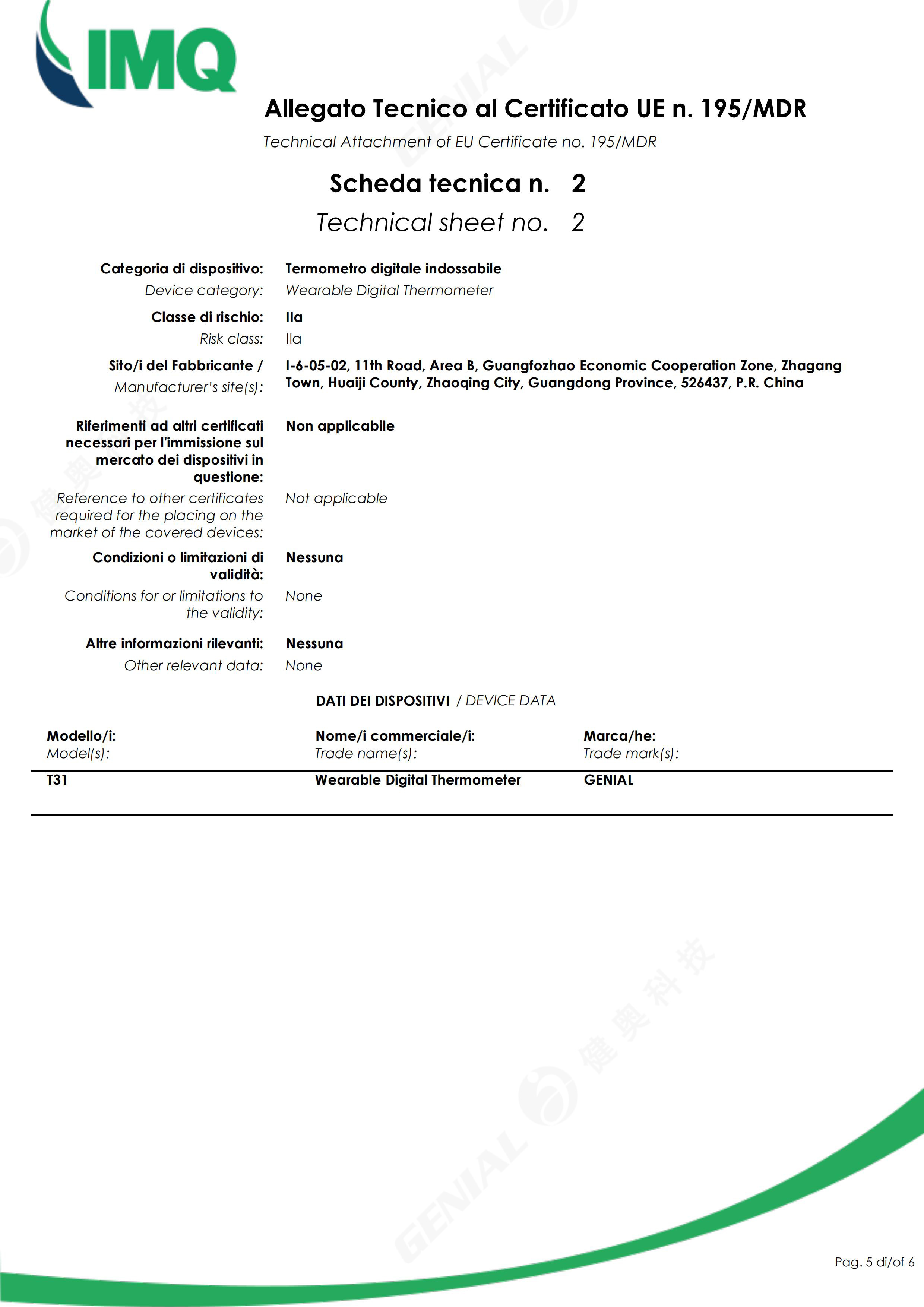
In the European Union, the instrument is a CE certificate issued under MDR (EU) 2017/745 by a notified body. GENIAL's blood pressure monitor certificate, number CN25/00007953, was issued by SGS Belgium NV (Notified Body 1639) with SRN CN-MF-000021465, cites MDR (EU) 2017/745 Annex IX Chapter I & III together with EN ISO 13485:2016, and runs from 25 November 2025 to 25 November 2030. A separate CE MDR quality management system certificate, 195/MDR, issued by IMQ S.p.A (Notified Body 0051), covers the T31 wearable thermometer and the full series of fingertip pulse oximeters under MDR (EU) 2017/745, the EN 60601 series and EN ISO 13485:2016, valid from 21 October 2024 to 20 October 2029. Two CE documents, two different notified bodies, two different product scopes — which is exactly why the scope line has to be read rather than assumed.
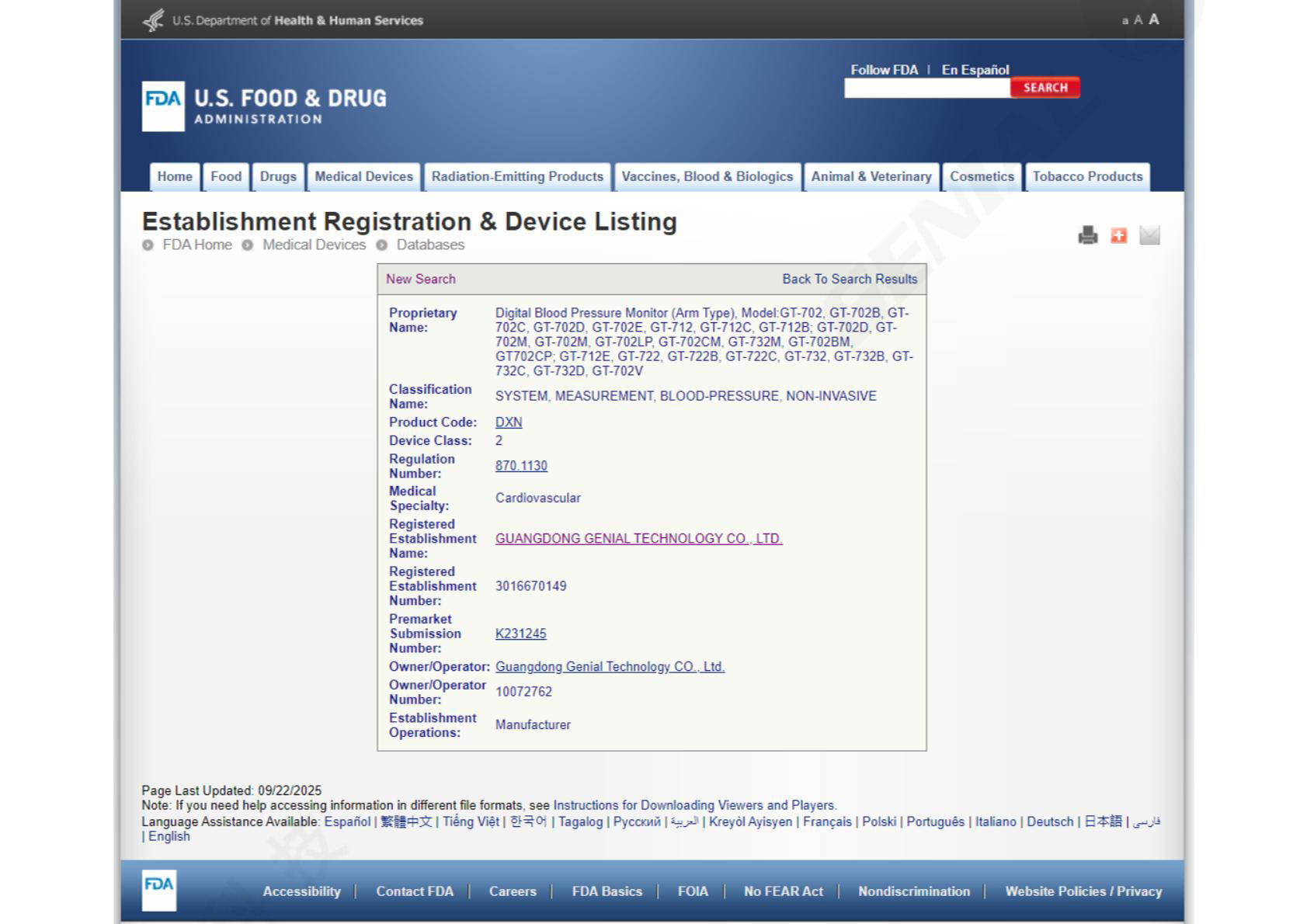
In the United States, the instrument is an FDA 510(k) premarket notification with a K number tied to a model list. GENIAL's records include K231245 for arm-type digital blood pressure monitors, K231250 for the GT-701 wrist series, K210014 for forehead infrared thermometers T80 to T87, K231243 for the GX fingertip oximeter series, K232678 for continuous-reading digital thermometers T23 to T28, 3016670149 for clinical electronic thermometers T11 to T19, and K240333 for the T31 wearable thermometer. In Japan, the relevant document is a Certificate of Foreign Medical Device Manufacturer issued under Article 23-2-4 of the PMD Act — BG10501496, granted by MHLW for the period 19 November 2024 to 18 November 2029, covering electronic upper arm blood pressure monitors, infrared clinical thermometers, reusable wireless thermometers and pulse oximeters as Class II home-use devices. In Great Britain, the MHRA registration record 0000037417 covers wireless reusable patient thermometers, pulse oximeter probes, infrared ear and skin thermometers, intermittent electronic thermometers, automatic electronic sphygmomanometers and self-care monitoring software.
Elsewhere the pattern repeats with local names. Brazil requires ANVISA registration under RDC 751/2022 for Class II devices including thermometers, blood pressure monitors and pulse oximeters. Russia requires Roszdravnadzor registration; GENIAL's record, № 1241/1-3 140/2-25, cites the GOST R national standards for medical device safety and performance for automatic electronic blood pressure monitors, issued 12 January 2026. For China, the application requirement is NMPA Class II registration together with a metrology certificate. None of these documents substitutes for another; a multi-market programme needs the full set.
The four-layer review: claim, model, scope, market
The most reliable way to review a compliance file is to work from your own claim outward rather than from the certificate inward. Start with the exact sentence you want to put on the packaging, the marketplace listing or the tender response, then test it against four layers.
- Claim layer. Write the claim in full, including device type and market: for example, "automatic upper-arm digital blood pressure monitor for home use, sold in the EU". Vague claims such as "CE certified healthcare device" cannot be tested.
- Model layer. Identify the exact model and configuration, including cuff type, accessories and any Bluetooth variant. Configurations often carry separate model numbers precisely because they are separately assessed.
- Scope layer. Find that model in the certificate's scope or model list, and note the device description used there. If the certificate says "arm type", a wrist device is out of scope by definition.
- Market layer. Confirm the certificate is issued for the market you are shipping to, and that its validity dates cover your delivery window, not just your order date.
Step-by-step: reading a certificate in seven passes
Step 1 — Fix the device description before opening any document
Compliance review begins with a locked device description. Record the device type, the measurement principle, the intended user, the use environment and the accessories. For a blood pressure monitor this means stating arm-type versus wrist-type, whether a Bluetooth app is included, and which cuff sizes ship in the box. Every later mismatch is easier to spot when this baseline exists in writing, because the certificate's own wording can then be compared against it word by word.
Step 2 — Read the header block, not the logo
The header carries the facts that decide whether the document is usable: certificate number, issuing body, notified body number where applicable, the standard cited, and the issue and expiry dates. GENIAL's EU blood pressure certificate shows all of these in one block — CN25/00007953, SGS Belgium NV, Notified Body 1639, MDR (EU) 2017/745 Annex IX Chapter I & III with EN ISO 13485:2016, valid 25 November 2025 to 25 November 2030. A document that cannot show an issuer, a number and a validity period is not a certificate you can put in a purchase file.
Step 3 — Read the scope line as a boundary
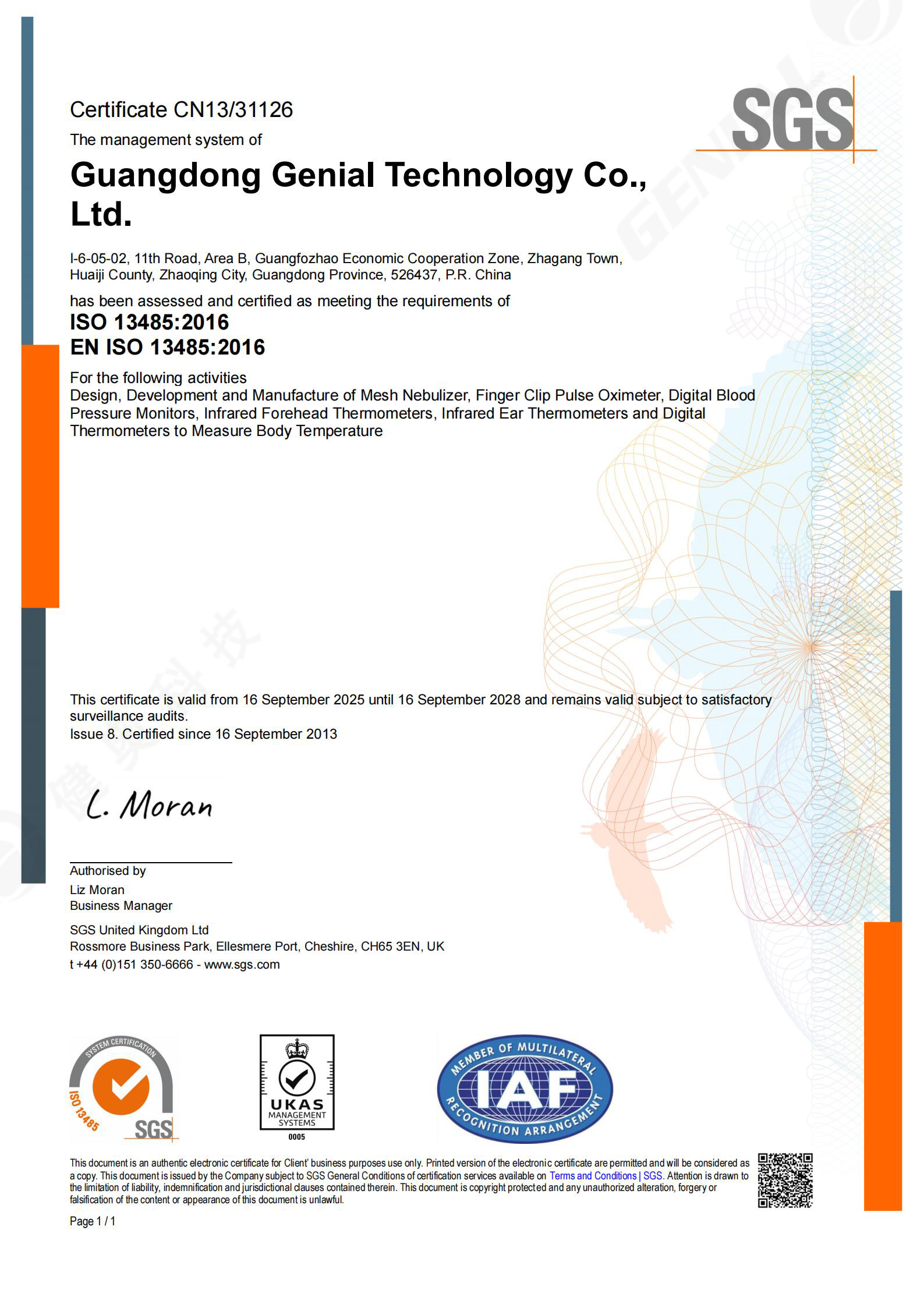
The scope line tells you what the issuer actually assessed. ISO 13485 certificate CN13/31126, issued by SGS United Kingdom Ltd and valid from 16 September 2025 to 16 September 2028, names the design, development and manufacture of mesh nebulizers, finger clip pulse oximeters, digital blood pressure monitors, infrared forehead thermometers, infrared ear thermometers and digital body thermometers. That is a precise list. A device family outside it needs its own evidence, even if the same factory builds it. Reading the scope line as a boundary rather than a badge is the single highest-value habit in this process.
Step 4 — Match the standard to the device type
Standards are cited for a reason, and the citation should be plausible for the product. Medical device quality management sits under ISO 13485:2016 and EN ISO 13485:2016; EU electrical safety for these device families typically appears as the EN 60601 series, as on certificate 195/MDR; EU market access cites MDR (EU) 2017/745; Russia cites the GOST R national standards; Brazil cites RDC 751/2022. If a supplier offers a certificate citing a standard from an unrelated field, treat that as a question rather than a qualification.
Step 5 — Confirm the market and the delivery window
Market and time are part of the scope, not footnotes. A certificate valid until 25 November 2030 supports a two-year programme comfortably; one expiring inside your delivery window does not, even if it is genuine today. GENIAL's portfolio illustrates why the check must be routine rather than occasional: GB/T29490 intellectual property certification 18123IP0672R2M runs to 14 December 2026, ISO 45001 certificate 02821S10111R1M to 14 March 2027, ISO 14001 certificate 02821E10125R1M to 14 March 2027, the NBCUniversal manufacturer registration L-4394 to 6 February 2027, amfori BSCI monitoring record 25-0372553 to 6 February 2028, while the CE and FDA records extend considerably further. Different documents expire on different clocks, so the review should list expiry dates side by side with the shipment schedule.
Step 6 — Cross-check the declared parameters against the model file
A certificate names a model; it does not publish that model's pressure range, cuff circumference, pulse error or housing material. Those parameters live in the model's technical documentation, which is why the parameter cross-check is a separate step rather than part of certificate reading. The next section shows how to run it.
Step 7 — Convert the findings into purchase terms
Compliance work only has value when it changes the contract, so the last step is translation. Every scope statement you verified should become a clause; every gap you found should become a deliverable. This is where documentation review turns into leverage.
Parameter cross-check: what GT-732, GT-732M and GT-702BM demonstrate
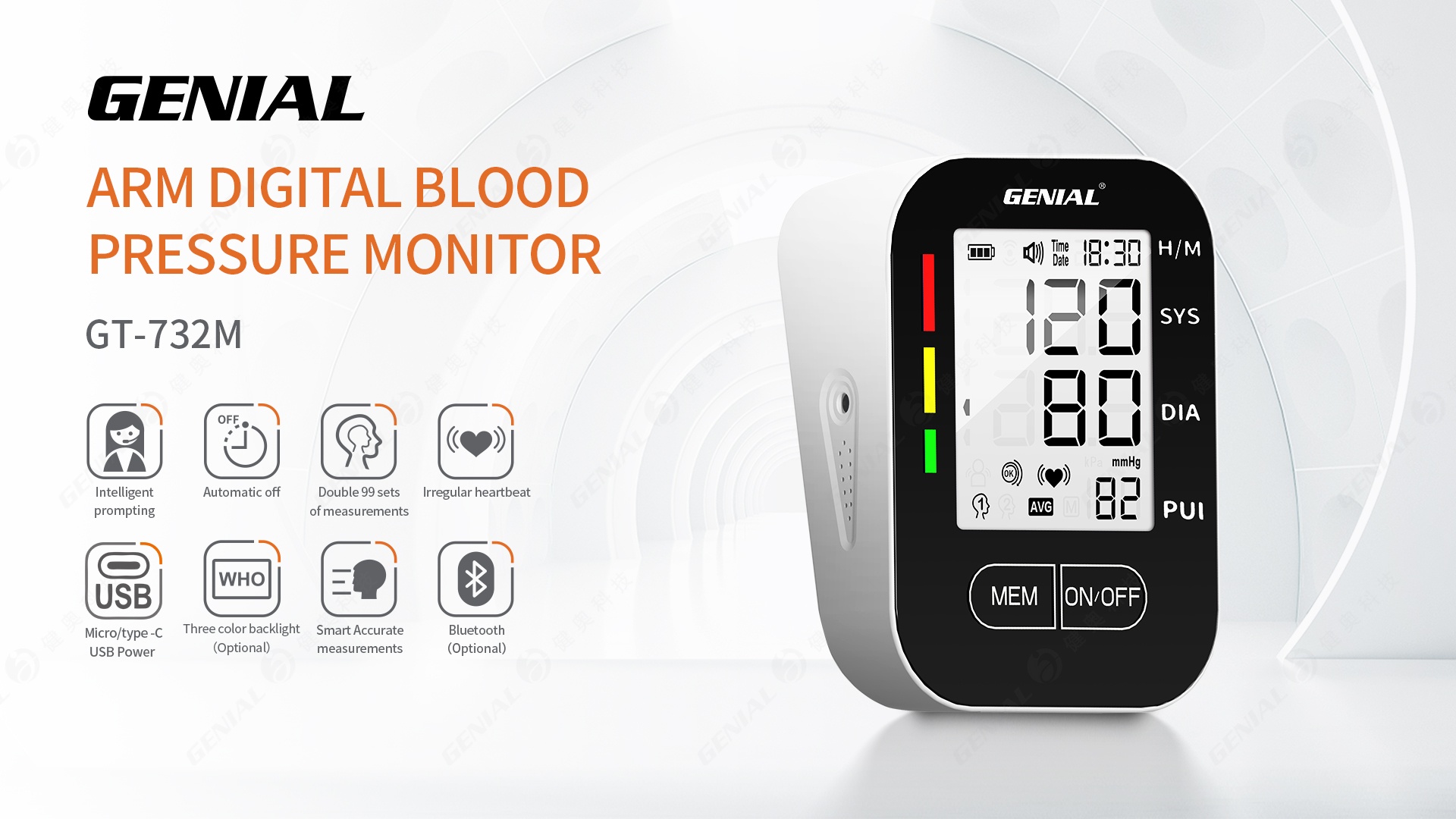
Parameter verification works from the model outward: take the documented specification, then ask which certificate covers that model, then ask which test evidence supports the numbers. GT-732M is a useful reference point because a complete parameter set is available for it.
The GT-732M upper arm digital blood pressure monitor is documented with a pressure measuring range of 0 to 290 mmHg, an arm circumference range of 22 to 42 cm, a pulse error of ≤±5%, dimensions of 136 × 103 × 54 mm, a net weight of 239 g ±15 g without battery, and a housing of ABS with an eco-friendly TPU air bag. Those five values do different jobs in a review. The pressure range tells you whether the device covers the clinical envelope you intend to claim. The cuff range determines which patient populations the product can serve and whether an additional cuff size is needed. The pulse error figure is the parameter most often quoted in tenders and the one most likely to be challenged, so it must appear in the technical file exactly as written, with the ± sign intact. Material and air-bag construction matter for skin contact, cleaning protocol and durability claims. Dimensions and weight matter for retail packaging and shipping cost.
GT-732 and GT-702BM illustrate the limitation of certificate reading on their own. Both model numbers appear in the CE MDR model list on certificate CN25/00007953 and in the FDA 510(k) K231245 scope for arm-type digital blood pressure monitors, which confirms they were assessed under those instruments. The same documents do not publish their pressure range, cuff circumference, pulse error or materials. Those values sit in the model-specific technical file and must be requested model by model. A buyer who assumes a family certificate carries family-wide parameters has confused two different kinds of document.
| Model | Parameters documented in the technical data | Certificate coverage to verify | Document to request before acceptance |
|---|---|---|---|
| GT-732M | Pressure 0–290 mmHg; arm circumference 22–42 cm; pulse error ≤±5%; 136 × 103 × 54 mm; 239 g ±15 g without battery; ABS housing with eco-friendly TPU air bag | CE MDR CN25/00007953 (SGS, NB 1639) model list; FDA 510(k) K231245 model list; Japan MHLW foreign manufacturer registration BG10501496 for electronic upper arm blood pressure monitors | Model specification sheet plus the test report supporting the declared pulse error |
| GT-732 | Not detailed in the supplied documentation set; obtain from the model technical file | Named in the CE MDR CN25/00007953 model list and the FDA 510(k) K231245 scope | Model specification sheet, declaration of conformity and label artwork for the target market |
| GT-702BM | Not detailed in the supplied documentation set; obtain from the model technical file | Named in the CE MDR CN25/00007953 model list and the FDA 510(k) K231245 scope | Model specification sheet, cuff options list and packaging proof matching the registered model name |
Only values present in the supplied technical data are shown. Blank parameter fields are a documentation request, not an indication that a value is absent from the product file.
From review to contract: purchasing terms and acceptance criteria
Compliance findings become useful when they are written into the purchase order as conditions rather than mentioned in correspondence. Five clauses cover most of the risk.
- Document set clause. Name the documents required at order confirmation: the certificate covering the ordered model, the model specification sheet, the declaration of conformity, the instruction manual in the destination language, and the label artwork. Attach the certificate page where the model appears.
- Model identity clause. State that the delivered product's model number, packaging and label must match the model named in the certificate, and that any substitution requires written approval and updated documents.
- Parameter clause. Quote the accepted values — pressure range, cuff circumference, pulse error, materials — as the acceptance criteria for incoming inspection, using the exact units and tolerances from the model file.
- Validity clause. Require that certificates remain valid through the delivery window, and that the supplier notifies you if a certificate is suspended, withdrawn or superseded.
- Change-notification clause. Require notification before any change to hardware, firmware, materials or manufacturing site for the ordered model, because such changes can affect the validity of the supporting evidence.
These clauses do two things at once. They protect the buyer, and they give the supplier a clear specification of what must be delivered, which shortens the documentation back-and-forth considerably on repeat orders.
Use cases: the same review applied to four buying situations
EU distributor building a retail listing
A distributor listing an upper arm monitor in the EU needs the CE certificate page showing the exact model, the declaration of conformity, and the instruction manual in the destination language. The review is complete when the model on the packaging matches the model on the certificate; it is not complete when the supplier sends a certificate for a sibling model in the same family.
US retail or marketplace onboarding
A US seller needs the 510(k) number that covers the specific device — for arm-type monitors that is K231245 — together with labelling that matches the cleared indication. Because 510(k) records are model-specific, the fastest way to fail a compliance review is to submit a clearance for a different model in the same product line.
Community clinic and insurance gift programmes
Programme buyers usually combine a device claim with a distribution claim: home blood pressure monitoring for chronic disease management, or a seasonal gift programme covering thousands of households. The document review then includes the customer-facing material, because a leaflet that overstates the measurement claim can create a problem the certificate cannot solve. Request the specification sheet and align the leaflet wording to the parameters actually documented.
Multi-market OEM programme
An OEM buyer shipping to the EU, Japan and Brazil needs three separate instruments: the CE certificate, the MHLW foreign manufacturer registration with its product-level documentation, and the ANVISA registration under RDC 751/2022. Because the ANVISA record is issued as a registration confirmation letter rather than a numbered certificate, the confirmation letter itself should be requested and filed with the market submission pack.

Five misreadings that survive even careful reviews
Even experienced buyers misread documents when they work quickly. The five errors below account for most of the corrections that appear late in a programme.
- Treating a quality system certificate as product approval. ISO 13485 establishes that the management system conforms; the CE certificate or 510(k) establishes market access for the model.
- Treating a social audit as product safety evidence. The amfori BSCI monitoring record 25-0372553, audited by Intertek with an overall rating of B and valid to 6 February 2028, addresses labour and social compliance at site level. Valuable for retail onboarding; irrelevant to whether a monitor measures pressure correctly.
- Treating an IP certificate as a regulatory document. GB/T29490 certification 18123IP0672R2M covers intellectual property management in R&D, production and sales. It supports brand protection discussions; it is not a registration.
- Treating a retail brand registration as a government approval. NBCUniversal manufacturer registration L-4394 covers full-process quality and social compliance for OEM production under a brand standard, valid to 6 February 2027. It is a supply-chain qualification, not a market authorisation.
- Ignoring the human-readable version of the document. A vendor that can isolate the certificate page for your model, explain the scope in plain language and produce the matching specification sheet is demonstrating document control, which is the same capability that will keep the file accurate after the order.
FAQ: compliance questions buyers ask before ordering
Does a CE certificate by itself allow a home blood pressure monitor to be sold in the EU?
It is the core market-access document, but only when three conditions hold: the certificate is issued under MDR (EU) 2017/745 by a notified body, the model you are shipping is named in its scope, and the certificate is valid for your delivery window. GENIAL's blood pressure certificate CN25/00007953, issued by SGS Belgium NV (Notified Body 1639) and valid from 25 November 2025 to 25 November 2030, works as a reference format because it shows the issuer, the standard, the model list and the validity dates together. Confirm the importer-side obligations separately, and keep the model list page in the purchase file rather than the certificate cover.
The factory holds ISO 13485 — does that cover every product it makes?
No. An ISO 13485 certificate is scoped, and the scope line is the boundary. Certificate CN13/31126, issued by SGS United Kingdom Ltd and valid from 16 September 2025 to 16 September 2028, names the design, development and manufacture of mesh nebulizers, finger clip pulse oximeters, digital blood pressure monitors, infrared forehead thermometers, infrared ear thermometers and digital body thermometers. A device family outside that list requires its own evidence. Read the scope line first, then decide which additional documents the order needs.
If we rebrand the product under our own label, does the certificate still apply?
Rebranding does not by itself move the product outside its certificate, but it does change documentation obligations. Under OEM terms, customisation covers packaging, gift boxes, user manuals, logo printing, colour schemes and packaging specifications, while core hardware, PCB and key functions remain unchanged — which is precisely why the certificate stays tied to the listed model numbers. If you need a new model number, modified hardware, a different display interface or changed firmware, the appropriate route is ODM or JDM with exclusive model registration, and the supporting documents must be updated accordingly. Decide which of these two situations you are in before the artwork is finalised.
What actually drives cost in a compliance-ready order?
Four variables dominate, and none of them is the certificate itself. Minimum order quantities differ by category — for OEM orders, thermometers start at 10,000 pcs while blood pressure monitors, oximeters, nebulizers, infrared thermometers, wireless thermometers and hair removal devices start at 2,000 units and ventilators at 500 units. Tooling matters when a new mould is needed: ODM new mould development starts at 10,000 units, with tooling cost refundable on large-volume projects, against 5,000 units for product modification without new tooling. Model registration work adds scope when a new model number or new market is involved. Packaging complexity — gift box, multi-language manual, shelf-ready carton — adds cost and approval time. Structure the RFQ around these four items instead of requesting a single unit price, and the quotes you receive will be comparable.
What should a pre-order sample package contain?
A sample alone is not a compliance sample. OEM samples are available in 3 days, and the package should include the certificate page naming the sampled model, the model specification sheet with the pressure range and pulse error as declared, the instruction manual in the destination language, the label artwork, and a physical check of the cuff against its stated circumference range. If the cuff range is 22 to 42 cm, measure it rather than reading the box. Sampling decisions made on the full document set rarely need to be revisited after the mass order arrives.
How long does delivery take, and what does the compliance review add?
Production timelines are short relative to the documentation timelines around them. Under OEM, small orders ship in 3 to 7 days and mass orders in 10 to 15 days; ODM takes 7 to 15 days for minor modifications without new tooling and 45 to 50 days for new mould development; JDM programmes run 45 to 60 days with an initial mass-production order of 10,000 units and no strict MOQ on repeat orders. A 12-month warranty applies with valid proof of purchase, supported by certification documentation and technical consultation. The documentation review itself is the variable: a market you have not registered in before can take longer than the production run, so sequence the two in parallel and start with the model list page. If it helps, the technical and compliance team can walk through the certificate set for your target market and prepare a sample and quotation request around the specific models you intend to list.
Conclusion: a short checklist that prevents long delays
Reading certificates is a repeatable process, not an expertise reserved for regulatory specialists. Fix the device description, read the header block, treat the scope line as a boundary, match the standard to the device type, confirm the market and the delivery window, cross-check the declared parameters against the model file, and write the findings into the purchase order. Applied to the examples above, that process distinguishes a CE certificate naming GT-732, GT-732M and GT-702BM from the parameter set documented for GT-732M alone, and it separates an ISO 13485 scope line from a BSCI audit record and a retail brand registration.
The same discipline applies to the manufacturer as a whole. GENIAL has been manufacturing medical devices since 2001, operates a 45,000 ㎡ facility with 251 employees, 29 engineers and an annual output of 15,000,000 units, exports about 80% of production, holds 262 intellectual property certificates, and has completed product and trademark registration in 29 countries with products sold to 117 countries and regions. Those figures describe capability; the certificate pages describe permission. A well-run procurement file keeps both, labelled correctly. For the full product and certification overview, the GENIAL English product brochure is available for download, and the company profile is published at www.cngenial.com.

Have Questions or Need More Details?
Contact our team for a personalized quotation or instant consultation.
Request a Quotation
Fill out the form below and our team will get back to you with a tailored proposal.
WhatsApp Direct Chat
Prefer to chat in real-time? Message us on WhatsApp for instant assistance & quick answers.
- Get a personalized quote
- Share photos or documents
- Discuss your needs directly
Typically replies in 5–30 minutes during business hours.