Matching Blood Pressure Devices to Community Clinics and Insurance Gift Programs
Community clinics and insurance gift programs buy the same product category for opposite reasons — and that difference decides which blood pressure monitor fits. A community medical center needs cuff coverage that accommodates a mixed adult population and enough measurement consistency for follow-up readings to be comparable. An insurance promotional gift program needs a device a household will use correctly with minimal instruction, in packaging and with certification that match the destination market.
This guide works through the constraint set that separates the two program types — cuff range, materials, accuracy signals, certification coverage by market, MOQ and lead time — and maps documented models from Guangdong Genial Technology Co., Ltd. (GENIAL) to each one. The two anchor models are the GT-732, specified for community clinics and health & wellness centers, and the GT-732M, specified for chronic disease management institutes, community medical centers, and insurance promotional gift programs.
Where the Constraint Actually Sits: Population, Market, and Use Pattern
The selection problem is not "which monitor is better." It is which monitor satisfies three constraints at the same time: the arm circumference of the people being measured, the regulatory market the device will be sold or given in, and the way the device will be used after it leaves the box.
Community clinic programs fail on the first constraint most often. A screening desk at a community medical center measures adults of very different body types in the same session, and a cuff that only covers part of that population produces unusable readings for the rest. A device specified at 22–32 cm and a device specified at 22–42 cm look nearly identical on a specification sheet, but they behave differently the moment a patient outside the narrower band sits down.
Insurance gift programs fail on the second and third constraints instead. The recipient population is not measured by a clinician; the device is often the household's first blood pressure monitor, so simplicity and a clear measurement routine matter more than advanced features. At the same time, a gift program still ships a regulated product, so the certification coverage must match each market the program runs in.
Both program types share one requirement that is easy to underestimate: accuracy that holds across repeat measurements. For a clinic, accuracy is what makes a patient's reading this month comparable with last month's. For a gift program, accuracy is the reason the device keeps being used at all. Documented accuracy signals in GENIAL's blood pressure monitor specifications include a pulse error of ≤±5% on the GT-732M and a pulse tolerance of ±5% on the GT-732, across a pressure measuring range of 0–290 mmHg.
Why Community and Gift-Program Demand Keeps Being Rebuilt Every Year
The global blood pressure monitoring devices market was valued at USD 4.2 billion in 2025 and is estimated to reach USD 8.6 billion by 2033, a CAGR of 9.3% according to Grand View Research. Within that market, digital blood pressure monitors accounted for approximately 48% of total revenue share in 2024, based on Fortune Business Insights data — meaning the digital upper arm format, not the traditional manual format, now carries the majority of commercial value.
Two procurement patterns sit inside that growth. Community chronic disease management projects and insurance healthcare gift projects both appear among the recurring project types for home blood pressure monitoring devices, alongside pharmacy retail and elderly-care programs. These programs are typically seasonal or cycle-based, which means a distributor or program manager is rebuilding the same specification decision repeatedly rather than buying once.
Competitive context matters for that decision. Omron Healthcare remains a dominant competitor in the global blood pressure monitor market as of 2024, according to iData Research, so program managers should expect their choice to be compared against an established brand name. The practical answer is not to compete on brand familiarity but to compete on documented specification fit — cuff coverage, material construction, and market-specific certification.
One technical baseline applies to the whole category: medical electrical equipment, including home health devices, must meet IEC 60601-1-2 standards for electromagnetic compatibility (EMC). This matters in clinics where multiple powered devices operate in the same room, and it matters for any program that will need to document compliance during an audit.
The Two Anchor Models: GT-732 and GT-732M
GENIAL specifies two upper arm monitors directly against the two program types covered in this guide. They share a footprint but differ on the two variables that matter most in procurement: cuff coverage and air bag material.
GT-732 — community clinic, health & wellness center, and OEM gift programs
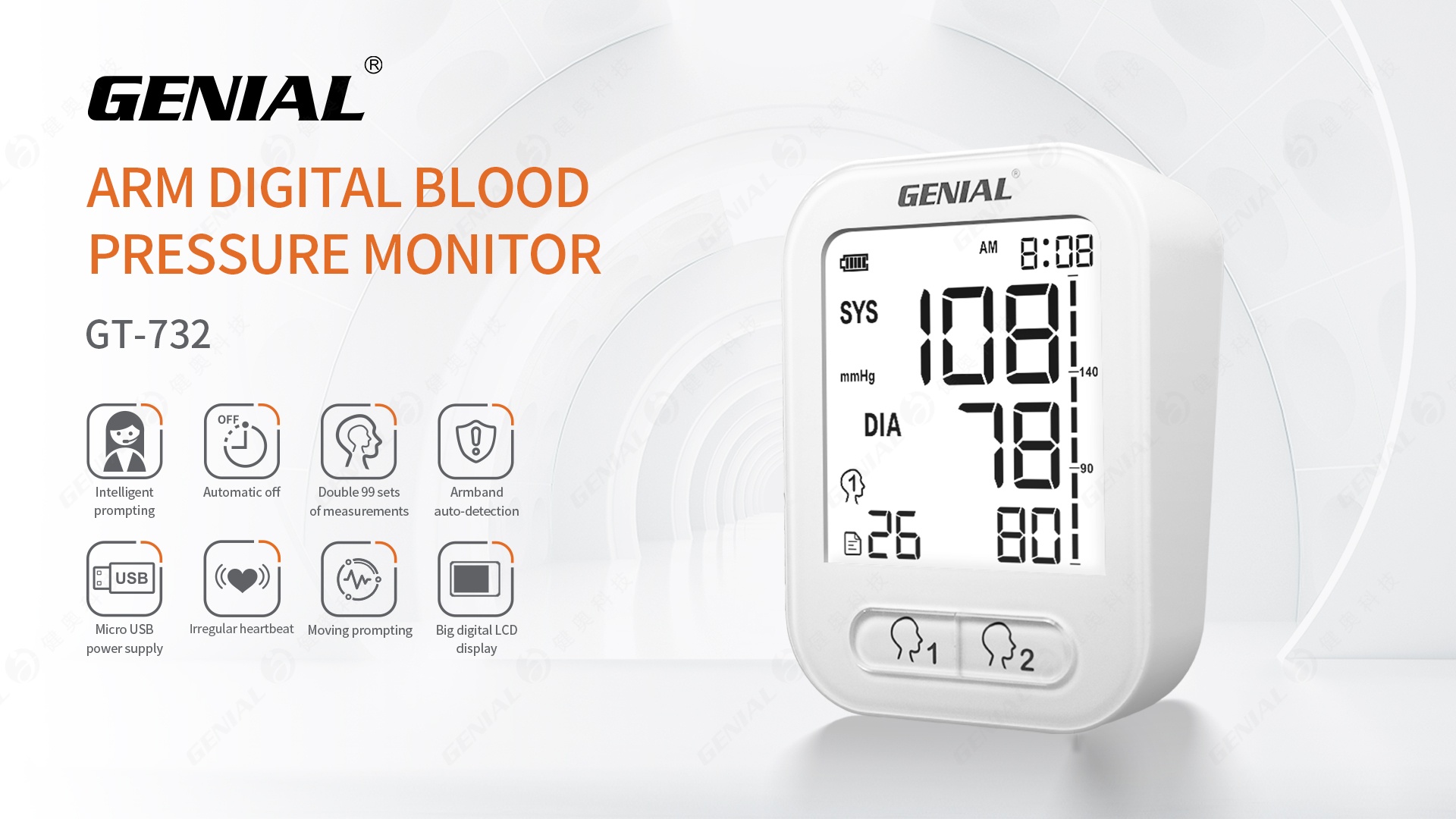
The GT-732 is an Upper Arm Digital Blood Pressure Monitor. Its documented specifications are: pressure measuring range 0–290 mmHg; pulse tolerance ±5%; arm circumference 22–32 cm; dimensions 136×103×54 mm; net weight 291 g ±15 g (without battery); construction in ABS with a PVC air bag and a Nylon binding strap. Its documented application industries are community clinic, health & wellness center, e-commerce, and customized OEM gift.
Read as a procurement profile, the GT-732 is the choice when the measured population sits inside a defined 22–32 cm band, when a Nylon binding strap is preferred for repeated fastening and unfastening at a screening desk, and when the program needs a device that also works as a customized OEM gift item. The Nylon strap and PVC air bag are practical, serviceable materials for a device that is handled by many different operators in a week.
GT-732M — chronic disease management institutes, community medical centers, and insurance promotional gifts
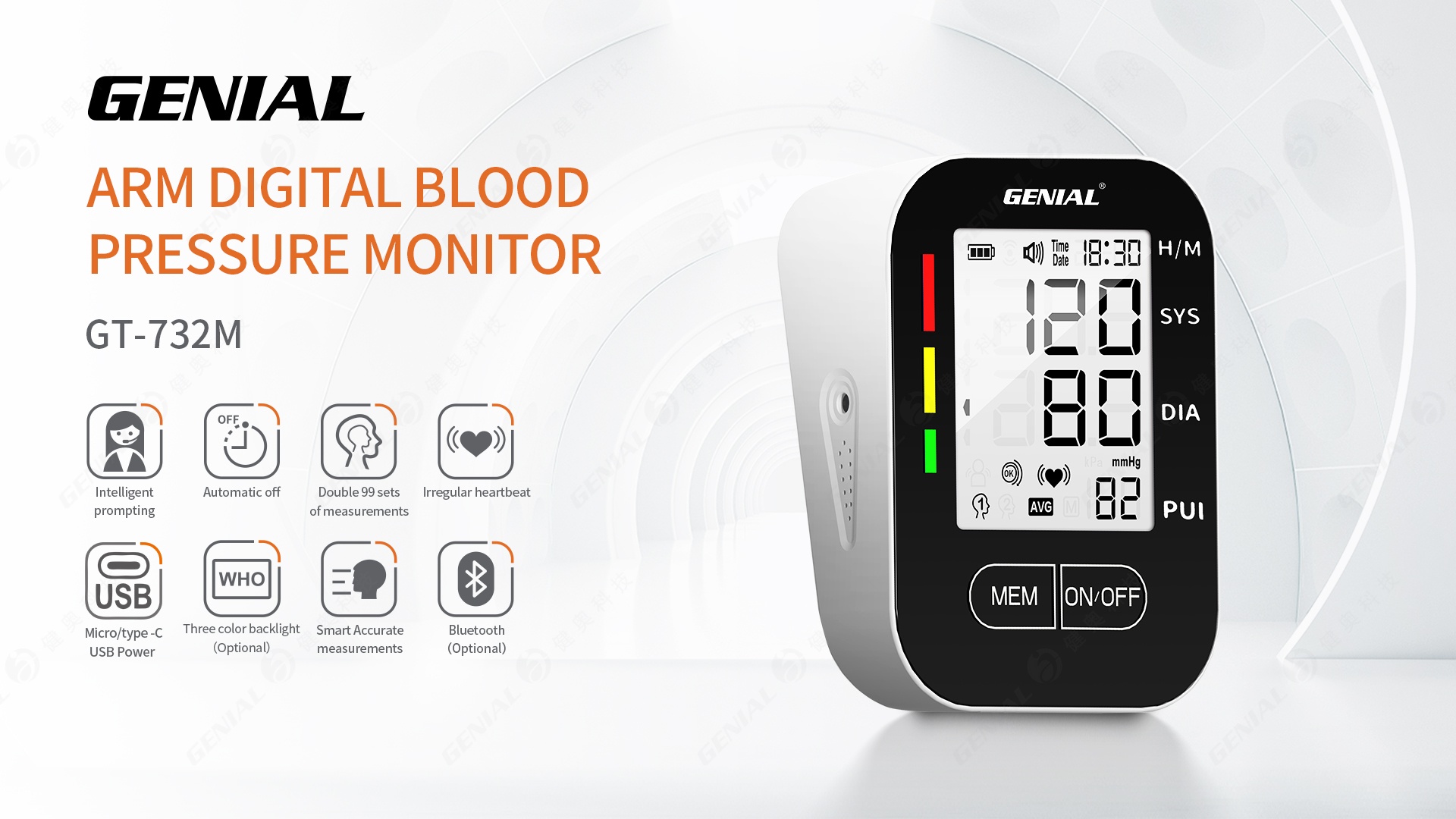
The GT-732M is also an Upper Arm Digital Blood Pressure Monitor, with a documented pressure measuring range of 0–290 mmHg, arm circumference 22–42 cm, pulse error ≤±5%, dimensions 136×103×54 mm, and net weight 239 g ±15 g (without battery). It is built from ABS with an eco-friendly TPU air bag, and it is specified for chronic disease management institutes, community medical centers, and insurance promotional gift programs.
Three differences are worth stating plainly, because they drive the model decision:
- Cuff coverage. The GT-732M covers 22–42 cm versus 22–32 cm on the GT-732. For a clinic measuring an unselected adult population, that wider range removes the need to keep a second cuff size at the desk.
- Air bag material. The GT-732M uses an eco-friendly TPU air bag, while the GT-732 uses a PVC air bag with a Nylon binding strap. For gift programs where the device is also a brand touchpoint, the TPU specification is the more defensible material story.
- Weight. Both models share the 136×103×54 mm footprint, but the GT-732M is documented at 239 g ±15 g against 291 g ±15 g for the GT-732 — a lighter device to pack and ship in volume.
The GT-732M is the only model in this selection that carries both a clinical program designation (chronic disease management institute, community medical center) and a gift program designation (insurance promotional gift) in its documented application fields. That dual designation is what makes it a starting point rather than an alternative when a distributor is serving both a clinic account and an insurance account.
Supporting models when a program needs memory, portability, or a different gift tier
Not every program resolves to GT-732 or GT-732M. Four documented alternatives cover the common exceptions.
- GT-702BM — upper arm, arm circumference 22–42 cm, 99 memory sets for 2 users, 135×102×46 mm, 220 g ±15 g (without battery), ABS with a composite fabric cuff. Documented for medical instrument wholesale and offline household retail. The 2-user, 99-set memory is the relevant feature when readings need to be recalled at a follow-up visit rather than written down.
- GT-702V — upper arm, 22–42 cm, 99 memory sets for 2 users, 119×93×43 mm, 180 g ±15 g (without battery), ABS. Documented for cross-border e-commerce and household medical supply, where a lighter, more compact body supports parcel economics.
- GT-702B — upper arm, 22–32 cm, 140×108×47 mm, 275 g ±15 g, ABS. Documented for insurance complimentary gift and cross-border commodity programs, which is the appropriate reference point when a gift allocation is volume-led rather than feature-led.
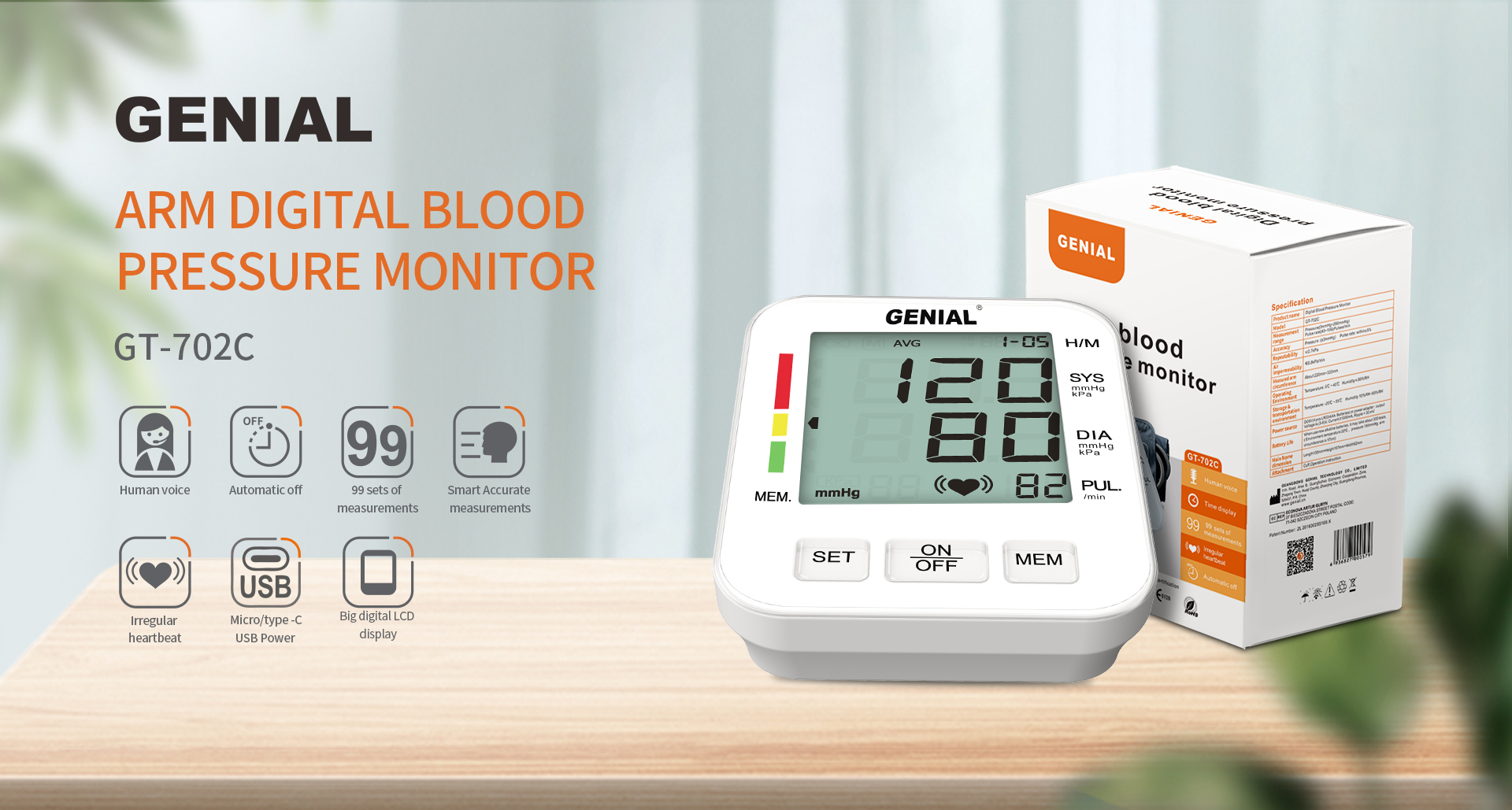
- GT-702C — upper arm, 22–32 cm, 135×107×62 mm, 304 g ±15 g (without battery), ABS. Documented for pharmacy store and seasonal promotional gift programs.
- Wrist formats — the GT-701C covers a wrist circumference of 13.5–21.5 cm (70×72×27 mm, 120 g ±15 g), documented for pharmacy chain and cross-border medical sales. The GT-701F covers 13.5–19.5 cm (90×67×28.5 mm, 120 g ±15 g) with a pulse range of 30–250 bpm, documented for portable healthcare, travel gift, and supermarket retail.
Constraint Checklist: What to Verify Before You Commit
1. Cuff coverage, decided before anything else
Establish the actual arm circumference range of the population the program serves, then match it to the documented specification. Documented ranges in this selection are 22–42 cm (GT-732M, GT-702BM, GT-702V), 22–32 cm (GT-732, GT-702B, GT-702C), and 13.5–21.5 cm or 13.5–19.5 cm for wrist formats (GT-701C, GT-701F). A clinic serving an unselected adult population and a gift program targeting a narrower demographic should not be given the same cuff specification.
2. Material and wear profile
Material choice is a maintenance decision, not a cosmetic one. Across these models the documented constructions are ABS with an eco-friendly TPU air bag (GT-732M), ABS with a PVC air bag and Nylon binding strap (GT-732), ABS with a composite fabric cuff (GT-702BM), and ABS alone (GT-702V, GT-702B, GT-702C, wrist models). Where a device is fastened and unfastened many times per day by different operators, the strap and air bag specification is what determines how long the cuff assembly stays serviceable. Where the device is a gift, the same specification becomes part of the product story the program tells recipients.
3. Accuracy signals the program can report
Reportable accuracy figures make follow-up measurement meaningful. Documented values include pulse error ≤±5% (GT-732M), pulse tolerance ±5% (GT-732), and a 30–250 bpm pulse measuring range on the GT-701F, all within a 0–290 mmHg pressure measuring range. Programs operating powered equipment alongside the monitor should also confirm the IEC 60601-1-2 electromagnetic compatibility baseline.
4. Certification coverage by destination market
Certification is the constraint that most often delays a program, because coverage is market-specific and model-specific. The table below lists the certifications applicable to the upper arm blood pressure monitors discussed in this guide.
| Market / scope | Certification | Reference number | Relevance to this selection |
|---|---|---|---|
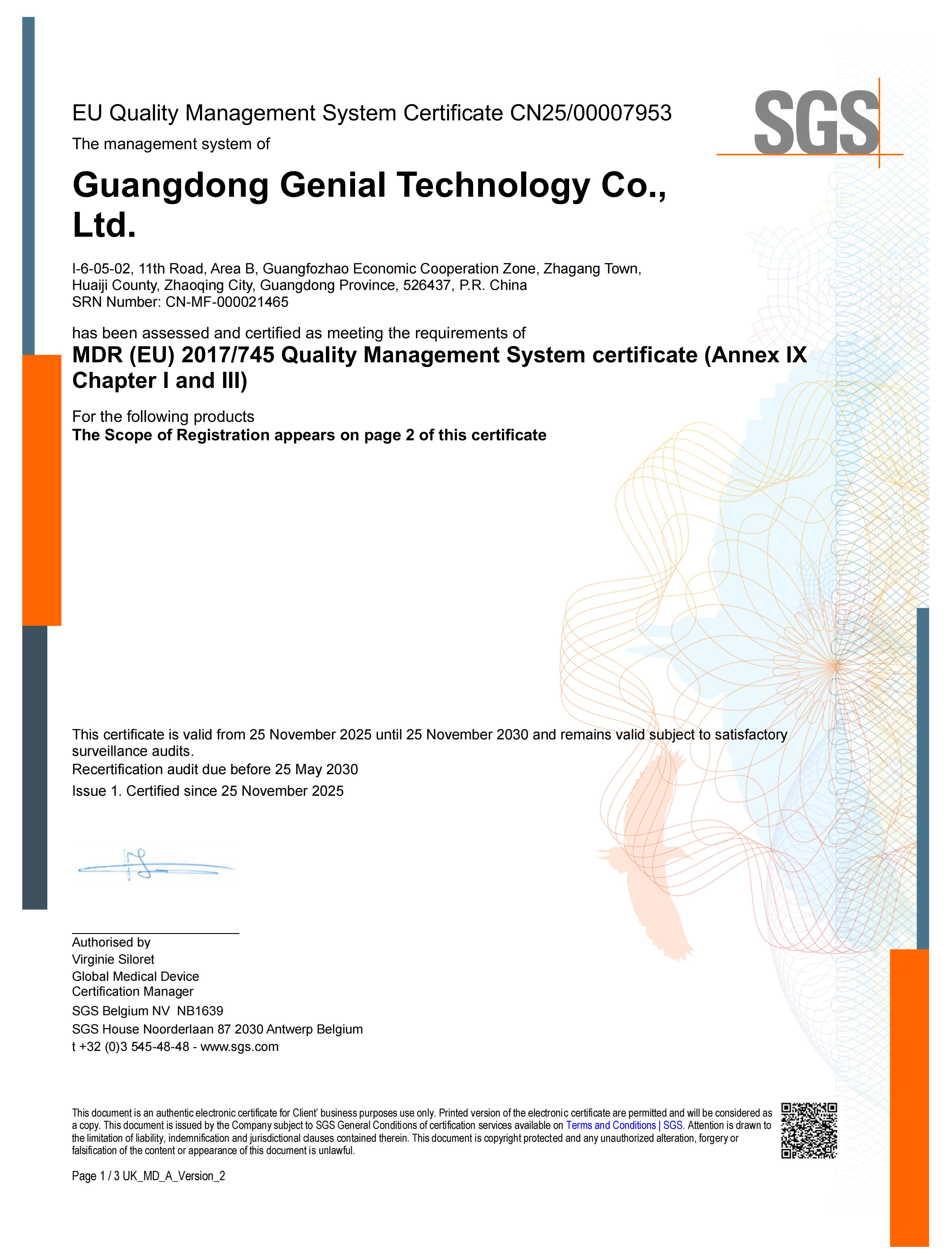
| 27 EU Member States | CE, MDR (EU) 2017/745, issued by SGS Belgium NV (Notified Body No. 1639) | CN25/00007953 | SRN: CN-MF-000021465, valid to 2030-11-25 | Covers arm-type digital blood pressure monitors including GT-732 |
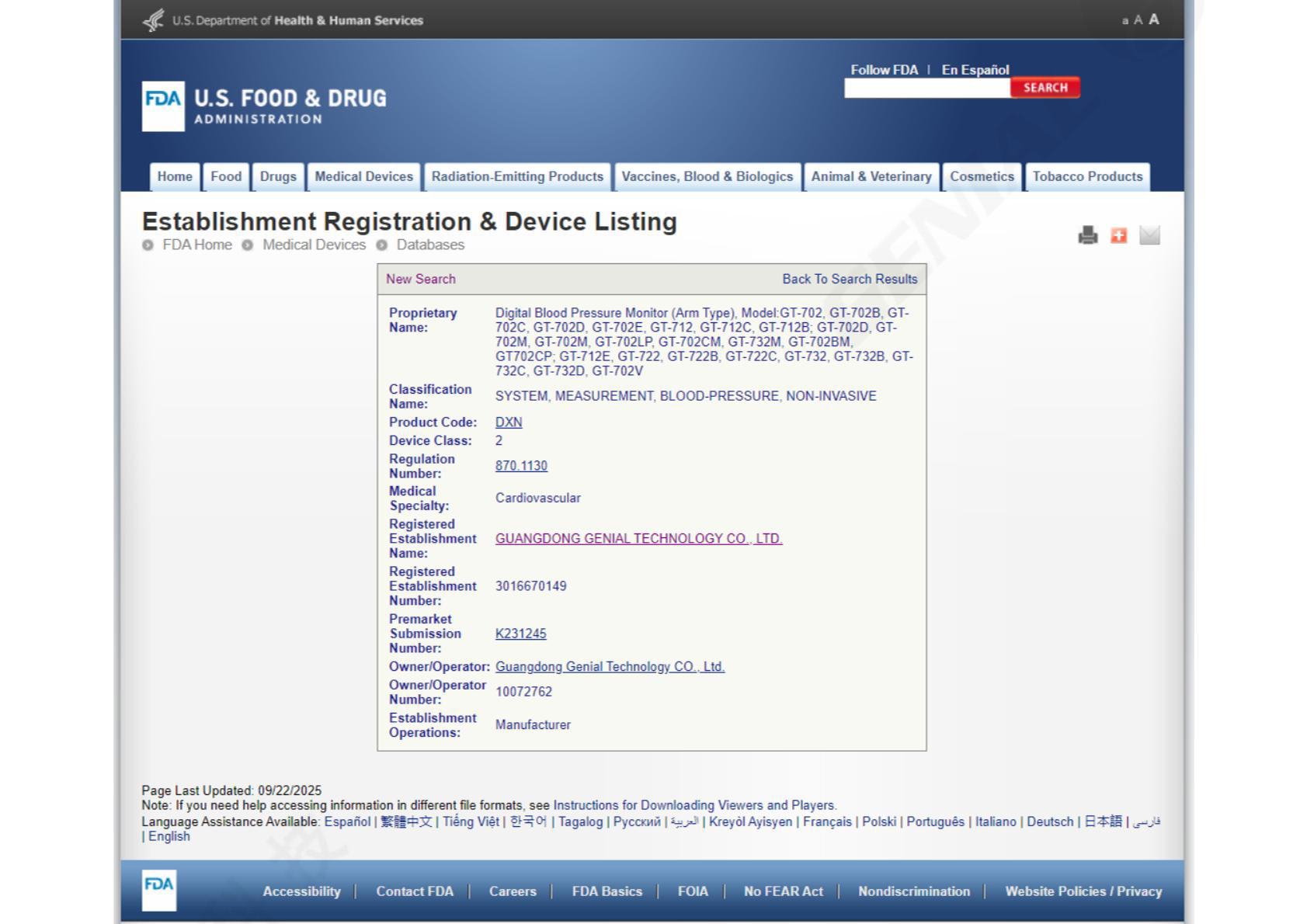
| United States | US FDA 510(k) Premarket Notification | K231245 | Arm-type digital blood pressure monitors including GT-732M |
| Japan | Certificate of Foreign Medical Device Manufacturer, MHLW, under Article 23-2-4 of the PMD Act | BG10501496, valid to 2029-11-18 | Electronic upper arm blood pressure monitors including GT-732 and GT-732M |
| Great Britain | MHRA registration | 0000037417 | Includes automatic electronic sphygmomanometer products such as GT-732 and GT-732M |
| Russia | Roszdravnadzor under GOST R medical device standards | No. 1241/1-3 140/2-25 | Automatic electronic blood pressure monitors including GT-732 and GT-732M |
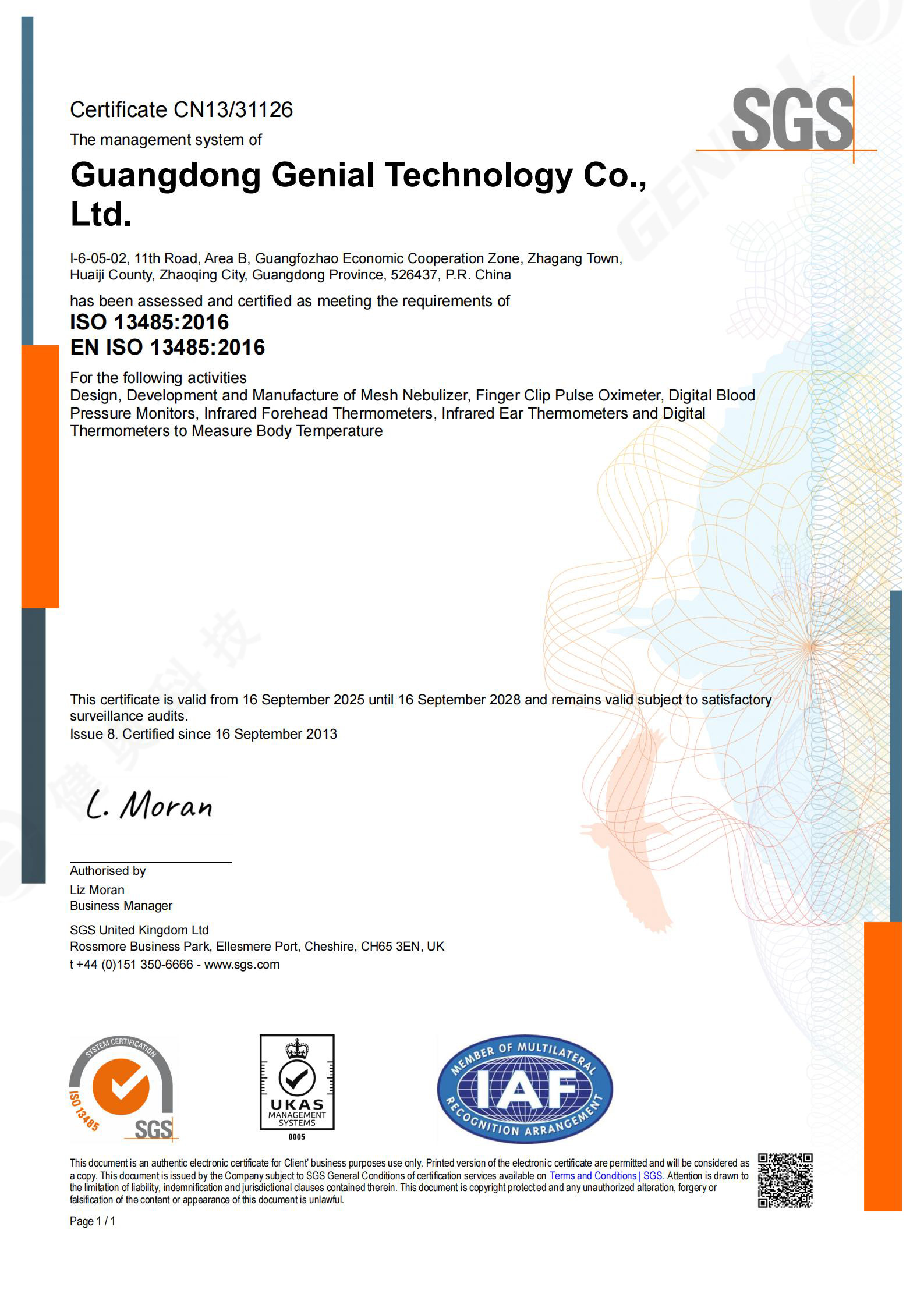
| Global quality system | ISO 13485:2016, issued by SGS United Kingdom Ltd (UKAS & IAF accredited) | CN13/31126, valid to 2028-09-16 | Design, development and manufacture of digital blood pressure monitors |
GENIAL also holds ISO 45001, ISO 14001, GB/T29490 intellectual property management certification, BSCI (Overall Rating B), and NBC Universal property management certification, and the company states product certifications including CE, FDA, NMPA, CB, FCC and RoHS. Registration has been completed in 29 countries, with products sold to 117 countries and regions.
Step-by-Step: Matching a Device to a Program
- Define the measured population. For a clinic, record the arm circumference range of the patients the program will actually serve; for a gift program, define the intended recipient profile. This single input decides between 22–42 cm, 22–32 cm, and wrist formats.
- Decide what the device does after delivery. Repeated screening and follow-up at a clinic points to the GT-732M; a household gift allocation points to the GT-732M or GT-702B; a seasonal pharmacy promotion points to the GT-702C; a travel or portable gift points to the wrist formats.
- Map the destination markets to certification. Check each market against the certification table above and confirm the specific model is within scope before the program is priced.
- Match materials to the handling profile. Choose the eco-friendly TPU air bag specification (GT-732M) where material story and repeated use both matter, or the PVC air bag with Nylon binding strap (GT-732) where a defined population is being measured.
- Lock the accuracy and record-keeping requirements. Confirm the pulse error or tolerance figure the program will report, and add a 2-user, 99-set memory model such as the GT-702BM or GT-702V if readings must be recalled at follow-up.
- Fix MOQ, customization depth and lead time. Documented thresholds: OEM orders for blood pressure monitors start at 2,000 units, with sample production in 3 days, small orders in 3–7 days and mass orders in 10–15 days; ODM product modification starts at 5,000 units with 7–15 days for minor modifications and 45–50 days for new mold development; JDM initial mass production starts at 10,000 units with 45–60 days; OBM in-stock products ship within 48 hours after order confirmation, with replenishment in 5–7 days.
Use Cases
Community medical center screening desk
A community medical center running hypertension screening alongside chronic disease management needs one device that fits most adults without a cuff change. The GT-732M's 22–42 cm specification and 239 g ±15 g body suit a desk where staff measure many patients per session, and its documented designation for community medical centers and chronic disease management institutes matches the program type directly. If the center also records readings between visits, the GT-702BM adds 99 memory sets for 2 users with the same 22–42 cm coverage.
Insurance promotional gift allocation
An insurance program distributing health devices to policyholders is buying a regulated product that also represents the brand. The GT-732M is documented specifically for insurance promotional gift programs, with the eco-friendly TPU air bag supporting a material claim the program can communicate. Where the allocation is volume-led, the GT-702B is documented for insurance complimentary gift and cross-border commodity programs, and the GT-702C is documented for pharmacy store and seasonal promotional gift programs.
Distributor building a clinic + gift portfolio
GENIAL's documented case pattern for channel partners includes pharmacy chain systems supplied at 100,000–1,000,000 units over five years with a broad SKU portfolio, medical device distributors supplied at 100,000–500,000 units with one-stop procurement, and hospitals and clinics supplied at 50,000–200,000 units with continuous monitoring and reduced manual inspection. A distributor serving both a clinic account and an insurance account can therefore anchor on the GT-732M and extend into the 22–32 cm and wrist specifications as the second and third SKUs.
Model Comparison Table
All figures below are taken from documented product specifications. Blank cells indicate that the parameter is not stated in the available specification.
| Model | Type | Cuff / wrist range | Memory (as specified) | Material | Documented program fit |
|---|---|---|---|---|---|
| GT-732 | Upper arm | 22–32 cm | — | ABS, PVC air bag, Nylon binding strap | Community clinic, health & wellness center, e-commerce, customized OEM gift |
| GT-732M | Upper arm | 22–42 cm | — | ABS, eco-friendly TPU air bag | Chronic disease management institute, community medical center, insurance promotional gift |
| GT-702BM | Upper arm | 22–42 cm | 99 memory sets for 2 users | ABS, composite fabric cuff | Medical instrument wholesale, offline household retail |
| GT-702V | Upper arm | 22–42 cm | 99 memory sets for 2 users | ABS | Cross-border e-commerce, household medical supply |
| GT-702B | Upper arm | 22–32 cm | — | ABS | Insurance complimentary gift, cross-border commodity |
| GT-702C | Upper arm | 22–32 cm | — | ABS | Pharmacy store, seasonal promotional gift |
| GT-701C | Wrist | 13.5–21.5 cm | — | ABS | Pharmacy chain, cross-border medical sales |
| GT-701F | Wrist | 13.5–19.5 cm | — | ABS, elastic knitted wrist band | Portable healthcare, travel gift, supermarket retail |
Shared across the upper arm models: pressure measuring range 0–290 mmHg and a 136×103×54 mm footprint on both GT-732 and GT-732M. The wrist models operate in the same pressure range with a 120 g ±15 g net weight.
Frequently Asked Questions
Which certifications should a clinic program or an insurance gift program verify before ordering?
Verify certification per destination market and per model, not per supplier. For the upper arm models discussed here, the documentation includes CE MDR (EU) 2017/745, certificate CN25/00007953 with SRN CN-MF-000021465, issued by SGS Belgium NV (Notified Body No. 1639) and valid to 2030-11-25, covering arm-type digital blood pressure monitors including GT-732. US FDA 510(k) Premarket Notification K231245 covers arm-type monitors including GT-732M. Japan registration BG10501496, issued by MHLW under Article 23-2-4 of the PMD Act and valid to 2029-11-18, covers electronic upper arm blood pressure monitors including GT-732 and GT-732M. MHRA registration 0000037417 and Roszdravnadzor registration No. 1241/1-3 140/2-25 also reference GT-732 and GT-732M. ISO 13485:2016, certificate CN13/31126 issued by SGS United Kingdom Ltd and valid to 2028-09-16, covers the design, development and manufacture of digital blood pressure monitors.
How do we choose between the GT-732 and the GT-732M for a community clinic?
Compare cuff coverage, air bag material and weight against the population being measured. The GT-732 is specified at 22–32 cm with a pulse tolerance of ±5%, built from ABS with a PVC air bag and Nylon binding strap, and documented for community clinics, health & wellness centers, e-commerce and customized OEM gifts. The GT-732M is specified at 22–42 cm with a pulse error of ≤±5%, built from ABS with an eco-friendly TPU air bag, and documented for chronic disease management institutes, community medical centers and insurance promotional gifts. Both share the 0–290 mmHg pressure range and the 136×103×54 mm footprint; the GT-732M is documented at 239 g ±15 g versus 291 g ±15 g for the GT-732. For a clinic measuring an unselected adult population, the wider 22–42 cm specification removes a cuff-change step at the desk.
What drives the cost of a blood pressure monitor program, and what are the MOQ tiers?
Program cost is driven by four documented variables: the model selected, the depth of customization, the order volume tier, and the tooling requirement. OEM customization covers packaging, gift box, user manual, product logo printing, color schemes and packaging specifications, with the core hardware, PCB and key functions unchanged, at a documented MOQ of 2,000 units for blood pressure monitors. ODM customization extends to industrial design, tooling, structure, PCB firmware, algorithms, Bluetooth functionality, display interface, packaging and exclusive model registration, at a documented MOQ of 5,000 units for product modification or 10,000 units for new mold development, with tooling cost refundable for large-volume projects. JDM starts at an initial mass-production order of 10,000 units with no strict MOQ for repeat orders. OBM works on full-carton MOQ per SKU, with mixed orders from 5 cartons. Because model choice, customization scope and volume all interact, budget should be built from a per-project quotation rather than a single published figure.
How do we validate the device before committing to a full program order?
Use sample validation against the specification you intend to report. The documented OEM sampling and production route is: order documentation and packaging approval, incoming material inspection, 100% production inspection, and final sampling inspection before shipment, with samples produced in 3 days. For ODM projects, the route is customer demand assessment, internal project approval, product development, sample approval, exclusive model registration, then mass production with incoming inspection, full-process inspection and final inspection; minor modifications without new tooling take 7–15 days. Every GENIAL device carries a free 12-month warranty on presentation of valid proof of purchase, together with certification documentation support and technical consultation.
How fast can a community clinic or gift program be supplied at volume?
Documented lead times depend on the production mode. OEM samples take 3 days, small orders 3–7 days, and mass orders 10–15 days. OBM in-stock products ship within 48 hours after order confirmation, with replenishment orders in 5–7 days. ODM minor modifications without new tooling take 7–15 days, while new mold development takes 45–50 days. JDM projects run 45–60 days. GENIAL was established in 2001, operates a 45,000 m² manufacturing base with an annual output of 15,000,000 units, exports to 117 countries and regions, and states 262 intellectual property certificates and product registration completed in 29 countries. To scope a specific clinic or insurance gift program, send the target model, destination market and order volume to market6@genial.cn, or request a sample and quotation through WhatsApp at +86 18938327866.
Conclusion: Match the Program, Then Match the Model
The community clinic decision and the insurance gift decision are both constraint problems, not product-preference problems. Start with the arm circumference range the program will actually measure, confirm the certification that the destination market requires for that specific model, then select the material, memory and packaging configuration that fits the way the device will be handled. For an unselected adult population receiving repeated measurements, the GT-732M's 22–42 cm specification and eco-friendly TPU air bag address both the clinical and the gift-program side of that brief; the GT-732 remains the fit where the measured population sits inside 22–32 cm and a Nylon binding strap and PVC air bag suit the handling profile.
GENIAL (Guangdong Genial Technology Co., Ltd.) is a global original medical device manufacturer established in 2001, providing one-stop OEM, OBM, ODM and JDM services for home medical health devices including digital thermometers, blood pressure monitors, oximeters, nebulizers, ventilators and therapeutic instruments.
Next Step: Request a Sample or Program Quotation
Send your program profile — destination market, target model, cuff range requirement and order volume — and GENIAL will confirm specification fit, certification coverage and lead time.
Email: market6@genial.cn | Tel / WhatsApp: +86 18938327866 | Website: www.cngenial.com
Address: No.2710-2711, 27/F, Bldg B, Fengxing Plaza, No.242 Tianhe Road, Tianhe Dist., Guangzhou, China
Download the full 2026 English catalogue: GENIAL 2026 English Catalogue (PDF)