
Upper-Arm BP Monitors for Care Programs: Matching Models to Project Scenarios
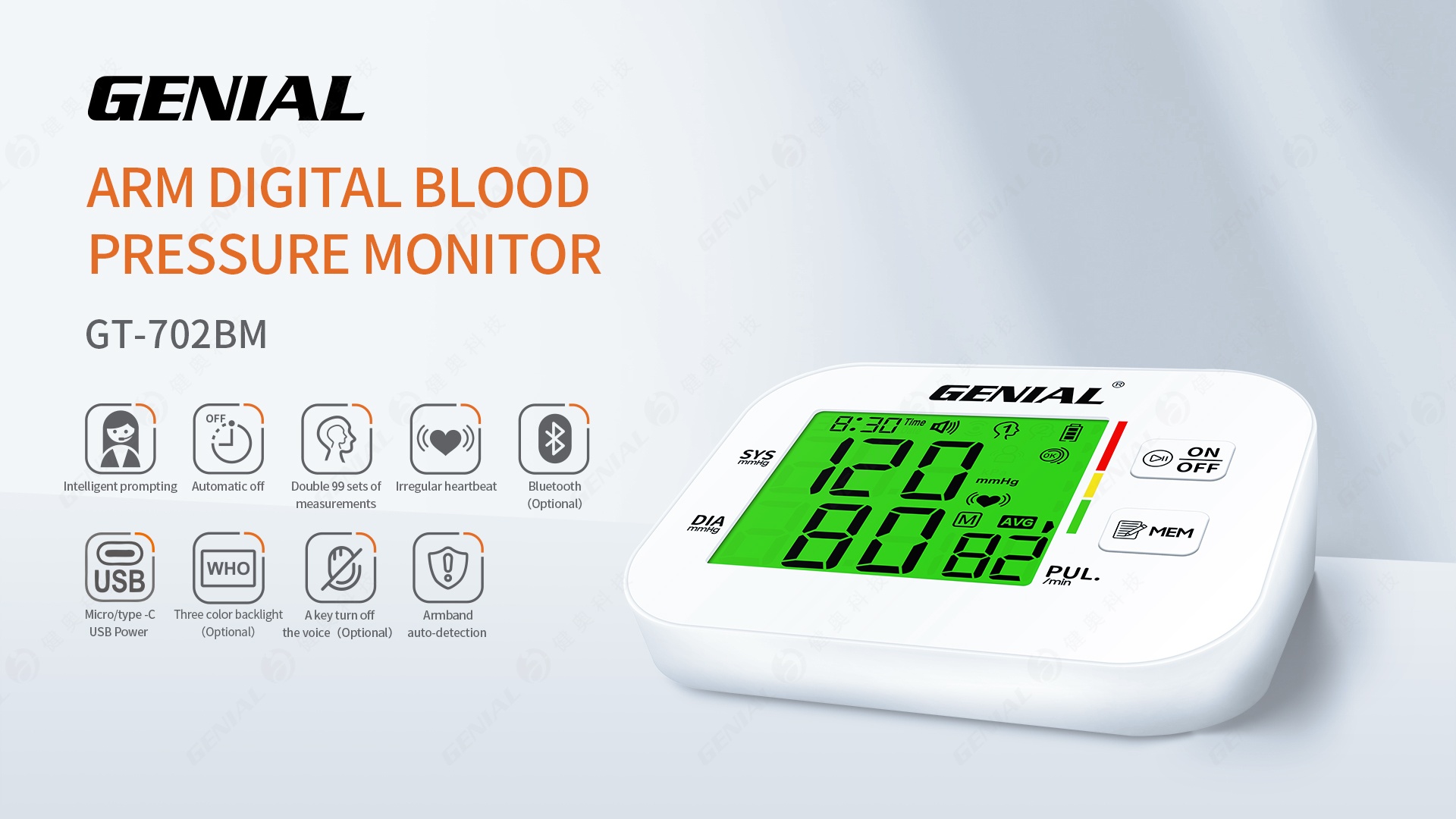
The harder question is not whether to use an upper-arm monitor. It is which model. Six GENIAL upper-arm models cover the scenarios that community health operators, distributors, e-commerce sellers and insurance program teams ask about most often: GT-732, GT-732M, GT-712B/C/E, GT-702V, GT-702VA and GT-702BM. All six share a 0~290 mmHg pressure range, but they differ in arm circumference window, cuff and housing material, memory behaviour, footprint and net weight — and those differences decide whether a program runs smoothly or generates returns.
This guide maps each model to the project scenarios it is documented for, explains the selection logic step by step, and closes with the procurement questions program buyers raise most frequently.
Why one upper-arm monitor line does not fit every care program
Program buyers typically discover three mismatches after the first deployment — and all three trace back to specification choices that looked minor on a quotation sheet.
1. Cuff-range mismatch
A 22~32 cm cuff and a 22~42 cm cuff are sold under the same product category, but they serve different populations. A chronic disease management institute enrolling patients across a wide adult range needs the 22~42 cm window. A community screening desk working with a known, narrower set of users can work with 22~32 cm. Selecting the wider cuff when it is not needed adds material cost; selecting the narrower cuff when the enrolled population is broad creates refusals and device returns.
2. Material mismatch
The cuff assembly is where most physical wear happens. GENIAL builds upper-arm cuff assemblies in three documented material combinations: PVC air bag with a nylon binding strap (GT-732), an eco-friendly TPU air bag (GT-732M), and a composite fabric cuff (GT-702BM). The housing is ABS on most models and modified ABS on GT-702VA. Material choice drives how the device is positioned — a sustainability-oriented program, a high-turnover retail shelf and a supervised clinic do not want the same cuff story.
3. Commercial-model mismatch
The same hardware is bought in four different ways. A private-label e-commerce seller needs ODM tooling and a light shipping weight. An insurance gift program needs a low unit weight and packaging flexibility. A wholesale distributor needs a stable multi-SKU family. Forcing one model and one commercial model across all three produces either over-specification or persistent replenishment problems.
Where the demand for upper-arm monitors in care programs is coming from
Third-party market research frames the category size. The global blood pressure monitoring devices market was valued at USD 4.2 billion in 2025 and is estimated to reach USD 8.6 billion by 2033, a CAGR of 9.3% (Grand View Research). Within that market, digital blood pressure monitors accounted for approximately 48% of total revenue share in 2024 (Fortune Business Insights).
What has changed is the shape of the demand. Purchases increasingly arrive as programs rather than as single-consumer transactions:
- Chronic disease management institutes that hand devices to enrolled patients and expect repeat readings.
- Community medical centres and community clinics running screening days and follow-up checks.
- Health & wellness centres bundling monitoring into membership packages.
- E-commerce sellers building private-label or cross-border SKUs.
- Insurers and corporate buyers using monitors as promotional, wellness or loyalty gifts.
GENIAL — Guangdong Genial Technology Co., Ltd., a medical device manufacturer established in 2001 — supplies this category from a 45,000 m² manufacturing base with 251 employees and an annual output of 15,000,000 units. Around 80% of output is exported, products are sold to 117 countries and regions, and product and trademark registration has been completed in 29 countries. The company holds ISO 13485, ISO 14001, ISO 45001, BSCI and GB/T29490 certifications and 262 intellectual property certificates.
For upper-arm blood pressure monitors specifically, the market-access documentation that program buyers ask about includes:
- CE MDR certificate CN25/00007953 issued by SGS Belgium NV (Notified Body No. 1639), SRN CN-MF-000021465, valid 25 November 2025 – 25 November 2030, covering arm-type digital blood pressure monitor models.
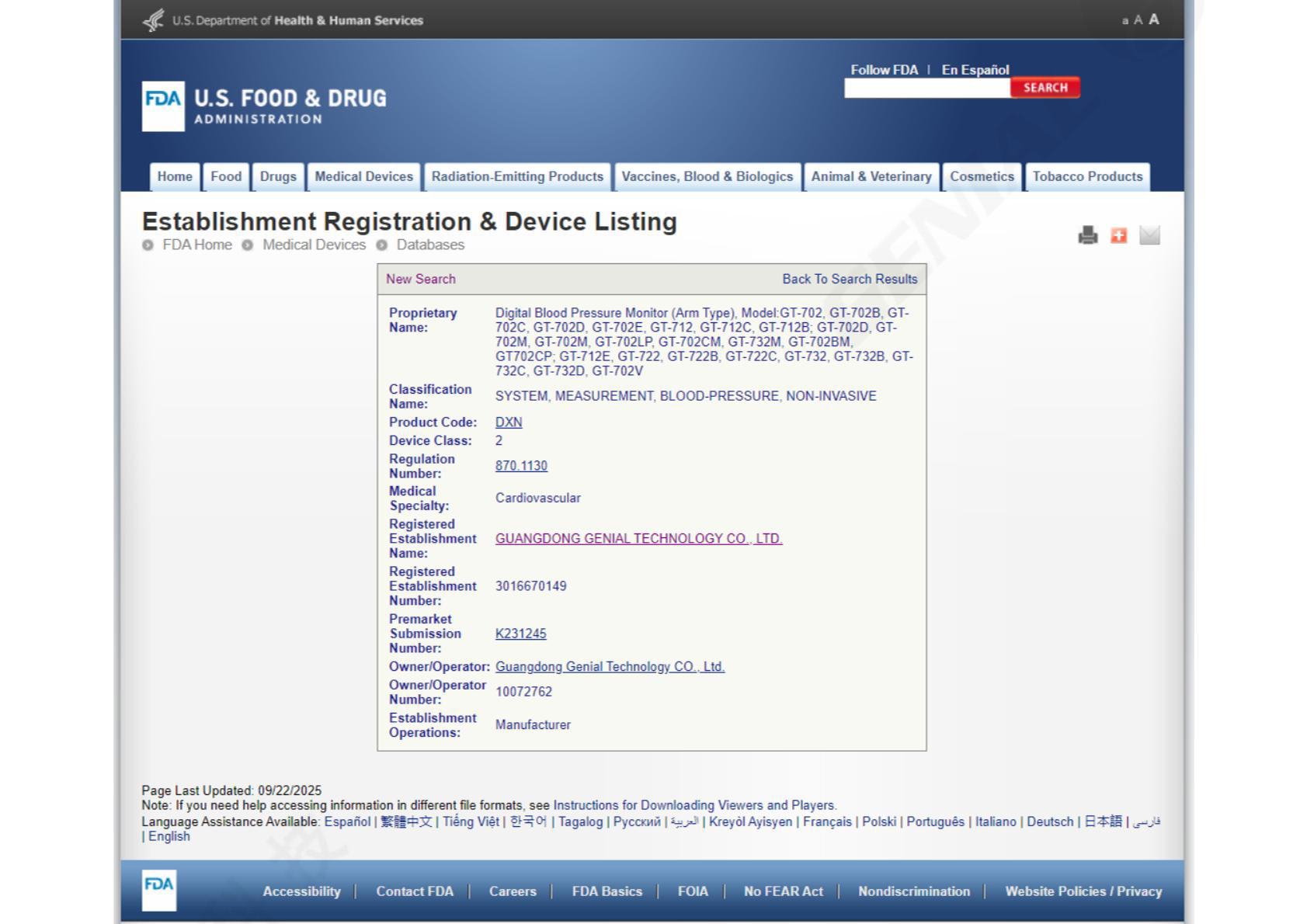
- US FDA 510(k) premarket notification K231245 for arm-type digital blood pressure monitors.
- Japan MHLW Certificate of Foreign Medical Device Manufacturer BG10501496, valid 19 November 2024 – 18 November 2029.
- ISO 13485:2016 certificate CN13/31126, valid 16 September 2025 – 16 September 2028, covering digital blood pressure monitors.
Additional registrations are held for Brazil (ANVISA, RDC 751/2022), Russia (Roszdravnadzor, No. 1241/1-3 140/2-25) and the United Kingdom (MHRA, 0000037417).
The six-model application map
Each of the six upper-arm models is documented for a specific set of project scenarios. The parameters below are the published model specifications.
GT-732 — the community clinic and wellness-centre workhorse
Specifications: measuring range 0~290 mmHg; pulse tolerance ±5%; arm circumference 22~32 cm; ABS housing, PVC air bag and nylon binding strap; 136 × 103 × 54 mm; net weight 291 g ±15 g (without battery).
Documented scenarios: community clinic, health & wellness centre, e-commerce, customized OEM gift.
Selection logic: the PVC air bag with a nylon binding strap is a conventional cuff construction suited to supervised settings where a staff member applies the cuff on behalf of a user. At 291 g it is the heaviest of the six models, which points it toward fixed-location deployments — a clinic desk or a wellness-centre station — rather than a take-home kit. Its 22~32 cm window is the narrower of the two cuff options, so it fits programs whose enrolled population is already known to fall inside that range.
GT-732M — chronic disease management and insurance gift programs
Specifications: measuring range 0~290 mmHg; arm circumference 22~42 cm; pulse error ≤±5%; ABS housing with an eco-friendly TPU air bag; 136 × 103 × 54 mm; net weight 239 g ±15 g (without battery).
Documented scenarios: chronic disease management institute, community medical centre, insurance promotional gift.
Selection logic: this is the widest-cuff model built on an eco-friendly TPU air bag, and it weighs 52 g less than the GT-732 while sharing the same external footprint. For a chronic disease management institute handing devices to patients with a broad range of arm sizes, the 22~42 cm window removes a recurring source of enrolment friction. For an insurance promotional gift, the same combination of wide cuff range, lower unit weight and a sustainability-oriented air bag material makes the device easier to package and easier to explain in a benefits leaflet.
GT-712B/C/E — ODM private labelling and supermarket retail
Specifications: measuring range 0~290 mmHg; arm circumference 22~32 cm; ABS housing; 140 × 80.5 × 50 mm; net weight 192 g ±15 g (without battery).
Documented scenarios: ODM private labelling, supermarket retail, customized gift.
Selection logic: at 80.5 mm the GT-712B/C/E has the narrowest body of the group, and at 192 g it stays well inside a retail-packaging weight budget. The B, C and E variant designations are individually listed in the CE MDR scope and in the FDA 510(k) K231245 scope, so a private-label program can select a variant without reopening the market-access question. This is the model to start from when the project brief says "our brand, our gift box, our retail shelf".
GT-702V — cross-border e-commerce and household medical supply
Specifications: measuring range 0~290 mmHg; 99 memory sets for 2 users; arm circumference 22~42 cm; ABS housing; 119 × 93 × 43 mm; net weight 180 g ±15 g (without battery).
Documented scenarios: cross-border e-commerce, household medical supply.
Selection logic: the 99 memory sets for 2 users is the feature that matters most in a two-person household — each user keeps a separate reading history without a separate device. Combined with 180 g and a 119 × 93 × 43 mm body, the model keeps parcel weight and dimensions low for cross-border shipping, which is where e-commerce sellers see the difference most directly.
GT-702VA — export trade and complimentary gift programs
Specifications: measuring range 0~290 mmHg; arm circumference 22~42 cm; modified ABS housing; 119 × 96 × 42 mm; net weight 155 g ±15 g (without battery).
Documented scenarios: global export trade, complimentary gift industry.
Selection logic: 155 g makes the GT-702VA the lightest of the six, and at 42 mm it has the lowest profile. When a monitor is one item inside a gift box shipped in high volumes, unit weight converts directly into freight, so the combination of the lightest body and the widest 22~42 cm cuff window makes this the natural candidate for global export trade and complimentary gift programs. The housing uses modified ABS rather than standard ABS.
GT-702BM — wholesale and offline household retail
Specifications: measuring range 0~290 mmHg; 99 memory sets for 2 users; arm circumference 22~42 cm; ABS housing with a composite fabric cuff; 135 × 102 × 46 mm; net weight 220 g ±15 g (without battery).
Documented scenarios: medical instrument wholesale, offline household retail.
Selection logic: the composite fabric cuff is the differentiator. In an offline retail or wholesale environment the cuff is handled and inspected by shoppers and counter staff rather than being applied once and stored, and a fabric cuff presents differently from a PVC air bag in that setting. With 99 memory sets for 2 users and 220 g, the model carries the same dual-user memory configuration as the GT-702V in a slightly larger body.
Comparing the cuff and weight profile at a glance
The two decision variables buyers return to most often are the cuff window and the net weight. Four models are built on a 22~42 cm window (GT-732M, GT-702V, GT-702VA, GT-702BM) and two on a 22~32 cm window (GT-732, GT-712B/C/E). From heaviest to lightest the sequence runs 291 g → 239 g → 220 g → 192 g → 180 g → 155 g across GT-732, GT-732M, GT-702BM, GT-712B/C/E, GT-702V and GT-702VA respectively.
Step-by-step: how a program buyer should sequence the decision
The sequence below follows the order in which each decision constrains the next. Running the steps out of order is the most common cause of a re-specification mid-project.
Step 1 — Define the measurement population and lock the cuff window
Start with the arm circumference range the program actually has to serve. GT-732M, GT-702V, GT-702VA and GT-702BM cover 22~42 cm; GT-732 and GT-712B/C/E cover 22~32 cm. The cuff window is the one parameter that cannot be corrected later through packaging or branding, so it comes first.
Step 2 — Match cuff and housing material to usage intensity and to the program message
Choose between the PVC air bag with nylon binding strap (GT-732), the eco-friendly TPU air bag (GT-732M), the composite fabric cuff (GT-702BM), standard ABS housing (GT-712B/C/E, GT-702V), and modified ABS housing (GT-702VA). A supervised clinic, a sustainability-driven insurance program and a retail shelf each justify a different answer.
Step 3 — Decide whether memory behaviour is required
GT-702V and GT-702BM each provide 99 memory sets for 2 users. Where the program tracks a named patient over time, or where a household has two regular users, this configuration replaces the manual reading log. Where the device is a single-use gift or a demonstration unit, it is a specification the buyer can decline.
Step 4 — Confirm market access for every destination market
Check that the selected model appears on the certificate annex for each destination market. CE MDR certificate CN25/00007953 (SGS Belgium NV, Notified Body 1639) and FDA 510(k) K231245 both relate to arm-type digital blood pressure monitor model ranges, and the Japan MHLW certificate BG10501496 remains valid through 18 November 2029. Buyers shipping to Brazil, Russia or the United Kingdom should reference the ANVISA, Roszdravnadzor and MHRA registrations respectively.
Step 5 — Choose the commercial model, then lock MOQ and lead time
- OEM — customization covers packaging, gift box, user manual, product logo printing, colour schemes and packaging specifications, while core hardware, PCB and key functions remain unchanged. MOQ for blood pressure monitors: 2,000 units. Samples in 3 days; small orders in 3–7 days; mass orders in 10–15 days.
- ODM — customization extends to industrial design, tooling, structure, PCB firmware, algorithms, Bluetooth functionality, display interface, packaging system and exclusive product model registration. MOQ: 5,000 units for product modification; 10,000 units for new mold development. Lead time: 7–15 days for minor modifications without new tooling; 45–50 days for new mold development.
- JDM — joint product development between customer and manufacturer, with hardware, software and structural R&D support and exclusive model registration; intellectual property ownership is allocated according to contractual agreements. Monthly capacity 300,000 units; lead time 45–60 days; initial mass-production order ≥10,000 units.
- OBM — regional distributor authorization, gift-box combinations and shipping carton labels, with original GENIAL product branding unchanged. In-stock products ship within 48 hours; replenishment orders in 5–7 days. Minimum order is a full carton per SKU, with mixed orders accepted from 5 cartons.
Step 6 — Validate with a sample and agree acceptance criteria before mass production
For OEM projects, the quality flow runs from order documentation and packaging approval, through incoming material inspection, to 100% production inspection and a final sampling inspection before shipment. For ODM and JDM projects it starts earlier, with customer demand assessment, internal project approval, product development, sample approval and exclusive model registration before mass production begins. Acceptance can be structured as inspection of bulk goods against samples, factory inspection, third-party inspection or video inspection, and payment terms are available as T/T or Letter of Credit. Shipping can be arranged by sea, air, express or rail under FOB, CIF, DDU or DDP terms, with FCL, LCL or overseas warehouse delivery.
Use cases: which model for which program
Chronic disease management institutes
The GT-732M is the documented fit. A chronic disease program enrols patients across a wide adult range, so the 22~42 cm cuff window avoids the enrolment friction that a narrower cuff creates. The eco-friendly TPU air bag also supports the health-promotion framing these programs usually communicate to members, and 239 g keeps a take-home device manageable.
Community medical centres and community clinics
Two models split this scenario. GENIAL documents the GT-732 and GT-712 for the community clinic setting and the GT-732M for the community medical centre. Where readings are taken by staff at a fixed station, the 291 g GT-732 and its PVC air bag with nylon binding strap suit repeated supervised application; where the community centre also distributes devices to patients, the GT-732M's wider cuff range serves both roles. GENIAL's pharmacy-chain program experience in blood pressure monitors covers supply at 100,000–1,000,000 unit scale over five years, built around portfolio breadth rather than a single SKU.
Health & wellness centres
The GT-732 is documented for the health & wellness centre scenario, and the model's fixed-location profile matches how these centres typically use monitors — at a check-in desk or a consultation room rather than travelling home with a member. Where a wellness operator also runs a small online shop, the GT-702V's 180 g body and 99 memory sets for 2 users let the same program cover both the in-centre and the take-home use case.
E-commerce and cross-border e-commerce
The GT-702V is documented for cross-border e-commerce and household medical supply, while GT-712B/C/E, GT-732 and GT-703V appear in e-commerce and private-label scenarios elsewhere in the range. For an online seller, the deciding factors are usually net weight and whether a private label is required: the GT-702V at 180 g with dual-user memory covers a general listing, while the GT-712B/C/E at 192 g with individually listed B, C and E variants covers a private-label listing that must stay inside an existing certification scope.
Insurance and customized OEM gift programs
The GT-732M is documented for insurance promotional gifts, the GT-702VA for the complimentary gift industry, and the GT-712B/C/E for customized gifts. Insurance programs that mail devices to members benefit from the GT-732M's combination of a wide cuff and a lower unit weight; high-volume gift-box programs that ship by container are usually better served by the 155 g GT-702VA; and gift programs that need a customer-specific gift box and manual rather than a different device platform start from the GT-712B/C/E under OEM customization.
Wholesale distribution and offline household retail
The GT-702BM is documented for medical instrument wholesale and offline household retail, with a composite fabric cuff and 99 memory sets for 2 users. Distributors building a counter-ready range typically pair it with the GT-702V and GT-732M so that a reseller can stock a 22~32 cm entry model, a 22~42 cm mainstream model and a fabric-cuff retail model without changing supplier.
Model comparison table
| Model | Pressure range | Arm circumference | Housing / cuff material | Memory | Dimensions (mm) | Net weight (without battery) | Documented scenarios |
|---|---|---|---|---|---|---|---|
| GT-732 | 0~290 mmHg; pulse tolerance ±5% | 22~32 cm | ABS; PVC air bag; nylon binding strap | Not specified | 136 × 103 × 54 | 291 g ±15 g | Community clinic; health & wellness centre; e-commerce; customized OEM gift |
| GT-732M | 0~290 mmHg; pulse error ≤±5% | 22~42 cm | ABS; eco-friendly TPU air bag | Not specified | 136 × 103 × 54 | 239 g ±15 g | Chronic disease management institute; community medical centre; insurance promotional gift |
| GT-712B/C/E | 0~290 mmHg | 22~32 cm | ABS | Not specified | 140 × 80.5 × 50 | 192 g ±15 g | ODM private labelling; supermarket retail; customized gift |
| GT-702V | 0~290 mmHg | 22~42 cm | ABS | 99 memory sets for 2 users | 119 × 93 × 43 | 180 g ±15 g | Cross-border e-commerce; household medical supply |
| GT-702VA | 0~290 mmHg | 22~42 cm | Modified ABS | Not specified | 119 × 96 × 42 | 155 g ±15 g | Global export trade; complimentary gift industry |
| GT-702BM | 0~290 mmHg | 22~42 cm | ABS; composite fabric cuff | 99 memory sets for 2 users | 135 × 102 × 46 | 220 g ±15 g | Medical instrument wholesale; offline household retail |
Read as a decision matrix rather than a ranking, the table gives a shortlist in one pass: the 22~32 cm models serve supervised, known-population settings, and the 22~42 cm models serve enrolled populations and gift programs. Net weight then decides between otherwise similar candidates, and the memory configuration decides whether the device can carry a patient history.
Frequently asked questions
Which certifications cover GENIAL upper-arm blood pressure monitors for care-program procurement?
GENIAL upper-arm digital blood pressure monitors are covered by CE MDR certificate CN25/00007953 issued by SGS Belgium NV (Notified Body No. 1639), SRN CN-MF-000021465, valid from 25 November 2025 to 25 November 2030, with a scope listing arm-type digital blood pressure monitor models. US market access runs through FDA 510(k) premarket notification K231245 for arm-type digital blood pressure monitors. Japan is covered by the MHLW Certificate of Foreign Medical Device Manufacturer BG10501496, valid 19 November 2024 to 18 November 2029. Manufacturing is certified to ISO 13485:2016 (certificate CN13/31126, valid 16 September 2025 to 16 September 2028). Additional registrations include Brazil (ANVISA, RDC 751/2022), Russia (Roszdravnadzor, No. 1241/1-3 140/2-25) and the United Kingdom (MHRA, 0000037417). Before committing, program buyers should confirm that the exact model appears on the current certificate annex for each destination market.
Can cuff material and arm circumference be adapted to a specific care program?
Adaptation happens at two different levels, and buyers should separate them. At the OEM level, customization covers packaging, gift box, user manual, product logo printing, colour schemes and packaging specifications, while core hardware, PCB and key functions remain unchanged — so an OEM program selects from the existing cuff windows of 22~32 cm and 22~42 cm rather than changing the cuff. Structural and material changes — industrial design, tooling, structure, PCB firmware, algorithms, Bluetooth functionality, display interface, packaging system and exclusive product model registration — sit under ODM, with an MOQ of 5,000 units for product modification and 10,000 units for new mold development. In practice, a program that needs a specific cuff window should first check whether GT-732, GT-732M, GT-712B/C/E, GT-702V, GT-702VA or GT-702BM already matches, and treat ODM tooling as the second option.
What order quantities apply to upper-arm blood pressure monitor programs?
Minimum order quantities depend on the commercial model. For OEM, the MOQ for blood pressure monitors is 2,000 units. For ODM, product modification requires 5,000 units and new mold development requires 10,000 units, with tooling costs refundable for large-volume projects. For JDM, the initial mass-production order is 10,000 units or more against a monthly capacity of 300,000 units. For OBM, the minimum is a full carton per SKU, and mixed orders are accepted from 5 cartons, which makes OBM the practical entry point for a distributor testing demand before committing to a private label. Overall monthly production capacity across the range runs from 60,000 to 6,000,000 units.
How does a program buyer validate a model before committing to mass production?
Validation starts with a sample: for OEM projects, samples are produced in 3 days. The buyer then approves order documentation and packaging before mass production begins. For OEM the production quality flow runs from order documentation and packaging approval, through incoming material inspection, to 100% production inspection and a final sampling inspection before shipment. For ODM and JDM the flow starts earlier, with customer demand assessment, internal project approval, product development, sample approval and exclusive model registration. Acceptance criteria can be set as inspection of bulk goods against samples, factory inspection, third-party inspection or video inspection, and payment terms are available as T/T or Letter of Credit. A registered 12-month warranty applies from valid proof of purchase, supported by certification documentation and technical consultation.
What lead times should a care-program buyer plan for?
Lead time depends on how much of the product is being changed. For OEM blood pressure monitor orders, samples take 3 days, small orders 3–7 days and mass orders 10–15 days. For ODM, minor modifications without new tooling take 7–15 days, while new mold development takes 45–50 days. For JDM, the typical lead time for initial mass production is 45–60 days. For OBM, in-stock products ship within 48 hours and replenishment orders take 5–7 days. Shipping can be arranged by sea, air, express or rail under FOB, CIF, DDU or DDP terms, with FCL, LCL or overseas warehouse delivery. To start a program, send your target market, cuff window and expected volume to market6@genial.cn or request a sample through the WhatsApp link below, and the range can be narrowed to two or three models before a first quotation.
Conclusion: specify the scenario before the model number
Upper-arm blood pressure monitors for care programs are not won or lost on the pressure range — every model in this guide covers 0~290 mmHg. They are decided on the arm circumference window, the cuff and housing material, the memory configuration, and the net weight that carries into freight and packaging. Against those four variables, the six-model map resolves cleanly: GT-732M for chronic disease management and insurance gifts, GT-732 for community clinics and wellness centres, GT-712B/C/E for ODM private labelling and retail, GT-702V for e-commerce, GT-702VA for export and gift-box programs, and GT-702BM for wholesale and offline retail.
The sequence matters as much as the shortlist. Lock the cuff window against the enrolled population first, confirm the model appears on the certificate annex for each destination market second, and only then choose between OEM, ODM, OBM and JDM — because that choice sets the MOQ and the lead time that a program calendar has to live with.
Request a sample or a program quotation
Send your target market, required cuff window and expected annual volume, and GENIAL will shortlist two or three upper-arm models from GT-732, GT-732M, GT-712B/C/E, GT-702V, GT-702VA and GT-702BM against your certificate requirements.
Contact Gary — Email: market6@genial.cn · Tel / WhatsApp: +86 18938327866 · Website: www.cngenial.com
Download the full product catalogue and specification sheets: GENIAL 2026 English Product Brochure (PDF)
Market data sources: Grand View Research, blood pressure monitoring devices market; Fortune Business Insights, digital blood pressure monitor revenue share. Product specifications, certifications and manufacturing data are GENIAL published facts.