
Upper Arm vs. Wrist Blood Pressure Monitors: Choosing the Right Fit for Home Care
Upper Arm vs. Wrist Blood Pressure Monitors: Choosing the Right Fit for Home Care
For most home-care programs, an upper arm digital blood pressure monitor with a correctly sized cuff is the safer default. A wrist monitor becomes the better choice when portability and storage space matter more than routine convenience, and when the user can reliably hold the wrist at heart level during every reading. The two formats differ in how the cuff fits the body, how the measurement is performed, and which users can follow the routine without extra help.
GENIAL (Guangdong Genial Technology Co., Ltd.) is a medical device manufacturer founded in 2001 that produces digital thermometers, digital blood pressure monitors in both upper arm and wrist formats, pulse oximeters, mesh nebulizers, ventilators and other home medical health devices. The company sells to 117 countries and regions and provides OEM, OBM, ODM and JDM services. This guide compares the two monitor formats from a buyer's point of view: cuff fit, measurement routine, materials, feature set, cost and compliance.
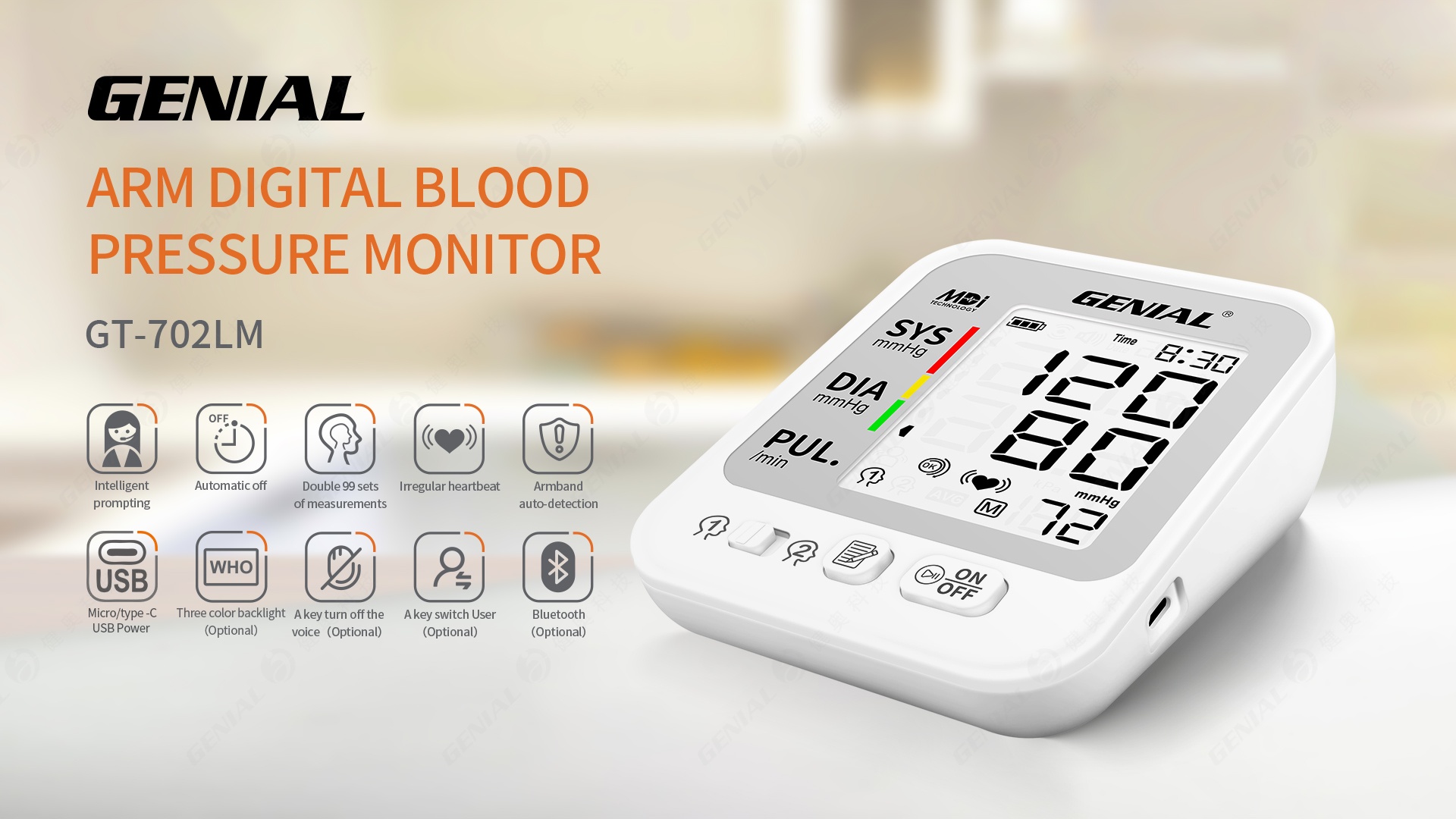
GENIAL digital blood pressure monitor (GT-702LM) for home blood pressure monitoring.
Problem Definition: Why Fit Decides the Outcome
Blood pressure monitors rarely fail in the field because of the electronics alone. In home care, three problems repeat: cuff fit, measurement position, and consistency between readings and between production batches.
Cuff fit
A cuff that does not match the user's arm distorts the reading no matter how capable the device is. Upper arm cuffs wrap around the mid-upper arm; wrist cuffs wrap around the wrist, and each model has its own supported circumference range. Model-level values — supported arm circumference, measurement range and cuff material — should be taken from the supplier's current datasheet for the exact model rather than inferred from the product category. For a single household user, fit is quick to check. For an elderly care facility or a clinic, the cuff range has to cover both the smallest and the largest expected users in the same purchase order.
Measurement position
An upper arm cuff sits at heart level when the arm rests on a table or armrest. A wrist monitor requires the user to raise the wrist to heart level and hold it still for the duration of the measurement, which is generally harder to repeat consistently, particularly for users with limited mobility or low vision. Positioning, not the measurement technology, is the variable that most often changes between the two formats in daily use.
Consistency and batch stability
Two readings from the same device should not differ dramatically, and two units from the same order should behave alike. GENIAL manages measurement consistency risk through multi-point calibration and batch validation, supported by a quality management system and professional laboratories established in accordance with GMP and ISO 13485, stable suppliers with rigorous annual on-site audits, and 100% full inspection throughout the production process. Batch stability is controlled through SPC (Statistical Process Control) with fixed automated production lines and an annual graded supplier assessment and elimination mechanism, so performance does not drift between production runs.
Industry Background: A Growing, Compliance-Heavy Category
The global blood pressure monitoring devices market was valued at USD 4.2 billion in 2025 and is estimated to reach USD 8.6 billion by 2033, growing at a CAGR of 9.3%, according to Grand View Research. Fortune Business Insights reports that digital blood pressure monitors accounted for approximately 48% of total revenue share in the blood pressure monitoring devices market in 2024. The upper arm versus wrist decision therefore sits inside a broader migration from mercury and aneroid devices to digital home devices.
Competition remains concentrated. Omron Healthcare was still a dominant competitor in the global blood pressure monitor and nebulizer markets as of 2024, according to iData Research. For buyers, the more useful question is not which global brand is largest, but which manufacturer can deliver a compliant device whose cuff range fits the intended users and whose registrations match the destination market.
Regulation adds a second layer of requirements. Medical electrical equipment, including home health devices, must meet IEC 60601-1-2 for electromagnetic compatibility (EMC), so a monitor has to be validated not only for measurement performance but also for how it behaves alongside other electronics in a home or a clinic.
GENIAL's position in this category: the company was founded in 2001 and operates a 45,000 sqm manufacturing base with 251 employees and an annual output of 15,000,000 units, supported by a 29-engineer R&D team. About 80% of production is exported, with key layouts covering Europe, North America, Southeast Asia, the Middle East, Africa, Latin America and Oceania. The product range includes upper arm blood pressure monitors, wrist blood pressure monitors and the wider home medical health device portfolio.
Detailed Solution: The Fit-First Comparison
Cuff fit and arm circumference
Arm circumference is the first filter — before brand, price or feature set. Upper arm monitors are sized against the mid-upper arm; wrist monitors are sized against the wrist. Neither can be judged from the category name, because the usable range varies inside a single manufacturer's catalogue. GENIAL's upper-arm line includes models such as the GT-702 series and the GT-732M, and the supported circumference range and measurement range are model-level values that must be confirmed per model from the current datasheet.
Three practical rules for buyers:
- Match the cuff to the user population, not to the average user. A facility buying for elderly residents should confirm that the model's cuff range covers both the smallest and largest expected arms, and should ask whether additional cuff sizes are available.
- Measure, do not estimate. Arm circumference should be measured with a tape at the midpoint of the upper arm before ordering; wrist circumference should be measured the same way for wrist models.
- Treat the two formats as two different fit questions. A monitor that fits one user well may not fit the next, and a single one-size order is a common source of returns in home-care projects.
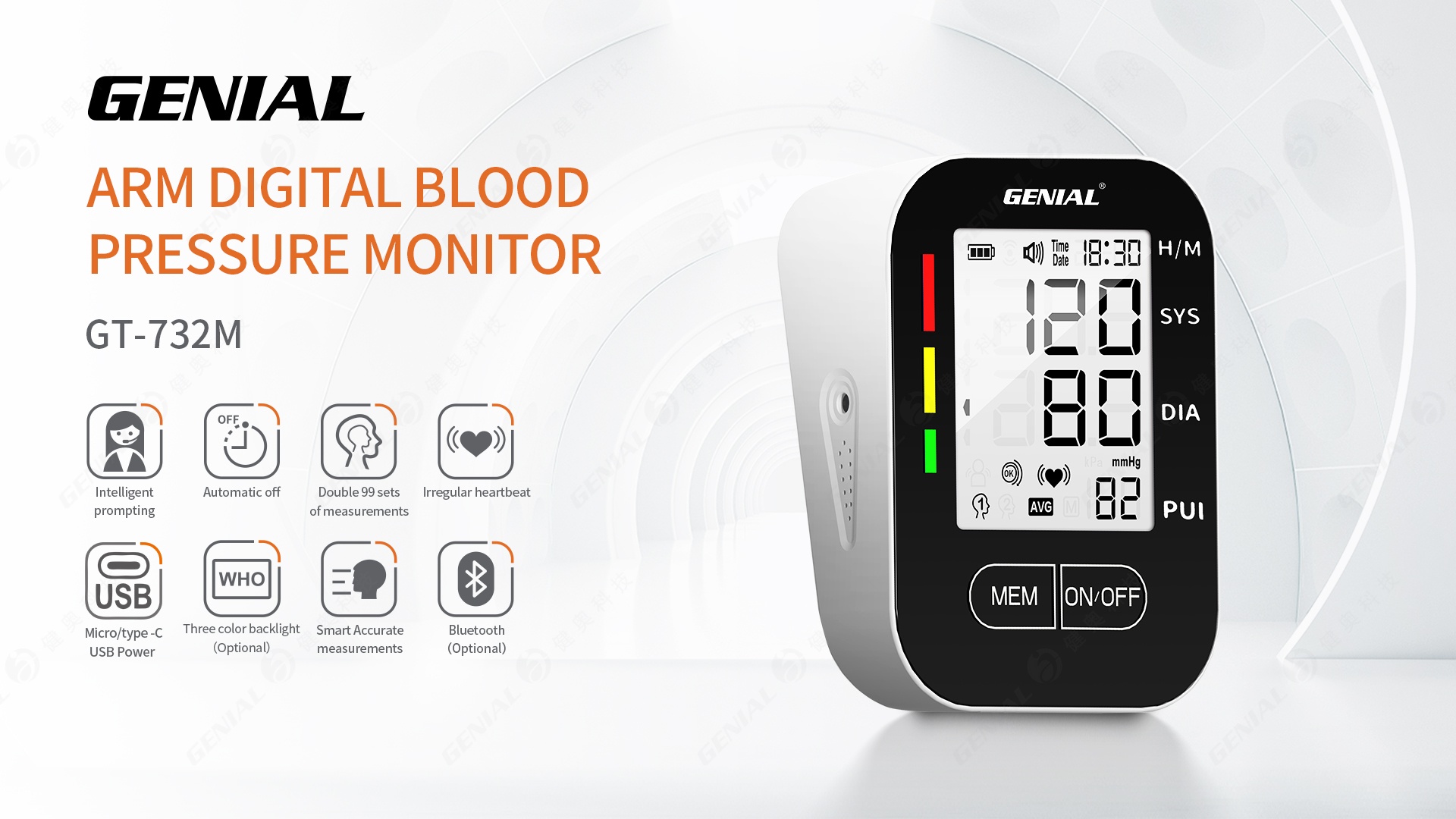
Upper arm digital blood pressure monitor (GT-732M) — cuff fit must be confirmed per model before ordering.
Positioning and the daily routine
With the upper arm format, the cuff is wrapped around the upper arm, the arm rests on a support, and the cuff sits at heart level during the reading. With the wrist format, the user raises the wrist to heart level and holds it still. The routine matters more than the format for users with limited mobility or hand strength: where raising and holding the wrist is unreliable, the upper arm format removes one variable from the measurement.
Materials: rigid ABS housings and flexible TPU air bags
Cuff and housing construction changes comfort, cleaning and product positioning, even though it does not by itself decide measurement quality. Two construction directions are common in digital monitors:
- Rigid ABS plastic housings and connectors — durable and easy to wipe clean, which suits shared devices in clinics, pharmacies and care facilities.
- Flexible TPU air bags inside a fabric cuff — the bladder folds and conforms around the arm. TPU is generally regarded as a more skin-friendly and more environmentally favourable flexible material than older PVC bladders, which is relevant for retail, gift and eco-positioned channels.
Buyers should state the intended scenario — shared clinical device, single elderly user, or gift channel — so the supplier proposes the right housing and bladder combination instead of the cheapest default.
Features that matter in home-care programs
GENIAL's automatic upper-arm blood pressure monitors use fully automatic measurement with no stethoscope required, one-button operation and a mercury-free large-screen backlight display, and store readings for two users with 99-memory capacity. Measurement takes about 30 to 60 seconds, compared with 3 to 5 minutes for a mercury sphygmomanometer. For connected home programs, the home blood pressure management device adds APP long-term data tracking, a programmable automatic measurement interval and dual-mode power supply, and weighs about 380 g. Because these features differ by model, the specification list should be confirmed against the exact SKU being quoted.

Automatic digital blood pressure monitor (GT-702MA) with one-button measurement and memory storage.
Step-by-Step: Choosing the Right Monitor for Home Care
- Define the scenario and the user. Single home user managing hypertension, elderly care institution, community clinic, telemedicine program or OEM gift channel — each points to a different cuff, housing and packaging decision.
- Measure and confirm fit. Record arm or wrist circumference, then confirm the model's supported range from the supplier datasheet; request alternative cuff sizes if the population is mixed.
- Choose the format. Routine daily measurement at home usually points to the upper arm format; travel, small storage or a portability-first requirement points to the wrist format, provided the user can hold the wrist at heart level.
- Specify the feature set. Dual-user memory, backlight display, programmable measurement interval, APP tracking, dual-mode power supply and mercury-free operation.
- Verify compliance for the destination market. Quality system certification (ISO 13485) and product certifications (CE, FDA, NMPA, CB, FCC, RoHS), plus EMC conformity under IEC 60601-1-2 — and confirmation that the specific model, not only the brand, is registered for your market.
- Validate samples and consistency controls. Check cuff fit, positioning, display readability and branding on a real sample; confirm the manufacturer's calibration, batch validation, SPC and 100% inspection practices, along with IPX7 waterproof testing and Bluetooth and APP compatibility testing across mainstream phone models.
- Confirm commercial terms. GENIAL branded products can be shipped within 24 hours after order confirmation, while OEM orders take 3 to 7 days for delivery; annual output capacity is 15,000,000 units.
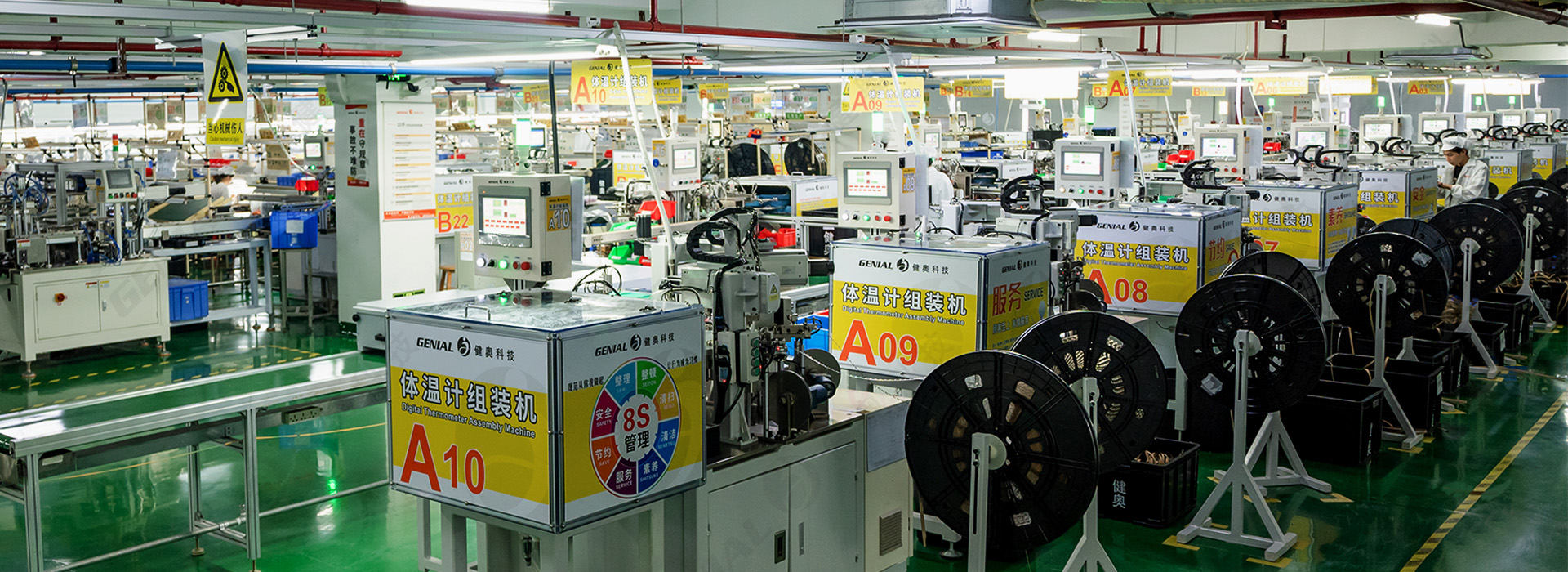
Production workshop inside GENIAL's 45,000 sqm manufacturing base.
Use Cases: Matching Format to Scenario
- Home chronic disease management and hypertension monitoring — upper arm format with dual-user 99-memory storage and a mercury-free display; the standard configuration for daily home readings.
- Elderly care institutions — upper arm format with a large backlight display reduces positioning errors and is easier for caregivers to operate.
- Community clinics, pharmacies, physical examination centers and enterprise health management — upper arm models for shared use, with cleaning-friendly housings, no stethoscope and no mercury handling.
- Telemedicine, internet hospitals and family doctor services — APP-based long-term data tracking with programmable measurement intervals, and no dedicated calibration team required for maintenance.
- Travel, personal portability and space-limited settings — wrist format where a compact device is the priority and the user can follow the wrist-positioning routine.
- OEM gift and retail channels — material and packaging choices, such as TPU air bag cuffs and mercury-free positioning, become part of the product story rather than only a cost line.
Comparison Table: Upper Arm vs. Wrist at a Decision Level
| Decision factor | Upper arm digital monitor | Wrist digital monitor |
|---|---|---|
| Measurement site | Cuff wrapped around the mid-upper arm | Cuff wrapped around the wrist |
| Fit variable to confirm | Upper arm circumference; range is model-specific | Wrist circumference; sized separately from upper arm cuffs |
| Routine stability | Arm rests on a support; cuff positioned at heart level | User must raise and hold the wrist at heart level and stay still |
| Portability and storage | Larger device body plus cuff | Compact and easier to carry or store |
| Typical home-care role | Default format for routine daily measurement and chronic disease management | Portability-first option for travel or space-limited use |
| Verified feature reference | Fully automatic measurement, one-button operation, dual-user 99-memory storage, large-screen backlight, mercury-free display, 30-60 second measurement | Wrist blood pressure monitors are part of the same digital blood pressure monitor category; confirm features per model |
| Confirm before ordering | Model cuff range, compliance documents for your market, memory and display features | Wrist cuff range, positioning instructions, compliance documents for your market |
Reference comparison: GENIAL automatic digital monitor vs. mercury sphygmomanometer
| Comparison point | GENIAL automatic digital blood pressure monitor | Mercury sphygmomanometer |
|---|---|---|
| Measurement method | Fully automatic, one-button measurement | Manual measurement requiring a stethoscope |
| Measurement time | About 30-60 seconds | About 3-5 minutes |
| Data handling | Dual-user, 99-memory storage | Manual recording |
| Operator requirement | No professional training required | Requires a trained operator |
| Mercury handling | Mercury-free digital display | Mercury use and recycling required |
| Measurement labor cost | Reduced by 100% | Baseline |
| Equipment maintenance and calibration cost | Reduced by more than 60% | Baseline |
| Typical settings | Home chronic disease management, hypertension monitoring, community health centers, pharmacies, elderly care institutions, physical examination centers, enterprise health management | — |
How to read these tables: the upper arm versus wrist rows describe decision criteria and typical use, not accuracy rankings. Fit, positioning and consistency controls are what determine whether a device works in a specific home-care setting, and model-specific values should always be taken from the current datasheet.
FAQ
1. What certifications and standards should we verify before buying upper arm or wrist blood pressure monitors in volume?
For medical electrical equipment, including home health devices, IEC 60601-1-2 electromagnetic compatibility is a baseline requirement, and clinical electronic thermometers are covered by ISO 80601-2-56:2017 where applicable. GENIAL's quality system is certified to ISO 13485, alongside ISO 45001, ISO 14001, BSCI and GB/T29490, and its products hold CE, FDA, NMPA, CB, FCC and RoHS certifications. Product and trademark registrations have been completed in 29 countries, and products are sold to 117 countries and regions. Buyers entering a new market should confirm that the specific model, not just the brand, holds the registration that market requires.
2. Can the same manufacturer supply both formats, and how is measurement consistency controlled?
GENIAL produces both upper arm and wrist blood pressure monitors within its home medical health device range and offers OEM, OBM, ODM and JDM services, supported by a 29-engineer R&D team, a medical technology research institute, a doctoral workstation and 262 intellectual property certificates. Consistency is controlled through multi-point calibration and batch validation, a quality management system and professional laboratories established in accordance with GMP and ISO 13485, annual on-site supplier audits, SPC for batch stability, and 100% full inspection throughout production. Water resistance is verified through IPX7 testing, and Bluetooth and APP compatibility are tested by the IT process department across mainstream phone models.
3. What drives the real cost of a home blood pressure monitoring program?
Unit price is only one part of the calculation. GENIAL's home blood pressure management device reduces equipment procurement cost by about 70% compared with medical monitoring devices and reduces long-term health management cost by more than 50%, and it does not require a dedicated calibration team for maintenance. Compared with a mercury sphygmomanometer, the automatic digital monitor reduces measurement labor cost by 100% and equipment maintenance and calibration costs by more than 60%, with no professional training and no mercury recycling required. Because standard branded items ship within 24 hours after order confirmation and OEM production runs take 3 to 7 days, inventory and follow-up planning remain simple.
4. Can we evaluate samples before placing a production order?
Yes, and sample evaluation should cover three things: cuff fit on the actual user's arm or wrist, the measurement routine (positioning and display readability), and the branding or packaging plan. Sample-stage evaluation can be scheduled without long delays because standard GENIAL branded products ship within 24 hours after order confirmation and OEM orders are delivered in 3 to 7 days. Buyers should state the target scenario — home chronic disease management, elderly care institution, community clinic or gift channel — so the sample configuration matches the intended use.
5. What lead times and production capacity should we plan for?
GENIAL operates a 45,000 sqm manufacturing base with 251 employees and an annual output of 15,000,000 units. Branded products can be shipped within 24 hours after order confirmation, while OEM orders take 3 to 7 days for delivery; MOQ and final lead time depend on the model, the cuff configuration and the customization scope, and are confirmed at quotation. To start, send your target market, user profile and required certifications to Gary at market6@genial.cn or via WhatsApp at +86 18938327866. The 2026 English catalogue is available for download here.
Conclusion: Fit First, Format Second
The format should follow the fit. Choose the upper arm format when the user measures routinely at home, when the target population includes elderly or shared-device users, or when arm circumference can be matched to a model's cuff range. Choose the wrist format when portability and storage are the deciding constraints and the user can consistently hold the wrist at heart level. In both cases, confirm the model-specific cuff range, the compliance documents for your market, and the consistency controls behind the product before committing to volume.
Next Step: Sample or Quotation

GENIAL (Guangdong Genial Technology Co., Ltd.) has supplied home medical health devices since 2001 — digital thermometers, upper arm and wrist blood pressure monitors, pulse oximeters, mesh nebulizers, ventilators and more — with OEM, OBM, ODM and JDM services for clients in 117 countries and regions.
Request a sample, a model-specific quotation or the full catalogue:
Contact: Gary · market6@genial.cn · Tel / WhatsApp: +86 18938327866
Website: www.cngenial.com
2026 English catalogue: download PDF
Address: No.2710-2711, 27/F, Bldg B, Fengxing Plaza, No.242 Tianhe Road, Tianhe District, Guangzhou, China