
What to Verify Before Sourcing Home Medical Health Devices: Parameters, Certifications, and Product Fit
What to Verify Before Sourcing Home Medical Health Devices: Parameters, Certifications, and Product Fit
Home medical health devices are not one uniform purchase category. A digital thermometer, an upper arm blood pressure monitor, a fingertip pulse oximeter, a mesh nebulizer and a sleep ventilation device all answer different clinical problems and enter different markets through different compliance paths. Buyers in the research and evaluation stage should therefore compare two layers of evidence: measurement parameters that define whether the device fits the intended user, and certification scope that defines whether the device can legally enter the target market. Guangdong Genial Technology Co., Ltd. (GENIAL), a medical device manufacturer founded in 2001 in Guangzhou, China, produces this range of home-use devices and provides OEM, ODM, OBM and JDM services. This guide explains how to read product specifications and certification documents before committing to a device program.
Where Sourcing Decisions Go Wrong
Most sourcing errors in this sector come from three gaps. The first gap is between a product claim and the certificate scope. A supplier may hold a recognizable mark such as CE, FDA or MDR, but the certificate usually lists specific models and specific device descriptions. The buyer needs the certificate page that names the model being ordered, not just a generic logo on a website. The second gap is between measurement design and the intended body site. For example, a forehead infrared thermometer and an armpit digital thermometer both present a temperature reading, but their measurement range, accuracy, waterproof rating and target setting are different. The third gap is between packaging design and clinical or regulatory suitability. A device selected for pediatric use, elderly care, school screening or a specific overseas pharmacy market may require different tip styles, cuff sizes, memory functions, alarm features or registration documentation.
Why Parameter-Driven Evaluation Matters Now
Several segments of the home medical health device market continue to grow, and this growth increases competition among importers, distributors and private-label brands. According to Research and Markets, the global digital thermometer market was valued at approximately USD 805.1 million in 2024 and is projected to reach USD 1 billion by 2030. Grand View Research estimated the global blood pressure monitoring devices market at USD 4.2 billion in 2025, with growth to USD 8.6 billion by 2033 at a CAGR of 9.3%. Fortune Business Insights reported that digital blood pressure monitors accounted for roughly 48 percent of total revenue in the blood pressure monitoring devices market in 2024. The pulse oximeter market is expected to reach USD 5.3 billion by 2030, with a CAGR of 6.6 percent from 2024 to 2030. Market Research Future valued the vibrating mesh nebulizer market at USD 0.75 billion in 2024, with a projection of USD 1.57 billion by 2035.
Regulatory standardization is equally active. Clinical electronic thermometers are expected to comply with ISO 80601-2-56:2017 for basic safety and essential performance. Medical electrical equipment used at home falls under electromagnetic compatibility requirements such as IEC 60601-1-2. Market access also depends on country-specific registration: Brazil requires ANVISA conformity under RDC 751/2022, Japan applies the PMD Act registration procedure for foreign manufacturers, Russia requires Roszdravnadzor registration under GOST R safety and performance standards, and the United Kingdom maintains MHRA registration. A buyer who checks parameters and certification scope at the evaluation stage avoids the far more expensive problem of discovering a regulatory mismatch after mass production.
Reading the Specification Sheet by Product Family
The most reliable way to evaluate a home medical device is to compare the datasheet against the physical measurement task. Different device families within the GENIAL portfolio illustrate the parameter fields that matter.
Digital Thermometers for Contact Measurement
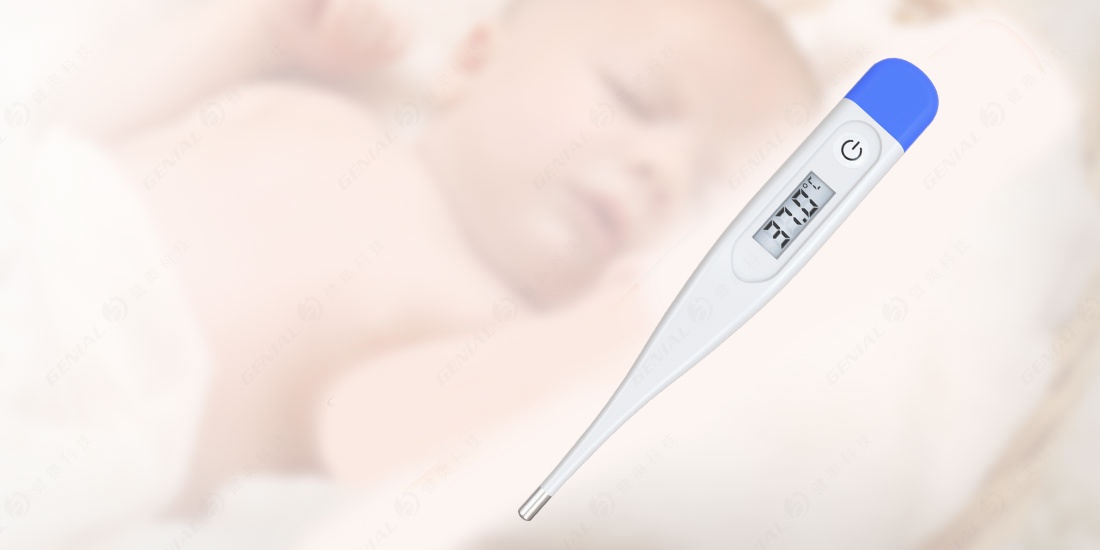
Contact thermometers are used for oral, underarm or rectal temperature measurement, and they are still the most economical family for clinics, pharmacies and household health kits. Rigid tip and flexible tip versions exist so that buyers can match the product to the end user. For example, models T11/T12 are rigid tip digital thermometers with a measurement range of 32.0 to 42.9°C, accuracy of ±0.1°C, IPX5 waterproof protection, dimensions of 125×18×9 mm, and weight of about 10 g including the LR41 battery. Model T14/T14SL/T14Y adds both rigid and flexible tip options, is made of PP and medical silicone, and is often used in clinic supply and maternal-infant distribution. T15S/T15SL/T15SC is an animal shape digital thermometer for the baby gift and children's commodity market; its tip is made of food-grade flexible rubber, and its accuracy is also ±0.1°C. T19C/T19D, T23/T24 and T28 provide additional choices for fever alert, medical PP construction or flexible probe comfort. When evaluating this category, check the measurement range, accuracy, waterproof grade, tip material and battery type.
Infrared and Wearable Temperature Monitoring
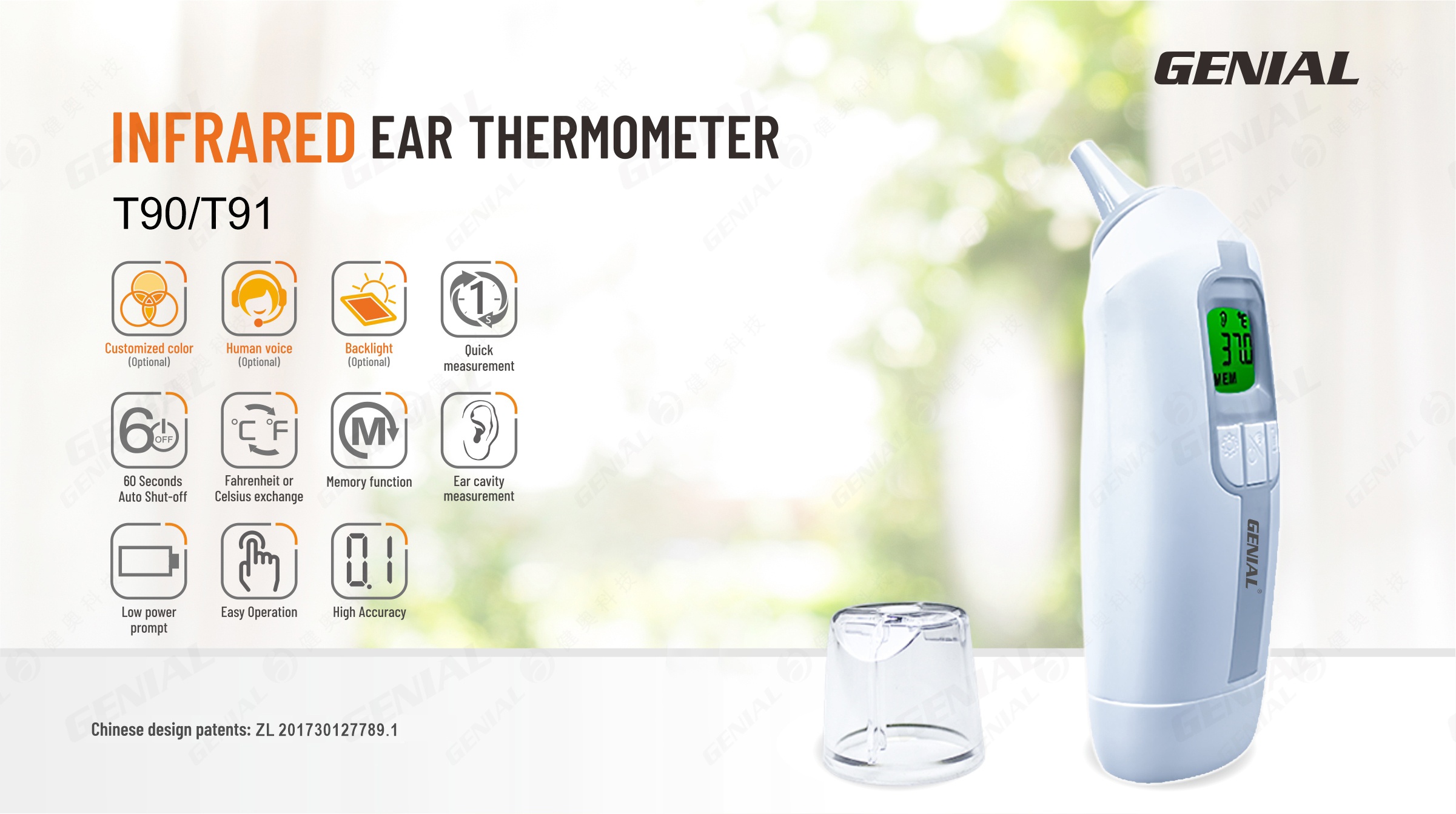
Infrared thermometers can be divided into forehead and ear measurement types. Non-contact infrared forehead thermometers such as T86/T87 measure forehead temperature from 32.0 to 42.9°C, with an error of ±0.2°C in the 35–42°C range, and are suited to schools, factory epidemic prevention, hospitals and customs entry inspection. Basic infrared ear thermometers such as T90/T92 measure ear temperature from 32 to 42.9°C and auto shut down after 60 seconds. The T94 infrared ear thermometer, made with ABS and a medical silicone ear cap, adds pediatric hospital suitability. For continuous monitoring, the wearable Bluetooth digital thermometer T31 measures 20.0 to 45.0°C with ±0.1°C accuracy, is IPX4 splash-proof, weighs 33 g including battery, and is made of medical-grade PP with a silicone adhesive patch. Its Bluetooth function allows data transmission to an app and supports continuous body temperature monitoring in maternal care, baby care and chronic disease settings. Buyers choosing between these technologies should compare contact versus non-contact behavior, measurement site, target temperature range, accuracy, and whether continuous trend data is necessary.
Blood Pressure Monitors: Upper Arm versus Wrist
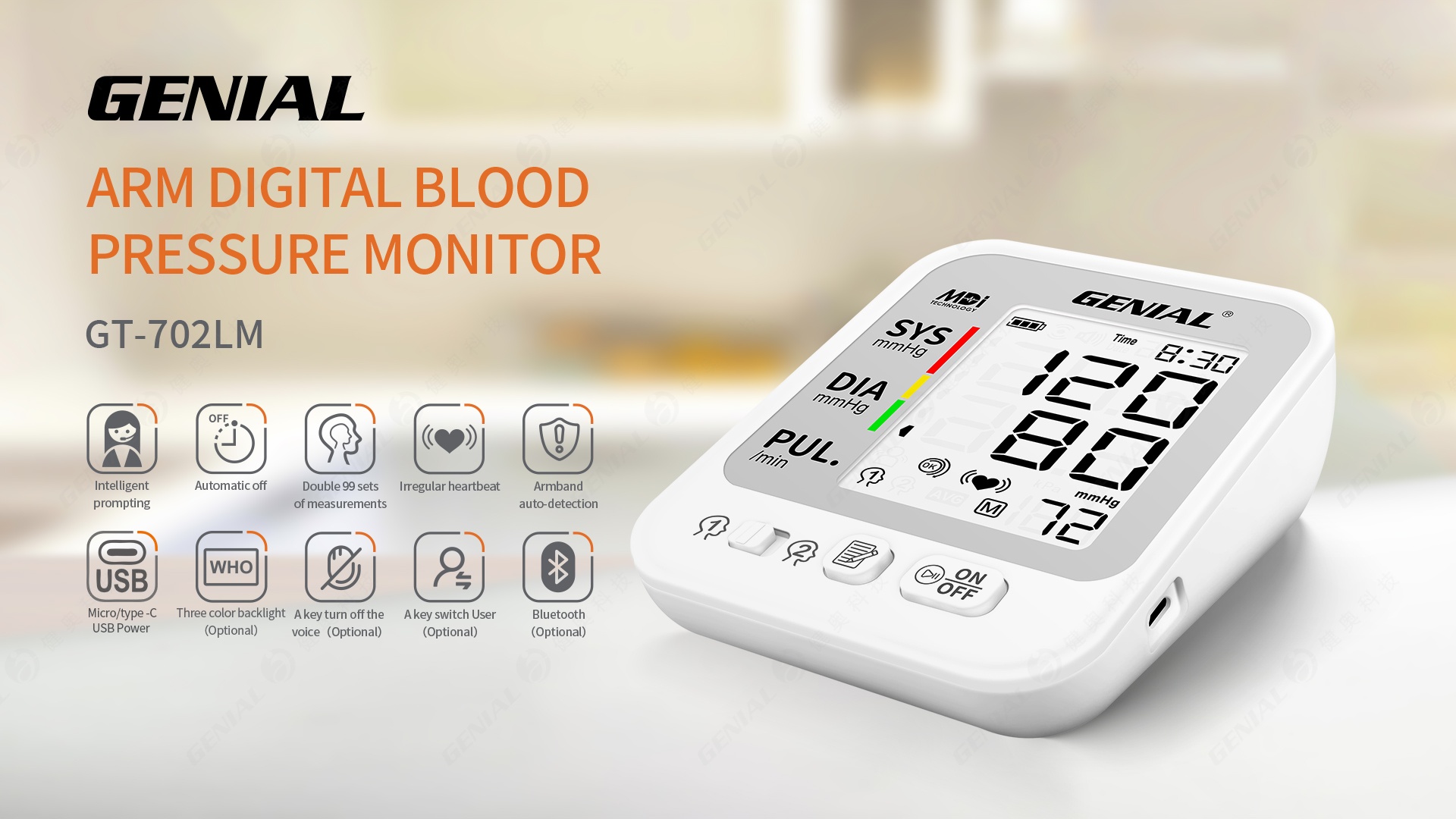
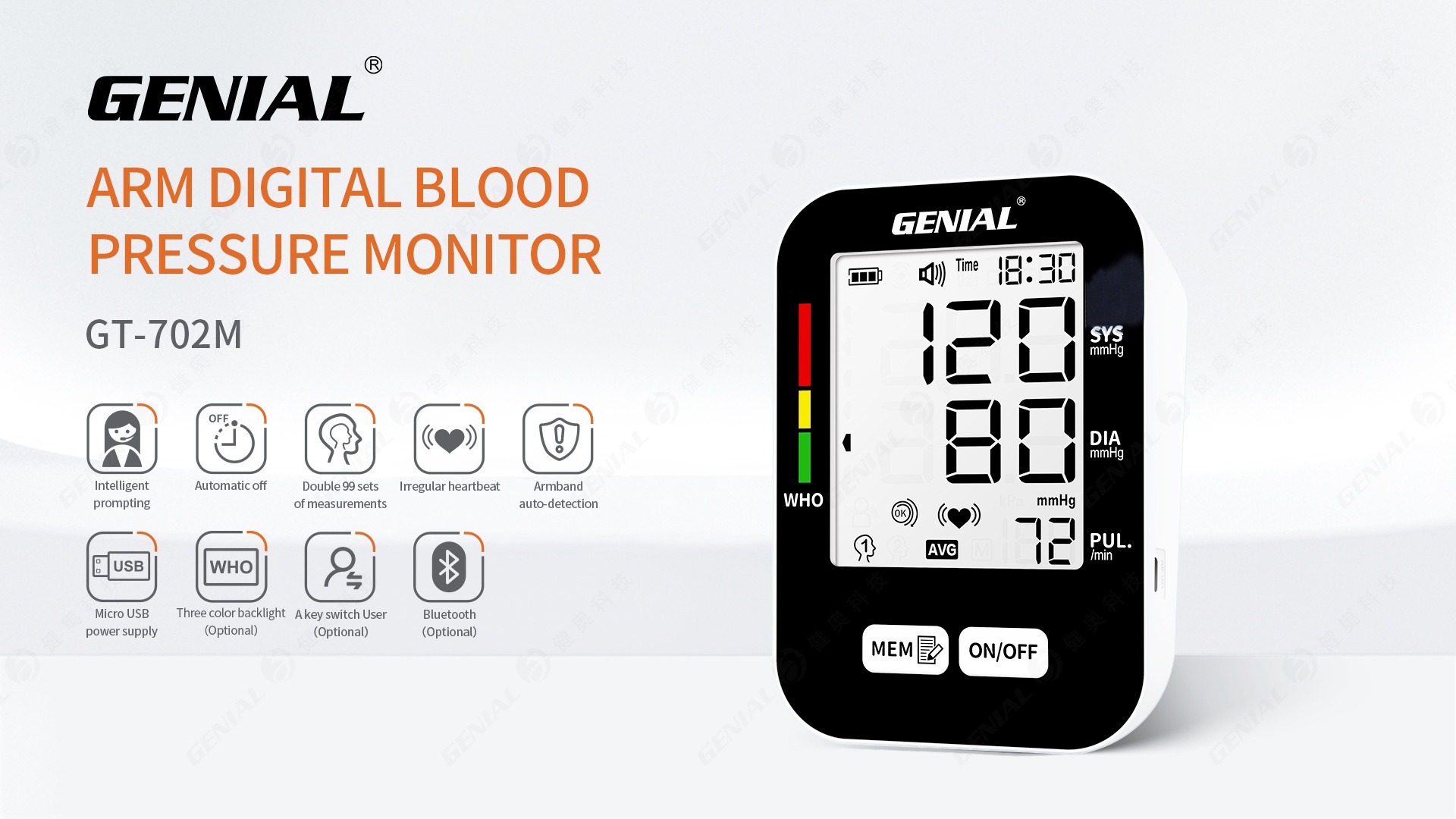
Digital blood pressure monitors in the GENIAL catalog are divided into upper arm and wrist models, and the division is meaningful for patient selection. Upper arm models typically support a pressure measurement range of 0 to 290 mmHg and an arm circumference range of either 22 to 32 cm or 22 to 42 cm, depending on model and cuff. Models such as GT-702M, GT-702LM, GT-702BM and GT-732M cover the wider 22–42 cm range. GT-702BM stores 99 memory sets for two users, which supports home monitoring of more than one person. GT-702MA includes a WHO blood pressure classification function and is made of ABS and TPU, making it suitable for physical examination centers and elderly care institutions. Wrist models, such as GT-701C, GT-701F and GT-701L, measure pressure in the same 0 to 290 mmHg range but support a wrist circumference of 13.5 to 21.5 cm or 13.5 to 19.5 cm, depending on the model. For a procurement project serving an elderly population, an upper arm monitor with a wide cuff range and multi-user memory is generally easier to use reliably; for a travel, gift or convenience channel, a wrist monitor may be more appropriate. The critical evaluation fields are cuff range, memory capacity, WHO classification, voice or Bluetooth functions, and whether the model has been clinically assessed for home use.
Pulse Oximetry, Nebulization and Sleep Support
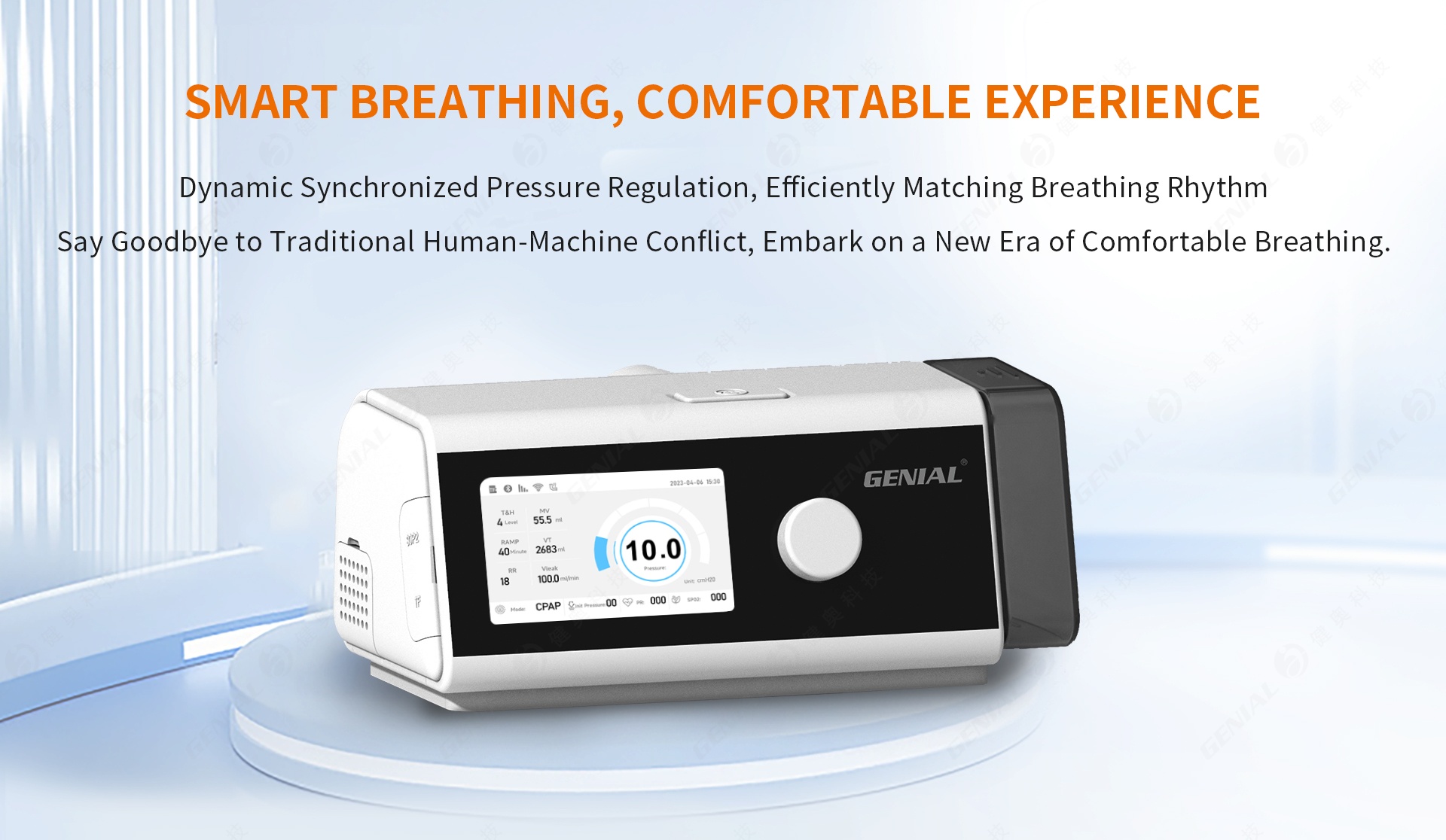
Fingertip pulse oximeters in the GX3/GX5/GX7/GX8/GX12/GX13/GX14 series measure SpO2 from 35 percent to 100 percent with ±2 percent accuracy in the 70 to 100 percent range, and pulse rate from 30 to 250 bpm. The product is made of ABS and medical elastic silicone, and is used in elderly care, respiratory departments, outdoor sports, households and pharmacies. For portable respiratory treatment, GENIAL produces mesh nebulizers in the N11/N21 and N12/N22/N12C/N22C/N12L/N22L series. They have an 8 ml liquid capacity, a nebulization rate of at least 0.2 ml per minute, a particle D50 below 5 μm for at least 60 percent of particles, and noise at or below 50 dB(A). These features matter because smaller particles and a steady nebulization rate support delivery of medication toward the lower respiratory tract. For sleep apnea therapy, the non-invasive sleep ventilator series GH-B20V/GH-B25V/GH-B20T/GH-B20/GH-B25/GH-A20A/GH-A20 supports CPAP, APAP, S/T and VGPS modes, with working pressure from 4 to 20 or 25 cmH₂O and noise no higher than 35 dB. It is intended for sleep disorder centers, hospital respiratory departments, rehabilitation institutes and household snoring treatment. In each case, the meaningful comparison is not only whether the device exists, but whether its measurement and delivery parameters match the clinical target.
The Certification Paper Trail
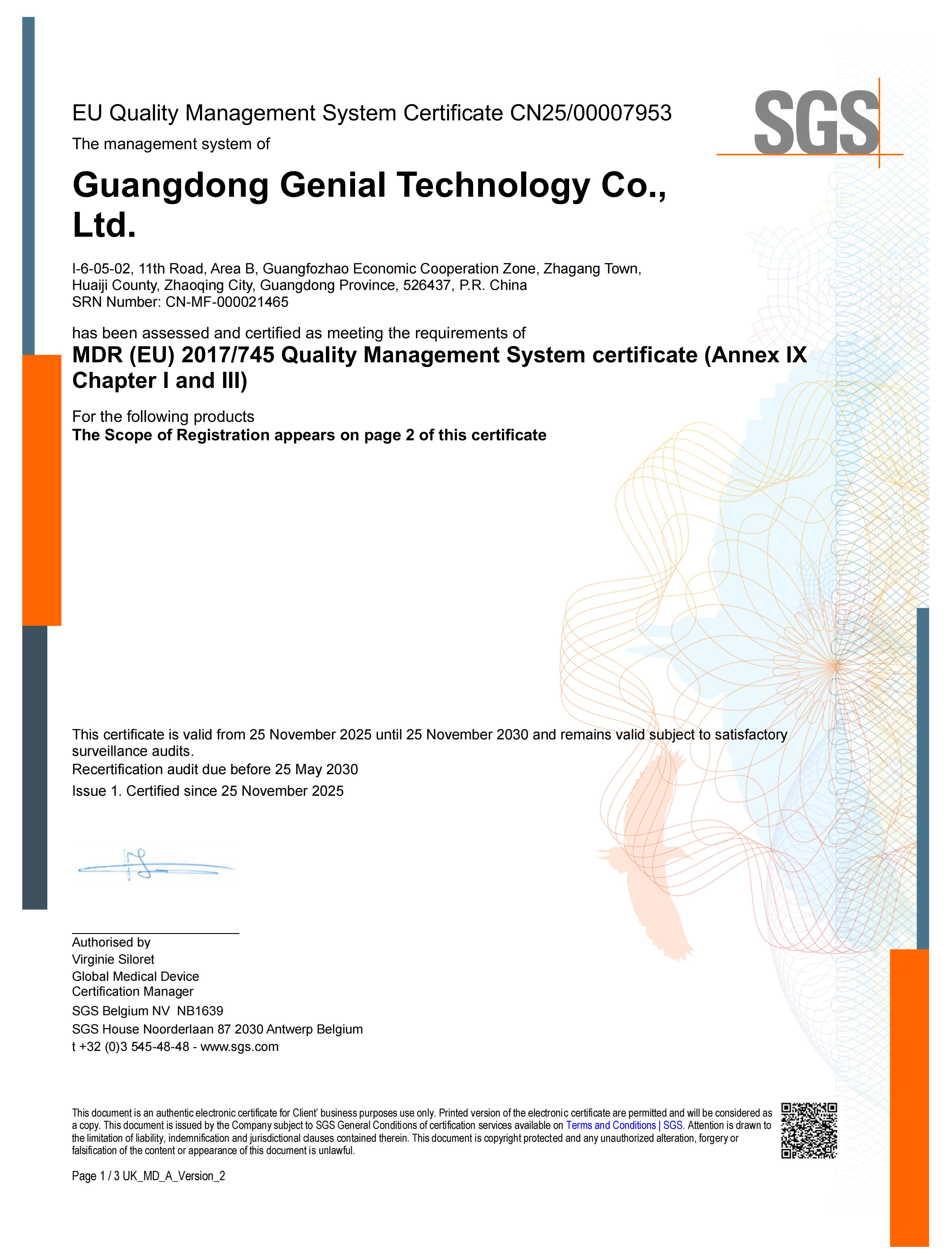
Parameter review should be paired with a document review. A useful certification package names the model and the market. In the GENIAL portfolio, the registration evidence covers multiple regulated geographies. The CE MDR Quality Management System Certificate under (EU) 2017/745, certificate number 195/MDR, issued by IMQ S.p.A (Notified Body No.0051), applies to the T31 wearable thermometer and the full series of fingertip pulse oximeters across the 27 EU Member States. A separate CE certificate, CN25/00007953 with SRN CN-MF-000021465, issued by SGS Belgium NV (Notified Body No.1639), covers digital blood pressure monitors and related devices under MDR (EU)2017/745. The United Kingdom registration with MHRA, certificate number 0000037417, covers wireless reusable patient thermometers, pulse oximeter probes, infrared ear and skin thermometers, intermittent electronic thermometers, automatic electronic sphygmomanometers and self-care monitoring software. The T31 wearable digital thermometer also holds US FDA 510(k) Premarket Notification K240333. Other FDA 510(k) notifications include K210014 for T80/T81/T82/T83/T84/T85/T86/T87 forehead infrared thermometers, K231243 for GX3 through GX14 fingertip pulse oximeters, K231250 for wrist blood pressure monitors GT-701 and related models, K231245 for upper arm blood pressure monitors, K232678 for continuous reading digital thermometers such as T28, and 3016670149 for clinical electronic thermometers including T11, T12, T14, T15, T19 and related model series. For Japan, GT-702L is listed under the Japan Certificate of Foreign Medical Device Manufacturer, number BG10501496, issued by MHLW under Article 23-2-4 of the PMD Act. The Marina series automatic electronic blood pressure monitors are registered with Roszdravnadzor in Russia under certificate number № 1241/1-3 140/2-25, and GENIAL thermometers, oximeters and blood pressure monitors have received ANVISA certification for Brazil under RDC 751/2022.
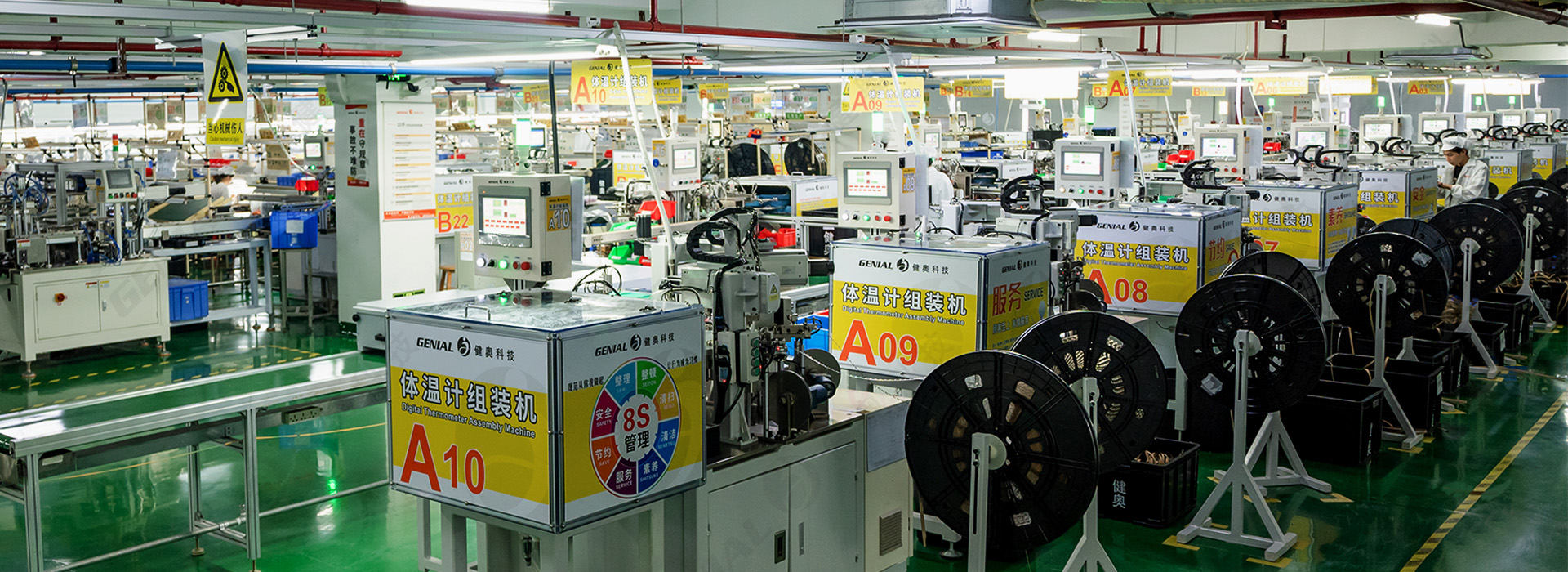
At company level, Guangdong Genial Technology Co., Ltd. reports that it has completed product and trademark registration in 29 countries and sells products to 117 countries and regions. The company operates a 45,000-square-meter production base, employs 251 people, and has an annual output capacity of 15 million units across its device families. Its manufacturing and quality systems are supported by certifications including ISO 13485, ISO 45001, ISO 14001, BSCI and GB/T29490 intellectual property management certification. The R&D team consists of 29 engineers, and the company reports 262 intellectual property certificates. For buyers, these structural facts reduce the risk that certification documents belong to a trading company rather than an original factory.
A Five-Step Checklist for Research and Evaluation
- Define the destination market first. Identify whether the order must meet CE MDR in the EU, FDA 510(k) clearance in the United States, MHRA registration in Great Britain, ANVISA registration in Brazil, Roszdravnadzor registration in Russia, MHLW foreign manufacturer registration in Japan, or local registration in another market. Keep a list of required certificate numbers by model.
- Match the measurement site to the device type. Select forehead, ear, contact or wearable thermometers based on the user. Select upper arm or wrist blood pressure monitors based on cuff circumference and patient setting. Select fingertip pulse oximeters for spot-check blood oxygen screening.
- Compare measurement range and accuracy. For example, prioritize ±0.1°C accuracy for clinical electronic thermometers and ±0.2°C error in the 35–42°C range for non-contact forehead thermometers. For oximeters, check the SpO2 measurement range and the accuracy window within 70–100 percent saturation.
- Check protection and usability constraints. Confirm the IP rating, materials, memory capacity, alarm function, battery type, and whether the device supports Bluetooth data reporting when remote monitoring is required.
- Connect the parameter profile to the manufacturer's capabilities. Verify which OEM, ODM or JDM customization route is required, and confirm the relevant quality system certification, registration support and delivery timeline before final selection.
Use Cases for Procurement and Channel Programs
Public Health and School Screening
Non-contact infrared forehead thermometers such as T86/T87 fit projects that need rapid temperature screening with limited physical contact. The evaluation profile should emphasize the 32.0 to 42.9°C forehead measuring range, ±0.2°C error at 35–42°C, IPX4 protection and available FDA 510(k) evidence. Procurement teams should request the product model list from the certificate and confirm that packaging language and instructions match the destination market.
Pharmacy and Distributor Assortment
Pharmacy chains and medical distributors generally need a broader portfolio. A dependable mix may include upper arm digital blood pressure monitors such as GT-702BM with 99 memory sets for two users, wrist models such as GT-701C for convenience channels, digital thermometers such as T11/T12 and T14/T14SL/T14Y, fingertip pulse oximeters from the GX series, and mesh nebulizers such as N11/N21 or N12/N22 series. Distributors benefit when one original factory can consolidate SKUs and manage certificates across categories.
Maternal, Infant and Elderly Care
Maternal and infant programs benefit from continuous temperature monitoring with the wearable Bluetooth digital thermometer T31, which supports 24-hour data continuity without repeated night-time measurement. Elderly care procurement projects tend to favor upper arm blood pressure monitors with wide cuff compatibility, memory sets and WHO classification, such as GT-702MA, because these functions reduce interpretation burden for non-clinical caregivers.
Respiratory and Sleep Therapy Projects
For respiratory projects, mesh nebulizers provide a portable alternative to compressor units, while sleep apnea therapy devices such as the GH-B20V/GH-B25V series support CPAP and APAP treatment with lower noise. Clinical projects should evaluate the ventilator pressure range, mode support, humidification and mask compatibility together with the respiratory department's care pathway.
Comparison Table: Representative Home Medical Device Families and Evaluation Priorities
| Product Family | Representative GENIAL Models | Key Specification Fields to Verify | Typical Sourcing Scenarios |
|---|---|---|---|
| Digital Thermometer | T11/T12, T14/T14SL/T14Y, T19C/T19D, T23/T24, T28, T15S/T15SL/T15SC | 32.0–42.9°C range; ±0.1°C accuracy; IPX5; rigid or flexible tip; material | Household kits, clinics, pharmacies, maternal-infant channels, OEM export |
| Infrared Thermometer | T86/T87 forehead; T90/T92 ear; T94 ear; T80/T81 voice forehead | Forehead or ear mode; 32.0–42.9°C range; ±0.2°C error at 35–42°C for forehead models; IPX4 | School screening, hospital entries, epidemic prevention, pediatric care |
| Wearable Thermometer | T31 | 20.0–45.0°C range; ±0.1°C accuracy; IPX4; Bluetooth; silicone adhesive patch | Continuous monitoring in maternal care, baby care and chronic disease management |
| Upper Arm Blood Pressure Monitor | GT-702M, GT-702LM, GT-702BM, GT-702MA, GT-732M, GT-703V, GT-703M | 0–290 mmHg pressure range; arm cuff 22–32 cm or 22–42 cm; memory; WHO classification | Household health, pharmacy, elderly care, medical distributors |
| Wrist Blood Pressure Monitor | GT-701, GT-701C, GT-701F, GT-701L | 0–290 mmHg pressure range; wrist circumference 13.5–21.5 cm or 13.5–19.5 cm; memory | Travel, convenience retail, low-cost gift and cross-border programs |
| Fingertip Pulse Oximeter | GX3/GX5/GX7/GX8/GX12/GX13/GX14 | SpO2 35–100%; ±2% at 70–100%; pulse 30–250 bpm; finger clip material | Elderly care, respiratory monitoring, sports and home care |
| Mesh Nebulizer | N11/N21, N12/N22/N12C/N22C/N12L/N22L | 8 ml liquid capacity; ≥0.2 ml/min nebulization rate; particle D50 below 5 μm for ≥60%; noise ≤50 dB(A) | Pediatric wards, respiratory clinics, home cough treatment, pet care |
| Sleep Apnea Therapy Device | GH-B20V/GH-B25V/GH-B20T/GH-B20/GH-B25/GH-A20A/GH-A20 | CPAP/APAP/S/T/VGPS modes; pressure 4–20/25 cmH₂O; noise ≤35 dB | Sleep centers, respiratory departments, home sleep apnea treatment |
Frequently Asked Questions
1. Which certifications should I request first when sourcing home medical health devices?
Request certification evidence that names the exact model and the destination market. For the United States, request FDA 510(k) Premarket Notification numbers such as K210014 for T86/T87 infrared forehead thermometers, K231243 for GX series pulse oximeters, K231250 for GT-701 wrist blood pressure monitors and K231245 for upper arm blood pressure monitor models. For the EU, request CE MDR certificates such as number 195/MDR for the T31 wearable thermometer and GX-series oximeters. For Great Britain, request MHRA registration 0000037417. For Japan, request the Foreign Medical Device Manufacturer registration BG10501496; for Russia, request Roszdravnadzor certificate № 1241/1-3 140/2-25; and for Brazil, request ANVISA certification under RDC 751/2022. Also request the company-level quality certificates, including ISO 13485, ISO 45001, ISO 14001 and BSCI.
2. What parameters should I compare before selecting a thermometer, blood pressure monitor or oximeter?
For thermometers, compare the measurement route, temperature range, accuracy, waterproof grade and tip material. Contact digital thermometers such as T11/T12 measure 32.0 to 42.9°C with ±0.1°C accuracy and IPX5 protection. Infrared devices such as T86/T87 are non-contact forehead models with ±0.2°C error in the 35–42°C range. For blood pressure monitors, compare upper arm versus wrist design, cuff circumference compatibility, memory capacity and functions such as WHO classification. Upper arm models with 22–42 cm cuff support, such as GT-702M, fit a wider range of adults. For oximeters, compare the SpO2 measuring range and accuracy window; GX-series models measure 35–100 percent SpO2 with ±2 percent accuracy at 70–100 percent.
3. What order quantities should a private-label buyer plan for?
MOQ depends on the customization route. In GENIAL OEM production, where packaging, logo, color and user manual can be adapted while core hardware remains unchanged, MOQs are 10,000 pieces for thermometers and 2,000 units for oximeters, infrared thermometers, blood pressure monitors, nebulizers, wireless thermometers and hair removal devices; ventilator MOQ is 500 units. ODM production with minor design changes has an MOQ of 5,000 units, while new mold development starts at 10,000 units, with tooling cost refundable for large-volume projects. OBM orders operate on a full-carton basis with mixable SKUs from five cartons.
4. Can I request samples for technical evaluation before committing to a large order?
Yes. For OEM production, samples are generally available within 3 days, and small orders can be completed in 3 to 7 days before mass production begins. This allows buyers to verify measurement accuracy, physical proportions, packaging and documentation before scaling. The evaluation period is also the right time to request certificate copies and confirm that the model number on each certificate matches the planned product.
5. What lead times should I expect after an order is confirmed?
For OEM orders, small orders typically ship in 3 to 7 days and mass orders in 10 to 15 days after confirmation. ODM minor modifications that do not require new tooling typically take 7 to 15 days, while new mold development takes 45 to 50 days or longer depending on the design. JDM programs require 45 to 60 days for initial mass production orders. Genial-branded products in stock can be shipped within 24 hours after order confirmation. To build a project timeline with accurate dates, share the model numbers, destination country and customization scope with the manufacturer at the inquiry stage.
Turning Specifications into a Sourcing Decision
Certification and parameter review is not only a compliance exercise. It is the fastest way to reduce returns, registration delays and post-sale service costs. For buyers who want to evaluate the complete GENIAL device portfolio, the current English catalog can be downloaded directly. For model-level certificate documentation, OEM and ODM MOQ planning, or a custom specification review, contact Gary at market6@genial.cn or by phone and WhatsApp at +86 18938327866.
market6@genial.cn | WhatsApp | Download the 2026 English Catalog (PDF)