2026 Top Cosmetic Powder Filling Machine Picks for Compact and Loose Formats
2026 Top Cosmetic Powder Filling Machine Picks for Compact and Loose Formats
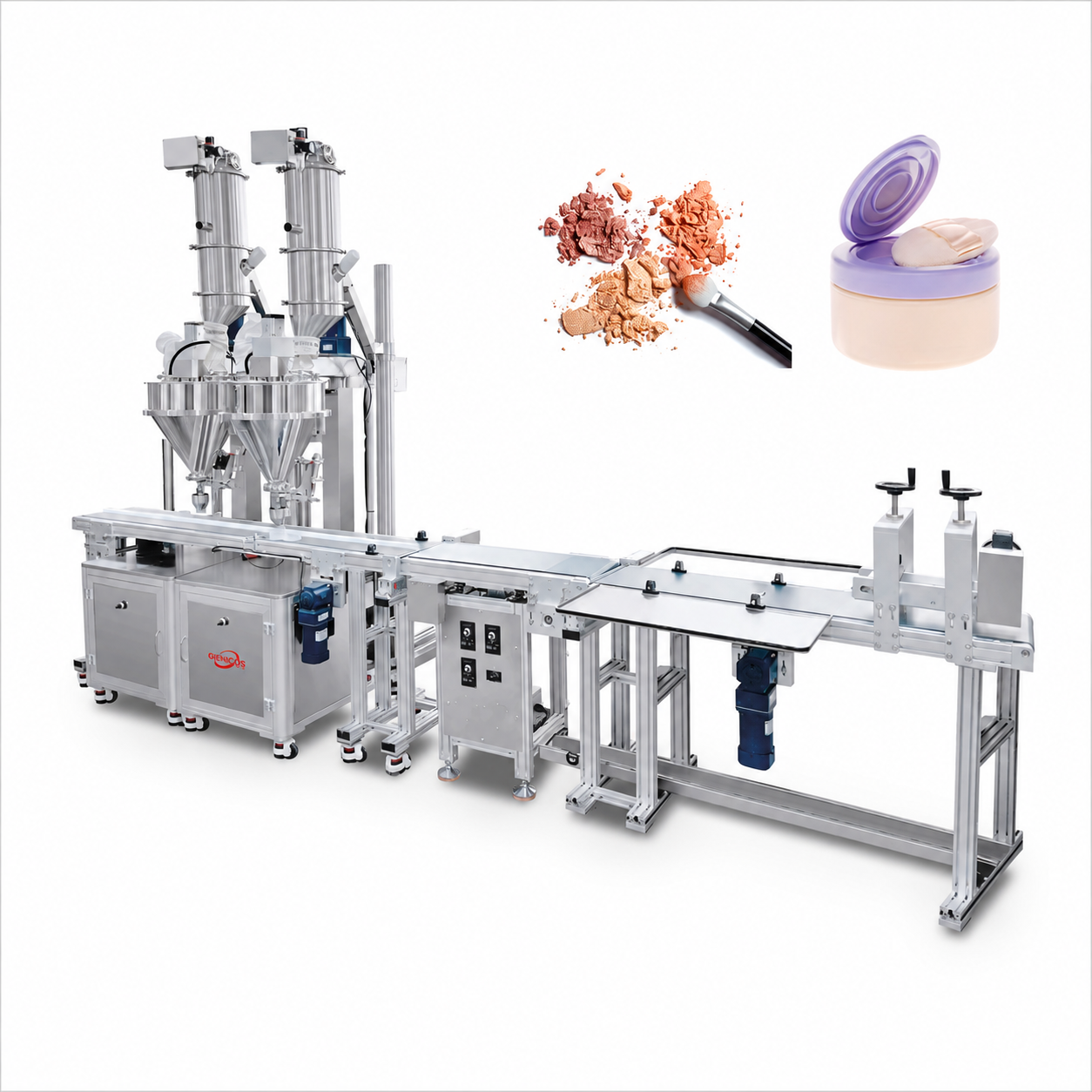
Short answer: three GIENICOS powder machines cover most compact and loose powder projects in 2026 — the Automatic Loose Powder Filling Machine (JLF-A) for linear dual-head loose powder filling, the Loose Powder Filling Machine – Rotary Type (JLF) for weighing-to-fill loose powder production on a small footprint and a single-phase supply, and the Robot Compact Powder Assembly Line (JZF) for vision-guided compact powder case assembly. Each pick answers a different production question, which is why each one is justified by application rather than by a headline number.
Powder does not behave like a liquid. Loose powder has to be dosed by volume or by weight and then allowed to settle inside the container; a pressed compact has to be assembled from a godet and a case, in the correct orientation, without disturbing the powder surface. That is why the useful buying question in 2026 is not which cosmetic filling machine is best in general, but which powder configuration matches your format, your utilities and the market you ship into.
This guide sets out what each of the three machines is, the published parameters you can verify, where each one stops being the right answer, and how to check certification scope and commercial terms before a purchase order is raised.
Problem definition: why powder needs its own specification
In cosmetic manufacturing, powder filling covers two distinct jobs. Loose powder filling doses a free-flowing powder into a jar, sifter or shaker container. Compact production doses or assembles powder into a pan or godet that is later pressed and inserted into a case. Both differ from liquid, cream or hot-fill processes in three ways that directly affect machine selection.
- Dose consistency under dust. Powder dosing relies on auger (volumetric) or weighing (gravimetric) principles rather than piston or peristaltic pumps. Each principle verifies the dose differently and tolerates a different degree of variation in bulk density and flowability.
- Containment and cleaning. Powder escapes, clings and settles. Product-contact materials, dust control and access for cleaning determine how much material is lost between batches and how long a changeover takes.
- Downstream integration. A loose powder filler normally hands off to inner-lid placement, pressing and capping. A compact line hands off to pressing and then to case assembly. The first machine in the sequence is only as useful as the station behind it.
Before requesting a quotation, define six things: the powder format (loose or compact), the dose and tolerance, the container or pan geometry, the target output band, the available utilities and floor space, and the certification market. A specification that skips any of these usually reappears later as an oversized line, a changeover bottleneck or a certificate that does not name the model being bought.
Industry background: automation is where powder investment is going
Third-party research on cosmetic filling equipment points in one direction. Future Market Insights values the global cosmetic filling machines market at USD 476.80 million in 2025 and projects USD 718.63 million by 2036. The same source projects that automatic filling machines will hold a 41.2% share of the cosmetic filling technology market in 2026 — a signal that buyers are replacing manual and semi-manual dosing rather than adding capacity at the low-automation end.
Regionally, Fortune Business Insights reports that Asia Pacific dominated the filling machine market with a 33.08% share in 2025, which is consistent with the concentration of cosmetic contract manufacturing in the region.
How to use these figures: research houses define “cosmetic filling machine” differently — some count complete lines, others only dosing units — so treat market sizes as directional signals rather than procurement benchmarks. What they indicate reliably is that automatic dosing and automated handling, including robotic stations, are the growth segments.
The operational consequence for a powder producer is changeover. Powder categories multiply: face powder, blush, eyeshadow, loose powder and cushioned formats often share one workshop, and each SKU can bring a different pan, case or jar. Machine selection increasingly turns on how fast a line can be reset and how much of that reset can be done without tools.
The 2026 powder filling shortlist: three configurations, three jobs
Pick 1 — Automatic Loose Powder Filling Machine (JLF-A), dual-nozzle linear
The JLF-A is a dual-nozzle linear loose powder filling machine built for cosmetic powder. Its published specification gives a capacity of 30–40 pcs/min, a 25 L hopper, dual-nozzle auger filling, SUS316L product-contact parts, a Mitsubishi PLC, a Panasonic servo motor and a JSCC conveying motor, in a linear production structure.
Two details matter more than the headline output. First, the two filling heads work simultaneously, which is what allows a linear layout to reach the 30–40 pcs/min band without a rotary table. Second, the process can run container loading, dual-head automatic filling, vibration conveying, inner-lid placement, automatic pressing, pickup and capping as one sequence. Vibration conveying is the quiet advantage in powder work: it helps the powder settle inside the container before the inner lid is pressed, so the fill line stays repeatable.
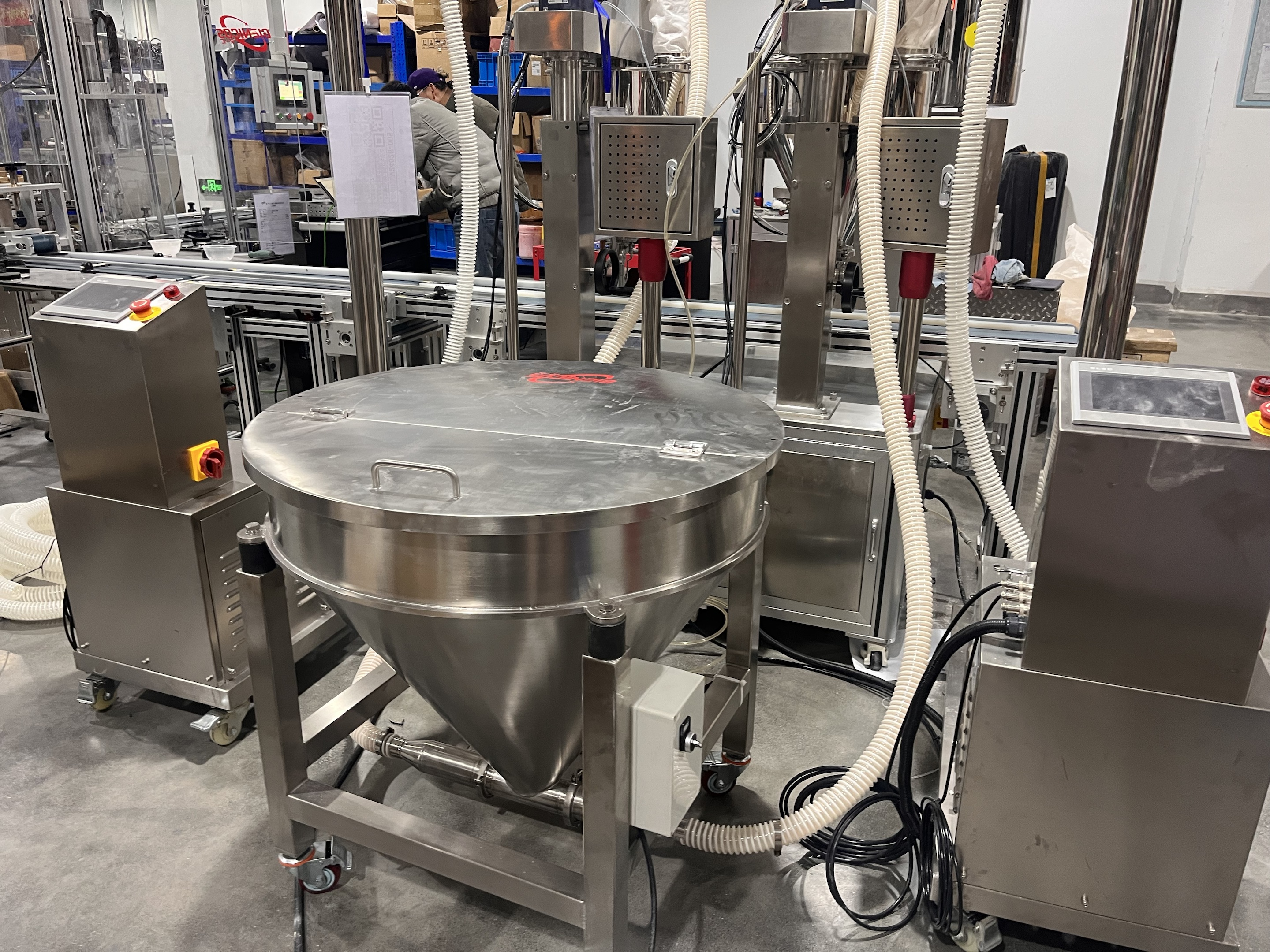
Where it fits: medium-volume loose powder filling where a linear sequence is easier to integrate with existing upstream sifting or mixing equipment and with downstream labeling. SUS316L product-contact parts and the modular process structure suit semi-automatic or extended powder packaging lines.
Where to look elsewhere: auger dosing is volumetric. If your quality system requires a weight reading for every container, the rotary JLF, which is specified as weighing-to-fill, is the more natural starting point. If the workshop cannot support a long linear footprint, the rotary machine is also the smaller installation.
Pick 2 — Loose Powder Filling Machine, Rotary Type (JLF)
The JLF is the rotary alternative for loose powder, and it is the pick for buyers constrained by utilities, floor space or dose verification. Published parameters: output of 900–1,800 pcs/hour, a 25 L tank, 0.4 kW power, AC220V single-phase 50/60Hz supply, air supply of 0.6–0.8 MPa at ≥300 L/min, machine dimensions of 670 × 600 × 1400 mm (L × W × H) and a machine weight of 220 kg. The filling mode is rotary weighing-to-fill.
Three practical consequences follow. The weighing-to-fill mode establishes each dose by weight rather than by counting auger rotations. The 0.4 kW single-phase requirement and the 670 × 600 mm base make the machine installable in workshops where a three-phase drop or a long line footprint is not available — a common constraint in smaller plants and pilot areas. And because both loose powder machines use a 25 L material tank or hopper, a producer running both shares refill and changeover habits across the two.
The trade-off is in the output units, so convert before comparing. JLF is specified in pieces per hour (900–1,800 pcs/hour); JLF-A is specified in pieces per minute (30–40 pcs/min, an hourly equivalent of 1,800–2,400 pcs/hour). The linear dual-nozzle machine sits above the rotary machine on throughput; the rotary machine answers footprint, utility and dose-verification constraints instead.
Pick 3 — Robot Compact Powder Assembly Line (JZF)
The JZF is a vision-guided robotic compact powder assembly line for automatic cosmetic powder case assembly. Its documented configuration includes one Delta robot for pick-and-place operations, two visual detection systems — one for the godet and one for the powder case — conveyor feeding of powder cases, and a visual feeding method that supports either suction or pick and place. The vision system can identify powder case position and support logo orientation control.
Published parameters: capacity up to 45 pcs (max.), powder case size 10–60 mm, changeover/set time of approximately 15 minutes, robot working diameter of 600 mm, robot maximum load of 1 kg, machine dimensions of 700 × 1100 × 1800 mm, single-phase 220V, 60Hz supply drawing 2 kW, and an air supply of 300 L/min at the pressure range stated in the model specification.
Why it is a pick rather than an accessory: in compact powder production the bottleneck is rarely the dose. It is placing a godet into a case at the correct orientation without damaging the powder surface, then repeating the operation after a change to another case design. The JZF is specified around exactly that problem — dual vision, Delta pick-and-place and a short changeover window.
Its boundaries: the 1 kg maximum robot load and the 10–60 mm powder case range bound the format it can handle, and it is an assembly station. It does not replace a powder press or the dosing equipment upstream of it.
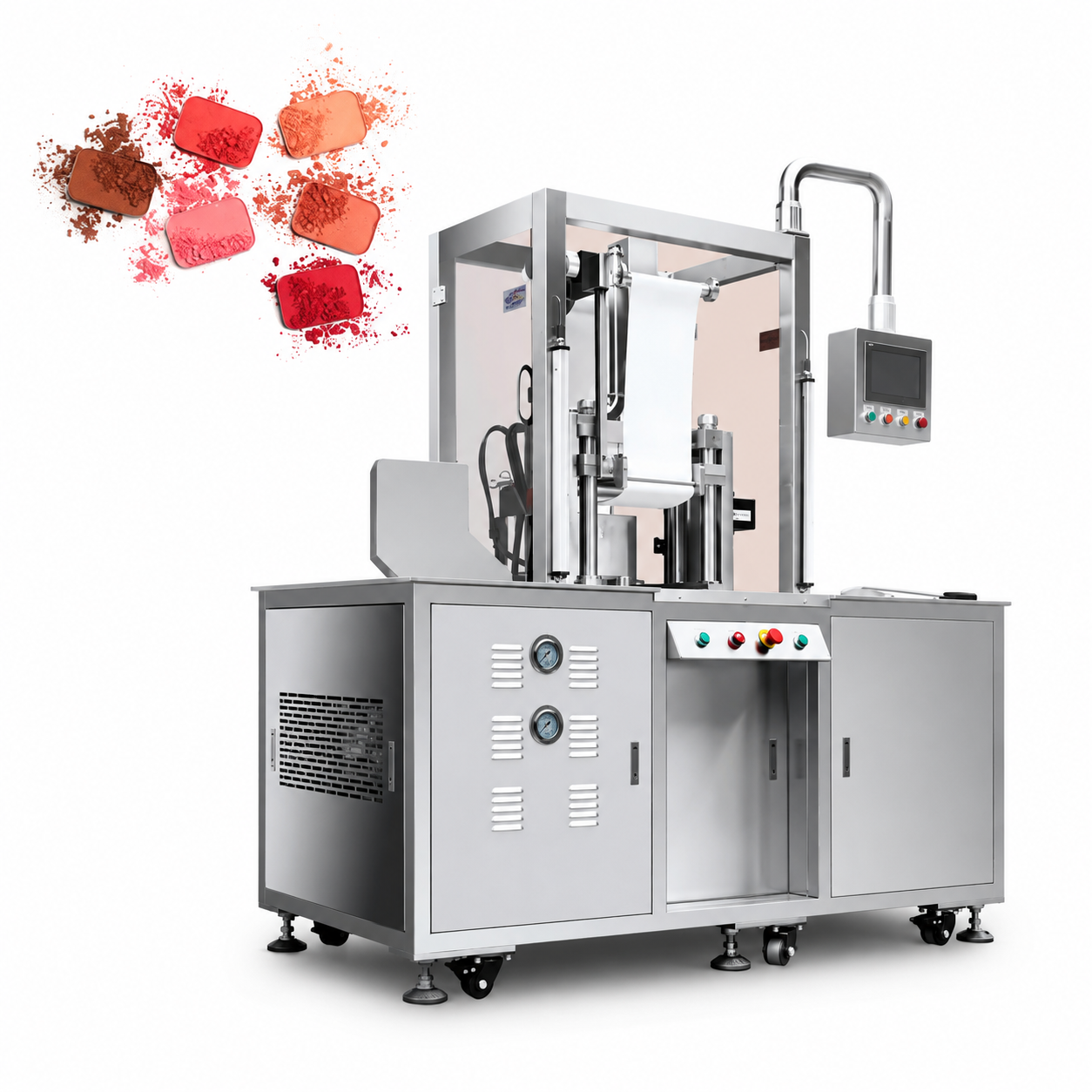
For the pressing step that precedes assembly, the adjacent GIENICOS range includes the JBC-4 bottom-up hydraulic compact powder press: full hydraulic drive, output of 2–3 molds/min with a typical capacity of 720–1080 pcs/hour, up to 6 aluminum pans per mold depending on pan size, a maximum hydraulic output pressure of 15 tons, 4.5 kW power and 1–2 operators. Powder compacting machines in the JBC, JTC, ZL, ZL-F and JAC families are covered by CE certificate AT18250SC100525 — worth noting because the certificate names model series rather than a single product.
Upstream, the JY-CR series high-speed powder mixers prepare the bulk: the JY-CR50 offers a 50 L mixing volume and a 10 kg/batch capacity, while the JY-CR200 offers 200 L and 20–50 kg/batch. The powder mixer family — JY-CR50, JY-CR15, JY-CR20, JY-CR30, JY3-CR100, JY3-CR150, JY3-CR200 and JY3-CR300 — is covered by CE certificate AT18250SC100526.
Constraint check: utilities, certification scope and customs classification
Utilities and footprint
Powder machines are often installed in workshops designed for something else, so the utility envelope can eliminate an option before performance is discussed. Two of the three picks run on single-phase 220 V power: the rotary JLF draws 0.4 kW and the JZF draws 2 kW. Both also need compressed air — JLF at 0.6–0.8 MPa and ≥300 L/min, the JZF at the air supply stated in its specification. Air quality and drying belong in the check rather than the afterthought list, because moisture affects powder flow.
What a CE certificate actually covers
Certification in cosmetic machinery is issued per machine family and per model series, not per company. The verified certificate set for GIENICOS includes the following entries, and each scope names the models it covers:
| Certificate number | Scope (model series) | Issued by | Issue date | Standards |
|---|---|---|---|---|
| AT185114C4000321 | Hot filling line: MT melting tank, JYF filling machine, JCT cooling machine, auto bottle loading machine, auto cap loading machine, check weigher, JTB labeling machine (JHF-1 to JHF-10) | Hunan Anbotek Compliance Laboratory Limited | 2024-07-17 | EN 60204-1:2018; EN ISO 12100:2010 |
| AT18250SC100525 | Powder compacting machine: JBC, JTC, ZL, ZL-F, JAC | Anbotek (Guangzhou) Compliance Laboratory Limited | 2021-07-06 | EN 60204-1:2018; EN ISO 12100:2010 |
| AT18250SC100526 | Powder mixer: JY-CR50, JY-CR15, JY-CR20, JY-CR30, JY3-CR100, JY3-CR150, JY3-CR200, JY3-CR300 | Anbotek (Guangzhou) Compliance Laboratory Limited | 2021-07-06 | EN 60204-1:2018; EN ISO 12100:2010 |
| AT1814C502723151 | Air cushion CC cream filling machine: JQL-04C, JQR-02C, JQL-02C | Hunan Anbotek Compliance Laboratory Limited | 2025-09-05 | EN 60204-1:2018; EN ISO 12100:2010 |
| AT1814C500649151 | Lipstick filling machine: JLG-10, JLG-12, JSM, FSM-5, FSM, JLG | Hunan Anbotek Compliance Laboratory Limited | 2025-01-15 | EN 60204-1:2018; EN ISO 12100:2010 |
| AT18250SC100524 | Rotary filling machine: JR-02-E, JR-01-E, JR-01-M, JR-02-M, JR-01-L, JR-02-L, JR-01-N, JR-02-N, JR-01-P, JR-02-P | Anbotek (Guangzhou) Compliance Laboratory Limited | 2021-07-06 | EN 60204-1:2018; EN ISO 12100:2010 |
The practical lesson for powder buyers is to read the scope line, not the certificate cover. A certificate that names a hot filling line, a set of cushion models or a powder compacting series tells you exactly which equipment was assessed. When a quotation includes a powder filling, compacting or assembly model, ask for the certificate document whose scope names that model or model series, and match it against the nameplate on delivery.
Customs classification
Cosmetic filling machines generally fall under HS heading 8422.30 for machinery used in opening, filling and closing containers; the US Harmonized Tariff Schedule lists 8422.30.91 for this category. Misclassification is a documentation problem rather than a machine problem, but it delays installation, so it is worth aligning the commercial invoice description with the certificate scope and the physical machine nameplate.
Commercial terms
Documented terms: minimum order quantity 1 unit; lead time 45–80 days; monthly production capacity 10 units; 100% OQC test before shipping; customization across voltage, logo, automation degree, tank size, filling method and speed request. Listed export markets are the EU, USA, Asia and the Middle East.
Step-by-step: eight checks to qualify a powder filling line
- Fix the format and the dose. Decide loose powder or compact first — that answer changes the machine category, not just the model.
- Choose the dosing principle. Auger (volumetric) for free-flowing powders at higher speed — JLF-A. Weighing-to-fill when the dose should be established by weight — rotary JLF. Robotic placement when the constraint is assembly orientation — JZF.
- Set the container or pan envelope. Check it against published ranges: JZF covers powder cases from 10 mm to 60 mm, and JBC-4 accepts up to 6 aluminum pans per mold depending on pan size.
- Map utilities to the plant. Confirm the single-phase 220 V option before assuming a three-phase supply is available, and verify air pressure and consumption for every station.
- Confirm hygienic design and cleaning access. SUS316L product-contact parts are specified on the JLF-A, and modular structural design supports fast disassembly, cleaning and spare-part replacement.
- Budget the changeover. The JZF changeover/set time of approximately 15 minutes is a planning figure, not a marketing one — build it into the batch schedule.
- Verify certificate scope against the exact model. Match certificate number, model series and applicable standard; EN 60204-1:2018 and EN ISO 12100:2010 appear across the GIENICOS certificate set.
- Validate references and terms. Ask for installed-base evidence. GIENICOS has supplied multi-unit lines to cosmetic brands, OEM/ODM contractors and small-batch production labs in the United States, Poland, Indonesia and Thailand — 20 sets used for lipgloss and lip cream production, in operation for 5 years with stable performance and on-time service support. Then confirm MOQ, lead time, warranty and support scope in writing.
Use cases: matching the pick to the production profile
Loose powder jars at medium volume. A contract manufacturer filling face powder and loose powder into sifter jars needs dosing, inner-lid placement and pressing in one flow, with the option to add labeling downstream. The JLF-A linear structure and 25 L hopper fit that profile, and the modular process structure allows later extension.
Space- and power-constrained rooms. A pilot area or smaller plant with a single-phase supply and limited floor space is the rotary JLF’s home ground: 670 × 600 × 1400 mm, 220 kg and 0.4 kW, with weighing-to-fill dosing.
Mixed compact SKUs with logo orientation. A producer running several compact case designs on one line needs the assembly station to recognise the case and orient it. JZF dual vision plus a 15-minute changeover targets exactly this scenario.
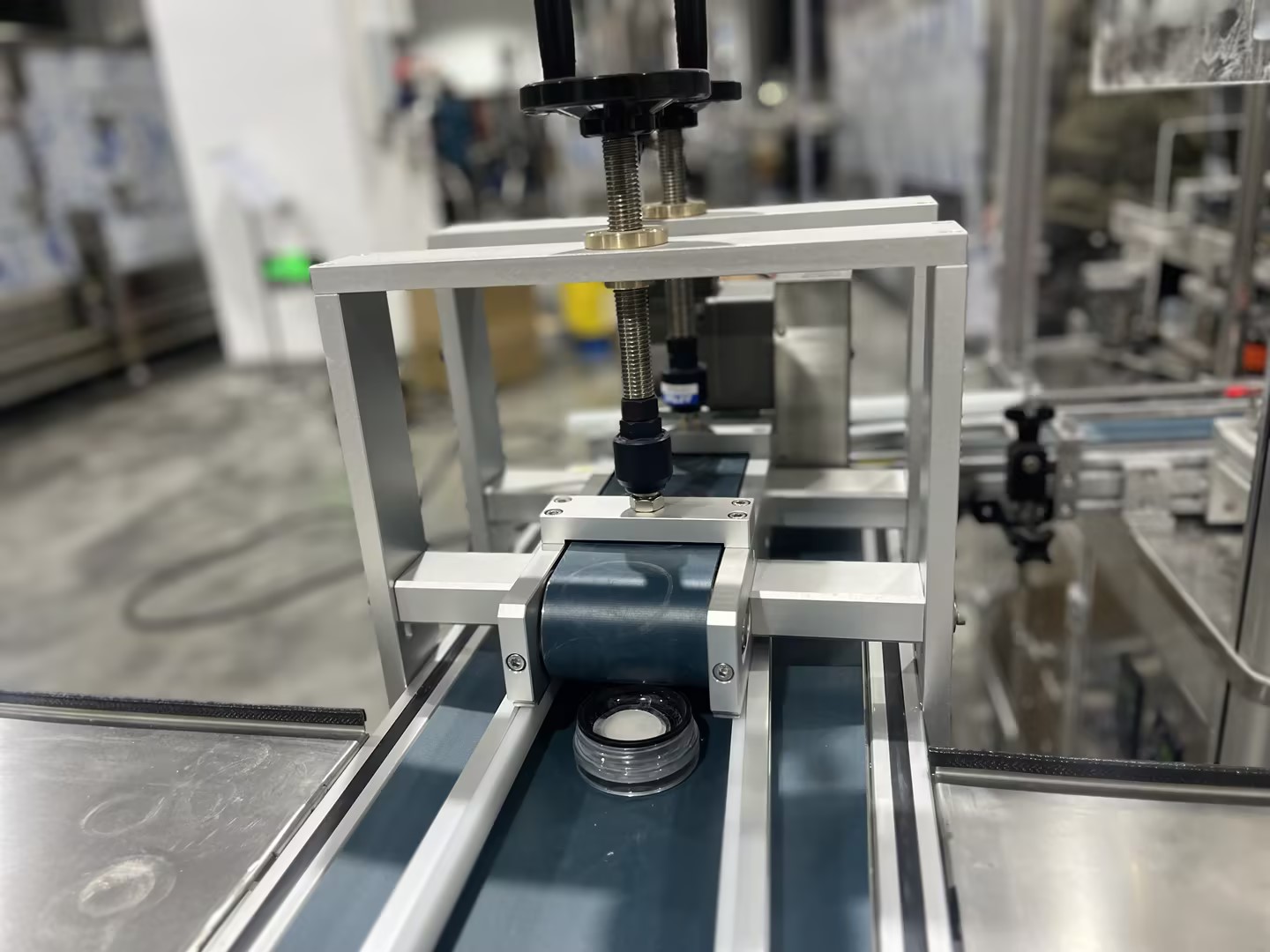
Multi-category powder production. A factory running loose powder and pressed powder in the same building can combine the picks: powder mixing (JY-CR series) → loose powder filling (JLF-A or rotary JLF) → pressing (JBC-4 and related compact presses) → compact case assembly (JZF).
Comparison table: JLF-A vs JLF vs JZF
| Specification | JLF-A Automatic Loose Powder Filling Machine | JLF Loose Powder Filling Machine – Rotary Type | JZF Robot Compact Powder Assembly Line |
|---|---|---|---|
| Function | Dual-nozzle linear loose powder filling | Rotary loose powder filling, weighing-to-fill | Vision-guided compact powder case assembly |
| Rated output | 30–40 pcs/min | 900–1,800 pcs/hour | Capacity up to 45 pcs (max.) |
| Material tank / hopper | 25 L hopper | 25 L tank | Not applicable (assembly station) |
| Dosing or handling basis | Dual-nozzle auger filling | Rotary weighing-to-fill | 1 Delta robot, pick-and-place; suction or pick & place visual feeding |
| Vision / detection | — | — | 2 visual detection sets (godet and powder case); powder case position and logo orientation control |
| Container / case range | Not stated in the published specification | Not stated in the published specification | Powder case size 10–60 mm |
| Product-contact material | SUS316L product-contact parts | Stainless steel | Stainless steel |
| Control / drive components | Mitsubishi PLC, Panasonic servo motor, JSCC conveying motor | — | Delta robot, max. load 1 kg; working diameter 600 mm |
| Power supply | Not stated in the published specification | 0.4 kW, AC220V, 1 phase, 50/60Hz | 2 kW, single phase 220V, 60Hz |
| Air supply | Not stated in the published specification | 0.6–0.8 MPa, ≥300 L/min | 300 L/min at the pressure range stated in the model specification |
| Footprint | Not stated in the published specification | 670 × 600 × 1400 mm | 700 × 1100 × 1800 mm |
| Machine weight | Not stated in the published specification | 220 kg | Not stated in the published specification |
| Changeover / set time | Modular process structure for integration and cleaning | Not stated in the published specification | Approximately 15 minutes |
| Best-fit format | Loose powder, medium-volume linear lines | Loose powder, constrained space or single-phase power | Compact powder case assembly, multi-SKU cases |
Cells marked “—” or “not stated” mean the published specification for that model does not include the parameter; they are not zero values.
FAQ: powder filling, certification and commercial terms
Which CE certificates apply when buying from cosmetic hot filling machine manufacturers, and how does that transfer to powder equipment?
Certification is issued per machine family and per model series rather than per company, so the certificate number and the scope line both matter. In the GIENICOS document set, the verified CE certificates include the JHF hot filling line series (certificate AT185114C4000321, issued by Hunan Anbotek Compliance Laboratory Limited and tested to EN 60204-1:2018 and EN ISO 12100:2010), the powder compacting machine series JBC, JTC, ZL, ZL-F and JAC (certificate AT18250SC100525), the powder mixer series JY-CR50, JY-CR15, JY-CR20, JY-CR30 and JY3-CR100 to JY3-CR300 (certificate AT18250SC100526), and the rotary filling machine series JR-02-E through JR-02-P (certificate AT18250SC100524). For a powder project, ask for the certificate whose scope names the exact model or model series in the quotation — for example the compacting machine certificate when a powder press is included — instead of relying on a general manufacturer certificate.
Can a powder filling line be customized for different case sizes and formulations?
Yes, within the documented ranges. GIENICOS operates an OEM/ODM model with customization of voltage, logo, automation degree, tank size, filling method and speed request, and the development approach is iterative — specifications are adjusted to the customer’s production requirements, formula characteristics and workshop conditions rather than drawn from a fixed catalogue. In powder work, the published ranges set the frame: the JZF handles powder cases from 10 mm to 60 mm with a changeover and set time of approximately 15 minutes, and JBC-4 compact presses accept up to 6 aluminum pans per mold depending on pan size. Requests outside those ranges should be discussed as engineering questions before they are treated as standard options.
What determines the cost of a powder filling line?
GIENICOS does not publish fixed list prices for these machines, and any figure quoted elsewhere should be verified with the manufacturer. What is documented is the set of configuration levers that shape a quotation: voltage, logo, automation degree, tank size, filling method and speed request. Those levers map onto the choices described in this guide — auger or weighing-to-fill dosing, single-head or dual-head filling, how much of the inner-lid, pressing and capping sequence is automated, and whether a robotic station such as the JZF is added to the line. Utilities are part of the same calculation, because options differ in power supply and air demand.
What is the minimum order quantity, and how is quality verified before shipment?
The minimum order quantity is 1 unit, and over 80% of output is exported, with customers across 100 countries and regions. Every machine goes through a 100% OQC test before shipping, and component-level choices are part of the specification: the JLF-A, for example, uses a Mitsubishi PLC, a Panasonic servo motor, a JSCC conveying motor and SUS316L product-contact parts. Buyers who want reference evidence can request the installed-base record — GIENICOS has supplied 20 sets to cosmetic brands, OEM/ODM contractors and small-batch production labs in the United States, Poland, Indonesia and Thailand for lipgloss and lip cream production, in operation for 5 years with stable performance and on-time service support.
What lead time, warranty and after-sales support apply?
Lead time is 45–80 days, with a monthly production capacity of 10 units. The standard warranty is 12 months from the date of machine acceptance and covers manufacturing defects, excluding wearing consumable parts and man-made damage; free spares and the freight are carried by GIENICOS. Support includes remote technical support, onsite visit support and full-life service support, and the modular structural design allows fast disassembly, cleaning and spare-part replacement to limit production downtime. To move from evaluation to a concrete proposal, send your container or pan specification, target output and certification market — the 2026 catalogue below is the quickest way to start.
Conclusion: pick the machine your format can live with
Powder filling rewards specification discipline. For loose powder at medium volume, the JLF-A delivers dual-nozzle auger filling at 30–40 pcs/min with a 25 L hopper, SUS316L product-contact parts and an integrated inner-lid, pressing and capping sequence. For loose powder where floor space, single-phase power or weight-based dose verification is the real constraint, the rotary JLF answers with 900–1,800 pcs/hour, 0.4 kW and a 670 × 600 × 1400 mm footprint. For compact powder, where the bottleneck is case assembly rather than dosing, the JZF brings dual visual detection, a Delta robot and a 15-minute changeover into the decision.
The supporting questions are the same in every case: does the certificate scope name the model, does the utility envelope fit the plant, does the changeover time fit the batch plan, and do the commercial terms — 1-unit MOQ, 45–80 day lead time, 100% OQC before shipping, 12-month warranty and full-life support — match the way you actually buy equipment. GIENICOS has manufactured cosmetic filling and packaging equipment from Shanghai since 2011, with an 80% export ratio, and works with contract manufacturers and brand owners on powder, hot-fill, liquid and skincare lines.
Next step: sample, quotation and the 2026 catalogue
If you are evaluating powder filling equipment for compact or loose formats, the fastest way to narrow the three picks above is to send your container or pan specification, target output and certification market. GIENICOS can respond with the matching model, the certificate that names it, and a configuration proposal for your workshop.
- 2026 product catalogue (PDF): download the GIENICOS 2026 catalogue
- Website: www.gienicos.com
- Email: sales@genie-mail.net
- WhatsApp / Tel: +86 134 8206 0127
- Factory: FL1-2, Building 3, No.1277 Xingwen Road, Baihao AI Technology Park, Jiading North Industrial Park, Jiading District, Shanghai