
Cosmetic Filling Machine Application Guide: Scaling from Trial Samples to Full Production
Short answer: a cosmetic filling line should be specified as three linked stages — trial sample, pilot and full production — because each stage is a different production problem. Trials run on semi-automatic units such as the Semi Automatic Mascara Lipgloss Filling Machine JR-01M/L and JR-02M/L or the Semi Automatic Lipstick Filling Machine JLG-10/12. Pilot volumes move to multifunctional and rotary systems such as the Multifunctional Filling Production Line JYF-2 to JYF-12 and the Rotary Filling Machine JR-01/02 series. Volume production is specified as a line, for example the Hot Filling & Cooling Line JHF-1 to JHF-10 with melting, filling, cooling, cap loading, check weighing and labeling. Filling upgrades alone rarely remove a bottleneck; capping, labeling, cooling and inspection must be matched stage by stage.
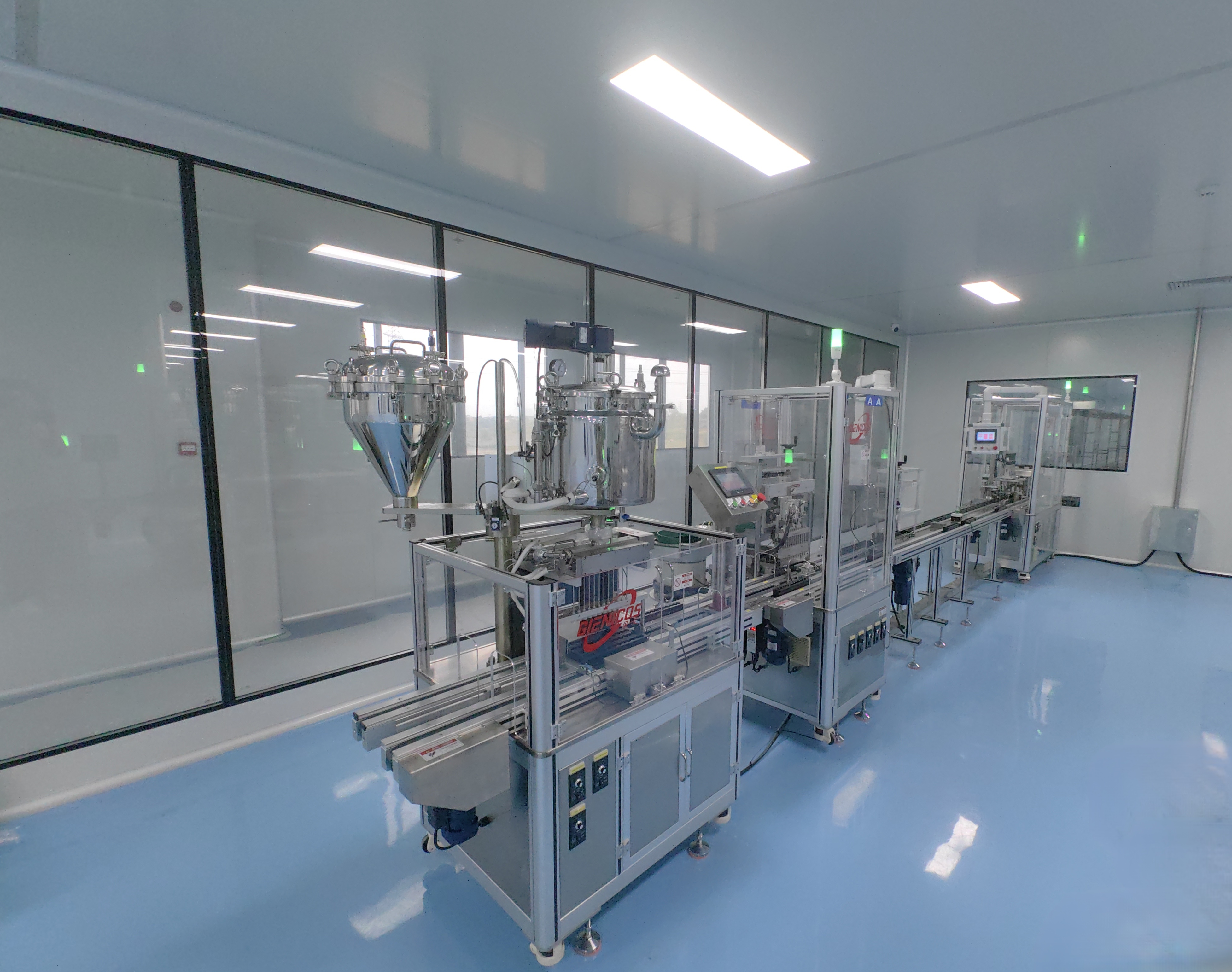
Scaling a cosmetics line is not one purchase decision; it is a sequence of decisions that must stay compatible with each other. A brand that validates a lip gloss formula on a semi-automatic filler and later moves to a rotary line needs the second machine to accept the same container, the same fill-weight logic and the same downstream capping and labeling discipline. This guide sets out that sequence using GIENICOS machine families. GIENICOS — SHANGHAI GIENI INDUSTRY CO., LTD. — is a Shanghai-based manufacturer of intelligent cosmetic filling and packaging equipment, founded in 2011, with a factory in the Baihao AI Technology Park in Jiading District and an export share of roughly 80% across the EU, USA and Asia.
Problem Definition: Where Cosmetic Scale-Up Usually Breaks
Scale-up failure in cosmetics is rarely a filling-accuracy failure; it is a stage-mismatch failure. Four patterns account for most of the cost:
- Automation bought before the formula is fixed. A fully automatic line specified during R&D locks the production team into long changeovers and large minimum batches at exactly the moment the formula is still changing.
- Filling upgraded, finishing left behind. A new rotary filler is installed while capping, check weighing and labeling stay manual, so real output is set by the slowest station rather than the filler.
- The thermal chain broken on hot-pour products. Lipstick, lip balm and other hot-poured formats depend on a continuous path from melting tank to filling head to cooling. When volume grows, an undersized or unmatched melting and cooling section distorts both the fill and the surface finish.
- Clean-room and changeover requirements added late. GMP clean-room compatibility, fast disassembly and modularity are structural decisions; retrofitting them costs more than specifying them at the start.
All four are planning errors rather than equipment defects. They are avoided by treating the trial-sample stage, the pilot stage and the full-production stage as three different production problems with three different equipment answers.
Industry Background: Why Staged Filling Capacity Is Planned More Carefully Now
Market data supports the direction of automation, but not the shortcut to it. Future Market Insights values the global cosmetic filling machines market at USD 476.80 million in 2025 and projects USD 718.63 million by 2036. The same source estimates that automatic filling machines will hold a 41.2% share of the cosmetic filling technology market in 2026, while Fortune Business Insights reports that Asia Pacific accounted for 33.08% of the wider filling machine market in 2025.
Two conclusions follow for buyers. First, automation is the mainstream investment, so equipment chosen today should be able to grow into automatic operation instead of being replaced by it. Second, because Asia Pacific carries a large share of global supply, specification quality rather than availability is the variable that separates projects.
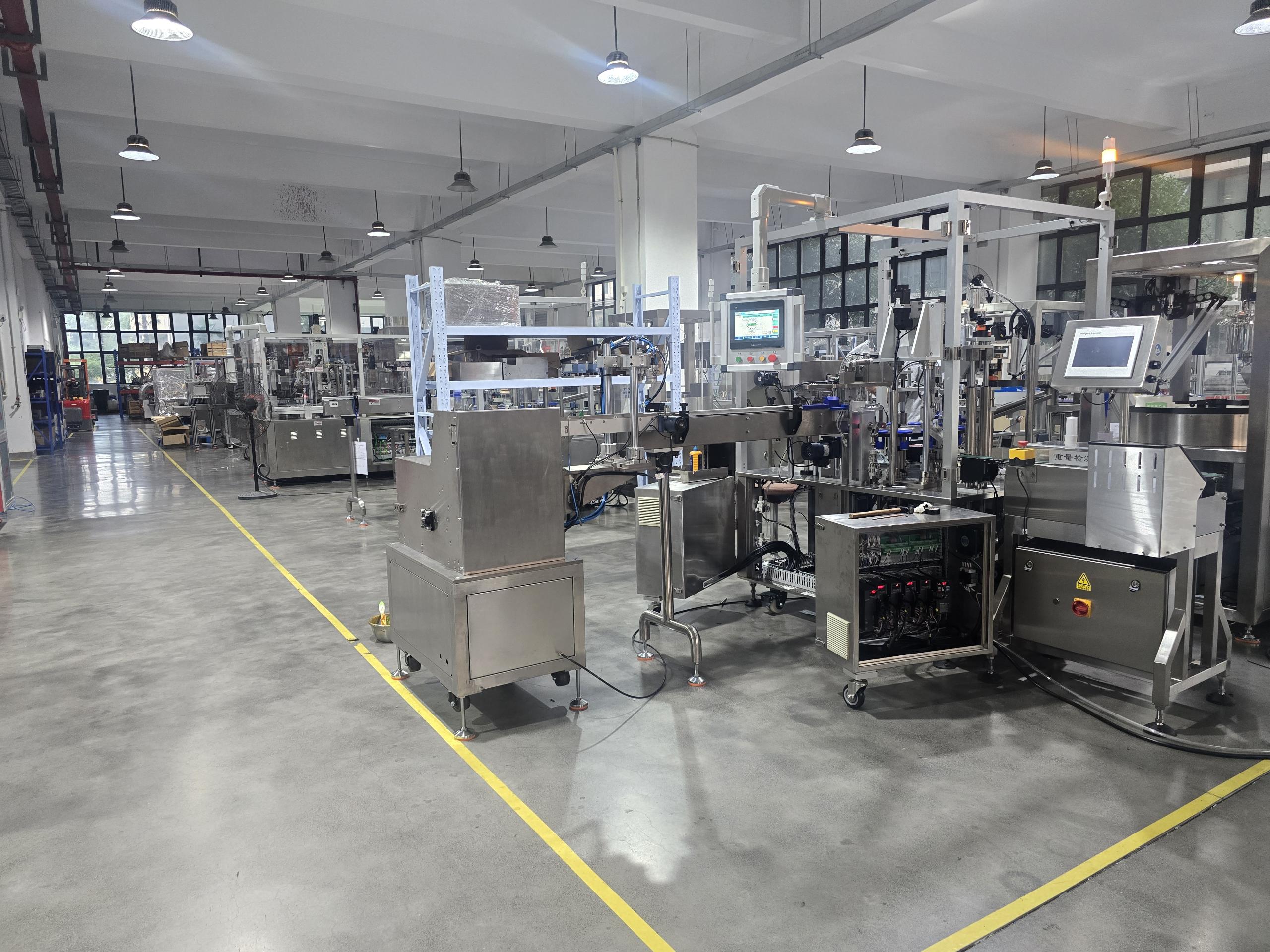
GIENICOS operates inside that supply base. The company runs a 2,000 ㎡ factory, employs 30 people with a 10-engineer R&D team, and reports an annual output of 100 units. It holds 42 authorized patents covering invention patents, utility model patents and software copyrights, and established an AI division in 2020 focused on vision-based applications, smart manufacturing and AI-driven solutions. Its customer base spans 100 countries and regions, including project partnerships with private-label and contract manufacturers such as COSMAX, INTERCOS and Weckerle, alongside brand owners including L’Oréal, Winona and Chando.
Detailed Solution: Matching Filling Equipment to Each Production Stage
A cosmetic filling machine is only correctly specified when its stage is named first. The three stages below describe what each machine family proves before the next investment is made.
Stage 1 — Trial samples: validate the formula, not the throughput
The trial-sample stage answers three questions: does the fill weight stay inside tolerance, does the container and closure combination work, and how does the formula behave after filling. Semi-automatic equipment is the appropriate answer because changeover stays short and many small batches can run in sequence.
Mascara, lip gloss, lip tint and concealer. The Semi Automatic Mascara Lipgloss Filling Machine JR-01M/L and JR-02M/L handle the product group that later moves to automatic filling. The Lip Pouch Filling Machine for Lipgloss Concealer JR-01P covers pouch and tube formats, and the Eyeliner Filling Machine JR-02E covers eyeliner and comparable fine-tip formats. Eyebrow pencil filling belongs to the same small-batch evaluation group, where the open question is usually container fit rather than speed.
Lipstick and lip balm. The Semi Automatic Lipstick Filling Machine JLG-10/12 and the Half Silicone Lipstick Lipbalm Filling Line JSM are the trial-stage tools for hot-poured bullets. They should not be specified without the thermal chain: the Cosmetic Melting Tank MT 100 SE and MT 300 SE, the Multi Tank Melting System MT 20 SE, the Oil Heating Melting Tank MT 30SE, the Lipstick Dispersion Tank MT 50P/MT 100P and the Hot Pouring Machine TSP. For single-nozzle trials, the Servo Piston Filling Machine JSFL 1-2 and the Single Nozzle Hot Filling Line JSFL provide a contained starting point before multi-station equipment is justified.
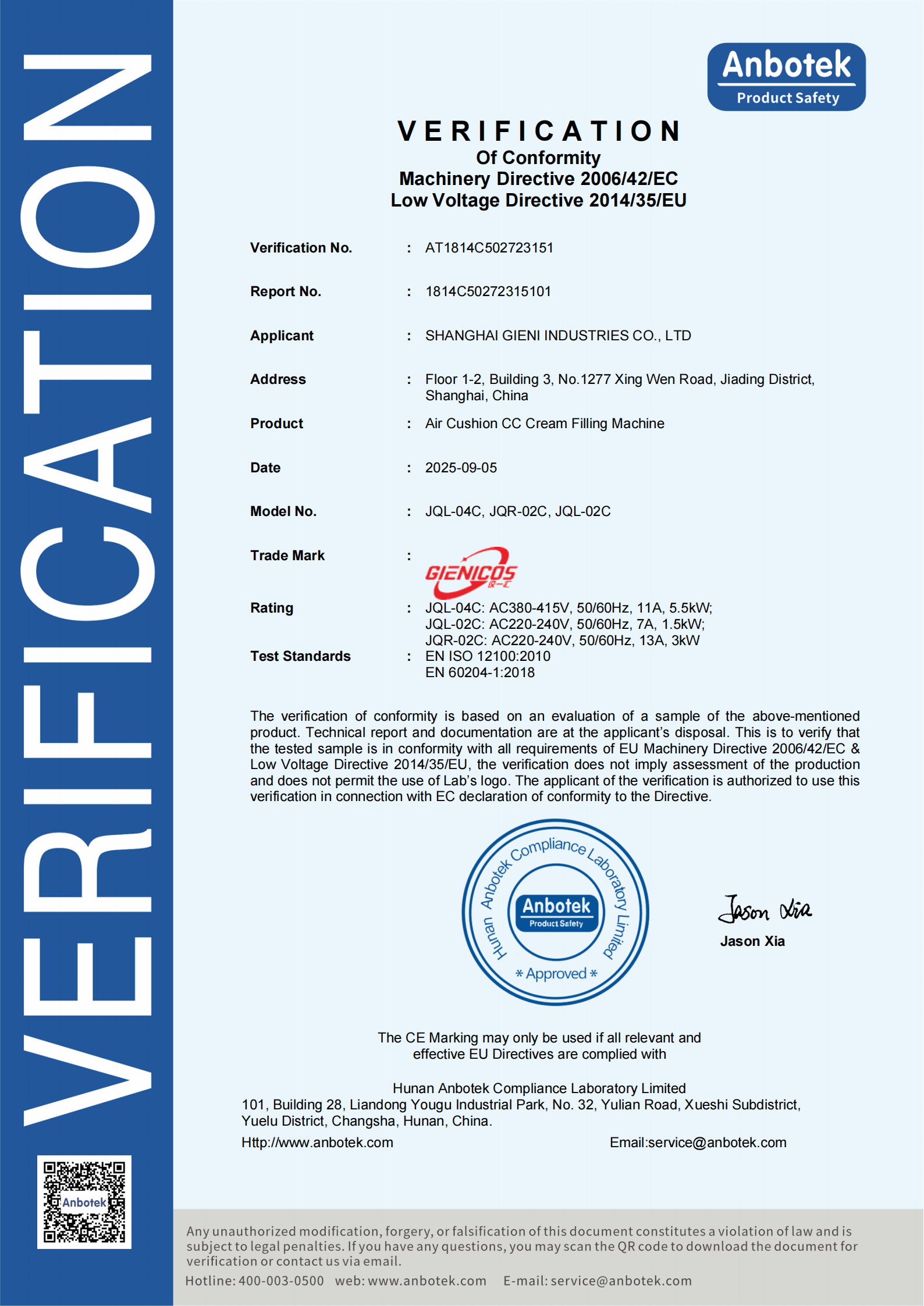
Cushion, cream and skin care. The Air Cushion CC Cream Filling Machine JQR-02C, the BB CC Cushion Filling Machine JQL-04C and the air cushion filling machine models JQL-02C cover cushion formats. Cream filling machine, toner filling machine and skin care filling machine configurations cover cream and lotion consistency trials, where the question is fill uniformity across viscosity rather than line speed, and foundation formats are evaluated on the same basis.
Powder. Powder work starts with blending: the High Speed Powder Mixer JY-CR50 through JY-CR300 covers lab to production blending. Forming follows with the Compact Powder Press Machine JBC-4, the Bottom Up Compact Powder Machine JBC-5, the Compact Powder Press Machine JTC and the Powder Compacting Machine ZL, ZL-F and JAC. Loose powder filling machine formats are evaluated at the same stage, because loose and pressed powder share the same upstream blend.
Stage 2 — Pilot production: add automation where the bottleneck actually is
Pilot production introduces indexing, in-line capping and repeatable shift output. The natural bridge is the Multifunctional Filling Production Line JYF-2 to JYF-12 together with the Rotary Filling Machine JR-01/02 series, where toner and cream formats, mascara and lip gloss, eyeliner and concealer pouches converge onto one machine architecture. The model suffix identifies the format: JR-02-E for eyeliner, JR-01-P for lipgloss and concealer pouches, JR-01-M/L and JR-02-M/L for semi-automatic mascara and lipgloss, JQR-01A for automatic mascara and lipgloss, and JQH-02 as a combined automatic filling and capping unit.
Rotary nail polish filling belongs to this stage as well: nail polish filling machine configurations are specified once a formula has been proven and the format needs consistent indexing rather than operator-paced filling.
The Automatic Lipgloss Filling and Capping Machine JQH-02 deserves specific attention in a scale-up plan, because combining fill and cap in one unit removes the manual handoff where pilot lines normally lose their theoretical speed.
Stage 3 — Full production: build the line as a system, not as a bigger filler
The Hot Filling & Cooling Line JHF-1 to JHF-10 is the clearest stage-three answer because it is delivered as a system: melting tank, JYF filling machine, JCT cooling machine, automatic bottle loading, automatic cap loading, check weigher and JTB labeling machine. In a high-speed lipgloss, mascara and lip tint application, GIENICOS specifies automatic precise filling, automatic wiper loading and pressing, 10-head automatic capping by servo motor and a line speed of 80 pcs per minute, with MES, remote system, automatic check weighing and rejection, automatic labeling and sleeve shrink labeling as matched equipment, under a GMP clean-grade compatible requirement.
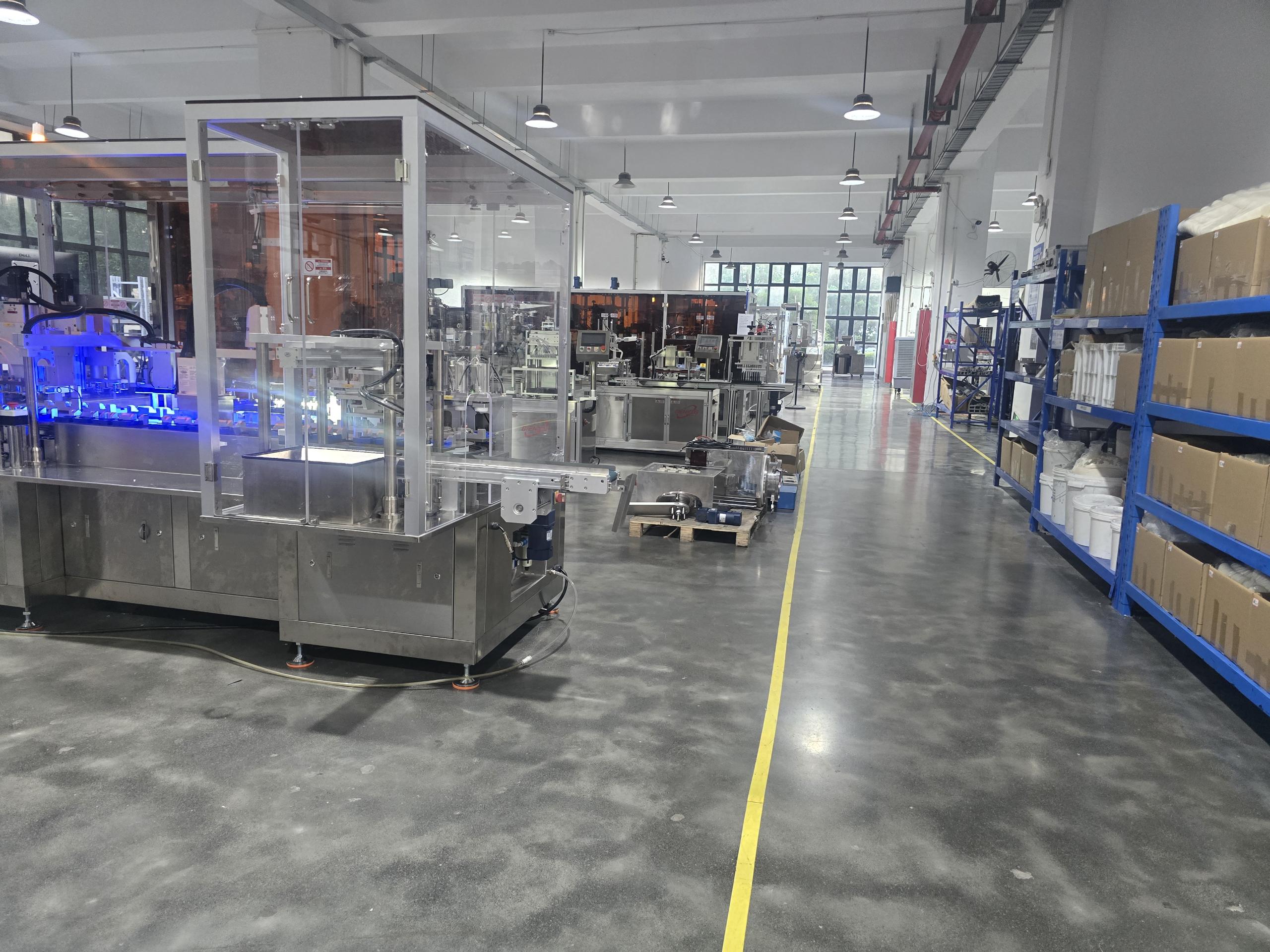
Two integration rules follow. First, an automatic cosmetic filling line is only as fast as its inspection and labeling stations, so check weigher, lipstick labeling machine, sleeve shrink labeling machine and the hot filling cooling machine section must be sized together with the filler. Second, customization should be decided once and applied across the whole line: voltage, logo, automation degree, tank size, filling method and speed request are the standard customization dimensions.
Stage rule of thumb: move to the next stage only when the current stage has a written exit criterion — an approved fill weight, an approved container and closure pair, and a documented machine setting that the next machine can inherit.
Step-by-Step Breakdown: A Scale-Up Plan That Holds Across All Three Stages
- Fix the product and packaging matrix first. List every format the line must run — lip gloss, liquid lipstick, lip tint, mascara, eyeliner, eyebrow pencil, concealer, lipstick, lip balm, foundation, cushion, cream, toner, lotion, nail polish, loose and pressed powder — with container, closure and target fill weight. The matrix determines how many machine families are needed and whether one rotary platform can cover several of them.
- Choose the filling principle per format, not per factory. Hot-poured products need melting, pouring and cooling; cream and lotion need viscosity-appropriate filling; powder needs blending and compacting. Merging these into one specification is the most common cause of a line that satisfies nobody.
- Build the trial-sample cell with a defined exit criterion. Run the semi-automatic unit until fill weight, appearance and cooling behaviour are stable, then record the settings that produced the approved sample. Those settings become the starting parameters for the pilot machine.
- Agree acceptance before the equipment is built. The standard route is a factory acceptance test on site or a video inspection before shipment, with 100% OQC testing before shipping. Payment terms are typically T/T 40%/60%, and delivery terms can be FOB, CNF, CIF or DDP.
- Bridge throughput station by station. Compare filling rate with cap loading, check weighing and labeling. If one station stays manual, that station sets the line. Add automation where output is limited, not where automation is easiest.
- Match capping and labeling to the stage. Semi-automatic filling can run with operator capping; pilot and production stages should use the in-line capping of JQH-02 or the automatic cap loading inside a JHF line. Labeling follows the same logic: sleeve shrink labeling and lipstick labeling are line-level decisions, and the choice between horizontal and rotary labeling should be resolved from container shape before installation, not after.
- Design for cleaning, changeover and clean-room compatibility. GIENICOS uses a modular structural design so key assemblies support fast disassembly, cleaning and spare-part replacement. This directly reduces changeover downtime, which is the real cost in a multi-format cosmetics factory.
- Secure service continuity before ramp-up. Standard warranty is 12 months from machine acceptance and covers manufacturing defects, excluding wearing consumable parts and man-made damage, with free spares and freight carried by the supplier. Remote technical support, on-site visits and full life service support should be confirmed in the contract, because a line without support during ramp-up will not hold its output.
Use Cases: How Different Cosmetic Formats Scale
Lip gloss and lip cream contract manufacturing. GIENICOS has delivered 20 sets of equipment to cosmetic brands, OEM/ODM contractors and small-batch production labs in the United States, Poland, Indonesia and Thailand for lip gloss and lip cream production. Those lines have run for five years with stable operation and on-time service support; the reported strengths are high precision, high efficiency, lower labour cost, modular customization and turnkey line delivery. That profile is the practical evidence that the trial-to-production logic holds across countries and formats.
Hot-pour lipstick and lip balm. A lipstick line scales by protecting the thermal chain: MT series melting and dispersion, TSP hot pouring, JLG or JSM filling, then controlled cooling. When a brand adds shades, the constraint moves from filling speed to changeover and cleaning between colours.
Cushion and foundation. Cushion work scales from JQL-04C and JQR-02C trials to indexed filling with consistent dosing into absorbent pads; the limiting factor is usually fill uniformity rather than throughput.
Powder. Powder lines scale in two directions: blending capacity through the JY-CR series, and pressing through JBC, JTC, ZL, ZL-F or JAC. Because powder is shared upstream, blend capacity is normally upgraded before pressing capacity.
Skin care, toner and nail polish. Cream filling machine and toner filling machine configurations follow the same staged logic as colour cosmetics, while nail polish filling is specified with attention to the solvent base of the product and the containment the workshop requires. Eyebrow pencil and eyeliner formats typically scale from semi-automatic to rotary units within the same JR platform.
Comparison Table: Stage, Machine Family and Production Role
| Production stage | Filling equipment | Automation profile | What the stage proves | Main constraint |
|---|---|---|---|---|
| Trial sample — cold fill (mascara, lip gloss, lip tint, concealer, eyeliner) | Semi Automatic Mascara Lipgloss Filling Machine JR-01M/L, JR-02M/L; Lip Pouch Filling Machine JR-01P; Eyeliner Filling Machine JR-02E | Semi-automatic, operator-loaded | Fill weight and container/closure fit | Frequent changeover, small batches, cleaning between formulas |
| Trial sample — hot pour (lipstick, lip balm, wax) | Cosmetic Melting Tank MT series; Hot Pouring Machine TSP/TSF; Semi Automatic Lipstick Filling Machine JLG-10/12; Half Silicone Lipstick Lipbalm Filling Line JSM; Single Nozzle Hot Filling Line JSFL | Semi-automatic with thermal control | Pour temperature, cooling behaviour and surface finish | Thermal continuity from tank to mold or bullet |
| Trial sample — cushion and cream | Air Cushion CC Cream Filling Machine JQR-02C, JQL-02C; BB CC Cushion Filling Machine JQL-04C; cream filling machine and toner filling machine configurations | Semi-automatic | Fill uniformity across viscosity and absorbent media | Sponge or foam behaviour, viscosity differences |
| Pilot production | Multifunctional Filling Production Line JYF-2 to JYF-12; Rotary Filling Machine JR-01/02 series; Automatic Lipgloss Filling and Capping Machine JQH-02; Automatic Mascara Lipgloss Filling Machine JQR-01A | Indexing automatic with in-line capping | Stable shift output and process capability | Balancing filler, cap loader and labeler |
| Full production — hot filling line | Hot Filling & Cooling Line JHF-1 to JHF-10: MT melting tank, JYF filling machine, JCT cooling machine, automatic bottle loading, automatic cap loading, check weigher, JTB labeling machine | Fully automatic, PLC control, MES and remote-system ready | Continuous output with inspection and rejection (application reference: 10-head servo capping, 80 pcs per minute) | Clean-room compatibility, inspection integration, upstream and downstream synchronization |
| Powder | High Speed Powder Mixer JY-CR50 to JY-CR300; Compact Powder Press Machine JBC-4, JTC; Bottom Up Compact Powder Machine JBC-5; Powder Compacting Machine ZL, ZL-F, JAC; loose powder filling machine formats | Semi-automatic to automatic | Press quality and powder fill consistency | Powder flow, tooling per pan size, dust control |
FAQ
Which CE documentation should a cosmetic filling line carry for EU delivery?
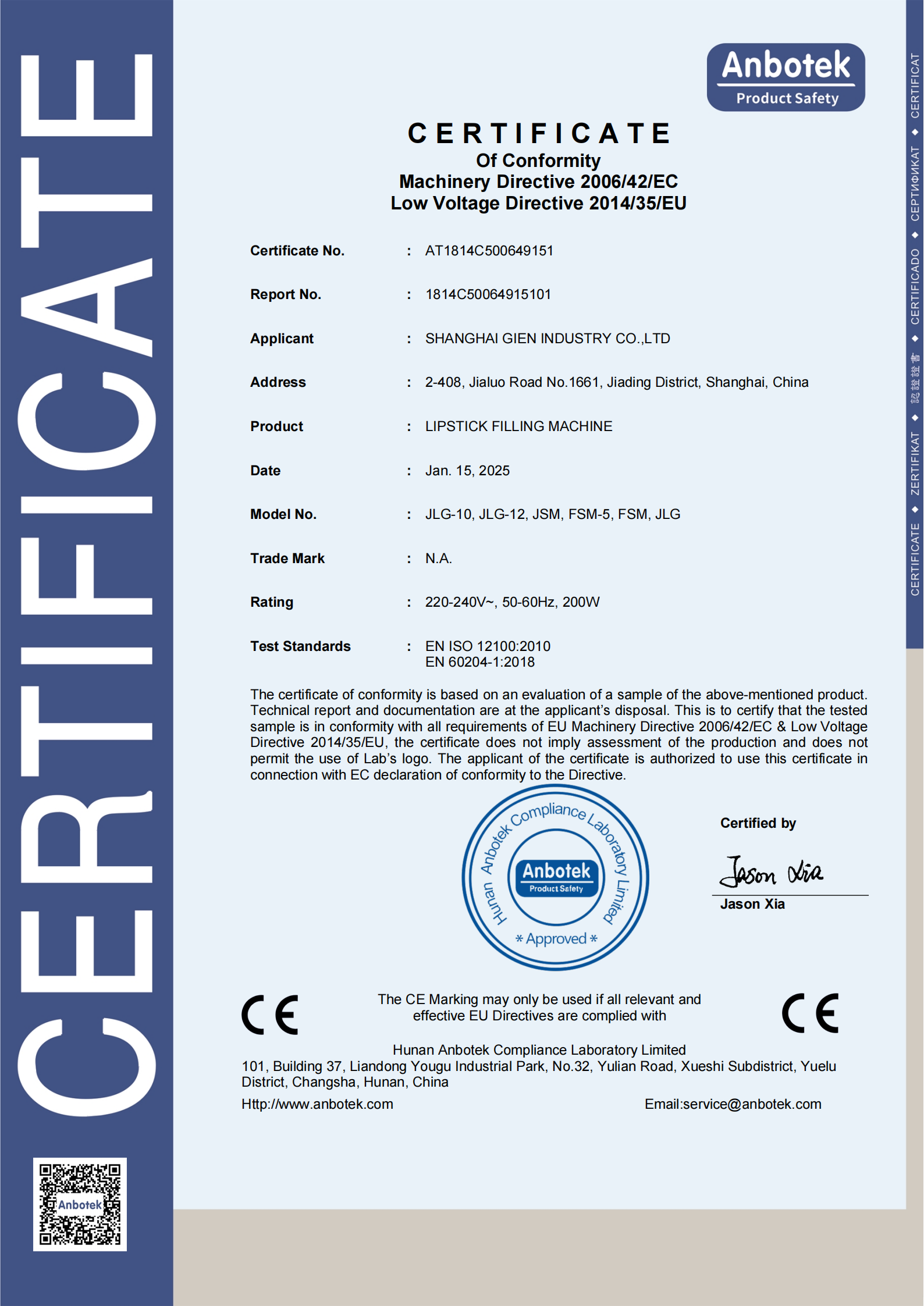
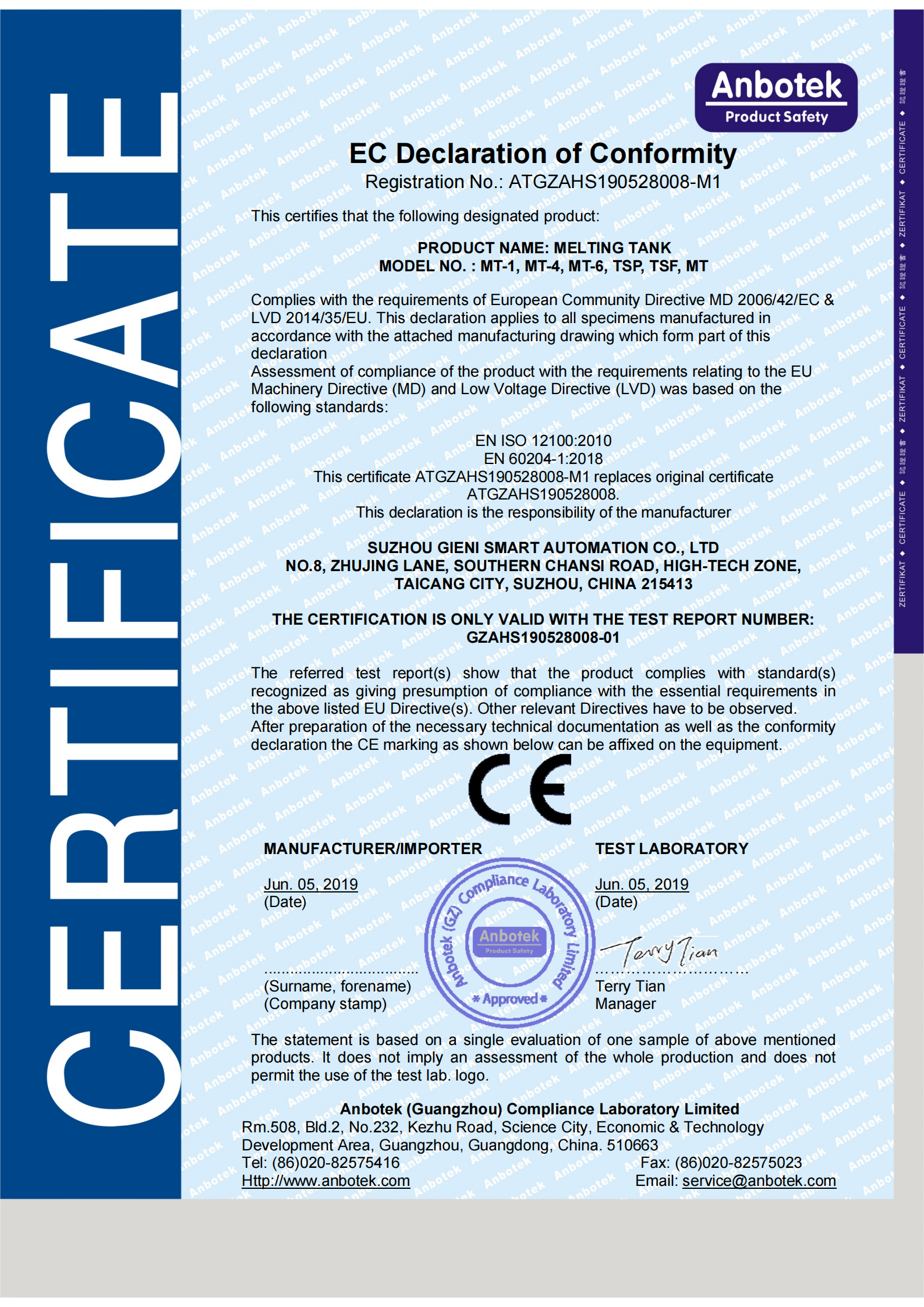
Every machine family should hold its own CE certificate stating the certificate number, issuing laboratory, applicable standards and the exact model list. GIENICOS certificates are issued by Anbotek compliance laboratories against EN 60204-1:2018 and EN ISO 12100:2010. Current examples include the Hot Filling & Cooling Line JHF-1 to JHF-10 under certificate AT185114C4000321, whose scope covers the MT melting tank, JYF filling machine, JCT cooling machine, automatic bottle loading, automatic cap loading, check weigher and JTB labeling machine; the Multifunctional Filling Production Line JYF-2 to JYF-12 under AT58250SC100097; the Single Nozzle Hot Filling Line JSFL under AT18250SC000523; the Rotary Filling Machine JR-01/02 series under AT18250SC100524; the Lipstick Filling Machine JLG-10, JLG-12, JSM, FSM-5, FSM and JLG under AT1814C500649151; the Air Cushion CC Cream Filling Machine JQL-04C, JQR-02C and JQL-02C under AT1814C502723151; the Melting Tank MT-1 family under ATGZAHS190528008-M1; the Powder Compacting Machine JBC, JTC, ZL, ZL-F and JAC under AT18250SC100525; and the Powder Mixer JY-CR series under AT18250SC100526. For customs classification, cosmetic filling machinery falls under HS Code 8422.30, with 8422.30.91 covering machinery for opening, filling and closing containers.
Can one supplier support the move from trial samples to full production?
Yes, but through a family of machines rather than a single unit. GIENICOS covers the trial stage with semi-automatic mascara, lipgloss, lipstick and hot pouring equipment, the pilot stage with the JYF-2 to JYF-12 multifunctional lines, the JR rotary series and the JQH-02 filling and capping unit, and the production stage with the JHF hot filling and cooling line together with check weigher and labeling equipment. Customization is available across voltage, logo, automation degree, tank size, filling method and speed request, and machines are built on a modular structural concept so key assemblies can be disassembled quickly for cleaning and spare-part replacement.
What defines the commercial scope of a staged filling project?
Four commercial terms frame the project. Minimum order quantity is 1 unit, delivery terms can be FOB, CNF, CIF or DDP, payment terms are typically T/T 40%/60%, and acceptance is a factory acceptance test on site or a video inspection before shipment. Beyond those terms, scope is driven by how many machine families the product matrix requires, how much customization is requested, the automation degree specified, and whether the project is a single machine or a turnkey line.
How is filling performance validated before the line ships?
Validation happens in three layers. Individual machines and lines undergo 100% OQC testing before shipping, acceptance is performed through a factory acceptance test on site or a video inspection before shipment, and commissioning support is provided at installation. As a reference point, 20 sets delivered to customers in the United States, Poland, Indonesia and Thailand for lip gloss and lip cream production have operated stably for five years with on-time service support.
What lead time and production capacity should be planned?
Standard lead time is 45 to 80 days, with a monthly production capacity of 10 units against an annual output of 100 units, so lead time should be confirmed against the delivery window of the complete line rather than the filling machine alone. To start a scale-up evaluation, request a sample trial or a quotation with your container, formula and target output. The 2026 GIENICOS catalogue can be downloaded directly, and the team can be reached at sales@genie-mail.net or +86 134 8206 0127.
Conclusion
Scaling cosmetic filling from trial samples to full production is a matching problem in three parts. The trial-sample cell must validate the formula on semi-automatic equipment, the pilot stage must add automation exactly where output is limited, and the production stage must be specified as a line — filling, cooling, capping, check weighing and labeling together. The machine families exist for each step: JR-01M/L, JR-02M/L, JR-01P, JR-02E, JLG-10/12, JSM and JSFL 1-2 for trial work; JYF-2 to JYF-12, the JR-01/02 rotary series and JQH-02 for pilot production; and the JHF-1 to JHF-10 hot filling and cooling line for volume. What determines success is not the size of the first purchase, but whether each stage’s settings, containers and acceptance criteria carry forward into the next.
Plan Your Scale-Up With GIENICOS
Send your container, formula and target output, and the GIENICOS team will map your product matrix to a trial-sample, pilot or full-production configuration — including the matching capping, labeling, check weighing and cooling equipment.
Contact: Yoyo · sales@genie-mail.net · Tel / WhatsApp +86 134 8206 0127 · www.gienicos.com
Factory: FL1-2, Building 3, No.1277 Xingwen Road, Baihao AI Technology Park, Jiading North Industrial Park, Jiading District, Shanghai
Catalogue: Download the 2026 GIENICOS catalogue (PDF)
Market figures cited in this article are attributed to Future Market Insights (cosmetic filling machines market, 2025–2036; automatic filling machine share, 2026) and Fortune Business Insights (Asia Pacific share of the filling machine market, 2025). Machine specifications, certificates, lead times and commercial terms are as stated in GIENICOS company and certification records.
Have Questions or Need More Details?
Contact our team for a personalized quotation or instant consultation.
Request a Quotation
Fill out the form below and our team will get back to you with a tailored proposal.
WhatsApp Direct Chat
Prefer to chat in real-time? Message us on WhatsApp for instant assistance & quick answers.
- Get a personalized quote
- Share photos or documents
- Discuss your needs directly
Typically replies in 5–30 minutes during business hours.