
Cosmetic Filling Machine Application Guide: Setting Up a Lipstick and Lip Gloss Production Cell
A lipstick and lip gloss production cell is built from four connected stages - bulk melting and dispersion, hot pouring or hot filling, cooling and solidification, and final filling and capping - and each stage is defined by how the product behaves, not by a single cosmetic filling machine. Lipstick and lip balm are wax-based and solid at room temperature, so they must be melted, dosed hot, poured into molds and cooled before demolding. Lip gloss, liquid lipstick and concealer flow at ambient temperature, so they are filled into bottles or pouches and then closed with wipers, brush caps or applicator caps.
GIENICOS - the brand of SHANGHAI GIENI INDUSTRY CO., LTD., a Shanghai-based manufacturer founded in 2011 that designs and builds intelligent cosmetic filling and packaging equipment - supplies machinery for both product paths, which means a colour-cosmetics line can be specified from a single source. This guide takes one project scenario, a colour-cosmetics line producing lipstick and lip gloss, and maps it onto specific equipment stages: melt and dispersion, hot filling, cooling, and filling and capping.
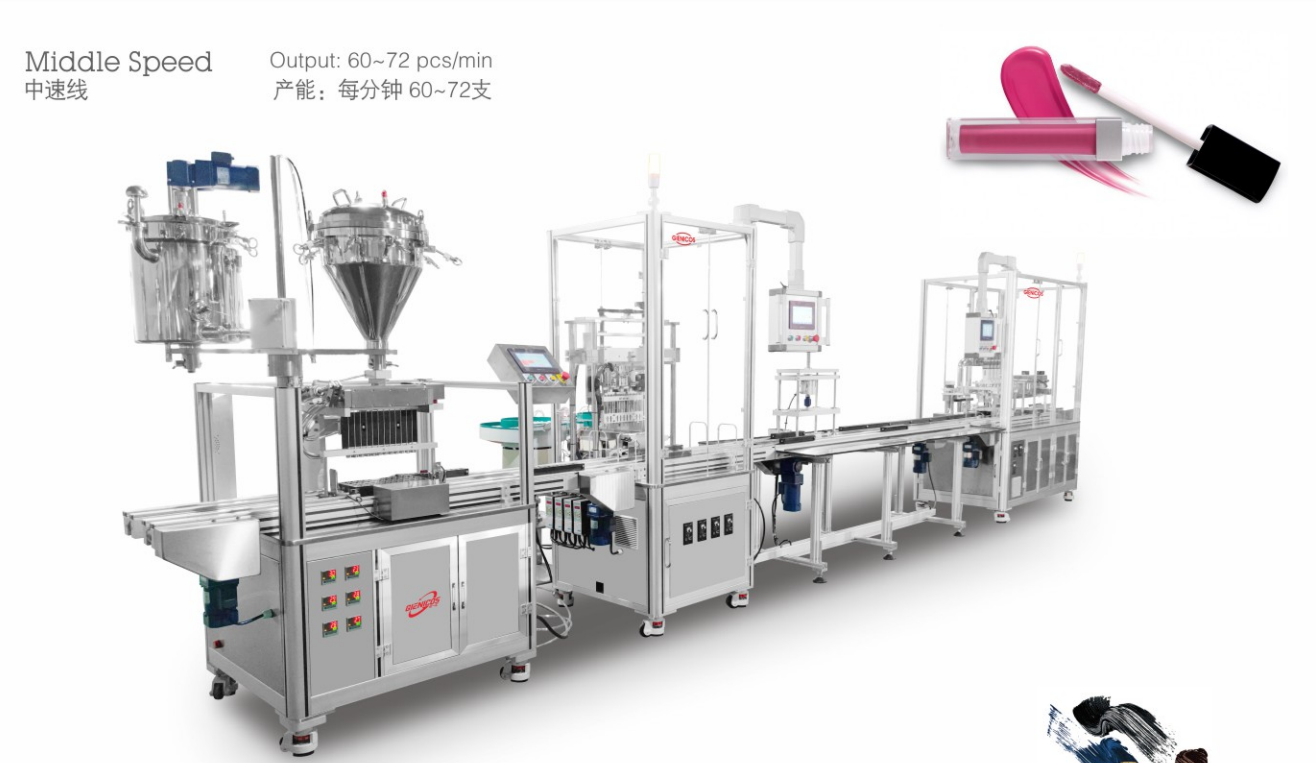
A linear lipgloss filling line in a cosmetic production cell - the downstream half of a combined lipstick and lip gloss project.
Problem Definition: Why 'Which Cosmetic Filling Machine?' Is an Incomplete Question
Most lipstick and lip gloss projects start with a single-machine question: which cosmetic filling machine should we buy? For a cell that runs both formats, that question returns an incomplete answer, because the filling machine is one node in a temperature- and time-controlled chain, and its specification depends on decisions made upstream.
Three constraints that decide the layout
Thermal continuity. A wax-based lipstick or lip balm bulk has to be melted, held and delivered to the nozzle inside a controlled working window. The melting equipment, the transfer path and the pouring or filling head all influence what arrives at the mold. Selecting a hot pouring machine without matching the melting and holding capacity usually produces a cell whose bottleneck simply moves upstream.
Downstream divergence. Beyond the shared bulk stage, the two formats separate completely. Lipstick needs molds, a cooling tunnel, demolding and stick assembly. Lip gloss needs bottle filling, inner wiper insertion, brush-cap feeding and servo-controlled capping. These are different mechanical sequences with different labour models and different changeover behaviour.
Changeover exposure. Colour-cosmetics lines rarely run one formula. Multi-color lipstick products and multiple gloss shades mean frequent cleaning, tank changes and recipe changes. Equipment chosen for a single SKU often becomes the constraint once the SKU list grows.
Industry Background: Scale, Automation and Classification
The global cosmetic filling machines market was valued at USD 476.80 million in 2025 and is projected to reach USD 718.63 million by 2036, according to Future Market Insights. Within the broader filling machine market, Asia Pacific held a 33.08% share in 2025 (Fortune Business Insights), while automatic filling machines are projected to account for 41.2% of the cosmetic filling technology market in 2026 (Future Market Insights).
The lipstick sub-segment points in the same direction: the automatic lipstick filling machines market has been projected to reach USD 1.2 billion by 2033, growing at a 5.8% CAGR from 2025 (Strategic Revenue Insights). That number should be read as directional only - market definitions for this sub-segment differ sharply between research houses, and a build decision should rest on the line specification rather than on a headline figure.
For importers and brand owners comparing suppliers, classification matters as much as price. Cosmetic filling machines fall under HS heading 8422.30, including 8422.30.91 for machinery used in opening, filling and closing containers, as listed in the Harmonized Tariff Schedule.
Supplier capability is the other half of the background. GIENICOS was founded in Shanghai in 2011, holds 42 authorized patents covering invention patents, utility model patents and software copyrights, operates a 2,000 m2 facility with approximately 30 staff including an R&D team of 10 engineers, and produces about 100 units annually with an export ratio of 80% across EU, USA and Asia markets. Its equipment is used by customers in 100 countries and regions, and the company maintains project partnerships with OEM/ODM manufacturers including COSMAX, INTERCOS, Weckerle, VIVA, OXYGEN, ICT and Fiabila, alongside brand owners including L'Oreal, Winona and Chando.
Detailed Solution: Mapping the Cell Stage by Stage
Stage 1 - Melting, dispersion and holding: the upstream half of the cell
The bulk stage determines how consistently the cell can feed hot filling. In a lipstick and lip gloss cell, four categories of melting equipment cover the range from pilot batch to industrial batch.
The MT 300 SE is a 300 L industrial cosmetic melting tank with oil circulation heating and a stirring function, intended for foundation, lipstick, primer cream and other wax-based cosmetic bulk. Its large capacity helps reduce repeated small-batch material preparation. The MT-300 melting tank is certified to CE standards.
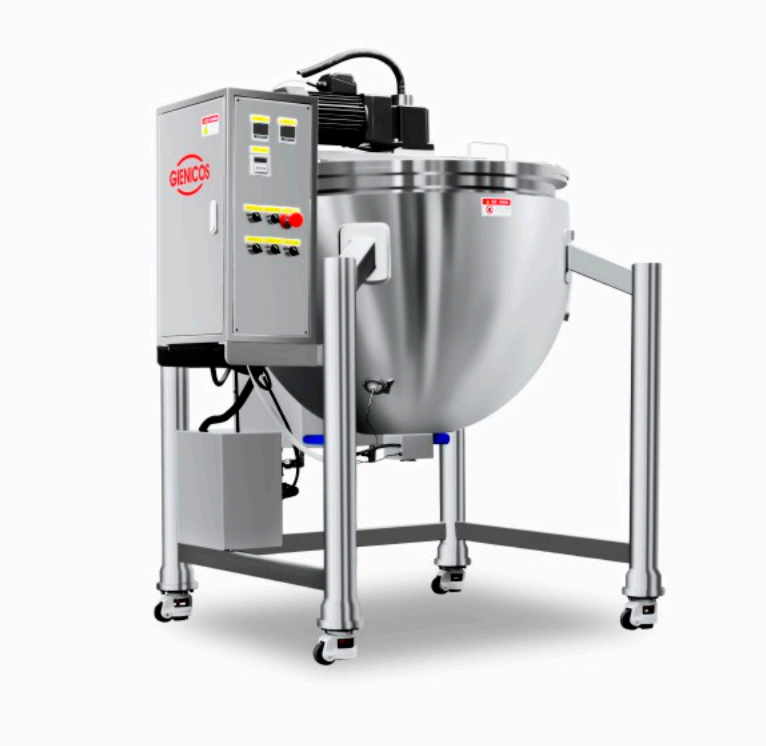
MT 300 SE 300 L industrial cosmetic melting tank with oil circulation heating, used for wax-based lipstick bulk.
The MT 100 SE is a 100 L cosmetic melting and mixing tank with heating, stirring and vacuum functions, an air-spring assisted lid and a flange design that supports the vacuum function; it can be used as an upstream bulk preparation unit before cosmetic filling.
The MT 50P and MT 100P are 50 L and 100 L lipstick dispersion tanks with heating, stirring and vacuum functions, automatic tank lid lifting and a fixed dispersion tank lid. They belong to the cosmetic material dispersion and mixing category and can be positioned before hot filling or lipstick molding.
The MT 30SE is a 30 L oil heating melting tank intended for lipstick, lip balm and other wax-based cosmetic products, with heating, mixing and vacuum functions, a tank lid lifting function and a high-sanitary bottom valve.
For multi-SKU work, the MT 20 SE Multi Tank Melting System integrates six 20 L tanks (20 L x 6) into one compact system with heating, stirring and vacuum functions, an optional timing start function and sanitary valves designed without dead angles. It is intended for pre-melting before downstream hot filling operations and is suited to multi-SKU production with frequent formula or colour changes.
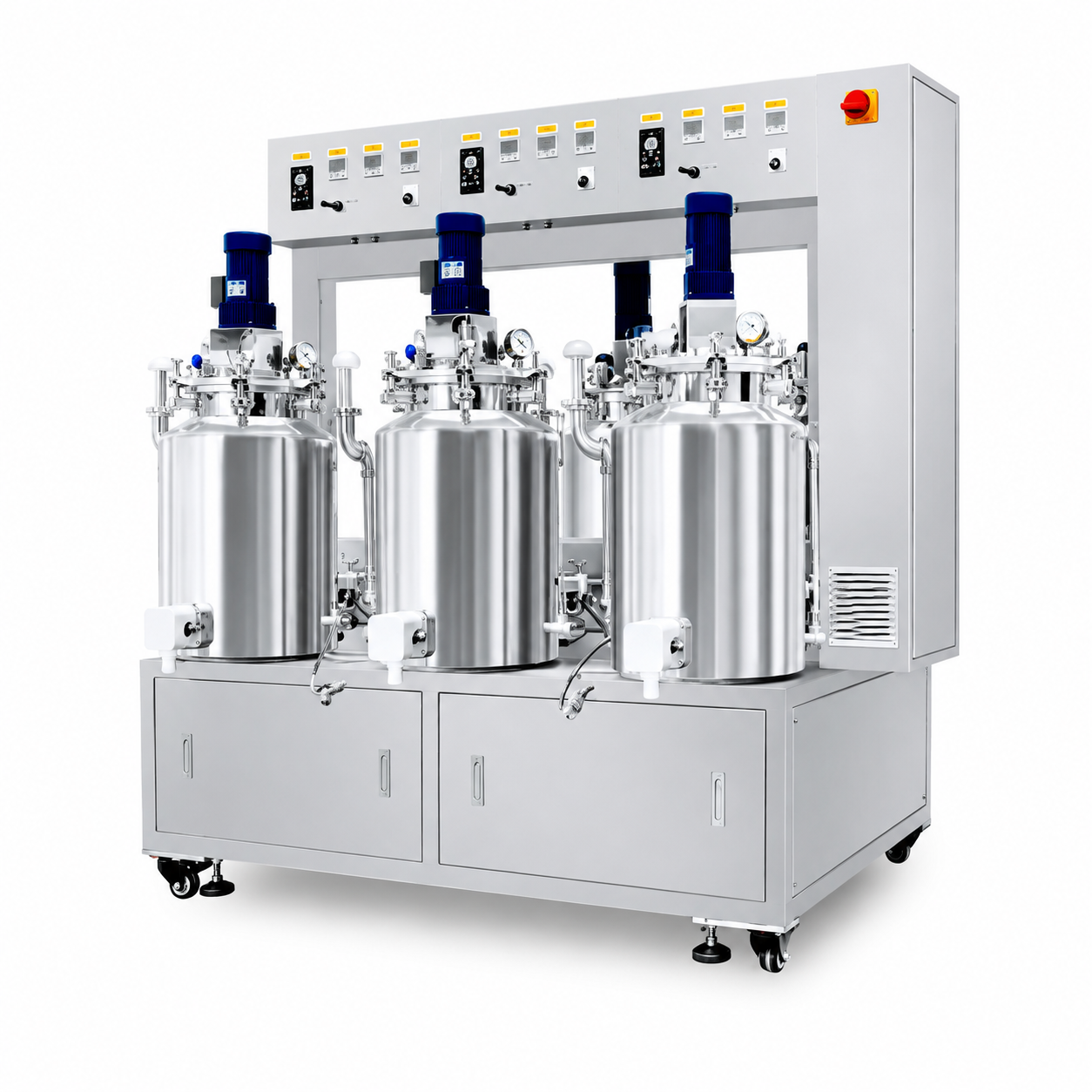
MT 20 SE six-in-one multi tank melting system: six independent 20 L tanks for parallel formulas and colours.
How to choose: capacity follows batch size (20 L for trials and small batches, 30-100 L for regular production, 300 L for large batches); tank count follows the SKU and colour map - six tanks handle six formulas or colours without repeated full cleaning; dispersion type follows the formula, since pigment-heavy lipstick bulk benefits from dedicated dispersion tanks rather than simple melting capacity.
Stage 2 - Hot pouring and multi-color hot filling
Hot pouring is where the temperature window is transferred into the mold. GIENICOS offers three approaches, built around a 20 L working scale or a multi-unit configuration.
The TSP Hot Pouring Machine is a 20 L unit for lipstick and lip balm with heating, stirring and vacuum functions and a sanitary valve designed without dead angles; it is certified to CE standards. The MT 20P 20L Hot Pouring Machine follows the same 20 L logic for lipstick, lip balm and other wax-based bulk materials and uses a sanitary, dead-angle-free discharge valve to support cleaner discharge.
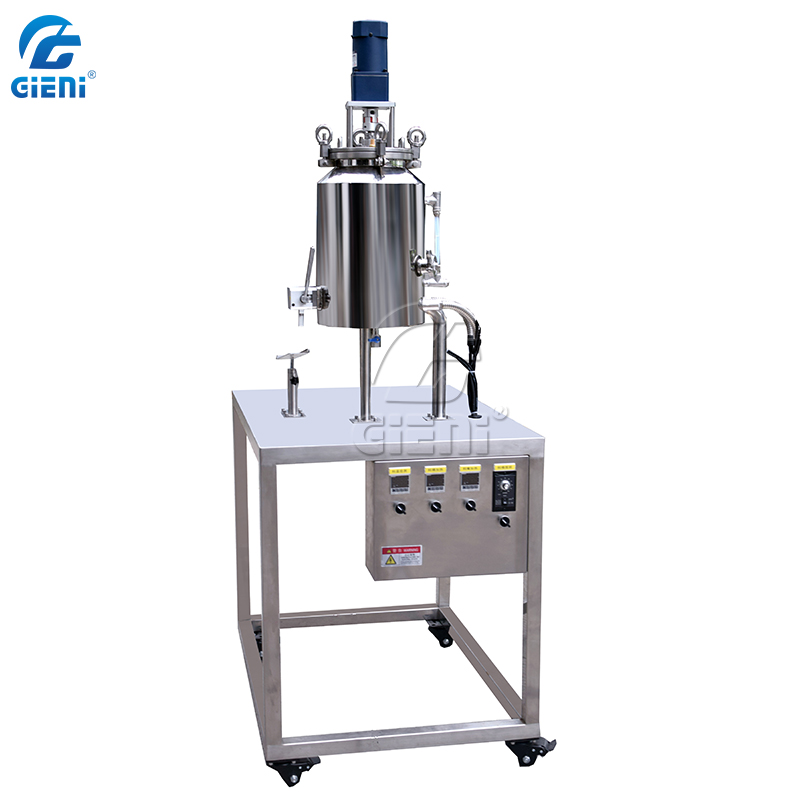
TSP 20 L hot pouring machine integrating heating, stirring and vacuum functions for lipstick and lip balm bulk.
The JYF-4 Multi-color Hot Filling Machine takes a different approach: it combines four single-head servo filling machines into one integrated line, so up to four colours can be filled from individual units, each of which can be independently controlled. Filling volume options are 2-20 mL, 20-50 mL and 50-100 mL, filling precision is approximately +/-0.1 g, the effective tank volume is 20 L, and product-contact parts are SUS316L stainless steel. The adjustable conveyor accommodates different container types, and the line can be configured for related formats such as mascara and nail polish, including irregular-shaped bottles.
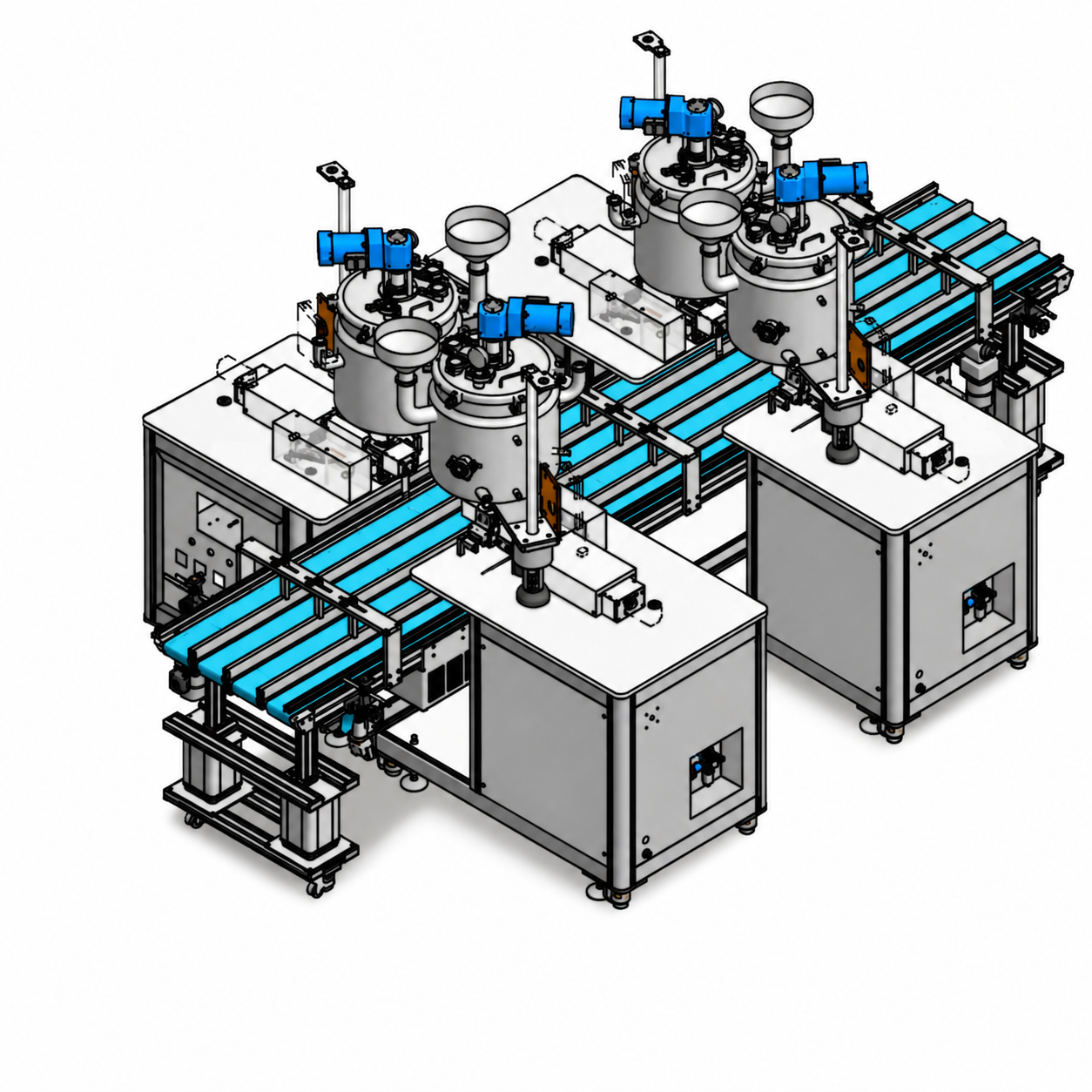
JYF-4 four-in-one single-nozzle multi-color hot filling line with independently controlled filling units.
For high-viscosity hot filling outside the multi-colour configuration, the JSFL 1-2 servo piston filling machine is available with a single or dual nozzle, a liftable tank and servo-controlled piston dosing at approximately +/-0.1 g, and can be integrated with upstream melting systems and downstream cooling or packaging equipment.
Stage 3 - Cooling and solidification
Cooling is the stage most often underestimated in lipstick projects. The JCT Lipstick Cooling Tunnel is continuous cooling and solidification equipment for lipstick production lines: it uses refrigerated air circulation and a continuous conveyor-type cooling tunnel, and it is applied to lipstick and lip balm molds after hot filling. Temperature, conveyor speed, dimensions and power supply are customizable according to production-line requirements, and the unit uses stainless steel conveyor components with an insulated industrial cooling chamber.
Cooling is a rate problem rather than a capacity problem. A cooling tunnel that is too short for the mold load forces the line to run below the filling machine's output; a tunnel that is oversized relative to the filling rate leaves capital idle. Because temperature and conveyor speed are customizable, the tunnel is normally specified last, after the filling rate and mold format are fixed. The Semi Automatic Lipstick Filling Machine series makes the same point structurally: the JLG-10/12 series configuration is described as a lipstick filling machine, cooling tunnel and vacuum releasing machine, so cooling is part of the series rather than an optional accessory.
Stage 4 - Lipstick filling, molding and demolding options
Three options cover the lipstick side of the cell, each with a different labour and output profile.
The Semi Automatic Lipstick Filling Machine JLG-10/12 belongs to the lipstick, lip balm and lip gloss filling series, is available with 10 or 12 nozzles, fills 1-20 mL at +/-0.1 g precision, and uses a multi-nozzle structure that supports simultaneous filling of multiple lipstick molds.
The Automatic Silicone Mold Lipstick Filling Machine GLU-1300 is the automatic route: 1,000-1,300 pcs/hour, a servo-driven piston pump with two filling nozzles, a 30 L material tank with electric oil heating, a silicone mold capacity of 112 pcs, two LEISTER hot air guns, and an applicable lipstick diameter of approximately 8-17.1 mm. It requires two operators, or one when robot integration is used.
The HALF SILICONE LIPSTICK LIPBALM FILLING LINE JSM is the higher-volume semi-automatic route: it accepts half-silicone molds or aluminium molds, producing 1,800-3,000 pcs/hour with silicone molds and 2,160-3,600 pcs/hour with metal molds. It requires 4-5 operators and is suitable for lipstick, lip balm and back-filling lipstick applications.
Decision rule: compare the three options on hourly output against the labour model, not on output alone. GLU-1300 converts labour into automation (two operators, or one with robot integration), while JSM converts labour into throughput (four to five operators at higher hourly capacity).
Stage 5 - Lip gloss, liquid lipstick and concealer filling and capping
The lipgloss side of the cell is filled at ambient temperature and depends on dosing accuracy, anti-drip behaviour and torque-controlled capping.
The JQH-02 is a high-speed automatic lipgloss filling and capping machine that integrates both functions: 1-20 mL filling volume, servo piston filling, 60-80 pcs/min and +/-0.1 g precision.
The JMG Lipgloss Mascara Filling Machine is a linear high-speed line running at 60-72 pcs/min in mid-speed configuration and 80-100 pcs/min in high-speed configuration, filling 10-12 pieces per cycle with static or fall-while-filling modes. It uses a return-suction anti-drip nozzle to reduce bottle-mouth contamination, no-bottle-no-fill detection to avoid material waste, and servo torque capping whose torque and speed are adjustable and which stops at the target torque value to protect caps. The feeding tank can be customized with heating, pressurization or lifting options, robot modules can handle bottle loading, brush-cap feeding and inner wiper insertion, wetted parts are SUS316L and GMP-compliant, and core electrical components use Mitsubishi and Schneider.
For pouch-format products, the JR-01P Lip Pouch Filling Machine for Lipgloss Concealer fills 2-10 mL at +/-0.1 g and 20-30 pouches/min, with a servo filling system, a 20 L pressurizing tank, automatic vibration sorting and cap loading, automatic servo capping with adjustable torque, and optional automatic pouch feeding. It is applied to lipgloss, concealer, foundation cream and pouch-type cosmetics.
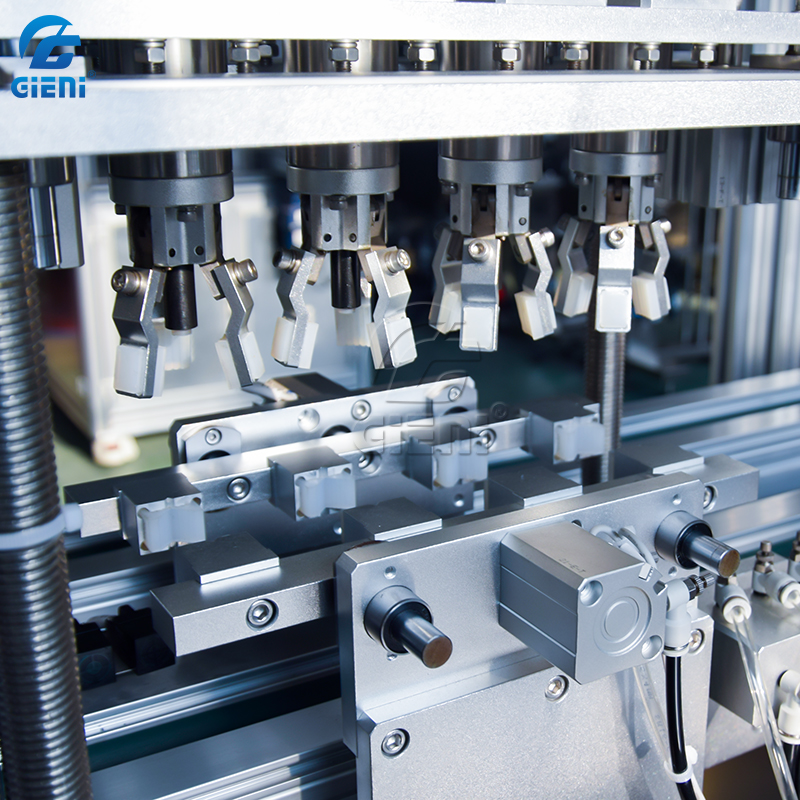
Automatic capping module used downstream of lipgloss filling, with servo torque control to protect caps.
Capping and finishing close the cell. The JR-01X Semi Automatic Rotary Capping Machine applies servo capping at 30-40 pcs/min with adjustable torque to round and square cosmetic bottles, and can operate with a single-nozzle filling machine - useful when a semi-automatic filler is retained. Decoration and coding sit after capping: the JTB-815S automatic bottom colour-code labeling machine handles lipstick and lipgloss containers of 15-30 mm diameter and 50-110 mm length at 60-90 pcs/min with +/-1 mm accuracy and a minimum label length of 9 mm, while the JSS-01 sleeve shrink labeling machine applies up to 100 pcs/min to slim, long items including lipstick, mascara and lip gloss.
Step-by-Step Breakdown: Configuring the Cell in Six Decisions
- Fix the product formats and the SKU map first. List every format the cell must run - molded lipstick, lip balm, liquid lipstick, lip gloss, concealer, pouch products - with target output and container dimensions. This list alone determines which stages exist. A cell without molded lipstick has no cooling tunnel and no demolding step.
- Size the bulk stage against batch policy, not against filling speed. Choose 20 L, 30 L, 100 L or 300 L tanks based on how much bulk a single production run consumes, then decide between one large tank and a multi-tank system such as MT 20 SE when several colours must be held simultaneously.
- Select the hot filling format by colour count and container geometry. A single-colour lipstick line can run on a TSP or MT 20P hot pouring machine; a multi-colour line requires a multi-color hot filling machine such as JYF-4 with independently controlled filling units, or a servo piston filling machine such as JSFL 1-2 for high-viscosity single or dual-nozzle work.
- Specify cooling after the filling rate is known. Because the JCT cooling tunnel allows temperature, conveyor speed, dimensions and power supply to be customized, the correct sequence is to fix filling output and mold format first, then size the tunnel to the required solidification time.
- Choose the lipstick filling platform by labour model. Semi-automatic 10 or 12-nozzle filling (JLG-10/12), automatic silicone-mold filling at 1,000-1,300 pcs/hour with two operators or one with robotics (GLU-1300), or a half-silicone/aluminium mold line at 1,800-3,600 pcs/hour with 4-5 operators (JSM).
- Close the loop with capping, verification and cleanroom integration. Match capping to the container (JR-01X for round and square bottles), add labeling for decoration and traceability, and confirm the cell fits a cosmetic GMP clean-room workshop - the operating condition specified for high-speed lipgloss production projects, which can also include MES and remote systems, automatic check weighing and rejection, and automatic labeling.
Use Cases: Three Typical Cell Configurations
Multi-SKU OEM/ODM colour-cosmetics factory. A contract manufacturer running private-label lipstick and lipgloss for several brands is limited by changeover, not by peak speed. The natural configuration is a multi-tank upstream stage (MT 20 SE, six 20 L tanks for different formulas or colours), a 20 L hot pouring machine (TSP or MT 20P) for small-batch wax work, semi-automatic lipstick filling (JLG-10/12), and a lipgloss filling and capping machine (JQH-02) for the liquid side. The module concept behind GIENICOS equipment - fast-disassembling assemblies designed for cleaning and spare-part replacement - matters more here than in a single-SKU plant.
High-volume lipgloss brand. A brand-owned plant producing a narrow gloss range at scale should specify downstream automation instead of tank flexibility: the JMG linear lipgloss line at 80-100 pcs/min with no-bottle-no-fill detection, return-suction nozzles and servo torque capping, supported by robot bottle loading, brush-cap feeding and inner wiper insertion where labour is the constraint.
Multi-colour lipstick and pouch-format specialties. A line producing multi-colour lipstick and on-the-go pouch products needs a four-unit multi-color hot filling machine (JYF-4) with independently controlled filling units and a lip pouch filling machine (JR-01P) for 2-10 mL pouch formats. Both formats are difficult to retrofit onto general-purpose filling equipment later, so they are best defined in the original layout.
Comparison Table: Lipstick and Lip Gloss Cell Equipment Reference
| Cell stage | Equipment | Model | Verified capability | Typical fit |
|---|---|---|---|---|
| Bulk melting | Cosmetic Melting Tank | MT 300 SE | 300 L tank; stirring; oil circulation heating; CE certified (MT-300 melting tank) | Medium-to-large batch wax-based bulk |
| Bulk melting | Cosmetic Melting Tank | MT 100 SE | 100 L; heating, stirring, vacuum; air-spring assisted lid; flange design for vacuum | Mid-batch, vacuum-assisted preparation |
| Dispersion | Lipstick Dispersion Tank | MT 50P / MT 100P | 50 L or 100 L; heating, stirring, vacuum; automatic lid lifting; fixed dispersion tank lid | Pigment dispersion for lipstick bulk |
| Pre-melting | Oil Heating Melting Tank | MT 30SE | 30 L; heating, mixing, vacuum; tank lid lifting; high-sanitary bottom valve | Pre-melting before hot filling |
| Pre-melting | Multi Tank Melting System | MT 20 SE | Six 20 L tanks (20 L x 6); heating, stirring, vacuum; optional timing start; sanitary valves without dead angle | Multi-SKU, frequent formula or colour change |
| Hot pouring | Hot Pouring Machine | TSP | 20 L; heating, stirring, vacuum; sanitary valve without dead angle; CE certified | Small-batch lipstick and lip balm |
| Hot pouring | 20L Hot Pouring Machine | MT 20P | 20 L tank; heating, stirring, vacuum; dead-angle-free sanitary discharge valve | Lipstick and lip balm bulk pouring |
| Hot filling | Multi-color Hot Filling Machine | JYF-4 | Four-in-one single-nozzle line; up to 4 colours (customizable); 2-20 / 20-50 / 50-100 mL; servo piston; +/-0.1 g; 20 L effective tank; SUS316L contact parts | Multi-colour hot filling |
| Hot filling | Servo Piston Filling Machine | JSFL 1-2 | Servo piston; single or dual nozzle; liftable tank; for lip balm, lipstick and lip cream | High-viscosity single or dual-nozzle filling |
| Cooling | Lipstick Cooling Tunnel | JCT | Refrigerated air circulation; continuous conveyor-type tunnel; temperature, conveyor speed, dimensions and power supply customizable | Solidification of filled lipstick and lip balm molds |
| Lipstick filling | Semi Automatic Lipstick Filling Machine | JLG-10/12 | 10 or 12 nozzles; 1-20 mL; +/-0.1 g; series includes lipstick filling machine, cooling tunnel and vacuum releasing machine | Semi-automatic lipstick and lip balm |
| Lipstick filling | Automatic Silicone Mold Lipstick Filling Machine | GLU-1300 | 1,000-1,300 pcs/hour; 2 nozzles, servo-driven piston pump; 30 L tank, electric oil heating; 112-pcs silicone mold; approx. 8-17.1 mm lipstick diameter; 2 operators (1 with robot integration) | Automatic lipstick production |
| Lipstick filling | HALF SILICONE LIPSTICK LIPBALM FILLING LINE | JSM | 1,800-3,000 pcs/hour with silicone mold; 2,160-3,600 pcs/hour with metal mold; 17 kW; 4-5 operators | Higher-volume lipstick and lip balm |
| Lipgloss filling and capping | Automatic Lipgloss Filling and Capping Machine | JQH-02 | 1-20 mL; servo piston filling; 60-80 pcs/min; +/-0.1 g; integrated filling and capping | Automated lipgloss filling |
| Lipgloss filling and capping | Lipgloss Mascara Filling Machine | JMG | 60-72 pcs/min mid-speed; 80-100 pcs/min high-speed; 10-12 pcs per cycle; return-suction nozzle; no-bottle-no-fill; servo torque capping; SUS316L wetted parts | High-speed multi-SKU lipgloss, lip oil and mascara |
| Pouch filling | Lip Pouch Filling Machine for Lipgloss Concealer | JR-01P | 2-10 mL; +/-0.1 g; 20-30 pouches/min; 20 L pressurizing tank; automatic servo capping with adjustable torque | Pouch-format lipgloss and concealer |
| Capping | Semi Automatic Rotary Capping Machine | JR-01X | Servo capping; 30-40 pcs/min; adjustable torque; round and square bottles; can operate with a single-nozzle filling machine | Standalone capping in semi-automatic layouts |
| Labeling | Bottom Color Code Labeling Machine | JTB-815S | 60-90 pcs/min; +/-1 mm accuracy; containers 15-30 mm diameter, 50-110 mm length; minimum label length 9 mm | Lipstick and lipgloss decoration coding |
| Labeling | Sleeve Shrink Labeling Machine | JSS-01 | Up to 100 pcs/min; for slim and long items such as lipstick, mascara, lip gloss, pencil boxes and oil bottles | Full-body shrink sleeve labeling |
FAQ
Are GIENICOS cosmetic filling machines CE certified, and does that cover hot filling equipment?
GIENICOS states that its product range carries CE certification, and CE certification is recorded for specific units used in lipstick and lip gloss production, including the TSP hot pouring machine, the MT-300 melting tank and a multi-functional filling production line. Because certification applies to the machine as supplied, buyers should confirm the CE documentation for the exact model and configuration being quoted. For import classification, cosmetic filling machines fall under HS heading 8422.30, including 8422.30.91 for machinery used in opening, filling and closing containers.
Can one production cell fill both lipstick and lip gloss?
They can share a cell footprint and, in many layouts, a shared bulk preparation area, but they cannot share the same filling station. Lipstick is wax-based: it is melted, hot-poured and cooled before demolding, using melting equipment, a hot pouring machine or multi-color hot filling machine, a lipstick cooling tunnel, and a lipstick filling platform such as the semi-automatic JLG-10/12 with 10 or 12 nozzles and a 1-20 mL filling range, the automatic silicone mold GLU-1300 at 1,000-1,300 pcs/hour, or the JSM half-silicone and aluminium mold line. Lip gloss is filled at ambient temperature, typically on the JQH-02 automatic lipgloss filling and capping machine at 60-80 pcs/min or the JMG linear line at 60-72 pcs/min mid-speed and 80-100 pcs/min high-speed. A multi-tank melting system such as MT 20 SE holds six 20 L tanks so different formulas and colours can be prepared in parallel.
What determines the equipment scope and cost structure of a lipstick and lip gloss cell?
Scope is driven by the stages included, not by a single machine price. The main variables are: how many stages the project covers (bulk preparation only, or a complete line through filling, cooling, capping and labeling); tank capacity and count, from a 20 L hot pouring machine up to a 300 L MT 300 SE melting tank or a six-tank MT 20 SE system; product format, since molded lipstick adds molds, cooling and demolding while lipgloss adds wiper insertion, brush-cap feeding and servo capping; automation level and labour model, for example GLU-1300 requires 2 operators or 1 with robot integration while JSM requires 4-5 operators; and integration items such as check weighing, labeling, MES connectivity and GMP clean-room compatibility. GIENICOS states that it focuses on customized development for key-account clients and iterates equipment according to production requirements, formula features and workshop conditions, so the equipment set is normally defined per project.
How can a buyer validate the configuration before full production?
Validation normally happens on small-batch equipment that can later support pilot or flexible production. The TSP and MT 20P 20 L hot pouring machines suit small-batch wax-based work and formula trials; the MT 20 SE multi-tank system supports frequent formula or colour changes with six independent 20 L tanks; the JHF multi-functional hot filling and cooling line is described as suitable for cosmetic laboratories, pilot production and flexible manufacturing; and for small sample bottles the JLG-10H trial sample filling machine fills 1-19 mL at 100-130 pcs/min with SS316L product-contact parts and a 25 L tank. GIENICOS also states that all machines are designed under a module concept, which keeps configuration changes and cleaning practical during validation.
What warranty and after-sales support come with the equipment, and what is the next step?
GIENICOS provides a standard 12-month warranty from the date of machine acceptance. It covers manufacturing defects and excludes wearing consumable parts and man-made damage, with free spares and freight carried by the company. Key assemblies use a modular structural design that supports fast disassembly, cleaning and spare-part replacement to minimise production downtime. The next step is to send your product formats, container dimensions, target output and SKU count to sales@genie-mail.net or WhatsApp +86 134 8206 0127 for a configuration proposal, or download the 2026 catalogue.
Conclusion
A lipstick and lip gloss production cell is specified stage by stage, not machine by machine. The bulk stage decides thermal continuity, the hot filling stage decides colour flexibility and dosing accuracy, the cooling tunnel decides whether the lipstick line can actually reach its filling output, and the downstream filling and capping stage decides how the lipgloss side performs across SKUs.
GIENICOS builds equipment for both halves of that cell and supplies it as a configured project rather than a catalogue list: MT 20 SE, MT 100 SE and MT 300 SE melting tanks, MT 50P and MT 100P lipstick dispersion tanks, the MT 30SE oil heating melting tank, TSP and MT 20P hot pouring machines, the JYF-4 multi-color hot filling machine, the JCT lipstick cooling tunnel, the JLG-10/12, GLU-1300 and JSM lipstick filling platforms, and the JQH-02, JMG and JR-01P lipgloss and pouch filling systems.
GIENICOS factory reception in Shanghai - project reviews, sample trials and factory acceptance visits.
Next step: send your product formats, container dimensions, target output and SKU count to request a configuration proposal for your lipstick and lip gloss cell.
Email: sales@genie-mail.net · Tel / WhatsApp: +86 134 8206 0127 · Website: www.gienicos.com
Or download the full equipment range here: 2026 GIENICOS catalogue (PDF).