
Cosmetic Filling Machine Compliance Guide: Certifications, Standards, and Regional Requirements
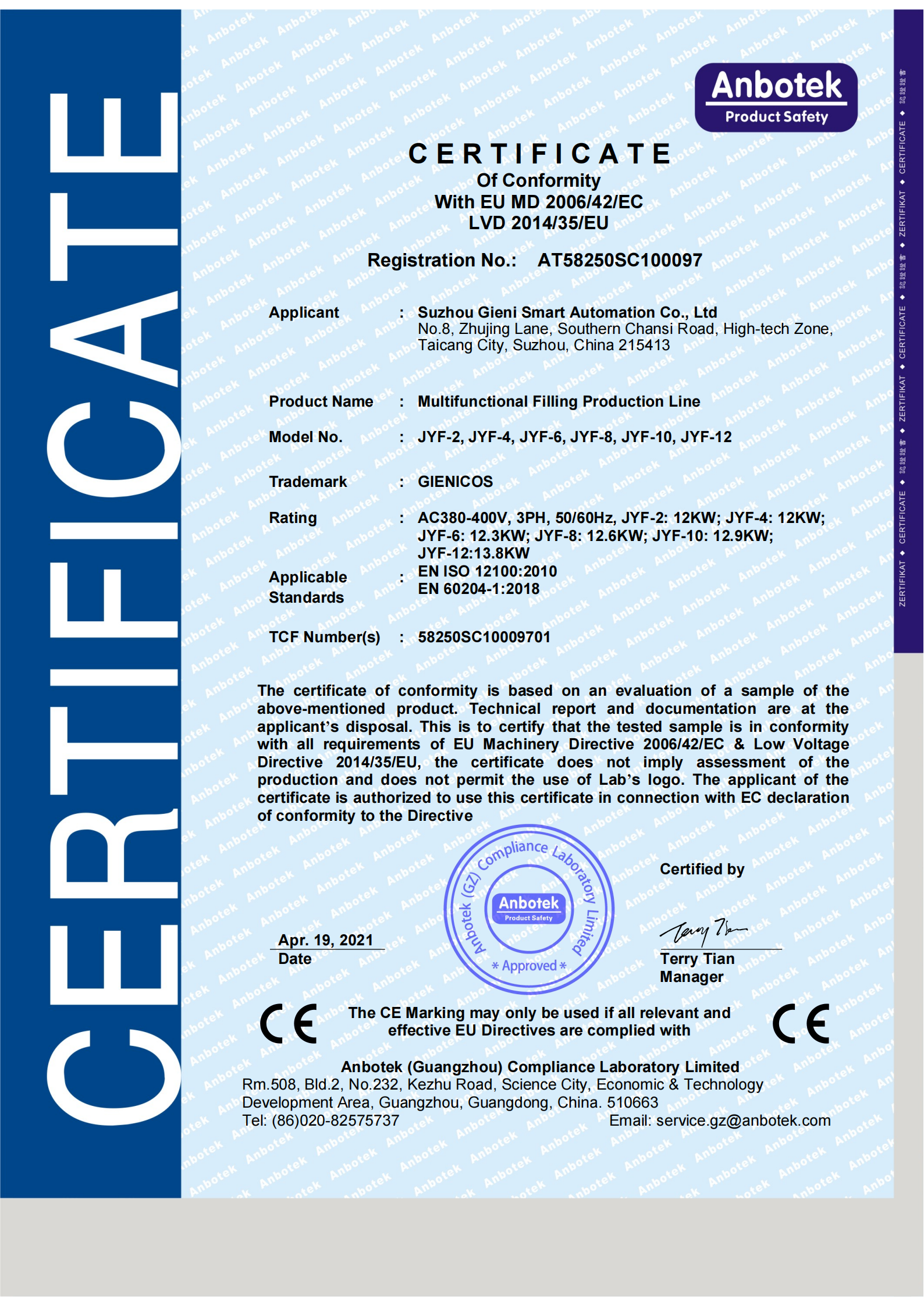
Certificate AT58250SC100097 covers the GIENICOS multifunctional filling production line, model series JYF-2 through JYF-12.
A cosmetic filling machine compliance file is a set of traceable documents, not a brochure. In practice it consists of six layers: a certificate, a scope statement naming the machine models covered, the standards applied during assessment, a declaration of conformity, machine nameplate and serial data, and a customs classification reference. When a buyer or importer verifies those six layers before shipment, most compliance questions are resolved at the factory rather than at the destination port.
This guide maps the certification, standards and regional documentation questions that apply to equipment such as the Rotary Nail Polish Filling Machine, the Tube Filling and Sealing Machine, the Automatic Loose Powder Filling Machine and the Lipstick Cooling Tunnel. It then applies one checklist across mascara and lipgloss lines, powder systems and hot filling and cooling machines. The reference manufacturer used throughout is GIENICOS — the brand of SHANGHAI GIENI INDUSTRY CO., LTD., a Shanghai-based manufacturer of intelligent cosmetic filling and packaging equipment, founded in 2011.
Why Compliance Verification Fails After the Purchase Order
Most compliance disputes are not caused by a missing certificate. They are caused by a mismatch between the document that was sent and the machine that was ordered. Four failure patterns repeat across cosmetic filling projects.
- Scope gap. A certificate exists for a machine family, but the exact model string on the purchase order does not appear inside the scope statement. A certificate cover page alone does not close this gap.
- Unverified issuing body. The certificate number is quoted in an email, but nobody has checked which laboratory issued it or whether the number corresponds to the model being purchased.
- Standards without a version. “CE compliant” is repeated as a phrase, while the applied standard list — including version year — is never matched to the machine’s electrical design.
- Documents split across departments. Certificates live with sales, manuals live with engineering, and customs papers live with logistics. At the port, no single file can answer a single question.
For a buyer at the Evaluation stage, this matters because a compliance gap discovered after production is far more expensive than one discovered before the order. For an exporter, it matters because the documentation package travels with the container whether or not it has been organised.
Industry Background: Why Documentation Now Travels With the Machine
Cosmetic filling equipment is a cross-border category, and the compliance burden scales with that trade. Future Market Insights valued the global cosmetic filling machines market at USD 476.80 million in 2025, with sales projected to reach USD 718.63 million by 2036. Fortune Business Insights reported that Asia Pacific held a 33.08% share of the filling machine market in 2025, and Future Market Insights projects that automatic filling machines will hold a 41.2% share of cosmetic filling technology in 2026. Each percentage point of that shift toward automated lines also moves a documentation package across a border.
Two reference points anchor most compliance conversations. The first is the certificate itself: the CE certificates held for GIENICOS machine families reference EN 60204-1:2018 and EN ISO 12100:2010, and each states the EU as the applicable market. The second is customs classification. Cosmetic filling machines fall under HS Code 8422.30, and within the US Harmonized Tariff Schedule the specific subheading 8422.30.91 covers machinery used in opening, filling and closing containers.
That combination — a CE certificate for the EU market plus a filling-machinery HS classification for customs — is the minimum spine of a compliance file. Everything else is organisation.
The Six Document Layers of a Verifiable Compliance File
A verifiable file has a fixed structure. Each layer answers a different question, and a missing layer is usually detected late — often by a customs broker or a plant engineer rather than by the purchasing team.
| Layer | Document | What to check |
|---|---|---|
| 1 — Certification | CE certificate and its scope statement | Certificate number, issuing laboratory, and every model string written into the scope |
| 2 — Standards | Applied standard list | That the standard list belongs to your certificate number, with version year |
| 3 — Declaration | Declaration of conformity | Machine family, signatory and issue date |
| 4 — Machine identity | Nameplate, model, serial number | That the delivered unit matches the ordered model and the scope statement |
| 5 — Technical file | Operation and maintenance manual, electrical drawings | Language, voltage and phase match the destination market |
| 6 — Trade documents | Packing list, invoice, HS classification reference | Classification under HS 8422.30 (US 8422.30.91 for opening, filling and closing machinery) |
How to Read a CE Certificate in Five Fields
A CE certificate for a cosmetic filling machine is readable in five fields. Reading them in order prevents the most common verification error — accepting a certificate as proof of something it does not state.
- Certificate number. This is the key that ties every other document back to one assessment. Example: AT1814C500649151.
- Issuing laboratory. Example: Hunan Anbotek Compliance Laboratory Limited, Anbotek (Guangzhou) Compliance Laboratory Limited, or Shenzhen Anbotek Compliance Laboratory Limited. Different machine families in the same product portfolio may be certified by different entities — that is normal, and it is exactly why the laboratory name must be read rather than assumed.
- Applied standards. The GIENICOS certificate set references EN 60204-1:2018 and EN ISO 12100:2010.
- Scope statement. The scope names the machine type and the model numbers covered. This is the field that decides whether your order is inside or outside the assessment.
- Issue date and stated validity. Issue dates in the GIENICOS set range from 2019 to 2025, and the certificates state a validity end date of 2099-01-01.
GIENICOS CE Certificate Registry
The table below lists the CE certificates held for GIENICOS machine families. Every entry states the EU as the applicable market and references EN 60204-1:2018 and EN ISO 12100:2010.
| Certificate number | Machine family and models in scope | Issuing laboratory | Issue date |
|---|---|---|---|
| AT185114C4000321 | Hot filling line: MT melting tank, JYF filling machine, JCT cooling machine, auto bottle loading, auto cap loading, check weigher, JTB labeling machine (series JHF-1 to JHF-10) | Hunan Anbotek Compliance Laboratory Limited | 2024-07-17 |
| AT1814C502723151 | Air cushion CC cream filling machine: JQL-04C, JQR-02C, JQL-02C | Hunan Anbotek Compliance Laboratory Limited | 2025-09-05 |
| AT1814C500649151 | Lipstick filling machine: JLG-10, JLG-12, JSM, FSM-5, FSM, JLG | Hunan Anbotek Compliance Laboratory Limited | 2025-01-15 |
| ATGZAHS190528008-M1 | Melting tank: MT-1, MT-4, MT-6, TSP, TSF, MT | Anbotek (Guangzhou) Compliance Laboratory Limited | 2019-06-05 |
| AT58250SC100097 | Multifunctional filling production line: JYF-2, JYF-4, JYF-6, JYF-8, JYF-10, JYF-12 | Anbotek (Guangzhou) Compliance Laboratory Limited | 2021-04-19 |
| AT58250SC000523 | Single nozzle hot filling line: JSFL | Shenzhen Anbotek Compliance Laboratory Limited | 2020-07-31 |
| AT18250SC100526 | Powder mixer: JY-CR50, JY-CR15, JY-CR20, JY-CR30, JY3-CR100, JY3-CR150, JY3-CR200, JY3-CR300 | Anbotek (Guangzhou) Compliance Laboratory Limited | 2021-07-06 |
| AT18250SC100525 | Powder compacting machine: JBC, JTC, ZL, ZL-F, JAC | Anbotek (Guangzhou) Compliance Laboratory Limited | 2021-07-06 |
| AT18250SC100524 | Rotary filling machine: JR-02-E, JR-01-E, JR-01-M, JR-02-M, JR-01-L, JR-02-L, JR-01-N, JR-02-N, JR-01-P, JR-02-P | Anbotek (Guangzhou) Compliance Laboratory Limited | 2021-07-06 |
All certificates in this registry state the EU as the applicable market, reference EN 60204-1:2018 and EN ISO 12100:2010, and state a validity end date of 2099-01-01.
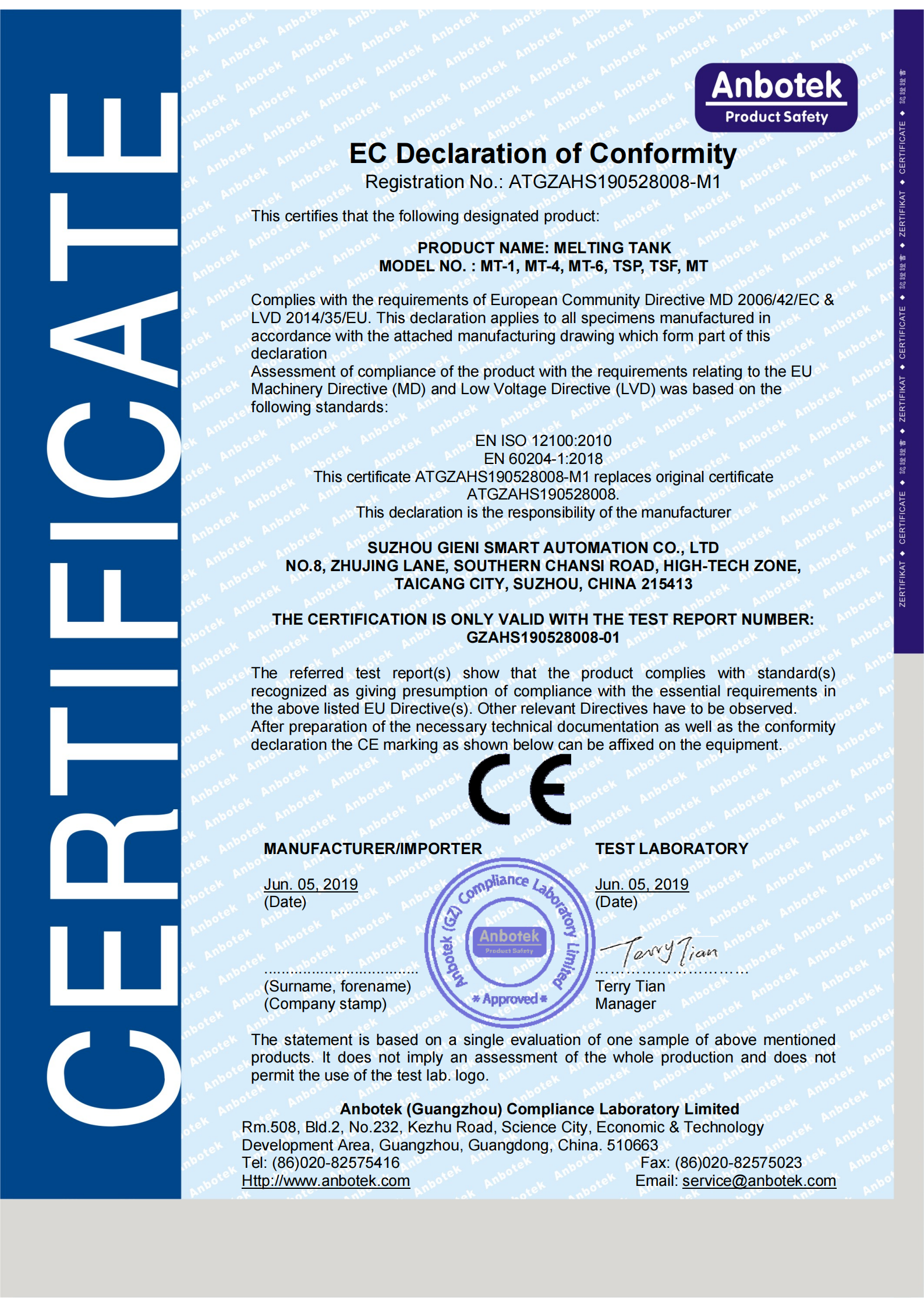
Certificate ATGZAHS190528008-M1 covers the MT-1, MT-4, MT-6, TSP, TSF and MT melting tanks — upstream equipment in a hot filling line.
Regional Requirements: What Changes by Destination Market
The certificate set does not change by destination. What changes is the supporting package around it — the electrical configuration of the unit, the language of the manual, and how the equipment is declared to customs.
| Destination market | Certification position | Document to request | Classification reference |
|---|---|---|---|
| European Union | CE certificates exist for defined machine families; standards referenced include EN 60204-1:2018 and EN ISO 12100:2010 | CE certificate plus its scope statement, declaration of conformity, manual | HS 8422.30 |
| United States | Electrical configuration and documentation are confirmed against the order | Machine manual, nameplate data, packing list and invoice | US HTS 8422.30.91 (opening, filling and closing machinery) |
| Asia, Middle East and other export markets | Configuration and documentation package confirmed against the order | Order-specific document set with the same six layers | HS 8422.30 |
GIENICOS exports to the EU, USA, Asia and the Middle East, with an export ratio of 80% of output. That distribution is the practical reason the document set has to be assembled once and reused per destination, rather than rebuilt for every order.
Step-by-Step: A Seven-Step Compliance Verification Workflow
Seven steps convert a folder of PDFs into a verifiable file. The sequence matters: identity first, configuration second, logistics last.
Step 1 — Collect the certificate and its scope statement, not just the cover page. The scope statement is where model numbers appear. Without it, the certificate cannot be matched to an order.
Step 2 — Match the model string on your order to the model string in the scope. A certificate may cover a machine family while the ordered configuration is defined by model and container format. If the string does not match, ask the manufacturer to clarify which document applies.
Step 3 — Verify the issuing laboratory and certificate number. In the GIENICOS set, certificates were issued by Hunan Anbotek Compliance Laboratory Limited, Anbotek (Guangzhou) Compliance Laboratory Limited and Shenzhen Anbotek Compliance Laboratory Limited. Record which entity issued the certificate for your machine family.
Step 4 — Confirm the applied standards and their version year. The reference standards across this certificate set are EN 60204-1:2018 and EN ISO 12100:2010.
Step 5 — Align the machine configuration with the destination. GIENICOS offers customization on voltage, logo, automation degree, tank size, filling method and speed request. Voltage and phase are the fields that most often need adjusting for the destination market, and they also affect what the manual must state.
Step 6 — Confirm the trade classification and delivery terms. Cosmetic filling machines are classified under HS 8422.30; the US subheading 8422.30.91 covers machinery for opening, filling and closing containers. GIENICOS delivery terms include FOB, CNF, CIF and DDP.
Step 7 — Inspect before shipment and archive against the serial number. Acceptance can be carried out as a factory acceptance test on site or by video inspection before shipment, and GIENICOS performs a 100% OQC test before shipping. Archive the inspection record with the certificate, the scope statement and the nameplate photograph under the same serial number.
Use Cases: One Checklist Across Five Product Families
The same seven steps apply whether the machine fills nail polish, toothpaste-style tubes, loose powder or hot-poured lipstick. What changes is which document field needs the closest attention.
1. Rotary nail polish and liquid colour cosmetics
The Rotary Nail Polish Filling Machine JQR-01N fills by piston, vacuum or pressurized method, handles a container range of 5–30 mL, holds a filling precision of about ±0.2 g, and runs on AC220V single phase at 2 kW. Its working process moves from bottle feed to filling, brush feed, cap feed, capping and discharge, and it applies to nail polish, essential oil, perfume, massage oil and medical oil.
On the compliance side, certificate AT18250SC100524 names rotary filling machine models including JR-01-N and JR-02-N in its scope statement. For a nail polish order, Step 2 of the workflow is the critical one: confirm that the exact model string being purchased appears in the scope rather than assuming that a rotary filling certificate covers every rotary configuration.
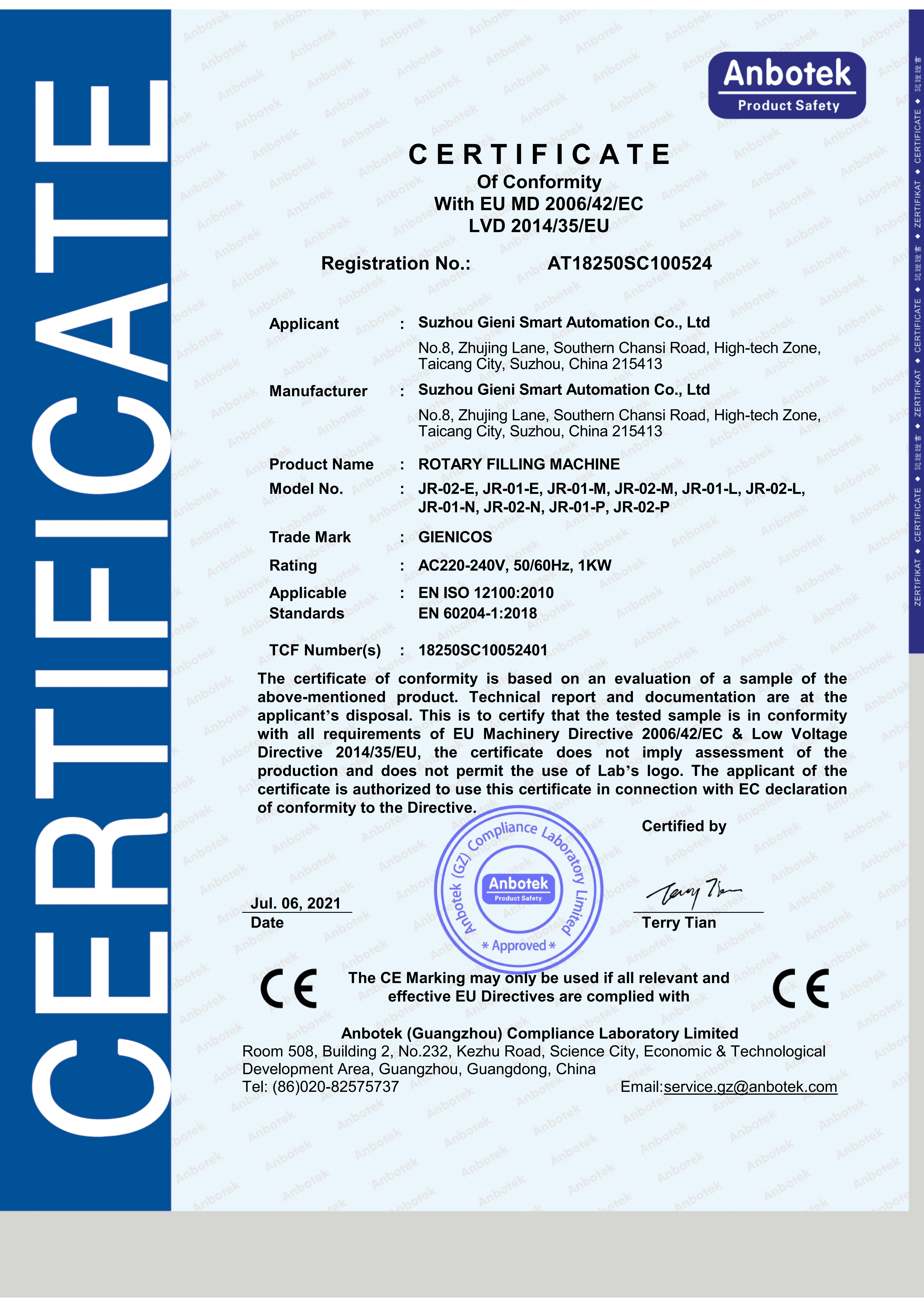
Certificate AT18250SC100524 covers rotary filling machines, including the JR-01-N and JR-02-N models, issued 2021-07-06.
2. Tube filling and sealing
The Tube Filling and Sealing Machine is supplied in two models: GFS-40 with a 5–250 mL filling volume and 30–40 pcs/min, and GFS-60 with a 5–200 mL filling volume and 60–80 pcs/min. Both use servo filling, handle tube diameters of 10–50 mm and tube lengths of 60–210 mm, run a single tank with optional level control, heating and mixing, and operate on 3-phase 380V at 5.0 kW and 5.3 kW respectively. Application covers plastic, aluminium and laminate tubes.
Because tube material changes sealing behaviour, the compliance file should name the exact model and the electrical configuration, and the manual should record the sealing parameters for the tube material specified. Tube format is also the field most likely to differ between the quotation and the final order, so it belongs in the same document set as the certificate.
3. Loose powder and compact powder
Powder equipment divides into filling, mixing and compacting. The rotary Loose Powder Filling Machine JLF runs 900–1,800 pcs/hour with a 25 L tank, 0.4 kW, AC220V single phase and rotary weighing-to-fill; the Automatic Loose Powder Filling Machine JLF-A uses dual-nozzle auger filling at 30–40 pcs/min with SUS316L product-contact parts and a Mitsubishi PLC.
Upstream, the High Speed Powder Mixer families are covered by certificate AT18250SC100526, whose scope names JY-CR50, JY-CR15, JY-CR20, JY-CR30 and the JY3-CR100 through JY3-CR300 models. Downstream, compact and pressed powder machines are covered by certificate AT18250SC100525, whose scope names JBC, JTC, ZL, ZL-F and JAC. The JBC-5 bottom-up compact press applies up to 14 tons at up to 3 molds/min, with a typical mold capacity of 9 pcs at approximately 50 mm diameter.
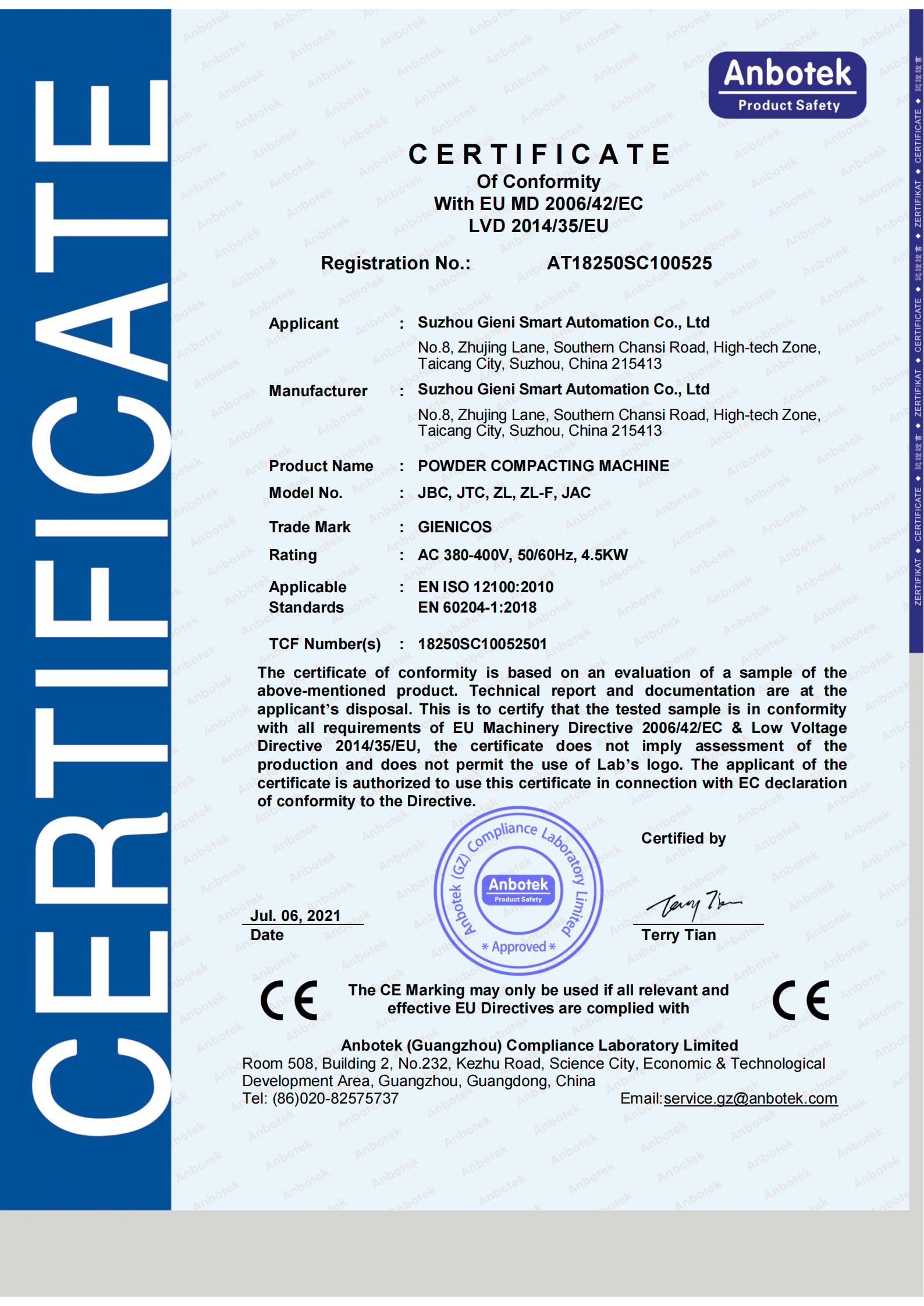
Certificate AT18250SC100525 covers powder compacting machines JBC, JTC, ZL, ZL-F and JAC, issued 2021-07-06.
4. Lipstick, hot filling and cooling
This is the family where the scope statement is most useful, because a hot filling line is a chain of machines rather than a single unit. Certificate AT185114C4000321, issued on 2024-07-17, defines its scope as a complete hot filling line: the MT melting tank, the JYF filling machine, the JCT cooling machine, the automatic bottle loading machine, the automatic cap loading machine, the check weigher and the JTB labeling machine, under model series JHF-1 through JHF-10.
The Lipstick Cooling Tunnel JCT uses refrigerated air circulation and a continuous conveyor-type cooling tunnel for lipstick and lip balm molds after hot filling, with temperature, conveyor speed, dimensions and power supply customizable to the production line. The Hot Filling & Cooling Line JHF offers filling ranges of 1–20 mL, 20–50 mL, 50–100 mL and 100–200 mL, with 2, 4, 6 or 16 nozzles depending on configuration, and a maximum output of up to 60 pcs/min with a 6-nozzle configuration. The Automatic Silicone Mold Lipstick Filling Machine GLU-1300 produces 1000–1300 pcs/hour with a 30 L material tank, electric oil heating and a 112-piece silicone mold, while lipstick filling machines JLG-10, JLG-12, JSM, FSM-5 and FSM are named under certificate AT1814C500649151.
Practical implication: when a hot filling line is quoted, ask for the certificate that names the whole line — not only the filling head — because the cooling tunnel and the check weigher sit inside the same scope.
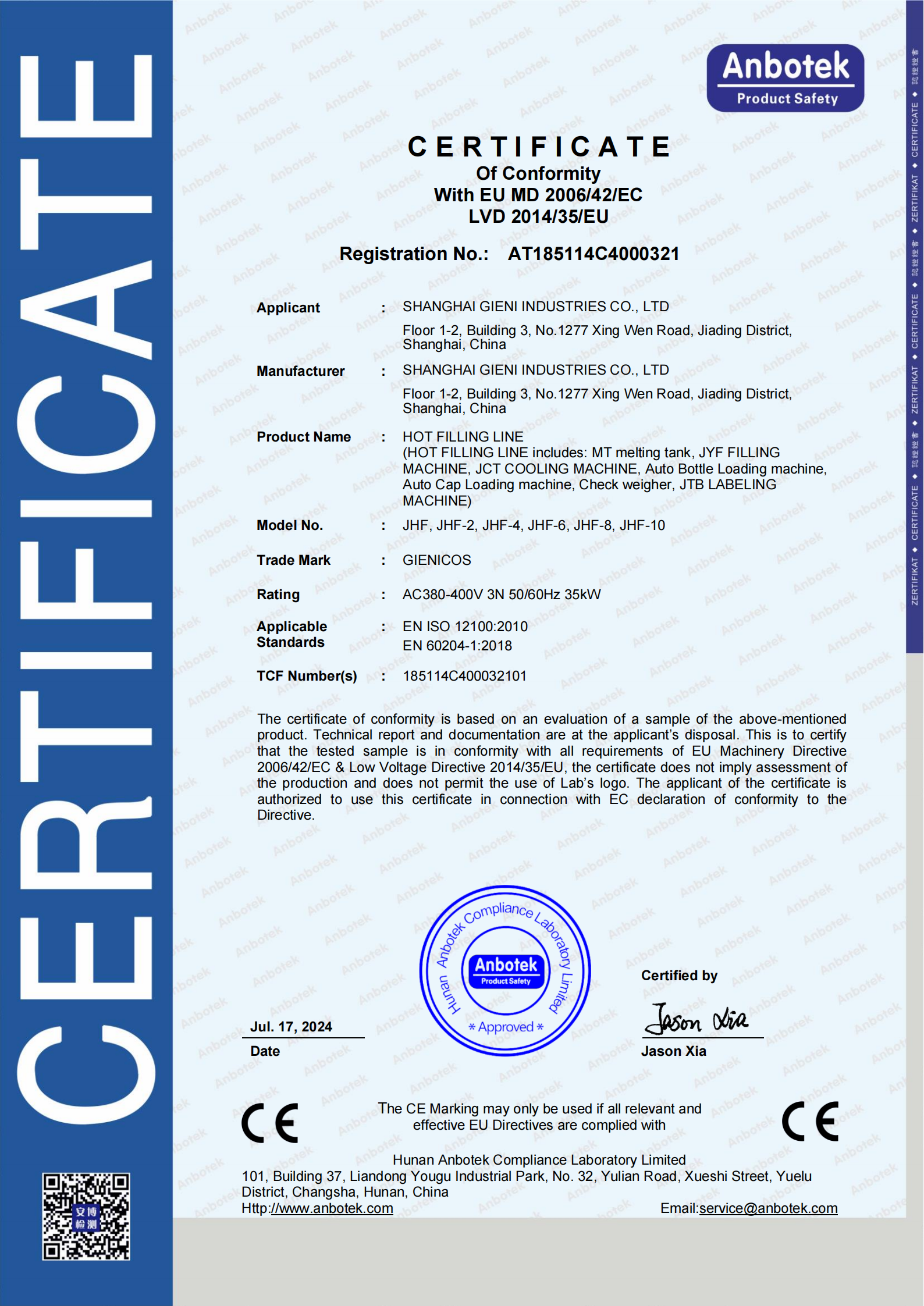
Certificate AT185114C4000321 defines the hot filling line scope, including the JCT cooling machine and the JTB labeling machine.
5. Mascara, lipgloss and skin care lines
For liquid colour cosmetics, the Lipgloss Mascara Filling Machine JMG runs a linear high-speed line at 60–72 pcs/min mid-speed and 80–100 pcs/min high-speed, with servo piston filling of 10–12 pcs per cycle, a return-suction anti-drip nozzle, no-bottle no-fill detection and servo torque capping with adjustable torque. Wetted parts are SUS316L and the line is described as GMP-compliant with easy disassembly and cleaning.
Adjacent families follow the same documentation logic. The Automatic Lipgloss Filling and Capping Machine JQH-02 fills 1–20 mL at 60–80 pcs/min with ±0.1 g precision; the Automatic Mascara Lipgloss Filling Machine JQR-01A runs 40–45 PPM across a container diameter range of 10–125 mm; the Rotary Liquid Eyeliner Filling Machine JR-02E uses peristaltic pump filling at 30–40 pcs/min; the Eyebrow Pencil & Eyeliner Gel Filling Line JPF-12 fills 2–10 mL at 45–50 pcs/min with cooling between −1°C and −2°C. For skin care, the Toner and Cream Rotary Filling Machine JRS-G3 handles 10–300 mL at up to 50 pcs/min with a stated precision of ±0.5 g across 20–100 mL, and the Air Cushion CC Cream Filling Machine JQR-02C fills up to 20 mL at 24–30 pcs/min.
A documented example of this equipment in service: GIENICOS has supplied 20 sets of equipment to customers in the United States, Poland, Indonesia and Thailand for lipgloss and lipcream production. Those units have been in stable operation for 5 years, with service support delivered on schedule.
Compliance Document Comparison: What Each Document Proves
Compliance documents are often treated as interchangeable. They are not. Each proves one thing and stays silent on the rest — which is why a buyer should know which document answers which question before the order is placed.
| Document | What it verifies | What it does not verify | Verification point |
|---|---|---|---|
| CE certificate with number | That a named machine family was assessed by a named laboratory against stated standards | That the individual unit on your order is configured identically | Compare the scope model string with the order line |
| Scope statement | Which machine models fall inside the assessment | How the machine performs in your process | Request the scope page, not only the cover |
| Applied standards list | The electrical safety and risk-assessment framework used (EN 60204-1:2018; EN ISO 12100:2010) | Requirements of markets outside the EU | Match the list to your certificate number |
| Nameplate and serial number | The identity of the delivered unit | That documentation exists for that identity | Photograph the nameplate during acceptance |
| Declaration of conformity | The manufacturer’s formal statement for the machine family | Laboratory test results | File it with the certificate, not separately |
| HS classification reference | The customs category for opening, filling and closing machinery (8422.30; US 8422.30.91) | Duty rates or destination import formalities | Confirm with your customs broker before booking freight |
| Acceptance record (FAT or video inspection) | That the unit was checked before shipment | Long-run performance in your plant | Archive against the machine serial number |
Frequently Asked Questions
Q1. What certifications do GIENICOS cosmetic filling machines hold for the EU market?
GIENICOS holds CE certificates for defined machine families, each stating a certificate number, an issuing laboratory, the applied standards and the models inside its scope. Standards referenced across the set are EN 60204-1:2018 and EN ISO 12100:2010, and the certificates state the EU as the applicable market. Examples: AT185114C4000321 for the JHF hot filling line, issued 2024-07-17 by Hunan Anbotek Compliance Laboratory Limited; AT1814C500649151 for lipstick filling machines JLG-10, JLG-12, JSM, FSM-5, FSM and JLG, issued 2025-01-15; and AT18250SC100524 for rotary filling machines including JR-01-N and JR-02-N, issued 2021-07-06 by Anbotek (Guangzhou) Compliance Laboratory Limited.
Q2. Can GIENICOS supply an OEM cosmetic hot filling machine configured for our product?
Yes. GIENICOS provides OEM and ODM production services, and customization options include voltage, logo, automation degree, tank size, filling method and speed request. For hot filling, the JHF hot filling and cooling line offers filling ranges of 1–20 mL, 20–50 mL, 50–100 mL and 100–200 mL, with 2, 4, 6 or 16 nozzles depending on configuration and a maximum output of up to 60 pcs/min with a 6-nozzle configuration. Configuration is customizable according to product and container requirements.
Q3. What are the commercial terms — minimum order quantity and payment?
The minimum order quantity is 1 unit. Delivery terms include FOB, CNF, CIF and DDP. Payment terms are T/T at 40%/60%.
Q4. How can a buyer verify the machine before it is shipped?
Acceptance criteria are a factory acceptance test on site or a video inspection before shipment, and GIENICOS performs a 100% OQC test before shipping. Verification can therefore be documented in two places: the inspection record, and the nameplate and serial data captured during that inspection. For projects where the filling behaviour of a specific formula needs to be seen first, the production configuration can be reviewed with the technical team before the order is confirmed.
Q5. What is the lead time, and what support continues after delivery?
Lead time is 45–80 days, with a monthly capacity of 10 units. After delivery, support includes remote technical support, onsite visit support, a 1-year warranty and full life service support. The standard warranty is 12 months from the date of machine acceptance and covers manufacturing defects, with free spares and freight carried by the company. Equipment uses a modular structural design so that key assemblies can be disassembled quickly for cleaning and spare-part replacement. To start a compliance review for a specific model, request the certificate and scope statement together with the 2026 catalogue at GIENICOS 2026 Catalogue, or send the model and destination market to sales@genie-mail.net.
Conclusion
Compliance for a cosmetic filling machine is not a single document — it is an ordered file. The certificate proves that a machine family was assessed; the scope statement proves which models were included; the standards list proves which framework was applied; the nameplate proves which unit was delivered; the declarations and trade papers connect all of it to a border crossing. Read in that order, the file answers the questions that buyers, importers and plant engineers actually ask.
The seven-step workflow above can be applied without modification to a Rotary Nail Polish Filling Machine, a Tube Filling and Sealing Machine, an Automatic Loose Powder Filling Machine, a Lipstick Cooling Tunnel or a complete hot filling and cooling line — only the model strings and the electrical configuration change. GIENICOS, the brand of SHANGHAI GIENI INDUSTRY CO., LTD., was founded in Shanghai in 2011, holds 42 authorized patents, and exports to 100 countries and regions with an 80% export ratio.
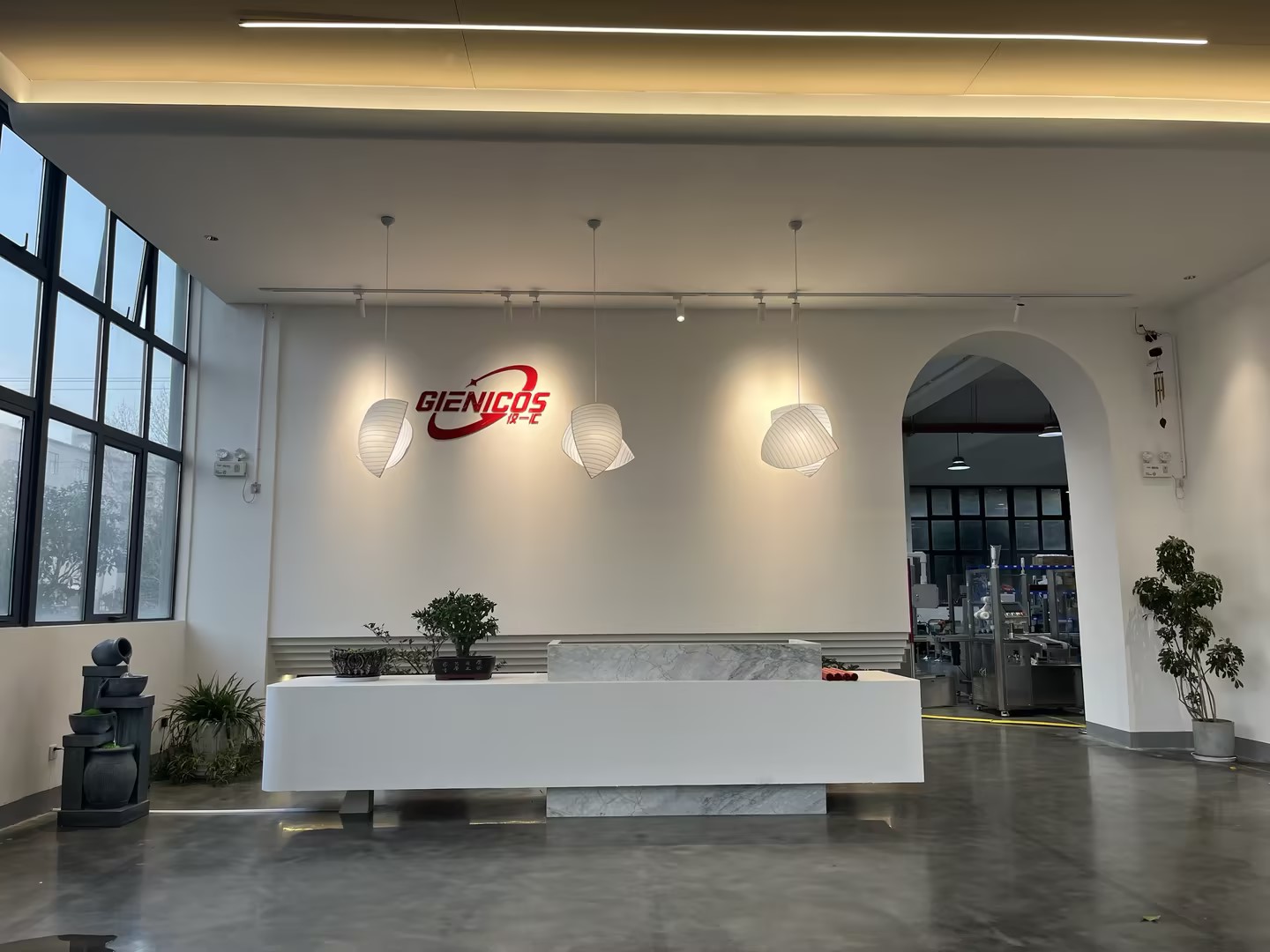
GIENICOS facility, Shanghai — certificates, scope statements and acceptance records are coordinated here before shipment.
Next step: build your compliance file before the container is booked
Send the exact model and the destination market, and GIENICOS will return the matching certificate and scope statement, the configuration options for that market, and the acceptance plan. OEM and ODM production services are available with a minimum order quantity of 1 unit, a lead time of 45–80 days, and acceptance by factory test on site or video inspection before shipment.
- Download the 2026 GIENICOS Catalogue (PDF)
- Request a quotation or sample discussion: sales@genie-mail.net
- WhatsApp: +86 134 8206 0127
- Website: WWW.GIENICOS.COM
- Factory address: FL1-2, Building 3, No.1277 Xingwen Road, Baihao AI Technology Park, Jiading North Industrial Park, Jiading District, Shanghai