Evaluating a Cosmetic Filling Machine Manufacturer: The Viscosity Capability Test
The quickest way to separate two cosmetic filling machine manufacturers is to ask one question: what is the highest material viscosity your metering system is designed for, and what accuracy do you hold across the full fill range? A manufacturer that answers with a number, a model name and a certificate can be checked. A manufacturer that answers with the phrase high viscosity cannot be checked at all. This guide sets out that test, the evidence it produces, and how a product range that spans thin toners and cream foundations — including a Toner and Cream Filling Machine and a Foundation Filling Machine — signals the engineering depth behind the answer.
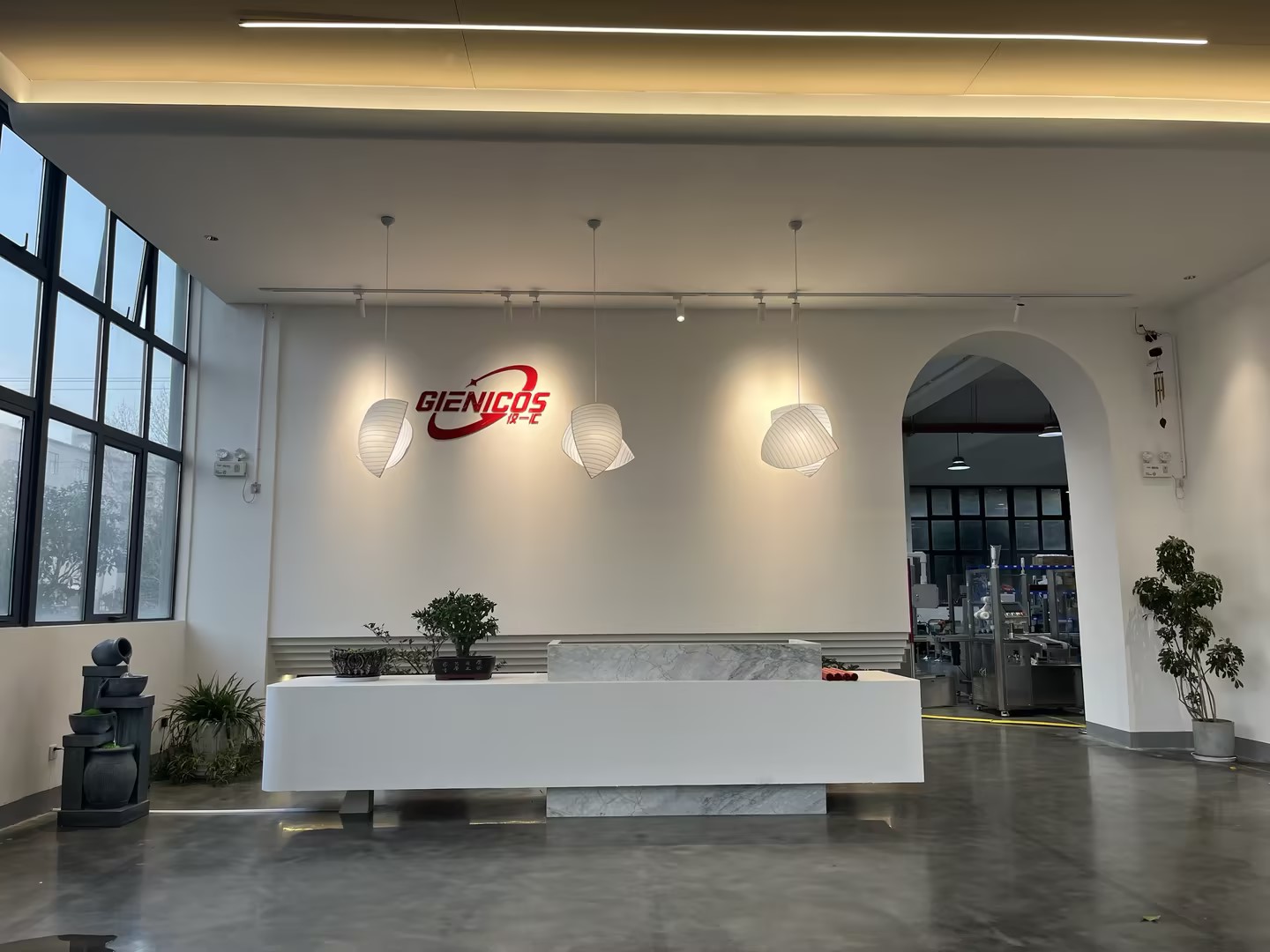
SHANGHAI GIENI INDUSTRY CO., LTD, trading as GIENICOS, is a Shanghai-based manufacturer founded in 2011 that designs and builds intelligent cosmetic filling and packaging equipment, together with robotic loading and unloading system solutions. Its machines are developed for color cosmetics and skincare production, are used inside GMP clean-room workshops, and are supplied to cosmetic brands, OEM/ODM contractors and small-batch production labs.
Why Viscosity, Not Model Count, Decides Supplier Fit
A cream foundation and a lipgloss are both liquids on a purchasing spreadsheet, and completely different materials at a filling head. Viscosity governs how a formula is drawn into the metering chamber, how it releases at the nozzle, and how it levels inside the container. A machine that fills lipgloss confidently at high speed can drip, string or underfill when the same piston and nozzle are asked to run a cream at 15,000 mPa·s.
Three failure patterns are widely reported when material and metering principle are mismatched: nozzle drip and product stringing, weight drift across a production run, and heat loss in the supply path that thickens or sets the bulk before the container is filled. None of these appear on a specification sheet that lists output speed only.
The buyer's task is therefore not to compare catalogue pages, but to make the manufacturer describe how its metering technology behaves with a defined material. The checks below convert that requirement into questions that produce verifiable answers.
Industry Background: Automation Growth Meets Thicker Formulations
Global demand data explains why supplier evaluation is worth doing properly. The global cosmetic filling machines market was valued at USD 476.80 million in 2025 and is projected to reach USD 718.63 million by 2036 (Future Market Insights). Automatic filling machines are projected to hold a 41.2% share of the cosmetic filling technology market in 2026. Regionally, Asia Pacific dominated the wider filling machine market with a 33.08% share in 2025 (Fortune Business Insights). Sub-segment forecasts vary by definition: one commercial research source projects the automatic lipstick filling machines market to reach USD 1.2 billion by 2033 at a 5.8% CAGR from 2025, while narrower definitions used elsewhere produce much smaller figures — a reminder to treat any single market number as directional rather than precise.
Trade classification is more stable. Cosmetic filling machines fall under HS Code 8422.30, with 8422.30.91 covering machinery used in opening, filling and closing containers (Harmonized Tariff Schedule, USITC).
The engineering trend that matters most to the viscosity test is the move toward thicker, higher-value formats: cream foundation, cushion and compact systems, wax-based lipstick and lip balm, and gel-based pencils. These are not filled by a single machine but by a chain — melting tanks with heating, stirring and vacuum; hot filling units; and downstream cooling. GIENICOS's own melting tank range runs from 20 L to 300 L for exactly this reason, and its portfolio includes thermal equipment such as the MT 300 SE melting tank for foundation, lipstick and primer cream bulk, the TSP 20 L hot pouring machine, the JHF hot filling and cooling line, and the JCT lipstick cooling tunnel.
The Viscosity Capability Test: Eight Checks Before You Shortlist
1. Metering principle matched to the material
Different materials need different pumps. Servo piston filling is the principle used for creams, lip cream and other high-viscosity products — the JSFL single or dual nozzle servo piston filling machine is specified for lip balm, lipstick, lip cream and high-viscosity cosmetic products, with a liftable tank and servo-controlled piston filling. Where the material is a low-viscosity liquid, peristaltic filling is used instead: the JR-02E eyeliner filling machine fills two products per cycle with peristaltic pump filling at 30–40 pcs/min. For dry powder, auger and weighing principles apply: the JLF-A automatic loose powder filling machine uses dual nozzle auger filling at 30–40 pcs/min with SUS316L product-contact parts, while the rotary JLF model uses weighing-to-fill and runs at 900–1,800 pcs/hour from a 25 L tank. A manufacturer should be able to name the principle, the model and the material range in one answer.
2. A published viscosity ceiling
Ask for a number with a unit. The JRS-G2 Toner and Cream Filling Machine states a material viscosity limit of ≤15,000 mPa·s with a 10–300 ml filling range at normal pressure, a 40–45 L tank, dual-nozzle servo filling, and a speed of 45 bottles/min at 50 ml. A viscosity figure is a design constraint the manufacturer has committed to; its absence usually means the limit has never been defined.
3. Accuracy stated across the whole fill range, not one setpoint
Accuracy usually degrades as fill volume falls, so a single headline figure is not enough. The JRS-G3 Toner & Cream Rotary Filling Machine specifies accuracy in two bands — 20–100 ml at ±0.5 g and 101–300 ml at ±0.5% — with a maximum speed of 50 pcs/min, servo piston filling, a 15-minute changeover, and holder diameters of 10–70 mm. For comparison within the same portfolio, the JYF-4 multi-color hot filling machine is rated at ±0.1 g across 2–20 ml, 20–50 ml and 50–100 ml, and the JQH-02 automatic lipgloss filling and capping machine is rated at ±0.1 g across 1–20 ml at 60–80 pcs/min. Where a formula or substrate introduces variability, the manufacturer should say so — the JQL-04C cushion filling machine states ±0.15 g, subject to material formula, sponge characteristics and other factors.
4. Thermal control from tank to nozzle
High-viscosity cosmetic bulk is often semi-solid until it is warmed, and it must stay warm all the way to the nozzle. Check the preparation side: the MT 20 SE six-in-one melting system carries 6 × 20 L tanks with heating, stirring and vacuum; the MT 30SE offers a 30 L tank with mixing, vacuum and tank lid lifting; the MT 50P and MT 100P dispersion tanks handle 50 L and 100 L; the MT 100 SE is a 100 L melting and mixing tank with air-spring assisted lid opening and a flanged lid for vacuum; and the MT 300 SE is a 300 L industrial tank using oil circulation type heating for foundation, lipstick, primer cream and other wax-based bulk. On the filling side, the TSP hot pouring machine uses a 20 L tank with heating, stirring, vacuum and a sanitary valve without dead angle. Downstream, the JHF hot filling and cooling line accepts 1–20 ml, 20–50 ml, 50–100 ml and 100–200 ml ranges with 2, 4, 6 or 16 nozzles and a maximum output of up to 60 pcs/min in the 6-nozzle configuration, and the GLU-1300 automatic silicone mold lipstick filling machine runs 1,000–1,300 pcs/hour with a 30 L tank, electric oil heating, a 112-cavity silicone mold, two LEISTER hot air guns and support for lipstick diameters of approximately 8–17.1 mm. Thermal capability is the part of the viscosity test most often skipped.
5. Container, puck and changeover data
Viscous products are usually packed in wider, shorter containers, which changes tooling. Useful published figures include puck inner diameters of 25–70 mm, bottle heights from 30 mm without cap to 205 mm with cap, and cap diameters of 20–55 mm on the JRS-G2; holder diameters of 10–70 mm on the JRS-G3; and, for tube formats, the GFS-40/60 tube filling and sealing machines covering 5–250 ml and 5–200 ml with tube diameters of 10–50 mm and tube lengths of 60–210 mm. Changeover time is equally telling: the JRS-G3 specifies a 15-minute changeover, and the JZF robotic compact powder assembly line specifies a changeover or set time of approximately 15 minutes.
6. Cleaning, material contact and uptime
In GMP environments, cleaning determines real capacity. The JMF vertical dual nozzle high-viscosity filling machine runs 22–28 pcs/min with one operator from dual 20 L tanks and specifies a cleaning time of approximately 30 minutes. GIENICOS states that its machines use a modular structural design so key assemblies support fast disassembly, cleaning and spare-part replacement. Product-contact grade should also be confirmed: the JMG lipgloss and mascara filling line uses SUS316L wetted parts, as does the JLF-A loose powder filler, with SUS316L also used on JYF-4 product-contact parts.
7. Certificates that can be checked against a register
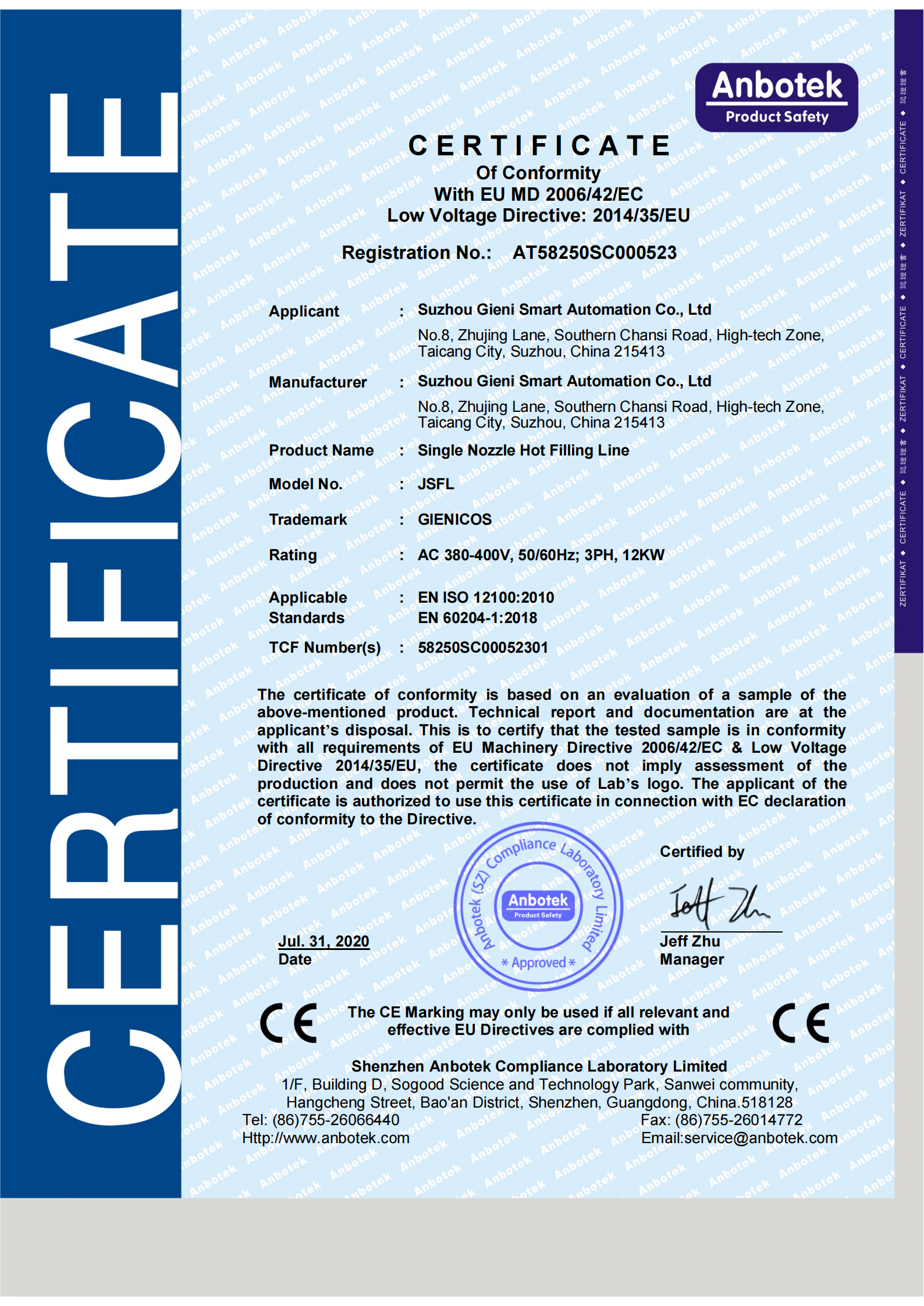
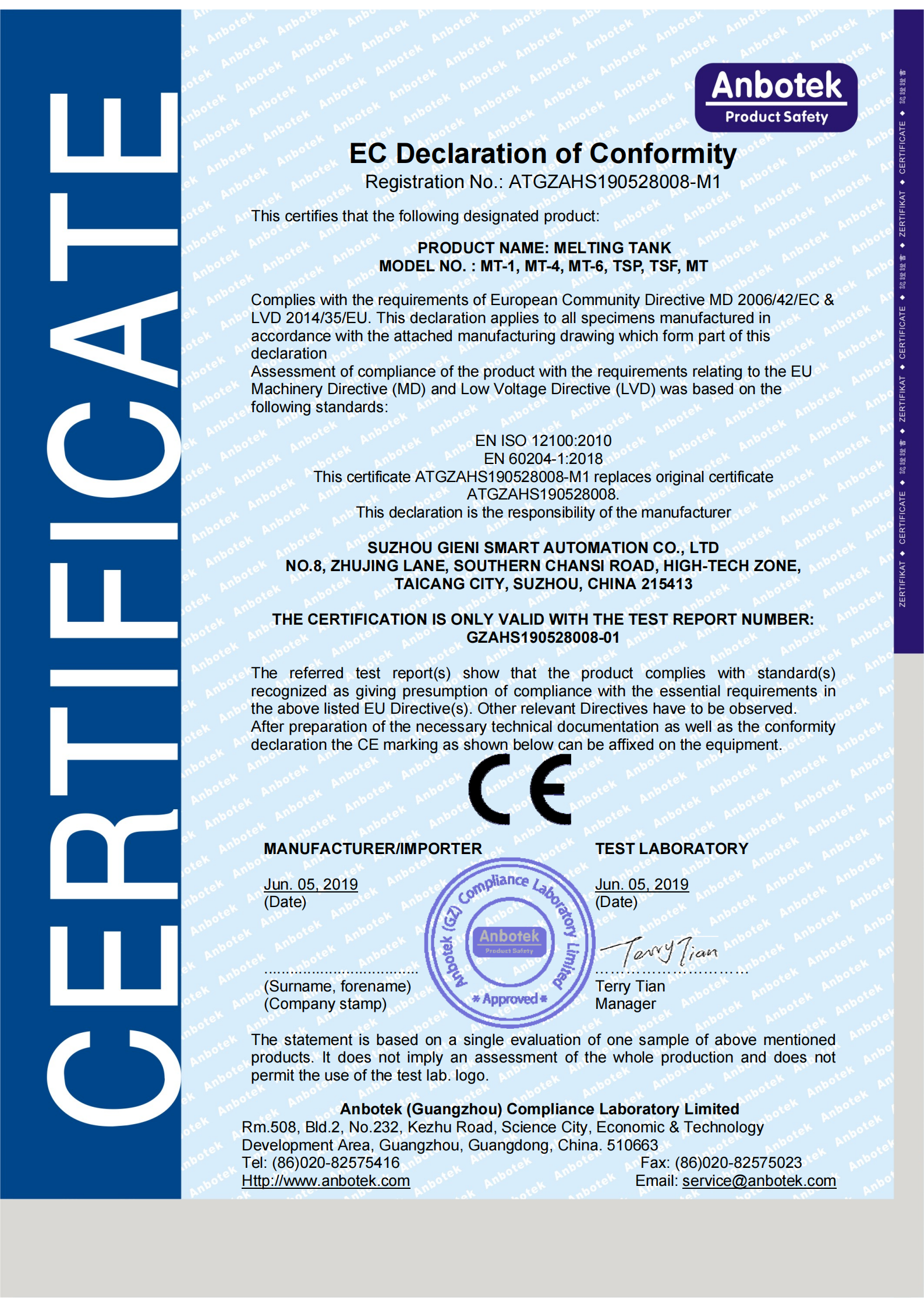
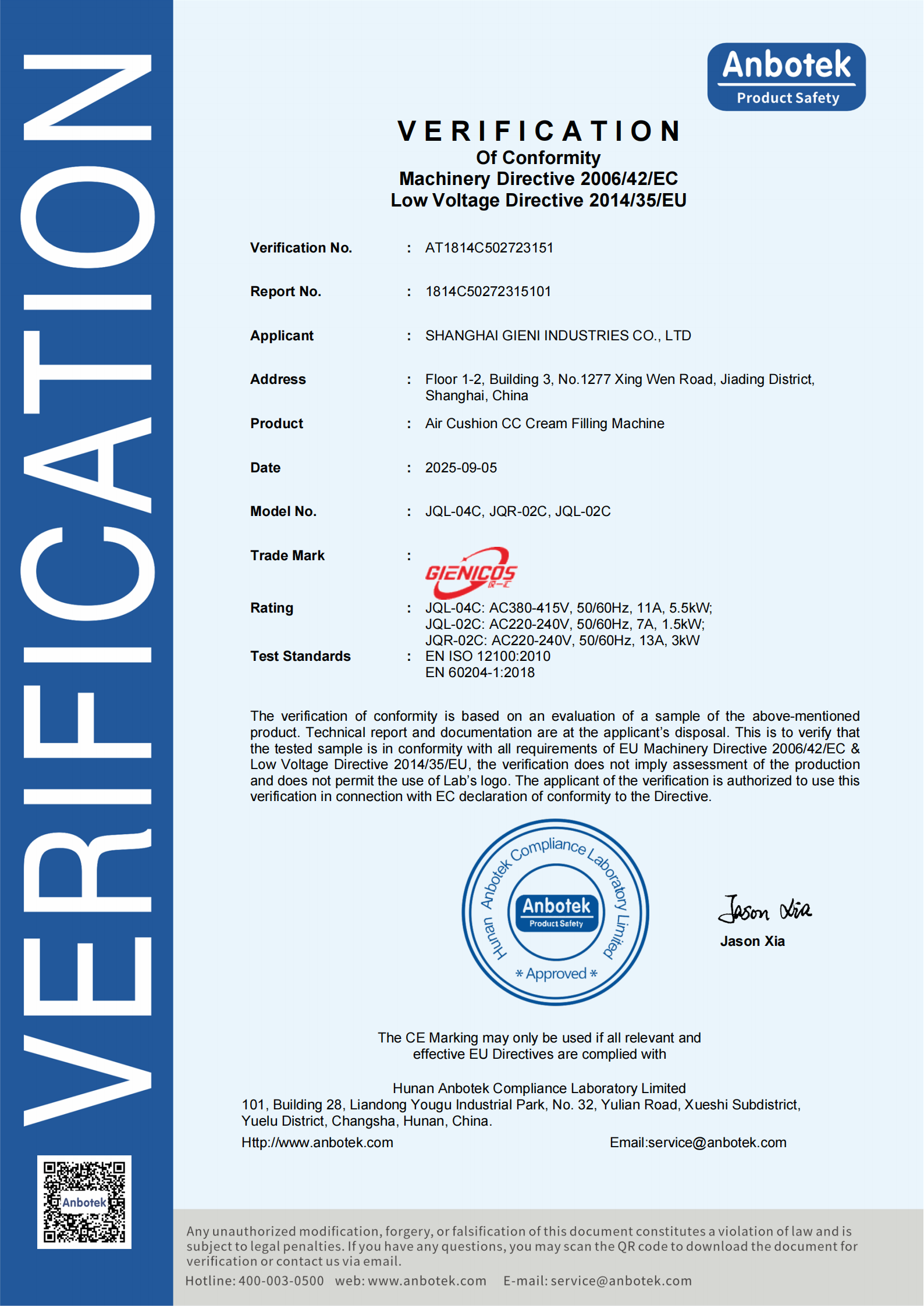
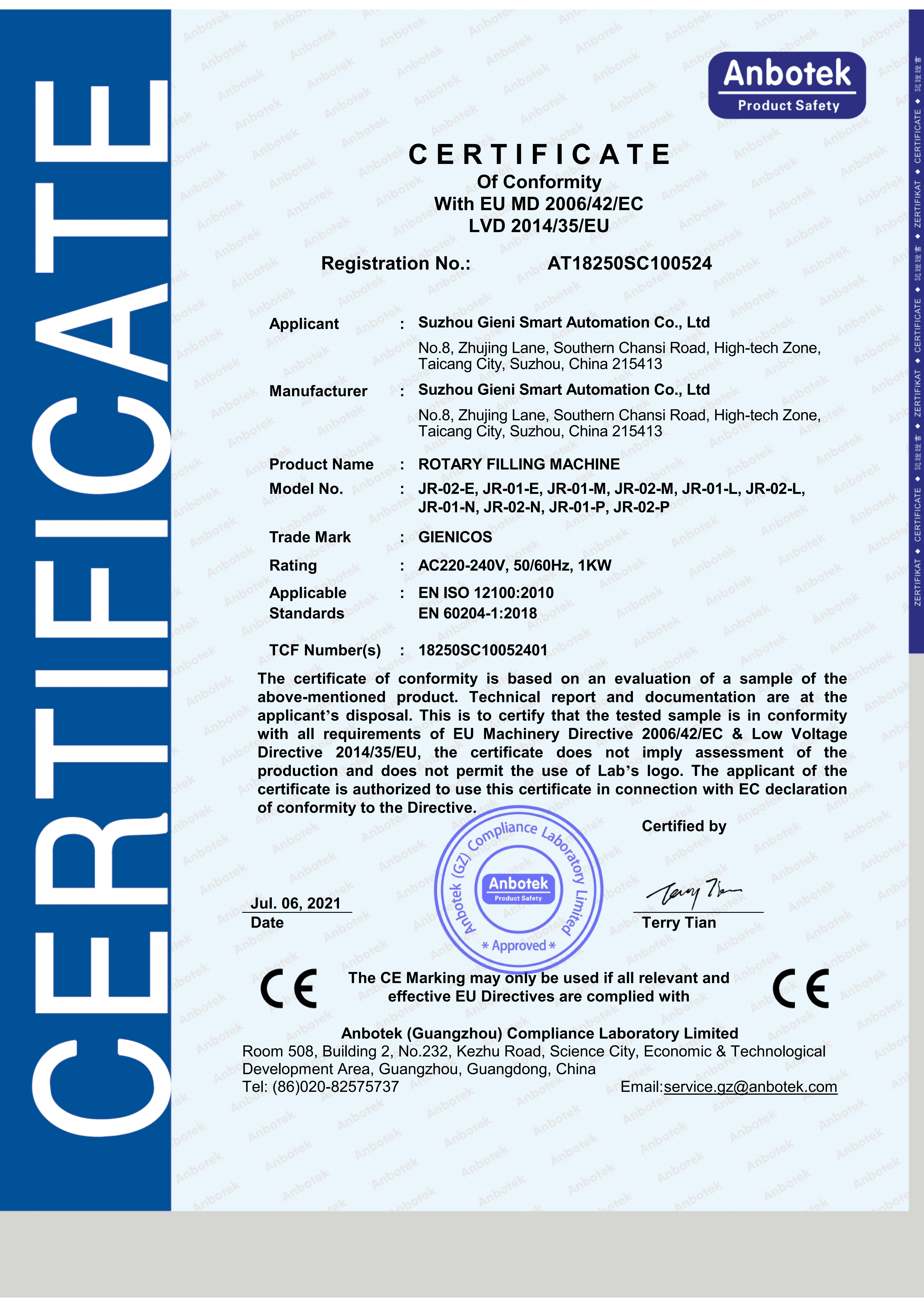
Ask for the certificate number, the issuing laboratory, the standard and the scope. GIENICOS holds CE certification for the EU market with declarations issued under EN 60204-1:2018 and EN ISO 12100:2010, including: the JHF hot filling line scope (certificate AT185114C4000321, Hunan Anbotek Compliance Laboratory Limited, issued 2024-07-17) covering the MT melting tank, JYF filling machine, JCT cooling machine, automatic bottle loading machine, automatic cap loading machine, check weigher and JTB labeling machine; the JYF-2 to JYF-12 multifunctional filling production line (AT58250SC100097, Anbotek Guangzhou, issued 2021-04-19); the JSFL single nozzle hot filling line (AT58250SC000523, Shenzhen Anbotek Compliance Laboratory Limited, issued 2020-07-31); the JQL-04C and JQR-02C cushion filling machines (AT1814C502723151, issued 2025-09-05); the JLG-10/JLG-12 lipstick filling range (AT1814C500649151, issued 2025-01-15); the MT-1 melting tank family (ATGZAHS190528008-M1, issued 2019-06-05); the JY-CR50 powder mixer range (AT18250SC100526, issued 2021-07-06); the JBC/JTC/ZL powder compacting machines (AT18250SC100525, issued 2021-07-06); and the JR rotary filling machine range (AT18250SC100524, issued 2021-07-06). Cross-checking scope matters: a certificate that names the model you intend to buy is worth more than one that names a factory.
8. Portfolio breadth as a proxy for engineering depth
Metering depth is easier to trust when it appears across many materials rather than one. GIENICOS builds filling equipment for toners and creams (JRS-G2, JRS-G3), foundations (JRS-G1, 30–40 pcs/min, full-servo rotary filling for cream and liquid foundation), cushion and BB/CC creams (JQL-04C and JQR-02C), lipstick and lip balm (GLU-1300, JLG-10/12, JSM), lipgloss and mascara (JMG, JQH-02, JQR-01A, JR-01M/L, JR-02M/L), eyeliner (JR-02E), eyebrow pencil and eyeliner gel (JPF-12/16, with a cooling temperature of −1°C to −2°C), nail polish (JQL-02N at 80 pcs/min and ±0.15 g; JQR-01N with piston, vacuum or pressurized filling at approximately ±0.2 g), loose and compact powder (JLF, JLF-A, JBC-4, JBC-5, JTC, GP 050 SE, JZF), powder mixing (JY-CR50, JY3-CR100, JY-CR200), tubes (GFS-40/60), plus labeling, check weighing and melting systems. A single-viscosity supplier rarely carries all of these because each format forces a different metering decision.
Step-by-Step: Running the Test in Seven Steps
- Define your material envelope. Write down the viscosity or flow behaviour, the process temperature window, whether the formula carries solids or wax, and the fill volume and container dimensions. Every later question is measured against this envelope.
- Ask for the metering principle and its viscosity limit. Request a named model and a numeric limit with a unit — for example, a dual-nozzle servo filling machine rated to ≤15,000 mPa·s.
- Request accuracy at two or more points in the fill range. Compare low-fill and high-fill performance; a stated band such as 20–100 ml at ±0.5 g and 101–300 ml at ±0.5% is more useful than one headline number.
- Trace the thermal path. Confirm tank volume, heating method, stirring and vacuum on the preparation side, and the nozzle heating or cooling arrangement at the filling head.
- Check container handling, changeover and cleaning. Match puck or holder diameters, bottle and cap dimensions, changeover time and cleaning time against your packaging plan.
- Verify documentation. Match certificate numbers, standards and scope to the exact model, and confirm quality control and after-sales terms. GIENICOS performs 100% OQC testing before shipping and offers a 1-year warranty with remote technical support, onsite visit support and full life service support.
- Validate with a single unit before scale-up. With a MOQ of 1 unit and a lead time of 45–80 days, a formula can be validated on one machine before a line decision is made. Monthly production capacity is 10 units, so scheduling should be planned early.
Use Cases: Where Viscosity Capability Is Really Tested
Cream and foundation production. The JRS-G1 foundation filling machine handles cream and liquid foundation at 30–40 pcs/min using full-servo rotary filling, while the JRS-G2 and JRS-G3 cover toner, serum, oil and cream from 10 ml to 300 ml. This is the clearest case where a viscosity limit and a precision band matter more than a speed headline.
Cushion and BB/CC cream. Semi-solid cream must be dosed into a sponge without over-saturating it. The JQL-04C uses four servo nozzles at 30–40 pcs/min across 5–20 ml, and the JQR-02C rotary model runs 24–30 pcs/min with a maximum filling volume of 20 ml from a 15 L stirred tank.
Wax-based hot fill. Lipstick, lip balm and chapstick rely on thermal control rather than viscosity alone. The JHF hot filling and cooling line supports up to 60 pcs/min with 6 nozzles, the GLU-1300 silicone mold machine runs 1,000–1,300 pcs/hour, and the JLG-10/12 semi-automatic series fills 1–20 ml at ±0.1 g through 10 or 12 nozzles.
Low-viscosity liquids. Eyeliner and nail polish test the opposite end of the spectrum. The JR-02E fills liquid eyeliner at 30–40 pcs/min, and the JQL-02N nail polish machine runs 80 pcs/min across 5–20 ml with ±0.15 g precision.
Powders. Dry material needs auger or weighing principles rather than pistons. Loose powder filling runs 900–1,800 pcs/hour on the JLF rotary model and 30–40 pcs/min on the JLF-A linear model, while compacting is handled by the JBC-4, JBC-5 and JTC presses at 720–1,080 pcs/hour and 2–3 molds/min respectively.
Comparison Table: Metering Technology vs. Material Viscosity
| Metering principle | Material fit | Representative equipment | Verifiable specification |
|---|---|---|---|
| Servo piston, dual nozzle, normal pressure | Creams, toners, lotions and serums up to ≤15,000 mPa·s | Toner and Cream Filling Machine, JRS-G2 | 10–300 ml; 45 bottles/min at 50 ml; 40–45 L tank; puck inner diameter 25–70 mm; bottle height 30 mm without cap to 205 mm with cap; cap diameter 20–55 mm |
| Servo piston, automatic rotary | Oil, toner, serum and cream | Toner and Cream Rotary Filling Machine, JRS-G3 | 10–300 ml; up to 50 pcs/min; 20–100 ml ±0.5 g and 101–300 ml ±0.5%; 15-minute changeover; holder diameter 10–70 mm; AC380V 3P, 5 kW |
| Full-servo rotary filling, semi-automatic | Cream and liquid foundation | Foundation Filling Machine, JRS-G1 | 30–40 pcs/min; 1P 220V, 25 A; 0.5–0.8 MPa; 3.5 kW; 1100 × 950 × 2200 mm |
| Servo piston with liftable tank | Lip balm, lipstick, lip cream and other high-viscosity cosmetic products | Single / Dual Nozzle Servo Piston Filling Machine, JSFL | Single or dual nozzle; servo-controlled piston filling; liftable tank; covered by CE certificate AT58250SC000523 |
| Servo piston, fixed-position multi-color | Multi-color wax-based bulk, up to 4 colors | Multi-color Hot Filling Machine, JYF-4 | 2–20 / 20–50 / 50–100 ml; ±0.1 g; 20 L effective tank; SUS316L product-contact parts; AC220V 1P |
| Hot filling with downstream cooling | Lip balm, chapstick and wax-based fill-and-set products | Hot Filling & Cooling Line, JHF | 1–20 / 20–50 / 50–100 / 100–200 ml; 2 / 4 / 6 / 16 nozzles; up to 60 pcs/min with 6-nozzle configuration |
| Auger, dual nozzle linear | Dry loose powder | Automatic Loose Powder Filling Machine, JLF-A | 30–40 pcs/min; 25 L hopper; SUS316L product-contact parts; Mitsubishi PLC; Panasonic servo motor |
| Weighing-to-fill rotary | Loose powder | Loose Powder Filling Machine, JLF | 900–1,800 pcs/hour; 25 L tank; 0.4 kW; AC220V 1P |
| Peristaltic pump, rotary | Low-viscosity liquid eyeliner | Eyeliner Filling Machine, JR-02E | 30–40 pcs/min; 2 products per cycle; 0.6–0.8 MPa; air consumption ≥900 L/min |
| Piston, vacuum or pressurized | Nail polish and low-viscosity oils | Rotary Nail Polish Filling Machine, JQR-01N | 5–30 ml container range; approximately ±0.2 g; AC220V 1P, 2 kW |
Evaluation Checklist: Question, Evidence Requested, and Reference Data
| Question to ask | Evidence to request | Reference data points available today |
|---|---|---|
| Which metering principle fits my formula? | Named model, principle and the materials that model is specified for | JSFL: servo piston filling, specified for lip balm, lipstick, lip cream and high-viscosity cosmetic products |
| What viscosity can the machine handle? | A numeric limit with a unit | JRS-G2: material viscosity ≤15,000 mPa·s at normal pressure |
| What accuracy is held across the range? | Accuracy at two or more fill volumes | JRS-G3: 20–100 ml ±0.5 g; 101–300 ml ±0.5% |
| How is temperature controlled from tank to nozzle? | Tank volume, heating method, stirring and vacuum, plus downstream cooling | MT 300 SE: 300 L with oil circulation type heating, for foundation, lipstick, primer cream and wax-based bulk |
| Which containers can the line handle? | Diameter and height ranges plus changeover time | JRS-G2: puck inner diameter 25–70 mm; bottle height 30 mm to 205 mm with cap; cap diameter 20–55 mm |
| What does cleaning and hygiene require? | Material contact grade, disassembly approach and cleaning time | JMF: dual 20 L tanks, cleaning time approximately 30 minutes; JMG uses SUS316L wetted parts |
| Which certificates cover this exact model? | Certificate number, issuing laboratory, standard, scope and issue date | JSFL: AT58250SC000523, Shenzhen Anbotek Compliance Laboratory Limited, EN 60204-1:2018 and EN ISO 12100:2010, issued 2020-07-31, EU market |
| What happens after shipping? | Warranty term, support channels and spare-part support | 1-year warranty; remote technical support; onsite visit support; full life service support |
| How fast can a unit be delivered? | Lead time, monthly capacity and minimum order quantity | Lead time 45–80 days; monthly production capacity 10 units; MOQ 1 unit |
Frequently Asked Questions
Which certifications should I verify before choosing a cosmetic filling machine manufacturer?
Verify four things: the certificate number, the issuing laboratory, the standard applied, and the scope — because the scope names the models actually covered. GIENICOS holds CE certification for the EU market under EN 60204-1:2018 and EN ISO 12100:2010. Examples include the JHF hot filling line scope (AT185114C4000321, issued 2024-07-17 by Hunan Anbotek Compliance Laboratory Limited), which covers the MT melting tank, JYF filling machine, JCT cooling machine, automatic bottle loading machine, automatic cap loading machine, check weigher and JTB labeling machine; the JYF-2 to JYF-12 multifunctional filling production line (AT58250SC100097, issued 2021-04-19); the JSFL single nozzle hot filling line (AT58250SC000523, issued 2020-07-31); the JQL-04C and JQR-02C cushion filling machines (AT1814C502723151, issued 2025-09-05); and the JLG-10/JLG-12 lipstick filling range (AT1814C500649151, issued 2025-01-15). A certificate that names your intended model is the only one that answers the question.
How do I verify that a manufacturer can handle high-viscosity creams and foundations?
Ask for the viscosity limit, the metering principle and the accuracy band on the model proposed for your product. On the cream and foundation side, the JRS-G2 Toner and Cream Filling Machine is rated to ≤15,000 mPa·s with a 10–300 ml range at 45 bottles/min for 50 ml fills; the JRS-G3 Toner & Cream Rotary Filling Machine fills oil, toner, serum and cream at up to 50 pcs/min with ±0.5 g accuracy between 20–100 ml and ±0.5% between 101–300 ml; and the JRS-G1 Foundation Filling Machine uses full-servo rotary filling for cream and liquid foundation at 30–40 pcs/min. For thicker semi-solid bulk, the JSFL servo piston machine is specified for high-viscosity products and the JMF vertical dual nozzle high-viscosity filling machine runs 22–28 pcs/min from dual 20 L tanks. A manufacturer that answers these prompts with model names and numbers is a manufacturer whose viscosity claim can be checked.
Can a filling machine be customized for a specific viscosity, container and speed?
GIENICOS operates an OEM/ODM model in which customization covers voltage, logo, automation degree, tank size, filling method and speed request. The minimum order quantity is 1 unit, monthly production capacity is 10 units, and lead time is 45–80 days. Practically, this is what allows a buyer to specify a tank volume, a filling method or a heating arrangement that matches a particular formula rather than accepting a standard configuration.
Can a single machine be ordered to validate a formula before committing to a full line?
Yes. With a minimum order quantity of 1 unit, a buyer can validate metering behaviour on one machine before scaling. Two published details make this easier to plan: the JMF vertical dual nozzle high-viscosity filling machine has a cleaning time of approximately 30 minutes, and the JRS-G3 rotary filling machine has a 15-minute changeover — both relevant when several formulas must be run through the same unit. For small-volume and trial outputs, the range also includes the JLG-10H trial sample filling machine with 10 nozzles, a 1–19 ml fill volume, a 25 L tank, SS316L product-contact parts and a speed of 100–130 pcs/min.
What lead time, quality control and after-sales support should a buyer expect?
GIENICOS quotes a lead time of 45–80 days and a monthly production capacity of 10 units, and performs 100% OQC (Outgoing Quality Control) testing before shipping. After-sales coverage includes remote technical support, onsite visit support, a 1-year warranty and full life service support. Buyers evaluating high-viscosity filling equipment can request the 2026 catalogue, submit a formula and container specification for review, or arrange a factory visit and commissioning discussion by contacting sales@genie-mail.net, WhatsApp +86 134 8206 0127, or visiting the factory at FL1-2, Building 3, No.1277 Xingwen Road, Baihao AI Technology Park, Jiading North Industrial Park, Jiading District, Shanghai.
Conclusion: What a Passed Viscosity Test Buys You
A supplier evaluation that stops at speed, price and delivery leaves the highest-risk variable untested. Viscosity capability is the variable that determines whether a cream, a foundation or a wax-based bulk fills accurately on day one and still fills accurately after a season of production. The test is straightforward: ask for a viscosity limit, a metering principle, accuracy across the fill range, the thermal path, container and changeover data, cleaning time, and certificate scope — then compare the answers against a register you can verify.
GIENICOS approaches this from the position of a manufacturer whose range covers toner and cream filling, foundation filling, cushion and BB/CC cream, lipstick and lip balm hot filling, lipgloss and mascara, eyeliner and eyebrow pencil, nail polish, loose and compact powder, plus the melting tanks, cooling tunnels, labeling and check-weighing equipment that surround them. That breadth is only useful to a buyer if it is expressible as data, which is why the model numbers, viscosity limits, precision bands, certificate numbers and lead times referenced in this guide are published rather than implied.
Next Step: Test a Formula, Not a Brochure
Send your formula viscosity, container dimensions and target output, and the GIENICOS team will match a metering principle and a model to it. You can download the 2026 catalogue, review the full equipment range at www.gienicos.com, or start a sample and quotation request at WhatsApp +86 134 8206 0127.
Email: sales@genie-mail.net · Tel / WhatsApp: +86 134 8206 0127 · Factory: FL1-2, Building 3, No.1277 Xingwen Road, Baihao AI Technology Park, Jiading North Industrial Park, Jiading District, Shanghai.