
Mascara Lipgloss Filling Machine: Semi vs Automatic Choice
Semi-Automatic vs Automatic Mascara and Lipgloss Filling Machine: A Buyer's Head-to-Head on Batch Size, Changeover and Capping
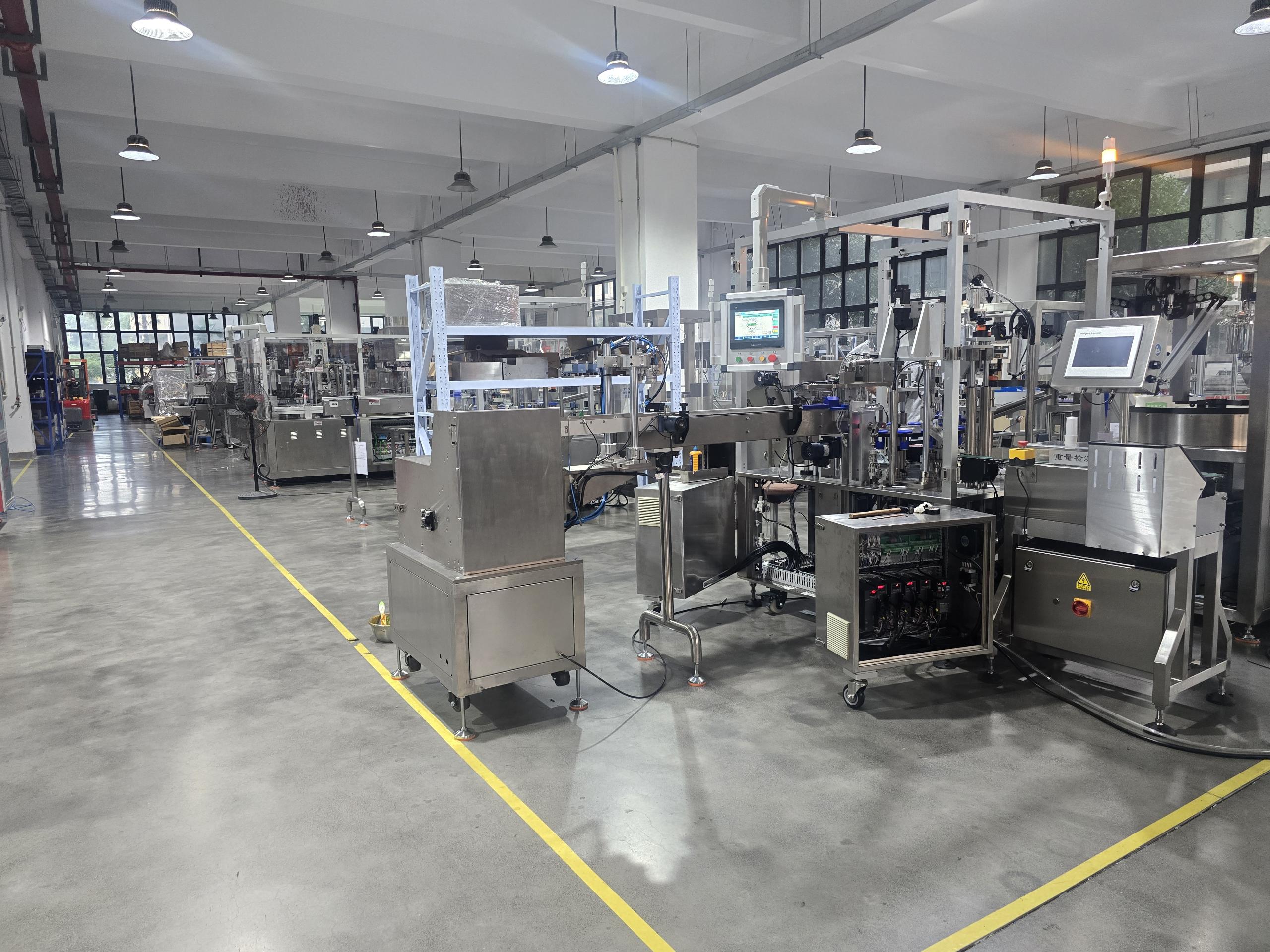
Semi-automatic and automatic mascara and lipgloss filling machines perform the same physical task: dosing a viscous cosmetic into a tube, bottle or pen barrel. The difference is who controls the pace. On a semi-automatic machine an operator loads containers, starts each cycle and removes the filled units. On an automatic line a PLC links filling, wiper or brush loading, pressing, capping and rejection into one timed sequence.
The purchase decision is therefore a fit question, not a ranking of machine quality. Batch structure, operator involvement, changeover frequency and the position of capping decide which path holds together. This head-to-head compares the two paths on those variables and shows when an integrated automatic lipgloss filling and capping machine is the cleaner third option.
The decision in brief
Two clarifications prevent expensive mistakes. First, semi-automatic and automatic are not two sizes of the same machine; they distribute control differently across the line. Second, automation changes the operator's role rather than removing it. The operator becomes a supervisor of replenishment, quality checks and minor interventions, and the plant needs maintenance capability to match.
Why the comparison matters in 2026
The category is growing, but growth does not make every plant an automatic-line candidate. Future Market Insights estimates the global cosmetic filling machine market at USD 476.80 million in 2025 and projects USD 718.63 million by 2036 (FMI, 2026). Fortune Business Insights reports that Asia Pacific held a 33.08% share of the wider filling machine market in 2025, which reflects where much of the manufacturing capacity and equipment supply sits.
Technology mix is the more useful signal for this decision. FMI projects automatic filling machines to hold 41.2% of the cosmetic filling technology market in 2026. By simple arithmetic, the remaining majority is still served by semi-automatic, manual and other categories — a calculated implication of the reported share, not a separately published figure. The practical reading is that both paths remain mainstream, and the choice depends on the production model rather than on automatic being the default.
Procurement paperwork also has a fixed point. Cosmetic filling machines fall under HS 8422.30, and the USITC cites 8422.30.91 for machinery used in opening, filling and closing containers. That classification matters for customs, spare-part planning and cross-border quotes, not for the semi-automatic versus automatic decision itself.
Batch size: the first filter
Batch size in this decision means the length of a continuous run per SKU, not monthly output. A plant that fills 200,000 units a month in twenty shades may still run short campaigns. A plant filling 60,000 units in two shades may run long, stable campaigns. The first pattern favors semi-automatic filling; the second gives an automatic line time to recover its setup and cleaning effort.
There is no universal batch-size number that separates the two paths. The reliable method is to list the last twelve months of orders by SKU, then record the actual run length and the number of changeovers per week. A run that ends before the line reaches a stable rhythm pays for automation it cannot use. A run that lasts several shifts makes manual pacing the limiting factor.
Container and formulation range belong in the same review. A line asked to handle several tube diameters, wiper styles and bulk viscosities needs accessible parts and short cleaning paths more than it needs maximum nominal speed. GIENICOS states that its machines use a modular structural design with key assemblies that can be disassembled quickly for cleaning and spare-part replacement, which is directly relevant to high-changeover production.
Operator involvement: pace-setter or supervisor
On a semi-automatic machine the operator is the pace-setter. Loading, cycle start, removal and in-process checks all sit with that person, so output tracks skill and attention across a shift. That is acceptable for short runs and trial work, where flexibility matters more than sustained repetition. It becomes a risk when the same team must hold a tight cycle for hours.
On an automatic line the operator supervises. The PLC and servo axes hold the rhythm; the person replenishes containers and bulk, audits fill weight, clears faults and manages changeover. This is not automatically a smaller labour requirement. It is a different skill requirement, and it depends on maintenance support being available when a sensor, nozzle or capping head needs attention.
The buyer's check is straightforward: write the actual shift routine for both options, including cleaning, weight checks and breaks. If the semi-automatic routine depends on one experienced operator and no backup exists, the apparent capital saving carries an operational concentration risk that belongs in the decision.
Changeover: the cost that sits between the two paths
Changeover is where the two paths often separate in practice. A shade change may require flushing the bulk path, cleaning the filling heads, changing wipers or brushes, adjusting the capping chute and confirming weight on the first containers. On a semi-automatic cell the physical path is shorter and easier to reach. On an automatic line the same work sits inside a longer machine, so accessibility and recipe management decide how fast it really is.
Stored recipes help, but they do not replace cleaning. A parameter recall shortens the setup of servo axes and capping positions; it does not remove residue from a filling head or a hopper. Buyers should time a real changeover with the supplier, from the last good container of shade A to the first good container of shade B, including cleaning and weight verification. That measured time is more useful than a catalogue speed figure.
Frequent changeovers therefore favor designs with modular assemblies, visible product paths and quick-release parts. Long campaigns favor lines that hold speed and accuracy without constant intervention. The same plant can need both, which is why a mixed equipment strategy is common rather than contradictory.
Capping integration: where the decision usually flips
Capping is frequently the step that decides the architecture. If filling is automated but capping remains manual, filled containers accumulate between the two steps and the effective line rate falls to the capping rate. The filling machine may be capable of far more, but the cell cannot deliver it. This is why the capping boundary should be drawn before the filling machine is selected.
An integrated automatic lipgloss filling and capping machine removes that transfer and holds filling and capping in one rhythm. GIENICOS documents a high-speed automatic configuration with automatic wiper loading and pressing, a 10-head servo capping unit and a line speed of up to 80 pcs/min. Those values belong to the specified high-speed configuration and product; they are the right starting point for a trial, not a guarantee for every container.
For hot-fill products the sequence matters as well. A heated bulk path, a temperature-stable filling head and a controlled cooling or setting step before capping all affect the result. Temperature fluctuation changes viscosity, and viscosity changes dose. A capping unit that closes containers before the product has settled can create overflow, incomplete fill or torque variation. The hot-fill loop and the capping step should therefore be reviewed together.
What the automatic path documents
The automatic path is easier to evaluate when the supplier publishes configuration-level data. For its high-speed mascara and lipgloss line, GIENICOS documents a filling tolerance of ±0.1–0.2 g, line speed up to 80 pcs/min, SUS316L stainless steel for wetted parts, and critical components sourced from Mitsubishi and Schneider. Control is PLC-based with touchscreen operation, and the line is described as GMP clean-room compatible.
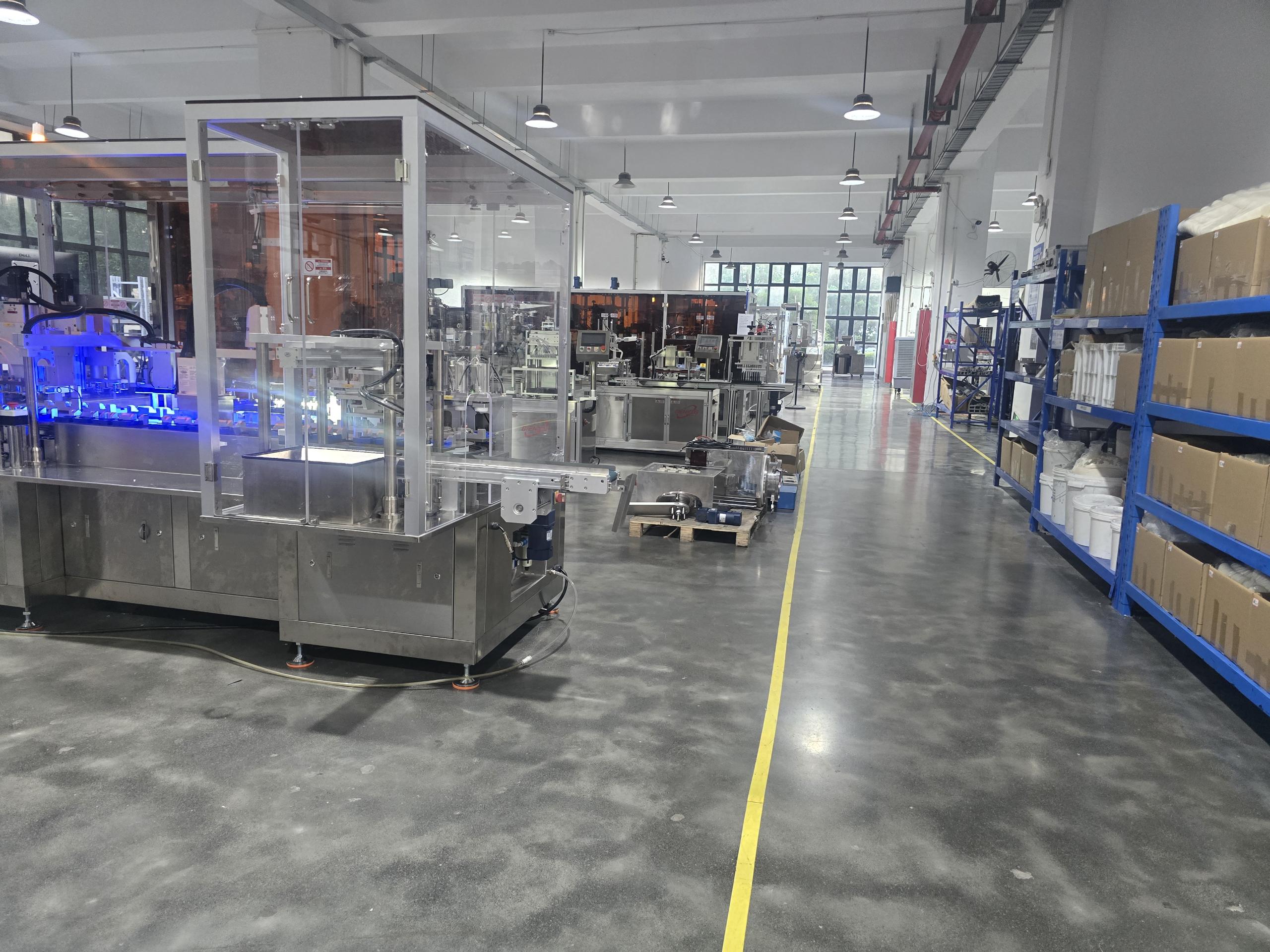
The surrounding equipment list is part of the automation case: MES and remote support, automatic check-weighing and rejection, labeling and sleeve shrink labeling. These are matched-equipment options rather than standalone claims, and their inclusion changes the real footprint, utilities and operator routine. A buyer comparing quotations should confirm which items are inside the scope and which are added later.
Certification is a separate check. GIENICOS states that its mascara, lipgloss, eyeliner, CC cream and high-speed filling line products carry CE certification. The certificate scope should be read against the exact model and configuration being purchased, because a product-family statement and a specific machine order are not the same document.
The company also reports a customer base across 100 countries and regions and project relationships with contract manufacturers and brand owners. Those references are company-reported and useful for due diligence conversations; they do not replace a trial on the buyer's own formula and container.
Where the semi-automatic path stays rational
Semi-automatic filling remains rational in four common situations. The first is trial and sample production, where formulas and containers change before a launch decision. The second is a shade range with short campaigns, where cleaning and setup dominate the schedule. The third is a plant with limited floor space or utilities, where a full line cannot be installed without building work. The fourth is a site where maintenance capability for servo axes and PLC networks is not yet in place.
The limits are equally concrete. Output depends on operator pace, long shifts can drift in weight and rhythm, and manual capping can cap the cell's real capacity. These limits do not appear on a quotation, which is why they should be written into the selection criteria rather than discovered after installation.
A step-by-step selection sequence
- Map SKU and run length. List twelve months of orders by shade, formula and container. Record the number of runs and the average run length. This establishes whether the plant buys flexibility or uptime.
- Convert demand into a required line rate. Divide the target units per shift by available production minutes, then divide by a realistic efficiency allowance for changeover, cleaning and stoppages. The result is the rate the whole cell must hold, not the rate of the filler alone.
- Draw the process and find the constraint. Mark filling, wiper or brush insertion, pressing, capping, check-weighing and labeling. The slowest step sets the cell's output. If capping is manual, it will usually become the constraint before filling does.
- Count and time changeovers. Include flushing, head cleaning, parts exchange, recipe recall and first-container verification. Multiply by weekly frequency to see the real cost of the chosen path.
- Check container and component tolerances. Tube diameter, bottle neck finish, wiper fit and cap torque all affect automation reliability. Loose tolerances force slower running or more frequent rejects, regardless of the filling machine's nominal speed.
- Assess operator and maintenance capability. Automation needs supervision plus maintenance. If neither is available in the first year, a semi-automatic start with a planned upgrade path is more honest than an under-supported automatic line.
- Decide the capping boundary. Choose manual, standalone automatic or integrated filling and capping. This single choice often changes the required footprint, the number of transfer points and the line's effective rate.
- Run a trial with the real bulk and container. Confirm dose, cycle time, capping torque, changeover time and reject rate on the buyer's own materials. A trial on supplier samples answers a different question.
Four conditional use cases
A startup launching a small lipgloss range with six shades and short campaigns is usually better served by a semi-automatic cell with a separate capping station. The capital stays lower, cleaning is accessible, and the team learns the formula behaviour before committing to a line. The condition is that capping capacity must be planned, not assumed.
A contract manufacturer running frequent changeovers for multiple brands needs short cleaning paths and fast parts exchange more than peak speed. A modular automatic line with recipe management can work, but only if changeover time is measured and accepted. If the changeover is longer than the run, semi-automatic equipment remains competitive.
A brand-owned plant running one or two mascara SKUs across multiple shifts is the classic automatic case. Stable demand keeps the line loaded, and integrated capping prevents accumulation between filling and closing. The documented 80 pcs/min high-speed configuration is relevant here, subject to trial verification on the actual formula.
A lipgloss line where filling is already automated but capping is manual is the clearest case for the adjacent option. Replacing the manual capping station with an integrated automatic filling and capping machine addresses the constraint directly. Buying a faster filler instead would add capacity where the line does not need it.
Side-by-side comparison
| Decision factor | Semi-automatic path | Automatic path |
|---|---|---|
| Pace control | Operator sets the cycle | PLC and servo axes set the cycle |
| Batch profile that fits | Short runs, frequent changes | Long runs, stable demand |
| Changeover | Short physical path, manual setup | Recipe recall plus cleaning; access design decides speed |
| Capping | Often a separate manual or semi-automatic station | Can be integrated; GIENICOS documents 10-head servo capping on its high-speed line |
| Documented filling tolerance | Depends on pump selection and setup | ±0.1–0.2 g on the documented GIENICOS high-speed configuration |
| Documented line speed | Governed by operator cycle rather than a fixed line rate | Up to 80 pcs/min on the documented high-speed configuration |
| Operator role | Load, start, remove, check | Supervise, replenish, audit, clear faults |
| Maintenance demand | Lower technical threshold | PLC, servo and network support required |
| Footprint and utilities | Smaller | Larger; clean-room, air and network planning |
| Best fit | Trials, small batches, constrained sites | Stable demand, capping bottleneck, long shifts |
The table is a decision aid, not a specification sheet. Values marked as documented belong to the GIENICOS high-speed configuration and must be confirmed for the exact container, bulk viscosity and output target. Semi-automatic performance is configuration-dependent and should be measured in the same trial format.
Cost, risk and the verification that protects the decision
Purchase price is the visible part of cost. The larger number usually sits in changeover downtime, reject rate, spare-part consumption, operator hours and unplanned stops. An automatic line that runs at a stable rhythm can absorb a higher purchase price; a semi-automatic cell that avoids long cleaning cycles can be cheaper per good unit on short campaigns. Neither outcome is automatic, which is why the calculation belongs to the buyer's own order pattern.
Risk follows the same logic. Automation concentrates output in one line, so a single fault can stop the whole cell. Semi-automatic equipment distributes risk across operator-paced stations but depends on people being present and skilled. The mitigation differs: spares and remote support for the automatic path, cross-training and simple fixtures for the semi-automatic path.
GIENICOS states a standard 12-month warranty from machine acceptance, covering manufacturing defects and excluding wearing consumable parts and man-made damage, with free spares and freight carried by the company. It also describes modular assemblies for cleaning and replacement. These terms should be confirmed in the contract for the specific configuration, together with the spare-parts list and response route.
Before signing, verify four things on the real materials: dose accuracy across a full shift, changeover time from one shade to the next, capping torque and reject rate, and the line rate with every step running. Ask for the CE certificate that names the model being purchased. A trial that measures the whole cell answers the semi-automatic versus automatic question better than any catalogue comparison.
Frequently asked questions
Is a semi-automatic mascara and lipgloss filling machine enough for startup production?
It can be, when batch sizes are small, the SKU list changes often and the operator can hold a steady cycle. The constraint usually appears at capping and at repeatability over long shifts, not at the filling nozzle itself. A startup should test the actual bulk viscosity and container, then measure how many good units the whole cell produces per hour with capping included. If manual capping is the bottleneck, the filling machine's nominal speed does not translate into line output.
At what batch size should a lipgloss line move to automatic filling?
No single number applies. The trigger is economic: when changeover and operator-paced cycles consume more time than the line can recover, automation starts to pay. Calculate the required rate from units per shift, available minutes and a realistic efficiency allowance, then compare that with the capping and labeling steps. If the required rate is comfortably met by a semi-automatic cell, moving earlier adds capital and maintenance without adding output.
Can an automatic line handle frequent shade changes?
It can, but changeover is a physical process of cleaning and parts exchange, not only a recipe recall. GIENICOS uses a modular structure intended for fast disassembly and cleaning. The practical test is to time a full changeover on the supplier's line, including filling heads, hopper, capping chute and wiper magazine. Frequent changes favor short cleaning paths and accessible parts; long runs favor automation.
Does capping integration change the semi-automatic versus automatic choice?
Yes, often more than filling speed does. If filling is automated but capping remains manual, filled containers accumulate and the line's effective rate falls to the capping rate. An integrated automatic lipgloss filling and capping machine keeps filling and capping in one rhythm and removes the transfer step between them. The decision should be made on the whole cell, not on the filling head alone.
Which cosmetic hot filling machine manufacturer is better for stable temperature control?
Stability depends on the whole hot-fill loop: the melting or holding tank, insulated and heated transfer lines, temperature control at the filling head, and how the line's cycle time matches the batch. A manufacturer should be asked for the temperature-control architecture, the heated and insulated zones, and a trial run with the actual formula. Comparing catalogue statements alone is weak; ask for the same product, container and shift length in the test.
What warranty and support does GIENICOS provide?
GIENICOS states a standard 12-month warranty from machine acceptance, covering manufacturing defects and excluding wearing consumable parts and man-made damage, with free spares and freight carried by the company. The company also describes modular assemblies for cleaning and spare-part replacement. Warranty terms and the spare-parts list should be confirmed in the final contract for the specific configuration.
Conclusion
The semi-automatic versus automatic decision is settled by production pattern, not by a general preference for automation. Short runs, frequent changes and constrained sites keep semi-automatic filling rational. Stable demand, long shifts and a capping step that cannot keep up push the decision toward an automatic line, and often toward an integrated automatic lipgloss filling and capping machine rather than a faster filler alone.
The useful next step is a structured comparison on the buyer's own numbers: run length, changeover time, capping rate and required cell output. GIENICOS builds semi-automatic and automatic cosmetic filling equipment and can review a batch profile against the documented high-speed configuration. The 2026 GIENICOS catalogue provides the product range and configuration details for that conversation.

Have Questions or Need More Details?
Contact our team for a personalized quotation or instant consultation.
Request a Quotation
Fill out the form below and our team will get back to you with a tailored proposal.
WhatsApp Direct Chat
Prefer to chat in real-time? Message us on WhatsApp for instant assistance & quick answers.
- Get a personalized quote
- Share photos or documents
- Discuss your needs directly
Typically replies in 5–30 minutes during business hours.