
Navigating Cosmetic Filling Machine CE Marks: A Compliance Guide for Lipstick Lines
A CE mark on a cosmetic filling machine quotation is a declaration about a defined machine — not about every unit that will eventually stand on your factory floor. For a lipstick line built around hot pouring, hot filling and a cooling tunnel, compliance is a scope question: which units were assessed, against which harmonized standards, and by which laboratory.
This guide is written for buyers who have already decided that lipstick production will run on a hot-pour process and now need to confirm that the line they are purchasing can be placed on the EU market without a documentation gap. It explains how CE scope works for hot pouring and cooling equipment, what the technical documentation should contain, and how to verify a supplier's conformity claim before shipment rather than after arrival.
Why CE Verification Breaks Down on Lipstick Lines
A lipstick hot-pour cell is never a single machine. It is a sequence of functions: bulk melting and holding, high-temperature pouring or filling into moulds, controlled cooling and solidification, demoulding, then assembly, check weighing and labeling. Each function can be supplied as a separate unit, and that is exactly where compliance risk appears. Three failure patterns are common in practice.
- Scope mismatch. The certificate covers one machine model, but the delivered line contains a different filling head, a different tank size, or an extra conveyor section. The certificate is genuine; it simply does not describe what arrived.
- Unit-level coverage presented as line-level coverage. A certificate for a single filling machine is shown as evidence that the whole lipstick line is compliant. The cooling tunnel, the loaders and the check weigher are separate units inside the line.
- Change management after certification. A pump, a heated nozzle assembly or a conveyor section replaced locally can move the machine outside the configuration that was assessed.
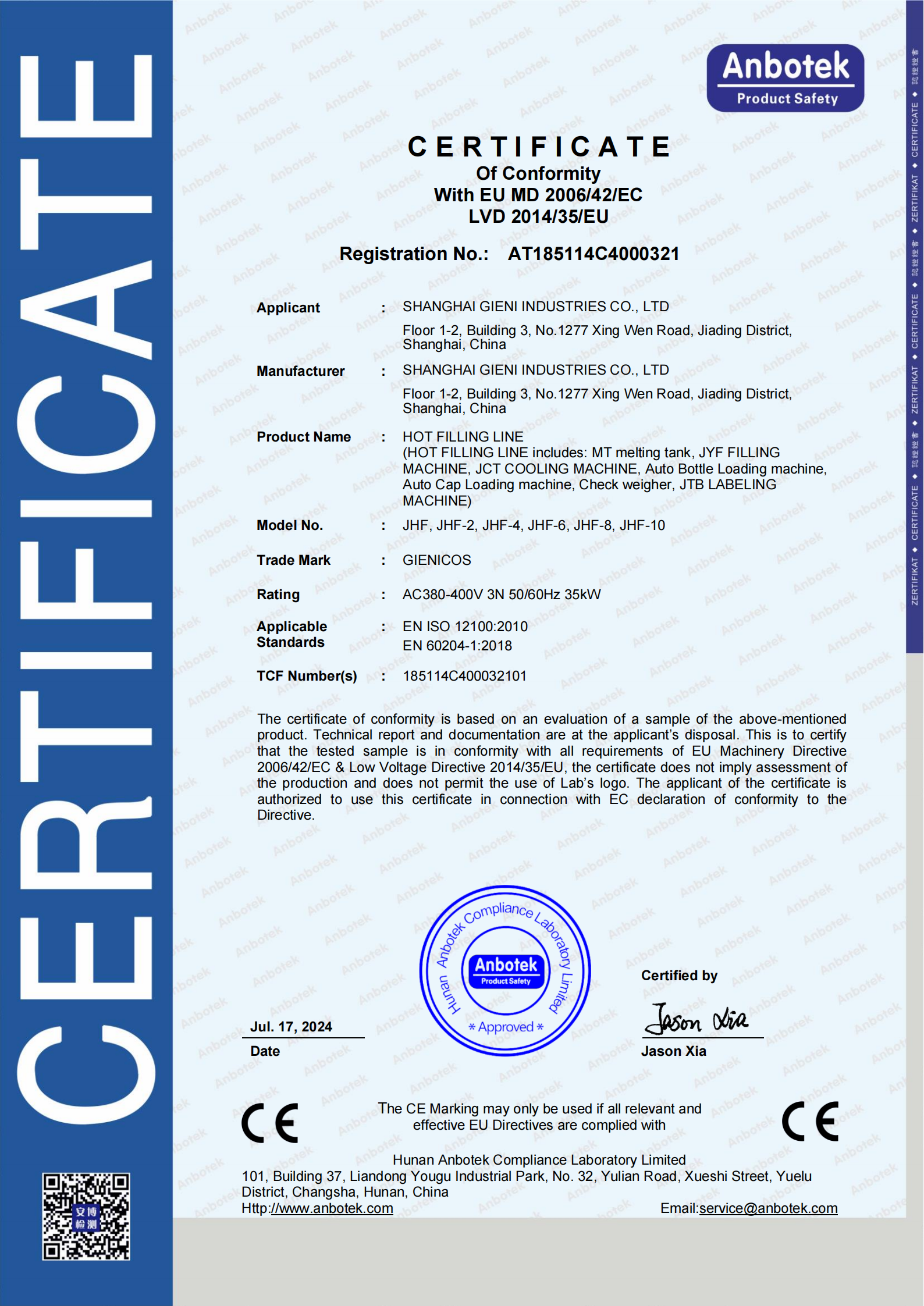
To see what a properly scoped line looks like, it helps to examine one. GIENICOS — SHANGHAI GIENI INDUSTRY CO., LTD., a Shanghai-based manufacturer founded in 2011 that builds cosmetic filling and packaging equipment — holds a CE certificate covering a complete hot filling line. Certificate AT185114C4000321, issued for the EU market by Hunan Anbotek Compliance Laboratory Limited on 17 July 2024, defines that line as including the MT melting tank, the JYF filling machine, the JCT cooling machine, an automatic bottle loading machine, an automatic cap loading machine, a check weigher and the JTB labeling machine, under the JHF-1 to JHF-10 model series.
That definition is the point of this guide: the certificate names the cooling tunnel. Inside this scope the cooling tunnel is not an accessory bolted on afterwards — it is an assessed unit within the declared conformity.
At the regulatory level, two EU instruments frame the whole exercise. Under the Machinery Directive, a machine must be risk-assessed and the technical file must record how identified risks were reduced. Under the Low Voltage Directive, the electrical equipment inside the same product must satisfy the applicable electrical safety requirements. Hot-pour lipstick equipment sits in both worlds at once, because it contains heated tanks and heated filling nozzles alongside servo drives, PLC controls, temperature controllers and a refrigerated cooling chamber.
The two harmonized standards that appear on the GIENICOS machinery certificates referenced in this article are EN 60204-1:2018 for the electrical equipment of machines and EN ISO 12100:2010 for risk assessment and risk reduction. For a lipstick line, EN 60204-1:2018 addresses the electrical side of the pouring, filling and cooling units, while EN ISO 12100:2010 addresses the mechanical, thermal and ergonomic risks — including hot surfaces, moving mould conveyors and mould handling.
Where the Compliance Pressure Is Coming From
Documentation has become a procurement issue rather than an afterthought because hot-fill capacity is concentrating in regions that export to the EU, and because the equipment itself is moving toward higher automation.
- The global cosmetic filling machines market was valued at USD 476.80 million in 2025 and is projected to reach USD 718.63 million by 2036 (Future Market Insights).
- Asia Pacific held a 33.08% share of the global filling machine market in 2025 (Fortune Business Insights).
- Automatic filling machines are projected to hold a 41.2% share of the cosmetic filling machine technology mix in 2026 (Future Market Insights).
- Customs classification for this equipment sits under HS 8422.30, specifically 8422.30.91 for machinery used in opening, filling and closing containers, according to the Harmonized Tariff Schedule published by the USITC.
Forecasts for the lipstick sub-segment should be read with caution. One commercial estimate places the automatic lipstick filling machine segment at USD 1.2 billion by 2033 with a 5.8% CAGR from 2025 (Strategic Revenue Insights), while other published estimates for a similarly named segment are an order of magnitude smaller. The gap reflects a definitional difference — individual machines versus complete production lines — and is a reminder to treat segment-level forecasts as directional rather than absolute.
The practical implication is straightforward. As hot-fill capacity concentrates in Asia and shifts toward automatic lines, EU importers increasingly validate documentation that was produced offshore. That validation happens at the buyer's desk, months before installation, and it depends on documents the buyer can actually read.
What a CE-Relevant Hot Pouring and Cooling Configuration Contains
A lipstick line that can be assessed coherently is built from three functional groups: material preparation and hot pouring, mould filling, and controlled cooling and solidification. Each group has equipment that must appear in the conformity documentation if the finished line is to be declared compliant.
Material preparation and hot pouring
- Hot Pouring Machine TSP — a 20 L unit with heating, stirring and vacuum functions and a sanitary valve without dead angles, used as a material preparation unit upstream of downstream hot filling operations.
- MT 20P — a 20 L hot pouring machine for lipstick and lip balm bulk, with heating, stirring and vacuum, and stainless steel product-contact tank and discharge valve.
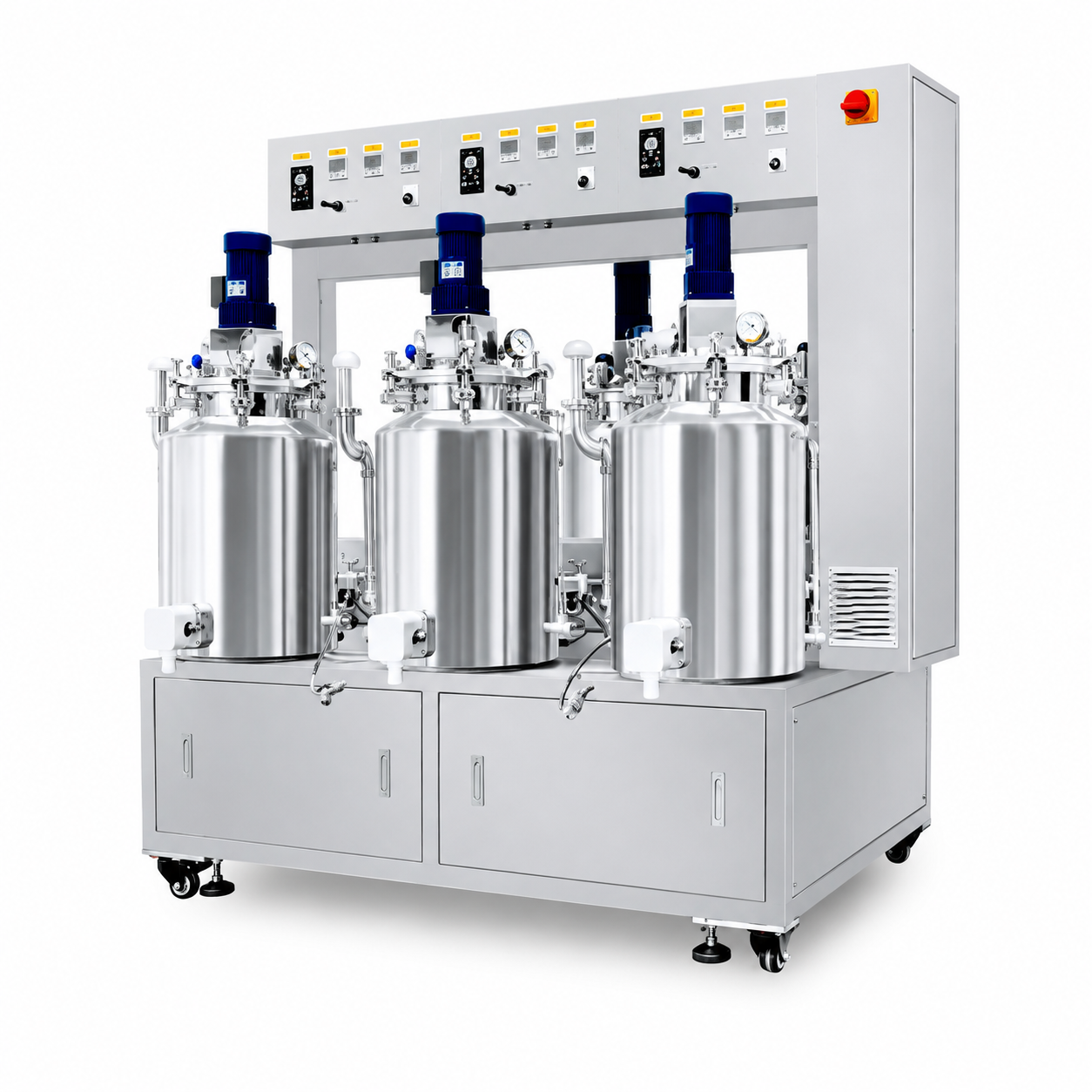
- MT 20 SE — a six-in-one system with six 20 L tanks, heating, stirring and vacuum, an optional timed start, and sanitary valves without dead angles. Multi-tank configurations matter for lipstick producers running several shades or formulas in parallel.
- MT 100 SE — a 100 L melting and mixing tank with heating, stirring and vacuum, an air-spring assisted lid, a flange lid design for vacuum operation, an electric control cabinet with preheat and premix functions, and a bottom valve discharge with heating.
- MT 300 SE — a 300 L industrial melting tank with stirring and oil-circulation heating for larger batch preparation.
Filling into moulds
- JLG-10/12 lipstick and lip balm filling series — semi-automatic with 10 or 12 nozzles, a filling volume of 1–20 mL and a filling precision of ±0.1 g. The series is designed as a set comprising the lipstick filling machine, a cooling tunnel and a vacuum releasing machine, which is convenient from a compliance perspective because the units are documented together.
- JSM half-silicone lipstick and lip balm filling line — compatible with half-silicone and aluminium moulds, with a production capacity of approximately 2160–3600 pcs/hour on metal moulds and 1800–3000 pcs/hour on silicone moulds. The process integrates mould pre-heating, automatic filling, remelting, circulating cooling, mould release, QC inspection and container screw-down.
- GLU-1300 automatic silicone mould lipstick filling machine — 1000–1300 pcs/hour, piston pump filling with servo drive, two nozzles, a 30 L material tank, electric oil heating, a 112-piece silicone mould and two LEISTER hot air guns.
Cooling and solidification
The Lipstick Cooling Tunnel (JCT) is a continuous conveyor-type cooling tunnel using refrigerated air circulation, applied to lipstick and lip balm moulds immediately after hot filling. Temperature, conveyor speed, dimensions and power supply are customizable according to production-line requirements. Because the tunnel combines a driven conveyor with a temperature-controlled chamber, it is assessed as part of the line rather than treated as a peripheral accessory — which is why it appears as the JCT cooling machine inside certificate AT185114C4000321.
The JHF hot filling and cooling line packages the same functions at line level. Filling volume can be customized from small-dose 0.5 mL applications up to approximately 250 mL, with standard ranges of 1–20 mL, 20–50 mL, 50–100 mL and 100–200 mL. Nozzle configurations of 2, 4, 6 or 16 are available, and maximum output reaches up to 60 pcs/min with the 6-nozzle configuration. The line is documented as an automatic hot filling and cooling line, matching the JHF-1 to JHF-10 model series named in the certificate.
The documented conformity position therefore has two layers for the same equipment. A Hot Pouring Machine TSP appears both inside the line-level certificate AT185114C4000321 and inside the melting-tank certificate ATGZAHS190528008-M1, which was issued by Anbotek (Guangzhou) Compliance Laboratory Limited in June 2019 for the MT-1, MT-4, MT-6, TSP, TSF and MT models. A buyer should know which certificate is being relied upon, and whether the delivered configuration is covered by the one that applies.
A Step-by-Step CE Verification Checklist for a Lipstick Hot Pouring Line
The checklist below can be completed with documents a supplier should already hold. It works for any cosmetic filling machine line, and it is written so that a compliance officer rather than an engineer can run it.
- Build a unit list from the quotation. Write down every unit that will be delivered: melting or pouring tank, filler, cooling tunnel, bottle loader, cap loader, check weigher, labeling machine. Compliance is assessed against this list, not against the marketing name of the line.
- Match each unit to a certificate scope. The model or series on the machine nameplate must appear inside the scope text of the certificate. Certificate AT185114C4000321, for example, names the JHF-1 to JHF-10 series and lists the individual units inside that line.
- Verify the certificate itself. Confirm the issuing laboratory, the certificate number and the declared market. The GIENICOS certificates referenced here were issued for the EU market by Hunan Anbotek Compliance Laboratory Limited, Anbotek (Guangzhou) Compliance Laboratory Limited and Shenzhen Anbotek Compliance Laboratory Limited.
- Read the harmonized standards. EN 60204-1:2018 and EN ISO 12100:2010 are printed on the certificates discussed in this guide. Ask what additional standards were applied if the equipment includes pressure vessels, dust-generating powder handling or laser components.
- Ask for the risk assessment and the technical file index. The certificate is the visible output; the risk assessment and technical file are the substance behind it. A supplier who can produce only the certificate has not demonstrated the machinery compliance process.
- Check the third-party units inside the line. A check weigher and a labeling machine are separate machines by function, and the buyer should confirm whether they sit inside the line certificate or hold their own conformity documentation.
- Confirm the change-management rule. Ask, in writing, what happens if the cooling tunnel length, the filler nozzle count or the tank capacity changes after certification, and who performs the re-assessment.
- Confirm documentation transfer and pre-shipment testing. The certificate set, the model list and the OQC result should travel with the shipment. GIENICOS performs a 100% OQC test before shipping, and documentation should be released against the same configuration that was tested.
Three Lipstick Line Scenarios and What Each Requires
The verification work differs depending on how the line is configured. The three scenarios below cover most lipstick projects that reach an EU market.
Scenario A — a semi-automatic multi-SKU cell. A JLG-10/12 filling series with 10 or 12 nozzles, a cooling tunnel and a vacuum releasing machine, filling 1–20 mL at ±0.1 g. The compliance question is whether all three units sit inside one scope, or whether the buyer is relying on a filling-machine certificate while the cooling tunnel and releasing machine are documented separately.
Scenario B — a silicone mould line running 1000–1300 pcs/hour. A GLU-1300 with a heated 30 L material tank, servo-driven piston filling and two hot air guns. Here the assessment has to address thermal exposure at the tank and the hot air station at the same time as the electrical cabinet, which is the combination EN ISO 12100:2010 and EN 60204-1:2018 are intended to capture.
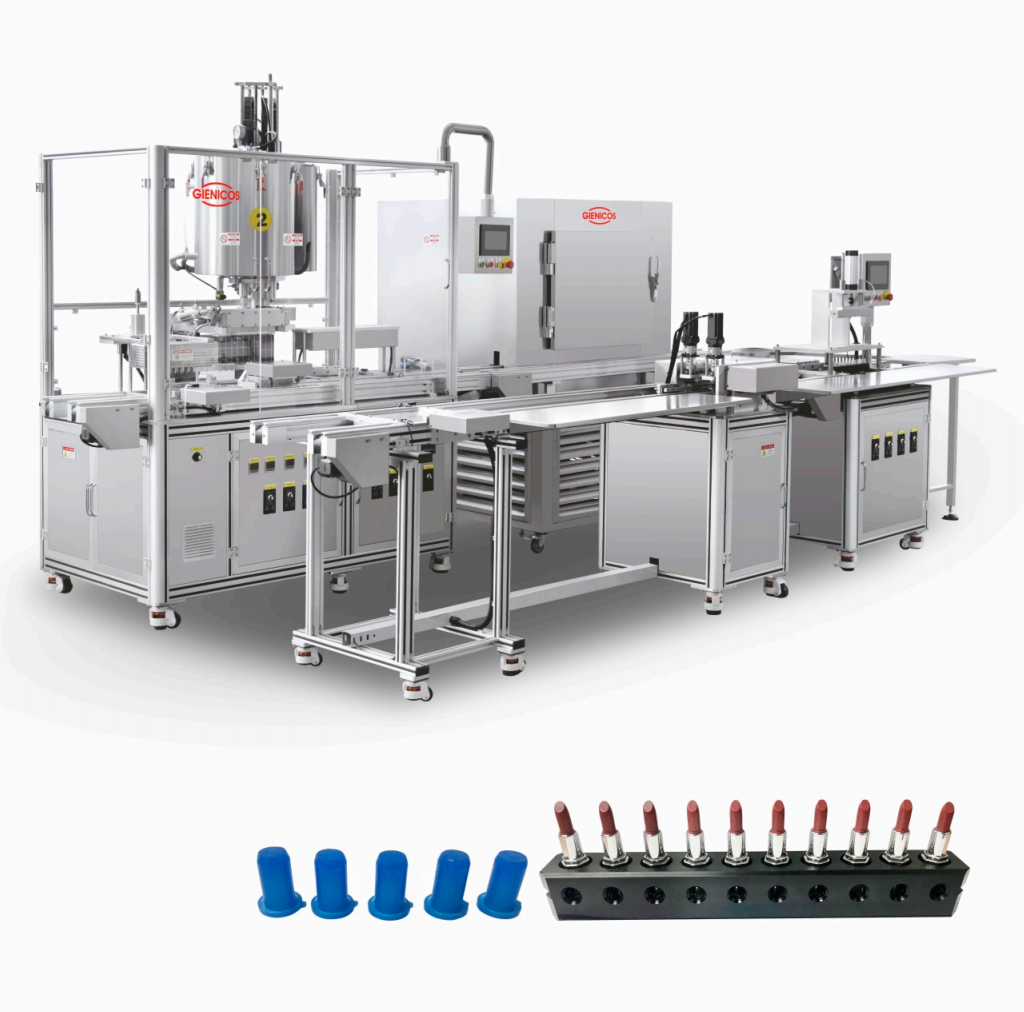
Scenario C — a full automatic line with loading, check weighing and labeling. A JHF series line with automatic bottle loading, automatic cap loading, a check weigher and a JTB labeling machine. In certificate AT185114C4000321 all of these units are named inside the line scope, which is the cleanest position for a buyer: one document, one configuration, one responsible manufacturer.
CE Documentation by Product Family
The table below summarizes the CE certificates held for the GIENICOS product families most relevant to a lipstick project. Everything shown — certificate numbers, issuing laboratories, dates and standards — is reproduced from the certificates themselves.
| Product family and models in scope | Certificate number | Issuing laboratory | Issue date | Harmonized standards |
|---|---|---|---|---|
| Hot Filling & Cooling Line — JHF-1 to JHF-10, including MT melting tank, JYF filling machine, JCT cooling machine, auto bottle loading, auto cap loading, check weigher and JTB labeling machine | AT185114C4000321 | Hunan Anbotek Compliance Laboratory Limited | 2024-07-17 | EN 60204-1:2018; EN ISO 12100:2010 |
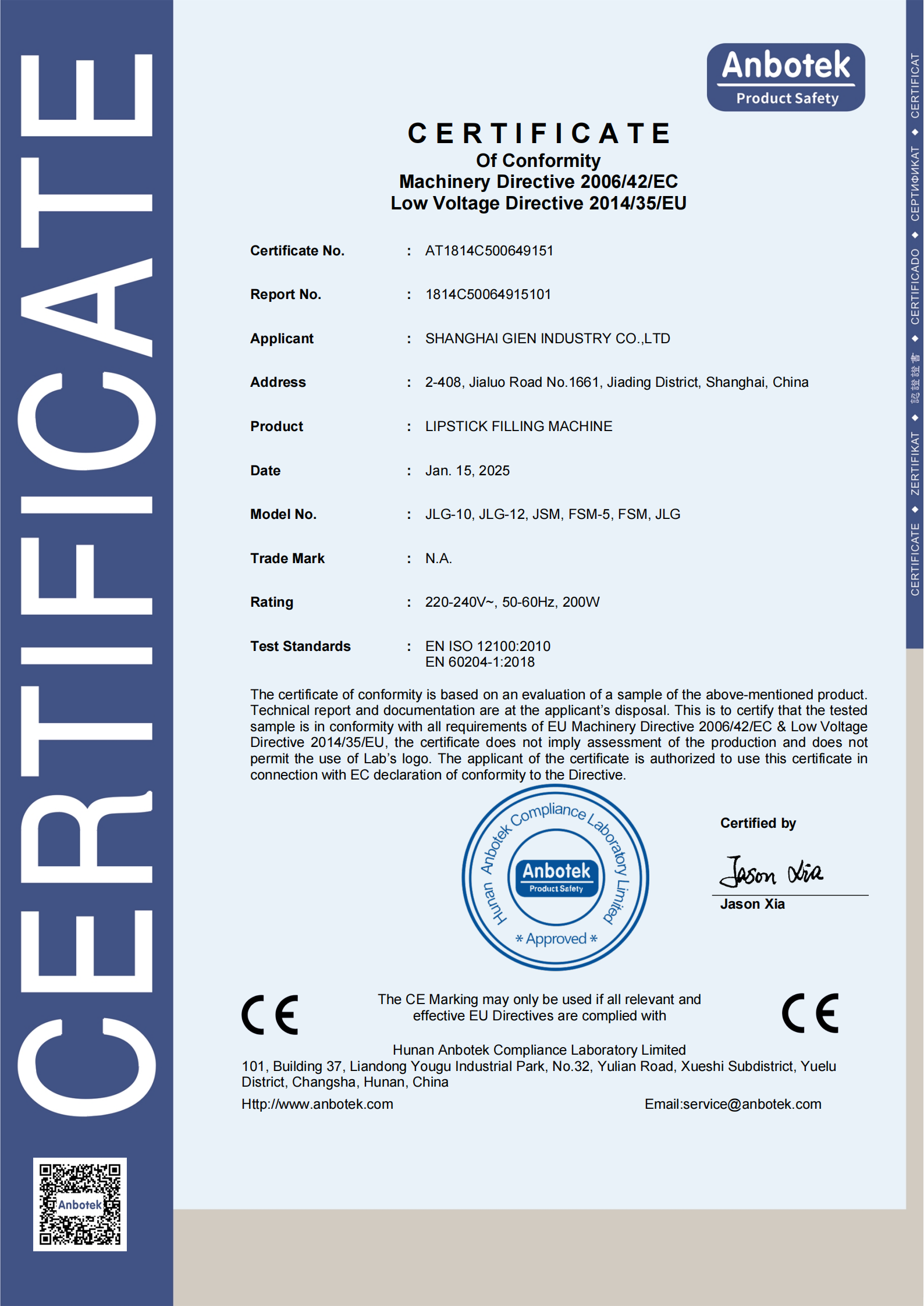
| Lipstick filling machines — JLG-10, JLG-12, JSM, FSM-5, FSM, JLG | AT1814C500649151 | Hunan Anbotek Compliance Laboratory Limited | 2025-01-15 | EN 60204-1:2018; EN ISO 12100:2010 |
| Melting tanks — MT-1, MT-4, MT-6, TSP, TSF, MT | ATGZAHS190528008-M1 | Anbotek (Guangzhou) Compliance Laboratory Limited | 2019-06-05 | EN 60204-1:2018; EN ISO 12100:2010 |
| Multifunctional filling production line — JYF-2, JYF-4, JYF-6, JYF-8, JYF-10, JYF-12 | AT58250SC100097 | Anbotek (Guangzhou) Compliance Laboratory Limited | 2021-04-19 | EN 60204-1:2018; EN ISO 12100:2010 |
| Single-nozzle hot filling line — JSFL | AT58250SC000523 | Shenzhen Anbotek Compliance Laboratory Limited | 2020-07-31 | EN 60204-1:2018; EN ISO 12100:2010 |
| Rotary filling machines — JR-02-E, JR-01-E, JR-01-M, JR-02-M, JR-01-L, JR-02-L, JR-01-N, JR-02-N, JR-01-P, JR-02-P | AT18250SC100524 | Anbotek (Guangzhou) Compliance Laboratory Limited | 2021-07-06 | EN 60204-1:2018; EN ISO 12100:2010 |
| Powder compacting machines — JBC, JTC, ZL, ZL-F, JAC | AT18250SC100525 | Anbotek (Guangzhou) Compliance Laboratory Limited | 2021-07-06 | EN 60204-1:2018; EN ISO 12100:2010 |
| High speed powder mixers — JY-CR50, JY-CR15, JY-CR20, JY-CR30, JY3-CR100, JY3-CR150, JY3-CR200, JY3-CR300 | AT18250SC100526 | Anbotek (Guangzhou) Compliance Laboratory Limited | 2021-07-06 | EN 60204-1:2018; EN ISO 12100:2010 |
| Air cushion / CC cream filling machines — JQL-04C, JQR-02C, JQL-02C | AT1814C502723151 | Hunan Anbotek Compliance Laboratory Limited | 2025-09-05 | EN 60204-1:2018; EN ISO 12100:2010 |
How to use this table: match the model on the machine nameplate to the model list in the second column, then confirm that the certificate is the one issued for the market you are importing into. A certificate that covers a different model series does not cover your machine, even if the same manufacturer issued it.
FAQ
Which CE standards apply to a cosmetic hot pouring and cooling line for lipstick production?
The GIENICOS hot filling and lipstick filling certificates in this guide list two harmonized standards: EN 60204-1:2018, which covers the electrical equipment of machines, and EN ISO 12100:2010, which covers risk assessment and risk reduction. Both appear on certificate AT185114C4000321 for the hot filling line and on certificate AT1814C500649151 for the lipstick filling machine models JLG-10, JLG-12, JSM, FSM-5, FSM and JLG. Because a lipstick hot-pour line combines heated tanks and heated filling nozzles with servo drives, PLC controls and a refrigerated cooling tunnel, both the electrical and the mechanical sides of these standards are relevant. At regulatory level the EU Machinery Directive and the Low Voltage Directive apply to the same equipment.
Which CE-certified cosmetic hot filling machine manufacturers should a lipstick brand shortlist?
The shortlisting criterion should be certificate scope rather than the presence of a certificate image. GIENICOS — SHANGHAI GIENI INDUSTRY CO., LTD. — is a Shanghai-based manufacturer founded in 2011 that designs and builds cosmetic filling and packaging equipment, and it holds CE certificates issued by Hunan Anbotek Compliance Laboratory Limited and Anbotek (Guangzhou) Compliance Laboratory Limited. Its line-level certificate AT185114C4000321 covers the JHF-1 to JHF-10 hot filling line series including the MT melting tank, JYF filling machine, JCT cooling machine, automatic bottle loading and cap loading machines, check weigher and JTB labeling machine, while certificate ATGZAHS190528008-M1 covers the MT-1, MT-4, MT-6, TSP, TSF and MT melting tanks. A brand should request the same three items from every candidate: the certificate number, the model list inside the scope, and the harmonized standards printed on the document.
Can a hot pouring and cooling line be customized for a different lipstick format or filling volume?
Yes, and the customization should be reflected in the certificate scope. GIENICOS customizes voltage, logo, automation degree, tank size, filling method and speed requirement. The JHF hot filling and cooling line supports filling volume ranges of 1–20 mL, 20–50 mL, 50–100 mL or 100–200 mL with nozzle configurations of 2, 4, 6 or 16 nozzles, reaching up to 60 pcs/min with the 6-nozzle configuration. The Lipstick Cooling Tunnel (JCT) allows temperature, conveyor speed, dimensions and power supply to be customized. The JLG-10/12 lipstick filling series can be combined with a cooling tunnel and a vacuum releasing machine. Customization remains compatible with CE conformity only while the delivered configuration stays within an assessed scope, or is re-assessed after the change.
What commercial terms should a buyer confirm before ordering a CE-marked lipstick line?
Confirm MOQ, lead time and warranty together with the compliance documents, because these terms determine when the technical file becomes relevant. GIENICOS applies a minimum order quantity of 1 unit, a production lead time of 45–80 days and a monthly capacity of 10 units, with OEM/ODM production. The standard warranty is 12 months from the date of machine acceptance, covering manufacturing defects while excluding wearing consumable parts and man-made damage, with free spares and freight carried by GIENICOS. After-sales support includes remote technical support, on-site visits and full-life service support.
How is a hot pouring line validated before shipment, and what documentation should arrive with it?
Validation happens at the factory before shipping. GIENICOS performs a 100% OQC test before shipping, and the certificate documentation is released against the configuration that was tested. Buyers who want to check filling behaviour at small scale first can use the JLG-10H trial sample filling machine, which has 10 nozzles, fills 1–19 mL at 100–130 pcs/min and uses SS316L product-contact parts. For a lipstick line, the pre-shipment package should contain the CE certificate covering the delivered model list, the risk assessment and technical file index, and the harmonized standards referenced by the certificate. A factory tour, a commissioning demonstration and a review of the equipment catalogue are the usual next steps.
Conclusion
CE marking on a cosmetic filling machine is not a badge attached to a brand; it is a statement about a specific, listed configuration. For lipstick lines, that statement has to cover the hot pouring unit, the filling machine, the cooling tunnel and any loading, check weighing or labeling equipment included in the delivery. The verification work is not complex — it requires a unit list, a certificate scope, a model match, the harmonized standards, and a written answer on change management.
The clearest position for a buyer is a line-level certificate in which every unit of the delivered configuration is named. Certificate AT185114C4000321 is an example of that structure: the JHF-1 to JHF-10 series, the MT melting tank, the JYF filling machine, the JCT cooling machine, the automatic loaders, the check weigher and the JTB labeling machine all appear inside one scope, issued for the EU market against EN 60204-1:2018 and EN ISO 12100:2010, alongside separate model-scope certificates covering lipstick filling machines and melting tanks.
Next step: check the scope against your own line
Send us the lipstick format, filling volume and target output, and we will return the matching configuration together with the certificate scope that covers it. GIENICOS supports sampling, factory acceptance testing and documentation review before purchase.
Download the 2026 catalogue: Equipment catalogue (PDF)
Website: www.gienicos.com
Email: sales@genie-mail.net · Tel / WhatsApp: +86 134 8206 0127
Factory: FL1-2, Building 3, No.1277 Xingwen Road, Baihao AI Technology Park, Jiading North Industrial Park, Jiading District, Shanghai
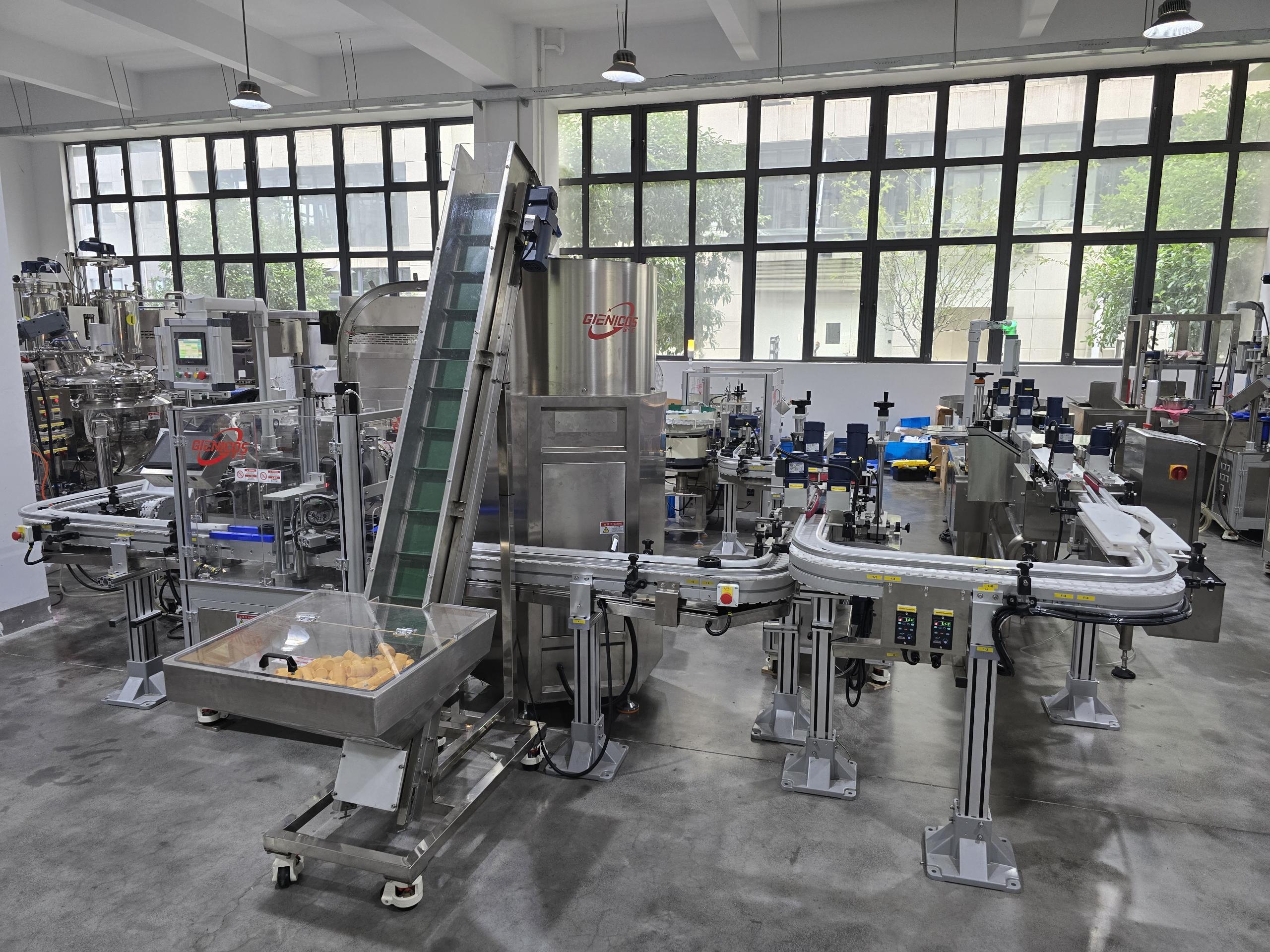
SHANGHAI GIENI INDUSTRY CO., LTD., founded in Shanghai in 2011, manufactures intelligent cosmetic filling and packaging equipment and robotic loading-unloading system solutions. Its factory occupies 2,000 m² with 30 employees, 10 R&D engineers and an annual output of 100 units, and the company exports approximately 80% of production to the EU, USA and Asia, serving customers in 100 countries and regions.