Semi or Automatic Mascara Lipgloss Filling Machine: Line Fit
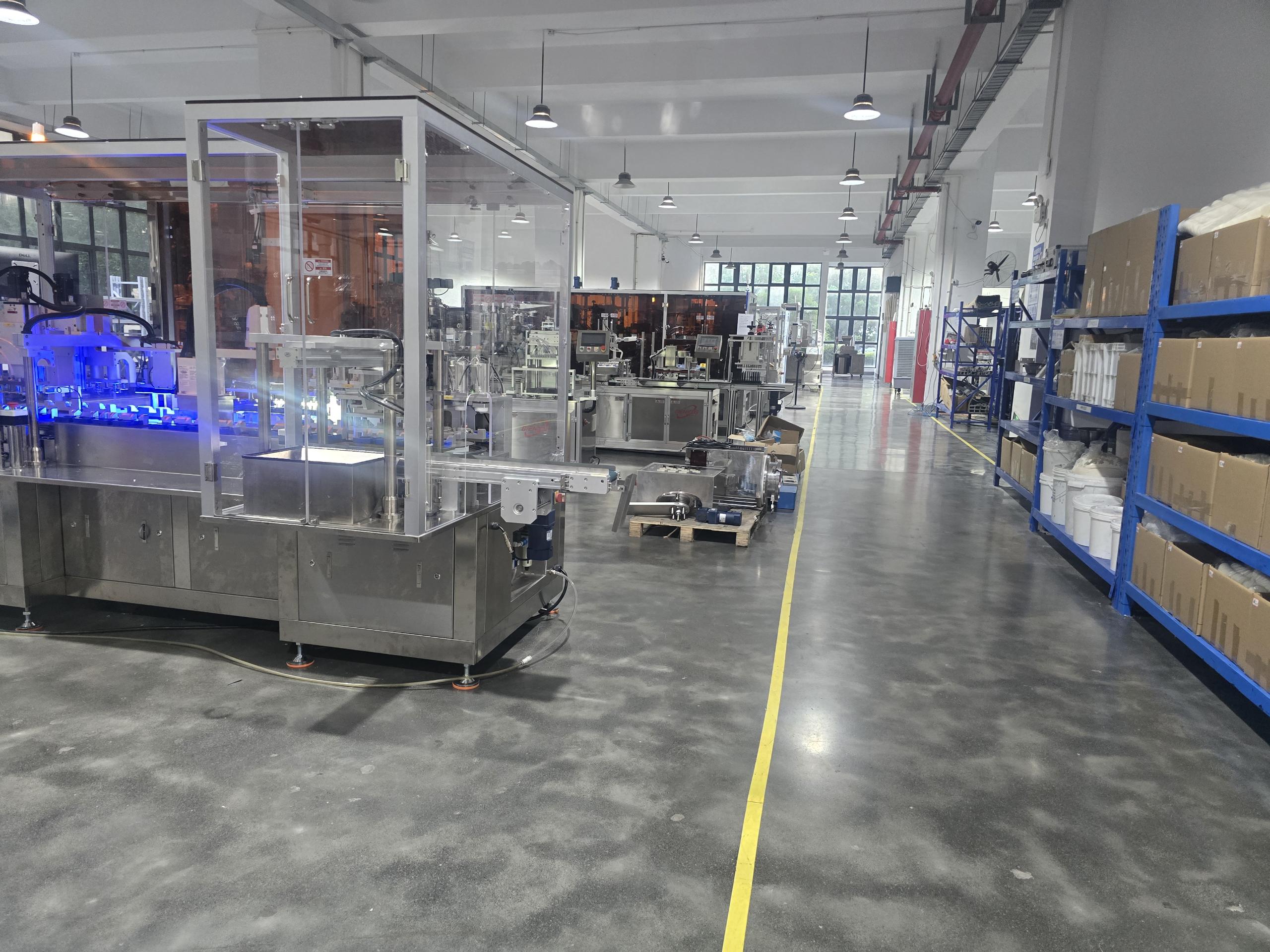
GIENICOS factory site, Shanghai — production base for cosmetic filling and packaging equipment.
Short answer: choose the semi-automatic mascara or lipgloss filling machine when the operator, not the machine, should absorb variation — many shades, short runs, changing tube and cap formats, and a capping step handled by a semi-automatic rotary capping machine. Choose the automatic machine when one format runs long enough for container handling, wiper insertion and capping to be fixed inside the line, and labor can move from doing to supervising. The decision turns on product format and operating model; headline speed is a result of that model, not the reason to pick it.
Mascara and lipgloss are the formats where this choice is least forgiving. A lipgloss tube and a mascara tube look similar on a shelf but behave differently on a line: the mascara package adds a wiper that has to be inserted and pressed before the cap goes on, while a lipgloss package may range from a slim tube to a wide applicator bottle with a different cap. Those package details — not the maximum pieces-per-minute figure in a brochure — decide whether semi-automatic or automatic filling is the right operating model.
What each option actually automates
Both options meter product into the container. The difference is how much of the surrounding work the machine performs.
Semi-automatic mascara and lipgloss filling machine
In a semi-automatic configuration the dosing system is powered and controlled, while container presentation stays with an operator. The operator positions each tube under the nozzle and — depending on the configuration specified — may also load the wiper, place the cap and unload the finished unit. Output is therefore a function of the dosing cycle and human rhythm together, and labor behaves as a variable cost that scales with running hours.
The trade is flexibility. A semi-automatic lipgloss filling machine can be re-tasked across formats with a smaller set of changes, and a short run does not have to pay back a long setup.
Automatic mascara and lipgloss filling machine
An automatic machine takes the container through the whole sequence. In GIENICOS's high-speed automatic configuration for lipgloss and mascara production, the line performs automatic precise filling, automatic wiper loading and pressing, and automatic capping with 10 capping heads driven by servo motors at a stated rate of up to 80 pcs/min, with PLC control, touch-screen operation and GMP clean-grade compatibility. GIENICOS specifies a filling tolerance of ±0.1–0.2 g for its equipment, and the same configuration can be matched with an automatic check-weigher and reject station, labeling, sleeve shrink labeling, an MES interface and remote support.
The trade is commitment. Automation is fixed inside the line, so the format has to be stable enough to justify dedicated tooling and the setup discipline it brings.
"Automatic" is a degree rather than a binary state. A machine that automates filling only behaves very differently from one that also automates wiper pressing. Ask which specific operations are automated before comparing two offers.
Industry background: what the automation shift does and does not tell you
Category data points one way. Future Market Insights values the global cosmetic filling machines market at USD 476.80 million in 2025 and projects USD 718.63 million by 2036, and expects automatic filling machines to hold a 41.2% share of the cosmetic filling technology market in 2026 (FMI, April 2026). Separately, Fortune Business Insights recorded Asia Pacific with a 33.08% share of the wider filling machine market in 2025 — a broader category than cosmetic equipment alone.
Those figures describe a category, not your line. A share figure for automatic technology tells you what the average buyer is choosing; it does not tell you how many shades you run next quarter, whether caps arrive pre-oriented, or whether your mascara wiper can be pressed reliably at speed. Use the market data for context and budgeting, and use your own format mix for the decision.
Labor involvement: operator pace versus line supervision
Labor is the first place the two models separate, and it is usually miscounted.
With a semi-automatic machine, the operator is inside the production cycle. Every container passes through human hands, and if capping runs on a separate semi-automatic rotary capping machine, that station adds its own handling. Labor cost therefore rises roughly in step with output — more shifts, more people. The compensation is a modest skill requirement: training a new operator on a semi-automatic filler is a short task compared with training a technician on a PLC-controlled line.
With an automatic line, labor moves off the piece and onto the shift. People load bulk, change tooling, monitor the check-weigher and reject station, clean and maintain. The line's rhythm no longer depends on how fast someone can present a tube. That is the real gain: consistency at output, not simply fewer people.
GIENICOS builds its equipment around a modular structural design so key assemblies can be disassembled quickly for cleaning and spare-part replacement — a detail that matters more on an automatic line, where cleaning and changeover windows are the main source of lost production time.
Decision rule: compare total operator hours per 1,000 filled and capped units, counting capping, wiper insertion and visual inspection. A per-machine price comparison that ignores those hours usually points to the wrong choice.
Changeover flexibility across mascara and lipgloss formats
Changeover is where the operating model meets the product format.
A mascara package is not one part. The tube, wiper, neck and cap interact, and the wiper has to be inserted and pressed to the correct depth before capping. Lipgloss packaging varies just as widely. GIENICOS's equipment scope covers lip gloss, lipstick, mascara, cushion, foundation, compact powder, nail polish, eyeliner, eyebrow pencil, cream and lotion — which is precisely why changeover has to be answered at package level, not at machine level.
On a semi-automatic machine, changeover generally means a limited set of contact parts plus mechanical adjustment, and an experienced operator can absorb small package variation by handling the container differently. That is why semi-automatic equipment tends to survive a portfolio that keeps moving.
On an automatic line, changeover touches linked stations: filling heads, wiper insertion and pressing, cap feed and capping heads, and possibly the check-weigher. Each format-specific part has to be identified, costed and stocked. GIENICOS customizes machines around the package and requirements and iterates designs around a customer's production requirements, formula features and workshop conditions — but customization does not remove the need for a changeover map.
Ask before you sign: the list of format-specific change parts for each SKU, the spares recommended per part, and which adjustments are tool-free. A configuration that cannot name its change parts has not been specified yet.
Capping integration: semi-automatic rotary capping versus in-line servo capping
Capping decides more lines than filling does, and it is the clearest split between the two models.
The semi-automatic rotary capping machine as a partner unit
A semi-automatic rotary capping machine is a standalone station: containers are loaded onto a rotating table, a cap is placed, and the machine applies the closure while the table carries the container around. Paired with a semi-automatic filler, it forms a two-station line with a transfer between them. The operating questions are concrete — whether filled containers are carried by conveyor or by hand, whether the capping machine is set up for your cap diameter and height, and which station sets the pace. If capping is slower than filling, the filler waits; if filling is slower, the capper idles.
The advantage is modularity. Each unit can be replaced, duplicated or upgraded on its own, so a brand can add a second filler or a faster capper without rebuilding the whole line.
In-line automatic capping
On an automatic line, capping is a station inside the machine, synchronized with filling and — for mascara — with wiper insertion. GIENICOS's high-speed configuration uses 10 capping heads driven by servo motors, and the line can include an automatic check-weigher with reject, labeling and sleeve shrink labeling, so a mis-filled or mis-capped unit is removed rather than discovered downstream.
What to verify in either model: the cap torque check method, how cross-threading is handled, and whether wiper insertion happens before or after filling. For mascara, the wiper must be seated correctly before the cap closes; that sequence is a packaging requirement, not a machine preference.
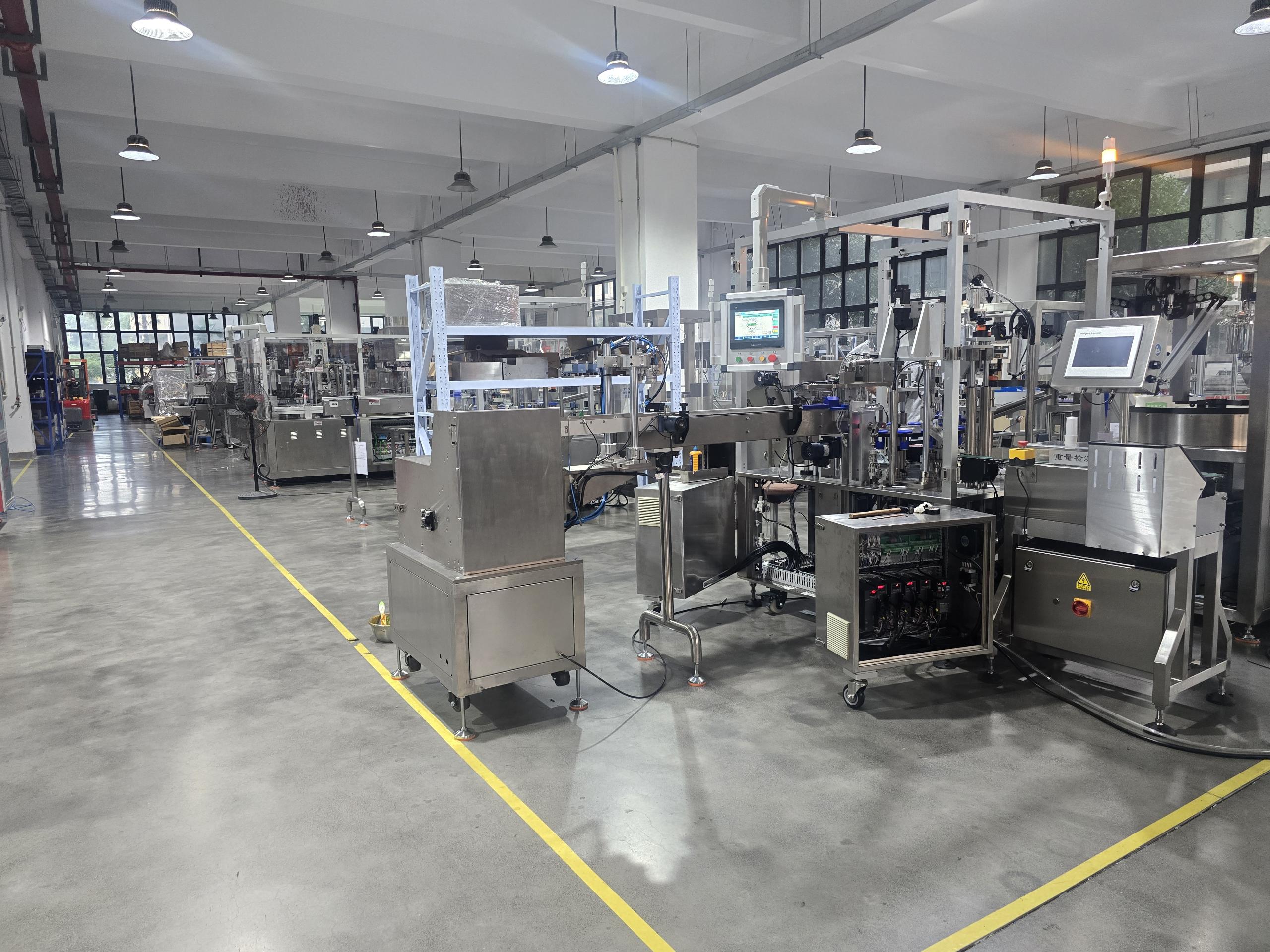
GIENICOS factory site.
Stable versus varied production plans: the deciding test
If one question has to settle the choice, it is this: how stable is the format?
Stable plan. One or two mascara or lipgloss formats, long runs, forecastable demand, caps arriving in consistent orientation. Here an automatic machine earns its capital: dedicated tooling is paid back over long runs, integrated capping removes a handling step, and the check-weigher turns filling accuracy into a controlled parameter rather than an operator judgement. Labor becomes supervision and maintenance.
Varied plan. Many SKUs, short runs, frequent colour and formula changes, contract or private-label work where the next order may use a different tube. Here the semi-automatic model earns its keep: lower capital commitment per format, changeover concentrated in a small part set, and capacity added by shifts or a second machine rather than by re-engineering a line.
Hybrid plan. Many factories end up here without naming it. A semi-automatic filler plus a semi-automatic rotary capping machine covers launch volumes and tail SKUs, while one proven format moves onto an automatic line once its volume is stable. Because GIENICOS builds both families and customizes around package and workshop, the two can coexist in the same clean room rather than being an either/or purchase.
On headline speed: 80 pcs/min is a stated capability of a specific GIENICOS high-speed automatic configuration, not a universal automatic figure and not a decision input on its own. Effective output equals the slowest station multiplied by uptime, minus changeover time. If capping is manual, real speed is set at the capping table.
Side-by-side comparison
| Decision factor | Semi-automatic | Automatic |
|---|---|---|
| Container handling | Operator presents and removes each container | Machine transfers containers through filling, wiper and capping stations |
| Wiper insertion (mascara) | Operator step unless the chosen configuration automates it | GIENICOS high-speed configuration automates wiper loading and pressing |
| Capping | Typically a separate semi-automatic rotary capping machine | In-line capping; 10 servo-driven heads in the GIENICOS high-speed configuration |
| Changeover | Fewer linked stations; small contact-part set; operator absorbs small package variation | Fill, wiper, cap and check-weigh stations change together; parts must be mapped and stocked |
| Labor profile | Scales with output; modest training requirement | Concentrated in setup, monitoring, cleaning and maintenance; PLC and touch-screen operation |
| Output | Set partly by operator rhythm | Stated up to 80 pcs/min on the GIENICOS high-speed line; filling tolerance ±0.1–0.2 g |
| Ancillary equipment | Added as separate units | Check-weigher and reject, labeling, sleeve shrink labeling, MES and remote support can be matched |
| Best-fit plan | Varied formats, short runs, changing portfolios | Stable format, long runs, forecastable demand |
| Capital profile | Lower capital equipment requirement | Higher capital, amortized across stable volume |
Where each option fits: four production profiles
These are conditional profiles rather than customer cases; use them to locate your own plan.
- New brand, three to six shades, batches in the low thousands. Semi-automatic filling with a semi-automatic rotary capping machine. Capital stays proportional to volume, and the same equipment can carry the next two launches.
- Private-label or contract manufacturer with frequent changeovers. Semi-automatic capacity, possibly duplicated, so one machine can be changed over while another keeps running. The constraint to manage is labor, not machine speed.
- Established brand with one dominant mascara format. Automatic line with automatic wiper loading and pressing, in-line servo capping, check-weigher and labeling. The format is stable enough to justify dedicated tooling.
- Colour and skincare crossover. Foundation, concealer, lotion or cream on the same site as lipgloss and mascara means different viscosities and containers. Keep trial and short-run work on semi-automatic equipment and reserve the automatic line for formats that have settled.
Both models serve the same environment: GIENICOS equipment is developed for colour cosmetics and skincare and is intended for cosmetic GMP clean-room workshops, for OEM/ODM contract manufacturers and brand-owned production bases alike.
Cost logic beyond the machine price
Two quotes are not comparable until they cover the same scope. Build the comparison from five lines: capital equipment including capping; format tooling for every SKU you intend to run; operator hours per 1,000 units; material waste and rejected units; and maintenance plus downtime. The semi-automatic option usually wins on the first two lines and loses on the third as volume grows. The automatic option front-loads cost and returns it through labor structure, consistency and yield — but only if the volume is genuinely there.
On supply positioning, GIENICOS states that its equipment costs 10–20% more than Guangdong supplier benchmarks, attributing the difference to SUS316L stainless steel for wetted parts that contact cosmetic bulk, core components from suppliers such as Mitsubishi and Schneider, a key-account focus on cosmetics and skincare equipment, and customer-specific development rather than standard mass production. Whether that premium is justified for your project is a question for your trial and your maintenance budget, not for a brochure.
Verification steps before you commit
- Trial on your own package. Run your tube, wiper, cap and bulk. Filling accuracy achieved on someone else's container proves very little.
- Get the tolerance in writing. GIENICOS specifies ±0.1–0.2 g; ask how it is measured, on which product, and over what run length.
- Map the change parts. For every SKU, list the format-specific parts and the spares you will hold.
- Check the capping method. Torque verification, cross-threading handling, and — for mascara — the wiper insertion sequence.
- Confirm cleaning and maintenance access. Ask for a demonstration of disassembly on the assemblies that contact product.
- Check the documents. GIENICOS states that its product range, including mascara, lipgloss and eyeliner machines and high-speed filling lines, carries CE certification. Cosmetic filling machinery falls under HS 8422.30 — 8422.30.91 for machinery used in opening, filling and closing containers — which matters for import documentation and duty planning.
- Read the warranty scope. GIENICOS offers a standard 12-month warranty from machine acceptance, covering manufacturing defects and excluding wearing consumable parts and man-made damage, with free spares and freight carried by the company.
Frequently asked questions
Do semi-automatic and automatic mascara filling machines carry the same compliance obligations?
Both must satisfy the machinery and electrical requirements of the destination market; the operating model does not change that. GIENICOS states that its product range, including mascara, lipgloss and eyeliner machines and high-speed filling lines, carries CE certification. Both machine types fall under HS 8422.30 (8422.30.91) for machinery used in opening, filling and closing containers — relevant to import documentation rather than to the semi-versus-automatic decision. Clean-room compatibility is a separate workshop requirement, and GIENICOS equipment is intended for cosmetic GMP clean-room environments.
Which cosmetic hot filling machine manufacturer is better for stable temperature control?
That cannot be settled by a brand ranking, because stable temperature control depends on the configuration offered for a specific bulk and container, not on a manufacturer's name. What can be checked is scope and evidence: GIENICOS builds hot pouring machines alongside its lipstick, lipgloss and mascara filling equipment and customizes machines around package, formula features and workshop conditions. For hot filling, ask each supplier for the temperature-related specification of the proposed configuration — set point, control method, tolerance and the heated path from tank to nozzle — then run your own bulk through it. A trial on your formula is the only evidence that transfers.
Can a semi-automatic filler be combined with a semi-automatic rotary capping machine?
Yes, as two linked standalone units: filled containers move from the filler to the rotary capping machine, where the operator loads containers and places caps. Check three things before ordering — whether the transfer is manual or by conveyor, whether the capping machine is set up for your cap diameter and height, and which unit sets the pace. Because the units are independent, either can later be duplicated or replaced without rebuilding the whole line, which is the structural advantage of this pairing.
Which option costs less overall?
It depends on annual output and changeover count, not on purchase price alone. A semi-automatic configuration generally requires less capital equipment, but labor scales with volume. An automatic line requires more capital upfront and concentrates labor in setup, monitoring and maintenance. Compare at equal output, including capping, wiper insertion, inspection and reject handling. Note too that GIENICOS positions its equipment 10–20% above Guangdong supplier benchmarks, attributing the difference to SUS316L wetted parts, Mitsubishi and Schneider components and customer-specific development.
What sample evidence should we request before deciding?
Four items: a trial run on your own tube, cap and bulk; the filling tolerance in writing with its measurement method (GIENICOS specifies ±0.1–0.2 g); a wiper insertion and cap torque check for mascara packs; and a demonstration of disassembly on product-contact assemblies. Add a reject-logic walkthrough if the offer includes a check-weigher, because a reject station that has not been verified is only a promise.
How do we turn this comparison into a purchase specification?
Sequence it: list the formats and volumes for the next 24 months; mark which operations must be automated for each (fill, wiper insert and press, cap, weight check, label); choose between a semi-automatic rotary capping machine and in-line capping per format; then request a configuration against those requirements. SHANGHAI GIENI INDUSTRY CO., LTD. (GIENICOS), founded in Shanghai in 2011 and manufacturing lipgloss, mascara, hot pouring and related cosmetic filling equipment, builds both semi-automatic and automatic families and develops configurations around customer packages. Package samples and volume figures are the useful starting input for that discussion.
Conclusion: pick the operating model, then the machine
The semi-automatic and automatic mascara lipgloss filling machines are not rivals on one axis; they answer different production questions. If your formats move, your batches are short and capping runs on a standalone semi-automatic rotary capping machine, the semi-automatic model keeps capital and changeover proportional to what you actually run. If one format is stable, runs long and needs consistent wiper insertion and capping inside the line, the automatic model converts labor into supervision and turns filling accuracy into a controlled parameter.
Decide in this order: format stability, capping model, labor structure, then configuration and price. Headline speed comes last, because the slowest station — usually capping or wiper insertion — sets the real output of any line.
Next step: send your tube, wiper and cap samples with target volumes, and request a configuration proposal covering the filling model, the capping option and the change-part list.
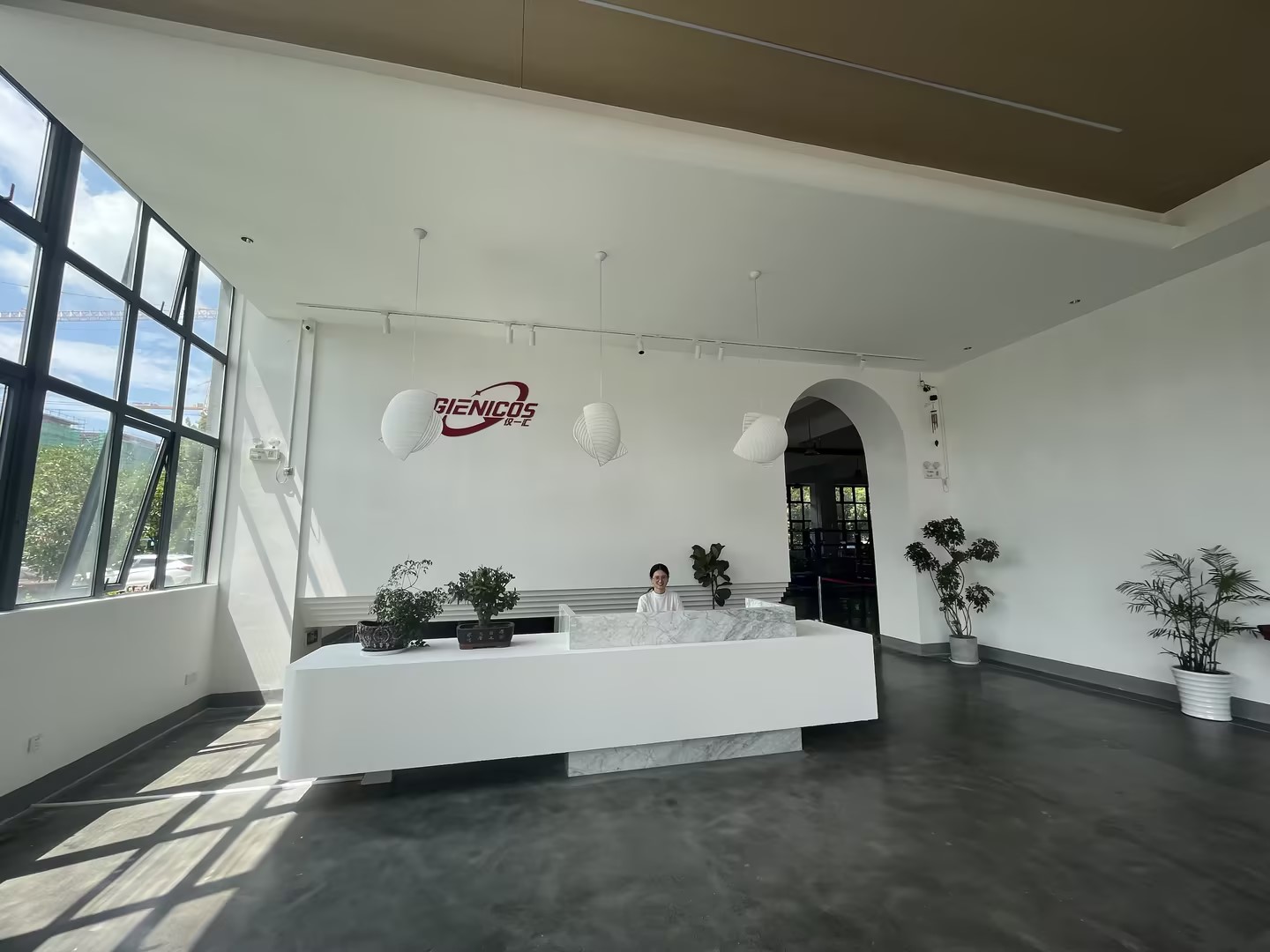
GIENICOS factory reception — contact point for configuration and sample discussions.
Have Questions or Need More Details?
Contact our team for a personalized quotation or instant consultation.
Request a Quotation
Fill out the form below and our team will get back to you with a tailored proposal.
WhatsApp Direct Chat
Prefer to chat in real-time? Message us on WhatsApp for instant assistance & quick answers.
- Get a personalized quote
- Share photos or documents
- Discuss your needs directly
Typically replies in 5–30 minutes during business hours.