
Small Batch, Big Problems: Trial Sample Filling Waste
A trial sample filling machine is a dedicated small-batch filler used to fill R&D, stability and sales samples without taking capacity from the main production line. The GIENICOS JLG-10H is one such machine: 10 servo-driven nozzles, a 1–19 ml filling range, 100–130 pcs/min, a 25 L tank and SS316L product-contact parts.
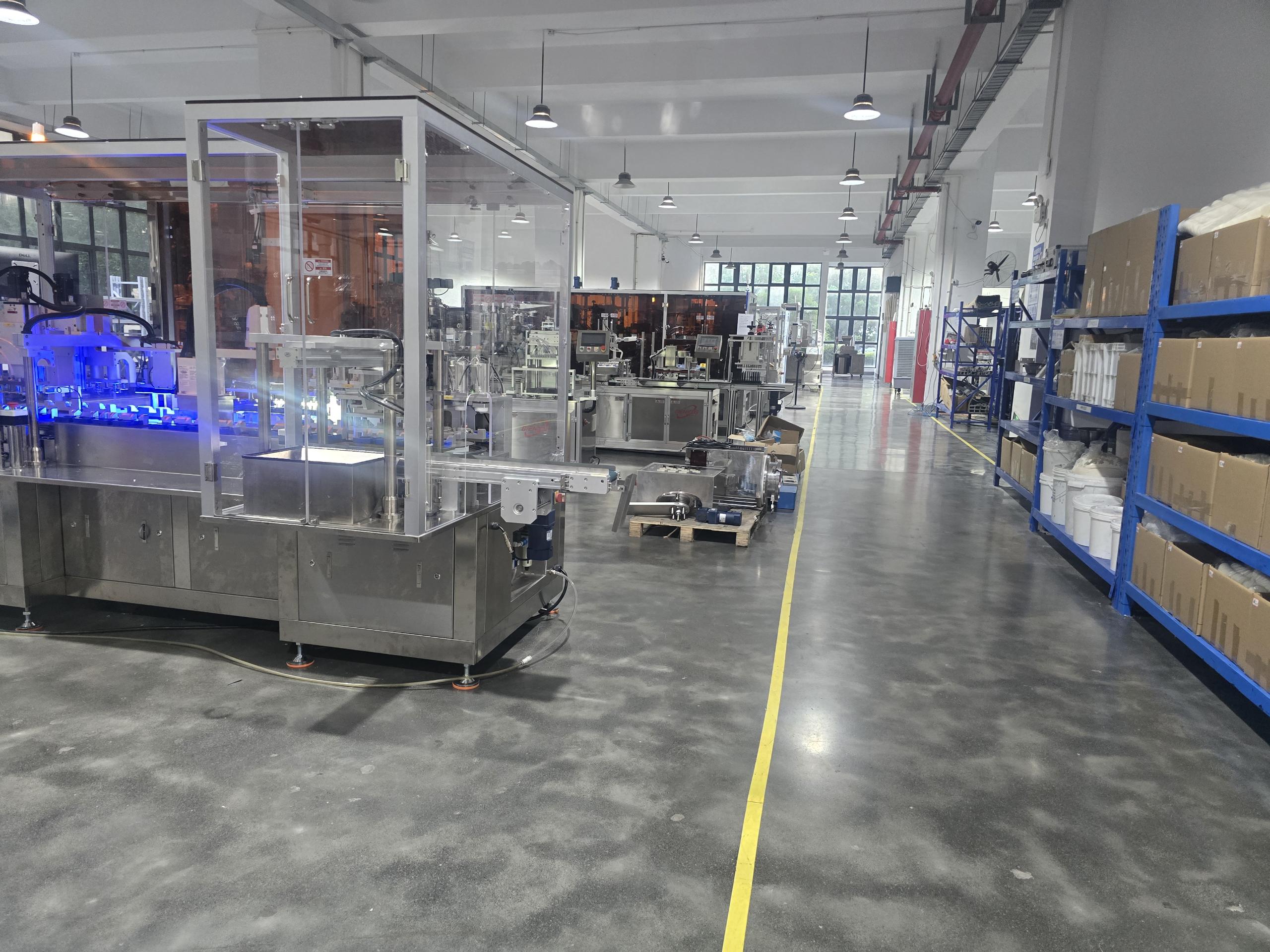
Every launch starts with a few hundred units: a lab batch for stability, a press set for approval, a handful of pieces for a trade show. Those units are few, but they compete with commercial orders for the same equipment — and on a line designed for volume, they lose. The sample run waits, the main line stops for a changeover it was never designed to make, and part of an expensive bulk ends up inside the machine instead of inside the bottle.
This article defines that bottleneck, reviews the market context, breaks the JLG-10H specification down line by line, and sets out a step-by-step method, a comparison table and a procurement FAQ for teams deciding between a dedicated sample filler and borrowed production capacity.
The problem: a sample lot is not a small production order
A 200-piece sample run is not a scaled-down 20,000-piece run. The bulk volume is small, the formula may still change between runs, the containers are often slim tubes or mini bottles, and the deadline is usually an approval meeting rather than a shipping window. All four differences point away from a production rotary filler.
In practice the bottleneck shows up as five recurring symptoms:
- Product tied up in the machine. Large tanks and pump circuits hold product at start-up and at the end of a run, so the usable yield of a small bulk is reduced by design rather than by operator error.
- Container handling built for a wide band. The JQR-01A automatic rotary mascara and lipgloss filler covers container diameters of 10–125 mm and container lengths of 40–90 mm — correct for production, but sample components still need their own holders and change parts.
- The main line stops. Changeover on a high-speed machine such as the JQH-02 lipgloss filler, published at 60–80 pcs/min on a 13 kW three-phase supply, is a scheduled production event. Inserting a sample run means stopping the asset that earns revenue.
- Cleaning multiplies. Sample work increases the number of shade and formula changes per week, and every change requires disassembly, cleaning and reassembly of product-contact parts.
- Senior operators get pulled in. Small runs need experienced hands, which removes them from the line that needs them most.
What a dedicated sample filler has to deliver
Six requirements separate a genuine small-batch tool from a production machine running a short job:
- Metering that holds at low volume — a servo piston system rather than a pump sized for litres.
- Low residual volume, so a small bulk is not consumed by the machine itself.
- Sample-size container handling, with adjustable or customizable bottle height.
- Fast clean-down between shades, supported by modular construction and quickly detachable assemblies.
- Single-phase power and a compact footprint, so the machine can stand in a lab or pilot room rather than a production hall.
- Documented validation — factory acceptance testing and outgoing quality control that can be referenced in a sample file.
Fail any one of them and the sample run drifts back into the production queue.
Market context: automation growth does not remove the sample bottleneck
Future Market Insights values the global cosmetic filling machines market at USD 476.80 million in 2025 and projects USD 718.63 million by 2036, and expects automatic filling machines to hold a 41.2% share of cosmetic filling technology in 2026. Fortune Business Insights reports that Asia Pacific held a 33.08% share of the wider filling machine market in 2025.
Read together, those figures describe capacity being added at the automatic end of the market. That trend raises, rather than lowers, the cost of interrupting production for a sample run: the faster and more automated the main line becomes, the more expensive every stop is. A dedicated sample filler is therefore complementary to automation, not a competitor to it.
The sampling workload itself is driven by launch cadence and shade count rather than by production tonnage. A brand adding line extensions, or a contract manufacturer running approval rounds for several clients at once, generates more small lots than a production schedule can absorb quietly.
For import purposes, cosmetic filling machinery is classified under HS 8422.30, with 8422.30.91 covering machinery for opening, filling and closing containers in the Harmonized Tariff Schedule maintained by the USITC — the code buyers normally quote when a sample filler ships as a separate unit.
The dedicated answer: Trial Sample Filling Machine JLG-10H
SHANGHAI GIENI INDUSTRY CO., LTD., trading as GIENICOS, is a Shanghai-based manufacturer of intelligent cosmetic filling and packaging equipment founded in 2011, with a 2,000 ㎡ factory in Jiading District, 30 employees, an annual output of 100 units and a 10-engineer R&D team. The company reports 42 authorized patents, an 80% export share and markets across the EU, USA and Asia.
The Trial Sample Filling Machine JLG-10H is the model in that range built specifically for trial samples and small batches.
- Filling nozzles 10
- Filling volume 1–19 ml
- Speed 100–130 pcs/min
- Tank 25 L
- Product-contact parts SS316L
- Bottle diameter 12–20 mm
- Bottle height Customizable
- Voltage AC220V, 1P
- Filling method Servo piston with servo lifting
- Application Cosmetic, pharmaceutical and personal care industries
What each parameter changes in a sample workflow
Ten nozzles. A single-nozzle semi-automatic rotary filler such as the JR-01M/L is published at 30–40 pcs/min; ten nozzles at 100–130 pcs/min take filling time out of the critical path. For a ten-shade sample set, cleaning and bulk handling become the constraint, not the filler.
1–19 ml. The range matches sample and travel sizes, and it overlaps the 1–20 ml window of the JQH-02 production lipgloss filler. A formula validated inside that envelope can move to production without re-developing its fill volume — although the published parameter set does not state a filling precision figure for the JLG-10H, so precision should be confirmed during a factory acceptance test rather than assumed from the production machine.
25 L tank. Bulk for a sample campaign stays small, and less product sits in the system at the end of a run. For wax-based products the bulk can be prepared in a matching small vessel — the MT 20 SE holds six 20 L tanks, the MT 30SE holds 30 L, and the TSP is a 20 L hot pouring machine with heating, stirring and vacuum — so melt size and fill size stay aligned.
SS316L product-contact parts. The specified wetted material is the same family used on the company's JYF-4 hot filling machine, which lists SUS316L product-contact material with a 20 L effective tank volume. It is a cleaning and compatibility decision rather than a marketing one.
12–20 mm bottles with customizable height. Sample tubes and mini bottles are the target format; where a sample arrives in a 10–50 ml tube, a tube filler is the better match instead.
AC220V single phase and servo piston with servo lifting. Single-phase power lets the machine sit in a pilot room or lab, and servo-controlled lifting gives a repeatable nozzle approach instead of a fixed mechanical stroke.
What the JLG-10H is not: the production rotary filler
Production rotary fillers remain the right answer for commercial volume, and their published parameters show why they belong there. The JQR-01A automatic rotary mascara and lipgloss filler runs 40–45 ppm across a 2–14 mL range at ±0.1 g, handling containers from 10–125 mm in diameter and 40–90 mm in length on a 380V/220V supply, 7 kW, with a machine weight of 900 kg. The JQH-02 reaches 60–80 pcs/min across 1–20 mL at ±0.1 g on three-phase 380V, 13 kW, 40 A.
Both machines are engineered around throughput, which is exactly what a sample run does not need. Keeping them on production work protects the capacity they were bought for.
Adjacent small-batch options in the same range
Sample work is not one task. The right machine depends on the product format:
- JR-01M/L — semi-automatic rotary single-nozzle filler, 2–14 ml or 10–50 ml by changing spare parts, 30–40 pcs/min, ceramic or SUS pump, AC220V single phase, 3.8 kW.
- JR-02M/L — semi-automatic rotary dual-nozzle filler, 1–20 ml at ±0.1 g, 30–40 pcs/min.
- JMF — economic vertical dual-nozzle filler with dual 20 L tanks, 22–28 pcs/min by one operator, cleaning time approximately 30 minutes, 4 kW.
- JRS-G2 / JRS-G3 — toner and cream filling for skincare samples: 10–300 ml and viscosity up to 15,000 mPa.s on the G2 (45 bottles/min at 50 ml), and ≤50 pcs/min on the G3 with a published 15-minute changeover.
- GFS-40/60 — tube filling and sealing for sample tubes, 5–250 ml at 30–40 pcs/min (GFS-40) or 60–80 pcs/min (GFS-60), tube diameters 10–50 mm.
- JLG-10/12 — semi-automatic lipstick and lip balm filler, 10 or 12 nozzles, 1–20 ml at ±0.1 g, supplied as a series with cooling tunnel and vacuum releasing machine.
Customization, OEM/ODM and delivery terms
Customization covers voltage, logo, automation degree, tank size, filling method and speed request, and both OEM and ODM production services are available. Commercial terms for sample-scale orders are published: MOQ 1 unit, monthly capacity 10 units, lead time 45–80 days, 100% OQC test before shipping, delivery terms FOB/CNF/CIF/DDP and payment at T/T 40%/60%. Acceptance runs through a factory acceptance test on site or a video inspection before shipment.
After-sales support is a standard 12-month warranty from the date of machine acceptance, covering manufacturing defects and excluding wearing consumable parts and man-made damage, with free spares and freight carried by GIENICOS, plus remote technical support, onsite visit support and full-life service support. More detail is available at GIENICOS.
Step-by-step: moving samples off the main line
- Separate the sample route from the production plan. List the lot types that will run on the small machine — lab, stability, press, sales — and take them out of the production filler's schedule entirely. The goal is not to fill faster; it is to stop the main line from stopping.
- Fix the container families first. The JLG-10H covers 12–20 mm bottles with customizable height. Larger components move to a semi-automatic rotary filler, and tube samples move to the GFS-40/60 range of 5–250 ml.
- Overlap the fill range with production. Keeping sample filling inside 1–19 ml and production inside 1–20 ml means scale-up does not require new fill settings; confirm the precision figure on the acceptance test for each machine.
- Prepare bulk at sample scale. Match the melt or mix vessel to the fill: a 20 L or 30 L melting tank, the six-tank MT 20 SE, or the 20 L TSP hot pouring machine keeps bulk volume and residual product under control.
- Schedule clean-down explicitly. Choose equipment built on a modular structural design with fast-disassembly assemblies, and record the changeover in the sample protocol; published reference points in the range include a 15-minute changeover on the JRS-G3 and approximately 30 minutes cleaning on the JMF.
- Validate before and after shipment. Run the factory acceptance test on site or by video before dispatch, rely on the 100% OQC test, retain first-article samples for the stability file, and route early service questions through remote support before scheduling an onsite visit.
Where dedicated sample filling pays back
Multi-shade R&D sets. Ten nozzles across 1–19 ml turn a shade family into one short session. The value is not the unit rate alone; it is that the same operator can run three formula revisions in a morning and still hand the machine back clean.
OEM/ODM sampling for brand approval. Contract manufacturers run approval rounds for several clients at once, usually in small volumes and tight sequence. GIENICOS reports a five-year installed base of 20 sets with cosmetic brands, OEM/ODM contractors and small-batch production labs across the US, Poland, Indonesia and Thailand, used for lipgloss and lipcream production, with stable operation and service support delivered on schedule.
Skincare samples. Serums, toners and creams need a different architecture: the JRS-G2 dual-nozzle servo filler covers 10–300 ml at viscosity up to 15,000 mPa.s with a 40–45 L tank, while the JRS-G3 rotary version holds precision of ±0.5 g between 20–100 ml and ±0.5% between 101–300 ml, with a 15-minute changeover between container formats.
Wax-based trial pours. Lipstick and lip balm samples begin upstream of the filler. The TSP 20 L hot pouring machine (heating, stirring, vacuum, sanitary valve without dead angle) or the MT 20 SE six-tank system supply small melts, and the JLG-10/12 semi-automatic series fills 1–20 ml at ±0.1 g with cooling tunnel and vacuum releasing machine.
Tube samples. Where the sample format is a tube rather than a bottle, the GFS-40/60 handles 5–250 ml across plastic, aluminium and laminate tubes at 30–40 or 60–80 pcs/min depending on model.
Comparison: matching the machine to the batch
The table below uses published parameters only. Where a figure is not part of the published parameter set, the cell is left blank rather than estimated.
| Machine / model | Typical role | Filling range | Output | Container and tank notes | Power and size notes |
|---|---|---|---|---|---|
| Trial Sample Filling Machine — JLG-10H | Dedicated trial samples and small batches | 1–19 ml | 100–130 pcs/min | 10 nozzles; 25 L tank; SS316L product-contact parts; bottle diameter 12–20 mm; bottle height customizable | AC220V, 1P; servo piston with servo lifting |
| Semi-automatic rotary — JR-01M/L | Small lots, single nozzle | 2–14 ml / 10–50 ml (by spare parts) | 30–40 pcs/min | Ceramic or SUS pump | AC220V, 1P, 3.8 kW; 1750 × 1100 × 2200 mm |
| Vertical dual nozzle — JMF | High-viscosity small lots | 22–28 pcs/min by one operator | Dual 20 L tanks; cleaning time approx. 30 min | AC220V, 1P, 4 kW; 810 × 570 × 1906 mm | |
| Toner & cream rotary — JRS-G3 | Skincare samples and small production | 10–300 ml | ≤50 pcs/min | ±0.5 g (20–100 ml); ±0.5% (101–300 ml); changeover 15 min; holder diameter 10–70 mm | AC380V, 3P, 5 kW; 2000 × 1700 × 2000 mm |
| Automatic rotary — JQR-01A | Production mascara, lipgloss, foundation liquid | 2–14 mL | 40–45 ppm | ±0.1 g; container diameter 10–125 mm; container length 40–90 mm | 380V / 220V, 7 kW; 900 kg; 2350 × 2150 × 1900 mm |
| High-speed — JQH-02 | Production lipgloss filling and capping | 1–20 mL | 60–80 pcs/min | ±0.1 g; air pressure 0.5–0.8 MPa | 3-phase 380V, 13 kW, 40 A |
Sources: GIENICOS published machine parameters. Blank cells indicate figures not included in the published parameter set.
FAQ: trial sample filling and small-batch procurement
1. Which certifications apply, and how does a buyer verify the scope?
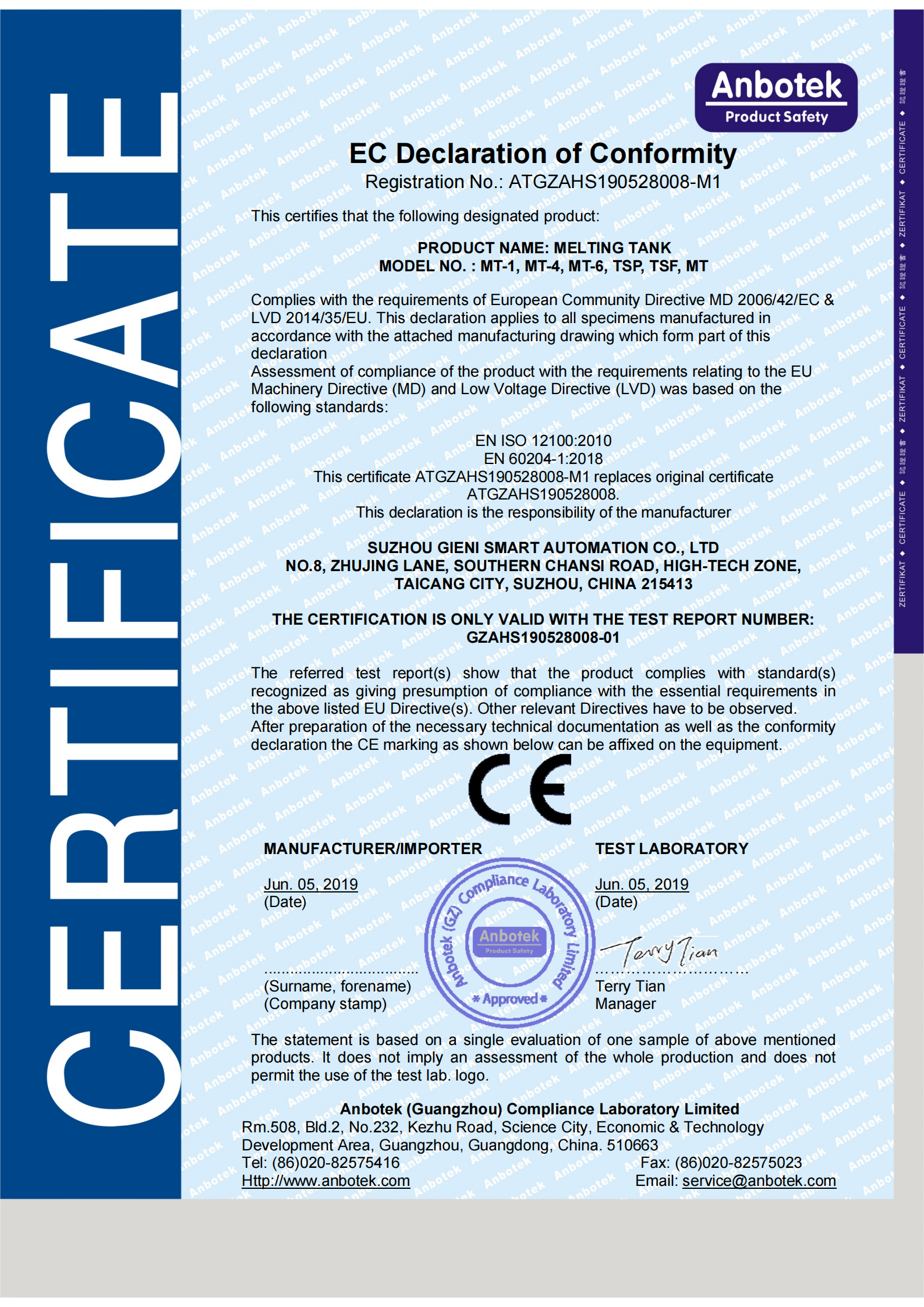
The lipstick filling machine series JLG-10, JLG-12, JSM, FSM-5, FSM and JLG holds CE certificate AT1814C500649151, issued 15 January 2025 by Hunan Anbotek Compliance Laboratory Limited against EN 60204-1:2018 and EN ISO 12100:2010 for the EU market. The JHF hot filling line holds AT185114C4000321, the JYF-2 to JYF-12 multifunctional filling line holds AT58250SC100097, and the MT-1 melting tank series holds ATGZAHS190528008-M1. Because a certificate lists specific models, confirm that the model you order appears in the certificate scope before signing, and quote HS 8422.30.91 for customs where a machine ships as a separate unit.
2. Can the machine be adapted to our containers and our formula?
Yes. The JLG-10H is specified with 12–20 mm bottle diameter, customizable bottle height, a 1–19 ml servo piston fill and SS316L product-contact parts, which covers most sample tubes and mini bottles. Customization options across the range include voltage, logo, automation degree, tank size, filling method and speed request, with both OEM and ODM production services available. Hot-pour formulas need the upstream step as well: the MT 20 SE (six 20 L tanks), MT 30SE (30 L) or the TSP 20 L hot pouring machine prepare the bulk before filling.
3. What drives the cost of a sample-scale setup, and what is the minimum order?
The MOQ is 1 unit, so a single sample machine is a valid order. Cost is driven by the configuration rather than by a published list price: nozzle count, tank volume, the servo and automation level, the material of product-contact parts, and any integration work with existing equipment. Delivery terms are FOB/CNF/CIF/DDP and payment is T/T 40%/60%, which means the commercial structure can be aligned to how your project is financed.
4. How do we validate the machine on our own formula before committing?
Validation is built into the shipment process: acceptance criteria are a factory acceptance test on site or a video inspection before shipment, and every machine passes a 100% OQC test before shipping. The modular structural design with fast-disassembly assemblies supports cleaning between formulas, so a formula trial does not require a full teardown. Where a longer reference is useful, GIENICOS reports 20 installed sets across the US, Poland, Indonesia and Thailand used for lipgloss and lipcream over five years, with stable operation and service support delivered on schedule.
5. What is the lead time, and what happens after installation?
Lead time is 45–80 days with a monthly capacity of 10 units and an MOQ of 1 unit. The standard warranty is 12 months from the date of machine acceptance, covering manufacturing defects and excluding wearing consumable parts and man-made damage, with free spares and freight carried by GIENICOS; remote technical support, onsite visit support and full-life service support follow. If you are planning a dedicated sample route, send your container list and fill volumes to sales@genie-mail.net or WhatsApp +86 134 8206 0127 for a sample-run quote.
Conclusion: closing the sample bottleneck without opening a new one
Sample filling is a fixed cost of every launch. The choice is whether it is paid in main-line downtime or in a dedicated asset. When the deciding factors are shade count, cleaning frequency and turnaround, a dedicated trial sample filling machine such as the JLG-10H is the lower-risk route: 10 nozzles, 1–19 ml, 100–130 pcs/min, a 25 L tank, SS316L wetted parts, AC220V single-phase power and a service structure that starts with a factory acceptance test.
When run length is driven by order volume, the semi-automatic rotary fillers and the production machines — JR-01M/L, JRS-G3, JQR-01A, JQH-02 — take over. Matching the machine to the batch, rather than forcing one machine to serve every batch, is what keeps both the sample promise and the production plan intact.
Next step: the 2026 GIENICOS catalogue lists the full filling, hot pouring, powder and labeling range with published parameters.
Download the 2026 catalogue (PDF) · www.gienicos.com · sales@genie-mail.net · +86 134 8206 0127
Have Questions or Need More Details?
Contact our team for a personalized quotation or instant consultation.
Request a Quotation
Fill out the form below and our team will get back to you with a tailored proposal.
WhatsApp Direct Chat
Prefer to chat in real-time? Message us on WhatsApp for instant assistance & quick answers.
- Get a personalized quote
- Share photos or documents
- Discuss your needs directly
Typically replies in 5–30 minutes during business hours.