
1.5ATA vs 2.0ATA Hyperbaric Chambers: Pressure, Flow, and Use Cases
Pressure, Flow and Application Guide
A 1.5ATA hyperbaric oxygen chamber and a 2.0ATA hyperbaric oxygen chamber differ in one labelled number, and that number is not the whole specification. Three figures decide how a chamber behaves in daily operation: the working pressure in ATA, the oxygen flow the concentrator delivers in litres per minute, and the pressure at which that oxygen is supplied in kPa. Two chambers can both be labelled 1.5ATA and still pair concentrators rated 5 L/min and 15 L/min respectively.
This guide separates those three variables and shows how they combine in real configurations, including how the GH05A integrated oxygen concentrator fits into 1.5ATA soft shell operation. It then maps pressure classes to wellness, sports recovery, home use and clinical-adjacent applications. Every model specification cited below comes from GIHOMO product data or from published regulatory and clinical sources.
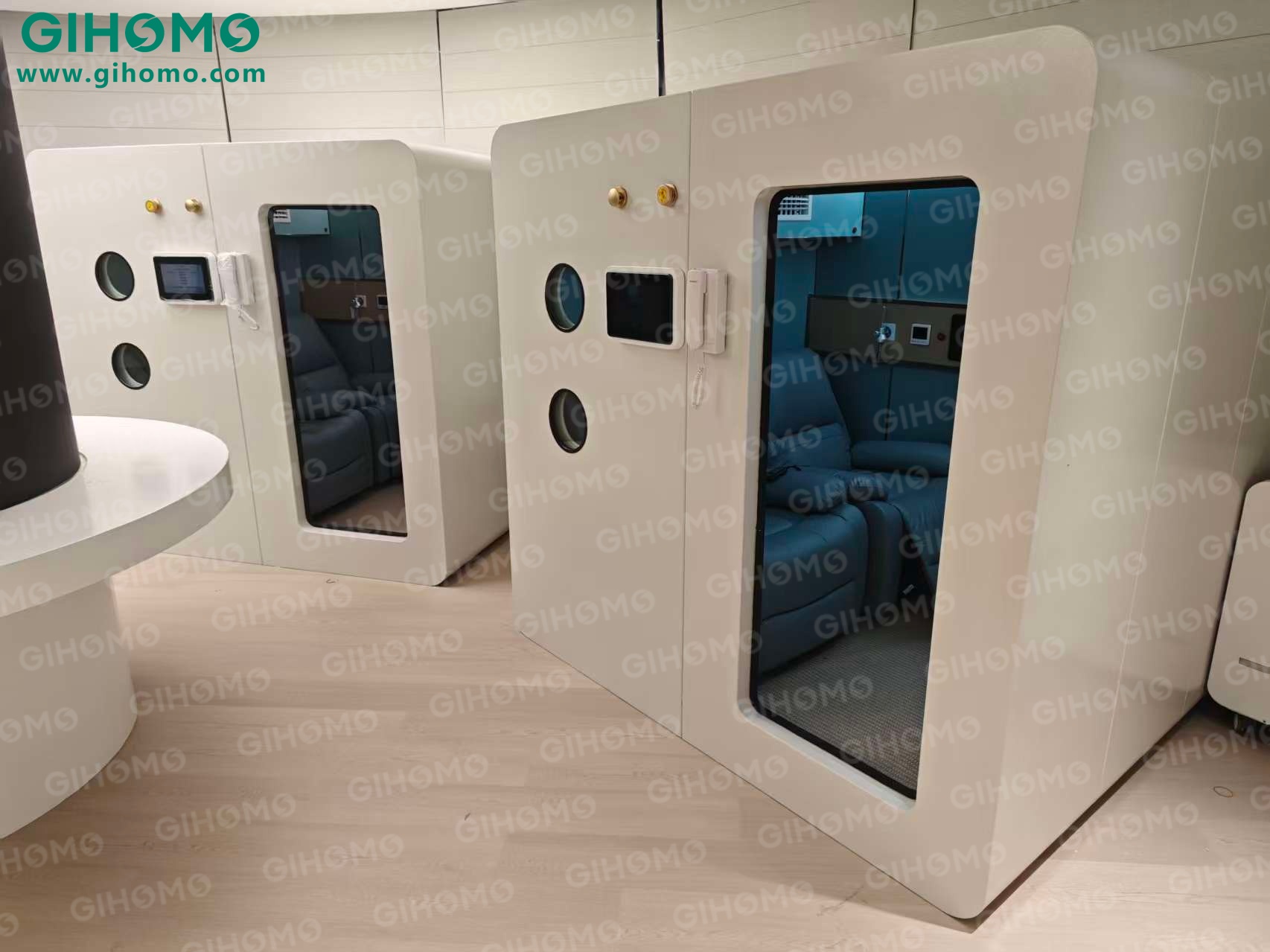
The problem: one visible number, three hidden specifications
Buyers comparing chamber listings tend to sort by the ATA figure because it is the most prominent value on the page. The habit breaks down at the second comparison. Within GIHOMO's catalogue, the 1.5ATA soft shell model SSL001 is paired with a GH05A concentrator rated 5 L/min at 100 kPa oxygen concentration pressure. The 1.5ATA soft shell model STW01 is paired with a GH15A rated 15 L/min at the same 100 kPa. Same pressure class, three times the flow.
The pattern continues in the other direction. The 2.0ATA model W900 uses a GH15S-12A at 15 L/min and 120 kPa — the same 15 L/min as STW01, but at a higher oxygen concentration pressure and a higher rated power, approximately 1,100 W against approximately 850 W.
So the practical question for a procurement team is not which pressure is better. It is which combination of working pressure, oxygen flow, concentration pressure, delivery method and chamber geometry matches the site, the number of users per session, the electrical supply, and the claims the operator is entitled to make. Treating ATA as a grading system produces mismatched equipment: an undersized concentrator on a large chamber, or a 5,000 W unit on a circuit that cannot support it.
Industry background: where 1.5ATA and 2.0ATA sit
Hyperbaric oxygen therapy delivers oxygen inside an enclosed space at higher than normal air pressure, which increases the amount of oxygen carried in the blood. That mechanism is described consistently by major medical institutions, including Mayo Clinic and MedlinePlus, and it is the basis for both clinical and non-clinical use of hyperbaric chambers.
Published guidance places the two pressure classes in different operating territories. Material referenced by the U.S. Food and Drug Administration describes soft shell chambers as operating at mild pressures, usually around 1.3 ATA and at most 1.4–1.5 ATA, while hard shell chambers typically operate between 2.0 and 3.0 ATA in clinical settings, with multiplace systems reaching 6.0 ATA. A 1.5ATA soft shell unit therefore sits at the top of the mild-pressure band, and a 2.0ATA unit sits at the bottom of the clinical band.
Commercial context matters for scale. Mordor Intelligence values the global hyperbaric oxygen therapy devices market at USD 7.43 billion in 2025 and projects USD 10.55 billion by 2031, a compound annual growth rate of 6.03% over 2026–2031. Growth of that order is driven by both clinical capacity and the wellness and sports recovery segment, which is where most 1.5ATA soft shell demand sits.
Regulatory context shapes what a buyer may claim. In the United States, the full-body hyperbaric chamber is a Class II device classified under 21 CFR 868.5470 with product code CBF, and hyperbaric oxygen therapy devices are cleared through the 510(k) pathway. The FDA has also reported fires and serious injuries associated with hyperbaric oxygen therapy devices and asks providers to follow manufacturer instructions and maintain fire-prevention measures. Pressure rating, oxygen handling and electrical design are therefore procurement questions as much as clinical ones.
Two segments, two documentation standards. A 1.5ATA soft shell chamber is normally positioned for wellness, recovery and home use. A 2.0ATA hard shell chamber can serve wellness or clinical-adjacent work, but the second path depends on regulatory clearance and intended-use labelling, not on the pressure figure alone.
What ATA actually measures
One atmosphere absolute, or 1 ATA, is the pressure of the atmosphere at sea level. A 1.5ATA chamber operates at 1.5 times that pressure; a 2.0ATA chamber at double it. The gauge pressure inside the chamber — the difference between internal and ambient pressure — is therefore about 0.5 atm at 1.5ATA and about 1.0 atm at 2.0ATA.
A simple way to picture the effect is a sealed plastic bottle of air. At constant temperature, the volume a fixed mass of gas occupies is inversely proportional to the pressure applied to it. At 1.5 ATA that gas occupies roughly two-thirds of its sea-level volume; at 2.0 ATA, roughly one half. The chamber wall carries the difference, which is why construction changes with pressure class. In GIHOMO's catalogue the 1.5ATA group includes TPU soft shell models (SSL001, STW01, STW02, STW03) and steel hard shell models (Z0780V, Y0780), while the 2.0ATA group includes TPU (SH001), steel (W900, W1800) and aluminium (C750, C900).
Pressure also has to be tolerated by the person inside. Equalisation of ears and sinuses becomes more demanding as the pressure differential grows, which is one reason the pressure class should be matched to the user group rather than to a marketing preference. A higher number is not automatically the better fit for a spa, a gym or a home installation.
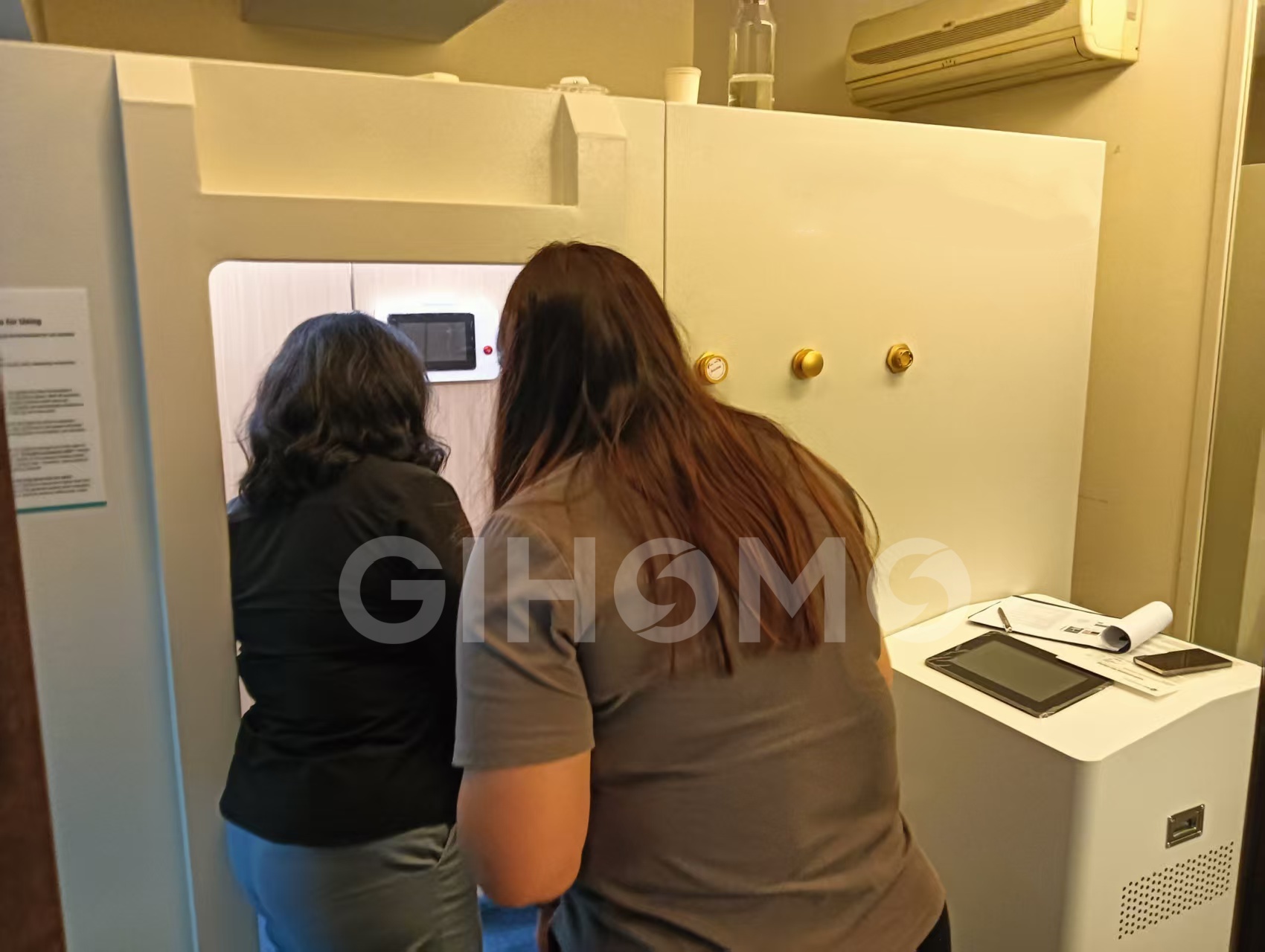
Why oxygen flow in L/min matters as much as pressure
The oxygen concentrator is the chamber's oxygen source, and its flow rating states how much oxygen-enriched gas it can deliver per minute. In a closed chamber the concentrator has to raise and hold the oxygen fraction while the chamber is pressurised and occupied, so flow needs to be matched to chamber volume and to the number of occupants. This is general engineering logic, and the catalogue reflects it in the way models are paired.
The GH05A integrated oxygen concentrator is rated 5 L/min at 100 kPa oxygen concentration pressure, with oxygen purity above 90% and rated power of approximately 750 W. In the catalogue it appears on the compact soft shell models: SL001 at 1.3ATA with a D2200 × 800 mm chamber and 20.5 kg net weight, SSL001 at 1.5ATA with a 1700 × 1100 × 1200 mm chamber and 24.5 kg net weight, and ST001, a 1.3ATA sitting type.
Step up one level and the GH15A delivers 15 L/min at the same 100 kPa concentration pressure at approximately 850 W. That is the concentrator paired with STW01, a 1.5ATA sitting type soft shell chamber measuring 1820 × 820 × 1500 mm, and with STW03, a 1.5ATA lying type soft shell chamber measuring D1000 × 2350 mm.
Two observations follow. First, the same 1.5ATA label covers both a 5 L/min and a 15 L/min oxygen supply, so the pressure headline tells a buyer nothing about flow. Second, the concentrator line determines the electrical and duty profile. Within the 1.5ATA hard shell group, Z0780V pairs a GH015A-12AA0C delivering 15 L/min at 120 kPa at 850 W, while B2020-3 pairs a GH15S-12A delivering the same 15 L/min at 120 kPa at approximately 1,100 W. Identical pressure and identical flow, different concentrator, different power draw.
Oxygen concentration pressure in kPa: the number most buyers skip
Oxygen concentration pressure, expressed in kPa on GIHOMO datasheets, describes the pressure at which the concentrator delivers oxygen. It is not the therapy pressure and it is not the chamber's ATA rating. It is the delivery-side figure that determines whether oxygen can be pushed into the chamber or through a mask line at the required rate.
The catalogue separates roughly into two concentration-pressure groups. The 100 kPa group contains the GH05A at 5 L/min and the GH15A at 15 L/min, and it sits on the lighter soft shell chambers. The 120 kPa group contains a wider spread: the GY20SR at 20 L/min, the GH15S-12A at 15 L/min, the GY30SR at 30 L/min, the GH30S-12A at 30 L/min and the GH60S at 60 L/min. That second group covers hard shell, BIBS-equipped and multi-person systems.
Flow alone does not predict concentration pressure. The GH15A and the GH15S-12A both deliver 15 L/min, but at 100 kPa and 120 kPa respectively. A buyer who compares only ATA and L/min can end up with a concentrator whose delivery pressure is mismatched to the chamber inlet or the mask system it is supposed to feed.
How the GH05A concentrator fits into daily operation
The GH05A is the entry point of the GIHOMO concentrator range: 5 L/min, 100 kPa concentration pressure, oxygen purity above 90%, approximately 750 W. In day-to-day use it produces three practical consequences.
- Electrical load. At approximately 750 W it is the lowest rated power among the models discussed in this guide. For a home installation, a small spa treatment room or a site with limited circuit capacity, that difference against a 1,100 W or 5,000 W unit decides whether additional electrical work is required.
- Occupancy. The models paired with the GH05A in the catalogue are single-occupant soft shell chambers. Flow should be matched to chamber volume and occupant count, so a 5 L/min concentrator belongs on a compact single-user chamber rather than a multi-person cabin.
- Purity and session consistency. Purity is listed above 90%. Buyers should ask how purity is maintained across a full session and at what chamber pressure the figure was measured, because the datasheet number alone does not establish in-session performance.
Where a session profile calls for 15 L/min at the same 100 kPa concentration pressure, the catalogue equivalent is the GH15A on STW01 or STW03, not a GH05A. Where the configuration uses a mask-based BIBS system, the catalogue pairs higher-flow concentrators instead: the GY20SR at 20 L/min and 120 kPa on STW02, a 1.5ATA portable chamber with BIBS, and the GY30SR at 30 L/min and 120 kPa on Y1800M, a 1.5ATA BIBS chamber. Directing oxygen to a mask rather than to the whole chamber volume is consistent with that higher flow requirement.
Step-by-step: how to choose between 1.5ATA and 2.0ATA
The sequence below is written for a buyer in the evaluation-to-execution stage, where the pressure class has to be fixed before a purchase order is raised.
- Start with occupancy and session throughput. Decide how many people are in the chamber per session and how many sessions per day. A single-user home or spa room and a two-person recovery cabin point to different chamber volumes, and volume drives flow.
- Fix the claim you intend to make. Wellness, sports recovery and home use sit naturally in the 1.3–1.5ATA band. Any medical claim requires regulatory clearance in the destination market; in the United States that means verifying 510(k) status for the specific device rather than reading a CE or EMC certificate.
- Read the concentrator line, not the headline. Record four values together: flow in L/min, oxygen concentration pressure in kPa, oxygen purity, and rated power in W. Compare all four across candidate models.
- Identify the oxygen delivery method. Chamber-atmosphere delivery and mask-based BIBS delivery are different configurations. Check which one the quotation describes and which concentrator model it pairs with.
- Check geometry and material against the room. A 1700 × 1100 × 1200 mm TPU soft shell chamber and a 1350 × 780 × 1880 mm steel hard shell chamber have different door widths, floor loading and ceiling clearance implications. Confirm the route into the room, not just the room itself.
- Confirm the electrical supply. Rated power ranges from approximately 750 W for the GH05A soft shell group to approximately 5,000 W for the GH60S on the two-person 2.0ATA model W1800. Verify circuit capacity and any dedicated-line requirement before delivery.
- Verify documentation before payment. Ask for certificate numbers with scope and model lists, the instructions for use, and any test reports. Then confirm commercial terms: minimum order quantity, lead time, acceptance testing and Incoterms.
Use cases: matching pressure class to application
Home use: 1.5ATA soft shell
GIHOMO chambers have been used by home-use clients for improving sleep, enhancing immunity and daily health management, with 80 units supplied over a two-year period and stable operation reported. The compact soft shell geometry suits this setting: SSL001 at 1.5ATA measures 1700 × 1100 × 1200 mm with 24.5 kg chamber net weight, and SL001 at 1.3ATA measures D2200 × 800 mm at 20.5 kg. Both run on concentrators in the 750–850 W band.
Wellness centres, spas and hotels
Chambers have been supplied to wellness centre clients, including applications in wellness centres, clinics, nursing homes and dental clinics, and to beauty salon and spa clients for beauty salon, spa and hotel purposes — 80 units and 30 units respectively across the recorded client groups. In these environments the sitting and lying 1.5ATA soft shell formats (STW01, STW03) and the sitting type hard shell formats allow a treatment-room layout with a single operator.
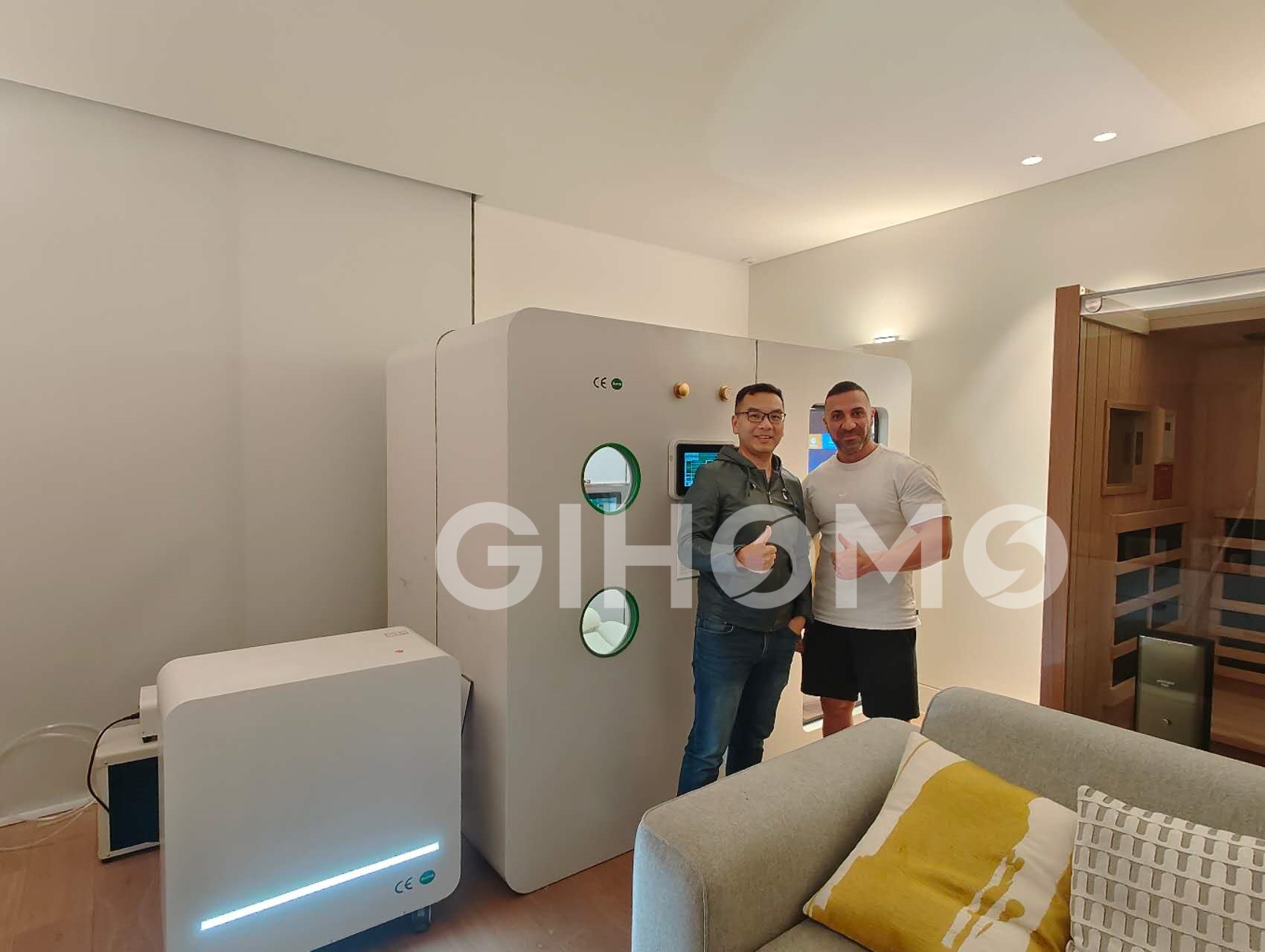
Gyms and sports clubs
Chambers have been used by gym and sport club clients for gym and sport club purposes, with 50 units supplied over a two-year period and stable operation reported. For recovery rooms, the choice between a 1.5ATA soft shell unit and a 2.0ATA single-person hard shell unit usually comes down to session logistics. The 2.0ATA models W900, C900 and SH001 all pair the GH15S-12A at 15 L/min and 120 kPa at approximately 1,100 W, so the electrical and flow profile is similar across those three body styles despite different geometry: 900 × 1500 × 1900 mm sitting type, Φ900 × 2100 mm aluminium lying type, and D800 × 2000 mm portable TPU.

Clinical-adjacent and disease-support applications
For disease-support positioning, the 2.0ATA hard shell models with mask-based delivery are the relevant group: W900 for a single seated user, C900 and C750 for a lying configuration in aluminium, and W1800 for two occupants with a GH60S at 60 L/min and 120 kPa at approximately 5,000 W. Pressure alone does not create a cleared indication. Operators intending medical claims must confirm the applicable regulatory pathway for the destination market and verify that the specific device carries the required clearance.
Multi-person and throughput-driven layouts
Two configurations illustrate how pressure class and flow diverge at the multi-person end. W1800 is a 2.0ATA two-person steel chamber on a GH60S rated 60 L/min at approximately 5,000 W. Y2400 is a 1.5ATA three-person steel chamber on a GH30SR-12A rated 30 L/min at 120 kPa at approximately 2,500 W. The chamber with the higher pressure rating is not the chamber with the higher occupancy, and the power requirement differs by a factor of two. Matching a site to throughput rather than to the ATA number is the safer decision.
ODM and reseller programmes
Chambers have been supplied to ODM reseller clients for resale in local markets, with 100 units recorded over a two-year period. GIHOMO provides OEM and ODM production services, with customization options covering logos, user interfaces, colours and languages. The listed customization scope is branding and interface level; pressure ratings, chamber dimensions and concentrator pairing are fixed per model, so a reseller should lock the model specification sheet before committing to a range.
Comparison table: representative models across both pressure classes
The table below uses GIHOMO catalogue values. It is deliberately model-level rather than class-level, because averaging the two classes would hide the differences that decide an installation.
| Model | Listed pressure | Type / material | Oxygen concentrator | Flow | Concentration pressure | Oxygen purity | Rated power | Chamber size |
|---|---|---|---|---|---|---|---|---|
| SSL001 | 1.5ATA | Soft shell, lying, TPU | GH05A | 5 L/min | 100 kPa | >90% | ≈750 W | 1700 × 1100 × 1200 mm |
| STW03 | 1.5ATA | Soft shell, lying, TPU | GH15A | 15 L/min | 100 kPa | >90% | ≈850 W | D1000 × 2350 mm |
| Z0780V | 1.5ATA | Hard shell, steel | GH015A-12AA0C | 15 L/min | 120 kPa | >90% | 850 W | 1350 × 780 × 1880 mm |
| SH001 | 2.0ATA | Portable, lying, TPU | GH15S-12A | 15 L/min | 120 kPa | >90% | ≈1,100 W | D800 × 2000 mm |
| W900 | 2.0ATA | Sitting type, steel | GH15S-12A | 15 L/min | 120 kPa | >90% | ≈1,100 W | 900 × 1500 × 1900 mm |
| C900 | 2.0ATA | Lying type, aluminium | GH15S-12A | 15 L/min | 120 kPa | >90% | ≈1,100 W | Φ900 × 2100 mm |
| W1800 | 2.0ATA | Hard shell, two-person, steel | GH60S | 60 L/min | 120 kPa | >90% | ≈5,000 W | 1800 × 2000 × 1900 mm |
Read across the flow column rather than down the pressure column. A 1.5ATA model can carry a 5 L/min or a 15 L/min supply. A 2.0ATA model can carry 15 L/min or 60 L/min. The rated power tracks the concentrator, not the ATA figure, which is why a 2.0ATA single-person chamber at approximately 1,100 W sits closer to a 1.5ATA soft shell unit at approximately 850 W than to a 2.0ATA two-person unit at approximately 5,000 W.
Documentation checklist before confirming an order
GIHOMO operates under an ISO 9001 quality management system and holds ISO 9001 certificate 21425Q0195R0S, ISO 14001 certificate 21425E0089ROS and ISO 45001 certificate 21425S0068ROS, all scoped to hyperbaric oxygen chambers. Product conformity documentation includes CE certificate JAT25062702642SC-1 against EN 60335-1 and EN 62233, CE EMC certificate JAT25062402743EC-1, and EMC test report UNIA23081019ER-11 against EN IEC 55014-1, EN IEC 61000-3-2, EN 61000-3-3 and EN IEC 55014-2.

- Certificate number, issuing body, issue and expiry date, and the product scope printed on the document.
- The specific model list covered, matched against the model on the quotation.
- The test report behind any EMC or electrical safety claim, with the laboratory named.
- The instructions for use, including fire-prevention and oxygen-handling procedures.
- The pre-shipment test record, since acceptance criteria are set at pre-shipment testing.
Do not treat a CE or EMC certificate as medical-device market authorisation. These are safety, electromagnetic-compatibility and quality-management documents. In the United States, a full-body hyperbaric chamber is a Class II device under 21 CFR 868.5470 requiring 510(k) clearance for medical claims. Buyers intending clinical positioning should verify clearance for the exact device separately.
Frequently asked questions
1. What certifications should a 1.5ATA or 2.0ATA hyperbaric oxygen chamber carry before purchase?
A hyperbaric oxygen chamber should come with quality-management and product-conformity documentation whose scope names the product and the model. GIHOMO holds ISO 9001 certificate 21425Q0195R0S, ISO 14001 certificate 21425E0089ROS and ISO 45001 certificate 21425S0068ROS, all scoped to hyperbaric oxygen chambers. Product conformity documents include CE certificate JAT25062702642SC-1 against EN 60335-1 and EN 62233, CE EMC certificate JAT25062402743EC-1, and EMC test report UNIA23081019ER-11 against EN IEC 55014-1, EN IEC 61000-3-2, EN 61000-3-3 and EN IEC 55014-2. These are quality, electrical-safety and electromagnetic-compatibility documents, not medical-device market authorisation. A buyer who intends to make medical claims in the United States must separately verify 510(k) clearance for the specific device, because a full-body hyperbaric chamber is a Class II device under 21 CFR 868.5470. Ask for certificate numbers, issuing bodies, expiry dates and the covered model list before payment.
2. Can a single supplier deliver both 1.5ATA and 2.0ATA chambers, and what can be customised?
Yes. GIHOMO's catalogue covers both pressure classes. The 1.5ATA group includes the soft shell models SSL001, STW01, STW02 and STW03, and the hard shell models Z0780V, Y0780, B2020-3, Y2400 and Y1800M. The 2.0ATA group includes SH001, W900, C750, C900 and W1800. GIHOMO provides OEM and ODM production services, with customization available for logos, user interfaces, colours and languages. The manufacturer reports monthly capacity of 80 units, annual output of 1,000 units, a six-engineer R&D team and 100% product testing, and exports about 60% of output to the EU and USA. The listed customization scope is branding and interface level: pressure rating, chamber dimensions and concentrator pairing are fixed per model, so confirm the model specification sheet rather than assuming the working pressure itself can be customised.
3. Does a 2.0ATA chamber cost more to operate than a 1.5ATA chamber?
No unit pricing is quoted here, but the verifiable running-cost driver is rated power, and rated power follows the concentrator rather than the ATA label. Within the GIHOMO catalogue, the 1.5ATA soft shell model SSL001 with a GH05A concentrator draws approximately 750 W. The 1.5ATA soft shell model STW03 with a GH15A draws approximately 850 W, and the 1.5ATA hard shell Z0780V draws 850 W. The 2.0ATA single-person models W900, C900 and SH001, all on the GH15S-12A, draw approximately 1,100 W. The 2.0ATA two-person W1800 on the GH60S draws approximately 5,000 W. A 2.0ATA single-person chamber therefore sits between the lightest 1.5ATA soft shell unit and a two-person 2.0ATA unit on power draw. Occupancy, session length and daily throughput usually affect operating economics more than the pressure class. Request a formal quotation with Incoterm and configuration for actual cost.
4. Can I order a single unit as a sample before committing to volume?
Yes. The minimum order quantity is 1 unit, so a single chamber can be ordered for evaluation. Acceptance criteria are based on pre-shipment testing, which means the unit is tested before it leaves the factory and the test record accompanies the order. Payment terms accepted are TT, XTransfer, PayPal and Alibaba.pay. Delivery terms offered are EXW, FOB, CIF and DDP. A single-unit trial is the practical way to verify what a datasheet cannot show: pressure hold during a full session, concentrator flow under load, noise in the actual room, and how the chamber geometry works with the site. For sample arrangements, contact the GIHOMO team through www.gihomo.com.
5. What is the lead time, and what after-sales support is included?
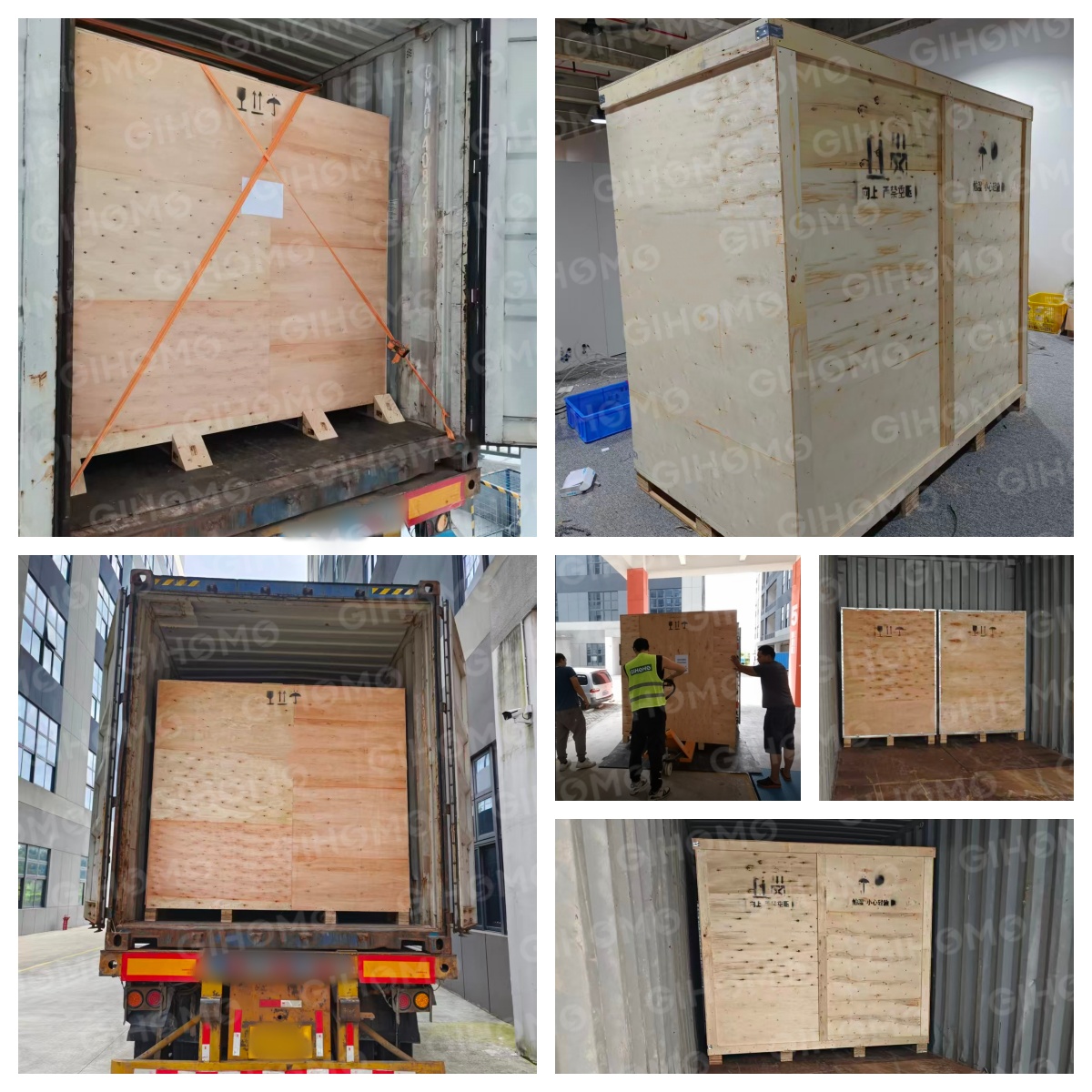
Lead time for a hyperbaric oxygen chamber order is 30 to 45 days, against a reported monthly capacity of 80 units. After-sales support comprises 24/7 instant response by a professional team, dedicated after-sales engineers providing one-on-one technical support, and a one-year warranty. For a buyer moving from evaluation to execution, the practical next step is to confirm the model, the concentrator pairing and the destination market on a single specification sheet, then request a quotation that states the Incoterm, the acceptance test and the warranty start date. GIHOMO can be reached at gihomo@hotmail.com or on WhatsApp at +852 68176191.
Conclusion
The difference between a 1.5ATA and a 2.0ATA hyperbaric oxygen chamber is real, but it is narrower than the label suggests and wider than a single number can express. Working pressure sets the pressure differential the shell must carry and the equalisation demand on the user. Oxygen flow in L/min sets how much oxygen-enriched gas the concentrator can deliver, and it has to match chamber volume and occupancy. Oxygen concentration pressure in kPa sets the delivery pressure on the concentrator side, and it determines whether the oxygen can reach the chamber inlet or the mask line as configured.
In the GIHOMO catalogue, 1.5ATA models run from a 5 L/min GH05A soft shell unit at approximately 750 W to a three-person hard shell chamber at approximately 2,500 W, while 2.0ATA models run from a portable TPU chamber at approximately 1,100 W to a two-person steel chamber at approximately 5,000 W. The pressure class narrows the field; the concentrator line decides the installation.
For wellness, spa, gym and home applications, the 1.3–1.5ATA soft shell range usually fits the room, the power supply and the session model. For clinical-adjacent positioning, the 2.0ATA hard shell range with mask-based delivery is the relevant group, provided the regulatory clearance for the destination market is verified first. Either way, the decision should be made from a model specification sheet that lists pressure, flow, concentration pressure, purity, rated power and chamber size together.
Check a specific configuration before you specify
GIHOMO supplies hard shell and portable hyperbaric oxygen chambers from a 2,000 m² facility in Foshan, Guangdong, with OEM and ODM production, a minimum order quantity of 1 unit, and lead times of 30 to 45 days. If you are comparing a 1.5ATA and a 2.0ATA configuration for a wellness centre, sports facility, clinic or home installation, request the model specification sheet, the certificate scope and a quotation with Incoterm in one go.
Website: www.gihomo.com | Email: gihomo@hotmail.com | WhatsApp: +852 68176191
Have Questions or Need More Details?
Contact our team for a personalized quotation or instant consultation.
Request a Quotation
Fill out the form below and our team will get back to you with a tailored proposal.
WhatsApp Direct Chat
Prefer to chat in real-time? Message us on WhatsApp for instant assistance & quick answers.
- Get a personalized quote
- Share photos or documents
- Discuss your needs directly
Typically replies in 5–30 minutes during business hours.