
Application Guide: Two-Person Hyperbaric Oxygen Chambers in Wellness and Sports Recovery
Quick answer: a two-person hyperbaric oxygen chamber is a pressure-rated enclosure that allows two occupants to complete a session at the same time. Successful deployment comes down to four matched decisions — chamber type and operating pressure, oxygen supply capacity, room layout, and the session-and-staffing model. In the GIHOMO range, two-person hard shell chambers such as the Y1800 family operate at 1.3–1.5ATA with 15L/min oxygen flow; the 2.0ATA W1800 runs on a 60L/min oxygen supply; and the two-person portable SS002 runs at 1.3ATA with 15L/min. Several single-occupant soft shell models, including the ST001, SSL001 and SL001, are built around the GH05A oxygen concentrator at 5L/min and 100KPa oxygen concentration pressure.

GUANGDONG GIHOMO MEDICAL TECHNOLOGY CO., LTD. (GIHOMO) is a hyperbaric oxygen chamber manufacturer established in 2021 in Foshan, Guangdong, operating under the ISO9001 quality management system. The company runs a 2000 square metre manufacturing facility with a workforce of 50–100 staff, a research and development team of six engineers and an annual production capacity of approximately 1000 units. Export business accounts for about 60% of total sales, with the EU and the USA as its main markets, and the portfolio covers hard shell hyperbaric oxygen chambers, portable hyperbaric oxygen chambers, mini portable oxygen concentrators and BIBS systems.
This guide is written for operators and buyers who have already decided to offer hyperbaric oxygen therapy (HBOT) on site and now need to make the deployment concrete: which chamber type fits the room, how to plan sessions, and what staffing model keeps the service running. Product and performance statements below are drawn from GIHOMO's published specification data. Where health-related outcomes are referenced, they are reported as the documented application scenarios of the equipment, not as treatment claims; clinical positioning remains with the operator's own clinical advisers and local regulation.
The Deployment Problem: Two Occupants Change the Specification
Verified market data attributes roughly 57% of 2024 global hyperbaric chamber revenue to monoplace (single-occupant) chambers, largely because they are easier to operate and install. Moving from one occupant to two is not simply a matter of ordering a wider box. Four variables change at the same time:
- Oxygen supply capacity. Two occupants need a concentrator sized for two breathing points, not one.
- Occupant geometry. Two adjustable sofas, two oxygen outlets and a wider control layout replace the fixed single sofa.
- Room and utility footprint. Floor area, door access, cooling and electrical load all scale with chamber size and pressure.
- Staff attention. One attendant supervising two people is a different task from one attendant supervising one person, and it has to be planned, not improvised.
Oxygen supply is the checkpoint most often underestimated. In GIHOMO's product data, two-person chambers are paired with concentrators delivering 15L/min or more: the Y1800, Y1800M, P1800 and R1800 use a 15L/min oxygen supply, the BIBS-equipped P1800M and R1800M use a 30L/min supply, and the 2.0ATA W1800 uses a 60L/min supply. By contrast, several single-occupant soft shell models — the ST001, SSL001 and SL001 — are built around the GH05A concentrator at 5L/min and 100KPa oxygen concentration pressure. Pairing a two-occupant chamber with a single-occupant oxygen source is a specification mismatch that is easy to avoid by checking the concentrator model number on the datasheet before the order is confirmed.
Industry Background: Where Two-Person Capacity Fits
The commercial context matters because it explains why two-person units have become a common entry point for non-hospital facilities. Published third-party estimates of the global HBOT device market diverge by scope: Grand View Research estimated the market at USD 3.71 billion in 2024, projected to reach USD 5.19 billion by 2030, while Strategic Market Research / SkyQuest reported USD 4.44 billion in 2024 with a projected CAGR of 9.4% through 2032. Mordor Intelligence's narrower device-only estimate was USD 1.28 billion for 2024. The divergence is mainly a definitional question — whether wellness-oriented and lighter-duty equipment is included — and it is a useful reminder to check what a market figure actually covers before quoting it in a business plan.
Regionally, Mordor Intelligence reported that North America accounted for 54.77% of 2024 HBOT revenue, generating approximately USD 700 million, while Grand View Research identified Asia Pacific as the fastest-growing region, with China projected to reach USD 379.7 million by 2030. On the product side, soft shell portable chambers were reported to represent over 18% of total sales in Asia Pacific, driven by wellness and athletic recovery trends — a direct signal that the light-duty, dual-occupancy recovery room is a real commercial segment rather than a niche.
Regulation is the other half of the background. The U.S. FDA classifies hyperbaric chambers as Class II medical devices requiring 510(k) clearance, and notes that soft-shell chambers have primarily been cleared for altitude sickness. In the EU, hyperbaric chambers must comply with the Medical Device Regulation (MDR) 2017/745 as Class IIb devices, and multiplace chambers must additionally adhere to EN 14931 and the fire-safety requirements of EN 16081. GIHOMO operates under ISO9001, and the certification requirements documented for its hyperbaric oxygen therapy application scenarios include CE, FCC and EMC, together with ODM/OEM service.
Buyer note: if you are deploying a two-occupant unit in the EU or the USA, confirm with your supplier and your local competent authority how that specific configuration is classified in your market before you publish service claims. Classification drives documentation, labelling and staff training requirements, not just the purchase price.
Matching Chamber Type to the Project
Hard shell two-person chambers: the fixed-installation default
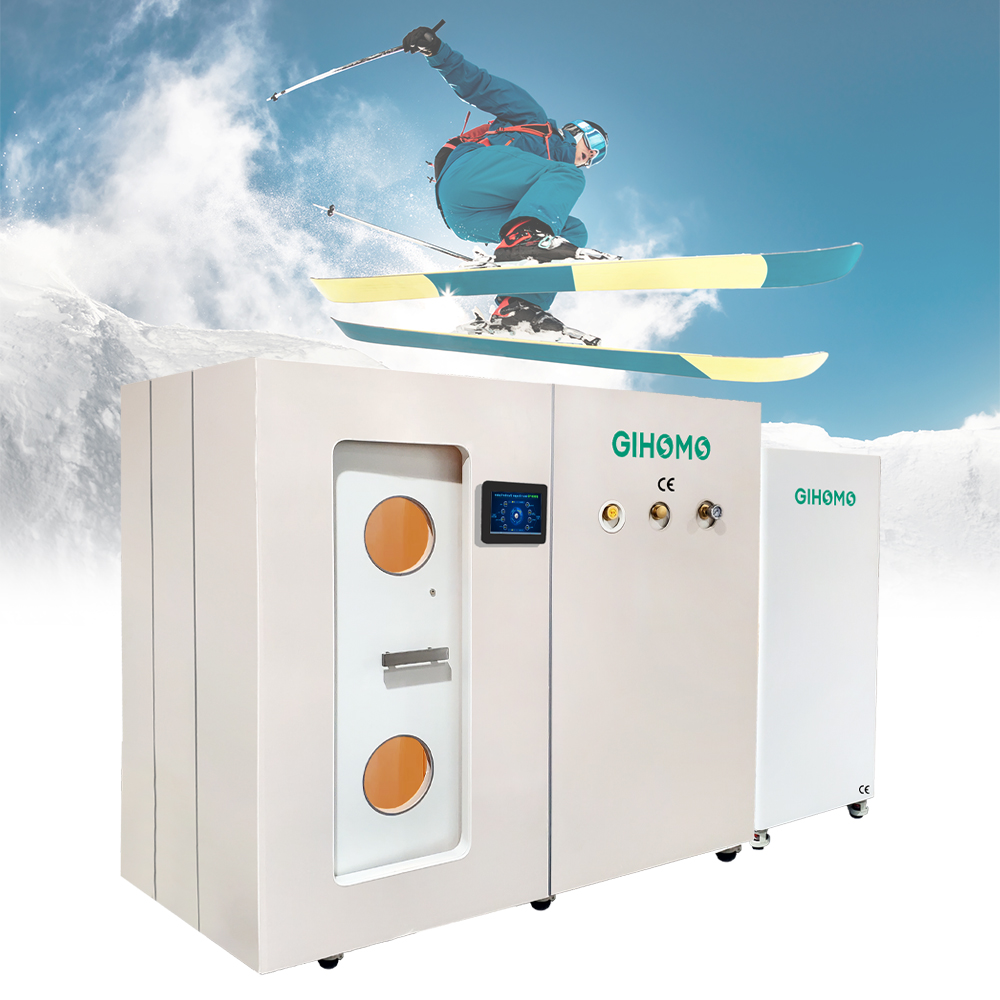
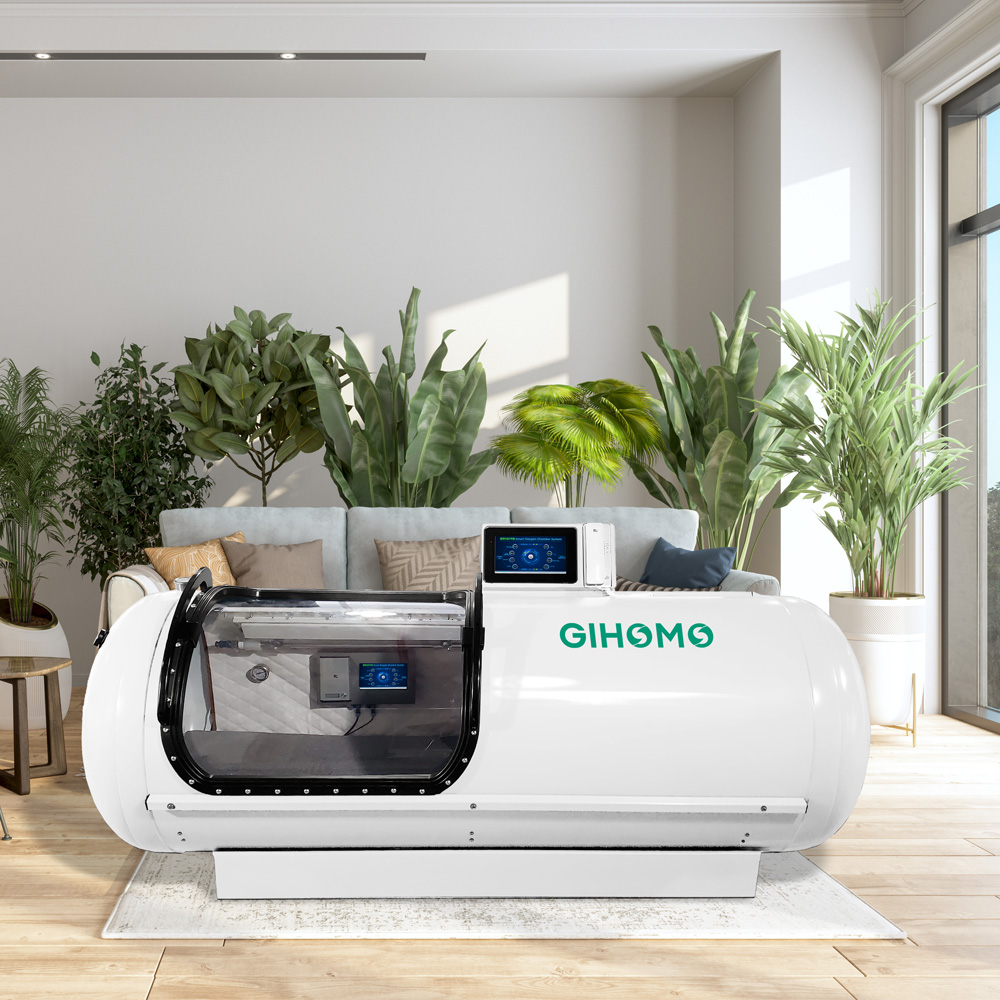
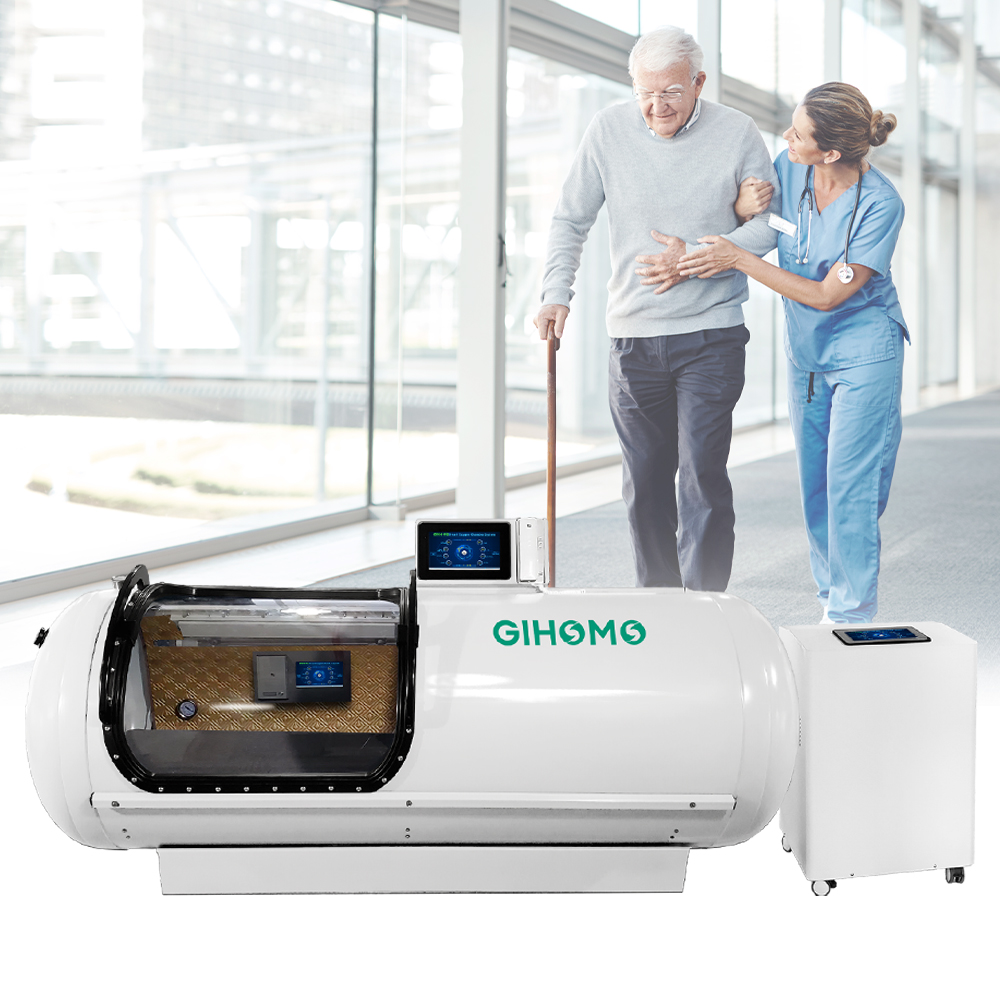
Hard shell chambers are steel-bodied units with fixed seating and built-in comfort systems, which makes them the standard choice for a dedicated recovery room where the chamber will not move. GIHOMO's two-person hard shell range covers several configurations that differ mainly in pressure, oxygen supply and control system:
- Y1800 — two-person hard shell chamber at 1.3–1.5ATA, with a GH15S-12A oxygen concentrator at 15L/min flow, 120KPa oxygen concentration pressure, oxygen purity above 90% and rated power of approximately 1100W. Chamber size is 2200mm x 1800mm x 1900mm. Options include a 27 inch TV set, power reclining sofa and space massage chair; the control system is a touch screen smart system with six language options.
- Y1800M — the BIBS variant, using a smart oxygen detection supply system and a double touch screen, at 1.3–1.5ATA with 15L/min flow. A 1.5ATA configuration of this model is documented with a GY30SR concentrator at 30L/min, 120KPa, 90–95% purity and approximately 2500W, with two adjustable sofas and two oxygen outlets.
- P1800 — two-person hard shell chamber at 1.3–1.5ATA, GH15S-12A concentrator, 15L/min, 120KPa, approximately 1100W, chamber size 2200mm x 1800mm x 1900mm, with two adjustable sofas and two oxygen outlets.
- P1800M — BIBS configuration at 1.3–1.5ATA with a GY30SR concentrator at 30L/min, 120KPa and approximately 2500W; chamber size 2260mm x 1800mm x 1900mm.
- R1800 and R1800M — two-sitter hard shell chambers at 1.3–1.5ATA in a 2200mm x 1800mm x 1900mm envelope, using a smart oxygen detection supply system and double touch screen; the R1800 uses a GH15S-12A 15L/min supply and the R1800M a GY30SR 30L/min supply.
- W1800 — the 2.0ATA option for buyers who need the higher pressure setpoint. It uses a GH60S concentrator at 60L/min and 120KPa with purity above 90%, rated power of approximately 5000W, chamber size 1800mm x 2000mm x 1900mm, two adjustable sofas, two oxygen outlets and a water-cooled air conditioner.
The documented working condition for these hyperbaric oxygen therapy applications is an indoor, cool and ventilated environment, with a 24/7 operation mode. The matched equipment list includes a water-cooled air conditioner, a 24V power supply, the oxygen concentrator, two manual pressure relief valves and automatic pressure relief valves — a combination worth replicating on the site plan before installation day.
Two-person portable soft shell: the flexible option
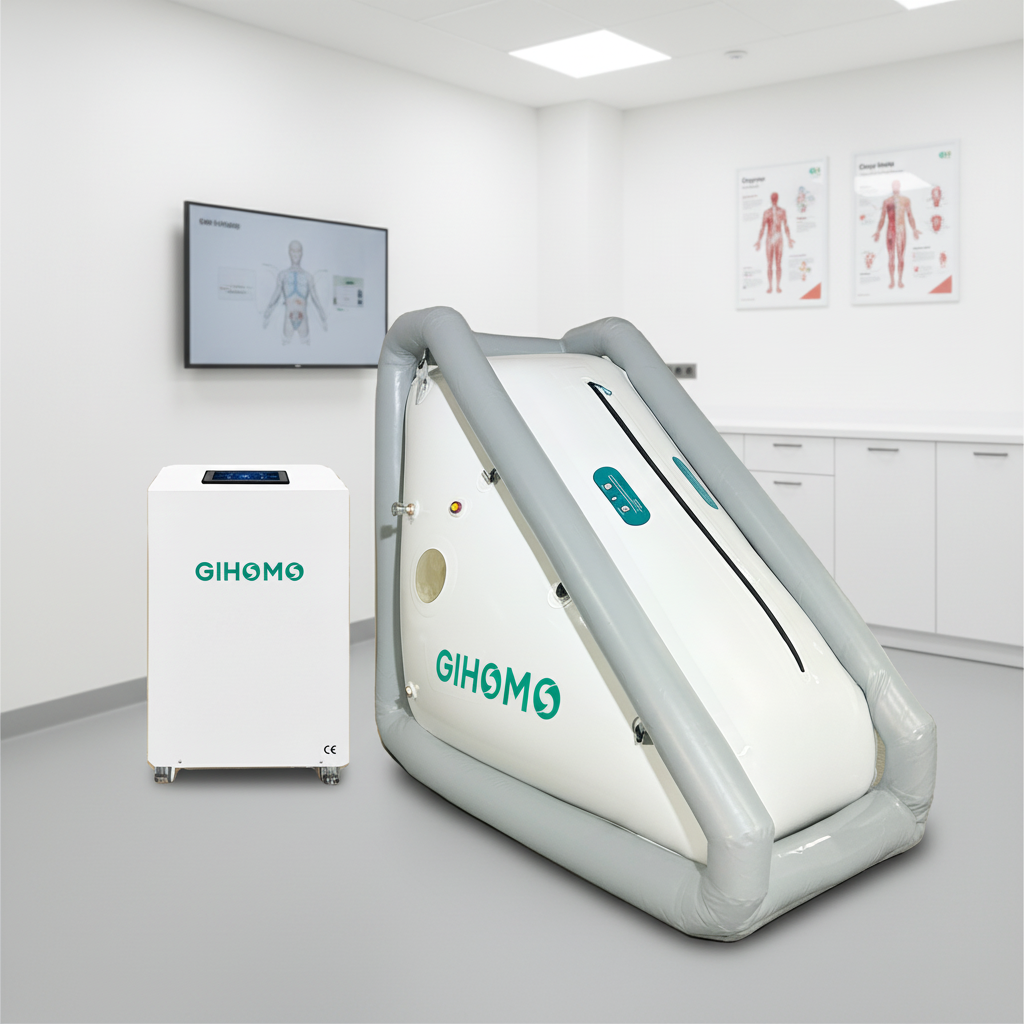
Not every project can dedicate a structural room. The SS002 is a two-person portable hyperbaric chamber built from TPU, operating at 1.3ATA with a GH15S-10A concentrator producing 15L/min at 120KPa and purity above 90%, rated power of approximately 1100W and a chamber size of 1600mm x 1200mm x 1300mm. For sports clubs that travel, or wellness operators testing demand before committing to a fixed installation, a portable dual-occupancy unit lets two people be treated in the same footprint as a single hard shell unit, with far lower installation work.
Sitting type, lying type and single-occupant soft shell additions
Most two-person rooms also need one single-occupant unit for solo bookings, overflow and staff-led demonstrations. GIHOMO's soft shell and lying type models cover this range:
- STW01 — sitting type soft shell chamber at 1.5ATA with a GH15A concentrator at 15L/min, 100KPa and purity above 90%; chamber size 1820mm x 820mm x 1500mm, rated power approximately 850W.
- ST001 — sitting type soft shell chamber at 1.3ATA with a GH05A concentrator at 5L/min, 100KPa, purity above 90% and approximately 750W; chamber size 1700mm x 1500mm x 1000mm.
- SSL001 — 1.5ATA soft shell chamber with a GH05A concentrator at 5L/min, 100KPa, purity above 90%, approximately 750W, chamber size 1700mm x 1100mm x 1200mm and a chamber net weight of 24.5kg.
- SL001 — lying type TPU chamber at 1.3ATA with a GH05A concentrator at 5L/min and 100KPa, dimensions D2200mm x 800mm, net weight 20.5kg and interior and exterior display panels for control.
- STW03 — lying type soft shell chamber at 1.5ATA with a GH15A concentrator at 15L/min and 100KPa, chamber size D1000mm x 2350mm.
- STW02 — portable chamber with a built-in breathing system at 1.5ATA, using a GY20SR concentrator at 20L/min and 120KPa; chamber size 1900mm x 920mm x 1500mm.
- C750 and C900 — lying type hard shell chambers at 2.0ATA with an aluminium body: the C750 uses a 15L/min, 120KPa supply with mask-based oxygen inhalation and measures Φ750mm x 2100mm, while the C900 uses a GH15S-12A concentrator at 15L/min, 120KPa, approximately 1100W and measures Φ900mm x 2100mm.
When two seats are not enough
Once the two-person room is running at capacity, the natural next step is a multi-seat unit rather than a second pair of chambers. GIHOMO's wider range includes the Y2400 (three persons, 1.5ATA), Y3000 and P3000 (four persons, with P3000 documented as a sports-oriented four-seat chamber at 1.3ATA), R3000M (four persons, 1.3ATA), P3600 (six persons, 1.3ATA), P4200 (eight persons, 1.3ATA) and the P5480 / P5480M eight-seat configurations. The P3300M is a wheelchair-accessible chamber measuring 3300mm x 1000mm x 1800mm at 1.3–1.5ATA, which matters for rehabilitation-oriented facilities.
Specification Checkpoints Before You Order
Pressure and oxygen supply are the two numbers that decide whether a two-person room can deliver the session programme you intend to sell. GIHOMO's documented operating pressures for chambers discussed here are 1.3ATA, 1.5ATA and 2.0ATA; the common oxygen flow checkpoints are 15L/min for standard two-person configurations, 20L/min and 30L/min for BIBS-equipped configurations, and 60L/min for 2.0ATA dual-occupancy hard shell units. The GH05A concentrator is the 5L/min, 100KPa checkpoint used across several single-occupant soft shell models.
| Oxygen concentrator model | Flow rate | Oxygen concentration pressure | Oxygen purity | Rated power | Typical fit in the GIHOMO range |
|---|---|---|---|---|---|
| GH05A | 5L/min | 100KPa | greater than 90% | approximately 750W | Single-occupant soft shell: ST001, SSL001, SL001 |
| GH10S-10A | 10L/min | 100KPa | greater than 90% | approximately 850W | SC001 sitting type soft shell |
| GH15A | 15L/min | 100KPa | greater than 90% | approximately 850W | STW01, STW03 soft shell chambers |
| GH15S-10A | 15L/min | 120KPa | greater than 90% | approximately 1100W | SS002 two-person portable |
| GH15S-12A | 15L/min | 120KPa | greater than 90% | approximately 1100W | Y1800, P1800, R1800 two-person hard shell; C900 |
| GY20SR | 20L/min | 120KPa | greater than 90% | approximately 1500W | STW02, Z0780M, R1200M, P3300M |
| GY30SR | 30L/min | 120KPa | greater than 90% (90–95% on one documented Y1800M configuration) | approximately 2500W | P1800M, R1800M BIBS configurations |
| GH60S | 60L/min | 120KPa | greater than 90% | approximately 5000W | W1800 2.0ATA two-person hard shell |
Three checks are worth running before signing: (1) does the concentrator flow rate match the number of breathing points in the chamber; (2) does the electrical supply support the rated power, particularly the step from roughly 1100W for a 1.5ATA two-person unit to roughly 5000W for a 2.0ATA unit; and (3) does the chamber's largest dimension fit the access route, not just the room.
Room Layout Planning
Layout planning for a two-person chamber starts from the equipment envelope and then works outward. The published chamber sizes below are the footprint figures to plan against.
| Model | Configuration | Pressure | Chamber size | Oxygen supply |
|---|---|---|---|---|
| Y1800 | Two-person hard shell | 1.3–1.5ATA | 2200mm x 1800mm x 1900mm | GH15S-12A, 15L/min, 120KPa |
| Y1800M | Two-person hard shell with BIBS | 1.3–1.5ATA | 2200mm x 1800mm x 1900mm | GZ15S-12A, 15L/min, 120KPa |
| P1800 | Two-person hard shell | 1.3–1.5ATA | 2200mm x 1800mm x 1900mm | GH15S-12A, 15L/min, 120KPa |
| P1800M | Two-person hard shell with BIBS | 1.3–1.5ATA | 2260mm x 1800mm x 1900mm | GY30SR, 30L/min, 120KPa |
| R1800 / R1800M | Two-sitter hard shell | 1.3–1.5ATA | 2200mm x 1800mm x 1900mm | GH15S-12A 15L/min or GY30SR 30L/min |
| W1800 | Two-person hard shell | 2.0ATA | 1800mm x 2000mm x 1900mm | GH60S, 60L/min, 120KPa |
| SS002 | Two-person portable soft shell | 1.3ATA | 1600mm x 1200mm x 1300mm | GH15S-10A, 15L/min, 120KPa |
From those figures, five layout decisions follow:
- Access route. Check the largest chamber dimension against door frames, corridor turns and lift dimensions before the unit is crated, not after it arrives.
- Service zone. The concentrator, water-cooled air conditioner and 24V power supply need a service position that can be reached without disturbing the occupant inside the chamber.
- Pressure relief and monitoring. Two manual pressure relief valves plus automatic pressure relief valves are part of the documented equipment set; place them where staff can reach them immediately.
- Environment. The documented working condition is an indoor, cool and ventilated space. Cooling is not an optional comfort item — a water-cooled air conditioner is listed on the matched-equipment schedule for these applications.
- Guest experience. Chamber interiors are typically specified with soft decoration, carpet and lighting; the Y1800 family and W1800 also support a 27 inch TV set, power reclining sofa and space massage chair, and portable or Z-series models offer a 24 inch TV set.
Session Planning
Session design sits between the equipment and the operator's protocol. The equipment determines the available pressure range, the oxygen delivery method and the in-chamber monitoring points; the facility determines session length, the number of cycles per day and the booking interval. Keeping those two responsibilities separate prevents unverifiable claims from ending up in marketing material.
- Pressure setpoint. Two-person hard shell chambers in the GIHOMO range are documented at 1.3–1.5ATA, with the W1800 and the lying type C750 and C900 at 2.0ATA. A facility that markets a 2.0ATA programme needs a 2.0ATA chamber, not a 1.5ATA unit run at its limit.
- Oxygen delivery method. Standard configurations use individual oxygen outlets — two outlets on the Y1800, P1800 and W1800 — while BIBS-equipped models such as the Y1800M, P1800M, R1800M and STW02 provide a built-in breathing system. The C750 instead specifies oxygen mask inhalation.
- In-chamber monitoring. Hard shell units are commonly configured with wireless intercom, call bell and lighting, and the M-series adds a smart oxygen detection supply system with a double touch screen, so staff can read supply status without opening the chamber.
- Sequencing. Plan the dual-occupancy session as one operation with a single pressurisation and decompression cycle, and schedule the next booking against the pressure relief steps rather than against a target number of guests per hour.
Documented application functions for these scenarios are stated in the product data as follows: in sport recovery, supporting rapid recovery after exercise, improved training efficiency and enhanced athletic performance; in health care, supporting sleep, immunity and daily health management; in beauty and anti-aging, supporting collagen regeneration, brighter skin tone and skin repair; and in rehabilitation, use as adjuvant therapy for postoperative wound healing, diabetes, brain injury and similar conditions. Facilities should present these in line with local regulation and their own clinical governance, and keep clinical positioning with qualified practitioners.
Staffing Considerations
Two occupants do not mean half the attention. A two-person chamber compresses two people's session into one pressurisation window, which concentrates the operator's workload at the start and end of each cycle. Practical staffing points from the equipment configuration:
- Attendant presence during pressure change. Manual pressure relief valves are provided alongside automatic relief valves, which assumes trained staff are present and can act.
- Two-point monitoring. With two occupants, checking oxygen outlet positioning and occupant comfort for each person is part of the cycle, and the dual touch screen on M-series chambers is designed to be read at a glance.
- Communication. Wireless intercom and call bell functions inside hard shell chambers allow occupants to signal without staff entering the chamber.
- Service planning. The documented operation mode for these applications is 24/7, which shifts the emphasis to scheduled service intervals, spare parts and consumables rather than to occasional checks.
- Supplier-side support. GIHOMO's R&D team of six engineers and the ODM/OEM service listed in its application requirements mean layout, seating and control-language changes can be discussed with the factory rather than resolved on site.
Step-by-Step Deployment Breakdown
- Define the service model. Decide whether the room is a wellness recovery suite, a sports recovery room, a beauty and anti-aging add-on, or a rehabilitation-adjacent service. Each has a different documented application scenario and a different equipment emphasis.
- Set the occupancy and pressure target. Two-person at 1.3–1.5ATA for general wellness and sports recovery; two-person at 2.0ATA if the programme requires the higher setpoint.
- Match the oxygen supply. Confirm the concentrator model against the number of breathing points — 15L/min for standard two-person units, 30L/min for BIBS units, 60L/min for the 2.0ATA W1800.
- Choose the enclosure. Hard shell (Y1800, Y1800M, P1800, P1800M, R1800, R1800M, W1800) for a fixed room; portable soft shell (SS002) for flexibility or piloting.
- Plan the room against the chamber envelope. Use the published chamber sizes, verify the access route, and reserve a reachable service zone for the concentrator, air conditioner and power supply.
- Add single-occupant capacity. One soft shell or lying type unit (STW01, ST001, SSL001, SL001, STW03, STW02) covers solo bookings and keeps the room productive outside paired sessions.
- Write the session and staffing protocol. One pressurisation cycle per booking, defined roles for pressure changes, and a training record for every operator.
- Confirm compliance and documentation. Check the certification set required for your market and how a two-occupant unit is classified locally before publishing service claims.
Use Cases
Sports recovery studio
A 1.3–1.5ATA two-person hard shell chamber with a 15L/min supply, such as the Y1800M with BIBS and dual touch screen, fits a recovery room serving paired athletes. Facilities with four-athlete demand can move to the P3000 four-seat sports configuration, while travelling teams may prefer the ICC-certified-free simplicity of the SS002 two-person portable unit.
Wellness lounge or spa
A 2.0ATA W1800 with two adjustable sofas, two oxygen outlets and a water-cooled air conditioner supports a premium paired-session format, with the 27 inch TV and massage chair options used to structure the guest experience. A single-occupant soft shell unit such as the STW01 or SSL001 fills the solo-booking slots.
Beauty and anti-aging clinic
Beauty and anti-aging is one of the documented application scenarios for these chambers. A compact soft shell unit at 1.3–1.5ATA with a GH05A concentrator, such as the ST001 or SSL001, gives a treatment-room footprint with approximately 750W rated power, while a two-person hard shell chamber supports couple bookings.
Health care and home use
For lower-intensity daily use, the lying type SL001 at 1.3ATA with a 20.5kg net weight and the STW02 with a built-in breathing system at 1.5ATA offer a softer installation profile than full hard shell rooms. The documented health care application function covers sleep, immunity and daily health management support.
Rehabilitation-adjacent facilities
Sites working alongside clinical teams should look at the wheelchair-accessible P3300M (3300mm x 1000mm x 1800mm, 1.3–1.5ATA) and the lying type C900 at 2.0ATA. In these settings, the equipment supports the clinically supervised programme; the therapy decisions remain with qualified practitioners and the applicable local rules.
Two-Person Chamber Comparison
| Model | Chamber type | Pressure | Oxygen concentrator / flow | Concentration pressure | Rated power | Chamber size | Best fit |
|---|---|---|---|---|---|---|---|
| Y1800 | Two-person hard shell | 1.3–1.5ATA | GH15S-12A / 15L/min | 120KPa | approximately 1100W | 2200 x 1800 x 1900mm | General wellness and sports recovery room |
| Y1800M | Two-person hard shell with BIBS | 1.3–1.5ATA (1.5ATA documented for BIBS configuration) | GZ15S-12A / 15L/min; GY30SR / 30L/min on the 1.5ATA BIBS version | 120KPa | approximately 1100W; approximately 2500W for the 30L/min version | 2200 x 1800 x 1900mm | Facilities wanting individual breathing systems and dual touch screen control |
| P1800 / P1800M | Two-person hard shell; BIBS variant | 1.3–1.5ATA | GH15S-12A / 15L/min; GY30SR / 30L/min (M) | 120KPa | approximately 1100W; approximately 2500W (M) | 2200 x 1800 x 1900mm; 2260 x 1800 x 1900mm (M) | Two adjustable sofas with two oxygen outlets |
| R1800 / R1800M | Two-sitter hard shell; BIBS variant | 1.3–1.5ATA | GH15S-12A / 15L/min; GY30SR / 30L/min (M) | 120KPa | approximately 1100W; approximately 2500W (M) | 2200 x 1800 x 1900mm | Smart oxygen detection supply system with double touch screen |
| W1800 | Two-person hard shell | 2.0ATA | GH60S / 60L/min | 120KPa | approximately 5000W | 1800 x 2000 x 1900mm | Higher-pressure paired sessions with two adjustable sofas |
| SS002 | Two-person portable soft shell (TPU) | 1.3ATA | GH15S-10A / 15L/min | 120KPa | approximately 1100W | 1600 x 1200 x 1300mm | Mobile or pilot installations |
For context on the wider supplier landscape, Mordor Intelligence lists Sechrist Industries, Perry Baromedical, Environmental Tectonics Corporation (ETC) and OxyHealth LLC among key global manufacturers, with one industry report citing OxyHealth as having more than 15,000 units in use globally. Those figures describe established clinical device suppliers; GIHOMO's positioning is different and narrower — a 2021-established manufacturer with a 1000-unit annual capacity, ISO9001 operations and CE, FCC and EMC requirements documented for its hyperbaric oxygen therapy applications.
Frequently Asked Questions
1. Do two-person hyperbaric oxygen chambers need regulatory certification?
It depends on the market. The U.S. FDA classifies hyperbaric chambers as Class II medical devices requiring 510(k) clearance, and notes that soft-shell chambers have primarily been cleared for altitude sickness. In the EU, hyperbaric chambers must comply with Medical Device Regulation (MDR) 2017/745 as Class IIb devices, and multiplace chambers must also adhere to EN 14931 and the fire-safety requirements of EN 16081. Buyers should confirm how a specific two-occupant unit is classified in their own market. GIHOMO operates under the ISO9001 quality management system, and the certification requirements documented for its hyperbaric oxygen therapy application scenarios include CE, FCC and EMC.
2. How much oxygen flow does a two-person chamber need?
In GIHOMO's product data, standard two-person configurations use a 15L/min oxygen supply: the Y1800, Y1800M, P1800 and R1800 pair with the GH15S-12A concentrator at 15L/min and 120KPa, and the two-person portable SS002 uses a GH15S-10A concentrator at 15L/min and 120KPa. BIBS-equipped configurations such as the P1800M and R1800M step up to a GY30SR concentrator at 30L/min, and the 2.0ATA W1800 uses a GH60S concentrator at 60L/min. Oxygen purity is above 90% across the range, with one documented Y1800M configuration at 90–95%. Single-occupant soft shell models such as the ST001, SSL001 and SL001 are built around the GH05A concentrator at 5L/min and 100KPa.
3. What drives the installation cost of a two-person chamber?
Three equipment-level drivers stand out. First, pressure: a 1.5ATA two-person hard shell chamber such as the Y1800 is rated at approximately 1100W, while the 2.0ATA W1800 is rated at approximately 5000W. Second, oxygen supply: a 15L/min concentrator, a 30L/min BIBS supply and a 60L/min supply carry different equipment footprints. Third, comfort and control systems: water-cooled air conditioning, 24V power supply, interior decoration, lighting, call bell, wireless intercom, and options such as a 27 inch TV set, power reclining sofa or space massage chair all form part of the configured unit. Trade-offs are real: high pressure and high flow raise the electrical and equipment budget, while soft shell models such as the SSL001 at approximately 750W keep the installation lighter at 100KPa concentration pressure.
4. Can a facility validate a two-person chamber before ordering a full installation?
A staged approach works best. GIHOMO lists ODM/OEM service among the requirements documented for its hyperbaric oxygen therapy applications, so layout, seating and control-language details can be discussed with the factory before a production run, and its touch screen smart control system supports six language options on models such as the Y1800. For sites that want to test demand first, the two-person portable SS002 at 1.3ATA with a 15L/min supply and a 1600mm x 1200mm x 1300mm footprint can be deployed with far less site work than a hard shell room. Sample, specification and layout questions can be sent to gihomo@hotmail.com or +86 13118899348.
5. How should delivery and long-term supply be planned?
Capacity and continuity are the two reference points. GIHOMO operates a 2000 square metre facility with an annual production capacity of approximately 1000 units, a workforce of 50–100 staff and a six-engineer R&D team, with export business accounting for about 60% of sales and the EU and the USA as main markets. Because the documented operation mode for these hyperbaric oxygen therapy applications is 24/7, service intervals and spare-part availability should be agreed at the same time as the purchase order rather than after commissioning. Delivery scheduling and configuration confirmations are handled through GIHOMO's contact channels.
Conclusion: Match the Chamber to the Room, the Session and the Team
Two-person hyperbaric oxygen chambers work commercially when three layers agree. The chamber layer is a pressure and oxygen-supply decision: 1.3–1.5ATA with 15L/min for most wellness and sports recovery rooms, 2.0ATA with 60L/min where the programme requires the higher setpoint, and a 5L/min GH05A-based unit at 100KPa when the room only needs single-occupant capacity. The room layer is an envelope decision: published chamber sizes run from 1600mm x 1200mm x 1300mm for the two-person portable SS002 to 2200mm x 1800mm x 1900mm for the Y1800 family, and access, service zones, cooling and power have to be planned against those numbers. The staffing layer is a protocol decision: one pressurisation cycle, two monitored breathing points, documented training and a service schedule suited to 24/7 use.
Get those three layers aligned before ordering, and the two-person configuration remains what it should be — a straightforward way to double room throughput without doubling the room.
Next Step: Plan Your Two-Person Room With GIHOMO
Send your room drawing, target pressure and expected daily occupancy, and GIHOMO can match a chamber configuration to the project — from the 1.5ATA two-person Y1800 and Y1800M with BIBS to the 2.0ATA W1800 and the portable two-person SS002. Sample and quotation requests are handled through the contact channels below.
Email: gihomo@hotmail.com
Tel: +86 13118899348
WhatsApp: +852 68176191
Website: www.gihomo.com
GUANGDONG GIHOMO MEDICAL TECHNOLOGY CO., LTD.
8th floor, Building 5, CIMC industrial park, Daliang, Shunde district, Foshan city, Guangdong province, PRC
Have Questions or Need More Details?
Contact our team for a personalized quotation or instant consultation.
Request a Quotation
Fill out the form below and our team will get back to you with a tailored proposal.
WhatsApp Direct Chat
Prefer to chat in real-time? Message us on WhatsApp for instant assistance & quick answers.
- Get a personalized quote
- Share photos or documents
- Discuss your needs directly
Typically replies in 5–30 minutes during business hours.