
Hard vs. Soft Shell Chamber Specs: Pressure, Flow, and Oxygen Purity Explained
A hyperbaric oxygen chamber is bought on three numbers: working pressure, oxygen flow, and oxygen purity. Hard shell chambers hold those numbers inside a rigid pressure vessel. Soft shell chambers reach them through a flexible fabric enclosure and a narrower regulatory pathway — in the United States, soft-shell chambers are primarily cleared by the FDA for altitude sickness. GIHOMO hard shell configurations are cited at 1.3–1.5 ATA working pressure, 15 L/min oxygen concentration flow, more than 90% oxygen purity, and a 100 kPa oxygen concentration pressure. Those figures are not independent variables: change one and the others move.
This guide is written for technically oriented buyers who have already shortlisted chamber formats and now need to read specification sheets critically. It separates what each parameter actually controls, shows where hard shell and soft shell designs diverge at the engineering level, and explains how an integrated oxygen concentrator — the GH05A model inside GIHOMO's configuration — sits within the pressure loop rather than beside it.
Guangdong GIHOMO Medical Technology Co., Ltd. (GIHOMO) is a Foshan, China–based manufacturer of hard shell and portable hyperbaric oxygen chambers, founded in 2021, operating a 2,000 m² facility with an annual output of 1,000 units, an R&D team of six engineers, and an export share of approximately 60% across the EU and USA. Its core products hold CE and FCC certification, and its operations follow the ISO9001 quality management system.
The Real Problem: Pressure, Flow, and Purity Are Not Independent
Most specification errors do not come from choosing the wrong shell type. They come from reading three separate datasheets and assuming the numbers can be combined freely.
A chamber rated at 1.3–1.5 ATA describes the pressure envelope of the vessel. It says nothing about whether the oxygen source on the other side of the inlet can keep delivering at that pressure for the length of a session. Oxygen concentration flow, expressed in litres per minute, describes the sustained delivery rate. Oxygen purity, expressed as a percentage, describes the concentration of the gas that actually arrives at the user. A fourth figure — the oxygen concentration pressure at the concentrator outlet, stated in kPa — determines whether that gas can be pushed into a vessel that is already pressurised.
In practice, mis-specified systems show up in four recognisable patterns:
- Pressure without support. The vessel reaches 1.5 ATA, but the oxygen source loses flow as chamber pressure rises, so sessions are run below the intended protocol.
- Flow without purity. A high flow rate is quoted at ambient concentration rather than at therapeutic purity, so the delivered dose is lower than the buyer expects.
- Purity without pressure. A concentrator delivers excellent purity into open air but cannot overcome chamber back-pressure, so the gas never enters the loop reliably.
- Compliance mismatch. A configuration acceptable for wellness use in one market may require a different clearance pathway in another.
The working rule for buyers is straightforward: pressure, flow, purity, and concentration pressure should be specified as one set, sourced from one supplier, with the safety controls that protect each parameter named explicitly in the quotation.
Industry Background: Why Specification Literacy Is Now a Purchasing Skill
The global hyperbaric oxygen therapy market was estimated at USD 3.71 billion in 2024 and is projected to reach USD 5.19 billion by 2030, according to Grand View Research. A separate estimate from Strategic Market Research / SkyQuest places 2024 market size at USD 4.44 billion with a projected CAGR of 9.4% through 2032. These figures are not contradictory so much as differently scoped: published estimates vary significantly depending on whether clinical and wellness segments are counted together, which is one reason specification-level comparison now serves buyers better than headline market numbers.
Within that market, monoplace hyperbaric chambers accounted for approximately 57% of global revenue share in 2024, driven largely by ease of operation, according to Mordor Intelligence. North America held a 54.77% revenue share in 2024, generating approximately USD 700 million. Asia Pacific is identified as the fastest-growing region, with China projected to reach USD 379.7 million by 2030. Soft-shell portable chambers accounted for over 18% of total sales in the Asia-Pacific region in 2023, driven by wellness and athletic recovery trends.
Regulation runs alongside demand. In the United States, the FDA classifies hyperbaric chambers as Class II medical devices requiring 510(k) clearance, and soft-shell chambers are primarily cleared for altitude sickness. In the European Union, all hyperbaric chambers — mild or clinical — must comply with Medical Device Regulation (MDR) 2017/745 as Class IIb devices, and multiplace chambers must additionally adhere to EN 14931 and the fire safety requirements specified in EN 16081.
Hard Shell vs Soft Shell: What Changes at the Specification Level
The two formats differ less in purpose than in how much pressure they can hold and how that pressure is governed. The table below lists the parameters a technical buyer should verify before choosing between them.
| Specification parameter | Hard shell chamber | Soft shell chamber |
|---|---|---|
| Enclosure construction | Rigid structural shell holding a fixed pressurised volume | Flexible fabric enclosure that expands under internal pressure |
| Referenced working pressure (GIHOMO configuration) | 1.3–1.5 ATA | Lower-pressure operating range; confirm the exact rating with the supplier |
| Oxygen source architecture | Integrated oxygen concentrator within the chamber system (GH05A configuration) | Typically an external concentrator or cylinder supply |
| Delivered oxygen purity | >90% in GIHOMO configurations; 90–96% cited for high-purity concentrator supply | Supplier-dependent; verify against a written specification |
| Pressure safety controls | Automatic pressure sensors plus dual emergency pressure release valves (GIHOMO configuration) | Relief-valve arrangement varies by design; verify valve count and access |
| US regulatory pathway | FDA Class II, 510(k) | FDA Class II, 510(k); primarily cleared for altitude sickness |
| EU regulatory pathway | MDR 2017/745 Class IIb | MDR 2017/745 Class IIb |
| Typical deployment | Clinics, wellness centers, sports recovery facilities, hotels and spas | Home use, travel recovery, mobile wellness and athletic recovery programmes |
Two rows deserve emphasis. First, the US regulatory pathway for soft-shell chambers is narrower than their marketing presence suggests: primarily cleared for altitude sickness. Second, pressure safety controls are a specification item, not an accessory — the number of release valves and the presence of automatic pressure monitoring should be confirmed in writing before an order is placed.
How GIHOMO Configures Pressure, Flow, and Purity
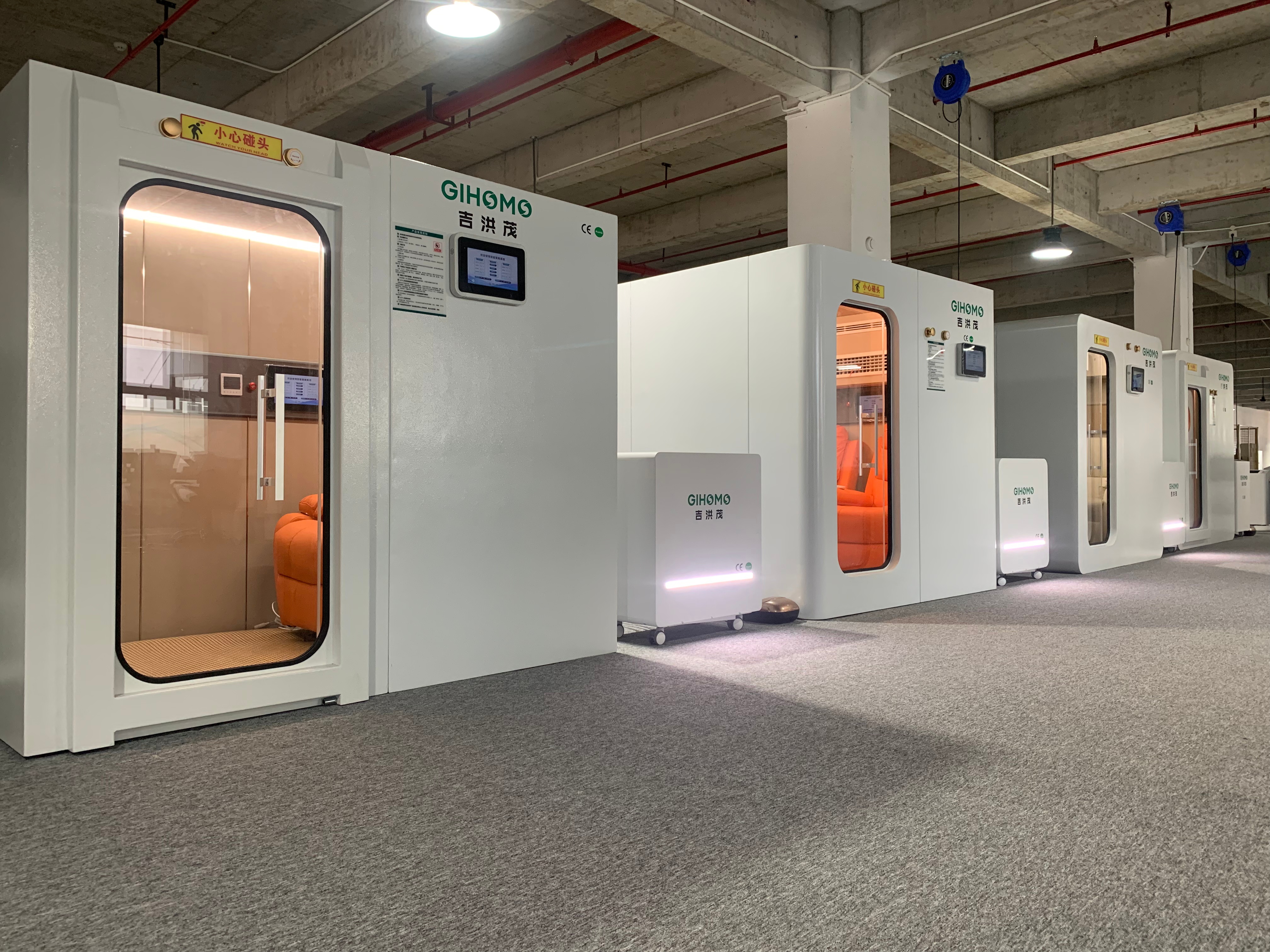
GIHOMO's approach is to treat the chamber and its oxygen source as one pressure system. That distinction shapes every configuration decision below.
Pressure: The 1.3–1.5 ATA Working Envelope
ATA, or atmospheres absolute, measures total pressure inside the chamber relative to a vacuum. A chamber operating at 1.5 ATA holds roughly half again the pressure of the surrounding atmosphere. GIHOMO hard shell configurations are cited at a 1.3–1.5 ATA operating range.
The commercial value of that range lies in stability rather than peak value. A rigid shell holds the envelope; the control system holds it steady. GIHOMO's configuration uses automatic pressure sensors that continuously monitor internal pressure and adjust it automatically to maintain the setting, instead of relying on manual valve regulation during a session. For a wellness centre running multiple sessions a day, that stability is what makes a protocol reproducible from one client to the next.
Flow: Why a 15 L/min Rating Must Be Read Together With Pressure
Oxygen concentration flow describes how much concentrated oxygen the system can deliver per minute. GIHOMO configurations are cited at 15 L/min. That figure only carries meaning when paired with the pressure at which it is delivered: a flow rating taken at ambient pressure falls once the chamber is pressurised, unless the oxygen source is designed to compensate.
GIHOMO's oxygen delivery logic is rhythm-responsive — the system adapts to the user's natural breathing tempo and delivers oxygen precisely when the user inhales. This matters for flow sizing because it reduces waste between breaths. It is also one of the differentiating points recorded in GIHOMO's published comparison data against the Olive alternative.
Purity: What ">90%" Actually Represents
Purity is the concentration of oxygen within the delivered gas stream. GIHOMO configurations are cited at more than 90% oxygen purity, and comparison data for high-purity concentrator supply cites a 90–96% range. Ambient air is roughly 21% oxygen, so a concentrator operating in this band delivers several times the oxygen concentration of room air.
Purity and safety are linked rather than opposed. GIHOMO's design evacuates exhaled gas externally so that diffuse oxygen concentration inside the chamber is kept below 25%, which reduces fire hazards dramatically while the user still receives high-purity gas through the delivery interface. Buyers who see a high purity figure should ask the companion question: what keeps the chamber atmosphere itself below the flammable-enrichment threshold?
Why a 100 kPa Oxygen Concentration Pressure Matters
The oxygen concentration pressure is the pressure at which the concentrator pushes gas out of its outlet. GIHOMO's configuration is cited at 100 kPa. This number is easy to overlook and expensive to get wrong.
A chamber operating at 1.3–1.5 ATA is, by definition, an environment under positive pressure. Oxygen must be injected into that environment against the chamber's internal pressure. If the concentrator's outlet pressure is too low relative to the chamber pressure, delivery becomes inconsistent: flow drops, sessions run short of the intended concentration, and operators compensate by extending session time rather than correcting the system. Sizing concentrator outlet pressure against the working envelope is therefore a core configuration decision, not a peripheral one.
The GH05A Integrated Oxygen Concentrator Inside the System
The GH05A is the integrated oxygen concentrator model used within GIHOMO's chamber configurations. Its role is to take ambient air and deliver a concentrated oxygen stream at the flow, purity, and outlet pressure the chamber requires — 15 L/min, more than 90% purity, and 100 kPa respectively — rather than functioning as a separately rated appliance.
Integration changes the buyer's verification job. Instead of matching a chamber datasheet to a concentrator datasheet and hoping the two align, pressure, flow, purity, and concentration pressure are specified as one system. GIHOMO's product portfolio also includes a BIBS system for controlled oxygen delivery, alongside its hard shell and portable hyperbaric oxygen chamber lines.
Safety Architecture That Protects the Specification
Two risk categories dominate hyperbaric operation: over-pressure and fire. GIHOMO's configuration addresses each with named hardware.
- Over-pressure. Automatic pressure sensors continuously monitor chamber pressure and adjust it to maintain the setting, while dual emergency pressure release valves allow rapid manual pressure release in an emergency.
- Fire risk. A 24V low-voltage DC power supply eliminates the risk of electrical sparks or shock hazards; a water-cooled air conditioner removes the fire risk associated with fluorine-containing air conditioning units; and a real-time oxygen monitoring system tracks oxygen concentration and adjusts it dynamically to keep the chamber atmosphere safe throughout the session.
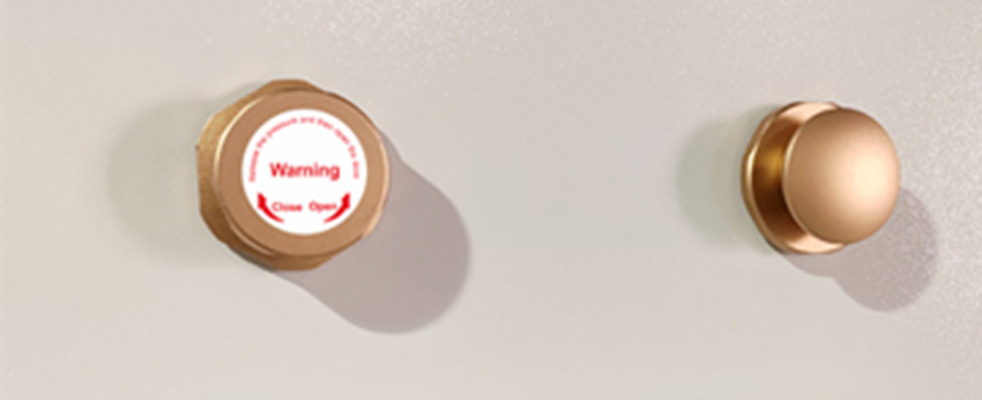
Dual emergency pressure release valves, part of GIHOMO's over-pressure control configuration.
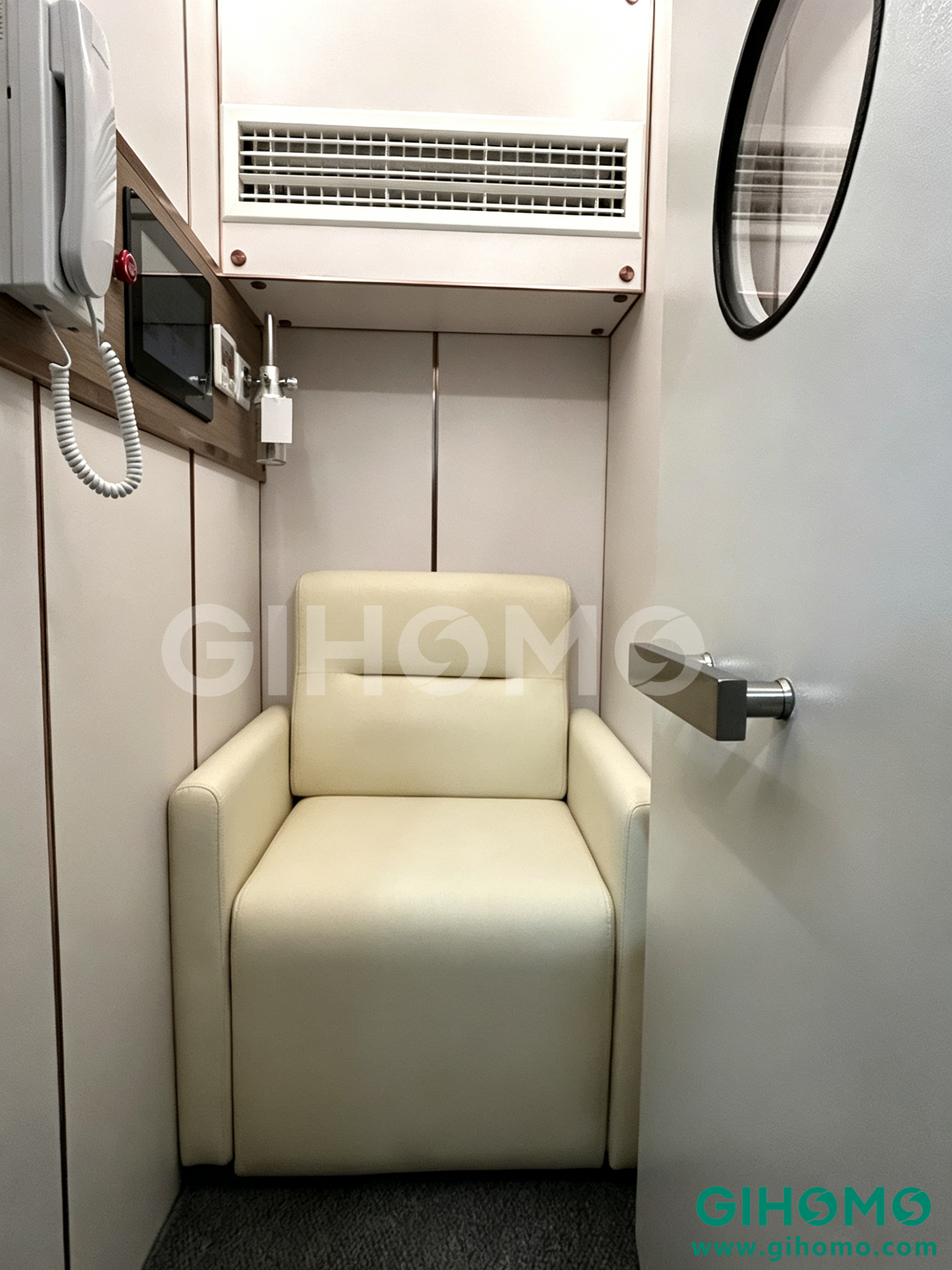
For a technical buyer, these are the specification lines that determine whether a chamber can be operated daily, by non-specialist staff, in a commercial setting.
Step-by-Step Breakdown: Specifying a Chamber in Eight Steps
- Fix the protocol pressure first. Choose the working envelope — for GIHOMO hard shell configurations, 1.3–1.5 ATA — and let it determine whether a rigid shell is required.
- Size the oxygen source against that pressure. Confirm the concentration flow rating (15 L/min in GIHOMO's configuration) is quoted at the working pressure, not at ambient pressure.
- Verify purity in writing. Ask for the delivered purity figure (>90% in GIHOMO configurations; 90–96% cited for high-purity concentrator supply) rather than a general capability statement.
- Check the oxygen concentration pressure. Confirm the concentrator outlet pressure (100 kPa in GIHOMO's configuration) can overcome chamber internal pressure across the full operating range.
- Confirm pressure safety hardware. Automatic pressure sensors plus dual emergency pressure release valves should appear as named line items in the specification.
- Confirm fire-risk controls. Look for low-voltage DC power (24V in GIHOMO's configuration), a water-cooled air conditioner, and real-time oxygen monitoring that keeps diffuse oxygen below 25%.
- Match the configuration to the venue. GIHOMO configurations are described as suitable for commercial use including hotels, spas, clinics, wellness centers, and beauty salons, as well as home use.
- Confirm the certification pathway for the destination market. CE and FCC certification for the product; MDR 2017/745 Class IIb in the EU; Class II 510(k) in the United States.
For procurement teams, these eight steps translate directly into RFQ line items. A quotation that answers all eight can be compared against another. A quotation that answers four cannot.
Use Cases: Matching Parameters to the Operating Environment
Wellness centers and spas. Throughput and uptime matter more than peak pressure. A stable 1.3–1.5 ATA envelope with automatic pressure regulation supports repeatable sessions across a working day, and a water-cooled air conditioner keeps the cabin usable during continuous operation.
Sports recovery facilities. The Asia-Pacific data point — soft-shell portable chambers above 18% of regional sales in 2023, driven by wellness and athletic recovery demand — reflects the value placed on mobility. Where a fixed installation is acceptable, a hard shell configuration holds the higher pressure envelope; where the unit must move between sites, the portable format is the practical choice.
Clinics. Documentation carries more weight in this segment. Buyers should expect written purity, flow, and concentration pressure figures, plus the fire-risk and over-pressure controls described above, before a configuration is approved.
Hotels, spas, and beauty salons. These venues typically need equipment that non-specialist staff can operate safely, which places emphasis on automatic pressure monitoring and real-time oxygen monitoring rather than manual adjustment.
Home use. Here the system must be self-contained. An integrated concentrator such as the GH05A removes the need to source, store, and connect separate oxygen supply equipment, and it keeps the flow, purity, and concentration pressure figures inside a single specification.
Comparison Table: GIHOMO Configuration vs. Named Alternatives
The comparison below reproduces GIHOMO's published comparison positioning as recorded in its comparison data. It is presented for reference; buyers should validate any commercial claim independently against their own market requirements and quotation.
| Compared against | Stated difference | Cost basis | Maintenance | Performance emphasis |
|---|---|---|---|---|
| Macy-pan | Same quality, lower price | Cheaper by at least 50% cost | Less maintenance | Higher efficiency |
| Dr. Hugo | Same price, higher quality | Same cost | Less maintenance | Higher efficiency |
| Olive | Same price, higher quality | Cheaper | Less maintenance | Higher efficiency than normal hyperbaric oxygen therapy; rhythm-responsive oxygen delivery; diffuse oxygen kept below 25%; 90–96% high-purity supply |
| OxyCheny | Same price, higher quality | Lower price | Less maintenance | More effective, more comfortable and safer; >90% oxygen purity delivered; 1.3–1.5 ATA pressure maintained |
The application profile cited across these comparisons is consistent: home use and commercial use including hotels, spas, clinics, wellness centers, and beauty salons.
Frequently Asked Questions
How are hard shell and soft shell hyperbaric chambers classified in the US and EU?
In the United States, the FDA classifies hyperbaric chambers as Class II medical devices requiring 510(k) clearance, and soft-shell chambers are primarily cleared for altitude sickness. In the European Union, all hyperbaric chambers — mild or clinical — must comply with Medical Device Regulation (MDR) 2017/745 as Class IIb devices, and multiplace chambers must additionally adhere to EN 14931 and the fire safety requirements specified in EN 16081. GIHOMO states that its core products hold CE and FCC certification and that its operations follow the ISO9001 quality management system.
What pressure, flow, and oxygen purity can a GIHOMO chamber configuration deliver?
GIHOMO hard shell configurations are cited at a 1.3–1.5 ATA operating pressure, a 15 L/min oxygen concentration flow, more than 90% oxygen purity, and a 100 kPa oxygen concentration pressure at the concentrator outlet. The GH05A integrated oxygen concentrator is the model used within these configurations, and comparison data for high-purity concentrator supply cites a 90–96% purity range.
How are over-pressure and fire risk controlled during a session?
Over-pressure is managed with automatic pressure sensors that continuously monitor and adjust internal pressure, plus dual emergency pressure release valves for rapid manual release in an emergency. Fire risk is managed with a 24V low-voltage DC power supply, a water-cooled air conditioner in place of a fluorine-containing unit, and a real-time oxygen monitoring system that tracks and dynamically adjusts oxygen concentration. GIHOMO's design also evacuates exhaled gas externally to keep diffuse oxygen concentration inside the chamber below 25%.
What drives the cost difference between hard shell and soft shell chamber configurations?
Cost is driven by the enclosure type and the pressure envelope it can hold, the oxygen source and its concentration pressure rating, the pressure and fire-safety control package, and the certification pathway required by the destination market. GIHOMO's published comparison data positions its configuration against named alternatives on a cost-and-quality basis: against Macy-pan the stated basis is same quality at lower price, cited as cheaper by at least 50% cost; against Dr. Hugo, Olive, and OxyCheny the stated basis is same price with higher quality. These are first-party comparison positions and should be validated against your own quotation and market requirements.
How can a buyer validate a chamber configuration before placing an order?
Start by requesting a written specification that states working pressure, oxygen concentration flow, delivered oxygen purity, and oxygen concentration pressure as one set, together with the pressure and fire-safety control list. Then confirm the certification pathway that applies in your destination market. For configuration-specific questions, GIHOMO can be reached by email at gihomo@hotmail.com or on WhatsApp at +852 68176191, and product information is available at www.gihomo.com.
Conclusion: Specify the System, Not the Shell
Hard shell and soft shell chambers answer different operating questions. A hard shell chamber holds a stable 1.3–1.5 ATA envelope inside a rigid vessel, which suits fixed commercial and clinical installations. A soft shell chamber trades part of that pressure envelope for portability, with a narrower US clearance pathway that is primarily limited to altitude sickness.
What determines whether either format performs in daily use is the system behind the shell: an oxygen source that sustains 15 L/min at the working pressure, purity above 90%, a concentrator outlet pressure of 100 kPa that can overcome chamber back-pressure, and safety hardware that keeps diffuse oxygen below 25% while protecting against over-pressure. Read those four figures together, and the hard-versus-soft decision becomes an engineering choice rather than a marketing comparison.
Request the GIHOMO Specification Sheet
If you are comparing hard shell and soft shell configurations, ask for the pressure, flow, purity, and concentration pressure figures in writing before you compare prices.

Email: gihomo@hotmail.com · WhatsApp: +852 68176191 · Website: www.gihomo.com
Have Questions or Need More Details?
Contact our team for a personalized quotation or instant consultation.
Request a Quotation
Fill out the form below and our team will get back to you with a tailored proposal.
WhatsApp Direct Chat
Prefer to chat in real-time? Message us on WhatsApp for instant assistance & quick answers.
- Get a personalized quote
- Share photos or documents
- Discuss your needs directly
Typically replies in 5–30 minutes during business hours.