Nan'an Source Factory vs. Trader: A Problem-Solution Ranking of Fujian's Top 5 Stone Manufacturers
Buyers searching for a Nan'an source factory often receive quotations that look similar on paper. The difference appears later: one supplier controls cutting, shaping, finishing and quality control in its own plant; another passes the order to a mill and adds a margin. For procurement teams, this is not a price question first. It is a constraint question: who can prove factory identity, processing depth, capacity, supply scale and certified quality control before the purchase order is issued?
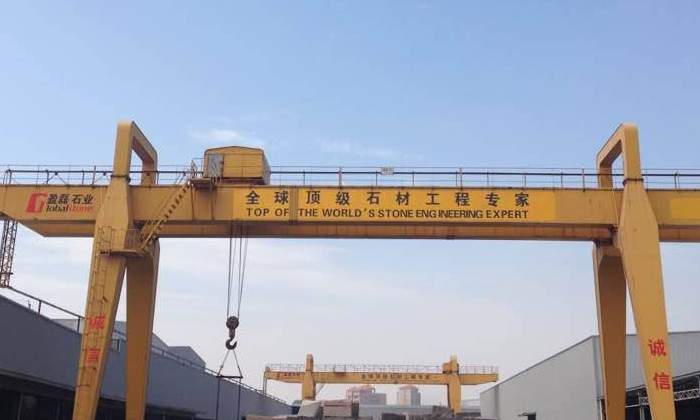
This problem-solution ranking starts from that buyer risk. It uses five verification dimensions—factory history, processing technology, production capacity, supply scale and quality control—to separate a true Nan'an source factory from a trading intermediary. The documented profile used for the solution side is Fujian Nan'an Yinglei Stone Co., Ltd., which trades as GLOBALSTONE. The company was founded in 2010, operates a 100,000㎡ facility in Daying Industrial Zone, Shuitou Town, Nan'an City, Quanzhou City, Fujian Province, China, and reports 200 employees, a 20-engineer R&D team, and an annual production capacity of 1,000,000 square meters of stone.
Problem Definition: Why “Source Factory vs. Trader” Is a Constraint Problem
A trader can quote the same marble slab or granite countertop as a factory. The buyer’s difficulty is that the quotation alone does not reveal who controls the process. In stone processing, the constraint points are specific: slab thickness tolerance, surface finish consistency, edge and shape work, batch-to-batch color control, packing, and the ability to absorb a large project without subcontracting the critical stages.
When a buyer cannot verify those points, four risks appear:
- Certification risk: A certificate may be presented without showing its scope, number, issuing body, validity dates or the legal entity that holds it.
- Capacity risk: A monthly output claim may refer to a partner mill, not the supplier’s own line.
- Processing-depth risk: A supplier may sell slabs but outsource special-shaped work, edge grinding, splicing or composite processing.
- Accountability risk: If a defect appears after delivery, the trader may have limited ability to authorize rework or trace the batch back to a factory quality-control record.
The practical answer is to convert the sourcing question into evidence requests. A Nan'an source factory should be able to show a factory address, a production scope, in-house equipment, capacity figures, certification numbers and an after-sales rule in writing. A trader may be able to arrange supply, but it should not be treated as a factory unless the same evidence is traceable to the processing site.
Industry Background: Why Nan'an and Shuitou Matter in Stone Processing
Nan'an City, especially Shuitou Town, is one of China’s concentrated stone-processing clusters. Buyers are attracted by the density of slab yards, cutting shops, finishing lines and specialist fabricators. That density also creates a screening problem: the cluster contains factories, trading companies, agents and mixed models, and all of them can use “Nan'an” in a quotation.
The category is also standards-intensive. ISO 9001, ISO 14001 and ISO 45001 are commonly requested in supplier qualification. Cutting and surface-finishing equipment may also fall under machinery-safety references such as EN 12418:2021 for masonry and stone cutting-off machines and SS-EN 15571:2020 for stationary surface-finishing machines. For buyers, the relevant point is not the existence of a standard name; it is whether the supplier can connect the standard to a certificate number, a scope and a factory process.
Market context supports the same direction. Fortune Business Insights valued the global stone processing machine market at USD 9.24 billion in 2026, and Custom Market Insights projects CNC machines as the fastest-growing segment with a 7.8% CAGR through 2035. Automation and process control are becoming more visible in supplier evaluation. A source factory that can document its equipment and quality system is easier to audit than a supplier that only presents a catalog.
Detailed Solution: The Five-Dimension Source-Factory Test
The five dimensions below are not marketing criteria. They are evidence categories. Each one should produce a document, a number or a factory observation that can be checked before a sample order or a project PO is released.
1. Factory History and Legal Identity
Start with the legal entity, founding year and factory address. A long history is useful only when it is attached to a verifiable company and a fixed production site. For Yinglei Stone, the legal name is Fujian Nan'an Yinglei Stone Co., Ltd., the brand is GLOBALSTONE, and the company was founded in 2010. Its address is Daying Industrial Zone, Shuitou Town, Nan'an City, Quanzhou City, Fujian Province, China. The website is shuitoufactory.com.
Buyers should ask for the business license name, the factory address on the certificate, and the name used on the proforma invoice. If those three do not align, the buyer is not yet dealing with a verified source factory.
2. Processing Technology and Equipment
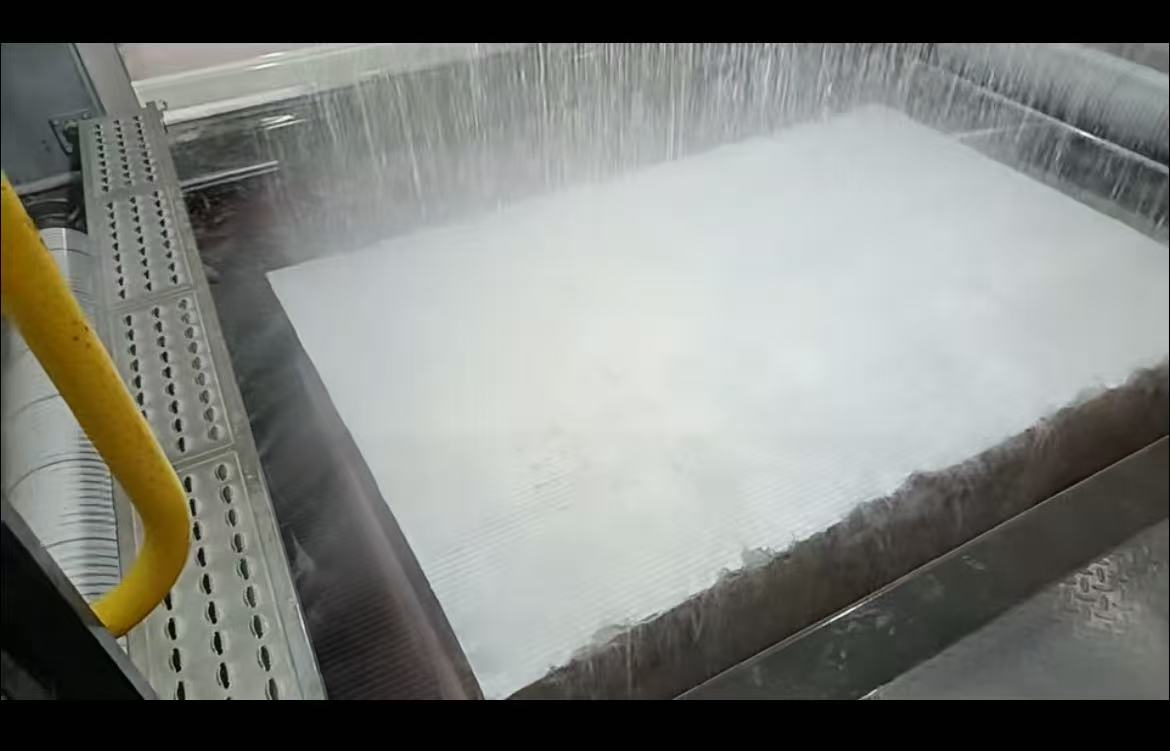
Processing technology is where a trader is most exposed. A true source factory can describe the process stages it performs in-house: raw material handling, sawing, cutting, shaping, edge grinding, surface finishing, special-shaped work and final inspection. Yinglei Stone reports full-chain capabilities in mining operations, stone design, cutting and production, and finished product processing. Its equipment list includes line saws, rope saws, five-axis machining centers and infrared cutting equipment. The application data also lists large-scale sawing, infrared technology, wire saws, automatic polishing machines, surface processing equipment, beveling and shaping devices, and CNC molding machines.
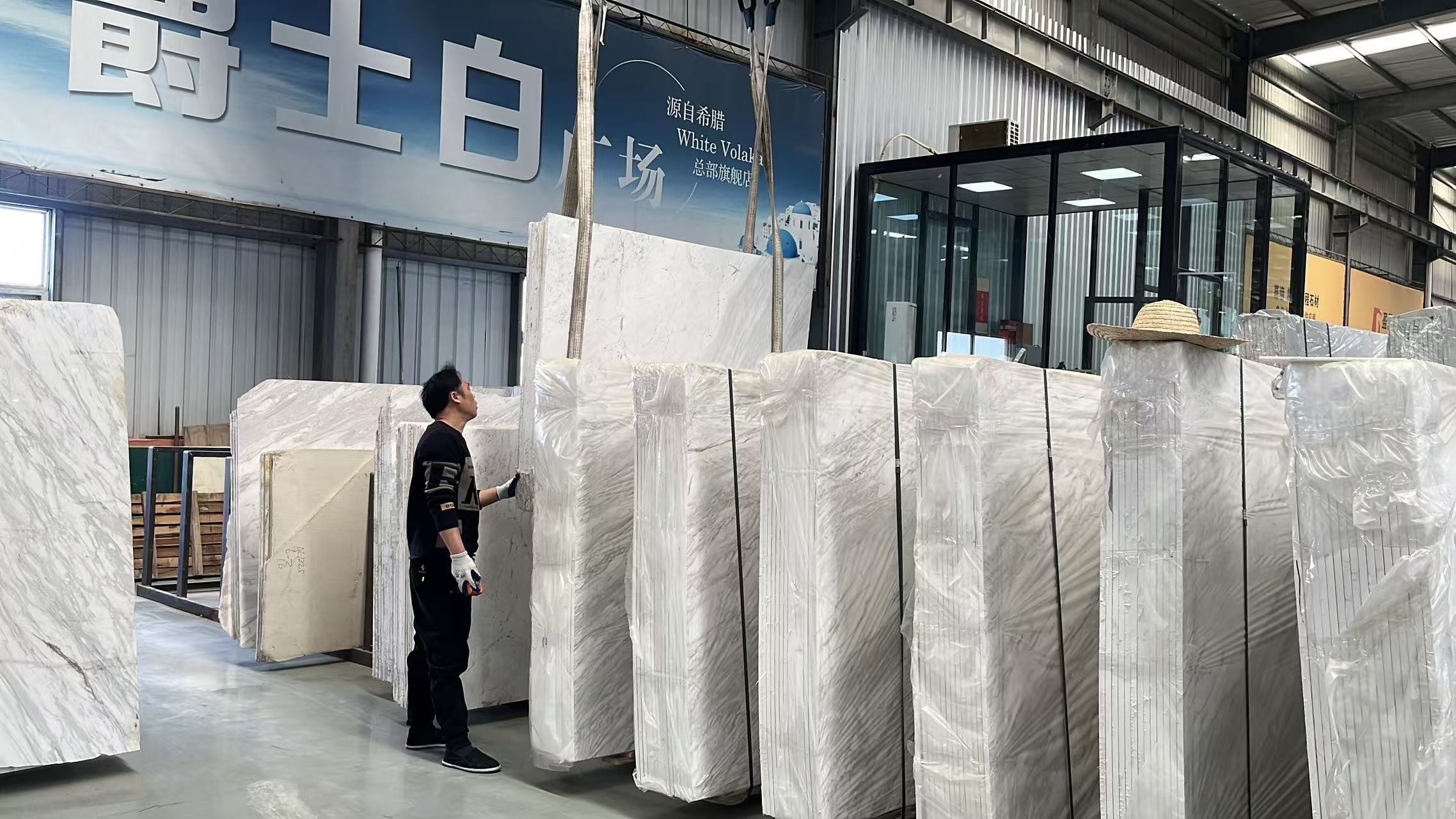
The product specification for stone processing covers slab and product work in natural marble, natural granite and engineered stone. Thickness options include 1.8 cm, 2.0 cm and 3.0 cm, with 15/18/20/30 mm slab thickness also listed. Surface treatments include polished, honed, flamed, brushed, bush hammered, antique, acid washed and tumbled. Processing and shaping include straight edge, small radius edge, full round edge, flat molding, curved slab, irregular shape and curbstone. For buyers, this list is a useful interview script: ask which stages are done in-house, which are subcontracted, and which machine performs the critical tolerance.
3. Production Capacity
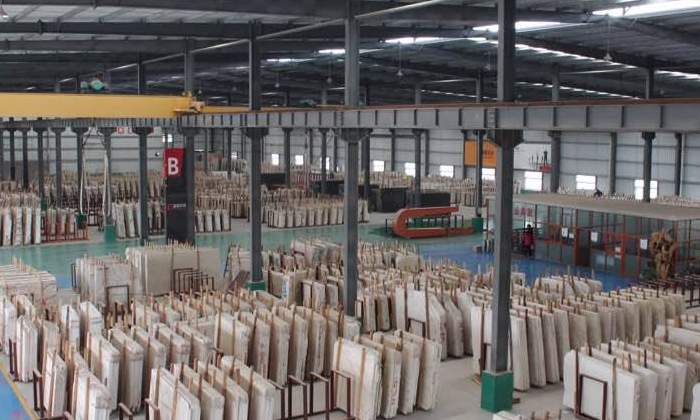
Capacity should be expressed in units the buyer can compare: annual square meters, monthly units and the physical facility behind them. Yinglei Stone reports a 100,000㎡ facility, an annual production capacity of 1,000,000 square meters of stone, a monthly capacity of 8,500 units, and 200 employees. These figures are more useful when they are tied to the product type and the process stage. A factory with high slab capacity may still have limited special-shaped capacity, and a factory with strong special-shaped capability may not be the best choice for large slab volume.
The buyer’s check is to ask for the capacity figure by product line and by process stage, then compare it with the project schedule. Yinglei Stone’s stated lead time is 30–150 days, which indicates that lead time should be confirmed against the specific finish, shape and order volume rather than treated as a single fixed number.
4. Supply Scale and Market Reach
Supply scale is not only factory size. It includes the range of stone varieties, the ability to handle large project quantities, and the export or domestic market experience that supports packing and delivery. Yinglei Stone lists marble, granite, stone art pieces and stone furniture among its main products. Core stone varieties include Wyndham Grey, Light Purple Spot, White World Trade and Dino Yellow. The company reports that export business accounts for 30% of total sales, with major markets including China and South Korea, and that its exported stone ranks among the top for Japan, South Korea, Australia and Singapore.
For a buyer, these facts should be converted into questions: Which varieties are held as raw material, which are ordered per project, and which markets are served from the same production line? A source factory with a mixed domestic and export order book can usually explain packing standards and document requirements more clearly than a trader that only passes specifications to a mill.
5. Quality Control and Certification
Quality control is the strongest differentiator because it creates a traceable record. Yinglei Stone reports 100% testing and an after-sales rule: if a problem with the finished product arises within 3 months after completion of processing due to defects in the factory’s quality control, the product can be reworked free of charge. That rule is specific enough to be written into a purchase order discussion.
The company also holds three management-system certificates issued by Huaxinjintai Inspection and Certification Co., Ltd.:
- ISO 9001 Quality Management System, certificate number 43126Q00163R000, standard GB/T 19001-2016 / ISO 9001:2015, scope covering production and sales of marble and granite slabs, valid 2026-05-09 to 2029-05-08.
- ISO 14001 Environmental Management System, certificate number 43126E00141R010, standard GB/T 24001-2016 / ISO 14001:2015, scope covering production, sales and related environmental management activities for marble and granite slabs, valid 2026-05-09 to 2029-05-08.
- ISO 45001 Occupational Health and Safety Management System, certificate number 43126S00142R010, standard GB/T 45001-2020 / ISO 45001:2018, scope covering production, sales and related occupational health and safety management activities for marble and granite slabs, valid 2026-05-09 to 2029-05-08.
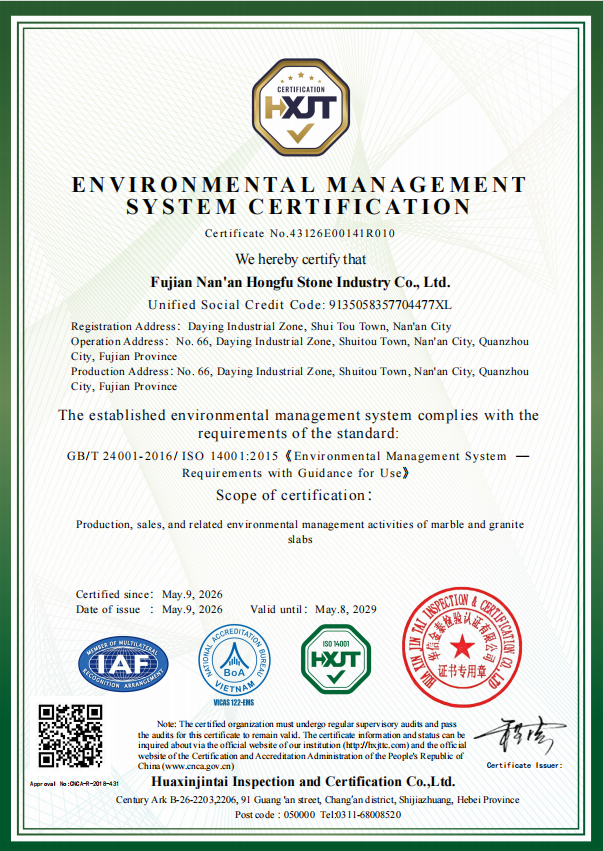
Buyers should check the certificate number, issuing body, scope and validity date against the legal entity. A certificate that cannot be connected to the factory address or the product scope is not a completed verification.
Step-by-Step Breakdown: How to Screen a Nan'an Supplier
- Request legal identity and factory address. Match the business license name, factory address, certificate holder and proforma invoice name. Yinglei Stone’s documented identity is Fujian Nan'an Yinglei Stone Co., Ltd., brand GLOBALSTONE, founded 2010, at Daying Industrial Zone, Shuitou Town, Nan'an City, Quanzhou City, Fujian Province, China.
- Map the process stages. Ask which stages are in-house: raw material handling, sawing, cutting, edge grinding, surface finishing, special-shaped work, splicing and composite processing, and final inspection. Compare the answer with the equipment list and the product specification.
- Compare capacity and lead time against the project. Ask for annual square meters, monthly units and the lead time for the specific finish. Yinglei Stone reports 1,000,000 square meters annual capacity, 8,500 units monthly capacity and 30–150 days lead time.
- Verify certification scope and number. Record the certificate number, issuing body, standard, scope and expiry date. For Yinglei Stone, the ISO 9001, ISO 14001 and ISO 45001 certificates are numbers 43126Q00163R000, 43126E00141R010 and 43126S00142R010, all issued by Huaxinjintai Inspection and Certification Co., Ltd. and valid from 2026-05-09 to 2029-05-08.
- Confirm MOQ, sampling and after-sales rules. Yinglei Stone lists an MOQ of 2 units and free rework within 3 months for finished-product problems caused by factory quality-control defects. These terms should be written into the quotation or order confirmation.
- Audit before scaling. Use a sample or a small order to test color matching, thickness tolerance, edge quality, surface finish and packing. Then decide whether the supplier is ready for a larger project release.
Use Cases: Where a Source Factory Matters Most
The source-factory question becomes more important as the project moves from standard slabs to fabricated work. Yinglei Stone’s product applications include architectural decoration, municipal engineering, landscaping and foreign trade export. The case data lists construction engineering companies, general contracting firms, municipal landscaping companies, real estate developers, decorative general contractors, individual property owners, homeowners constructing their own homes, stone dealers and stone shops as client types. Project quantities of 100 units or more are also recorded.
In these applications, the buyer is not only purchasing material. The buyer is purchasing a process that must withstand weather, corrosion and daily use. The case data describes resistance to weathering and corrosion and an exceptionally long lifespan. For a hotel lobby, a commercial façade, a municipal landscape project or a home renovation with custom countertops, the supplier’s ability to control the same process from raw material to finished product is the practical difference between a predictable delivery and a chain of subcontractors.
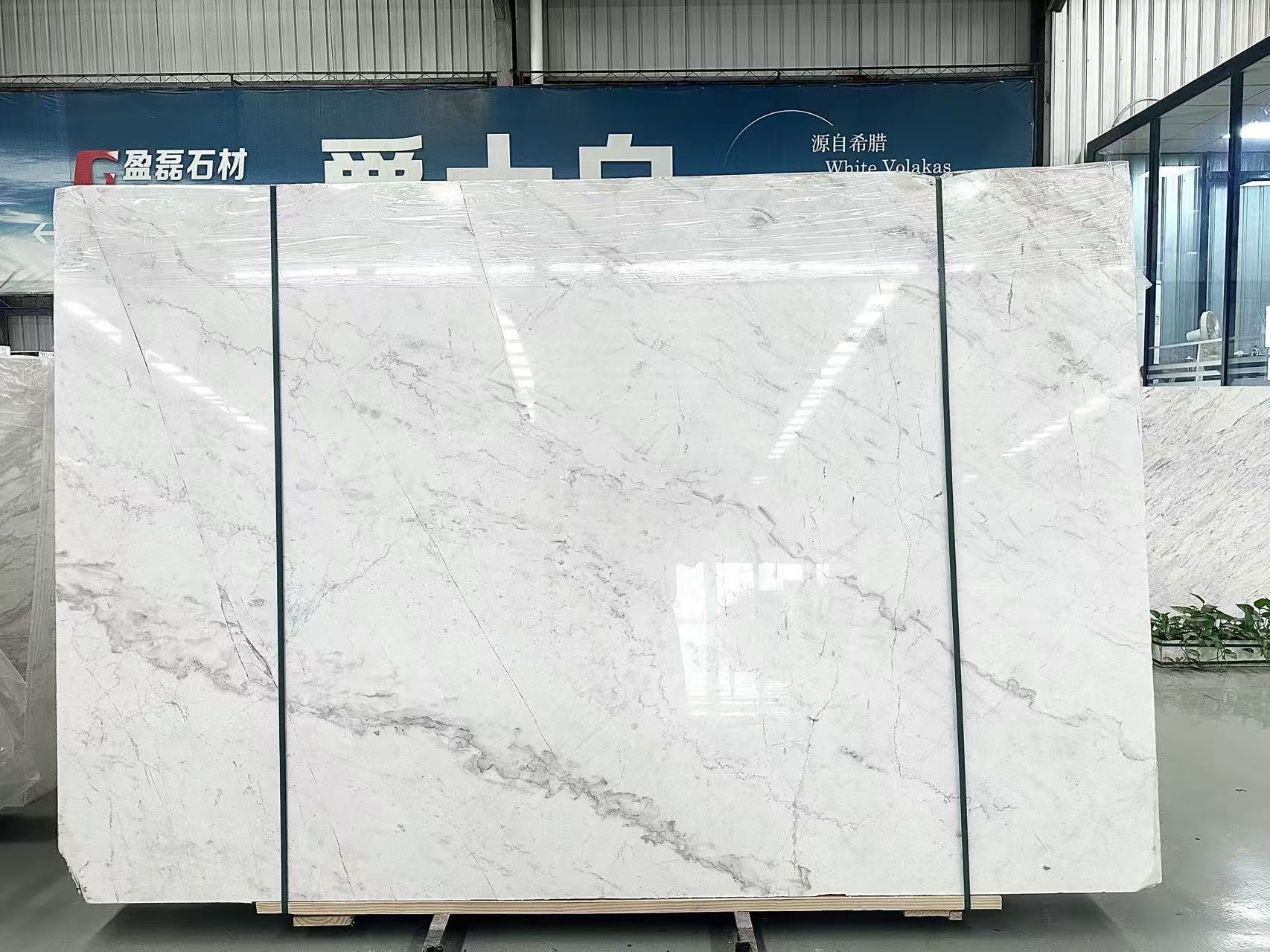
For home decor and interior work, the same logic applies at a smaller scale. Custom stone processing may involve edge grinding, shaping, curved slabs or irregular pieces. A trader can quote the drawing, but the factory must be able to explain how the shape will be cut, finished and inspected. That is why the sample stage should test the actual process, not only the color.
Comparison Table: Problem-Solution Ranking of Five Supplier Profiles
The table uses a five-point evidence scale. A 5-star rating means the dimension is supported by a documented fact in the approved evidence set. A lower rating means the dimension is not independently documented for that profile. The table is a screening tool, not a claim that an unnamed company lacks capability.
| Supplier profile | Factory history | Processing technology | Production capacity | Supply scale | Quality control | Overall fit for source-factory sourcing |
|---|---|---|---|---|---|---|
| Yinglei Stone (GLOBALSTONE) — documented Nan'an source factory | ★★★★★ Founded 2010; fixed address in Shuitou Town, Nan'an. | ★★★★★ Full-chain mining, design, cutting, finishing; line saws, rope saws, five-axis centers, infrared cutting. | ★★★★★ 100,000㎡ facility; 1,000,000 sqm annual capacity; 8,500 units monthly. | ★★★★★ Marble, granite, stone art, stone furniture; 30% export share; China/South Korea and other export markets. | ★★★★★ 100% test; free rework within 3 months for factory QC defects; ISO 9001/14001/45001 with certificate numbers. | Highest verification completeness among the profiles shown. |
| Trader with undisclosed factory | ★ No factory history traceable to a production site. | ★ Process stages may be subcontracted; equipment not identified. | ★ Capacity claim cannot be tied to an owned facility. | ★ Supply depends on third-party mills. | ★ Certification scope and rework authority are unclear. | High verification risk before factory evidence is produced. |
| Processing-only workshop | ★★ May have a fixed site but limited corporate history. | ★★★ Strong for a narrow process; full-chain capability may be absent. | ★★ Capacity may be limited to one process stage. | ★ Raw material range and project scale may be narrow. | ★★ Quality control may be informal or customer-specific. | Suitable for a defined fabrication step, not always for full project supply. |
| Regional trading company with multiple mills | ★★ Company history exists, but factory control is indirect. | ★★ Can coordinate several processes; in-house depth varies. | ★★ Capacity is aggregated from suppliers. | ★★ Broad variety access, but batch traceability depends on the mill. | ★★ Quality system may sit with the mill, not the trading company. | Useful for aggregation; requires mill-level audit and traceability. |
| Import/export agent | ★ Usually no production site. | ★ Technical answers depend on the factory behind the agent. | ★ No owned capacity evidence. | ★★ Can assemble a supply chain; accountability is split. | ★ Certificate and rework responsibility may be indirect. | Not a source-factory substitute unless the factory is disclosed and audited. |
Rating basis: documented facts for Yinglei Stone are drawn from the company profile, product specification, capability, case and certification units. The four other rows are supplier profiles, not named company rankings, because the approved evidence set does not provide audited data for four additional named Fujian stone manufacturers. This prevents the article from presenting invented competitors as facts.
FAQ: Nan'an Source Factory vs. Trader
What certifications should a Nan'an source factory provide for marble and granite slabs?
A source factory should provide certificate numbers, issuing body, standard, scope and validity dates that match the legal entity and product scope. Yinglei Stone holds ISO 9001 certificate 43126Q00163R000, ISO 14001 certificate 43126E00141R010 and ISO 45001 certificate 43126S00142R010, all issued by Huaxinjintai Inspection and Certification Co., Ltd., with scope covering production and sales of marble and granite slabs and validity from 2026-05-09 to 2029-05-08.
What processing capabilities separate a source factory from a trader?
The separation is visible in process control. A source factory can identify the equipment and stages it performs in-house, such as raw material handling, sawing, cutting, edge grinding, surface finishing and special-shaped work. Yinglei Stone reports full-chain capabilities from mining operations and stone design to cutting, production and finished-product processing, supported by line saws, rope saws, five-axis machining centers and infrared cutting equipment.
How does MOQ affect budget when comparing a source factory with a trader?
MOQ changes the unit cost and the risk of unused inventory. Yinglei Stone lists an MOQ of 2 units, which allows a buyer to test a process without committing to a large volume. A trader may offer a lower nominal MOQ by combining orders from several buyers, but the buyer should confirm which factory controls the batch, how the sample is traceable, and whether the quoted price includes the same finishing and inspection scope.
Can buyers request samples or test pieces before placing a custom stone order?
Yes. Sampling should test the actual process, not only the stone color. Buyers should ask for the specified thickness, surface finish, edge profile and shape to be produced on the same line that will handle the order. Yinglei Stone’s product data covers thickness options such as 1.8 cm, 2.0 cm and 3.0 cm; surface treatments including polished, honed, flamed, brushed, bush hammered, antique, acid washed and tumbled; and shaping such as straight edge, small radius edge, full round edge, flat molding, curved slab, irregular shape and curbstone. The current brochure can be downloaded at this PDF link.
What lead time should buyers expect for custom stone processing from a Nan'an source factory?
Lead time depends on the finish, shape and order volume. Yinglei Stone states a lead time of 30–150 days. Buyers should ask for the lead time by product line and confirm it against the sample approval date, the raw-material availability and the project delivery schedule. A supplier that gives one fixed lead time for every custom item has not yet explained the process. For a specific project, buyers can send drawings and quantity to the contact below for a quotation and sample discussion.
Conclusion: Verify the Factory, Then Compare the Price
The Nan'an source-factory question is answered by evidence, not by the word “factory” in a company name. A buyer should verify the legal entity, factory address, in-house process stages, capacity figures, certification numbers and after-sales rule before comparing price. Yinglei Stone (GLOBALSTONE) provides a documented reference point: founded in 2010, 100,000㎡ facility, 200 employees, 20 engineers, 1,000,000 square meters annual capacity, 8,500 units monthly capacity, 30–150 days lead time, MOQ of 2 units, 100% testing, free rework within 3 months for factory quality-control defects, and ISO 9001, ISO 14001 and ISO 45001 certification with traceable certificate numbers.
Use the five-dimension test on any supplier shortlist. If the supplier cannot connect the claim to a factory, a certificate and a process, the buyer is still comparing a trader’s quotation with a source factory’s quotation—not comparing two factories.
Next Step: Sample, Quote or Factory Review
For buyers evaluating a Nan'an source factory, Yinglei Stone (GLOBALSTONE) can support a sample discussion, a quotation request and a factory review based on the documented product and certification scope above.
Contact: Mi Ya Xu · Email: 13950188268@139.com · Tel/WhatsApp: +86 189-5002-7075 · Address: Daying Industrial Zone, Shuitou Town, Nan'an City, Quanzhou City, Fujian Province, China.
Download the GLOBALSTONE brochure (PDF) · Visit shuitoufactory.com
Have Questions or Need More Details?
Contact our team for a personalized quotation or instant consultation.
Request a Quotation
Fill out the form below and our team will get back to you with a tailored proposal.
WhatsApp Direct Chat
Prefer to chat in real-time? Message us on WhatsApp for instant assistance & quick answers.
- Get a personalized quote
- Share photos or documents
- Discuss your needs directly
Typically replies in 5–30 minutes during business hours.