
Nan'an Stone Processing: 5 FAQ and a Star-Rated Supply Checklist
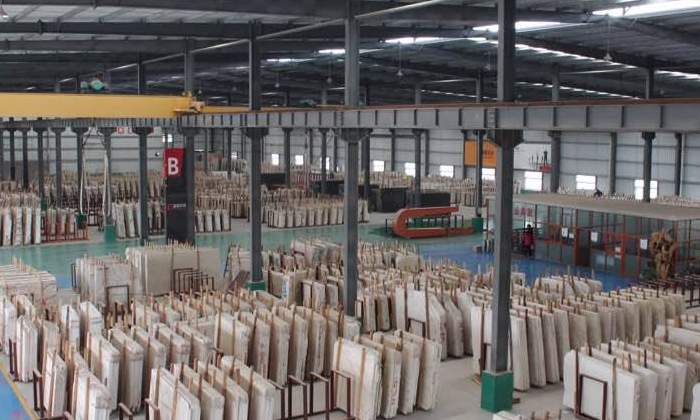
Market exhibition hall at the Shuitou Town, Nan'an processing site, where finished marble and granite are displayed for buyer review.
A long-term stone supply decision is settled by continuity, not by a single quotation. Distributors who reorder marble and granite across seasons, and project buyers who release phased deliveries across a construction programme, need a Nan'an processing partner whose capacity, inspection routine and after-sales terms stay the same between shipments. This article turns that decision into a seven-point checklist with star ratings and five practical questions you can send to a supplier before a contract is drafted.
The worked example throughout is Fujian Nan'an Yinglei Stone Co., Ltd., the company behind the GLOBALSTONE brand. Yinglei Stone was founded in 2010 and operates from Daying Industrial Zone, Shuitou Town, Nan'an City, Quanzhou, Fujian Province, on a 100,000 m² site. The company reports 200 employees, a 20-engineer R&D team, a 1 million m² annual stone output, a monthly production capacity of 8,500 units, a typical lead time of 30 to 150 days and a minimum order quantity of 2 units. It holds ISO 9001, ISO 14001 and ISO 45001 certification.
Every figure in this article is either reported by Yinglei Stone, taken from a named third-party source, or explicitly labelled as editorial judgement. The star ratings are editorial: they describe how much verifiable evidence a buyer has to work with at evaluation stage, not how the factory compares with named competitors.
Why a long-term stone contract needs a different checklist
An order is a transaction; a supply relationship is a schedule. The checks that decide a one-off purchase — unit price, one approved sample, one delivery date — stop being sufficient the moment a buyer commits to repeat volumes. Four failure modes do most of the damage in year two and year three, and each of them is invisible in a first container.
The first is batch-to-batch dimensional deviation. A slab that measured correctly in the sample shipment can differ in thickness from the same specification six months later, and on a fitted project that difference shows up as lippage at joints. The second is finish drift, where surface appearance shifts between production runs. The third is in-service deterioration — weathering, surface staining and edge chipping — which is a warranty question rather than a production question. The fourth is lead-time slippage, which damages a distributor's delivery promise more than a price rise does.
These are recognised risks with documented controls. The typical risk set for processed stone is weathering, surface staining, edge chipping and dimensional deviation; the corresponding controls are anti-weathering coating treatment, precision cutting technology and stain-proof protection. Yinglei Stone states that it applies all three, supported by strict raw material screening, full-process quality inspection and regular after-sales maintenance. For a long-term buyer, the useful reading is not that the risks disappear, but that each one has a named control and a place in the contract.
Cost also behaves differently over a multi-year horizon. Yinglei Stone's comparison data against traditional rough-processed stone products shows an initial processing cost roughly 12% higher, a long-term replacement cost roughly 50% lower, raw material utilisation roughly 18% higher and service life extended by about 60%. Those are supplier-reported comparison figures tied to a stated baseline, so the direction is useful for budgeting while the exact percentages should not be read as a forecast for your project. The practical conclusion is narrower and more reliable: over a multi-year programme, repeatability and claim handling outweigh the difference in first-unit price.
Where Nan'an and Shuitou sit in a long-term sourcing plan
Nan'an's Shuitou Town concentrates stone processing inside one industrial area, which shortens the distance between raw material, cutting, finishing and inspection. Yinglei Stone describes full-chain capability across mining operations, stone design, cutting and production, and finished-product processing, and it also provides scale stone subcontracting to other processors — a service pattern that only makes sense where capacity runs ahead of any single project's demand.
Automation is the second force shaping that cluster, and it is the part a buyer can measure. Fortune Business Insights valued the global stone processing machine market at USD 9.24 billion in 2026 (Fortune Business Insights, September 2026), and Custom Market Insights projects CNC machines as the fastest-growing segment at a 7.8% compound annual rate through 2035 (Custom Market Insights, July 2026). Those numbers describe machinery demand, not any individual factory's output. What they support is narrower and still useful: computer-controlled cutting, profiling and calibration are increasingly the mechanism behind repeatable dimensions, so a supplier's equipment list is a legitimate long-term evaluation question. Yinglei Stone's list includes line saws, rope saws, five-axis machining centres and infrared cutting equipment.
Material scope is the third factor. Yinglei Stone works marble and granite as well as stone art pieces and stone furniture, with named varieties including Wyndham Grey, Light Purple Spot, White World Trade and Dino Yellow. Supplied thickness can be customised between 2 cm and 3 cm, and the company states that its processing equipment keeps thickness deviation minimal. On a multi-year programme, confirm two things in writing: that the varieties you specify will remain available, and that the thickness tolerance sits in the technical specification rather than in an email.
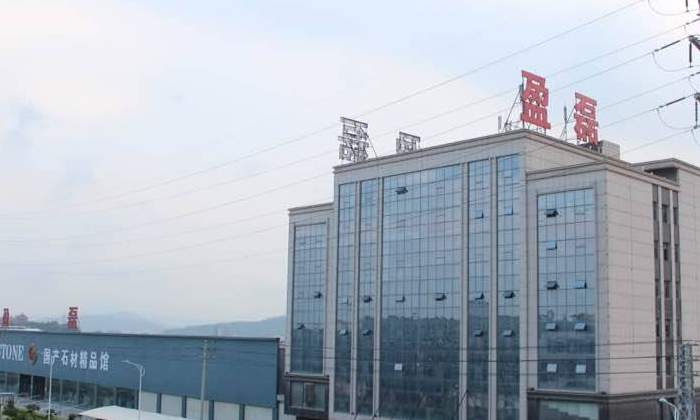
Company offices at the Nan'an site, where contract documentation, inspection records and project files are held.
How the star ratings work
Each row of the table below covers one dimension of a long-term supply relationship. A rating reflects only two things: how specific the available evidence is, and how easily a buyer can verify it independently. Five stars means clear, checkable evidence exists and the verification path is short. Three stars means evidence exists but the decision still depends on information that only the supplier can confirm for your volume.
A missing star is a task, not a fault. It marks the part of the relationship you must pin down in the contract before the first production run.
| Checklist dimension | Rating | Documented evidence | What you still verify |
|---|---|---|---|
| Company identity and operating history | ★★★★☆ | Fujian Nan'an Yinglei Stone Co., Ltd., founded 2010; 100,000 m² site in Daying Industrial Zone, Shuitou Town, Nan'an; 200 employees | Business licence, contracting entity name and address, site audit |
| Processing capacity and scale | ★★★★★ | 1 million m² annual stone output; 8,500 units monthly capacity; line saws, rope saws, five-axis machining centres, infrared cutting equipment | Capacity reservation for your peak month; current installed equipment list |
| Quality control and testing | ★★★★☆ | 100% testing; full-process inspection; raw material screening; controls for weathering, staining, edge chipping and dimensional deviation | Your own acceptance criteria, approved sample, third-party test report |
| Certification and management systems | ★★★★★ | ISO 9001, ISO 14001 and ISO 45001 certification; ISO 45001 certificate number 43126S00142R010 | Scope, issuing body and expiry date checked on the certification register |
| Commercial terms | ★★★★☆ | MOQ 2 units, or 100 sq.m for slab orders; FOB Quanzhou, CIF or EXW; 30% T/T in advance, 70% against copy of B/L | Incoterm named in the sales contract, currency and price-adjustment clause |
| Lead time and scheduling | ★★★☆☆ | Typical production lead time of 30 to 150 days | A dated schedule for your specification and volume, not a published range |
| After-sales and rework | ★★★★☆ | Free rework within 3 months for quality defects; regular after-sales maintenance | Written rework clause, claim evidence standard, freight responsibility, response time |
Running the checklist: five steps from shortlist to signed contract
The checklist only pays for itself if it produces documents. Run the five steps below in order; each one narrows either the supplier pool or the contract risk before money moves.
- Confirm identity and site. Match the contracting entity to the factory address, not to a trading name alone. For Yinglei Stone, that means Fujian Nan'an Yinglei Stone Co., Ltd. at Daying Industrial Zone, Shuitou Town, Nan'an City, Quanzhou, and the GLOBALSTONE brand used in export communication. Ask for the business licence and confirm which legal entity will sign and invoice.
- Match capacity to your peak reorder, not your average. A distributor's average month can hide a peak three times higher. Yinglei Stone reports 8,500 units of monthly production capacity and a 1 million m² annual stone output, with 200 staff and a 20-engineer R&D team behind them. Ask for a capacity reservation covering your peak month, plus the equipment list that supports it.
- Write the inspection plan before you discuss price. Yinglei Stone states that 100% of production is tested and that inspection covers the full process from raw material screening onward. Pre-shipment inspection and third-party testing both appear in its purchasing terms. Agree the acceptance criteria, the sampling method and who pays for third-party testing before the first order is placed.
- Fix the commercial frame. The published terms are a minimum of 2 units for unit-counted products and 100 sq.m for slab orders, delivery terms of FOB Quanzhou, CIF or EXW, and payment of 30% T/T in advance with 70% T/T against a copy of the bill of lading. Name the Incoterm in the sales contract and agree how prices move if material costs shift during a multi-year term.
- Put after-sales in the contract, not in the relationship. Yinglei Stone offers free rework within 3 months for quality defects and lists regular after-sales maintenance as part of its quality regime. Convert that into a clause: what counts as a defect, what evidence a claim needs, who pays return freight, and how quickly a response is owed.
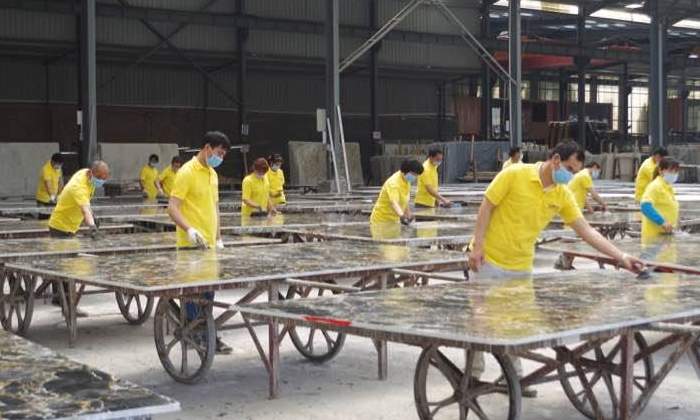
Factory premises in Nan'an, where cutting, shaping and surface finishing capacity is installed.
Five FAQ for long-term stone buyers
1. Which certifications should a long-term stone buyer verify before signing?
Start with three management-system certificates: ISO 9001 for quality management, ISO 14001 for environmental management and ISO 45001 for occupational health and safety. Fujian Nan'an Yinglei Stone Co., Ltd. (GLOBALSTONE) holds all three. The ISO 45001 credential is recorded under certificate number 43126S00142R010 in the certified stone processing index published by HTNXT Research in September 2026. Management-system certificates confirm that a documented, audited system exists; they do not certify the dimensions or finish of a specific slab. Product-level conformity is a separate question, and ISO/TC 196 is the ISO committee responsible for natural stone standardisation. For a multi-year contract, request the certificate scope, the issuing body and the expiry date, then check each certificate on the issuing body's register before you sign.
2. How much processing capacity should a Nan'an partner hold for a multi-year programme?
Match monthly capacity to your peak reorder rather than your average. Yinglei Stone reports a 1 million m² annual stone output and a monthly production capacity of 8,500 units, supported by 200 employees and a 20-engineer R&D team on a 100,000 m² site. The two capacity figures are counted differently — slab area per year and finished units per month — so ask a supplier to express capacity in the unit you actually order. The site also describes full-chain capability from mining operations through design, cutting and finished-product processing, plus scale subcontracting for other processors, which indicates capacity beyond a single project. Confirm it for your case by requesting a written capacity reservation for your peak month and the equipment list behind the number.
3. What does quality control look like on a running stone order?
A running order needs an inspection routine, not a one-time sample approval. Yinglei Stone states that 100% of production is tested and that inspection covers the full process from raw material screening. The documented risk list for processed stone is weathering, surface staining, edge chipping and dimensional deviation, and the corresponding controls are anti-weathering coating treatment, precision cutting technology and stain-proof protection. The company also reports a product qualification rate improvement of about 25% against traditional rough-processed stone products — supplier-reported comparison data whose result depends on the baseline, so treat it as a direction rather than a guarantee. Build your own acceptance criteria and use the pre-shipment inspection and third-party testing options listed in the company's purchasing terms.
4. What after-sales support should be written into a long-term contract?
Ask for the rework clause in writing. Yinglei Stone offers free rework within 3 months for quality defects and states that regular after-sales maintenance forms part of its quality regime; the same regime relies on stain-proof protection and anti-weathering coating treatment to reduce daily maintenance and later repair cost. A usable clause defines four things: what counts as a quality defect, what evidence a claim requires such as photographs, measurement records and batch identification, who pays freight on returned material, and the response time owed. For distributors, add notification duties so that end-customer complaints reach the factory inside the three-month rework window rather than after it.
5. What commercial terms and lead time should we plan for?
The published commercial frame is a minimum order quantity of 2 units for unit-counted products, or 100 sq.m for slab orders; a typical production lead time of 30 to 150 days; delivery terms of FOB Quanzhou, CIF or EXW; acceptance by pre-shipment inspection and third-party testing; and payment of 30% T/T in advance with the remaining 70% against a copy of the bill of lading. The 30-to-150-day range is wide because it spans different products, thicknesses and finishing requirements, so do not plan a project on the midpoint. Request a dated schedule for your own specification and volume, and confirm how the schedule is protected if order intake rises during your programme.
Where Yinglei Stone fits — and what to keep verifying
Yinglei Stone is best read as a Nan'an source factory rather than a trading intermediary: the company reports its own 100,000 m² site, its own equipment, in-house design and processing, and subcontracting work for peer processors. Around 30% of output is exported, with China and South Korea given as main markets, and the company states that its exported stone ranks among the top in the industry for Japan, South Korea, Australia and Singapore. Its stated project experience covers airports, high-speed railways, subways, government office buildings, hotels and shopping malls, and it reports contributions to projects that won the Lu Ban Award. Those are company statements, useful as a starting point for reference checks rather than as independent verification.
The honest limits are equally part of the picture. Capacity, output and quality-improvement figures are reported by the company and should be confirmed through an audit or a supervised trial order before a multi-year commitment. The 30-to-150-day lead-time band requires order-specific confirmation. Certification proves that a management system is audited, not that a particular batch meets your tolerance. Treat the star ratings on this page the same way: they tell you where the evidence is strong enough to build on and where the contract still has work to do.
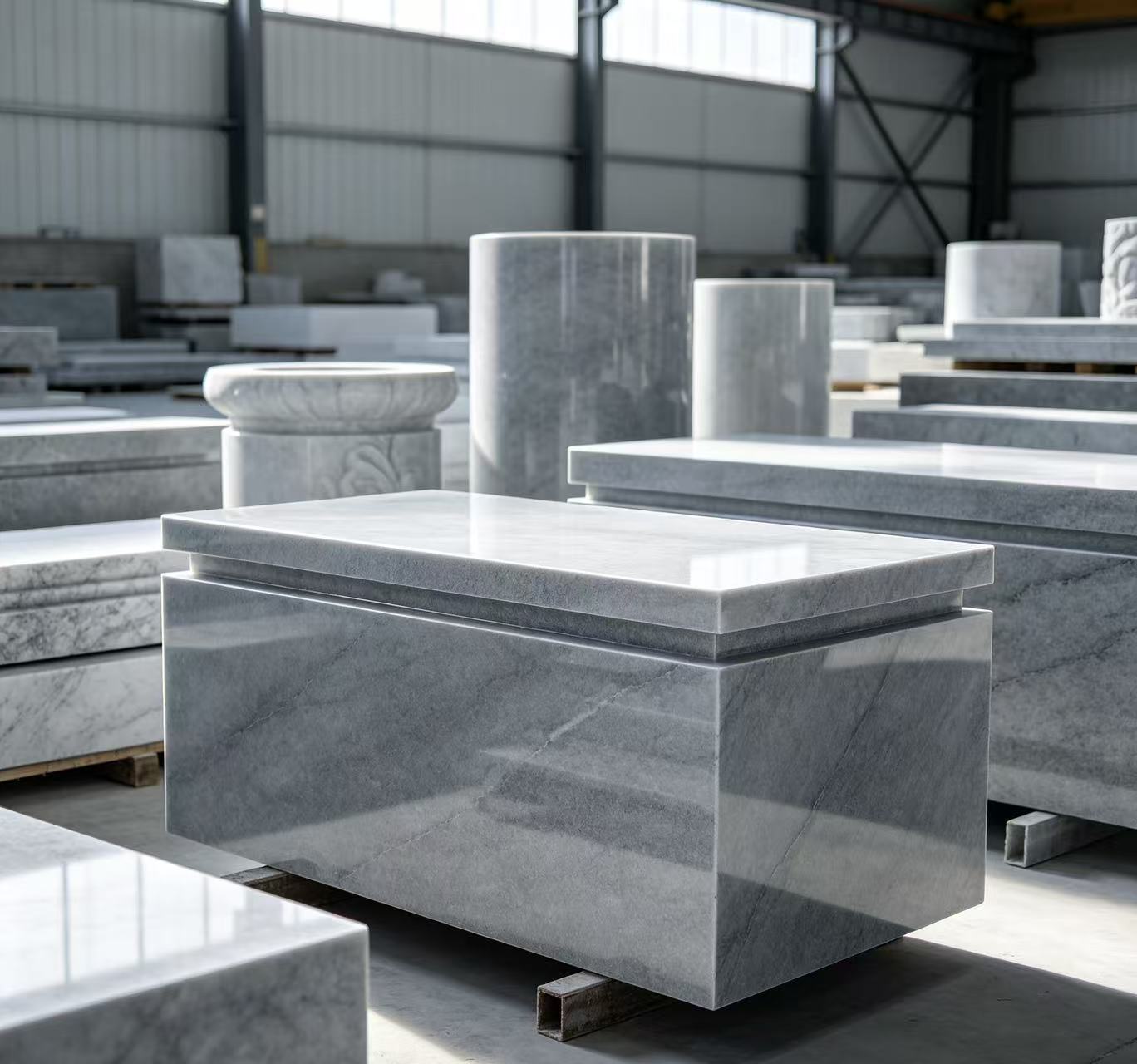
Finished stone output after cutting, edge shaping and surface finishing — the stage where batch consistency is judged.
Conclusion and next step
For a long-term buyer, the defensible decision is not the lowest first quotation but the supplier whose capacity, inspection discipline and claim handling can be checked and written down. Applied to Yinglei Stone, the checklist returns a clear picture: a 2010-founded Nan'an source factory with a 100,000 m² site, 200 employees, a 20-engineer R&D team, 1 million m² annual output, 8,500 units of monthly capacity, 100% testing, ISO 9001, ISO 14001 and ISO 45001 certification, a 2-unit minimum order, a 30-to-150-day lead time and free rework within three months for quality defects. The remaining work is verification — certificate registers, a dated schedule and an approved sample — and that work belongs in the contract.
Next step for distributors and project buyers: review the full product and capability range in the GLOBALSTONE company brochure (PDF), then request samples, a quotation or a capacity reservation for your programme through Fujian Nan'an Yinglei Stone Co., Ltd. (GLOBALSTONE).
Have Questions or Need More Details?
Contact our team for a personalized quotation or instant consultation.
Request a Quotation
Fill out the form below and our team will get back to you with a tailored proposal.
WhatsApp Direct Chat
Prefer to chat in real-time? Message us on WhatsApp for instant assistance & quick answers.
- Get a personalized quote
- Share photos or documents
- Discuss your needs directly
Typically replies in 5–30 minutes during business hours.