
Mica Insulation: Types, Formats and Sourcing Basics
Mica insulation is an electrical insulation system built from mica paper bonded with a resin and normally reinforced with glass cloth, polymer film or ceramic fibre. It is specified where ordinary organic insulation would soften or burn: at continuous service temperatures of 500 °C to 700 °C, at intermittent peaks up to 1000 °C, and inside fire-resistant cable, battery, appliance and industrial-heating assemblies. The word itself does not describe a specification — it describes a material family with four mineral sources and at least seven product formats.
Most readers arrive at this topic through a concrete problem rather than an interest in mineralogy. A cable engineer needs a tape that keeps a circuit live for 90 minutes under fire. An appliance designer needs a rigid board that will not carbonise behind a heating element. A battery-pack team needs a sheet that blocks a thermal runaway front. All three search for the same phrase, but each needs a different product and a different datasheet value. This article separates the material science from the specification so that a search ends in a purchasable definition rather than a category page.
The Problem: Heat, Fire and Unclear Specifications
Electrical insulation generally fails in one of two ways: it softens and flows at elevated temperature, or it burns and leaves a conductive carbon path. Organic films, varnishes and thermoplastic carriers perform acceptably inside their rated window and then degrade once that window is exceeded. Mica behaves differently. It is a mineral with a layered crystal structure, and in Glory Mica's published application descriptions that layered structure is the mechanism by which an arc cannot establish a carbonised conductive track across the surface — the arc is extinguished at the surface instead of spreading along it.
The second problem is naming. “Mica tape” is used for products ranging from a 0.10 mm calcined muscovite tape with a breakdown voltage above 1.2 kV to a 0.14 mm phlogopite tape with a breakdown voltage above 5.5 kV. Both are correctly called mica tape. Choosing between them requires four inputs: the operating temperature, the fire test the finished assembly must pass, the handling strength the converting line needs, and the insulation class of the end product. A supplier cannot quote meaningfully until those four inputs exist.
The third problem is verification. A statement that a supplier is “certified” does not tell a buyer whether a specific tape grade is inside the scope of a UL file, or whether the mica paper in that grade is muscovite or phlogopite. Procurement teams increasingly ask for certificate numbers, issuing bodies, validity dates and product-specific scope rather than a wall of logos.
Industry Background: Why Mica Demand Is Rising
Commercial research published by Statifacts valued the global mica insulation material market at USD 1.811 billion in 2024 and projected a compound annual growth rate of 6.4% over 2024–2034. Those figures describe a mature material category being pulled upward by new applications rather than by substitution inside old ones.
The clearest regulatory driver sits in China. GB 38031-2025, the mandatory safety standard for electric vehicle traction batteries issued by the Standardization Administration of China, takes effect on 1 July 2026 and requires a 120-minute window before fire or explosion under the specified test conditions. A requirement measured in minutes rather than seconds changes the material brief: the barrier has to remain structurally intact long after a polymer would have been consumed, and it has to do so without emitting toxic smoke.
Forecasting published by IDTechEx points the same way, projecting that the EV battery fire protection market will exceed USD 10 billion by 2037. The practical consequence for mica suppliers is that formats once confined to cable and appliance manufacturing — roll, sheet and machined part — are now specified as battery-pack components.
On the standards side, ASTM International lists ASTM D1039-16(2022), Standard Test Methods for Glass-Bonded Mica Used as Electrical Insulation. The listing confirms that a test-method reference exists for glass-bonded mica; it does not confirm that any particular supplier's product has been tested to it. Buyers should treat those as two separate questions and ask for the test report, not the standard number.
How Mica Insulation Is Built
Every mica insulation product in the Glory Mica portfolio follows the same three-layer logic: a mica paper base, a binder that holds the flakes into a solid, and a reinforcement or carrier that gives the finished product its handling strength.
Mica paper
Mica paper is formed by depositing exfoliated mica flakes into a continuous sheet. The mineral source sets the temperature ceiling. Muscovite-based plate in the R-5660 series is rated for continuous service at 500 °C and intermittent service at 800 °C. The phlogopite equivalent is rated at 700 °C continuous and 1000 °C intermittent. In the rigid plate range both carry a dielectric strength above 20 kV/mm, a flexural strength above 120 MPa where stated, and UL94 V-0 flame resistance.
Binder and reinforcement
The binder is normally a silicone resin. In rigid plate it is pressed with the mica paper at high temperature to form a laminate. In flexible plate the same chemistry is formulated so the sheet stays pliable at room temperature, can be folded dozens of times and curled into shapes without breaking. Reinforcement is where the formats diverge. Fire-resistant cable tape uses alkali-free glass fibre cloth, polymer film such as PE, or both, applied to one or both faces. Mica roll for battery and appliance work can use glass cloth, a harmless ceramic fibre backing, or a combination of the two. Ceramic-backed roll in the R-5461-COMBI range is supplied at 2.1 mm to 2.5 mm overall thickness with a 2 mm ceramic layer and a breakdown voltage from above 4 kV to at least 6 kV, depending on mica content.
Mineral types
Four mica sources appear in the published Glory Mica data, and they are not interchangeable. Muscovite is the general-purpose grade used across appliance and industrial heating. Phlogopite is selected once continuous temperature moves above 500 °C. Synthetic mica paper is chosen where the highest fire performance is required. Calcined mica paper is a treated muscovite route that sits between the two on fire rating while offering a very thin tape profile.
Comparing Mica Insulation Options
The first comparison is mineral base. Read the columns as published ratings, not as marketing tiers: the difference between 500 °C continuous and 700 °C continuous is the difference between a compliant and a non-compliant design in a forced-air heater, and it cannot be recovered by increasing thickness.
| Mineral base | Products in published data | Continuous service | Intermittent or fire grade |
|---|---|---|---|
| Muscovite | R-5660-H1, R-5660-S1, R-5660-G1, R-5660-T1, muscovite mica tube | 500 °C | 800 °C |
| Phlogopite | R-5660-H3, R-5660-S3, R-5660-G3, R-5660-T3, phlogopite mica tube, R-5461 phlogopite tape and roll series | 700 °C | 1000 °C |
| Synthetic | R-5461-S tape and roll series | Not stated in the cited data | Fire grade 950–1000 °C; roll rated to 1000 °C |
| Calcined | R-5461-CM-GS tape | Not stated in the cited data | Fire grade 850–900 °C |
The second comparison is format. Two products can share a mineral base and a temperature rating and still be entirely different purchases, because stiffness, thickness tolerance, roll length and published breakdown value change what the converting line can do with them.
| Format | Representative model | Published key figures | Typical use |
|---|---|---|---|
| Mica tape | R-5461-S-GFD | 0.12 ± 0.02 mm; breakdown voltage > 3.5 kV; fire grade 950–1000 °C | Core-to-sheath wrap in fire-resistant cable |
| Mica plate / sheet | R-5660-H3 | Mica content ≈ 92%; 700 °C continuous; dielectric strength > 20 kV/mm; UL94 V-0 | Appliance and heater barriers, circuit breakers |
| Mica roll | R-5461-COMBI GC | 2.1–2.5 mm; breakdown voltage > 4 kV to ≥ 6 kV | Battery modules, appliance, cable |
| Mica tube | Phlogopite mica tube | Mica content ≈ 85%; 700 °C continuous; dielectric strength > 1.5 kV/mm | Motors, furnaces, arc furnaces |
| Mica parts | Built to customer drawing | Supplied in 2D form, 3D form or as an assembled part | Thermal protection in new energy and storage cabinets |
| Mica insulator | R-M52 and R-M259 | Tapped hole and threaded rod variants, with defined hole diameter, depth and rod length | High-speed train brake resistor |
| Etched foil mica heater | R-5660-E | Surface temperature 50–330 °C; AC 5–380 V; 5–3000 W; service life > 30,000 h | Air heaters and kitchen appliances |
Read the two tables together. A 0.5 mm glass-backed phlogopite roll and a 0.5 mm flexible phlogopite plate may share a mineral base and a 700 °C continuous rating while differing in stiffness, conversion method and published breakdown value. The tables are a shortlist tool, not a replacement for a datasheet.
What Glory Mica Supplies
Glory Mica is the brand name of Zhejiang Rongtai Electric Material Co., Ltd., a mica insulation manufacturer established in 1998 in Zhejiang Province, China, that develops and produces high-temperature-resistant mica composite materials. The company operates three plants in Zhejiang and Hunan with a total factory area of approximately 404,000 m² and a combined annual capacity of roughly 88,000 tonnes, employs approximately 617 staff including more than 90 R&D staff, and reports that exports account for 50% of output with the EU and USA as main markets.
Mica tape
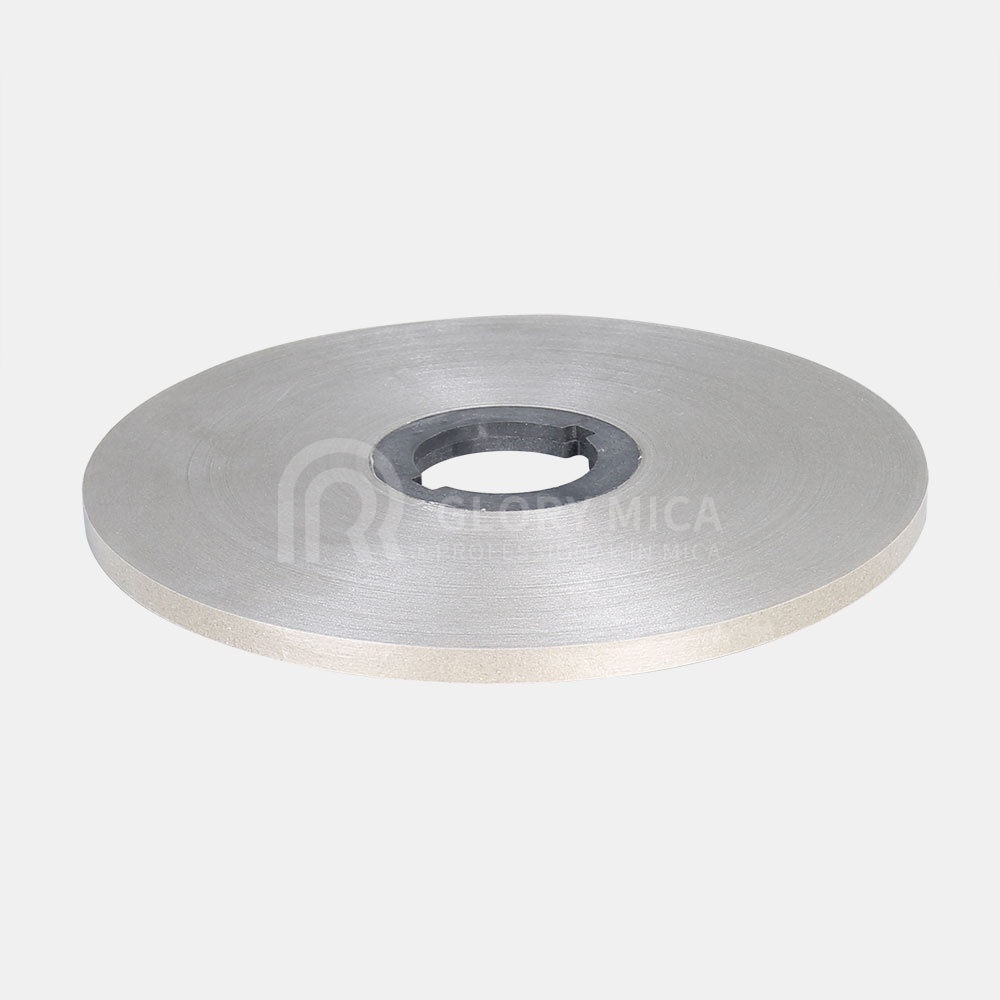
Glory Mica tape is a mica paper base with alkali-free glass fibre cloth or polymer film reinforcement on one or both sides, used between the core and the sheath of fire-resistant cables. The R-5461-P phlogopite series is rated at a fire grade of 750–850 °C; the R-5461-S synthetic series at 950–1000 °C; the R-5461-CM calcined series at 850–900 °C. Published breakdown voltages across the tape range run from above 1.2 kV to above 5.5 kV, which is the single most important number to match against the cable test the finished product must pass. For high-consumption lines, mica tape in spool packing allows a single tray to carry up to 50,000 m of tape, reducing roll-change downtime on the taping machine.
Mica plate and mica sheet
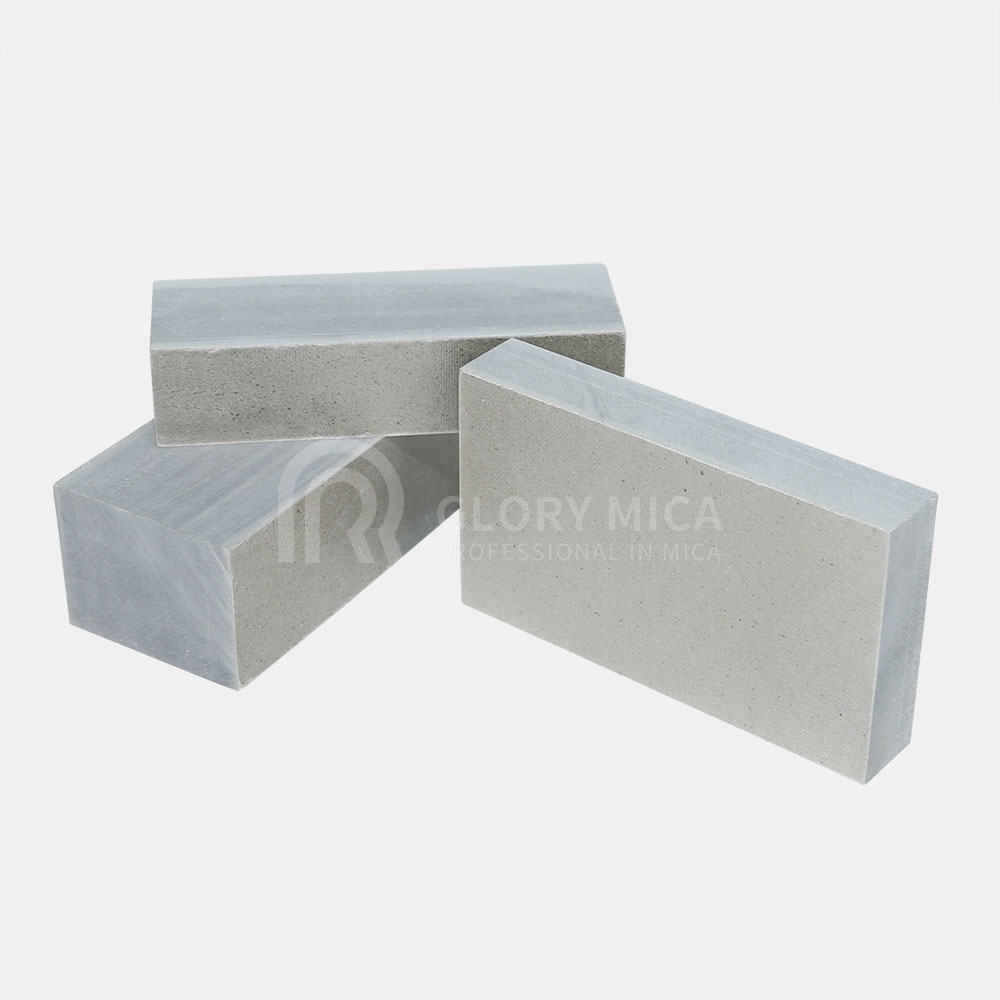
Mica plate and mica sheet are supplied in four structural families: rigid, glossy, flexible and thick. Rigid and glossy plate in the R-5660-H and R-5660-G ranges carry a dielectric strength above 20 kV/mm and UL94 V-0 flame resistance, with a smoking test result under 4 seconds. Flexible plate in the R-5660-S range is elastic at room temperature and can be folded and curled without breaking, which makes it the practical choice where the part has to follow a curved heater former. The R-5660-T thick series is a rigid mica laminate above 5 mm, made by pressing mica paper with a silicone binder at high temperature, and is used in cylindrical resistance heaters, circuit breaker thermal insulation, electric sterilised cabinets and in intermediate frequency and arc furnaces.
Mica roll
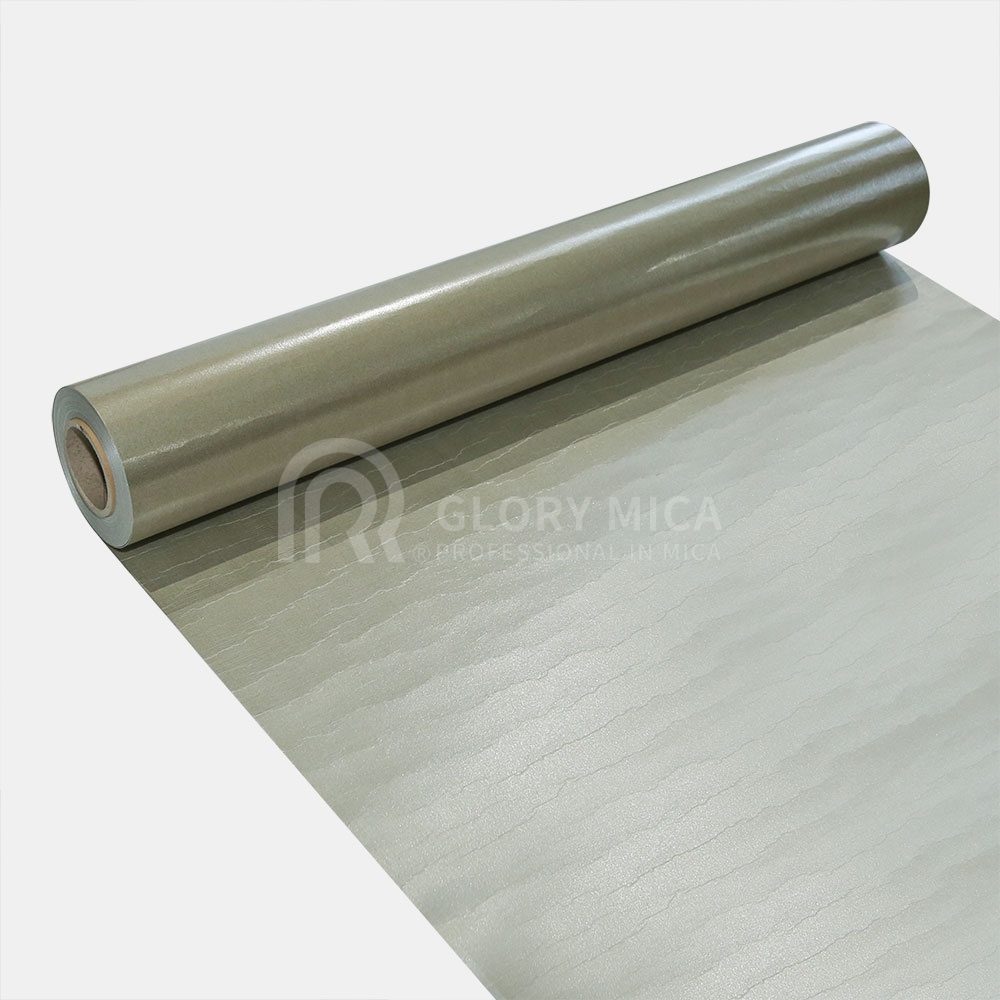
Mica roll is the format that moved from appliances into battery packs. R-5461 roll consists of mica paper impregnated with a special silicone resin on glass cloth, available in lengths of 20 m, 25 m, 40 m, 50 m and 100 m. Thicknesses from 0.2 mm to 0.5 mm carry published breakdown voltages from above 2 kV to at least 5 kV. In the new energy vehicle field the material is used as a fireproof layer in battery power modules and as gaskets and separators, where its documented function is to block flame spread to adjacent cells, to prevent high-voltage sparking from metal debris, and to avoid toxic smoke emission. The same product is used as temperature-resistant insulation in power lines and home decoration cables, and in irons, hair dryers, toasters, kettles, cookers and microwave ovens.
Mica tube
Mica tube is formed by rolling mica paper fixed with silicone resin into a tube. Phlogopite tube is rated at 700 °C continuous and 1000 °C intermittent with a dielectric strength above 1.5 kV/mm; muscovite tube at 500 °C and 800 °C. Both are used as insulating tube material in electric equipment, motors, furnaces and arc furnaces.
Mica parts and mica insulator
Mica parts are produced to customer drawings rather than to a catalogue number, in 2D form, 3D form or as an assembled component, with shape, size and tolerance set by the drawing. Parts for thermal protection are built from phlogopite mica paper, mica tube and mica roll, and serve new energy, energy storage cabinet and intelligent robot applications. The mica insulator is a different construction: an entirely mineral body of mica and a glass binding agent that is vitrified by fusion, mixed in powder form and heated under pressure until the melted glass covers the mica flakes into a compact, hard mass. Models R-M52 and R-M259 are specified for the high-speed train brake resistor, with variants for one or two tapped holes or threaded rods.
Etched foil mica heater
The etched foil mica heater puts the mineral to work as a heat carrier rather than a barrier. A metal foil resistance element is etched and sandwiched between two mica sheets. In the wire-wound mica heating element range, the insulation is muscovite or phlogopite plate, the resistance wire is Cr20Ni80 or 0Cr25Al5, the voltage range is 100–230 V, and the voltage breakdown resistance is 15 kV/mm at an operating ambient of 500 °C to 1000 °C. Model R-5660-E is manufactured to GB4706.1-2005 and GB4706.23-2007, with a surface temperature of 50–330 °C, an AC voltage range of 5 V to 380 V, a power range of 5 W to 3000 W, a service life above 30,000 hours, a heating time of 3 minutes and a power density of no more than 0.85 W/cm².
A Five-Step Selection Process
- Fix the thermal case. Write down continuous service temperature and intermittent peak separately. If continuous duty exceeds 500 °C, muscovite plate and muscovite tube fall outside the published rating and the specification moves to phlogopite.
- Choose the mineral base from the fire test, not from habit. A cable that must hold at 750–850 °C is a phlogopite tape case; a cable that must hold at 950–1000 °C is a synthetic tape case; the 850–900 °C band is served by calcined tape. Choosing a higher grade than the test requires adds cost without adding compliance.
- Match the format to the conversion process. Wrapping a cable core needs a tape with defined tensile strength and a smooth, dry, non-adhesive surface. Lining a battery module needs a roll with a defined breakdown voltage and a ceramic or glass backing. Insulating a heater former needs rigid or flexible plate cut to shape. A tube replaces a wound sleeve in motors and furnaces.
- Verify the electrical numbers against the drawing. Published figures such as dielectric strength above 20 kV/mm for plate or above 1.5 kV/mm for tube are material properties, not part properties. Confirm the value at the specified thickness and confirm the tolerance that the drawing allows.
- Close the compliance and supply loop. Ask for the certificate numbers, the product scope covered by each certificate, and validity dates. Then ask for the production base behind the quotation, because a fire-rated material that cannot be resupplied is a line-stop risk rather than a saving.
Where Mica Insulation Is Used
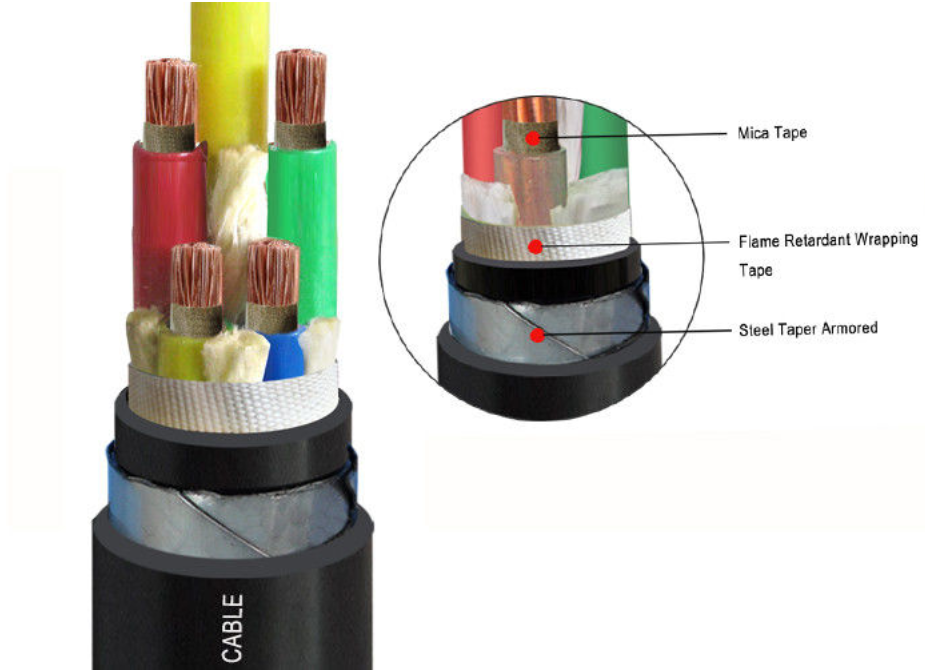
Fire-resistant cable. The tape is wrapped between the core and the sheath. In normal conditions it is soft and insulating; under fire the adhesive peels away while the mica sheet remains, the sheet ceramicises into a shell, and the shell provides physical insulation. That sequence is what keeps fire emergency systems, evacuation indicator lights and rail braking circuits powered for a defined period after a fire starts.
Electric vehicles and energy storage. Current battery packs operate in the 400 V to 800 V range, and a cell short can drive local temperature above 1000 °C. Mica sheet and roll act as a non-conductive, non-combustible barrier that blocks flame propagation to neighbouring cells and prevents high-voltage sparking from ejected metal debris.
Industrial heating and metallurgy. In transformers, electric furnaces, generators and magnetic coils, mica plate is attached to the inner side of the energised coil. A plate of about 1 mm is described as blocking tens of thousands of volts, which is why the material is used both as coil insulation and as a containment layer that limits the consequence of a furnace crack.
Household appliances. Irons, hair dryers, fan heaters, toasters, coffee cookers and microwave ovens all use mica as the barrier between a heating element and a plastic housing. In smart ovens the heating circuit can be etched directly onto a flat mica carrier, so the same sheet insulates and heats.
Rail traction and braking. Because the layered crystal structure resists arc burning, mica is used to stop a high-voltage arc from establishing a conductive carbonised channel on the surface. The R-M52 and R-M259 mica insulators are specified for the high-speed train brake resistor.
Quality, Compliance and Supply

Glory Mica's published company profile states that the company has passed ISO9001, ISO14001, ISO14005 and IATF16949 management system certification, that its products have passed UL and FDA certification, and that they meet EU RoHS and REACH environmental requirements. These are company-reported claims, and the profile does not publish certificate numbers, issuing bodies, validity dates or the product scope each certificate covers. A buyer should request those documents before approving a grade for a regulated application.
Two structural facts matter for supply risk. First, production is spread across three plants — Pingjiang at 136,000 m² and 52,000 tonnes per year, Xinhuang Plant I at 68,000 m² and 16,000 tonnes per year, and Xinhuang Plant II at 200,000 m² and 20,000 tonnes per year — rather than concentrated at a single site. Second, the company reports a 50% export share with the EU and USA as main markets, which implies routine handling of RoHS and REACH documentation rather than occasional requests.
Frequently Asked Questions
How should buyers evaluate China mica insulation tape manufacturers?
Start with the compliance file, not the price. Ask each manufacturer for certificate numbers, issuing bodies, validity dates and the exact product scope covered by ISO9001, ISO14001, ISO14005, IATF16949, UL and FDA certification, plus a RoHS and REACH declaration for the specific grade. Glory Mica's published profile states all six of these, but the profile itself does not carry certificate numbers or scope, so the documents must be requested. Where glass-bonded mica is part of the specification, ASTM D1039-16(2022) is the published ASTM test-method reference for glass-bonded mica used as electrical insulation, and a test report should be requested separately from the standard citation.
What mica insulation formats can Glory Mica supply?
The published portfolio covers mica tape, mica plate and mica sheet, mica roll, mica tube, mica laminate and mica washer, mica parts for thermal protection, mica insulator, etched foil mica heater, mica paper and epoxy glass laminate. Tape is supplied in 500 m, 1000 m and 2000 m lengths and also in spool packing with trays carrying up to 50,000 m. Roll is supplied in 20 m to 100 m lengths. Plate is available in rigid, glossy, flexible and thick families from 500 °C to 700 °C continuous rating. Parts are produced to customer drawings in 2D, 3D or assembled form.
What drives the price of a mica insulation order?
No public price benchmark exists for mica insulation, and quotations are built per specification. Four variables dominate. The mineral base sets the raw material cost, because phlogopite, synthetic and calcined mica paper are different inputs from muscovite. The reinforcement sets the converting cost, since glass cloth on one side, glass on both sides, film backing and ceramic fibre backing are different lamination steps. The dimensional package matters, because a 0.10 mm tape and a 2.5 mm ceramic-backed roll consume very different amounts of material per square metre. Finally, the electrical target matters: within one tape family, published breakdown voltage moves from above 1.2 kV to above 5.5 kV, and a higher target is reached with more mica content rather than with a thicker binder. Quotations should therefore be requested against a drawing and a target breakdown value, not against a product name.
Can mica tape or mica plate be validated before a volume order?
Validation should combine published data with a specification agreed against your own drawing. Glory Mica publishes per-model figures such as thickness and tolerance, mica content, binder content, breakdown voltage, tensile strength and fire grade for each tape, plate, roll and tube model, which allows a shortlist to be built without a sample. Dimensions, voltage, power and specifications can be customised to customer requirements, and mica parts are produced to customer-supplied shape, size and tolerance. The practical validation package for a first order is therefore: the target application temperature and fire test, the required breakdown value, the drawing or roll dimensions, and the compliance documents for that specific grade.
What supports supply continuity for large mica insulation orders?
Capacity and site diversification are the two observable indicators. Glory Mica operates three manufacturing plants in Zhejiang and Hunan with a total factory area of approximately 404,000 m² and a combined annual capacity of roughly 88,000 tonnes, staffed by approximately 617 employees with more than 90 in R&D, and reports a 50% export share with the EU and USA as main markets. Those figures describe production scale rather than a committed delivery date, so lead time should always be confirmed per order and per grade. Buyers can request a quotation, technical datasheet or company profile directly from Glory Mica at info@glorymica.com or through www.glorymica.com to start that confirmation.
Conclusion
Mica insulation is not a single product. It is a family defined by four mineral bases — muscovite at 500 °C continuous, phlogopite at 700 °C continuous, synthetic and calcined grades for the highest fire ratings — delivered in seven formats from tape to etched foil heater. The specification decision is driven by continuous temperature, the fire test the finished assembly must pass, the conversion process, and the electrical target at the specified thickness. The commercial decision is driven by whether the supplier can produce certificate numbers, a product-scoped compliance file, and a production base that survives a second order. Get those two decisions in the right order and the material stops being a commodity search and becomes an engineered component.

Next step: match a grade to your drawing
Send the operating temperature, the fire test, the required breakdown value and the drawing or roll dimensions, and Glory Mica will confirm the matching mica tape, plate, roll, tube, part, insulator or heater specification, together with the datasheet and quotation for that grade.
Request a quotationDownload the company profile (PDF)Email: info@glorymica.com | Tel: +86-573-83679942 (Overseas) | WhatsApp: +86 158-6837-3120
Have Questions or Need More Details?
Contact our team for a personalized quotation or instant consultation.
Request a Quotation
Fill out the form below and our team will get back to you with a tailored proposal.
WhatsApp Direct Chat
Prefer to chat in real-time? Message us on WhatsApp for instant assistance & quick answers.
- Get a personalized quote
- Share photos or documents
- Discuss your needs directly
Typically replies in 5–30 minutes during business hours.