
Hybrid Solar Inverter for Telecom Base Stations: Sizing, MPPT and Battery Setup
A hybrid solar inverter for an off-grid telecom base station is not sized like a residential unit. The site carries a constant, non-negotiable load; the PV array must stay inside a narrow MPPT window; and the battery bank's charge acceptance is capped by the inverter itself. For a 6.5 kW class site, the SYP6.5KW48V hybrid solar inverter from GOTOSOLAR (FOSHAN SOLARUP TECHNOLOGY CO.,LTD) is configured around three limits: 12 kVA surge capacity for compressor and pump starts, a 9000 W maximum PV input inside a 60–450 VDC MPPT range, and 120 A maximum charge current into a 48 V battery bank.
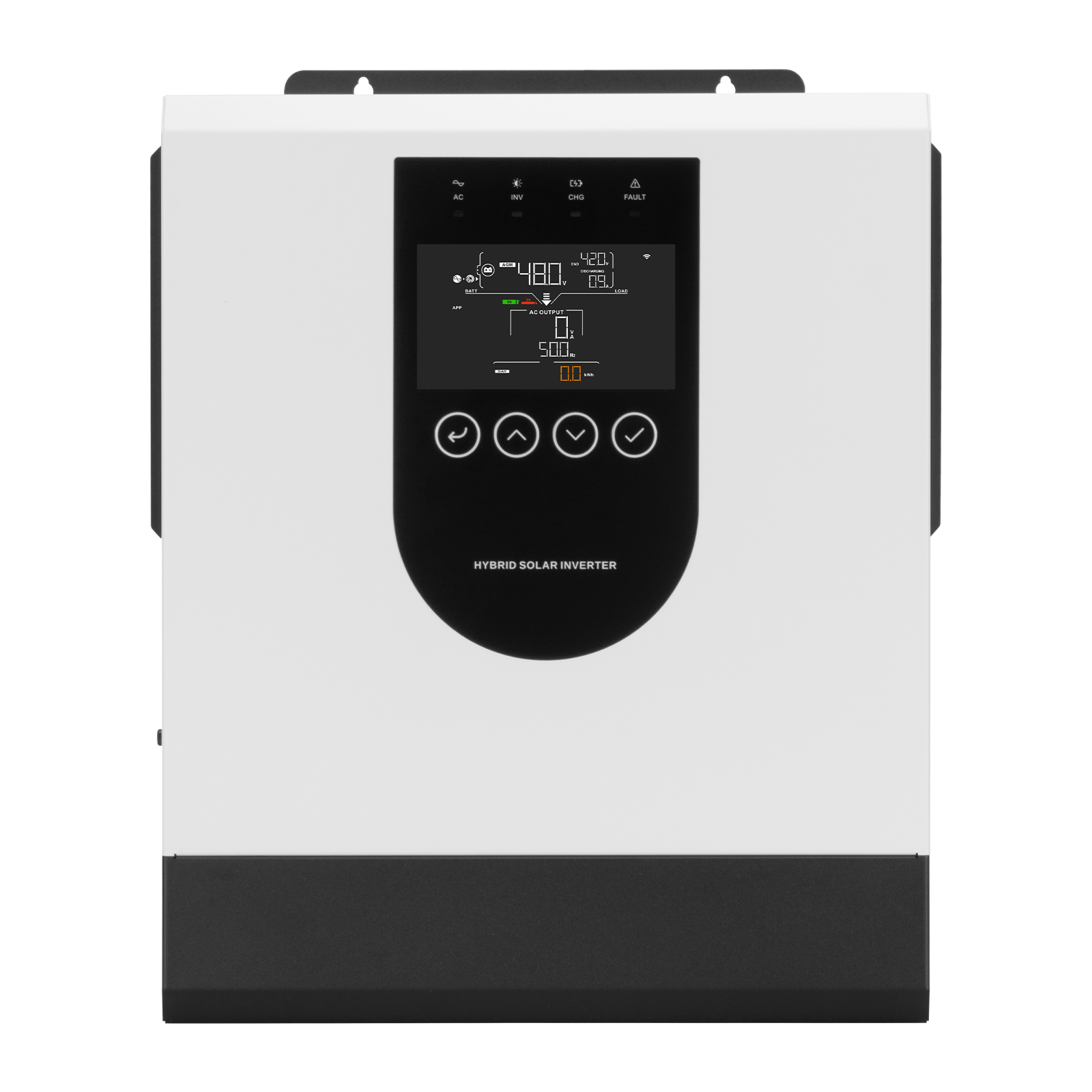
SYP6.5KW48V hybrid solar inverter — the unit covered in this application guide for off-grid telecom base station projects.
This guide is written for buyers at the evaluation and execution stage: EPC contractors, telecom site engineers and importers who have already selected a topology and now need a specific site to work. It covers load sizing with the dual AC output, MPPT string design, battery selection for lithium or lead-acid, generator integration, and the environment and compliance checks that decide whether a unit can be signed off.
One working rule applies throughout: audit the load first, design the array second, size the battery third, and treat IP21 protection, altitude derating and CE documentation as handover conditions rather than afterthoughts.
Problem Definition: Where Off-Grid Telecom Sites Actually Break Down
A base station load profile is narrow, constant and non-negotiable. Radio and transmission equipment draws a steady current around the clock, while air-conditioning, pumps and service tools add intermittent peaks. Most failures in this class trace back to five sizing and commissioning errors rather than to hardware defects.
- Surge trips on startup. Continuous load may sit well below 6.5 kW, yet a compressor or pump start can momentarily demand several times that figure. An inverter without surge headroom trips, and the site drops.
- Strings outside the MPPT window. An array whose open-circuit voltage climbs past the 450 VDC upper limit on a cold morning, or which cannot reach 60 VDC to start, will either be refused by the inverter or deliver nothing.
- Charge current above what the bank can absorb. The inverter can deliver up to 120 A of charge current. A bank sized too small for that current is pushed toward BMS protection or accelerated ageing.
- Chemistry commissioning errors. Lead-acid banks require an activation step; lithium banks depend on a matching BMS communication protocol. Skipping either produces a bank that looks connected but is not properly managed.
- Environment mismatches. An IP21 unit installed where rain reaches the terminals, or a site above 1000 m operated without derating, will not deliver its datasheet behaviour.
Industry Background: Why Small Off-Grid Sites Are Moving to Hybrid
Off-grid telecom sites have historically run on diesel generators with a battery buffer. Fuel delivery to remote towers is both the dominant operating cost and the dominant failure risk — a generator that runs dry takes the site down regardless of how good the radio equipment is. Hybrid architecture keeps the generator as a backup and lets a PV array plus a battery bank carry the base load.
The commercial weight behind that shift is visible in the market. The global solar hybrid inverter market was valued at USD 10.7 billion in 2024, according to Grand View Research. Demand is not uniform across product classes, but the 48 V low-voltage segment is where small and mid-size off-grid sites, including telecom shelters, are typically configured.
Standards context matters as much as market context. IEC 62109 is the international standard for PV power converters, while UL 1741 is the primary safety standard for grid-connected inverters in North America, as published by UL Solutions. For projects in Europe or in markets that follow European practice, CE marking under the Low Voltage Directive and the EMC Directive is the documentation set most often requested at handover. GOTOSOLAR lists telecommunications base stations among its documented application scenarios, alongside residential rooftop, commercial projects and remote off-grid villages.
Detailed Solution: How the SYP6.5KW48V Maps to a Base Station
The SYP6.5KW48V is a 6.5 kW, 48 V low-voltage hybrid solar inverter. Its value at a telecom site comes from how each interface behaves under a constant DC load, not from a single headline figure.
Dual AC output separates critical from non-critical load
The unit provides dual AC output, which allows the site to be split into two circuits. Radio and transmission equipment can sit on the priority output while air-conditioning, lighting and service sockets run on the second. When battery state of charge falls, the non-critical circuit can be shed without touching the traffic-bearing load. This is a wiring and configuration decision, and it belongs to the design stage rather than to commissioning day.
PV input: a 9000 W ceiling inside a 60–450 VDC window
The MPPT input accepts a maximum PV input of 9000 W and operates across a 60–450 VDC range. Two checks follow directly. First, the installed array should not exceed the 9000 W input limit — oversizing beyond it adds no harvest and complicates the compliance file. Second, string voltage must be calculated at the coldest expected site temperature, because open-circuit voltage rises as temperature falls and 450 VDC is a hard boundary. At the lower end, the array must be able to reach 60 VDC to start production, which rules out very short strings on low-irradiance sites.
Battery interface: 48 V low voltage, 120 A charge current
The battery interface is 48 V DC low voltage and supports both lithium (LiFePO4 / Li-ion) and lead-acid chemistries. Maximum charge current is 120 A. That figure is a ceiling, not a target: the bank should be sized so its recommended charge rate is reached before the inverter limit is reached. For lithium banks, the specific BMS communication protocols must be checked against the compatibility list before the order is placed. For lead-acid banks, an activation step is part of commissioning.
Generator compatibility and transfer time
The inverter is generator compatible, which makes a hybrid design possible: a diesel set covers prolonged poor-weather periods instead of running continuously. Transfer between sources is specified at under 10 ms, fast enough that sensitive equipment does not restart during a changeover. Generator sizing, fuel logistics and run-hour policy remain site-level engineering decisions, but the inverter interface is designed to accept generator input.
Monitoring: RS485 standard, WiFi optional
Remote monitoring is available through RS485 as standard, with WiFi as an option. For a telecom operator this is an operational requirement rather than a convenience: battery state of charge, PV yield, load status and fault codes need to reach a network operations centre without a site visit. Because RS485 is also the physical layer behind many BMS and Modbus integrations, the same port can serve both monitoring and battery communication planning, subject to the protocol list.
Environment and compliance envelope
The unit carries an IP21 rating: protection against solid objects larger than 12.5 mm and against vertically falling water drops. In practice that means an indoor installation or a protected outdoor position such as under an eave — not direct rain exposure. Telecom shelters normally satisfy this, but outdoor cabinets opened during rain do not. The inverter is rated for operation up to 4000 m altitude, with derating required above 1000 m, which directly affects mountain and highland sites. CE certification covers the model through a CE-LVD certificate against EN 62109-1:2010 and EN 62109-2:2011, and a CE-EMC certificate against the EN IEC 61000-6 series under EMC Directive 2014/30/EU.
| Design parameter | SYP6.5KW48V specification | What it constrains at the site |
|---|---|---|
| Output class | 6.5 kW | Sets the continuous AC load ceiling for the shelter |
| Surge capacity | 12 kVA | Covers compressor, pump and tool starting currents |
| AC outputs | Dual output | Splits critical radio load from non-critical load |
| Maximum PV input | 9000 W | Caps installed array size |
| MPPT voltage range | 60–450 VDC | Defines string length and the cold-temperature Voc check |
| Maximum charge current | 120 A | Caps usable battery bank charge acceptance |
| Battery voltage | 48 V DC low voltage | Fixes bank configuration and BMS selection |
| Battery chemistries | Lithium (LiFePO4 / Li-ion) and lead-acid | Determines the commissioning procedure |
| Transfer time | Under 10 ms | Prevents equipment restart during changeover |
| Monitoring | RS485 standard; WiFi optional | Enables remote site supervision |
| Ingress protection | IP21 | Requires indoor or protected installation |
| Altitude | Up to 4000 m, derating above 1000 m | Applies to highland and mountain sites |
| Certification | CE (LVD EN 62109-1/-2; EMC EN IEC 61000-6-3/-1) | Supplies the handover documentation set |
OEM, ODM, OBM and JDM options for telecom projects
Telecom rollouts often require the inverter to match an operator's or distributor's own specification. GOTOSOLAR provides OEM, ODM, OBM and JDM production services, with customization covering hardware (PCB layout, enclosure material and colour, terminal type, display screen), software (startup logo, UI language, charging algorithms, communication protocols on RS485/Modbus) and packaging (colour box design, manual language). Monthly capacity is 60,000 units for standard models and 20,000 units for customized models.
Step-by-Step Breakdown: Configuring a Site
Step 1 — Audit the load and assign the two outputs
List the continuous AC load, the peak loads with their starting currents, and the DC radio load separately. Then decide which circuits belong on the priority output. A common mistake is to place air-conditioning on the priority circuit because it is the largest load; that defeats the purpose of a dual output, which is to protect the traffic-bearing load when the battery is low.
Step 2 — Size the inverter against surge, not average
With 6.5 kW of continuous output and 12 kVA of surge capacity, the unit accommodates typical cycling loads at a small or mid-size site. If the largest motor start plus the standing radio load approaches or exceeds 12 kVA, either split the loads across the two outputs or stagger the starts. Compare the result against the surge figure before ordering, not after commissioning.
Step 3 — Design the array inside 9000 W and 450 VDC
Calculate string open-circuit voltage at the minimum expected site temperature and confirm it stays below 450 VDC. Confirm the array can reach 60 VDC to start. Keep total PV input at or below 9000 W. Sites with long cable runs should also account for voltage drop, because a string that starts close to the lower limit at the inverter terminals may not start at all once cable losses are included.
Step 4 — Size the bank against 120 A
Select the chemistry first, then size the bank so its recommended charge rate is met by the array before the inverter's 120 A ceiling is reached. For lithium, match the BMS communication protocol against the compatibility list. For lead-acid, plan the activation step into the commissioning schedule. In both cases the bank voltage is fixed at 48 V DC low voltage.
Step 5 — Integrate the generator
Confirm the generator is compatible and decide the run-hour policy — for example, start on low state of charge and stop on a defined recharge level. The under-10 ms transfer time keeps the radio load stable during changeover. Check that the generator's charge path does not push the bank beyond its recommended acceptance rate, since the 120 A ceiling applies to the charging system as a whole.
Step 6 — Close environment, compliance and acceptance
Verify that the mounting position satisfies IP21, that any site above 1000 m carries a derating calculation up to the 4000 m limit, and that the CE certificate set is filed for handover. On the supply side, every unit is aged before delivery, testing data can be confirmed by video, and third-party inspection by SGS or TUV is welcome. Those three acceptance steps are worth writing into the purchase order.
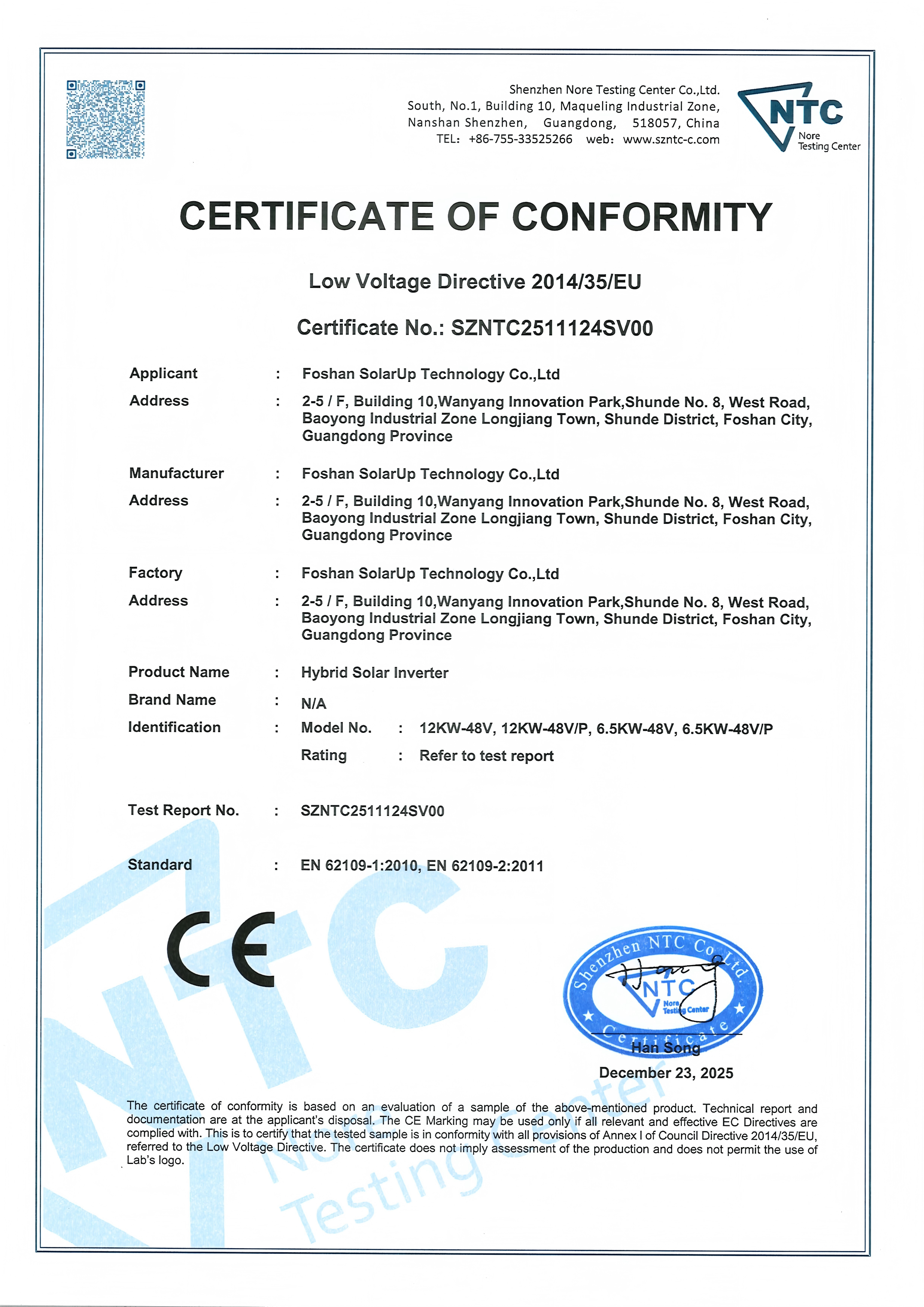
CE-LVD certificate covering the SYP 6.5KW/12KW 48V series against EN 62109-1:2010 and EN 62109-2:2011 — the document most often requested at telecom site handover.
Use Cases: Four Telecom Scenarios That Fit This Configuration
1. Off-grid macro site with diesel backup
A shelter running radio and transmission equipment continuously, with air-conditioning cycling through the day, is the reference case. The 6.5 kW output covers the standing load, the 12 kVA surge covers the air-conditioning start, and the generator remains available for extended low-irradiance periods. Dual output keeps the radio circuit energised when the non-critical circuit is shed.
2. Rural micro site in Africa or the Middle East
GOTOSOLAR lists Africa and the Middle East among its main markets, and the 48 V low-voltage architecture suits small sites where a technician visit is expensive. In a South African solar storage distribution project documented by the manufacturer, hybrid inverters were used to replace diesel generators, fuel costs fell by 80%, and systems ran at 45°C without derating with a failure rate below 1% over more than three years of continuous operation. That project was residential rather than telecom, but it illustrates the same substitution logic: solar plus battery carries the base load, diesel covers the exception.
3. Highland sites above 1000 m
Mountain and highland towers are common in several of the manufacturer's export markets. The unit operates up to 4000 m, but output must be derated above 1000 m. A highland site therefore needs its load list reviewed against the derated capability, not the sea-level figure, and the derating calculation should be filed alongside the CE documentation.
4. Lead-acid retrofit on an existing shelter
Where a shelter already has a 48 V lead-acid bank, the inverter can be introduced without changing chemistry, provided the activation step is planned and the bank's charge acceptance is matched to the 120 A ceiling. This is often the lowest-disruption route for an operator upgrading an existing diesel-only site in stages.
Comparison Table: Lithium and Lead-Acid on the Same 48 V Inverter
Both chemistries are supported by the SYP6.5KW48V. The decision is driven by site conditions, maintenance access and monitoring requirements rather than by a general preference.
| Decision criterion | Lithium (LiFePO4 / Li-ion) | Lead-acid |
|---|---|---|
| Compatibility with the SYP6.5KW48V | Supported; BMS communication protocol must be matched against the compatibility list | Supported; an activation step is required at commissioning |
| Charge management | Handled through the battery BMS | Handled by the inverter's charging algorithm |
| Space and weight at equal usable capacity | Generally more compact and lighter | Generally bulkier and heavier, which matters in a small shelter |
| Thermal behaviour | Operating limits are enforced by the BMS | Performance and service life are generally more sensitive to sustained high temperature |
| Data available for remote monitoring | BMS data can be surfaced through the communication interface | Typically voltage and current only, unless external monitoring is added |
| Typical fit | Sites with limited shelter space and a requirement for remote supervision | Sites with an existing bank, or rural builds where the bank is already in place |
Neither column is universally better. At a remote site where a technician visit is costly, the BMS data and smaller footprint usually justify the higher unit cost of lithium. Where a lead-acid bank already exists, planning the activation step and the charge algorithm is a smaller change than a chemistry migration.
Every unit is aged before delivery; testing data can be confirmed by video and third-party inspection is accepted.
FAQ: Telecom Base Station Hybrid Solar Inverter Questions
Which CE certificates should a telecom project expect for the SYP6.5KW48V?
Two certificate sets apply. The CE-LVD certificate, numbered SZNTC2511142SV00 / SZNTC2511124SV00 and issued by Shenzhen Nore Testing Center Co., Ltd. (NTC), covers the SYP 6.5KW/12KW-48V series against EN 62109-1:2010 and EN 62109-2:2011 under the Low Voltage Directive 2014/35/EU. The CE-EMC certificate CTC191J0808101EC, issued by Shenzhen Circle Testing Certification Co., Ltd., names the SYP-6.5KW-48V specifically and covers EN IEC 61000-6-3:2021, EN IEC 61000-6-1:2019, EN IEC 61000-3-2:2019/A1:2021 and EN 61000-3-3:2013/A2:2021 under EMC Directive 2014/30/EU. CE is not a substitute for UL 1741, which is the primary safety standard for grid-connected inverters in North America; projects in that market need separate documentation.
Can the SYP6.5KW48V be customized for an operator's monitoring and branding requirements?
Yes. The manufacturer provides OEM, ODM, OBM and JDM production services. Customization covers hardware (PCB layout, enclosure material and colour, terminal type, display screen), software (startup logo, UI language, charging algorithms, RS485/Modbus communication protocols) and packaging (colour box design, manual language). For telecom projects the software items usually matter most, because the RS485 interface typically has to map into an existing network management system.
What are the purchasing terms, MOQ and payment conditions for a project order?
Documented purchasing terms for project orders list an MOQ of 50 units, FOB delivery, 30% T/T deposit with 70% balance before shipment, and L/C at sight accepted for large orders. Acceptance criteria include a 100% aging test before shipment, video confirmation of testing data, and third-party inspection by SGS or TUV is welcome.
How is a sample validated before a telecom project order is placed?
Samples are available with a 7–10 day lead time. A practical validation plan covers the aging test record, a live check of the dual AC output configuration, confirmation of MPPT start voltage against the actual string, and a BMS protocol test where a lithium bank is specified. Because every unit is aged before delivery, sample results follow the same test path as production units.
What are the sample and bulk lead times for this hybrid solar inverter?
Sample lead time is 7–10 days, small orders under 500 pieces run 15–20 days, and bulk orders run 30–45 days depending on customization complexity. Monthly capacity is 60,000 units for standard models and 20,000 units for customized models, so staged rollouts can usually be scheduled. To confirm dates for a specific rollout, send the site load list and target quantity to wilson@gtsolar.cn.
Conclusion
Telecom base station sizing is a three-part calculation, and the SYP6.5KW48V sits inside it when each part is completed in order: a surge check against 12 kVA with the dual AC output assigned correctly, an array design that respects the 9000 W ceiling and the 60–450 VDC window at the coldest site temperature, and a 48 V bank whose charge acceptance is reached before the inverter's 120 A limit.
Two conditions decide whether a site is signed off rather than merely commissioned. The mounting position must match the IP21 rating, and any site above 1000 m must carry a derating calculation up to the 4000 m limit. The CE documentation — LVD against EN 62109-1/-2 and EMC against the EN IEC 61000-6 series — supplies the handover file, while the under-10 ms transfer and the RS485 monitoring interface cover the operational requirements a network operations centre will ask about.
For projects that need a private-label or protocol-adapted unit, OEM, ODM, OBM and JDM services are available with customization across hardware, software and packaging.
Next step: send the site load list, not a generic enquiry
A single page is enough — continuous AC load, largest motor starting current, DC radio load, target autonomy, site altitude and preferred battery chemistry. With that, the configuration can be confirmed, a sample plan prepared and a quotation issued.
Email: wilson@gtsolar.cn | Tel / WhatsApp: +86 153-0713-5737 | Website: www.gotosolar.com.cn
Product catalog (PDF): Download the GOTOSOLAR inverter catalog

Packed units ready for container shipment; bulk orders run 30–45 days depending on customization complexity.
Have Questions or Need More Details?
Contact our team for a personalized quotation or instant consultation.
Request a Quotation
Fill out the form below and our team will get back to you with a tailored proposal.
WhatsApp Direct Chat
Prefer to chat in real-time? Message us on WhatsApp for instant assistance & quick answers.
- Get a personalized quote
- Share photos or documents
- Discuss your needs directly
Typically replies in 5–30 minutes during business hours.