
Top Hybrid Solar Inverter Picks for 2026: Why the 6.5 kW MPPT Model Makes the Shortlist
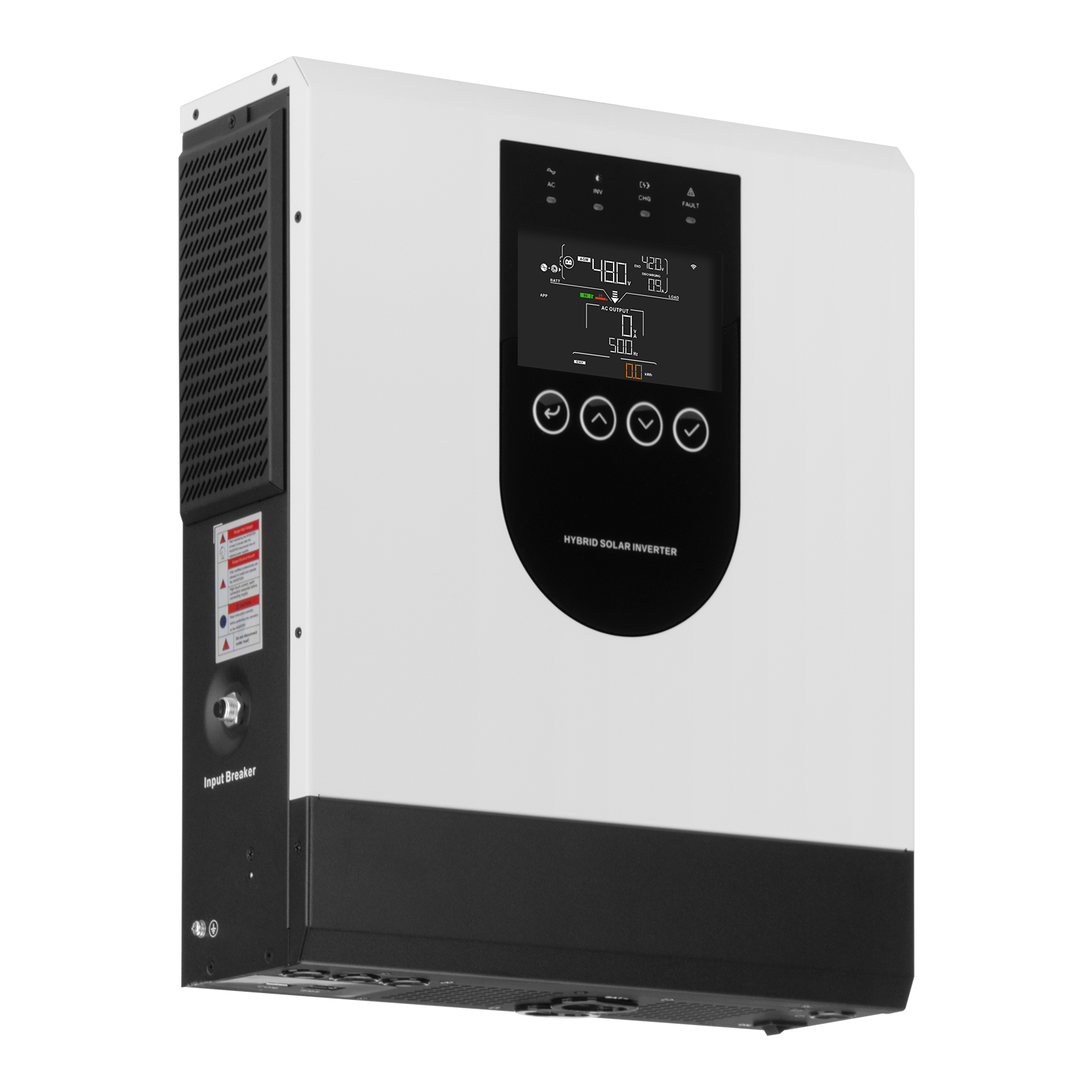
A hybrid solar inverter shortlist for 2026 should be built from project conditions, not from brochure wattage. This article ranks hybrid solar inverter configurations for one specific scenario: a home or light-commercial solar storage system that must ride through grid outages, may be installed at high altitude, and may keep a generator as a second charging source. The top pick is the GOTOSOLAR SYP6.5KW48V, a 6.5 kW, 48 V, MPPT-based hybrid inverter whose documented feature set clears all four entry criteria used below.
Problem Definition: What Actually Decides a Hybrid Inverter Shortlist
A hybrid solar inverter earns a place on a 2026 shortlist when it satisfies four measurable entry criteria at the same time — not when it carries the largest nameplate rating in a supplier catalogue. Those four criteria are the filter used throughout this article:
- Pure sine wave output. The output waveform decides whether motors, compressors, pumps and sensitive electronics run cleanly on inverter power. The GOTOSOLAR SYP series is specified with a pure sine wave output.
- Optional WiFi monitoring. Monitoring matters to installers who need to prove system performance and to owners who need early warning. On the SYP6.5KW48V, WiFi monitoring is available as an optional internal or external module.
- Generator compatibility. Where the grid is unreliable, an existing diesel or petrol generator is usually the second charging source. An inverter that cannot accept generator input forces an expensive redesign of the whole system. The SYP6.5KW48V is documented as workable with a generator.
- Operation up to 4000 m altitude. High-elevation sites reduce air density and cooling headroom. The SYP6.5KW48V is rated for a maximum operating altitude of 4000 m, with derating applied above 1000 m.
Each criterion exists because its absence creates a predictable failure mode. A modified sine wave output can make compressors and pumps run hot or refuse to start. An inverter without a generator input leaves a rural site with a single charging source. An altitude rating below the actual site forces a mid-project derate or a replacement. An incomplete certificate file can hold a container at customs or block a utility approval long after the hardware has been paid for.
Industry Background: How the Hybrid Inverter Market Looks Going Into 2026
Market scale is not a purchase criterion, but it explains why the 6–8 kW single-phase class remains crowded and why supplier selection matters more than model hunting. The global solar hybrid inverter market was valued at USD 10.7 billion in 2024, according to Grand View Research, while the residential sub-segment alone was valued at USD 4.55 billion in 2023 (Markets and Data). Product mix skews toward larger systems: three-phase hybrid inverters held a dominant revenue share of over 61.3% in the global market in 2024, per Grand View Research — a figure driven by commercial and utility-side installations rather than by single-phase home systems.
Concentration at the top is high. Huawei and Sungrow combined for 55% of the global PV inverter market share in 2024, according to Wood Mackenzie. That concentration shapes the buying experience: small and mid-sized projects are frequently served by specialist manufacturers rather than by the market-share leaders, and the differentiator shifts from brand recognition to documented specifications, certification completeness and factory testing discipline.
Two regulatory and trade reference points belong in any 2026 procurement file. UL 1741 is the primary safety standard for grid-connected inverters in North America, while IEC 62109 is the international standard for PV power converters (UL Solutions). For customs classification, solar inverters fall under HS Code 8504.40 as static converters. Forecasts for the category differ by methodology: Grand View Research projects an 8.1% CAGR for 2025–2030, while Precedence Research estimates 9.2% for 2025–2034 because of a longer forecast window and more aggressive off-grid assumptions. Treat any growth figure as directional, not as a planning input.
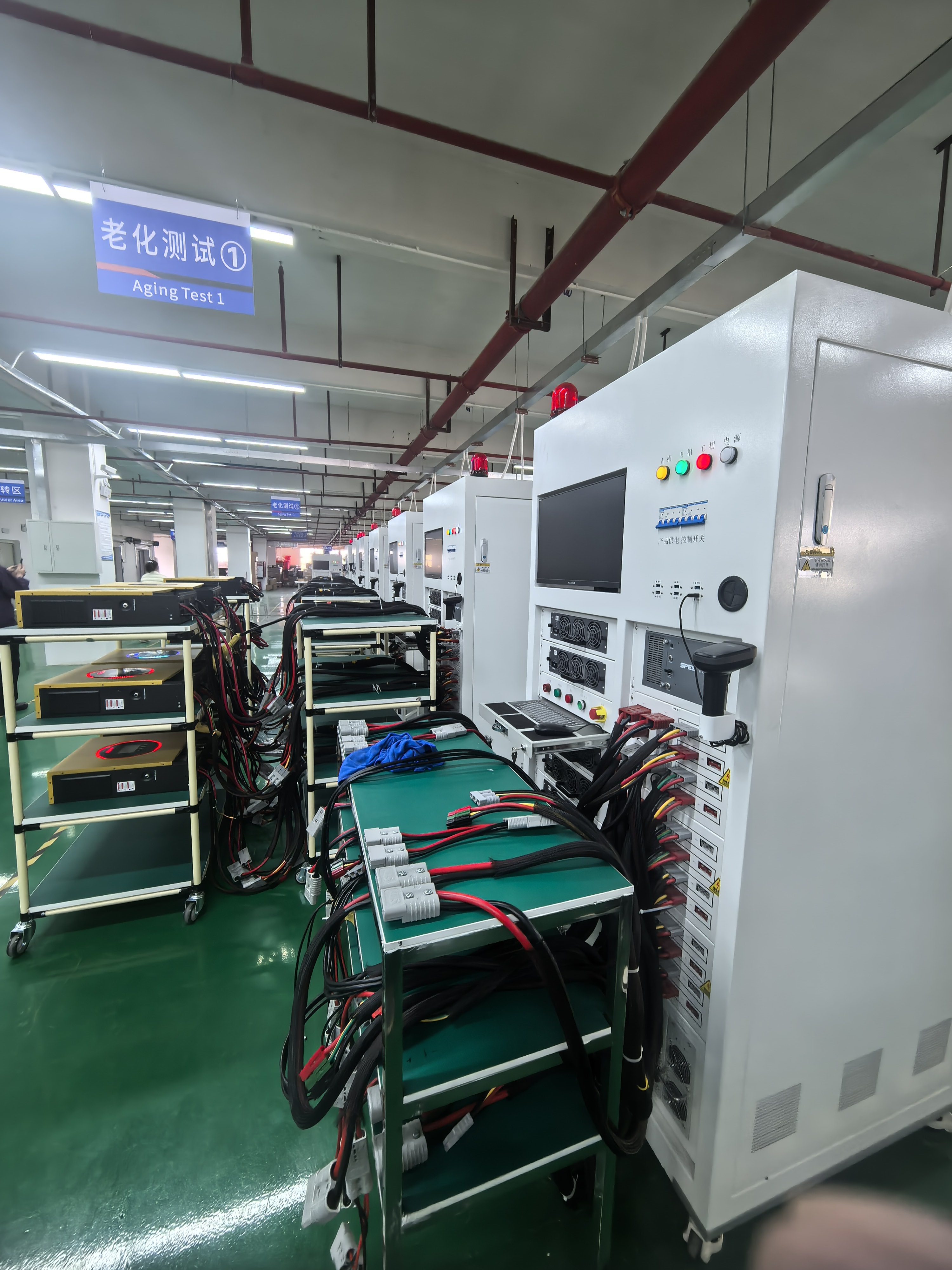
The manufacturer behind the top pick is GOTOSOLAR, the brand of FOSHAN SOLARUP TECHNOLOGY CO.,LTD, a Foshan-based photovoltaic energy-storage manufacturer that produces hybrid solar inverters and solar charge controllers and exports roughly 80% of its output, with Africa and the Middle East as its main markets. The company operates three production bases in Foshan, Yiwu and Yingtan, with a factory area of 40,000 m², 320 employees and 25 R&D engineers. Its registered annual output is 2,000,000 units, annual shipments of controllers exceed 1 million units, and daily hybrid inverter production capacity reaches 2,000 units. Product quality is supported by ISO9001:2015, CE, RoHS, EN and IEC certification across approximately 50 product series, with 100% full-function testing of all goods before delivery.
Detailed Solution: The Ranked 2026 Shortlist
Rank 1 — GOTOSOLAR SYP6.5KW48V: the 6.5 kW, 48 V MPPT hybrid inverter
The SYP6.5KW48V clears all four entry criteria and adds the two pieces of evidence that matter most at the evaluation stage: a complete CE certificate and a maximum efficiency of 94% in battery mode at 48 VDC. The documented specification set is as follows:
- Power stage: rated capacity 6.5 kW, surge power 12 kVA, power factor 1, pure sine wave output, 50/60 Hz auto-adaptive, overload capacity of 1 minute at 102%–120% load and 10 seconds above 120% load in battery mode.
- Efficiency: maximum 94% in battery mode at 48 VDC — the figure to quote when comparing configurations, because it is measured at the nominal battery voltage.
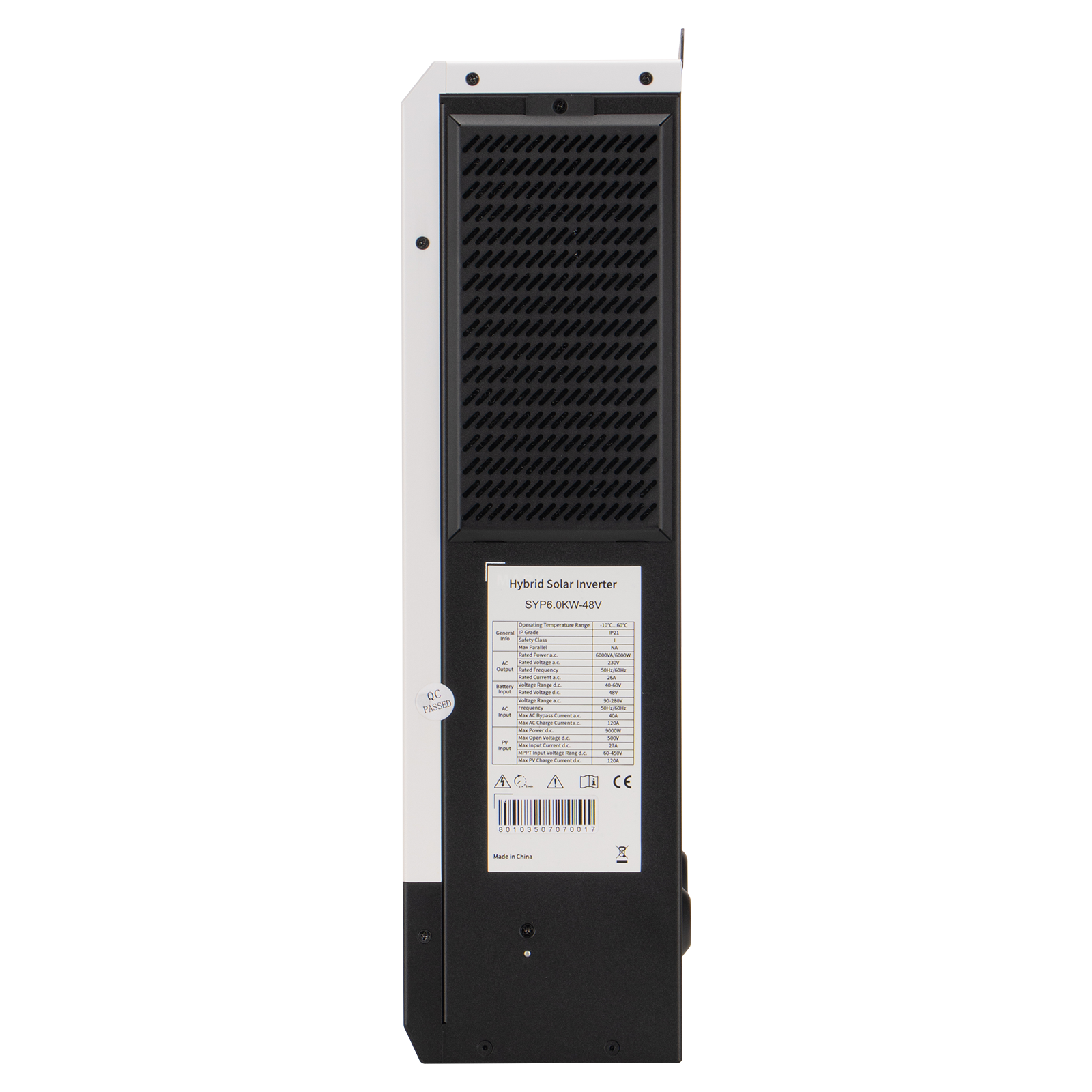
- Solar charger: built-in MPPT type; maximum PV input current 27 A and maximum PV input power 9000 W; MPPT operating window 60–450 VDC; maximum PV open-circuit voltage 500 VDC; maximum PV charge current 120 A.
- Charging: maximum AC charge current 120 A; maximum combined PV + AC charge current 120 A.
- Battery system: 48 VDC rated battery voltage, float charge 54 V, overcharge protection 61 V; supports lithium and lead-acid batteries and includes lithium battery activation.
- Input and output: rated input voltage 208 / 220 / 230 / 240 VAC (L + N + PE); voltage range 90–280 VAC ±3 in normal mode and 170–280 VAC ±3 in UPS mode; dual AC output and feed-in to grid are listed among the platform features.
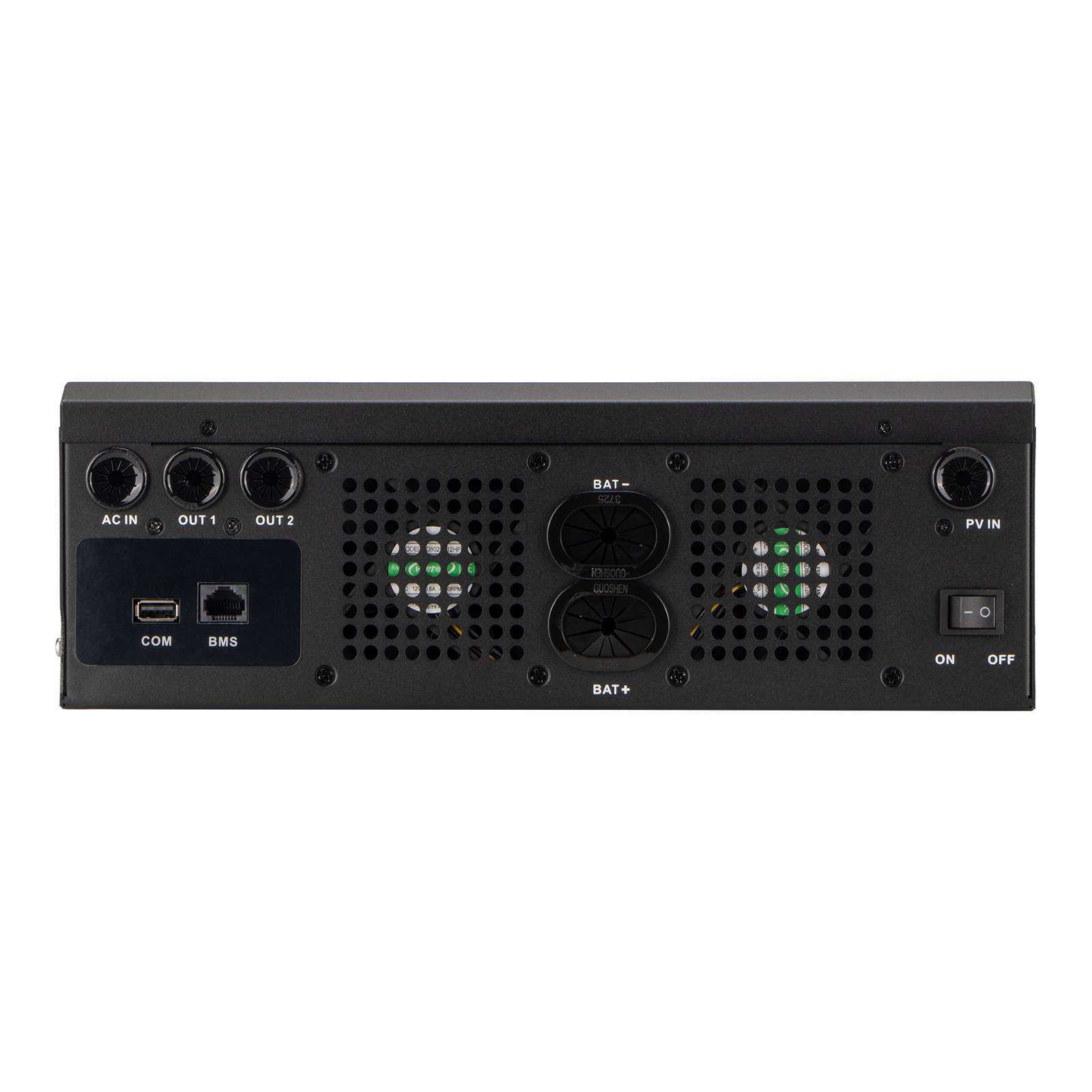
- Interface and monitoring: LCD human-machine interface; RS232 / RS485 / USB ports; WiFi monitoring optional (internal or external).
- Environment: IP21 ingress protection; operating temperature −10 °C to 60 °C; relative humidity 5%–95% non-condensing; storage temperature −15 °C to 60 °C.
- Physical: 8.4 kg net weight; 410 × 336 × 110 mm.
Why this configuration ranks first: the 6.5 kW class matches the load profile of a home with battery backup plus a small commercial circuit, the 48 V battery platform is the voltage class that inverter and battery suppliers most commonly build around, and the 9000 W PV input allows a generous array without stepping up to a larger chassis. The 94% battery-mode efficiency and the complete CE certificate are the two facts that turn a specification sheet into an evaluation argument.
Two limits should be stated plainly. First, IP21 protects against solid objects larger than 12.5 mm and vertically falling water drops — it is designed for indoor installation or a sheltered outdoor position such as under an eave, and it is not an IP65 outdoor enclosure. Second, the 4000 m altitude rating carries derating above 1000 m, so high-elevation projects must size the array and the load with that margin built in.
Rank 2 — GOTOSOLAR 48 V platform for larger projects
Projects that need more headroom stay on the same architecture. The SYP family extends to the SYP12.0KW48V and SYP12.0KW48V/P models, which keep the 48 V battery platform while moving up in capacity class — useful for larger homes, small commercial sites and installations that separate critical loads from general loads. GOTOSOLAR also publishes an 8.2 kVA / 8200 W 48 V single-phase hybrid inverter with an IP65 enclosure and parallel function capability, which is the relevant option when an outdoor-rated enclosure or parallel operation is required. Model-specific values for these units should be confirmed against the current data sheet before the shortlist is finalised.
Rank 3 — GOTOSOLAR SYP4.0KW24V
The 24 V, 4.0 kW configuration suits smaller homes, shops and light-duty backup where a 48 V battery bank would be oversized. It sits on the same SYP platform, so the operating logic, protection behaviour and service model stay familiar for installers who already work with the family.
Rank 4 — GOTOSOLAR SYP1.5KW12V and SYP2.5KW12V
The 12 V models target mobile and small off-grid applications: RV and marine power systems, remote cabins, lighting circuits and small pumps. They belong on a shortlist only when the calculated load stays inside their capacity — they are not substitutes for the 6.5 kW unit in a whole-home backup design.
Rank 5 — Tier-1 global grid-tied platforms (Huawei, Sungrow)
Huawei and Sungrow hold 55% of the global PV inverter market combined (Wood Mackenzie, 2024), and their scale advantage is real in large grid-tied portfolios where global service networks dominate the decision. For the generator-backed, high-altitude, single-phase scenario in this article, however, the same four entry criteria still have to be verified model by model. Where a criterion is not confirmed in the evidence set used here, confirm it directly with the supplier rather than assuming it from brand strength.
Step-by-Step Breakdown: Running the Shortlist Against a Real Project
The ranking above is only useful if it is applied in the right order. Work through these eight steps before issuing a purchase order.
- Define the load and the backup window. Split the site into critical loads (lighting, refrigeration, communications, computers) and normal loads. This determines whether dual AC output is a convenience or a requirement.
- Match the battery voltage to the inverter class. 48 VDC for the 6.5 kW model, with float charge at 54 V and overcharge protection at 61 V; 24 V for the 4.0 kW model; 12 V for the 1.5–2.5 kW models. Voltage mismatch is the most common cause of a system that never reaches its rated output.
- Size the PV array against the charger window. The SYP6.5KW48V accepts up to 27 A / 9000 W of PV input inside an MPPT window of 60–450 VDC, with a hard ceiling of 500 VDC open-circuit voltage. String design is limited by that voltage ceiling, not by the array wattage alone.
- Check the site environment. Operating temperature range is −10 °C to 60 °C, humidity 5%–95% non-condensing, ingress protection IP21, maximum operating altitude 4000 m with derating above 1000 m. IP21 requires an indoor or sheltered position.
- Confirm battery compatibility and activation. The platform supports lithium and lead-acid batteries and includes lithium battery activation. Confirm the BMS communication protocol of the chosen battery against the supplier's compatibility list before delivery, not after.
- Verify the electrical and control interface. 208 / 220 / 230 / 240 VAC input, 50/60 Hz auto-adaptive frequency, and RS232 / RS485 / USB ports for integration. Decide at this stage whether WiFi monitoring is needed as an internal or external module.
- Audit the certificate and testing file. The SYP6.5KW48V carries a complete CE certificate; at company level, GOTOSOLAR holds ISO9001:2015, CE, RoHS, EN and IEC certification. Production quality control runs through IQC, IPQC, a 100% aging test of 4–8 hours, FQC and out-of-box audit, with 100% full-function testing before delivery.
- Plan after-sales before you need it. Hybrid inverters carry a standard 2-year warranty inside a tiered 1–3 year replace-or-repair programme. Bulk orders include 1% free spare parts, and online technical support plus video troubleshooting is provided.
Use Cases: Where the 6.5 kW MPPT Model Fits
Residential rooftop solar with battery backup. This is the primary scenario. The inverter operates through MPPT tracking of the PV array, regulates voltage and current from the panels to charge the battery safely, and prevents overcharging and over-discharging — the two failure modes that shorten battery life fastest. Continuous operation in variable weather conditions is the normal working condition, and 50/60 Hz auto-adaptive output keeps the unit usable across different grid regimes.
Diesel generator replacement in weak-grid and off-grid areas. A large-scale solar EPC contractor serving the South African market ordered two 40HQ containers — approximately 3,000 to 4,000 units — for a large-scale residential solar storage project and regional distribution stocking. The installed systems replaced diesel generators, cutting fuel costs by 80%, and have run continuously for over three years with a failure rate below 1%. The systems also operated stably at an ambient temperature of 45 °C without derating, which is the relevant proof point for hot-climate deployments.
Telecommunications base stations and remote off-grid villages. These sites typically require 24/7 uninterrupted supply, silent operation and support equipment such as solar PV panels, deep-cycle batteries and DC loads. The 45 °C stable-operation result and the sub-1% failure record over three years are the two data points that matter most when a project's maintenance access is limited.
High-temperature and high-altitude installations. The operating range extends to 60 °C ambient with a 4000 m altitude ceiling and derating above 1000 m. Sites above 1000 m should treat the derating factor as a design input rather than a footnote.
Comparison Table: How the Shortlist Lines Up
The table below compares the ranked configurations against the four entry criteria. Where a value has not been confirmed in the evidence set used for this shortlist, it is marked for direct verification instead of being estimated.
| Rank | Configuration | Capacity / battery voltage | Best-fit project | Entry criteria confirmed in published data |
|---|---|---|---|---|
| 1 | GOTOSOLAR SYP6.5KW48V | 6.5 kW rated, 12 kVA surge / 48 VDC | Home or light-commercial backup with generator support and altitude exposure | Pure sine wave: yes. WiFi monitoring: optional internal/external. Generator: workable with generator. Altitude: 4000 m, derating above 1000 m. Efficiency: 94% max in battery mode at 48 VDC. Certification: complete CE certificate. |
| 2 | GOTOSOLAR SYP12.0KW48V / SYP12.0KW48V/P; published 8.2 kVA 8200 W 48 V single-phase (IP65, parallel function) | 12 kW class and 8.2 kVA class / 48 VDC | Larger homes, small commercial sites, outdoor or parallel operation | Platform-level criteria carried from the SYP family; model-specific values to be confirmed against the current data sheet. The 8.2 kVA model is published with IP65 enclosure and parallel function capability. |
| 3 | GOTOSOLAR SYP4.0KW24V | 4.0 kW class / 24 VDC | Smaller homes, shops, light-duty backup | Same SYP platform logic; model-specific values to be confirmed against the current data sheet. |
| 4 | GOTOSOLAR SYP1.5KW12V / SYP2.5KW12V | 1.5–2.5 kW class / 12 VDC | RV, marine, remote cabins, lighting and small pump loads | Intended for mobile and small off-grid use; not a substitute for the 6.5 kW unit in whole-home backup. |
| 5 | Tier-1 global grid-tied platforms — Huawei, Sungrow | Not specified in the evidence set used here | Large grid-tied portfolios where global service networks dominate | Combined 55% of global PV inverter market share in 2024 (Wood Mackenzie). The four entry criteria must be verified model by model; unconfirmed values were excluded rather than estimated. |
For the anchor model, the specification snapshot below translates each documented value into its project consequence.
| Parameter | Documented value (SYP6.5KW48V) | What it means for the project |
|---|---|---|
| Rated capacity / surge | 6.5 kW / 12 kVA | Covers a typical home backup circuit and absorbs motor start-up surges. |
| Output waveform | Pure sine wave | Safe for motors, compressors and sensitive electronics. |
| Max efficiency (battery mode) | 94% at 48 VDC | Quantifies conversion loss at the nominal battery voltage. |
| Solar charger | MPPT, 27 A / 9000 W max PV input | Allows a larger array without changing the inverter chassis. |
| MPPT window / PV voltage ceiling | 60–450 VDC / 500 VDC open circuit | Sets the string design limits. |
| Charge current | 120 A (PV), 120 A (AC), 120 A combined | Defines realistic recharge time for the battery bank. |
| Battery | 48 VDC rated, float 54 V, overcharge 61 V; lithium and lead-acid; lithium activation | Determines which battery chemistries and BMS options qualify. |
| Switch time | 10 ms in normal and UPS mode | Keeps computers and similar loads running through a grid failure. |
| Monitoring and interface | WiFi optional (internal/external); RS232 / RS485 / USB | Supports remote monitoring and system integration. |
| Ingress protection | IP21 | Indoor or sheltered installation only; not for direct rain exposure. |
| Operating temperature | −10 °C to 60 °C | Suits hot-climate deployments within the stated range. |
| Max operating altitude | 4000 m (derating above 1000 m) | High-elevation projects must apply a derating margin. |
| Dimensions / weight | 410 × 336 × 110 mm / 8.4 kg | Relevant for wall mounting and shipping calculations. |
| Certification | Complete CE certificate | Supports import and compliance documentation. |

Frequently Asked Questions
Does the SYP6.5KW48V hybrid solar inverter carry a complete CE certificate, and what does its IP21 rating cover?
Yes. A complete CE certificate is listed as part of the SYP6.5KW48V feature set, and the manufacturer holds company-level certification covering ISO9001:2015, CE, RoHS, EN and IEC across its product series. IP21 means protection against solid objects larger than 12.5 mm and against vertically falling water drops, so the unit is designed for indoor installation or a sheltered outdoor position such as under an eave, and it must not be exposed to direct rain. Where an outdoor-rated enclosure is required, GOTOSOLAR publishes an 8.2 kVA / 8200 W 48 V single-phase hybrid inverter with IP65 enclosure and parallel function capability. Buyers in North America should also note that UL 1741 is the primary safety standard for grid-connected inverters in that market and IEC 62109 is the international standard for PV power converters; confirm the specific listing your project requires before ordering.
Residential hybrid solar inverter manufacturer for home battery backup projects — how should one be evaluated?
Evaluate two layers. On the technical layer, check the solar charger type (MPPT rather than PWM), battery voltage and chemistry support (the SYP6.5KW48V supports lithium and lead-acid at 48 VDC and includes lithium battery activation), generator compatibility, pure sine wave output, and whether dual AC output is available for separating critical loads from general loads. On the manufacturing layer, check full-function testing and aging discipline (100% full-function testing before delivery plus a 100% aging test of 4–8 hours), the completeness of the certificate file, and whether the supplier can support customization. GOTOSOLAR operates three production bases in Foshan, Yiwu and Yingtan, with monthly capacity of 60,000 standard units and 20,000 customized units, and offers OEM, ODM, OBM and JDM models with customization of hardware, software and packaging.
Can the 6.5 kW model run with a generator and with lithium batteries, and how fast does it switch to backup?
The SYP6.5KW48V is documented as workable with a generator, which lets a genset act as a second charging source alongside PV and grid input. It supports both lithium and lead-acid batteries at a 48 VDC rated battery voltage, with float charge at 54 V and overcharge protection at 61 V, and includes lithium battery activation. Switch time is 10 ms in both normal mode and UPS mode, and the output is a pure sine wave, so computers and similar sensitive loads continue running through a grid failure rather than restarting.
What drives the cost of a 6.5 kW hybrid inverter configuration?
Four variables dominate. First, the battery bank: the 48 V lithium or lead-acid bank is normally the largest single line item, and its size is set by the required backup window. Second, the PV array: the SYP6.5KW48V accepts up to 27 A / 9000 W of PV input inside a 60–450 VDC MPPT window with a 500 VDC open-circuit ceiling, so array sizing is constrained by string voltage limits. Third, optional items such as WiFi monitoring and customized branding, packaging or interface language. Fourth, order structure: the standard-model MOQ is 10 units with trial orders supported, while customized models typically start at 100–500 units depending on mould cost. Unit economics improve with order size, but no price should be assumed without a formal quotation.
Can I validate a sample before committing, and what lead times and warranty apply?
Samples ship in 7–10 days. Small orders under 500 pieces typically take 15–20 days, and bulk orders run 30–45 days depending on customization complexity. Hybrid inverters carry a standard 2-year warranty within a tiered 1–3 year replace-or-repair programme, and bulk orders include 1% free spare parts as standard, supported by online technical support and video troubleshooting. To move from shortlist to validation, request a sample or a quotation for the SYP6.5KW48V: email wilson@gtsolar.cn, call or message +86 153-0713-5737 on WhatsApp, or download the inverter catalogue below.
Conclusion: Why the 6.5 kW MPPT Model Holds Rank 1
The 2026 shortlist for hybrid solar inverters comes down to four verifiable criteria — pure sine wave output, optional WiFi monitoring, generator compatibility, and operation up to 4000 m altitude — plus the evidence that a supplier can actually run a production line to that specification. The GOTOSOLAR SYP6.5KW48V clears all four criteria, backs them with a complete CE certificate and a 94% maximum battery-mode efficiency at 48 VDC, and is supported by a 40,000 m² manufacturing operation running 100% aging tests and 100% full-function testing before delivery.
The limits are equally clear and should be carried into the project file: IP21 requires indoor or sheltered installation, and the altitude rating derates above 1000 m. Configurations above and below the 6.5 kW class — including the SYP12.0KW48V family, the SYP4.0KW24V and the 12 V models for mobile use — exist for a reason, and the correct pick is the one whose capacity, voltage and enclosure match the site rather than the one with the largest number on the label.
Next Step: Validate the Top Pick on Your Own Load Profile
Send the site load list, the battery chemistry and the installation environment, and GOTOSOLAR will confirm whether the SYP6.5KW48V, the SYP4.0KW24V or a 48 V higher-capacity model fits the project — with sample lead time, MOQ and customization options stated up front.
Email: wilson@gtsolar.cn | Tel / WhatsApp: +86 153-0713-5737 | Website: www.gotosolar.com.cn
Download the full inverter catalogue: GOTOSOLAR Inverter Catalog 2025 (PDF)
Have Questions or Need More Details?
Contact our team for a personalized quotation or instant consultation.
Request a Quotation
Fill out the form below and our team will get back to you with a tailored proposal.
WhatsApp Direct Chat
Prefer to chat in real-time? Message us on WhatsApp for instant assistance & quick answers.
- Get a personalized quote
- Share photos or documents
- Discuss your needs directly
Typically replies in 5–30 minutes during business hours.