
Galvanized Steel Prop vs. Plywood vs. Cold Storage Panels: A Green Building Comparison Guide
Galvanized Steel Prop vs. Plywood vs. Cold Storage Panels: A Green Building Comparison Guide
Short answer: galvanized steel props, plywood and cold storage panels are not interchangeable options on a single purchase list — they solve three different problems on the same construction site. Galvanized steel props in Q195/Q235 steel carry vertical load during deep foundation pit, tunnel, subway and bridge works. Plywood provides the formwork contact surface, packaging boards and general building panels. Cold storage panels built on a rigid polyurethane (PU/PIR) core form the insulated envelope of a temperature-controlled facility and operate continuously between −50 °C and +15 °C. The useful comparison is therefore project fit: which material layer does your project actually need, and what specification does that layer require?
Why "Which Material Is Better" Is the Wrong Question
Procurement teams frequently open one budget line labelled "green building materials" and then compare everything inside it on unit price. That approach breaks down for three structural reasons.
1. The three products are not measured in the same unit. Galvanized steel supports are ordered by piece, with a minimum order quantity of 500 PCS for the series. Cold storage panels are ordered by area, with a minimum of 100 m² or one 20 ft container. Plywood is ordered by panel, with size selection driven by jobsite handling and assembly requirements. A per-unit price comparison across these three units produces a number that cannot be used for any decision.
2. The governing constraint is different in each case. For steel props, the constraint is supporting height, tube thickness and load configuration — the series covers maximum heights of 3 m, 3.2 m, 3.6 m, 4 m, 4.5 m and 5 m, with tube thicknesses of 1.5–2.5 mm and 1.5–3.5 mm. For plywood, the constraint is cutting and fastening behaviour, thickness consistency and panel stability during repeated site handling. For cold storage panels, the constraint is thermal conductivity, airtightness and fire rating.
3. Compliance obligations attach to the building, not to the material category. A project does not become compliant because it bought an "eco-friendly" material. It becomes compliant because the specified layers of the building — structure, formwork, envelope — each meet the requirement relevant to them.
A single project can legitimately need all three product lines at once: a cold chain logistics park with an underground utility gallery, cast-in-place slab and beam formwork, and a refrigerated enclosure is a normal combination, not an unusual one.
Industry Background: Material Choice Has Become a Compliance Decision in China
China's policy framework has shifted green material selection from a marketing preference to a documented requirement. Under the 14th Five-Year Plan, China has mandated that 100% of new urban buildings meet green building standards by 2025, according to the International Trade Administration. The national standard GB/T 50378-2019, Assessment Standard for Green Building, issued by the Ministry of Housing and Urban-Rural Development (MOHURD), establishes four certification grades: Basic, 1-Star, 2-Star and 3-Star.
Market size figures are frequently quoted without scope, and the difference is large. IMARC Group estimates the China green building materials market at USD 216.3 billion in 2025, projected to reach USD 484.9 billion by 2034. Markets and Data estimates China's green building market — integrated systems and services — at USD 69.13 billion in 2024, growing to USD 147.86 billion by 2032. The gap reflects different segment definitions, raw materials versus integrated project revenue. Buyers importing these figures into a business case should read each one as a scope statement rather than a fixed truth.
For export-facing projects, the Belt and Road policy layer matters as well. The Third Belt and Road Energy Ministerial Conference in October 2024 adopted the Green Energy Cooperation Action Plan (2024–2029) to scale green infrastructure. GREEN BIO's export markets — Southeast Asia, Central Asia, Russia, South America and Africa — overlap directly with Belt and Road markets, and the company exports roughly 70% of its output.
A verification point worth keeping: terms such as "carbon neutral" or "low-carbon" are claims that require documentary support, not descriptions. GREEN BIO's published product data states specific, checkable properties — B1/B2 fire rating, thermal conductivity of ≤0.024 W/(m·K), a CFC-free foaming agent — rather than a certified carbon-neutral label. That is the level of specificity a buyer should request from any supplier before writing a green claim into a tender document.
Three Material Lines, Three Project Functions
GREEN BIO (JIANGSU GREEN BIO-ENVIRONMENTAL PROTECTION TECHNOLOGY CO.,LTD) is a manufacturer based in Nantong, Jiangsu Province, China, founded in 2015. The company operates a 10,000 m² factory with approximately 50 employees, a 25-engineer R&D team and an annual output of 120,000 units, and it supplies insulated sandwich panels, plywood, steel supports, cable brackets and aluminium profiles. The three product lines compared in this guide serve three distinct construction layers.
Galvanized Steel Support Series: Load-Bearing Equipment for Deep Excavation and Structural Work
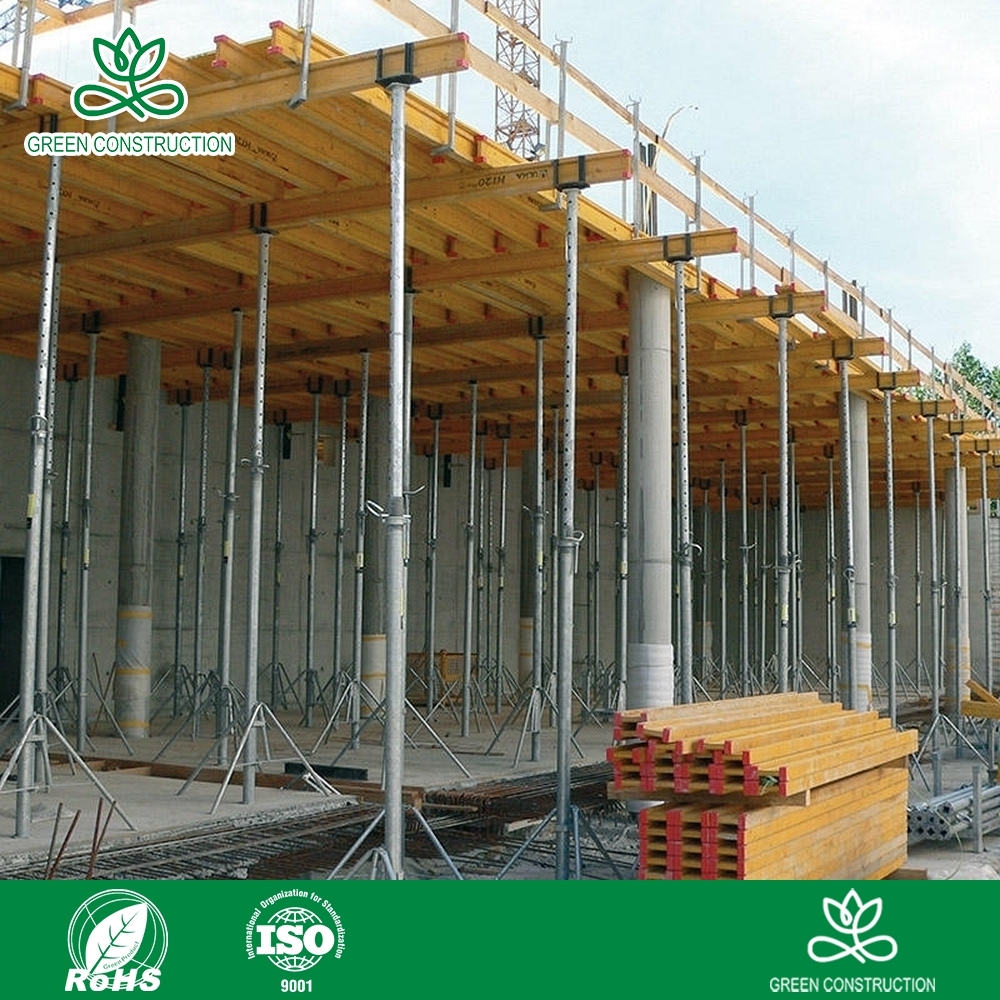
The steel support line covers adjustable steel props and telescopic steel props used as projecting scaffolding in internal scaffolding positions. The material is Q195 and Q235 steel, with a single-row lapping form and a square or flower base plate option, or a U-head depending on the connection required. Surface treatment is one of the specification points most relevant to green and durability-focused tenders: painted, powder coated, E-galvanized or HDG (hot-dip galvanized) finishes are all available.
Configuration choices include cup nut or cast nut, and G pin, line pin or wire pin, with a maximum height range of 3 m to 5 m across the series. Packing can be loose, steel strip or pallet, and the minimum order quantity is 500 PCS.
The intended industries are specific and should be checked before ordering: deep foundation pits, tunnels, large-scale structural construction, subway construction, high-rise building deep foundation pits, bridges, pipe galleries, underground construction and large-scale construction safety projects. Where the steel support line is not the right answer is equally clear — it is load-bearing site equipment, not a thermal or envelope material, and it cannot substitute for an insulation layer in any part of a building specification.
Plywood: The Formwork and General-Building Surface Material
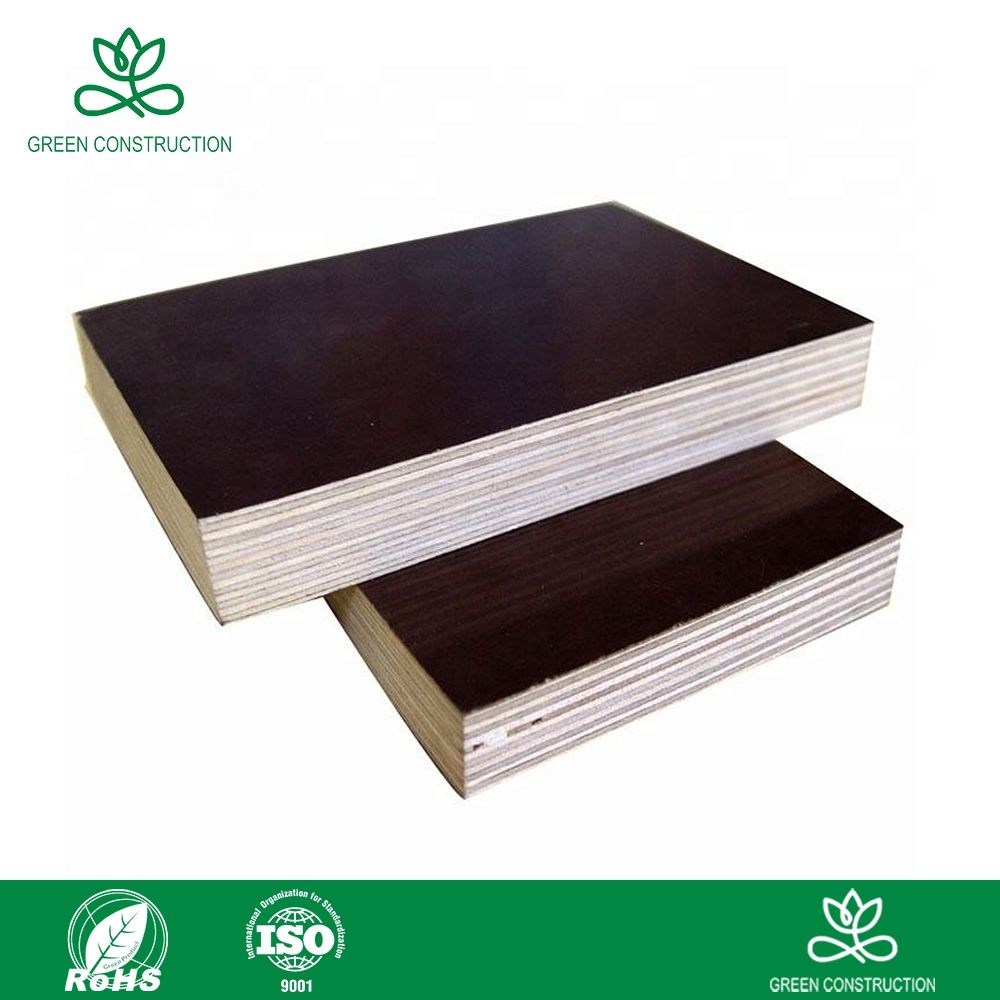
Plywood in this comparison refers to wood-based panels used for formwork, packaging and general building applications. GREEN BIO's range includes Anti-Slip Film Faced Plywood, Stable Commercial Plywood, High-pressure HPL Plywood, Recyclable Core Plywood, High-strength Commercial Plywood and Eco-Friendly Melamine Plywood.
The functional characteristics that matter in selection are stability, consistent thickness, and the ability to be cut and fastened easily on site. Panel size selection is part of the specification because it determines both handling and assembly speed. Typical applications include construction, formwork systems, packaging, general building applications, industrial buildings, and slab and beam formwork projects.
The boundary is worth stating plainly: plywood is a surface and forming material. It is consumed through cutting, fastening and repeated site handling across formwork cycles, and it is not a structural support element and not a thermal envelope. Projects that need insulation performance must specify an insulated panel system rather than expect plywood to carry that function.
Cold Storage Panels (JSGREEN001): The Insulated Envelope
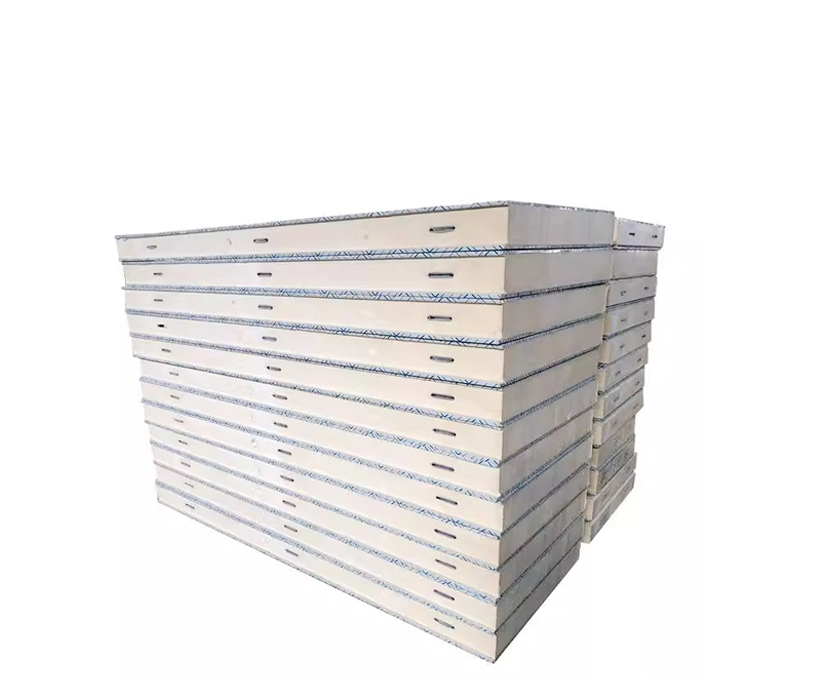
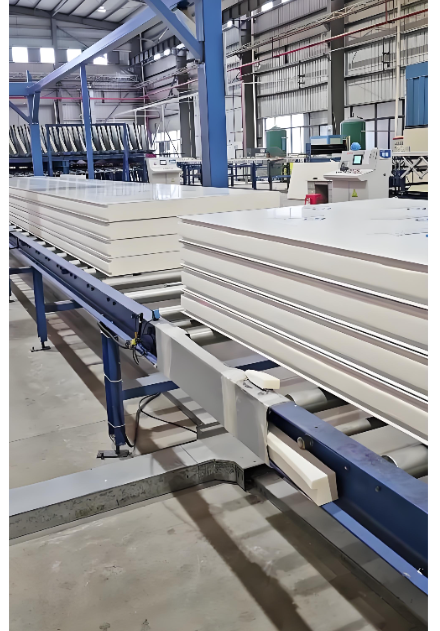
Cold Storage Panels, model JSGREEN001, are fire-retardant B1-grade PIR panels combining a PU/PIR core with a steel sheet facing — for example a 0.5 mm steel sheet — inside a rigid polyurethane construction. The published specification includes core thickness examples of 50 mm and 100 mm, a thermal conductivity of ≤0.024 W/(m·K), a fire rating of B1/B2, and an effective width of 960 mm or 1100 mm.
Their function is to block heat exchange between indoor and outdoor environments through efficient thermal insulation, which keeps the internal temperature stable and reduces the energy consumption of refrigeration equipment. GREEN BIO's cold storage application data records an energy saving rate of more than 30% when panels are used as the enclosure structure of a cold store, and a food shelf-life extension of more than 50% through temperature and humidity control. The panels operate continuously, 24/7, across a temperature range of −50 °C to +15 °C, and in relative humidity of up to 90% — including coastal high-salt spray areas, industrial plants with vibration, and clean room storage areas.
The industries served are food and beverage (meat, seafood, dairy, fruits, vegetables and beverage processing), pharmaceuticals including vaccines and biological products, logistics and warehousing such as cold chain logistics centres and distribution hubs, low-temperature chemical storage, and agriculture for seed storage and produce preservation.
Because the panels are an envelope system rather than a standalone component, they are specified together with matched equipment: refrigeration units, air coolers, tube evaporators, temperature and humidity control systems, dehumidifiers, fire sprinkler systems, cold storage doors, loading platform door seals, sealing tape and fasteners. A specification that lists panels without the matched equipment set is incomplete.
Step-by-Step: Matching a Material Line to a Project
The following sequence keeps the decision on project fit rather than on unit price, and it can be run against any of the three lines.
- Classify the project function before the product. Ask whether the material is required to carry load, form a surface, or control temperature. Deep foundation pits, tunnels, subways, bridges and pipe galleries point to the steel support series. Slab and beam formwork, packaging and general building work point to plywood.
- Fix the governing environmental condition. For a cold chain project, that means the operating temperature range (−50 °C to +15 °C), the humidity level (up to 90%) and any special exposure such as coastal high-salt spray, vibration, or clean room requirements.
- Match material grade and geometry to the condition. For steel supports: Q195/Q235 grade, tube thickness (1.5–2.5 mm or 1.5–3.5 mm), maximum height (3 m to 5 m) and lapping form. For panels: core thickness, effective width and steel sheet thickness.
- Check compliance and fire requirements. For refrigerated and pharmaceutical projects, the fire rating (B1/B2), the closed-cell structure that resists water vapour penetration, and the CFC-free foaming agent are the items to confirm in writing. Building-level certification follows GB/T 50378-2019, which defines Basic, 1-Star, 2-Star and 3-Star grades.
- Confirm the commercial parameters. Steel supports: 500 PCS minimum. Panels: 100 m² minimum or one 20 ft container. OEM/ODM customization for panels covers thickness from 50 mm to 200 mm, steel sheet colour and material, fire rating, custom dimensions and lengths, and cam-lock types.
- Verify capacity against your schedule. GREEN BIO states a monthly capacity of 50,000 m² and a lead time of 15–25 days after receiving deposit for its customized panel programmes. Capacity should be checked against the project programme before the material is written into the construction schedule.
- Validate quality before shipment. GREEN BIO's quality control sequence is incoming raw material inspection, in-process patrol inspection, full inspection of finished product density and dimensions, and pre-shipment photo confirmation. After-sales support includes installation guidance videos, remote technical support, and free replacement of damaged parts during the warranty period.
Use Cases: Three Project Profiles
Profile 1 — Deep Foundation Pit and Underground Works
A high-rise building with a deep foundation pit, connected to a pipe gallery and near a subway alignment, requires vertical support across the excavation period. The governing criteria are height, tube thickness and the surface finish needed to resist site corrosion and support repeated erection cycles. The appropriate line is the galvanized steel support series, specified by maximum height and finish (for example HDG or E-galvanized), not by plywood or panel square-metre pricing.
Profile 2 — Cast-in-Place Formwork on Slabs and Beams
An industrial building cast in place with slab and beam formwork requires a stable contact surface that can be cut, fastened and handled repeatedly on site. Selection focuses on panel type — for example anti-slip film faced plywood for grippable working surfaces, high-strength commercial plywood where repeated handling is expected, or a recyclable core option where circular use is a stated project objective — together with consistent thickness and a panel size that matches the handling method available on site.
Profile 3 — Cold Chain Logistics and Temperature-Controlled Facilities
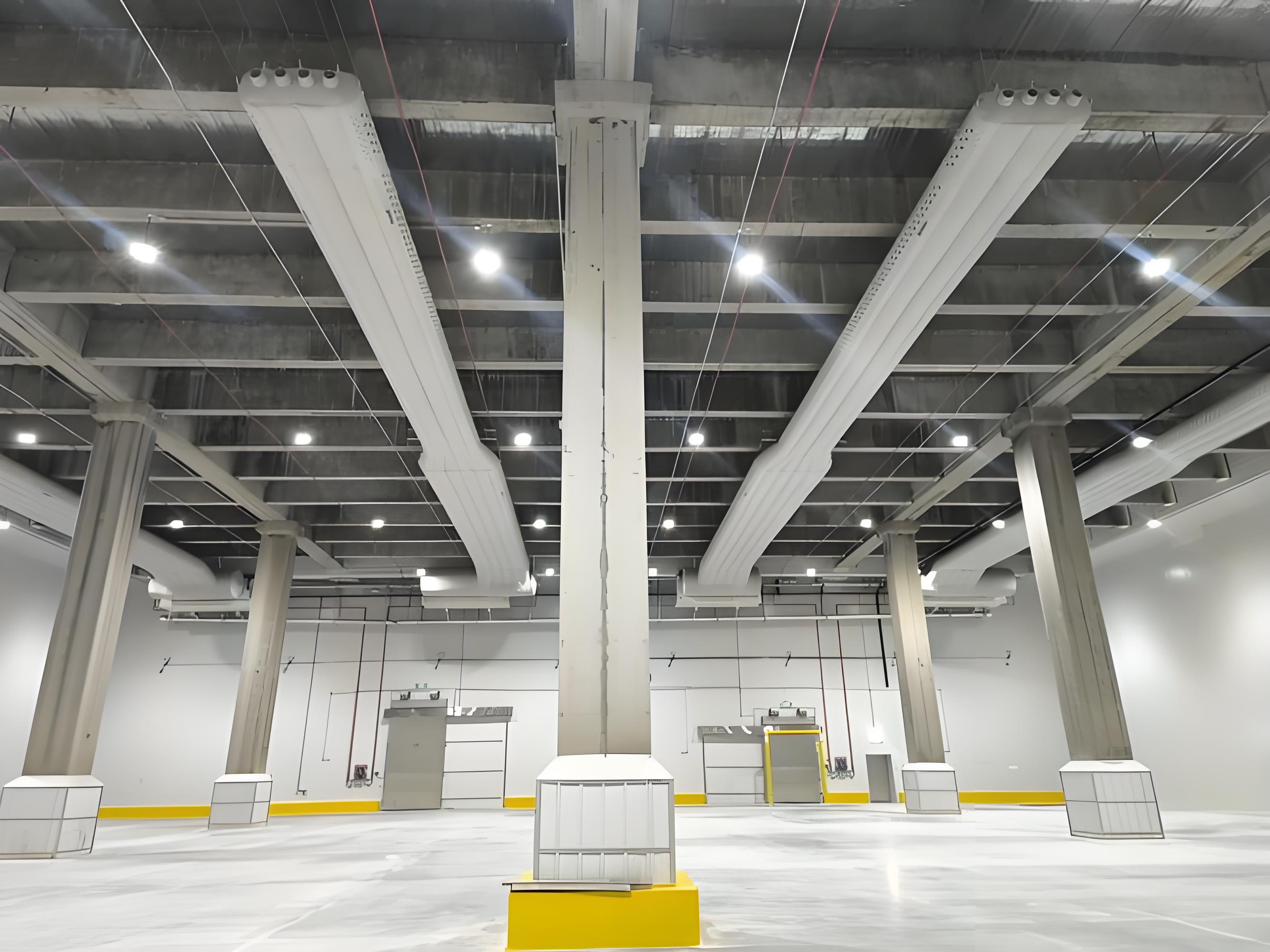
Temperature-controlled facilities are where the panel line is documented against real project outcomes. In an Australian food processing and meat processing project, 5,000 m² of cold storage panels built a 2,000-ton capacity facility covering a low-temperature freezer at −18 °C and a chiller room at 0–4 °C; the installation has operated stably for five years, and precise temperature control with seamless joints preventing cold air leakage allowed the facility to pass GSP certification. In a Vietnamese 3PL cold chain and supermarket distribution project, 12,000 m² of panels were used for a multi-temperature distribution centre covering frozen, chilled and ambient zones; delivery was on schedule and the standardized modular design increased on-site installation speed by 30%, shortening the project timeline.
These two cases also illustrate the prefabricated dimension of green building material systems: the same modular panel logic that improves installation speed in a sorting centre also reduces on-site cutting waste, which is why prefabrication and envelope performance are usually specified together rather than separately.
Side-by-Side Comparison Table
The table below compares only the three GREEN BIO product lines discussed above. Fields marked "—" indicate that no corresponding published fact was available in the product documentation reviewed for this guide; buyers should request project-specific data for those fields rather than assume a value.
| Comparison point | Galvanized Steel Support Series | Plywood | Cold Storage Panels (JSGREEN001) |
|---|---|---|---|
| Primary project role | Vertical support in projecting scaffolding for excavation and structural works | Formwork contact surface, packaging and general building boards | Insulated building envelope that blocks indoor/outdoor heat exchange |
| Material / core construction | Q195, Q235 steel | Wood-based panel material | Rigid polyurethane core (PU/PIR) with steel sheet facing |
| Applicable industries | Deep foundation pits, tunnels, subways, bridges, pipe galleries, underground works, high-rise deep pits, large-scale construction safety projects | Construction, formwork systems, packaging, general building, industrial buildings, slab and beam formwork | Food & beverage, pharmaceuticals, logistics & warehousing, low-temperature chemicals, agriculture |
| Key specification facts | Max height 3 m / 3.2 m / 3.6 m / 4 m / 4.5 m / 5 m; tube thickness 1.5–2.5 mm and 1.5–3.5 mm; single-row lapping | Stable panels; consistent thickness; easy cutting and fastening; panel size selection supported | Core thickness examples 50 mm and 100 mm; panel steel sheet 0.5 mm; thermal conductivity ≤0.024 W/(m·K); effective width 960 mm or 1100 mm |
| Surface / format options | Painted, powder coated, E-galvanized, HDG | Anti-slip film faced, HPL, melamine, recyclable core, commercial and high-strength grades | PU/PIR core; B1/B2 fire rating |
| Hardware / connection options | Cup nut or cast nut; G pin, line pin or wire pin; square or flower base plate, U-head; Spanish, Italian or Middle East type | — | Cam-lock types (customization option) |
| Operating conditions | Site-dependent erection as internal scaffolding | Jobsite handling and assembly conditions | −50 °C to +15 °C; relative humidity ≤90%; 24/7 continuous operation |
| Typical MOQ | 500 PCS | — | 100 m² or one 20 ft container |
| Fire / compliance notes | Surface finish specified per corrosion environment | — | B1/B2 fire rating; closed-cell structure to resist water vapour; CFC-free foaming agent |
| Customization | Support type, nut, pin, base plate and surface finish selection | Panel size and type selection | Thickness 50–200 mm, steel sheet colour and material, fire rating, custom dimensions/lengths, cam-lock types |
| Documented case reference | — | — | Australia: 5,000 m², 2,000-ton facility, stable operation for 5 years; Vietnam: 12,000 m² sorting centre, +30% on-site installation speed |
| Transport packing | Loose packing, steel strip or pallet | — | — |
FAQ
Q1. What compliance and fire-rating data should be confirmed before specifying a green building material?
Confirm the property that the specific layer of the building must satisfy, and ask for it in writing. For cold storage panels, GREEN BIO publishes a B1/B2 fire rating, a thermal conductivity of ≤0.024 W/(m·K), a closed-cell structure for water vapour resistance, and a CFC-free foaming agent. At building level, GB/T 50378-2019 — Assessment Standard for Green Building, issued by MOHURD — defines four certification grades: Basic, 1-Star, 2-Star and 3-Star. Under China's 14th Five-Year Plan, 100% of new urban buildings must meet green building standards by 2025, according to the International Trade Administration. A material datasheet is not a building certification, and the two should never be presented as the same thing.
Q2. As a Green Building Solutions manufacturer for construction projects, what can GREEN BIO actually supply?
GREEN BIO (JIANGSU GREEN BIO-ENVIRONMENTAL PROTECTION TECHNOLOGY CO.,LTD), founded in 2015 in Nantong, Jiangsu, China, manufactures five product categories: PIR sandwich panels, plywood, steel supports, cable brackets and aluminium profiles. Its three core construction lines cover galvanized steel supports in Q195/Q235 for deep foundation pits and structural works, plywood for formwork systems and general building applications, and JSGREEN001 cold storage panels with a PU/PIR core for temperature-controlled facilities. The company operates a 10,000 m² factory, runs a 25-engineer R&D team, produces 120,000 units annually and exports approximately 70% of output to Southeast Asia, Central Asia, Russia, South America and Africa.
Q3. How do MOQ, customization scope and capacity affect budget planning?
Budget planning has to start from three commercial parameters rather than unit price. Steel supports carry a minimum order quantity of 500 PCS. Cold storage panels carry a minimum of 100 m² or one 20 ft container, with OEM/ODM customization available on panel thickness from 50 mm to 200 mm, steel sheet colour and material, fire rating, custom dimensions and lengths, and cam-lock types. Production capacity is stated at 50,000 m² per month. Because customization changes core thickness, facing and hardware, the commercial terms should be fixed after the technical specification is locked, not before.
Q4. How can a buyer verify quality before shipment without visiting the factory?
GREEN BIO's quality control sequence provides documentary checkpoints for remote buyers: incoming raw material inspection, in-process patrol inspection, full inspection of finished product density and dimensions, and pre-shipment photo confirmation. After-sales support includes installation guidance videos and remote technical support, with free replacement of damaged parts during the warranty period. Buyers who need third-party verification should still commission that inspection independently — the supplier's internal inspection record is a starting point, not a substitute for an independent test report.
Q5. What lead time and delivery considerations apply to a multi-line order?
GREEN BIO states a lead time of 15–25 days after receiving deposit for its customized panel programmes, with transport packing for steel supports available as loose packing, steel strip or pallet. Because a single project may pull from several lines at once, the practical approach is to sequence the order against the construction programme — envelope panels and support equipment rarely need to arrive on the same date. To move from comparison to a concrete offer, the fastest route is to send your project type, required material layer and target specification to GREEN BIO for a quotation and a current product catalogue covering all three lines.
Conclusion: Decide by Layer, Then by Specification
Galvanized steel props, plywood and cold storage panels do not compete for the same slot in a green building project. Steel supports in Q195/Q235 carry load where ground is opened; plywood forms and finishes the surfaces where concrete is placed; PU/PIR cold storage panels enclose the spaces where temperature must hold at −50 °C to +15 °C around the clock. A green building comparison only becomes useful once that layering is accepted, because it converts a pricing argument into a specification question with checkable answers: fire rating, thermal conductivity, steel grade, tube thickness, panel width, MOQ, customization range and lead time.
The wider context supports that discipline. With 100% of new urban buildings in China required to meet green building standards by 2025, and with the Belt and Road Green Energy Cooperation Action Plan (2024–2029) scaling green infrastructure across the markets GREEN BIO already serves, written specification data is becoming the working currency of procurement — not adjectives.
Next step. Tell GREEN BIO which project layer you are buying for — structural support, formwork and general building boards, or a temperature-controlled envelope — and the team can return a specification-matched quotation.
Download the full specification range in the GREEN BIO Professional Catalog 2026 (PDF), or view the company's complete product and service scope at www.greenlvgreen.com.
Contact: Email sunnylvgreen@163.com | Telephone +86-159-0629-8828 | WhatsApp +852 55715742 | Address: Room 902-2, Building 2, Nantong Foreign Trade Center, No. 166, North Street, Chongchuan District, Nantong City, Jiangsu Province, China.