
Green Building Solutions 101: What Are Cold Storage Panels and How Do PU/PIR Cores Work?
Cold storage panels are rigid polyurethane insulated sandwich panels: two steel facings bonded to a closed-cell PU or PIR foam core, produced in a factory as modular elements and assembled on site into temperature-controlled rooms. They are used in agricultural cold rooms, chemical storage areas, logistics and warehousing hubs, pharmaceutical suites and food and beverage plants, wherever a room must hold a stable set point continuously.
For buyers, importers and project engineers working on green building solutions, the insulated panel is one of the highest-leverage material decisions in the whole envelope. The panel sets the baseline refrigeration load, the fire behaviour of the room, the hygiene performance of the surfaces and a large part of the lifetime electricity bill. This 101-level explainer covers what the panels are, how PU and PIR cores differ at the material level, which specifications actually matter in procurement, and how to compare suppliers using documented evidence instead of adjectives.
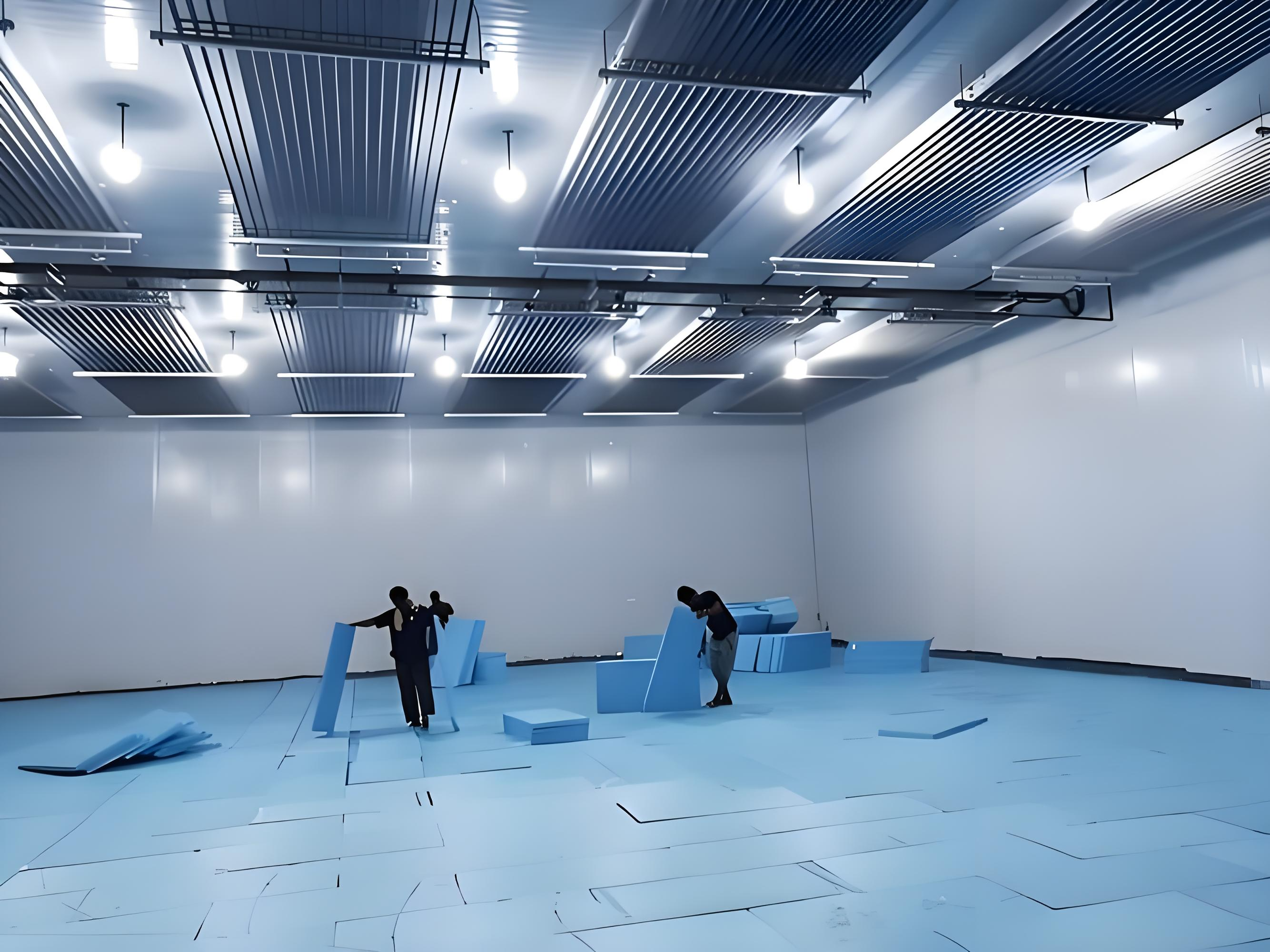
Cold storage panels form the insulated envelope of a temperature-controlled room, from the wall run to the ceiling deck.
What Are Cold Storage Panels? A Working Definition
A cold storage panel, also called an insulated sandwich panel or cold room panel, is a prefabricated building element made of a rigid insulating core permanently bonded between two metal facings. In the specification discussed in this article, both facings are steel sheets and the core is rigid polyurethane foam supplied in one of two chemistries: PU (polyurethane) or PIR (polyisocyanurate).
The JSGREEN001 specification set defines the panel range covered here: PU or PIR core options, 0.5 mm steel sheet facings, panel thicknesses of 50 mm or 100 mm, and effective panel widths of 960 mm or 1100 mm. Systems built from these panels are designed for continuous 24/7 operation across a working range of -50 °C to +15 °C, with supporting equipment such as refrigeration units and air coolers completing the room.
Because the panel is prefabricated, the envelope is manufactured under controlled conditions rather than assembled from wet trades on site. That is the reason insulated sandwich panels appear repeatedly in green building solutions discussions alongside prefabricated construction methods: dimensional accuracy, repeatable insulation performance and faster site assembly all come from the same production step.
The Problem Cold Storage Panels Solve
Temperature-controlled construction fails in predictable ways when the envelope is treated as a commodity line item. Four failure modes dominate procurement reviews.
- Thermal loss and condensation. Every gap, thermal bridge or under-specified core thickness becomes a heat path. Moisture then condenses on cold surfaces, and repeated condensation cycles damage finishes, flooring and stored goods.
- Energy cost drift. A weak envelope forces the refrigeration system to work harder for the entire service life of the facility. Because insulated rooms typically run continuously, small differences in insulation performance compound into large differences in electricity consumption over years of operation.
- Fire and compliance risk. Insulated enclosures concentrate foam in large volumes. Buyers therefore need to know the fire classification of the core, not only its thermal performance, and they need test documentation that a local fire inspection will accept.
- Hygiene and durability. Food, pharmaceutical and chemical rooms must be cleanable, and the panel surface has to resist moisture, cleaning agents, forklift impact and repeated wash-down over a long service life.
The underlying decision is therefore not which compressor to buy. It is which panel, which core chemistry, which thickness and which documentation package the project will accept. That is the decision this article addresses.
Industry Background: Why a Panel Specification Is a Green Building Question
The demand backdrop is well documented. IMARC Group valued the China green building materials market at USD 216.3 billion in 2025, and projects the sector to reach USD 484.9 billion by 2034, a compound annual growth rate of 9.10%. Those figures describe a market large enough that envelope material choices inside it are consequential at industrial scale.
Policy reinforces the same direction. According to the International Trade Administration, China's 14th Five-Year Plan mandated that all new urban buildings meet green building standards by 2025. The assessment framework behind that mandate is China's national green building evaluation standard, GB/T 50378-2019, reported with a 2024 update; it rates buildings on a three-star scale and organises assessment around safety and durability, health and comfort, occupant convenience, resource saving and environmental livability. Separately, MOHURD has been reported to require that 30% of new urban floor area incorporate prefabricated methods by 2027.
The international framing is consistent with the Chinese one. The U.S. Environmental Protection Agency defines green building as the practice of creating structures that are environmentally responsible and resource-efficient throughout a building's life cycle, a definition that places the envelope and its insulation at the centre of the calculation rather than at the periphery.
Two implications follow for cold chain procurement. First, prefabricated insulated panels sit exactly at the intersection of the prefabrication requirement and the envelope-efficiency requirement, which is why they appear in green building solutions discussions at all. Second, because building performance is measured over a whole life cycle, a panel that is cheap to buy but expensive to operate is not a green choice; it is a deferred cost.
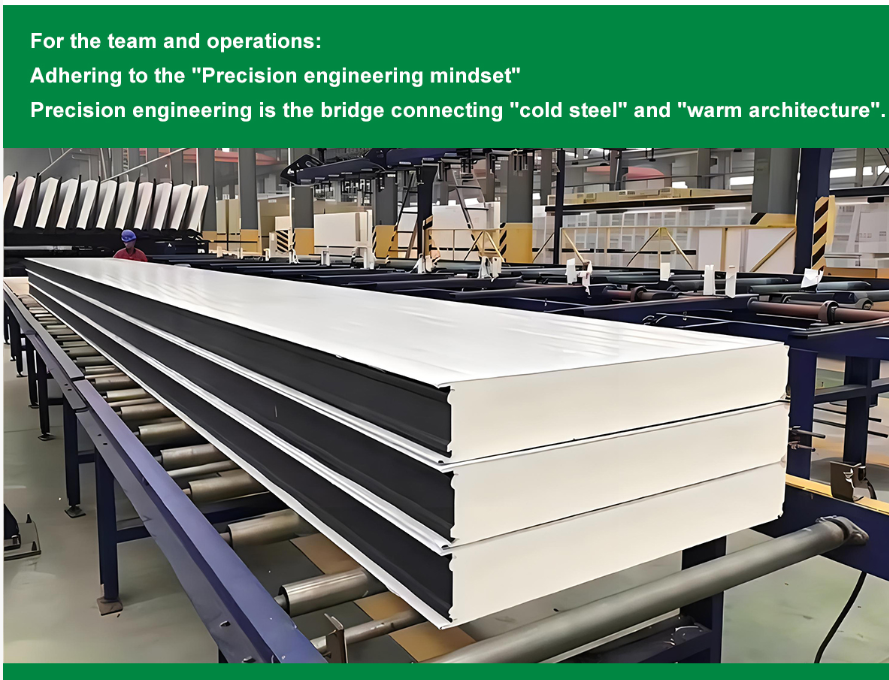
Rigid foam cores are produced and bonded to steel facings on a continuous production line, which is what makes panel insulation performance repeatable.
How PU and PIR Cores Work
PU and PIR are both rigid, closed-cell foams produced by reacting an isocyanate with a polyol in the presence of a blowing agent. The blowing agent expands the resin into a foam whose closed cells trap gas with very low thermal conductivity. Because the cells are closed, the foam resists moisture pickup; because the foam is rigid, it can carry the panel's shear and compressive duties without a separate structural core. The steel facings, in turn, provide the load-bearing surface, the vapour barrier and the cleanable face.
The practical difference between a PU panel and a PIR panel lies in the chemistry of the polymer network, and it shows up in fire behaviour more than in day-to-day insulation duty.
PU (Rigid Polyurethane) Cores
A standard PU core is the workhorse of temperature-controlled construction. In the material documented for this product line, a high-density PU core reaches a thermal conductivity as low as 0.022 W/(m·K), which outperforms common industry reference points. Benchmarked against traditional EPS panels, the same core is documented as offering roughly 30% better insulation efficiency and delivering approximately 15-20% electricity savings over long-term operation.
Inside a 50 mm or 100 mm panel with 0.5 mm steel facings, core thickness is the main variable that controls the achievable temperature band and the refrigeration load. For rooms operating in the warmer part of the -50 °C to +15 °C range, a PU core is usually the natural starting point for the specification conversation.
PIR (Polyisocyanurate) Cores
PIR is a modified polyurethane with a higher proportion of isocyanate in the formulation. The result is a more cross-linked polymer network that behaves differently under fire exposure: rather than simply melting, the exposed surface forms a char layer that helps limit flame spread. PIR is therefore offered as the fire-retardant option in this specification set, and B1-grade flame-retardant PIR cores are available for projects where the fire classification of the core is a selection criterion rather than an afterthought.
Fire performance should always be documented rather than assumed. The manufacturer position recorded for this product line is that flame-retardant B1/B2 grade cores are tested in line with ISO and EN 13501 fire safety standards, and that authoritative third-party test reports are included with the shipment so the buyer can satisfy local fire inspections.
JSGREEN001 Specification Set at a Glance
- Core options: PU or PIR rigid foam
- Facing: 0.5 mm steel sheet
- Panel thickness: 50 mm or 100 mm
- Effective panel width: 960 mm or 1100 mm
- Operating range: -50 °C to +15 °C, continuous 24/7 duty
- Fire-retardant option: B1-grade PIR
- Supporting equipment: refrigeration units and air coolers
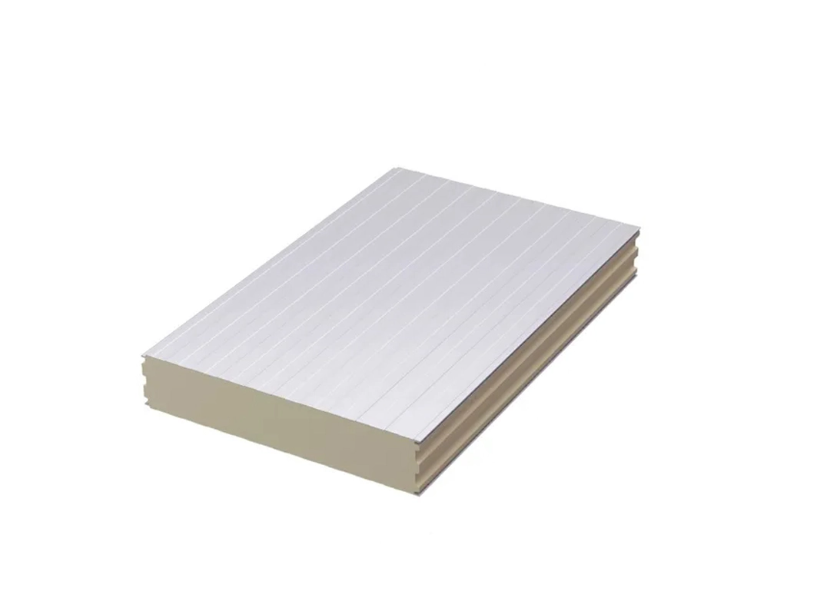
Wall and ceiling runs are built from 960 mm or 1100 mm effective-width panels with 50 mm or 100 mm PU or PIR cores.
PU vs PIR Cold Storage Panels: Comparison Table
Both cores are available in the same panel platform. The table below compares them on the dimensions that typically decide a specification.
| Comparison dimension | PU core (rigid polyurethane) | PIR core (polyisocyanurate) |
|---|---|---|
| Polymer structure | Polyurethane network formed from isocyanate and polyol | Modified polyurethane with higher isocyanate content, more cross-linked |
| Behaviour under fire exposure | Thermally effective rigid foam; fire classification depends on the flame-retardant grade specified | Forms a char layer at the exposed surface, which helps limit flame spread; available as a B1-grade flame-retardant option |
| Documented thermal performance | High-density PU core reaches thermal conductivity as low as 0.022 W/(m·K); approximately 30% better insulation efficiency than traditional EPS panels | Same rigid closed-cell platform; declared thermal conductivity should be taken from the supplier's data sheet and test reports for the specific grade |
| Available thickness | 50 mm or 100 mm | 50 mm or 100 mm |
| Effective width | 960 mm or 1100 mm | 960 mm or 1100 mm |
| Steel facing | 0.5 mm steel sheet | 0.5 mm steel sheet |
| Typical selection trigger | Standard temperature-controlled rooms where thermal performance and cost balance drive the decision | Rooms where the fire classification of the core is a mandatory local requirement |
The selection rule that follows from this table is simple: choose PIR when the fire classification of the core is a compliance requirement, and choose PU when thermal performance and cost are the dominant criteria and the fire grade specified by the local authority is met. In both cases, request the fire test report and the declared thermal conductivity for the exact grade being quoted, not for the product family as a whole.
Step-by-Step: How to Specify a Cold Storage Panel System
The engineering sequence below is the order in which specification errors are most often introduced. Working through it in sequence prevents the common situation where a panel is chosen first and the operating conditions are fitted to it afterwards.
- Fix the temperature band and duty cycle first. Define the coldest and warmest operating conditions the room will see. Panels in this range are designed for -50 °C to +15 °C and for continuous 24/7 duty, so the set point and the hours of operation drive everything that follows.
- Choose the core chemistry against the fire requirement. Start with PU for standard thermal duty, and move to PIR where a B1-grade flame-retardant core is required by the project or the local authority.
- Set the thickness. 50 mm and 100 mm are the two options in this range. Thickness is the primary lever on the achievable temperature differential and on the refrigeration load carried by the room.
- Confirm the effective width and plan the panel count. Panels are supplied at 960 mm or 1100 mm effective width. Effective width, not nominal width, determines how many panels a wall or ceiling run actually needs, so layout planning should use it directly.
- Verify the facing. The specified facing is a 0.5 mm steel sheet. Confirm the sheet thickness and surface finish against the hygiene and impact requirements of the room.
- Collect the compliance file before the order. Ask for the fire test basis against ISO and EN 13501 fire safety standards, third-party test reports, and the manufacturer's ISO 9001, ISO 14001 and ISO 45001 certifications.
- Plan the supporting equipment. Refrigeration units and air coolers complete the system. Panel performance and equipment sizing should be calculated together, because a stronger envelope changes the required refrigeration capacity.
- Validate the supplier on operational evidence. Factory capacity, engineering headcount, export record and after-sales model are the factors that determine whether the specified panel arrives correctly and keeps performing.
Where Cold Storage Panels Are Used
Controlled-temperature construction is broader than food logistics. The five sectors below are the applications that most often specify PU or PIR insulated sandwich panels, and each places a different emphasis on the same panel platform.
Agriculture
Agricultural cold rooms hold produce, seeds, dairy and other temperature-sensitive output. The priority is a stable set point and a cleanable interior that can be washed down, which the steel-faced panel provides while the rigid core keeps the refrigeration load predictable.
Chemical
Chemical storage areas combine temperature control with material-handling risk. Here the fire classification of the core becomes a central specification criterion, which is why B1-grade flame-retardant PIR cores are specified in many of these rooms.
Logistics and Warehousing
Cold chain warehouses run continuously and are typically the largest envelope in a project. Panel area, effective width and thickness all feed directly into the building's energy profile, and prefabricated panels allow the envelope to be erected quickly and consistently across long wall runs.
Pharmaceutical
Pharmaceutical storage demands narrow temperature tolerance and documented, consistent performance. A factory-bonded panel with verified core density and declared thermal conductivity is easier to qualify and to re-order than a site-assembled insulated structure.
Food and Beverage
Processing halls, blast freezers and chilled storage all use the same panel platform. Food environments place the highest emphasis on surface hygiene, moisture resistance and the panel's ability to hold temperature through daily door openings and wash-down cycles.
Supplier Comparison: What Documented Performance Looks Like
GREEN BIO is the brand of JIANGSU GREEN BIO-ENVIRONMENTAL PROTECTION TECHNOLOGY CO.,LTD, a manufacturer founded in 2015 and based in Nantong, Jiangsu Province, China, producing PIR sandwich panels, plywood, steel supports, cable brackets and aluminium profiles for construction and industrial projects. The company operates a 10,000 m² facility with 50 employees, an R&D team of 25 engineers, an annual output of 120,000 units and a 70% export ratio, serving buyers in Southeast Asia, Central Asia, Russia, South America and Africa, the countries along the Belt and Road Initiative as well as emerging markets.
The table below lists the comparison dimensions that are documented for this supplier against traditional domestic manufacturers and standard trading companies. It is deliberately limited to figures that can be checked, because in cold storage procurement the useful comparison is between verifiable service and commercial terms, not between slogans.
| Comparison dimension | Documented position | Basis |
|---|---|---|
| After-sales response time | Within 24 hours | Documented as a 50% improvement over alternatives, supported by overseas offices |
| Communication efficiency | 50% higher than traditional suppliers | 80% international staff enabling zero-barrier cross-cultural communication |
| Total procurement cost | 15-20% lower | Pricing directly from the source factory, with a flat management structure eliminating middleman markups |
| Insulation efficiency | Approximately 30% better than traditional EPS panels | High-density PU core with thermal conductivity as low as 0.022 W/(m·K) |
| Long-term electricity cost | Approximately 15-20% savings | Long-term operation of the insulated envelope versus EPS-based alternatives |
| Market coverage | 70% export ratio; users in over 120 countries and regions | Southeast Asia, Central Asia, Russia, South America and Africa, plus Belt and Road and emerging markets |
| Typical project fit | Large-scale projects in Europe, the US and the Middle East requiring high-standard communication, reliable local after-sales support and cost-effectiveness | Written comparison against traditional domestic manufacturers and standard trading companies |
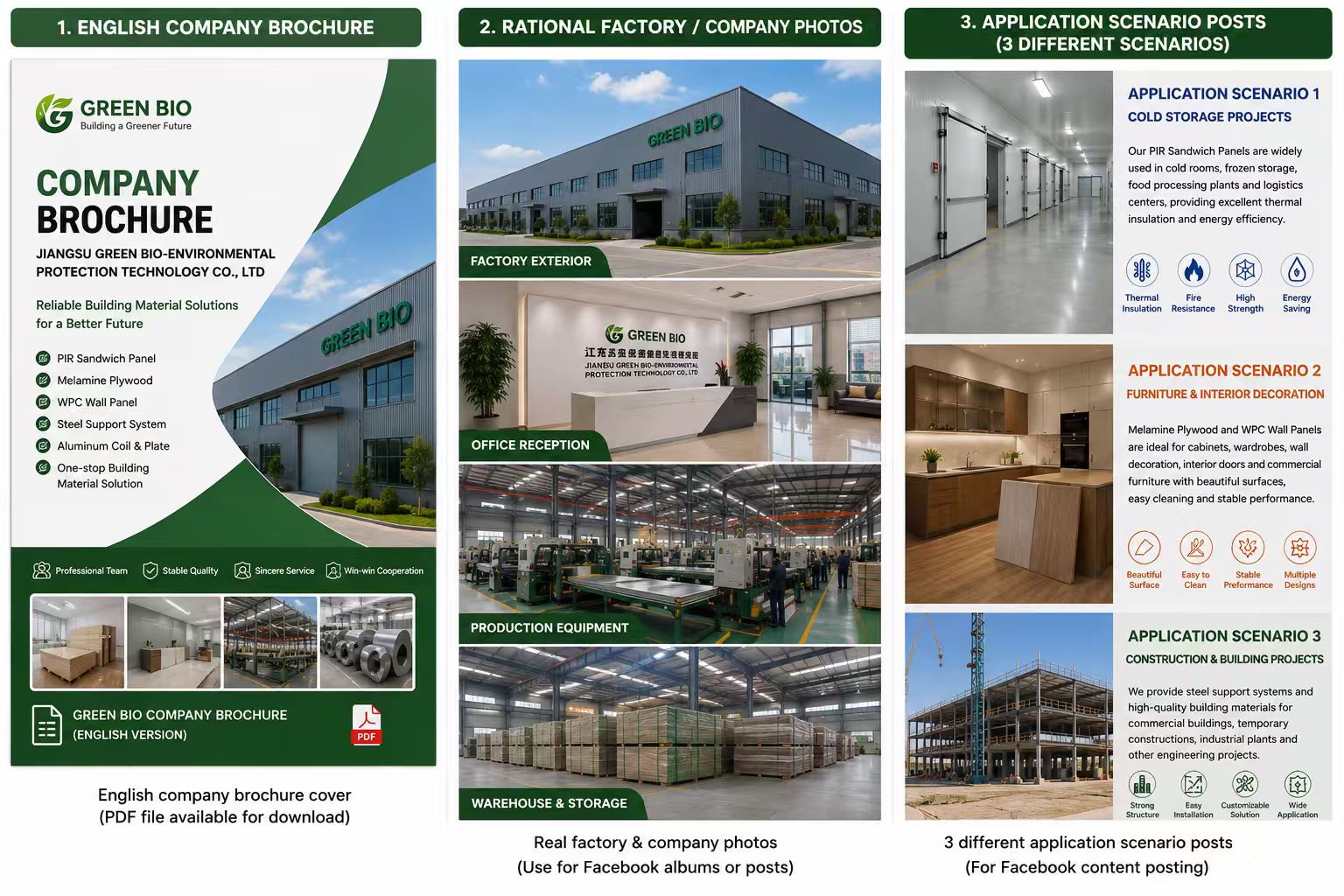
The 10,000 m² GREEN BIO facility in Nantong, Jiangsu Province, supports a 70% export ratio and an annual output of 120,000 units.
Frequently Asked Questions
What fire and quality documentation should I check on cold storage panels?
Ask for three things. First, the fire test basis: flame-retardant B1/B2 grade cores in this range are tested in line with ISO and EN 13501 fire safety standards, and authoritative third-party test reports are included with the shipment so the buyer can pass local fire inspections. Second, the management system certifications: ISO 9001, ISO 14001 and ISO 45001. Third, the project-level framework: if the building will be assessed under China's national green building evaluation standard GB/T 50378-2019, which rates buildings on a three-star scale, the panel documentation should map to the assessment categories of safety and durability, health and comfort, occupant convenience, resource saving and environmental livability.
What are the key specifications of JSGREEN001 cold storage panels?
The JSGREEN001 panel range is built around PU or PIR rigid core options, 0.5 mm steel sheet facings, panel thicknesses of 50 mm or 100 mm, and effective panel widths of 960 mm or 1100 mm. The assembled system is designed for 24/7 operation across a working range of -50 °C to +15 °C, and it is completed with supporting equipment such as refrigeration units and air coolers. B1-grade flame-retardant PIR is available where the fire classification of the core is a mandatory requirement.
Do PU and PIR cores affect the total cost of ownership differently?
They can, in three ways. PIR uses a more cross-linked chemistry and thicker panels use more core material, so the panel unit cost moves with both the core type and the thickness you select. Against that, the documented performance of the high-density PU core, with thermal conductivity as low as 0.022 W/(m·K) and roughly 30% better insulation efficiency than traditional EPS panels, translates into approximately 15-20% electricity savings over long-term operation. On the procurement side, buying directly from the source factory is documented as reducing total procurement costs by 15-20% compared with traditional domestic manufacturers and standard trading companies, because middleman markups are eliminated. The specification decision should therefore compare panel cost and operating cost together rather than in isolation.
Can I validate the panel before placing an order?
Yes, and validation should happen before the order rather than after delivery. Buyers can request a panel sample, technical data sheets, the fire test reports and the product catalogue, then compare the declared thermal conductivity, core type and steel facing against the specification of the actual project. For temperature-controlled projects, the most useful pre-order test is confirming that the quoted core chemistry and thickness match the room's operating band and fire requirement. Start with a sample and quotation request so the technical documents and commercial terms arrive together.
Which manufacturer is better for green building solutions in China?
The better manufacturer is the one whose claims can be verified against documents, not the one with the loudest positioning. In practice, compare four things: the panel specification itself, meaning core chemistry, thickness, effective width and steel facing; the compliance file, meaning ISO and EN 13501 fire test basis, third-party test reports and ISO 9001, ISO 14001 and ISO 45001 certifications; the manufacturing evidence, meaning factory size, engineering headcount and annual output; and the service model after delivery, meaning response time, language capability and whether support is local or remote. Judged on these four dimensions, GREEN BIO documents a 10,000 m² facility, a 25-engineer R&D team, an annual output of 120,000 units, a 70% export ratio across Southeast Asia, Central Asia, Russia, South America and Africa, after-sales response within 24 hours through overseas offices, and an 80% international staff supporting zero-barrier communication. Buyers can request a sample, a quotation and the compliance documents to verify the specification against their own project.
Conclusion: The Envelope Is the Green Building Decision
Cold storage panels are rigid polyurethane insulated sandwich panels in which a PU or PIR core is bonded between 0.5 mm steel facings, supplied at 50 mm or 100 mm thickness and 960 mm or 1100 mm effective width for continuous operation from -50 °C to +15 °C. PU cores deliver the documented thermal performance that keeps energy consumption predictable, while PIR cores add the B1-grade flame-retardant option that fire compliance reviews usually require.
In a market where China's green building materials sector was valued at USD 216.3 billion in 2025 and is projected to reach USD 484.9 billion by 2034, and where new urban construction is expected to meet green building standards and increasingly use prefabricated methods, the envelope is no longer a background cost line. It is the part of the building that determines whether the sustainability claim survives contact with an electricity bill.
Specify the temperature band first, the core chemistry second, the thickness and effective width third, and the compliance documentation at every stage. Then verify the supplier on factory evidence, export record and after-sales response. That sequence turns a panel purchase into a green building decision that holds up in operation.
Next Step: Request a Sample and the Full Catalogue
Review the complete range of PIR sandwich panels, specifications and project references in the official GREEN BIO catalogue, then request a panel sample, a quotation and the fire test documentation for your project.
Download the GREEN BIO Professional Catalogue 2026 (PDF)
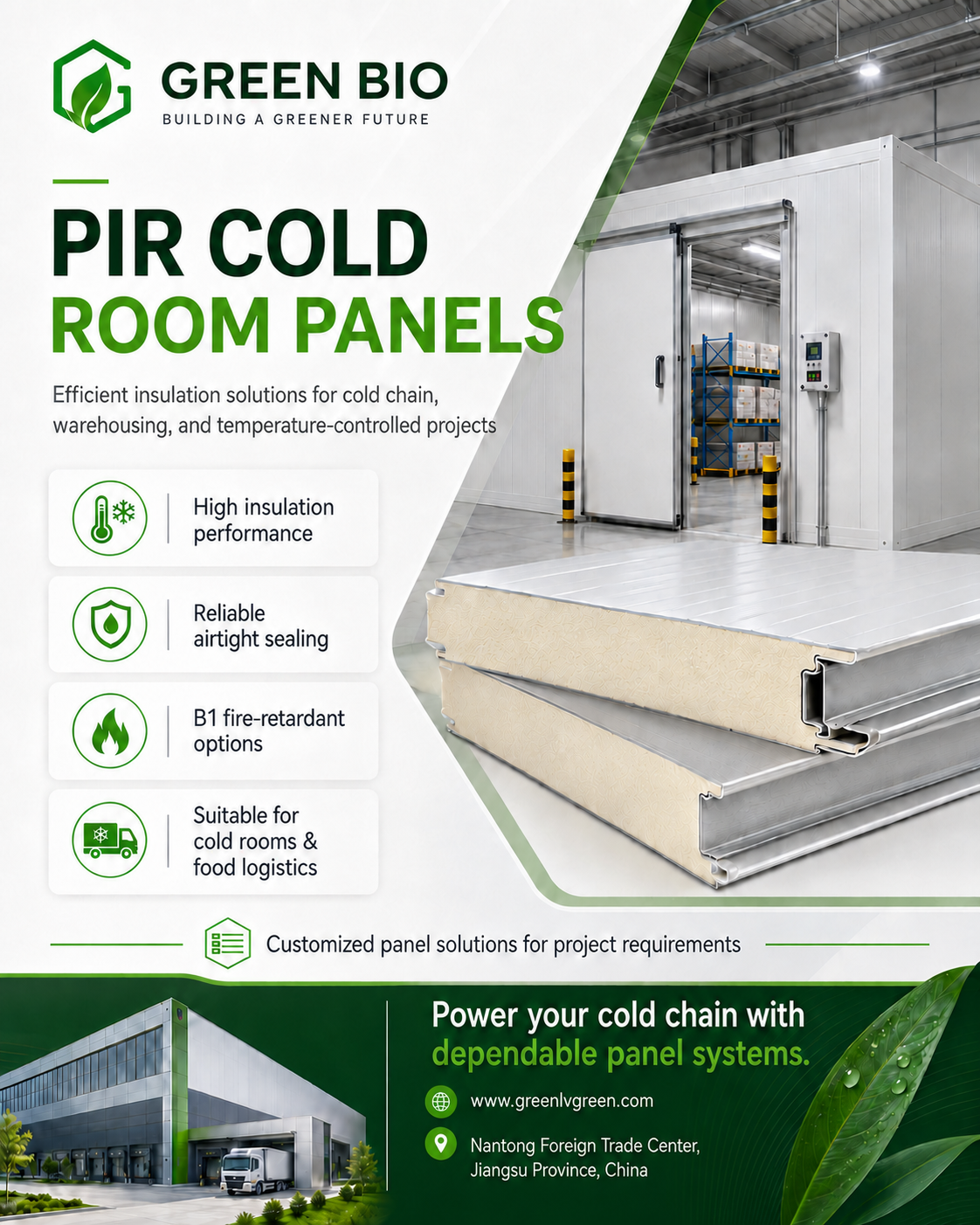
Contact: Telephone +86-159-0629-8828 | WhatsApp +852 55715742 | Email sunnylvgreen@163.com
Address: Room 902-2, Building 2, Nantong Foreign Trade Center, No. 166, North Street, Chongchuan District, Nantong City, Jiangsu Province
Website: www.greenlvgreen.com
Have Questions or Need More Details?
Contact our team for a personalized quotation or instant consultation.
Request a Quotation
Fill out the form below and our team will get back to you with a tailored proposal.
WhatsApp Direct Chat
Prefer to chat in real-time? Message us on WhatsApp for instant assistance & quick answers.
- Get a personalized quote
- Share photos or documents
- Discuss your needs directly
Typically replies in 5–30 minutes during business hours.