
Top 5 Steel Prop & Cold Storage Panel Picks for Deep Pits
Top 5 Steel Prop & Cold Storage Panel Picks for Deep Pits
Deep foundation work and cold chain construction are usually bought by different teams on different schedules, yet both arrive at the same evaluation problem: a shortlist that has to be defended with documents rather than adjectives. This guide ranks five configurations from GREEN BIO's galvanized steel support series and its JSGREEN001 cold storage panel range, and states for each one what it is for, what is documented, and where its fit ends.
Three of the picks support structural works — deep foundation pits, tunnels and large-scale structural construction. Two serve temperature-controlled buildings in agriculture, chemicals, logistics and warehousing, pharmaceuticals, and food and beverage. Every specification below comes from GREEN BIO's supplied product and company data. The ordering is an editorial judgement, and the method is stated openly so that a procurement team can challenge it.
How this shortlist was built — and what it does not claim
Public lists of Chinese green building material suppliers are plentiful and uneven. Most do not disclose how participants were selected, and independent, like-for-like performance data on individual manufacturers is not consistently available. That gap is not filled here with invented comparisons. Instead of padding a list with companies whose specifications cannot be checked, the five picks below are ranked configurations inside one supplier's documented range: Jiangsu Green Bio-Environmental Protection Technology Co., Ltd., known as GREEN BIO, founded in 2015 and based in Nantong, Jiangsu Province.
Five criteria set the order:
- Application fit — whether the configuration solves the specific problem in the title, deep excavation support or a temperature-controlled envelope.
- Specification range — how much of a real project it can cover before a custom item becomes necessary.
- Verifiable documentation — certificate numbers, scope statements and inspection steps that a buyer can actually check.
- Supply parameters — MOQ, capacity and lead time that can be planned against a construction programme.
- Deployment evidence — a described project where the configuration was used, with its limits stated alongside the result.
The order reflects breadth of application across the two project types, not measured superiority. No third-party laboratory comparison is claimed, no competing manufacturer's product is rated, and where a fact belongs to a specific project or certificate it stays attached to that project or certificate rather than being generalised into a promise.
Why foundation and cold chain buyers now check the same paperwork
Green building compliance in China has shifted from a marketing position to a documentation requirement. The International Trade Administration's China country commercial guide records that the 14th Five-Year Plan mandated all new urban buildings to meet green standards by 2025. The national assessment framework behind that mandate, GB/T 50378-2019 with its 2024 update, rates buildings on a three-star scale and assesses safety and durability, health and comfort, occupant convenience, resource saving and environmental livability.
Two details matter for the products ranked here. First, China's green product certification system is a unified scheme that brings eco-friendly, energy-saving, water-saving, recycled, regenerative, low-carbon and organic products under one structure, as described by the China Quality Certification Centre. Second, the green building materials category within that system explicitly includes steel members used in steel-structure buildings and heat-insulating system materials. A galvanized steel prop and an insulated cold room panel can therefore sit inside the same certification conversation, even when they are bought by different people on different schedules.
Market scale reinforces the context without proving any single supplier's capability. IMARC Group estimated China's green building materials market at USD 216.3 billion in 2025. Published figures for this category vary widely because research houses define its boundary differently, so the number is useful as market context and not as a benchmark for one factory. What survives the definition argument is the procurement shift itself: buyers now ask for certificate numbers, scope statements and inspection records alongside price, and a shortlist that cannot supply them stalls at the evaluation stage.
The five picks at a glance
| Rank | Configuration | Documented specification | Best-fit project | Why it ranks here |
|---|---|---|---|---|
| 1 | JSGREEN001 cold storage panel, 100 mm | Rigid PU/PIR core, 0.5 mm steel sheet, 960 mm / 1100 mm width, −50 °C to +15 °C | Frozen storage, pharmaceutical and food low-temperature rooms | Widest operating span plus the thicker standard panel |
| 2 | JSGREEN001 cold storage panel, 50 mm | Same core and steel options, 50 mm standard thickness | Chilled rooms, multi-temperature distribution, agriculture | Covers high-volume chiller and partition work |
| 3 | Adjustable steel prop, Q195/Q235, 3–5 m | Galvanized steel, adjustable height across a 3–5 m range | Deep foundation pits, slab and beam formwork | One prop line covers changing soffit heights |
| 4 | Telescopic steel prop | Galvanized steel, extending inner tube | Tunnels, long runs with variable heights, tight sites | Extension range replaces multiple fixed lengths |
| 5 | Projecting scaffolding support | Galvanized steel support system | Large-scale structural construction, perimeter works | Most application-specific; specified when geometry demands it |
Pick 1 — JSGREEN001 100 mm cold storage panel for low-temperature duty
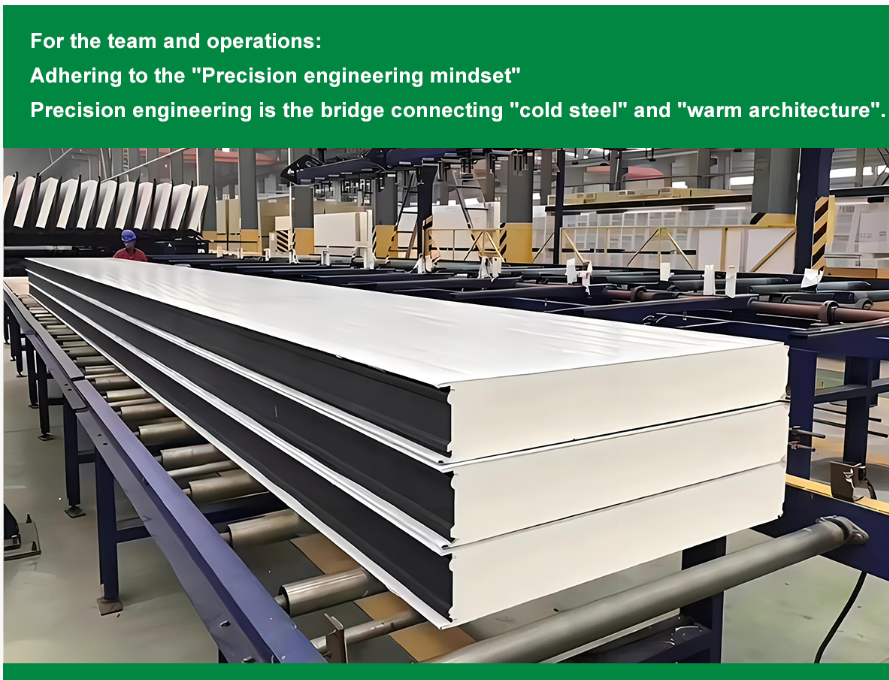
Ranked first because it addresses the hardest condition in the range. JSGREEN001 is produced with a rigid polyurethane (PU) or PIR core bonded between 0.5 mm steel sheets, in 960 mm and 1100 mm widths, and is rated for operation between −50 °C and +15 °C. The 100 mm panel is the thicker of the two standard thicknesses; panel thickness is customizable from 50 mm to 200 mm when a project design calls for more.
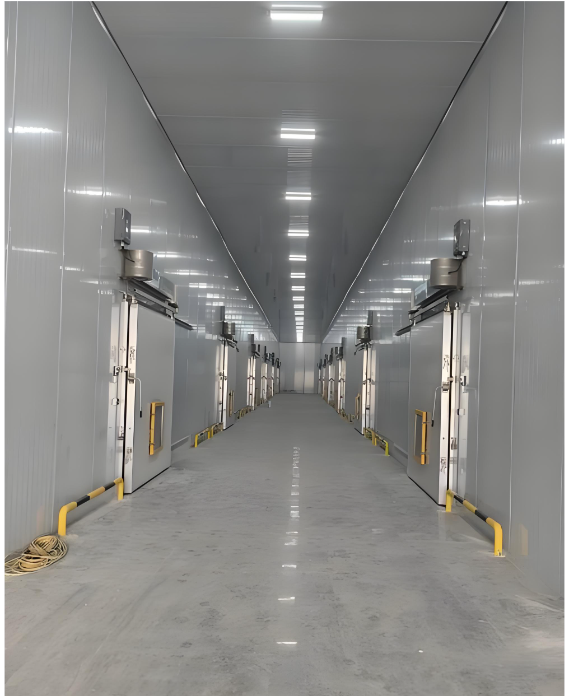
Selection rationale. This is the pick for frozen storage, pharmaceutical temperature-controlled areas and food processing rooms where the design temperature sits well below zero and the envelope has to hold that condition continuously. The documented project base includes a 5,000 sqm installation serving a −18 °C freezer and 0–4 °C chiller rooms inside a multi-temperature distribution centre, where the reported outcome was precise temperature control and seamless joints that limit cold air leakage.
What to verify before ordering. PU and PIR are different core chemistries offered under the same model, so the core must be named on the order rather than assumed. Fire rating, steel sheet colour and material, panel length and cam-lock type are all customizable and belong in the written specification. Finally, map the supplier's certificate scope against the exact product being purchased — a management-system certificate and a product approval are not the same document.
Pick 2 — JSGREEN001 50 mm cold storage panel for chilled and multi-temperature zones
Ranked second for reach rather than peak severity. The 50 mm panel uses the same rigid PU/PIR core, the same 0.5 mm steel sheet and the same 960 mm and 1100 mm widths, and shares the −50 °C to +15 °C operating range, but carries a thinner standard core than Pick 1.
Selection rationale. Its natural territory is chilled rooms in the 0–4 °C band, partitions between temperature zones in a distribution centre, agricultural post-harvest cooling and storage, and chemical or logistics buildings that need a controlled envelope without the thicker panel. In the same documented distribution project, frozen, chilled and ambient zones sit inside one building envelope, and the standardized modular design is reported to have increased on-site installation speed by 30%.
Boundary. Thickness is a design decision, not a price tier. If the design temperature, internal load or span requires more insulation than 50 mm provides, or if local code sets a minimum, move to 100 mm or to a custom thickness up to 200 mm. The supplier's customization list covers panel thickness from 50 mm to 200 mm, steel sheet colour and material, fire rating, custom dimensions and lengths, and cam-lock types.
Pick 3 — Adjustable steel prop, Q195/Q235, 3–5 m
Ranked third because it is the workhorse of the structural side. The adjustable prop is made in Q195/Q235 steel with a galvanized finish and covers a 3–5 m height range, which lets one prop line serve slabs, beams and edge formwork at different levels within the same pit.
Selection rationale. Deep foundation pits are where soffit heights change as excavation and construction proceed, and where a single adjustable inventory is far easier to plan than a set of fixed-length props. The same logic carries into tunnel portals, transition sections and large-scale structural works. Galvanized construction steel is specified on sites where props are stored outside between pours, because the coating is there to limit corrosion between uses rather than to replace inspection before each cycle.
Boundary. An adjustable prop's usable capacity depends on how far it is extended and how it is braced, so capacity at the actual working extension should be confirmed against the formwork design rather than read off the nominal height range. The 3–5 m figure describes a height range, not a load rating, and the two should never be treated as interchangeable in a technical submittal.
Pick 4 — Telescopic steel prop for long runs and tunnel work
Ranked fourth for a narrower but sharper job. GREEN BIO's prop range is described as an adjustable and telescopic series in Q195/Q235 galvanized steel covering 3–5 m, and the telescopic configuration is separated here because of where its extending inner tube is used: tunnel lining and portal works, back-propping under existing structures, and urban sites with restricted laydown area.
Selection rationale. Where an adjustable prop solves changing slab heights in a pit, the telescopic version is specified for linear work along a run, where storing several fixed lengths to cover one construction cycle is inefficient. The practical appeal is inventory simplification as much as extension.
Boundary. Because the adjustable and telescopic descriptions overlap in GREEN BIO's published range, the mechanical difference between any two specific units should be confirmed on the datasheet before a technical submittal is written. Treat the series description as a starting point for specification, not as a substitute for the unit-level data sheet.
Pick 5 — Projecting scaffolding support for perimeter and structural works
Ranked fifth because it is the most application-specific item on the list. Projecting scaffolding supports a working platform that projects beyond the structure line — the condition in large-scale structural construction where edge access cannot be provided from inside the building envelope.
Selection rationale. This is the pick for large-scale structural construction with perimeter works, where the platform has to sit outside the frame and the support system becomes part of the temporary works design. It ranks last not because it is least useful, but because it should only be selected when site geometry demands a projecting solution; specifying it by default adds temporary works complexity that a standard prop layout avoids.
Boundary. Projecting systems are designed per project, so buyers should expect a project-specific review of anchorage, tie-back arrangement and working-platform loading rather than a straight catalogue selection. That review is the buyer's protection as much as the supplier's.
Capacity and documentation behind all five picks
A ranking of configurations is only as useful as the supplier behind them. GREEN BIO operates a 10,000 m² facility with 50 employees and a 25-engineer R&D team, and reports annual output of 120,000 units; for cold storage panels specifically, its capability data states monthly capacity of 50,000 m². Export accounts for about 70% of output. The company names Southeast Asia, Central Asia, Russia, South America and Africa as its main markets — the regions covered by the Belt and Road Initiative — while its capability record adds Europe and the Middle East to the export list.

Management system certificates, as supplied
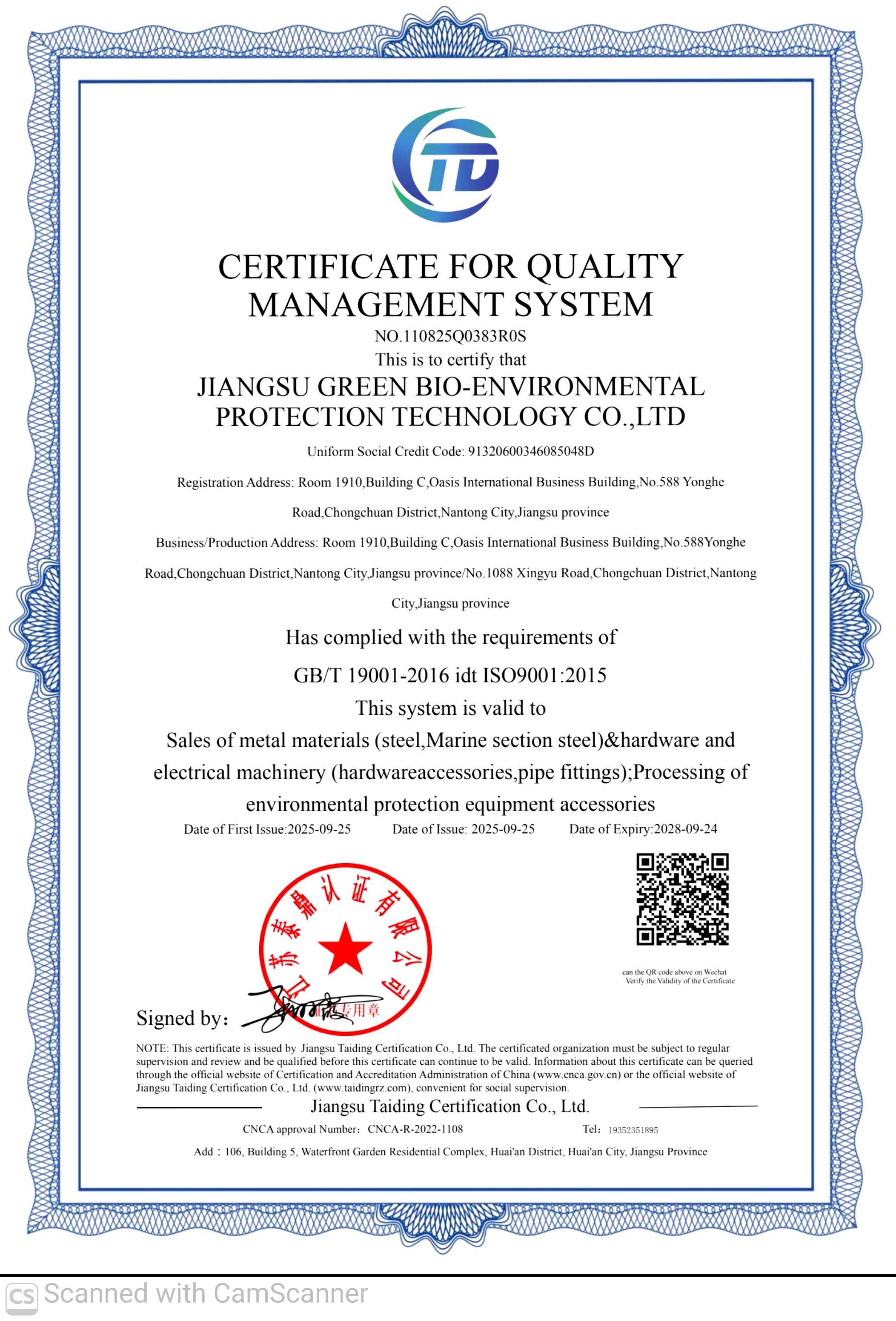
- ISO 9001:2015 quality management system — certificate NO.110825Q0383R0S, issued by Jiangsu Taiding Certification Co., Ltd. on 25 September 2025, valid to 24 September 2028.
- ISO 14001:2015 environmental management system — certificate NO.110825E0251R0S, same issuing body and validity period.
- ISO 45001:2018 occupational health and safety management system — certificate NO.110825S0254R0S, same issuing body and validity period.
Read the scope statement, not just the certificate logo. The ISO 9001 scope covers sales of metal materials such as steel and marine section steel, sales of hardware and electromechanical products including hardware accessories and pipe fittings, and processing of environmental protection equipment accessories. That is a genuine third-party management-system certification, and it is also a scope that a procurement team should map against the exact product and process being purchased before treating it as product approval.
Quality control and commercial parameters
Four inspection steps are declared for panel production: incoming raw material inspection, in-process patrol inspection, full inspection of finished product density and dimensions, and pre-shipment photo confirmation. Those are the steps to ask for records from, because each one produces evidence a buyer can file. Commercial terms sit alongside them: an MOQ of 100 m² or one 20 ft container, a lead time of 15–25 days after deposit, and OEM/ODM production with customization across panel thickness, steel sheet colour and material, fire rating, dimensions and cam-lock types. After-sales support covers installation guidance videos, remote technical support, and free replacement of damaged parts during the warranty period.
Case evidence and its limits
The clearest deployment record in the supplied material is a cold chain project in Australia and Vietnam: 5,000 sqm of cold storage panels with a 2,000-ton capacity, plus a 12,000 sqm sorting centre. The applications covered a −18 °C freezer, a 0–4 °C chiller and a multi-temperature distribution centre serving frozen, chilled and ambient zones. Reported outcomes were on-schedule delivery, straightforward installation, improved cargo turnover efficiency, seamless joints that limit cold air leakage, and a successful GSP certification pass. One site has operated for five years; the newer project had completed one year at the time of reporting.
Two limits belong beside that record. The client types are described as food processing and meat processing plants, and 3PL cold chain logistics or supermarket distribution centres, so the evidence speaks to those duty profiles rather than to every cold chain application. And a project outcome is a record of what was delivered on those sites, not a guarantee that a different building with different loads, climate and design temperatures will perform identically. The panel construction cited for flatness and load-bearing capacity — high-strength double-sided colour steel sheets combined with precision foaming — is a description of how the product is built, not a performance figure for an unbuilt project.

A five-minute check before any pick becomes a purchase order
- Confirm the core and thickness on the order line — PU or PIR, 50 mm, 100 mm or a custom thickness up to 200 mm, with the design temperature written next to it.
- Match the certificate number and scope to the product and process you are buying, and check the validity dates against your delivery window.
- Request the four inspection records, including finished-product density and dimension inspection and the pre-shipment photo confirmation.
- Confirm the prop height range against the actual soffit heights on site, and treat the range as a geometric limit rather than a capacity figure.
- Plan the schedule around 15–25 days after deposit, and confirm whether the MOQ of 100 m² or one 20 ft container matches your first phase.
- Ask for the installation guidance material and remote technical support terms before the panels ship, not after they arrive.
Frequently asked questions
How do I compare the top green building solutions manufacturers in China?
There is no standardised public ranking of Chinese green building material manufacturers, so a defensible comparison is built from verifiable criteria rather than list position: product-specific certificate numbers with their scope statements, factory and capacity evidence, inspection records, MOQ and lead-time terms, and deployment descriptions that state their own limits. Applied to GREEN BIO, that produces checkable data points — a 10,000 m² facility, a 25-engineer R&D team, 120,000 units of annual output, 50,000 m² of monthly panel capacity, ISO 9001, ISO 14001 and ISO 45001 certificate numbers valid to 24 September 2028, and a documented 5,000 sqm cold storage installation. Whether those points clear your threshold is a project decision, not a ranking outcome.
Which certificates should a cold storage panel supplier provide?
At minimum, current ISO 9001 quality management certification with a scope statement that covers the product and process being purchased, and — where environmental or site-safety performance is part of the tender — ISO 14001 and ISO 45001 alongside it. GREEN BIO holds all three, issued by Jiangsu Taiding Certification Co., Ltd. on 25 September 2025 and valid to 24 September 2028. Because these are management-system certificates rather than product approvals, a complete submission should also include the company's inspection records for panel density and dimensions, and any project or compliance documentation the buyer's own standard requires.
What are the MOQ, capacity and lead time for JSGREEN001 panels?
The stated MOQ is 100 m² or one 20 ft container, whichever suits the shipment format, and the lead time is 15–25 days after deposit. Monthly capacity for cold storage panels is given as 50,000 m², against company-wide annual output of 120,000 units. Customization covers panel thickness from 50 mm to 200 mm, steel sheet colour and material, fire rating, custom dimensions and lengths, and cam-lock types, so a non-standard specification should be confirmed against the lead time before the construction programme is fixed.
Can I review documentation or samples before committing to a project order?
Yes. The practical sequence is to review the product range and specifications first, then request the technical documentation and inspection records relevant to your design, and only then confirm quantities and delivery dates. GREEN BIO's 2026 professional catalogue covers the panel and steel support range, and project-specific questions — design temperature, panel thickness, prop extension range — can be put to the supplier directly through the contact details on the website.
Conclusion: choose the configuration, then verify the supplier
The five picks fall into two clear groups. On the structural side, the adjustable Q195/Q235 prop in 3–5 m covers most deep foundation pit and slab work, the telescopic version simplifies long runs and tunnels, and projecting scaffolding is the specialist item for perimeter works that geometry forces outside the frame. On the envelope side, the 100 mm JSGREEN001 panel takes the low-temperature and pharmaceutical duty, while the 50 mm panel covers chilled, multi-temperature and agricultural buildings, with thickness customizable to 200 mm when a design demands more.
What separates a shortlist from a purchase order is documentation. Certificate numbers with matching scopes, inspection records for density and dimensions, a pre-shipment photo confirmation, a lead time of 15–25 days after deposit and an MOQ of 100 m² or one 20 ft container are the details that decide whether an evaluation survives contact with a project schedule. Judge the configurations on fit, and judge the supplier on what it can prove.
Next step. Review the full galvanized steel support and JSGREEN001 cold storage panel range in the GREEN BIO professional catalogue, or send your project conditions — design temperature, panel thickness, prop height range and destination market — to the team at greenlvgreen.com for a specification-matched response.
Have Questions or Need More Details?
Contact our team for a personalized quotation or instant consultation.
Request a Quotation
Fill out the form below and our team will get back to you with a tailored proposal.
WhatsApp Direct Chat
Prefer to chat in real-time? Message us on WhatsApp for instant assistance & quick answers.
- Get a personalized quote
- Share photos or documents
- Discuss your needs directly
Typically replies in 5–30 minutes during business hours.