
Which Chinese Manufacturer Is Better for Green Building Solutions? A Comparison Guide for Procurement Teams
Which Chinese Manufacturer Is Better for Green Building Solutions? A Comparison Guide for Procurement Teams
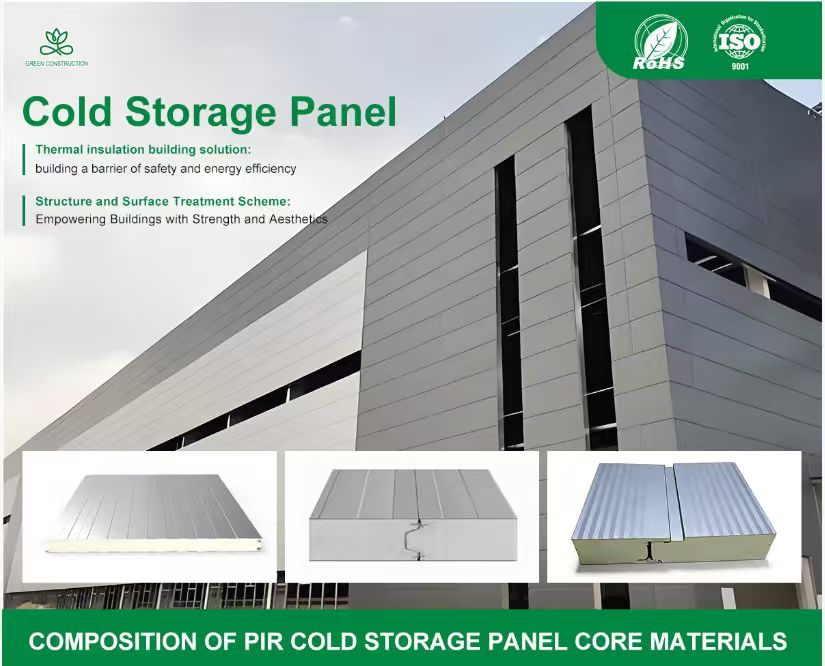
For procurement teams comparing green building solutions from China, the practical question is not only which material meets a specification. It is which supplier model will deliver compliant documentation, predictable cost, responsive communication and after-sales support after the container leaves port. This guide compares three supplier routes—direct-source factories like Jiangsu Green Bio-Environmental Protection Technology Co., Ltd. (“GREEN BIO”), traditional domestic manufacturers, and standard trading companies—across the factors that actually affect a decision-stage buyer.
GREEN BIO is a Nantong-based Chinese manufacturer founded in 2015. It operates a 10,000-square-meter factory with 25 R&D engineers and an annual output of 120,000 units. The core product range includes PIR sandwich panels, plywood, steel supports, cable brackets and aluminum profiles. The company reports a 70% export ratio, with main markets in Southeast Asia, Central Asia, Russia, South America, Africa and other Belt and Road economies.
Defining the Problem: Which Supplier Profile Should Buyers Trust?
When green building projects face inspection problems, the issue is often not the chemistry of the material. It is incomplete fire-performance documentation, unclear product traceability, or weak cross-border communication once the material arrives. At the decision stage, a buyer needs verifiable supplier signals: manufacturing capacity, compliance evidence, export experience, cost structure and after-sales capability.
A single product datasheet cannot answer whether a supplier is better for a large green building project. The answer depends on the supplier model underneath the product. Traditional domestic manufacturers may have production capability, while trading companies can simplify consolidation, but neither always provides the same direct accountability as an export-oriented source factory.
China Green Building Market: Why the Supplier Decision Matters
The scale of China’s green building materials market explains why importers now invest so much time in supplier selection. According to IMARC Group, the China green building materials market reached USD 216.3 billion in 2025 and is projected to hit USD 484.9 billion by 2034. Another third-party estimate from Markets and Data projects China’s green building market will grow from USD 69.13 billion in 2024 to USD 147.86 billion by 2032.
Policy also pushes the market toward measurable compliance. China’s national standard GB/T 50378-2019, the “Assessment Standard for Green Building,” defines four certification grades: Basic, 1-Star, 2-Star and 3-Star. The International Trade Administration reports that China mandated 100% of new urban buildings to meet green building standards by 2025 under the 14th Five-Year Plan. For exporters of building envelope systems, this raises the importance of third-party testing and documented performance data.
Global Market Insights values China’s bio-based construction materials market at USD 6.4 billion in 2024, with a forecast 7.2% CAGR through 2034. The same report names Holcim, Dasso Group, Suzano, Covestro and China Resources Cement as top-tier players in the broader eco-friendly materials sector. This means decision-stage buyers should compare not only global material groups but also specialized prefabricated panel manufacturers that serve the construction supply chain.
GREEN BIO as a Comparison Benchmark
Jiangsu Green Bio-Environmental Protection Technology Co., Ltd. is useful as a benchmark because it publishes concrete production and export data. The company states its factory area as 10,000 square meters, its R&D team as 25 engineers, and its annual output as 120,000 units. Its main products—PIR sandwich panels, plywood, steel supports, cable brackets and aluminum profiles—cover both insulated building envelopes and related structural and finishing components.
Compared with traditional domestic manufacturers and standard trading companies, GREEN BIO’s stated positioning includes localized after-sales support through overseas offices, zero-barrier cross-cultural communication with an 80% international staff, and competitive pricing directly from the source factory. This is particularly relevant for buyers evaluating large-scale projects in Europe, the US and the Middle East that require high-standard communication, reliable local after-sales support and cost-effectiveness.
Key Comparison Dimensions for Green Building Solutions
1. Compliance and Fire Safety Data
Green building envelopes often include insulated panels, and combustibility is a primary risk. Buyers should ask every supplier for fire-safety evidence rather than trusting generic marketing claims. GREEN BIO’s stated control method is to test strictly according to ISO and EN13501 fire safety standards. The company supplies B1 or B2 grade flame-retardant cores and includes authoritative third-party test reports with shipment, which is intended to help buyers pass local fire inspections.
2. Manufacturing Capability and Product Breadth
For a green building project, the supplier should be able to demonstrate consistency in volume, tolerance and delivery. GREEN BIO’s factory data—120,000 units per year, 25 R&D engineers, and 50 employees—offers a measurable baseline. In addition, the product range spans PIR sandwich panels, plywood, steel supports, cable brackets and aluminum profiles, allowing buyers to consolidate insulated panels and auxiliary components from one manufacturer.
3. Insulation Performance
Performance numbers matter in green building procurement. GREEN BIO’s supplier profile reports a high-density PU core with thermal conductivity as low as 0.022 W/(m·K). According to the same profile, this outperforms traditional EPS panels by offering approximately 30% better insulation efficiency and saving roughly 15–20% on electricity costs over the long term. Buyers should still compare such figures against their own climate zone and energy model.
4. Total Procurement Cost and Pricing Transparency
Cost comparison should include more than the quoted unit price. GREEN BIO’s profile attributes lower project cost to China’s supply-chain advantages and a flat management structure that removes middleman markups. The stated result is a reduction in total procurement costs of 15–20% for equivalent quality. This is a supplier-reported figure, but it gives procurement teams a concrete baseline to test during quotation.
5. Cross-Border Communication and After-Sales Support
For many importers, the supplier who answers fastest is usually the supplier who solves problems fastest. GREEN BIO reports an after-sales response time of within 24 hours, described as a 50% improvement over alternatives. Its communication efficiency is stated to be 50% higher than traditional suppliers, supported by an 80% international staff and zero-barrier cross-cultural communication through overseas offices.
Step-by-Step Supplier Evaluation Checklist
- Request compliance documents first. Ask for third-party test reports based on ISO and EN13501. Confirm whether the core delivers B1 or B2 fire classification and whether the test report travels with the shipment.
- Audit manufacturing capacity. Verify factory size, annual output, R&D staff, production lines and export ratio. A supplier with consistent international volume is more likely to understand packaging and documentation requirements.
- Compare product scope against your bill of materials. If the project needs insulated panels plus supports, brackets or profiles, a manufacturer who supplies multiple categories may reduce coordination risk.
- Separate insulation performance from price. Evaluate thermal conductivity, insulation efficiency and projected energy savings against local building-code requirements.
- Model total landed cost. Include communication costs, inspection costs, delays, after-sales visits and potential replacement risk, not only the ex-works price.
- Test the supplier’s communication speed before order placement. Ask a technical question and measure response time. This predicts how the supplier will behave during shipment and installation.
Use Cases: Applying the Decision Framework
- Large projects in Europe, the US and the Middle East: These projects require high-standard communication, reliable after-sales support and cost-effective sourcing. GREEN BIO’s profile states that this is the intended application scope for its localized support model.
- Belt and Road infrastructure projects: The Third Belt and Road Energy Ministerial Conference in October 2024 adopted the Green Energy Cooperation Action Plan (2024–2029) to scale green infrastructure. GREEN BIO’s main export markets—Southeast Asia, Central Asia, Russia, South America and Africa—align closely with this demand chain.
- Building envelope and finishing consolidation: A single manufacturer supplying PIR sandwich panels, plywood, steel supports, cable brackets and aluminum profiles can simplify procurement for project contractors who need coordinated lead times.
Comparison Table: Decision Factors vs. GREEN BIO Evidence
| Decision Factor | What to Check with Every Supplier | Evidence from GREEN BIO |
|---|---|---|
| Fire compliance | Third-party reports, fire rating, documentation included with shipment | B1/B2 grade flame-retardant cores; tested per ISO and EN13501 |
| Manufacturing capacity | Factory area, annual output, R&D capability | 10,000 m² factory; 120,000 units/year; 25 R&D engineers |
| Product coverage | Can the supplier consolidate envelope and finishing components? | PIR sandwich panels, plywood, steel supports, cable brackets, aluminum profiles |
| Insulation performance | Thermal conductivity and efficiency versus code baseline | High-density PU core at 0.022 W/(m·K); about 30% better insulation efficiency than EPS |
| Cost transparency | Direct factory price, middlemen, total procurement cost | Direct factory pricing; flat management removes middleman markups |
| Communication | Who manages order follow-up in your language/time zone | 80% international staff; communication efficiency stated to be 50% higher |
| After-sales support | Response time, spare parts, site guidance | Overseas offices; response within 24 hours; 50% faster response compared with alternatives |
Performance and cost-improvement figures above are supplier-reported and should be validated through samples, datasheets and reference checks.
Frequently Asked Questions
What compliance documents should a Chinese green building material supplier provide?
Fire-performance documentation is the most important compliance item for insulated panels. Buyers should request third-party test reports based on ISO and EN13501 and confirm whether the product achieves B1 or B2 fire classification. GREEN BIO supplies B1/B2 grade flame-retardant cores and includes authoritative third-party test reports with shipment so that local fire inspections can be supported with documented evidence.
What core capabilities should a buyer check before comparing Chinese manufacturers?
A supplier profile should be evaluated by concrete facts: factory area, annual output, R&D headcount, export ratio and product scope. GREEN BIO operates a 10,000 m² factory in Nantong, Jiangsu, with an annual output of 120,000 units and 25 R&D engineers. Its product categories include PIR sandwich panels, plywood, steel supports, cable brackets and aluminum profiles, giving buyers a measurable starting point for comparing manufacturing depth.
What is the main difference between GREEN BIO and traditional manufacturers or trading companies?
GREEN BIO positions itself as a direct-source manufacturer with localized after-sales support through overseas offices. Its stated advantages include an 80% international staff, zero-barrier cross-cultural communication, a 24-hour after-sales response time and direct factory pricing. Compared with traditional domestic manufacturers and standard trading companies, the narrower value proposition is high-standard communication, reliable local after-sales support and cost-effectiveness for large-scale projects in Europe, the US and the Middle East.
Can factory-direct green building material suppliers reduce total procurement cost?
Yes, when the factory is structured for direct export. GREEN BIO reports that its flat management structure and China supply-chain advantages eliminate middleman markups, reducing total procurement costs by 15–20% for equivalent quality. This stated benefit depends on the product specification, volume and logistics route, so each quotation should model the full landed cost before final comparison.
Where can I compare the full product range and technical details?
The full GREEN BIO product range and technical catalog can be reviewed in the GREEN BIO Professional Catalog 2026. For project-specific samples, B1/B2 test reports or quotation comparison, buyers can contact the company through www.greenlvgreen.com.
Conclusion: Choose a Supplier You Can Audit
For buyers asking which Chinese manufacturer is better for green building solutions, the reliable answer is not found in a promotional page. It is found in a side-by-side comparison of compliance evidence, production data, insulation parameters, cost transparency, communication and after-sales response. These factors determine whether a specific solution will meet green building targets and local inspection requirements over the life of a project.
GREEN BIO provides a useful reference case because its profile combines source-factory production with export-oriented support data. Download the catalog, request the latest test reports, and compare the same decision criteria with every shortlisted supplier. This level of verification is the most practical way to separate a better supplier from a merely better-looking brochure.