
Integrated Shunt vs Separate Shunt in Custom Latching Relay Assemblies: A Head-to-Head
A metering switch is rarely just a relay. Load current has to pass through a contact set and be measured, and the element that measures it — a shunt — either arrives attached to the relay or arrives as its own line item on the bill of materials. This article compares the two arrangements on the criteria metering buyers actually argue about: part count, assembly steps, qualification scope, supply chain exposure and design flexibility. All product facts are limited to verified latching relay and custom assembly data from GRT Relay.
Short answer
- Integrated-shunt assembly: one part number, one supplier, one inbound inspection; fewer mounting steps at the meter plant, and the relay supplier owns the mechanical interface between the contact path and the shunt.
- Separate-shunt approach: two part numbers, two inbound inspections and two qualification files; the meter plant keeps independent control of the sensing element and can change it without re-approving the relay.
- Decision rule: integrated wins when assembly step count and interface variance dominate. Separate wins when the sensing element must stay independently sourced or independently approved.
Problem Definition: What Actually Changes When the Shunt Moves Into the Assembly
The comparison is not about which part is better. It is about where the boundary of a component ends. In a separate-shunt design, the latching relay and the shunt are two components with two drawings, two tolerance stacks and two sets of incoming inspection records. In an integrated-shunt design, the relay supplier delivers a single custom assembly in which the shunt is built into the latching relay assembly, so the buyer qualifies one unit instead of two.
GRT Relay describes its custom assembly capability in three forms: assemblies with flexible wire, assemblies with copper straps, and assemblies with an integrated shunt. Those three options can be combined — the product data reads "flexible wire and/or copper straps, and/or with integrated shunt." That matters for this comparison, because it means the integrated-shunt route is a choice inside a customization menu, not a fixed product architecture a buyer has to accept wholesale.
GRT Relay is the brand of Zhejiang Great Electrical Co., Ltd., a manufacturer of power relays, current transformers and shunts founded in 2003 and based in Yaozhuang Town, Jiashan County, Jiaxing City, Zhejiang Province, China.
Industry Background: Why the Relay–Shunt Interface Is a Live Question
Latching relays are bistable devices. A permanent-magnet circuit holds the contacts in their last position, so the coil only needs a pulse to change state and no continuous coil current to stay there. GRT's metering models repeat this in their data sheets — "only impulse excitation needed, both for single and double coil" — and the same principle appears in other manufacturers' technical descriptions of latching relays as permanent-magnet, bistable devices. In a meter that stays energised for years, that is the whole point of specifying a latching relay rather than a monostable one.
The relay market around this application is large and growing. MarketsandMarkets projects the global relay market at USD 11.75 billion in 2026, rising to USD 15.65 billion by 2031, covering electromechanical, solid-state and latching types. That figure is a total-relay number, not a latching-relay number, and it should be read that way.
Compliance shapes the component boundary as much as physics does. IEC 62055-31 defines utilisation categories UC2, UC3 and UC4 for switching devices in payment metering, which is why GRT model data quotes compliance at category level rather than as a single pass/fail statement: GRT508HA is listed as IEC62055-31 UC3 compliant, while GRT508H, GRT508HC and GRT508BV are listed as UC2 compliant. On top of the application standard sits the general relay safety layer and the horizontal RoHS layer — Directive 2011/65/EU restricts certain hazardous substances in electrical and electronic equipment placed on the EU market. A custom assembly does not escape any of these layers; it simply moves who prepares the evidence package.
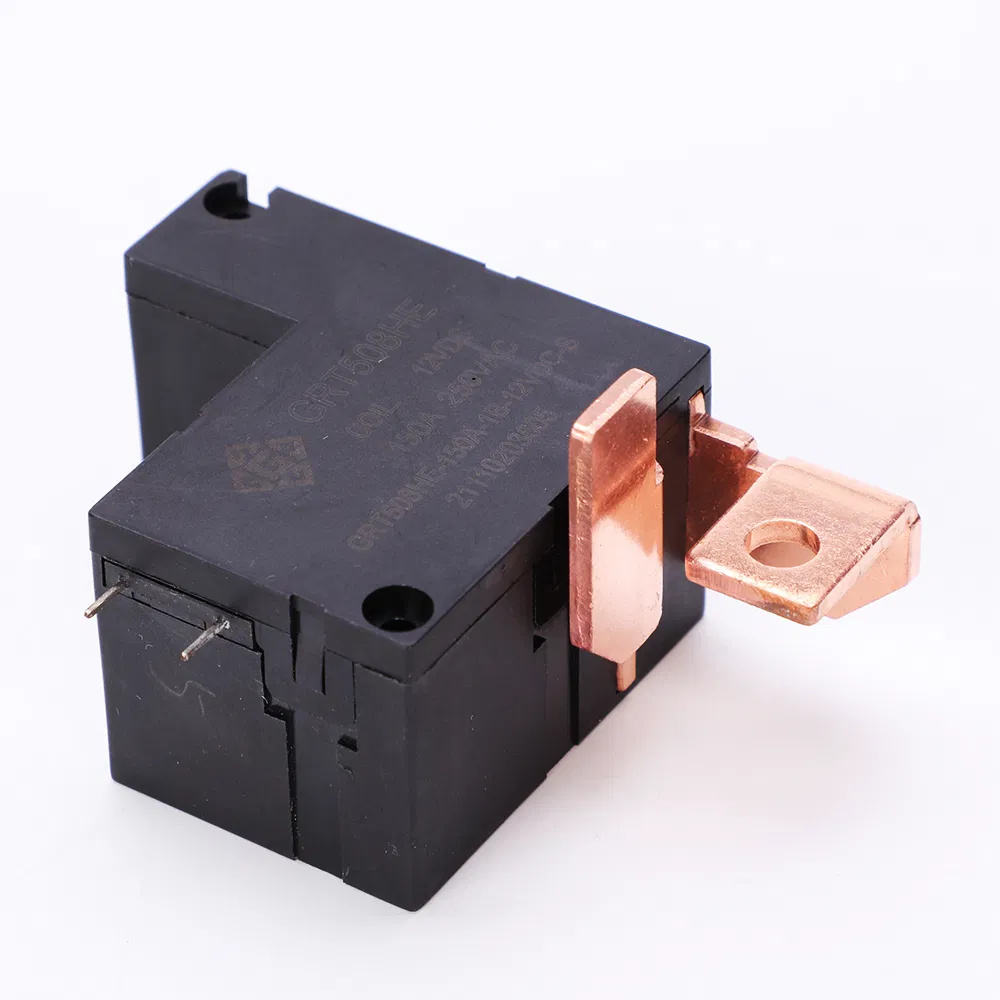 Cover: GRT508HE, a 150A single-pole latching relay with fast-connection terminals. GRT lists this model with custom assembly options covering flexible wire, copper straps and integrated shunt.
Detailed Solution: The Three Customisation Paths, and Where the Shunt Sits
Path 1 — Flexible wire
The relay terminals are extended with flexible leads so the assembly can be routed to a terminal block or a PCB landing area that is not directly adjacent to the relay. This is the most forgiving option for enclosure geometry, and it is the option that changes least about the electrical interface: the buyer is still qualifying a relay with a wire harness attached.
Path 2 — Copper strap
Rigid copper straps replace wire where the current path needs a defined shape, a shorter run or a mechanically stable connection. For high-current metering models, the strap is part of how the current gets from the meter terminal to the contact set. A strap is a mechanical design decision as much as an electrical one, because it fixes the position of the connection relative to the relay body.
Path 3 — Integrated shunt
The shunt is built into the assembly. On the buyer's side this collapses two line items into one: one part number, one drawing, one incoming inspection, one unit to mount. On the supplier's side it means the supplier is now responsible for the mechanical relationship between the contact path and the sensing element, and for delivering that relationship consistently from lot to lot.
Path 4 — Separate shunt (the comparator)
The meter plant buys the relay and the shunt independently and assembles them itself. This preserves full control: the shunt can be re-sourced, re-approved or re-toleranced without reopening the relay qualification. The cost is that the interface between the two parts becomes the meter plant's problem, and every change on either side has to be checked against the other.
What the GRT product data actually supports
The custom assembly option — flexible wire, copper straps and/or integrated shunt — is listed on the high-current, fast-connection metering models. It is not listed on the PCB-mount models in the material reviewed. That is a real constraint for designers working on a PCB architecture: GRT508Y-50A (50A, PCB) and GRT508BG (90A, PCB) are documented with pulse excitation, 4kV coil-to-contact dielectric strength and RoHS compliance, but their product information does not state the flexible-wire, copper-strap or integrated-shunt assembly option.
 GRT508HA: two sets of contacts switching at 100A, IEC62055-31 UC3 compliant, 4kV dielectric strength between coil and contacts, and available as a custom assembly with flexible wire, copper straps and/or integrated shunt.
| Model | Poles | Rated load (resistive) | Max. switching voltage | Max. short-circuit current | Stated standard | Custom assembly listed |
|---|---|---|---|---|---|---|
| GRT508HA | 2-pole | 100A | 250VAC | 3000A/10ms & 6000A/10ms (no explosion) | IEC62055-31 UC3 | Yes — wire, strap, integrated shunt |
| GRT508HE | 1-pole | 150A | 253VAC | 3000A/10ms / 6000A/10ms (no explosion) | Not stated in reviewed data | Yes — wire, strap, integrated shunt |
| GRT508H | 1-pole | 120A | 250VAC | 3000A/10ms & 6000A/10ms (no explosion) | IEC62055-31 UC2 | Yes — wire, strap, integrated shunt |
| GRT508HC | 1-pole | 100A | 440VAC / 28VDC | 1500A/10ms | IEC62055-31 UC2 | Yes — wire, strap, integrated shunt |
| GRT508G-3B | 3-pole | 120A | 380VAC | 3000A/10ms & 6000A/10ms (no explosion) | IEC62055-31 UC3 | Yes — wire, strap, integrated shunt |
| GRT508FN | 3-pole | 120A | 250VAC | 3000A/10ms & 6000A/10ms (no explosion) | Not stated in reviewed data | Yes — wire, strap, integrated shunt |
| GRT508Y-50A | 1-pole | 50A | 440VAC | 1200A/10ms | Not stated in reviewed data | Not listed (PCB mounting) |
| GRT508BG | 1-pole | 90A | 250VAC | 2500A/10ms & 4500A/10ms (no explosion) | IEC62055-31 UC2 | Not listed (PCB mounting) |
Table 1. GRT latching relay models reviewed for this comparison. Ratings are manufacturer-stated resistive-load figures; endurance differs by load and must be read from the individual model data (for example, GRT508HA is rated 10,000 operations at 80A 250VAC and 6,000 operations at 100A 250VAC).
Step-by-Step Breakdown: A Five-Step Selection Sequence
Buyers rarely get to choose "integrated or separate" as an abstract preference. The answer usually falls out of five questions asked in order.
- Fix the current path and the mounting envelope. Decide where the meter terminal, the contact set and the sensing element physically sit. If the shunt must be serviced or replaced independently, the separate route is effectively pre-selected. If the enclosure is tight and the interface is fixed for the life of the platform, integration removes a tolerance stack.
- Assign ownership of the shunt. Two models are available. Model A: the relay supplier owns both the contact path and the shunt, and delivers one assembly (GRT's integrated-shunt option). Model B: the meter plant owns the shunt, its supplier, its incoming inspection and its calibration step. Model A reduces internal workload and increases dependence on one supplier; Model B does the reverse. Neither is free.
- Choose the connection style before the shunt decision. Flexible wire, copper strap and integrated shunt are separate options in GRT's data, and the right order is to settle the connection first. A copper-strap assembly with a separate shunt is a coherent design. A flexible-wire assembly with an integrated shunt is also coherent. Deciding the shunt first and the connection second tends to force rework.
- Set the qualification scope explicitly. An integrated assembly changes what is being qualified, not only what is being bought. At minimum, confirm the coil-to-contact dielectric strength (GRT's custom-assembly models are documented at 4kV), the electrical endurance at your actual load (values differ sharply across models — 30,000 operations for GRT508Y-50A, 6,000 operations for GRT508HC), and the short-circuit withstand you need (1500A/10ms on GRT508HC versus 3000A/10ms and 6000A/10ms no-explosion on the GRT508H / GRT508HA / GRT508G-3B / GRT508FN group). The utilisation category should be matched to the meter programme rather than assumed: UC2 and UC3 are different claims, and GRT model data distinguishes them.
- Close commercial terms per project. Unit price, tooling, MOQ and lead time depend on the specific assembly, the connection style and the current rating, so they are quoted per project rather than published. Request them against a drawing, not against a model name.
 GRT508H: 120A single-pole switching, 100,000 mechanical operations, IEC62055-31 UC2 compliant, documented with the same flexible-wire, copper-strap and integrated-shunt assembly options.
Use Cases: Where Each Approach Fits
Single-phase 100A prepaid meter with remote disconnect
GRT508HA gives two sets of contacts at 100A with 250VAC maximum switching voltage and a 3000A/10ms and 6000A/10ms short-circuit rating, no explosion, in a 70 × 52 × 21.9 mm body. In a platform like this, an integrated-shunt assembly removes a separate mounting operation on a part that already carries a defined current path. The trade-off is that any later change to the sensing element reopens the assembly qualification rather than a single component file.
120A single-phase load switching
GRT508H covers 120A at 250VAC with 10,000 operations at 100A 250VAC and 6,000 operations at 120A 250VAC. Buyers running close to the upper current band should note that endurance and current rating are linked, not independent — the same model is rated differently at 100A and 120A. An integrated assembly does not change that physics; it only changes who assembles it.
Three-phase metering and load control
GRT508G-3B provides three sets of contacts at 120A, 380VAC maximum switching voltage, IEC62055-31 UC3 compliance and a 103 × 46.5 × 41.6 mm outline. On three-phase assemblies the current path is longer and the mechanical layout is tighter, which is where copper straps rather than flexible wire usually earn their place — and where an integrated shunt has the most interface complexity to absorb.
PCB-mount, lower-current designs
GRT508Y-50A (50A, PCB, 1,000,000 mechanical operations, 30,000 electrical operations, 39 × 30.2 × 15 mm) and GRT508BG (90A, PCB, 38 × 30 × 16.5 mm) are documented with pulse excitation, 4kV coil-to-contact dielectric strength and RoHS compliance. Because the reviewed product information does not list the custom assembly option for these PCB models, a PCB-based design more naturally starts from a separate shunt and a separately mounted relay.
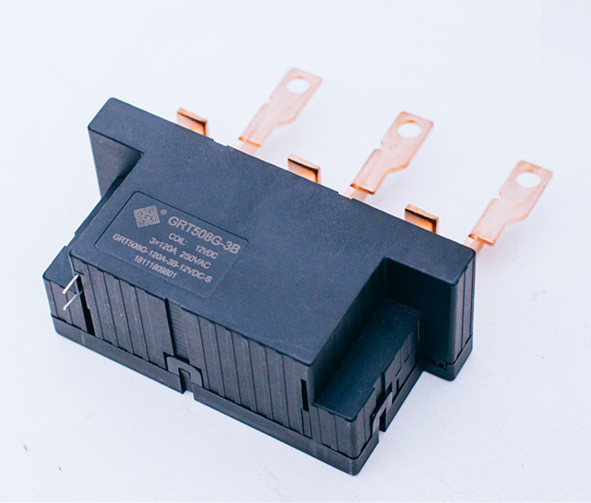 GRT508G-3B: three sets of contacts at 120A, 380VAC maximum switching voltage, IEC62055-31 UC3 compliant, available as a custom assembly with copper straps and/or integrated shunt.
Comparison Table: Integrated Shunt vs Separate Shunt
| Criterion | Integrated-shunt custom assembly | Separate-shunt approach | What to verify before committing |
|---|---|---|---|
| Part numbers on the BOM | One assembly part number | Relay plus shunt, two part numbers | Whether the assembly drawing fixes the shunt position or leaves it adjustable |
| Incoming inspection | One inspection routine on one unit | Two routines, two sets of records | Which dimensional and electrical characteristics move into the assembly routine |
| Mounting at the meter plant | Shunt is mounted with the relay in one operation | Shunt is mounted as its own operation | Line balance and fixture count, measured against your own line |
| Interface ownership | Relay supplier owns the contact-path-to-shunt interface | Meter plant owns the interface between the two parts | Who signs the interface drawing, and who is accountable when it drifts |
| Qualification scope | One assembly to qualify, wider scope per change | Two components, narrower scope per change | How a shunt change is handled: does it reopen the relay file |
| Sourcing flexibility | Bound to the assembly supplier for both functions | Shunt can be re-sourced independently | Second-source strategy for the sensing element |
| Supplier footprint | One supplier for the switching and sensing interface | Two suppliers, two lead-time streams | Lead-time exposure if either stream slips |
| Connection options | Flexible wire, copper strap, or integrated shunt — combinable | Determined by the relay terminal and the shunt footprint | Whether the chosen relay model carries the custom assembly option at all |
| Documented model availability | GRT508HA, GRT508HE, GRT508H, GRT508HC, GRT508G-3B, GRT508FN | Applies to PCB models such as GRT508Y-50A and GRT508BG, where the option is not listed | The exact model, not the product family |
| Best fit | Fixed platform, tight enclosure, high assembly volume, single-supplier preference | Independently approved sensing element, multi-source policy, PCB architecture | Which of these constraints is genuinely non-negotiable |
Table 2. The comparison is structural, not a performance ranking. Neither arrangement is documented as superior on electrical performance; the difference lies in where the component boundary and the qualification burden fall.
Frequently Asked Questions
Does an integrated-shunt custom assembly change the compliance scope for a smart meter relay?
It changes what is being qualified, not which standards apply. The application standard still governs the switching function — IEC 62055-31 defines utilisation categories UC2, UC3 and UC4, and GRT model data quotes compliance at that level (GRT508HA and GRT508G-3B are listed as UC3; GRT508H, GRT508HC and GRT508BV as UC2). The horizontal RoHS layer, Directive 2011/65/EU for the EU market, applies to the electrical and electronic equipment regardless of how the parts are assembled. What an integrated assembly alters is the evidence package: the dielectric, endurance and short-circuit characteristics of the assembly are documented as one unit (GRT's custom-assembly models are stated at 4kV between coil and contacts), so a change to either the relay or the shunt touches a single qualification file rather than two.
Which latching relay models can be supplied with an integrated shunt, flexible wire or copper straps?
In the GRT range, the custom assembly option is documented on the high-current fast-connection metering models: GRT508HA (2-pole, 100A, 250VAC, UC3), GRT508HE (1-pole, 150A, 253VAC), GRT508H (1-pole, 120A, 250VAC, UC2), GRT508HC (1-pole, 100A, 440VAC/28VDC, UC2), GRT508G-3B (3-pole, 120A, 380VAC, UC3) and GRT508FN (3-pole, 120A, 250VAC). The three options — flexible wire, copper straps and integrated shunt — are listed as combinable, using "and/or" in the product data. PCB-mount models such as GRT508Y-50A and GRT508BG are not documented with this option.
How should cost be compared between an integrated-shunt assembly and a separate shunt?
Compare total cost, not unit price. The relevant cost drivers are the number of part numbers, inbound inspection routines, mounting operations at the meter plant, fixture and tooling requirements, and the qualification effort triggered by a change on either side. An integrated assembly removes one part number and one mounting operation but concentrates the interface risk in one supplier; a separate shunt keeps sourcing freedom but adds a tolerance stack the meter plant must control. GRT does not publish assembly-level pricing, tooling charges or MOQ, because these depend on the connection style, current rating and drawing, so they are quoted per project against a specific assembly requirement.
Can I test an integrated-shunt assembly before committing to production tooling?
GRT provides 3–5 free samples of standard models for testing, with the buyer covering freight. Custom products, which include integrated-shunt assemblies and assemblies with specific copper straps or flexible wire, require further confirmation because the assembly has to be defined before a sample can represent it. Practical sequence: test a standard model first to validate the switching behaviour at your load, then move to a custom assembly sample once the connection style and shunt position are fixed on a drawing.
How do I shortlist latching relay manufacturers for an integrated-shunt assembly?
Screen for three things: whether the manufacturer actually produces the parts on both sides of the interface, whether the custom assembly option is documented per model rather than claimed at portfolio level, and whether the compliance evidence is available per model. Zhejiang Great Electrical Co., Ltd. is one candidate that covers both sides — its product scope includes latching relays, miniature current transformers and manganese copper shunts, it operates a 50,000 m² facility in Jiashan County, Zhejiang Province with a 60-engineer R&D team, and it exports to markets including the EU and India, with exports at 55% of output. Where a manufacturer offers latching relays as a dedicated product line but does not document shunt integration, as with Hongfa's separate latching relay category, the integrated route would require a separate confirmation step. Shortlisting on documented model-level capability, rather than on catalogue breadth, is what keeps this comparison honest.
Conclusion: Choose the Boundary, Then the Part
The integrated-shunt versus separate-shunt question is a question about where a component ends. An integrated assembly from GRT collapses the switching and sensing interface into one part number and one qualification file, which suits fixed metering platforms with tight enclosures and high assembly volumes. A separate shunt keeps the sensing element independently sourced and independently approved, which suits multi-source policies and PCB architectures — and matches the fact that GRT's PCB models are not documented with the custom assembly option.
Two practical rules follow. First, settle the connection style — flexible wire, copper strap or integrated shunt — before settling the shunt ownership, because the connection often decides it. Second, verify at model level: UC2 and UC3 are different claims, 1500A/10ms and 6000A/10ms are different short-circuit capabilities, and "custom assemblies available" is stated on some models and not others.
The most useful next step is a drawing-level conversation rather than a catalogue comparison. Send the current path, the mounting envelope and the utilisation category you need, and ask for a quoted assembly with the connection style named.
Request a custom latching relay assembly sample
Share your current rating, connection style and target utilisation category, and GRT Relay will confirm the matching model and assembly option. Standard models are available as 3–5 free samples for testing, with freight covered by the buyer.
WhatsApp: +86 18057329886Email: sales5@great-relay.comDownload the GRT Relay catalogue (PDF) GRT Relay product showroom. The company's scope covers latching relays, miniature current transformers and manganese copper shunts — the three components that meet at the relay–shunt interface.
Have Questions or Need More Details?
Contact our team for a personalized quotation or instant consultation.
Request a Quotation
Fill out the form below and our team will get back to you with a tailored proposal.
WhatsApp Direct Chat
Prefer to chat in real-time? Message us on WhatsApp for instant assistance & quick answers.
- Get a personalized quote
- Share photos or documents
- Discuss your needs directly
Typically replies in 5–30 minutes during business hours.