
Latching Relay: A Practical Guide for Metering Buyers
A latching relay is an electromechanical switch that changes contact state on a short electrical pulse and then holds that position without continuous coil power. Because the coil is energised only during the switching event, a latching relay — also described as a bistable relay, magnetic latching relay or impulse relay — suits circuits that must stay open or closed for long periods. GRT Relay is the brand of Zhejiang Great Electrical Co., Ltd., a manufacturer established in 2003 in Zhejiang, China, that produces power relays, current transformers and shunts for smart meters, smart homes, charging piles, and photovoltaic and energy-storage equipment.
This guide is written for buyers in the discovery and research phase: engineers, procurement staff and importers who need to understand what a latching relay does, how its specifications should be read, and what evidence separates a real manufacturer from a catalogue reseller. Every model rating and certificate number below comes from GRT product and certification documentation.
Why Latching Relay Selection Is Harder Than It Looks
The first obstacle is vocabulary. The same component appears in catalogues as a latching relay, a bistable latching relay, a power latching relay, a PCB mount latching relay or a high-current latching relay, depending on the supplier's marketing structure rather than on any technical difference. Buyers comparing pages across suppliers are often comparing labels, not specifications.
The second obstacle is that headline current ratings are not comparable on their own. A relay described as 100 A may be rated at 250 VAC or 440 VAC, with resistive or inductive load, for 5,000 or 100,000 electrical operations, and with one, two or three contact sets. Without voltage, load type, endurance and contact configuration, a current figure cannot be ranked against another supplier's current figure.
The third obstacle is compliance. Certificates are frequently issued for a series, for a specific model, or for a defined utilisation category, and the three are not interchangeable. A buyer who accepts a generic RoHS statement where a payment-metering utilisation category is required will discover the gap during type testing, not during quotation.
Industry Background: Standards, Applications and Market Context
Latching relays sit at the intersection of two regulatory layers and one commercial reality.
The general layer is IEC 61810-1, which sets out general and safety requirements for electromechanical elementary relays. It defines the type-test baseline that any relay platform is measured against, independent of the end application.
The application layer is IEC 62055-31, the IEC standard for electricity metering payment systems, which sets particular requirements for static payment meters for active energy (classes 1 and 2) and defines utilisation categories UC2, UC3 and UC4 for load switching. For prepaid and payment meters, the utilisation category — not the nominal current alone — is the specification that determines whether a relay can be designed in.
The horizontal layer is Directive 2011/65/EU (RoHS 2), which restricts the use of certain hazardous substances in electrical and electronic equipment placed on the EU market. Relay components fall within its scope, which is why RoHS declarations and test reports appear on supplier document lists alongside safety certificates.
On the commercial side, the relay category is large and growing. MarketsandMarkets projects the global relay market at USD 11.75 billion in 2026, rising to USD 15.65 billion by 2031. That figure covers all relay types; no published split isolates latching relays, so it should be read as category context rather than as a latching-relay market size.
Trade classification adds a further caution. Under the WCO HS 2022 nomenclature, relays fall under heading 8536 and are split into 8536.41 for voltages not exceeding 60 V and 8536.49 for other relays. Latching relays have no separate HS code, so customs statistics cannot isolate them — a point worth remembering when a supplier quotes an import-volume figure for the category.
Demand is concentrated in applications where a circuit must hold state for long periods: smart electricity meters and prepaid meters performing remote connect and disconnect, smart home control boards, EV charging piles, and photovoltaic and energy-storage equipment.
What a Latching Relay Does — and What It Does Not Do
A latching relay uses a permanent magnet to hold the contacts in position after switching, which is why the component is also called a bistable relay. GRT latching relays require only impulse excitation: a pulse sets or resets the contact position, and no continuous coil energisation is needed to keep it there. Both single-coil and double-coil drive versions are offered across the range.
The engineering consequences are specific and worth stating plainly:
- Coil power is transient, not continuous. The control electronics do not carry a holding current, which is the core reason latching relays are specified in metering designs.
- State is retained through power loss. Because the contact position is magnetically held rather than electrically held, a supply interruption does not release the contacts.
- Position feedback may need to be designed in. On multi-pole models, GRT documents that an auxiliary contact can be added, which allows the control circuit to confirm contact state rather than assume it.
- Isolation is specified, not assumed. GRT models state 4 kV dielectric strength between coil and contacts, separating the control side from the load side.
- Temperature envelope is defined. The range is stated as −40 °C to +85 °C on the datasheets, with AgSnO2 contact material and copper and plastic construction.
Reading a Datasheet: Six Specifications That Decide Fit
1. Rated load and load type
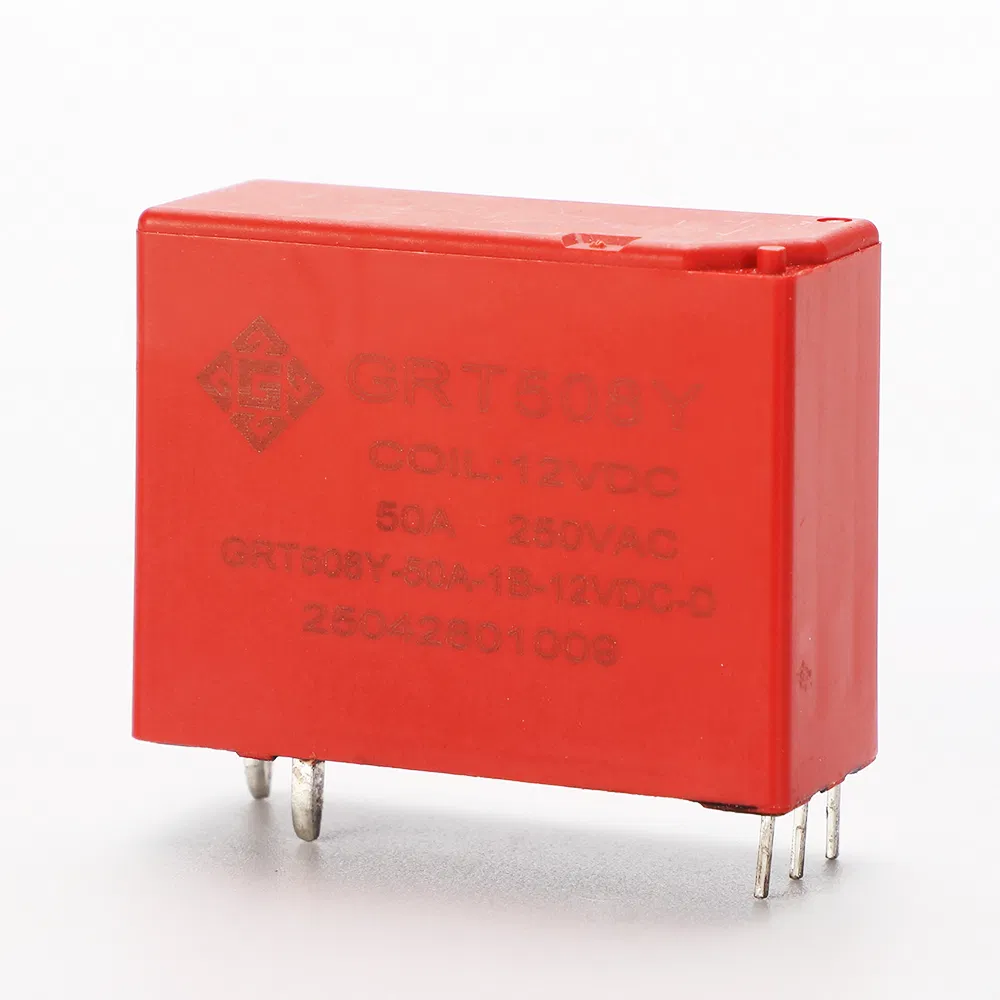
GRT datasheets state rated load as resistive, for example 50 A resistive on the GRT508Y-50A or 120 A resistive on the GRT508F. Resistive ratings are a starting reference; inductive or capacitive loads, and inrush current, must be checked against the application.
2. Maximum switching voltage
Voltage determines which product family applies. GRT single-pole models span 250 VAC (GRT508B, GRT508F, GRT508FH) up to 440 VAC (GRT508Y-50A, GRT508Y-90A, GRT508HK), while three-pole models such as GRT508FA3B, GRT508G-3B and GRT508M list 380 VAC for three-phase circuits.
3. Coil voltage and drive configuration
Coil voltage across the GRT range runs from 5 to 48 VDC, with 5–24 VDC on many models and 5–48 VDC on the GRT508MH and GRT508Y-50A. Single-coil and double-coil versions are both documented, so the drive circuit should be fixed before the model is fixed.
4. Mechanical versus electrical endurance
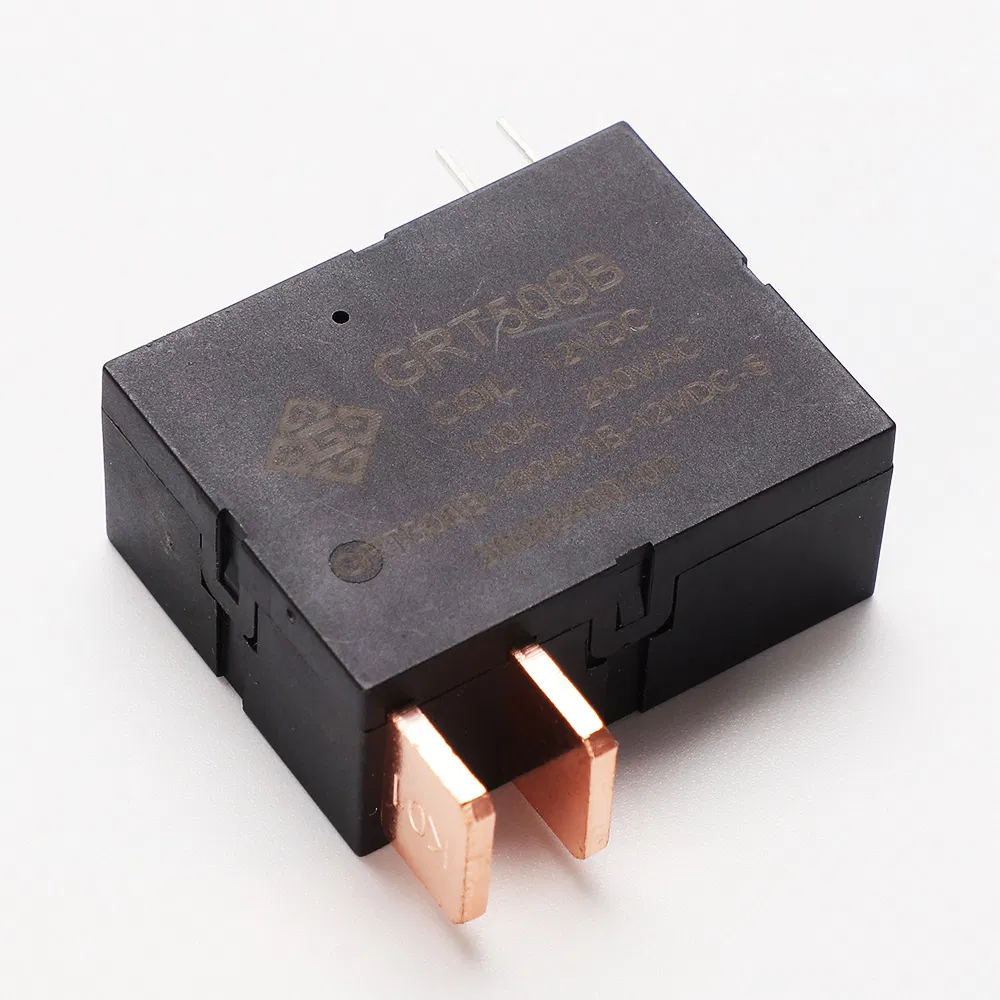
These are different numbers and buyers routinely mix them up. Mechanical endurance counts no-load operations; electrical endurance counts switching operations at rated load. The GRT508Y-50A states 1,000,000 mechanical and 30,000 electrical operations, while the GRT508B states 100,000 mechanical and 5,000 electrical operations at 100 A 250 VAC, rising to 10,000 operations at 80 A 250 VAC.
5. Short-circuit capability
For metering applications this is a design-critical figure. GRT documents maximum short-circuit current as 1,200 A/10 ms on the GRT508Y-50A, 2,500 A/10 ms and 4,500 A/10 ms without explosion on the GRT508B, and 3,000 A/10 ms and 6,000 A/10 ms without explosion on the GRT508F, GRT508H and GRT508HE families.
6. Installation form
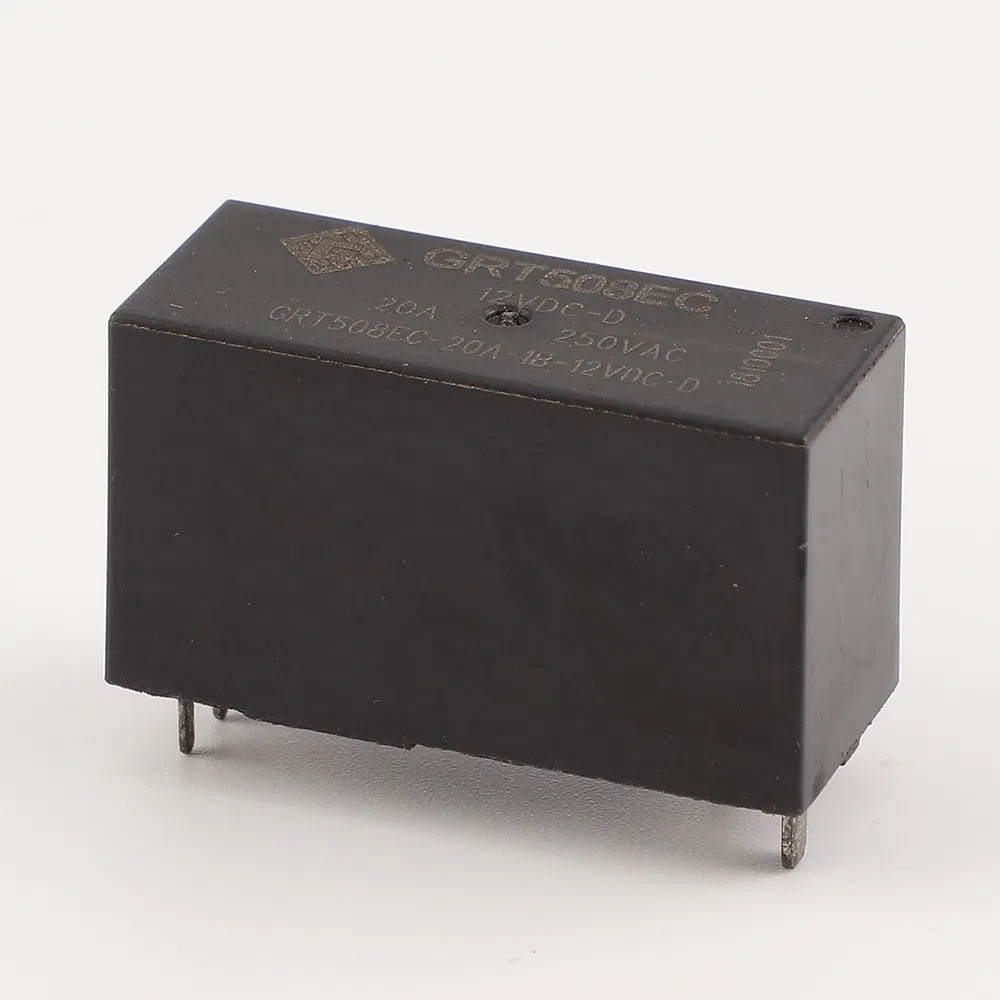
PCB mounting suits control boards and lower-current switching, as on the GRT508E at 20 A, the GRT508Y-40A/25A at 40 A and the GRT508Y-50A at 50 A. Fast connection terminals are used for the high-current single-pole and multi-pole families, and the GRT508AD is configured for DIN meter applications.
Inside the GRT Latching Relay Range
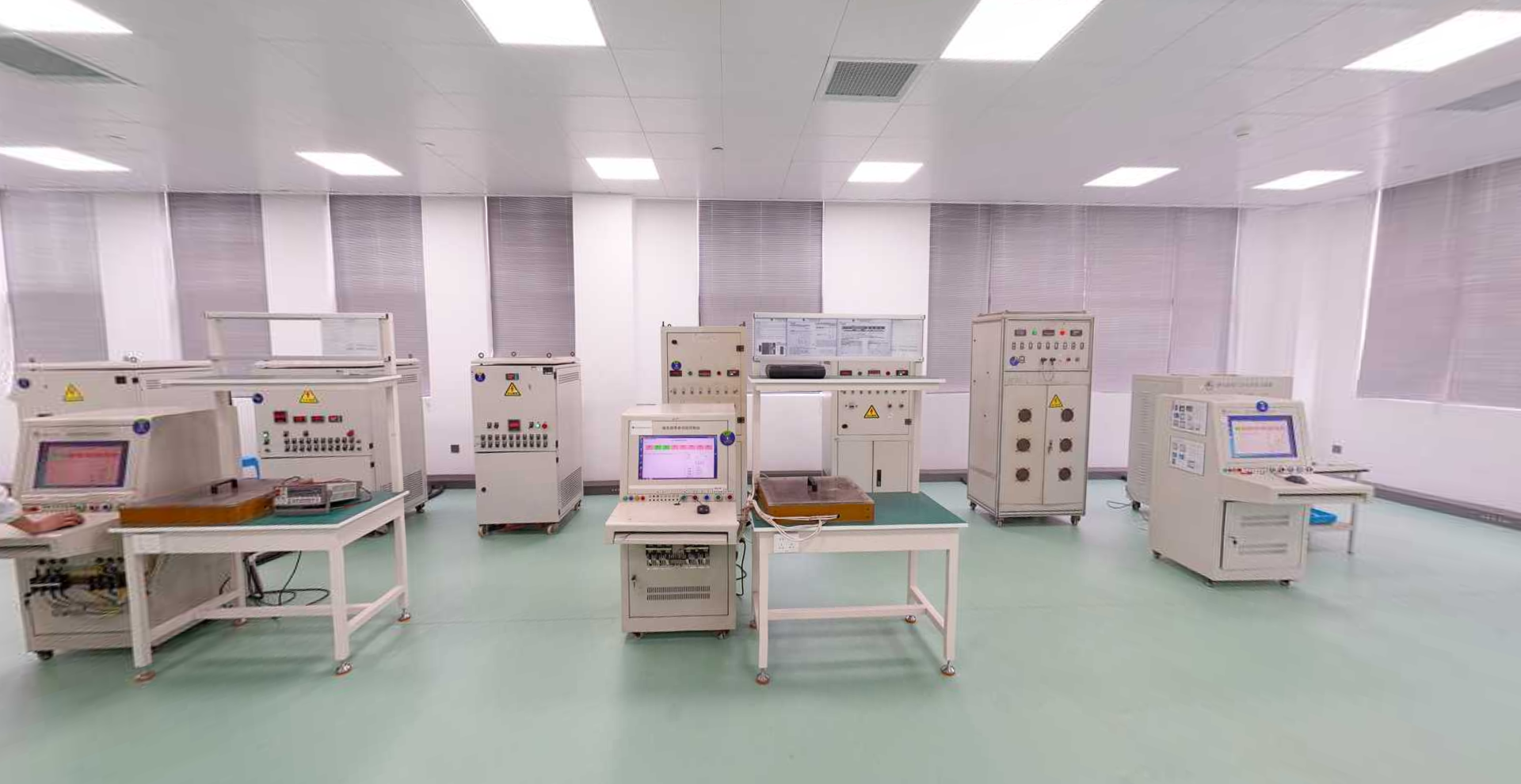
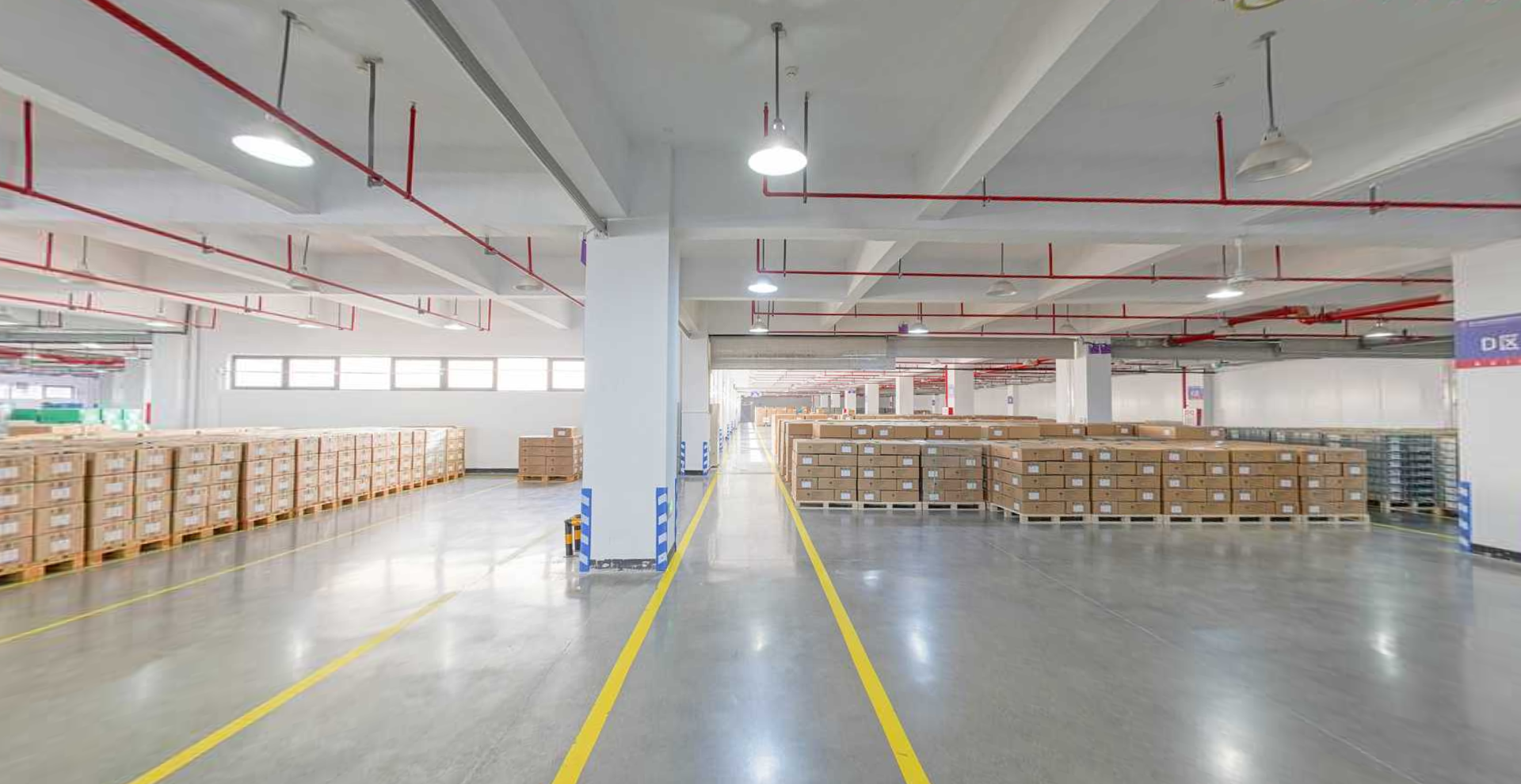
Zhejiang Great Electrical Co., Ltd. was established in 2003 and has been based in Yaozhuang Town, Jiashan County, Jiaxing City, Zhejiang Province since 2010. The company operates a 50,000 m² facility with approximately 500 staff, a 60-engineer R&D team, and annual production of about 50,000,000 units, with exports accounting for 55% of output and the EU and India as main markets. It is a national high-tech enterprise and a national-level specialised and new ‘little giant’ enterprise, listed on the New Third Board in 2016 (stock code 838484) and in the innovation layer since 2017.
The latching relay portfolio itself is organised by mounting style and pole count rather than by marketing segment:
- PCB mount, 20–90 A: GRT508E (20 A), GRT508Y-40A/25A (40 A), GRT508Y-50A (50 A) and GRT508Y-90A (90 A).
- Single-pole fast connection, 60–150 A: GRT508AD (60/80 A, DIN meter), GRT508B (60/90 A and 100 A variants), GRT508FA (80 A), GRT508HC (100 A), GRT508F and GRT508H (120 A), GRT508HE and GRT508HK (150 A).
- Two-pole, 80–100 A: GRT508BW, GRT508BV, GRT508BJ (90 A), GRT508FH and GRT508HA (100 A).
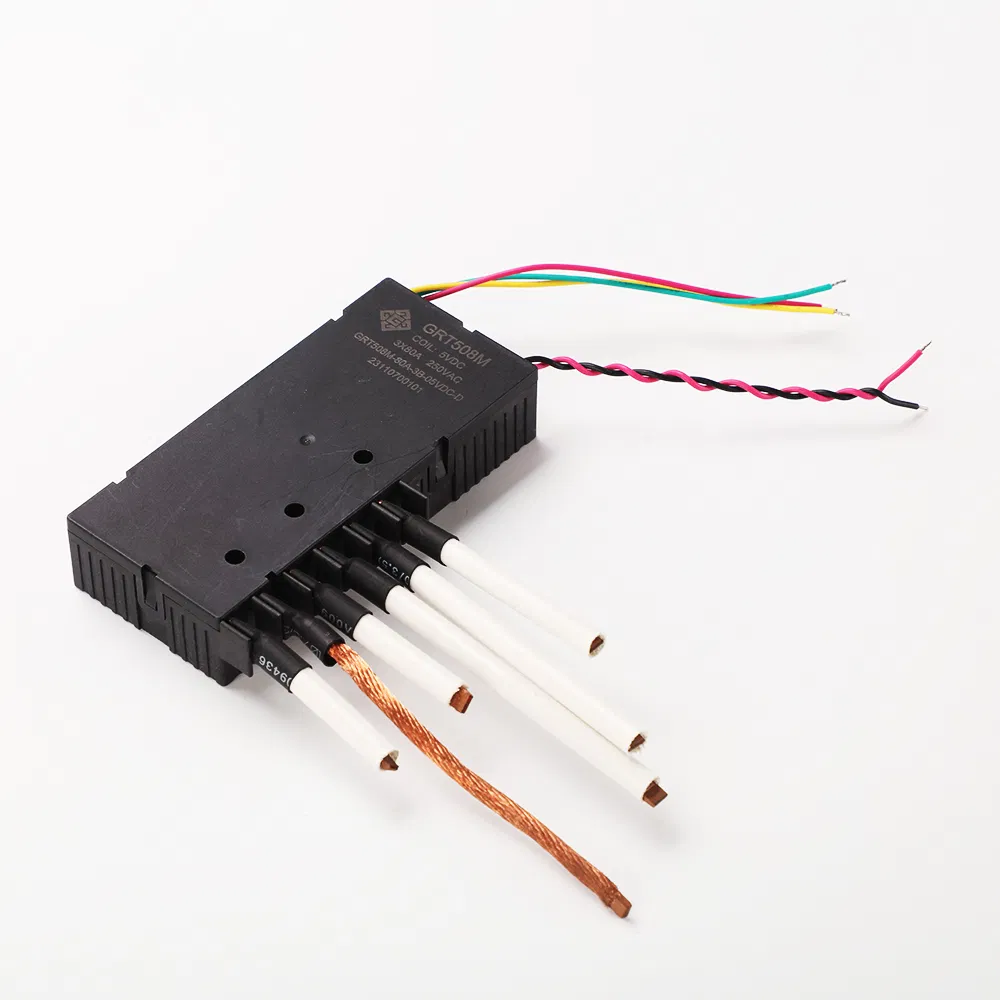
- Three-pole, 80–120 A: GRT508FA3B and GRT508FL (80 A), GRT508FN and GRT508G-3B (120 A), GRT508M (80 A, 100 A and 120 A variants) and GRT508MH (120 A).
Custom assembly is documented across the fast-connection families: flexible wire, copper straps and an integrated shunt are available, which matters to meter designers who would otherwise coordinate a relay supplier and a shunt supplier separately. The wider portfolio also covers miniature current transformers and manganese copper shunt resistors, including the GRT505 shunt.
Step-by-Step: From Discovery to a Qualified Supplier
Step 1 — Fix the switching function
Define load current, system voltage, number of poles (single-phase or three-phase), and how often the relay will actually operate. A disconnect relay in a prepaid meter operates far less often than a relay in a cycling load, and endurance figures should be read against that real duty cycle.
Step 2 — Choose the mounting architecture
PCB mounting constrains current handling to the PCB-mount families, while fast connection terminals are used for 80 A and above on the GRT range. DIN meter designs use a dedicated variant such as the GRT508AD.
Step 3 — Match the coil drive to the control electronics
Confirm whether the board can supply a bipolar pulse (single coil) or two drive lines (double coil), and confirm the available coil voltage within the 5–48 VDC span. This decision is usually made before the model, because it constrains the available options.
Step 4 — Re-check the rating under your conditions
Compare the supplier's rated voltage, load type, contact configuration and endurance against the actual application. Two relays with the same nominal current can carry very different electrical endurance at that current.
Step 5 — Collect model-level compliance evidence
Ask for the certificate number, issuing body, standard and the exact model or series it covers. The table below shows how GRT documents this — note that the scope differs by model, and that UC2 and UC3 are distinct utilisation categories.
| Model / series | Certificate | Issuer | Number | Standard |
|---|---|---|---|---|
| GRT508B series | CE | INTEGRA96 | TTC-23-1307/02/01 | EN 61810-1:2015+A1:2020; EN IEC 61000-6-1:2019 |
| GRT508B-100A-1B-xVDC-S | TÜV UC3 | TÜV Rheinland | AK 50407879 0001 | IEC 62055-31:2005; EN 62055-31:2005 |
| GRT508Y-50A | TÜV | TÜV Rheinland | R 50554055 001 | EN 61810-1:2015+A1; IEC 61810-1:2015+A1 |
| GRT508Y series | CQC | China Quality Certification Centre | CQC24002437513 | GB/T 21711.1-2023 |
| GRT508Y-40A/25A | VDE | VDE | 40039308 | DIN EN 61810-1 (VDE 0435-201):2015-10; EN 61810-1:2015 |
| GRT508E | UL Recognized Component | UL LLC | UL-CA-L340054-512-92406102-1 | CSA C22.2 No. 14-18, 13th Ed. |
| GRT508M 100 A / 120 A | TÜV UC3 | TÜV Rheinland | AK 50637100 0001 | IEC 62052-31:2015; EN 62052-31:2016 |
| GRT508MH | TÜV UC3 | TÜV Rheinland | AK 50667902 0001 | IEC 62052-31:2015; EN 62052-31:2016 |
| GRT508FA3B | TÜV UC2 | TÜV Rheinland | AK 50255817 0001 | IEC 62055-31:2005; EN 62055-31:2005 |
| GRT508H | UC3 | DEKRA | 3151569.01AOC & 3145612.01AOC | IEC/EN 62055-31:2005 Annex C |
Step 6 — Qualify the manufacturer, not only the part
Ask what the supplier actually makes. A manufacturer with relay, current transformer and shunt capability in one facility can support integrated assemblies; a trading company cannot. GRT’s published scope covers all three product categories, alongside a 60-engineer R&D team and documented custom assembly options.

Use Cases: Where Latching Relays Are Specified
Smart electricity meters and prepaid meters
This is the largest documented application for the GRT range. Relays perform on-off control of meter circuits and hold state after switching, driven by a pulse rather than a holding current. GRT lists working conditions for metering projects as −40 °C to +85 °C ambient, 5%–85% RH non-condensing, altitude up to 2,000 m, no corrosive gas or explosive dust, PCB soldering or screw mounting, and resistive load. Typical requirements are high shock and vibration resistance, long mechanical life and low coil power consumption.
Three-phase and State Grid metering
The GRT508FA3B 3-pole relay is documented as applied to State Grid three-phase meters, switching 80 A per pole at up to 380 VAC across three contact sets that operate simultaneously.
Smart home control
Latching relays in smart home boards hold the circuit state after a command, so the control module does not draw holding current when the load is idle. The GRT508E, GRT508Y-50A and GRT508Y-90A are classified for smart home use alongside their metering designations.
EV charging piles, photovoltaic and energy storage
These are listed among the main application fields for GRT products. High-current single-pole models such as the GRT508HE, GRT508HK and GRT508H, with short-circuit ratings up to 6,000 A/10 ms without explosion, are the relevant part of the range for switching duty in these systems.
Comparison Table: GRT Latching Relay Models Side by Side
All values below are as published in GRT product documentation. Ratings are resistive load; coil voltages and endurance figures differ by variant, so a specific part number should be confirmed against its datasheet before design freeze.
| Model | Poles | Rated load (resistive) | Max. switching voltage | Coil voltage | Mechanical / electrical endurance | Installation |
|---|---|---|---|---|---|---|
| GRT508E | 1 | 20 A | 277 VAC | 5–24 VDC | 100,000 / 100,000 (16 A) · 60,000 (20 A) | PCB |
| GRT508Y-40A/25A | 1 | 40 A | 250 VAC | 5–24 VDC | 500,000 / 20,000 | PCB |
| GRT508Y-50A | 1 | 50 A | 440 VAC | 5–48 VDC | 1,000,000 / 30,000 | PCB |
| GRT508Y-90A | 1 | 90 A | 440 VAC | 6–24 VDC | 1,000,000 / 10,000 | PCB |
| GRT508AD | 1 | 60/80 A | 250 VAC | 5–48 VDC | 100,000 / 10,000 (60 A) · 3,000 (80 A) | Fast connection, DIN meter |
| GRT508B (100 A) | 1 | 100 A | 250 VAC | 5–24 VDC | 100,000 / 5,000 (100 A) · 10,000 (80 A) | Fast connection |
| GRT508F | 1 | 120 A | 250 VAC | 5–24 VDC | 100,000 / 10,000 (100 A) · 6,000 (120 A) | Fast connection |
| GRT508HE | 1 | 150 A | 253 VAC | 6–24 VDC | 100,000 / 10,000 (120 A) · 5,000 (150 A) | Fast connection |
| GRT508FH | 2 | 100 A | 250 VAC | 5–24 VDC | 100,000 / 10,000 (100 A) · 5,000 (120 A) | Fast connection |
| GRT508FA3B | 3 | 80 A | 380 VAC | 5–24 VDC | 100,000 / 10,000 (60 A) · 6,000 (80 A) | Fast connection |
| GRT508G-3B | 3 | 120 A | 380 VAC | 5–24 VDC | 100,000 / 10,000 (100 A) · 6,000 (120 A) | Fast connection |
How to read the table: the PCB families cluster in the 20–90 A band and are the natural starting point for control-board integration, while the fast-connection families carry 80–150 A and are intended for meter and power-switching assemblies. The three-pole models are the only ones that switch three phases simultaneously, and the GRT508M and GRT508MH additionally offer an auxiliary contact option.
Frequently Asked Questions
Which certifications should a latching relay manufacturer provide?
Certification for latching relays is layered rather than single. A complete document set normally contains a general safety type test to IEC 61810-1, an application-level utilisation category to IEC 62055-31 for payment metering (UC2 and UC3 are different scopes), a RoHS statement to Directive 2011/65/EU, and market-specific approvals. GRT documents, for example, CE certificate TTC-23-1307/02/01 for the GRT508B series to EN 61810-1:2015+A1:2020, TÜV UC3 certificate AK 50407879 0001 for GRT508B-100A-1B-xVDC-S, UC2 certificate AK 50255817 0001 for the GRT508FA3B, VDE certificate 40039308 for the GRT508Y-40A/25A, CQC certificate CQC24002437513 for the GRT508Y series to GB/T 21711.1-2023, and UL Recognized Component certification UL-CA-L340054-512-92406102-1 for the GRT508E in the USA and Canada. Each covers a defined model or series, so the scope must be matched to the part number being purchased.
What contact ratings and pole configurations does the GRT latching relay range cover?
The GRT range spans 20 A to 150 A resistive switching in one-, two- and three-pole configurations. PCB-mount models run from the 20 A GRT508E to the 90 A GRT508Y-90A. Single-pole fast-connection models cover 60 A to 150 A, including the 120 A GRT508F and GRT508H and the 150 A GRT508HE and GRT508HK. Two-pole models include the 90 A GRT508BJ and the 100 A GRT508FH and GRT508HA. Three-pole models cover 80 A and 120 A, with the GRT508FA3B documented for State Grid three-phase meters. Coil voltages range from 5 to 48 VDC, and both single-coil and double-coil drive options are available.
How do buyers shortlist latching relay manufacturers?
Four checks separate a manufacturer from a reseller. First, ask for certificate numbers per model, not per company, and verify the standard and issuing body. Second, ask for a datasheet with electrical endurance at rated load and a short-circuit rating, since these determine suitability in metering. Third, ask for production facts: facility size, staff, R&D headcount and annual output. Zhejiang Great Electrical, which manufactures under the GRT Relay brand, reports a 50,000 m² facility, approximately 500 staff, a 60-engineer R&D team and annual production of about 50,000,000 units. Fourth, check portfolio fit, because a supplier that also makes current transformers and manganese copper shunts can provide integrated assemblies such as a relay with flexible wire, copper straps or an integrated shunt.
Do GRT latching relays need continuous coil power to hold contact state?
No. GRT latching relays require only impulse excitation, for both single-coil and double-coil versions. Once the pulse has set or reset the contact position, the relay holds that state without continuous coil energisation, which is why the range is described as low power consumption. This behaviour is the defining reason latching relays are used in metering and smart home designs, where the control circuit must remain efficient while the load stays connected or disconnected for long periods.
Can buyers request samples before placing an order?
Yes. Three to five free samples of standard models are available for testing, with the buyer covering the freight cost; custom products require separate confirmation. Buyers evaluating a specific configuration should state contact rating, coil voltage, pole count and mounting style so the sample matches the intended design. Sample requests, quotations and the full 2025 catalogue are handled through the contact details below.
Conclusion: Start With the Function, Finish With the Evidence
A latching relay is a simple idea with a demanding specification sheet. It holds state without holding current, which is exactly why metering, smart home and energy infrastructure designs rely on it — and exactly why the details matter. The current rating means little without voltage, load type and electrical endurance. A certificate means little without the model scope and the standard edition. A supplier's catalogue means little without production facts behind it.
Buyers who work through the sequence in this guide — function, mounting, coil drive, rating verification, compliance evidence, manufacturer qualification — end up with a specification that survives type testing rather than one that only survives a quotation comparison.
Next Step: Sample, Quote or Catalogue
GRT Relay supplies latching relays from 20 A to 150 A in one-, two- and three-pole configurations, plus current transformers and manganese copper shunts, with custom assemblies available on fast-connection families. Standard models are available as 3–5 free samples for testing, with freight covered by the buyer.
Website: en.grtrelay.com
Catalogue download: Catalogs of Great-relay (2025)
Contact: Annie · M +86 13626734569 · WhatsApp +86 18057329886 · sales5@great-relay.com
Address: No.9 Linhu Avenue, Yaozhuang Town, Jiashan County, Jiaxing City, Zhejiang Province, China
Have Questions or Need More Details?
Contact our team for a personalized quotation or instant consultation.
Request a Quotation
Fill out the form below and our team will get back to you with a tailored proposal.
WhatsApp Direct Chat
Prefer to chat in real-time? Message us on WhatsApp for instant assistance & quick answers.
- Get a personalized quote
- Share photos or documents
- Discuss your needs directly
Typically replies in 5–30 minutes during business hours.