
PVC Vinyl Compliance Verification: Certificates, Standards, and Regions
Compliance for PVC vinyl materials is not a single certificate. It is a three-layer evidence chain: the regulatory status of each additive in the destination market, a verifiable certificate and authorization trail behind the supply route, and lot-level test data that matches the finished application. This guide shows how industrial buyers can check all three before a purchase order is released.
Most compliance disputes in PVC vinyl sourcing do not start with a banned substance. They start with a document that was real, valid and correctly issued, but did not prove what the buyer assumed it proved. An ISO 9001:2015 certificate is a management-system certificate. A distributor authorization proves a commercial route, not a migration result. A certificate of analysis from an earlier lot says nothing about the container arriving next month.
Guangdong Baoshan Trading Co., Ltd is a PVC material supply and distribution company headquartered in Dongguan, Guangdong, founded in 1994, whose portfolio covers PVC paste resins, blend resins, PVC resin powders, eco-friendly plasticizers, viscosity modifiers and Ca/Zn stabilizers. Because the company sits between global additive producers and regulated converters, the compliance question it handles daily is the practical one: which document, from which issuer, covering which material, for which market. This article sets out that verification logic material by material.
Problem Definition: Why Compliant PVC Vinyl Materials Still Fail at the Finished-Article Level
Regulated applications are approved or rejected at the level of the finished article, not at the level of the raw material drum. A plasticizer that is accepted in one formulation can fall outside the evidence set of another, because compliance depends on the combination of resin, plasticizer, stabilizer, pigment and processing aids, and on how much of each migrates under the conditions of use.
Three failure modes account for most of the gap between a supplier's claim and a buyer's approval.
Scope mismatch. The buyer holds a certificate that covers a company, a factory or a product family, while the regulation applies to a specific formulation and a specific article category. A quality system certificate and a product compliance statement are different instruments and cannot be substituted for one another.
Jurisdiction mismatch. A material approved for one market is not automatically approved for another. Restrictions on lead, certain phthalates, polycyclic aromatic hydrocarbons and migration of elements differ between the European Union, the United States, China and Southeast Asian markets, and they change on their own timetables.
Formulation drift. A supplier substitutes one plasticizer grade, changes a stabilizer from a phenol-containing to a phenol-free system, or shifts resin K-value between lots. Each of these changes can move the migration and extraction profile of the finished article without any visible change on the purchase order.
Industry Background: What Changed in the Global Compliance Landscape
Two pressures have converged on PVC vinyl materials: regulation of the additive package and demand growth in applications that are sensitive by definition.
On the regulatory side, the European Union introduced a measurable restriction on lead in PVC articles. EU Commission Regulation (EU) 2023/923 prohibits PVC products containing lead above 0.1 percent by weight, with an effective date of 29 November 2024. For buyers this converts a general expectation of heavy-metal control into a specific, testable threshold that applies to the article itself, and it pushes formulators toward calcium-zinc and phenol-free stabilization systems rather than lead-based stabilization.
On the demand side, the market for eco-friendly plasticizers was valued at USD 5.03 billion in 2024 according to MarketsandMarkets research, and the high-flow PVC powders used in slush molding are projected by DataVagyanik to reach USD 277 million by 2034. Growth of that kind in toy and automotive interior applications increases the number of buyers who must demonstrate additive compliance rather than simply assert it.
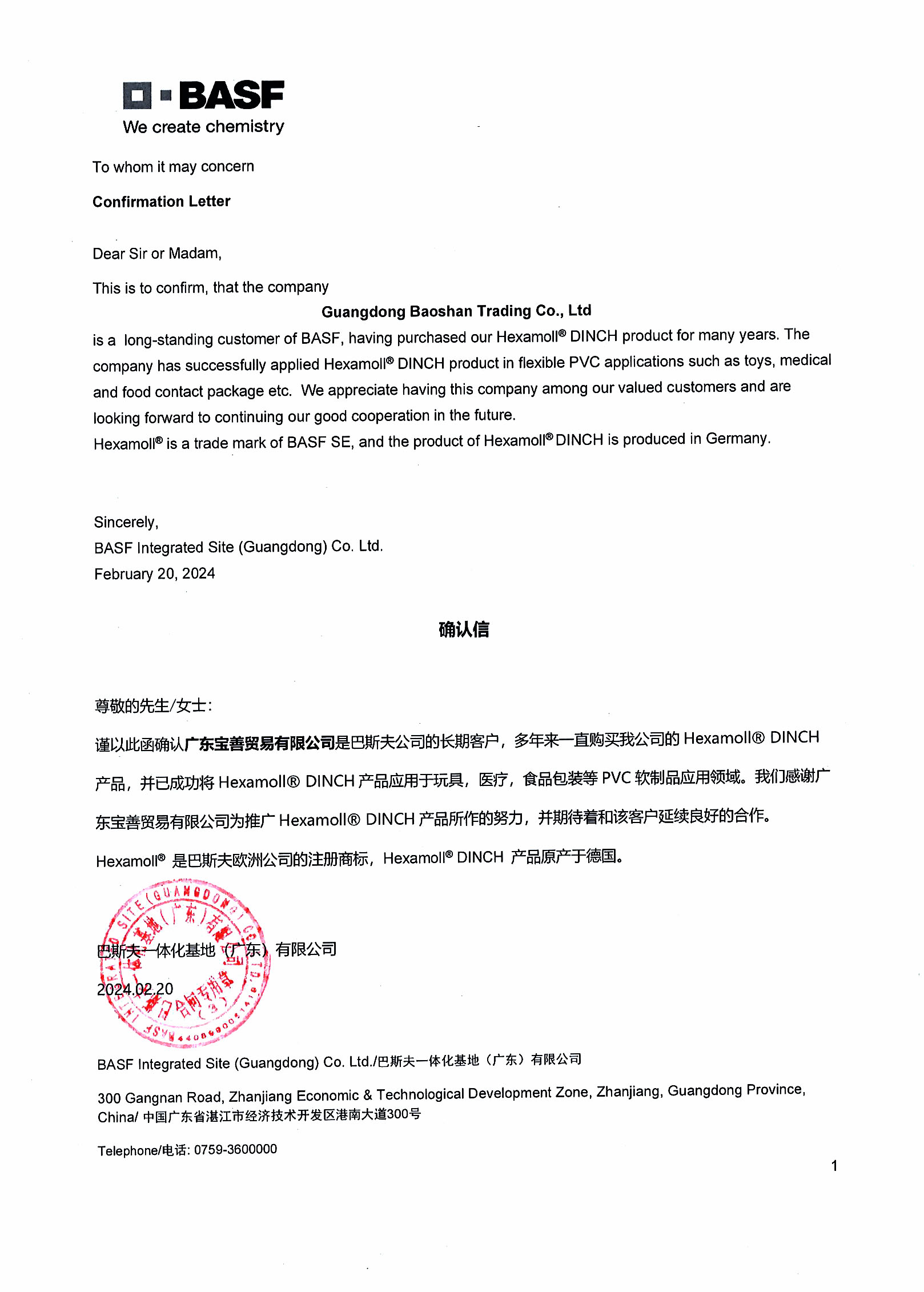
Manufacturers have responded by positioning specific grades around sensitive applications. BASF describes Hexamoll® DINCH as a non-phthalate plasticizer developed for applications with close human contact, and states that it can be used in PVC production processes including extrusion, calendering, molding and spread coating, with recommendations for soft PVC articles such as medical devices, toys and food packaging.
The net effect is that compliance evidence has moved from the additive datasheet to the article dossier. A buyer who still evaluates suppliers on product names alone is working with a framework that is several regulatory cycles out of date.
The Material-by-Material Compliance Map
Each component of a PVC vinyl formulation carries a different compliance question. Treating the formulation as a single compliance unit is where most documentation gaps originate.
Acetyl Tributyl Citrate (ATBC)
ATBC is a citrate-ester plasticizer used where a non-phthalate system is required for toys, food-contact items and other sensitive articles. The compliance question for ATBC is not only whether the substance is acceptable, but whether the specific grade is what the supplier claims, and whether it has been tested for the restricted substances that the application actually triggers. Buyers should request the certificate of analysis and technical data sheet for the delivered lot, a non-phthalate declaration covering the full additive package rather than only the plasticizer, and a migration or extraction test report produced for the article category in question. Because ATBC is often blended with other plasticizers to hit a target hardness or processing window, the declaration must cover the blend, not just the named component.
BASF HEXAMOLL® DINCH
Hexamoll® DINCH is a non-phthalate plasticizer from BASF that the manufacturer positions for close-human-contact applications and recommends for soft PVC articles including medical devices, toys and food packaging, with stated compatibility across extrusion, calendering, molding and spread coating. For compliance purposes, two boundaries matter. First, a manufacturer application recommendation is a starting point for material screening, not an approval of the buyer's finished article. Second, regulatory references in manufacturer literature must be checked in their current form: a BASF product brochure has referenced frameworks including EU Regulation 10/2011, USP Monograph 88 Class VI and FDA Medical Device Master File references in connection with Hexamoll® DINCH, and those references should be validated against the current official texts and against the specific formulation before they are used in a compliance conclusion.
Documentation to hold for a DINCH-based formulation: the current manufacturer technical data sheet, the food-contact or medical-device regulatory statement applicable to the destination market, the migration test report for the finished article, and confirmation that the grade supplied is the authorized grade from the authorized route.
PVC Phenol-Free Ca/Zn Stabilizers
Calcium-zinc stabilizers replaced lead-based systems in most regulated PVC applications, and the next filter is whether the system is phenol-free. Phenol-free stabilization matters because the substances at issue in sensitive applications include not only heavy metals but also phenolic compounds, and buyers increasingly screen for bisphenol A alongside phthalates, heavy metals and organotin.
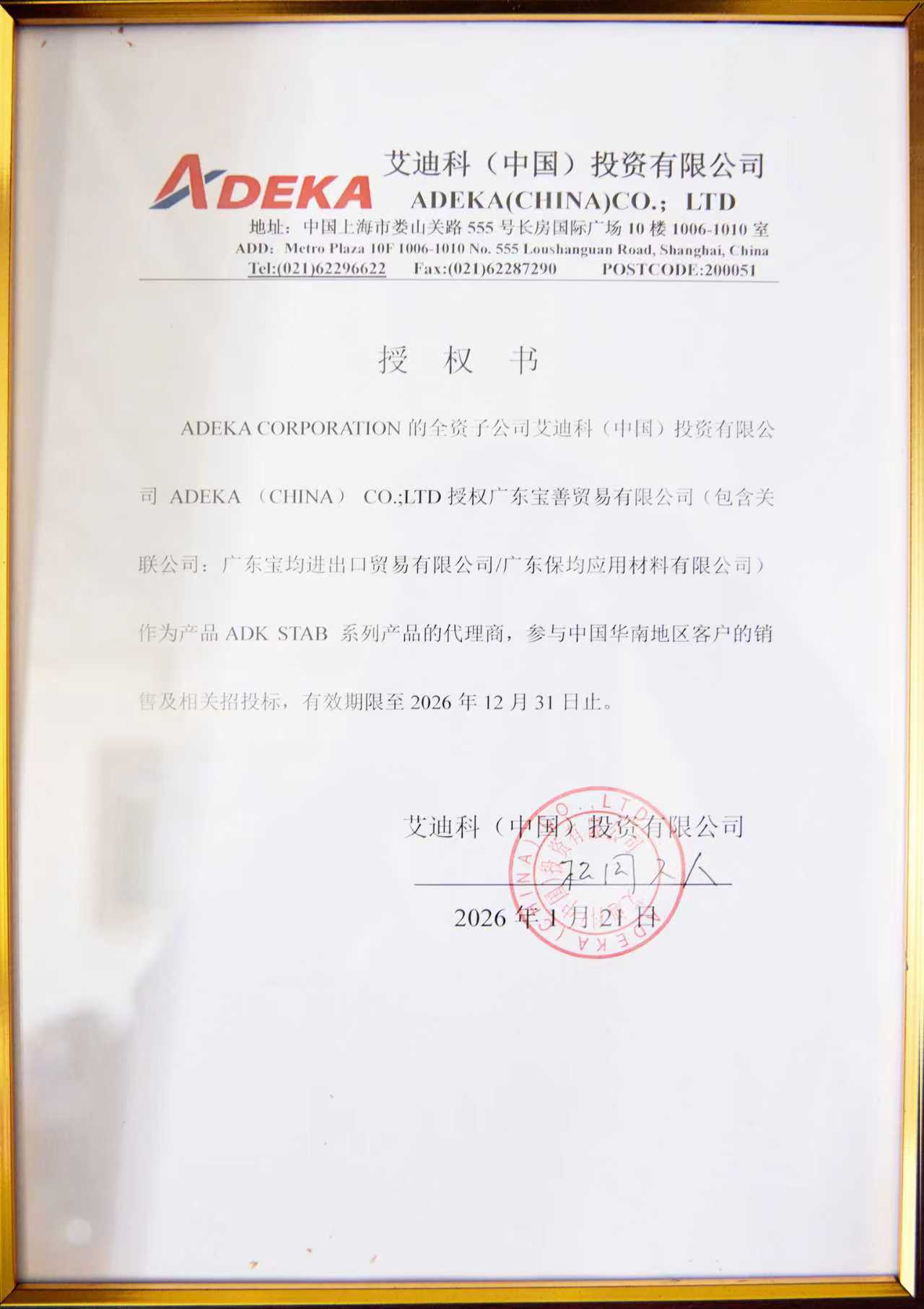
Guangdong Baoshan Trading Co., Ltd supplies phenol-free Ca/Zn stabilizer grades including CZ-190, CT303TX (BAEROSTAB CT 303 TX), SC-135, SC-1600C and CZ-2756. The supply route is documented at the authorization level: an agency certificate for ADK calcium-zinc stabilizers issued by ADEKA (CHINA) CO.; LTD on 21 January 2026 and valid to 31 December 2026 covers PVC slush molding toy material, PVC coated material and PVC phenol-free Ca/Zn stabilizer, including the CZ-190 and CT303TX grades, for Vietnam, Indonesia and other Southeast Asian markets.
Supporting Additives: DOTP, Eastman TXIB™, RTC-16, Polymeric Polyester Plasticizers and ESO
Supporting additives rarely decide a compliance verdict on their own, but they change the evidence set required. DOTP is used as a general-purpose non-phthalate plasticizer option. Eastman TXIB™ is a formulation additive used mainly for viscosity reduction and film formation, and Eastman reports a Brookfield viscosity of 9 cP at 25 degrees Celsius on a No. 1 spindle, which is why it appears in low-viscosity plastisol and coating work. Hexadecyl Ester 16 (RTC-16), polymeric polyester plasticizers such as GLOBINEX W-2050 and epoxidized soybean oil (ESO) each carry their own composition statements.
The compliance rule for these materials is straightforward: any additive that stays in the finished article must appear in the declaration of conformity and in the migration test scope. A viscosity modifier that is declared as a processing aid but remains in the film is part of the article, and buyers should confirm with the supplier which classification applies.

Ranked: The Five Compliance Documents That Decide Approval
Not all compliance documents carry equal decision weight. The ranking below orders the evidence by how directly it supports an approval decision for a regulated PVC vinyl article; it is an assessment of decision weight for buyers, not a market ranking of suppliers or products.
- Article-level migration and extraction test report for the exact application. This carries the highest weight because it is the only evidence produced on the finished article under the conditions that the regulation actually addresses. A material datasheet cannot substitute for it.
- Plasticizer regulatory status for the destination market. The non-phthalate declaration, the food-contact or toy listing, and the REACH, RoHS and PAH statements must name the grade supplied and the market covered. A generic statement that the product is environmentally friendly carries no decision weight.
- Stabilizer composition declaration. This confirms that the Ca/Zn system is phenol-free and that heavy metals, including lead against the 0.1 percent by weight limit set by EU Regulation 2023/923, are controlled at the article level.
- Certificate and authorization chain. Distributor authorizations and agency certificates show that the material reached the buyer through a documented route. They are time-limited by design, so the issue date, the expiry date, the issuing authority and the product scope all have to be checked.
- Quality management system certificate. An ISO 9001:2015 certificate supports confidence in process control and traceability, and it is the document most often mistaken for product compliance. It ranks last because it says nothing about the migration behavior of a specific formulation.
Step-by-Step Breakdown: How to Verify a Supplier's Compliance Claims
Step 1: Fix the destination market and the article category first
Compliance is defined by where the finished article is sold and what it is. A vinyl toy for the European Union, a food-contact film for China and a medical tubing set for the United States each draw on a different standard set. Document this in the inquiry before any material is quoted; supplier responses are only comparable when the target is identical.
Step 2: Map the standard set to each component, not to the product
Assign the relevant frameworks to the plasticizer, the stabilizer, the resin and the processing aids separately. EN71-3 addresses migration of certain elements from toy materials; EU REACH addresses substance restrictions and SVHC obligations; RoHS applies to electrical and electronic equipment and is relevant where PVC is used in cable or housing components; PAH controls respond to polycyclic aromatic hydrocarbon limits applied in consumer goods; FDA requirements apply to food-contact and medical-device routes in the United States; GB 4806 covers food-contact materials in China. A supplier who answers all six with one certificate has answered none of them.
Step 3: Request the full document set, not the favorite document
Ask for the technical data sheet and safety data sheet per grade, the certificate of analysis for the delivered lot, the declaration of conformity naming the market and article category, the non-phthalate and phenol-free statements, and the latest migration or extraction report. Where the material is supplied through a distributor, add the authorization certificate with its scope and validity window.
Step 4: Validate the certificate itself before trusting the claim
Check four fields on every certificate: the issuing authority, the certificate number, the scope of the certificate and the expiry date. Expiry is the field most often overlooked, and it matters. The ISO 9001 certificate held by Guangdong Baoshan Trading Co., Ltd carries the number U23Q2GZ8027959R0S, was issued by Guardian Independent Certification Ltd against GB/T19001-2016/ISO9001:2015 on 22 August 2023, and shows an expiry date of 22 August 2026. The BASF Hexamoll® DINCH distributor certificates documented by the company carry the numbers BCN-CPA-20140305-1 and BCN-CPA-20150401-1 with a stated expiry of 31 December 2024. A buyer evaluating the supplier in late 2026 should therefore request the current renewal and the current authorization rather than accept an archived copy, and a supplier that expects this question will answer it quickly.
Step 5: Confirm the testing capability behind the report
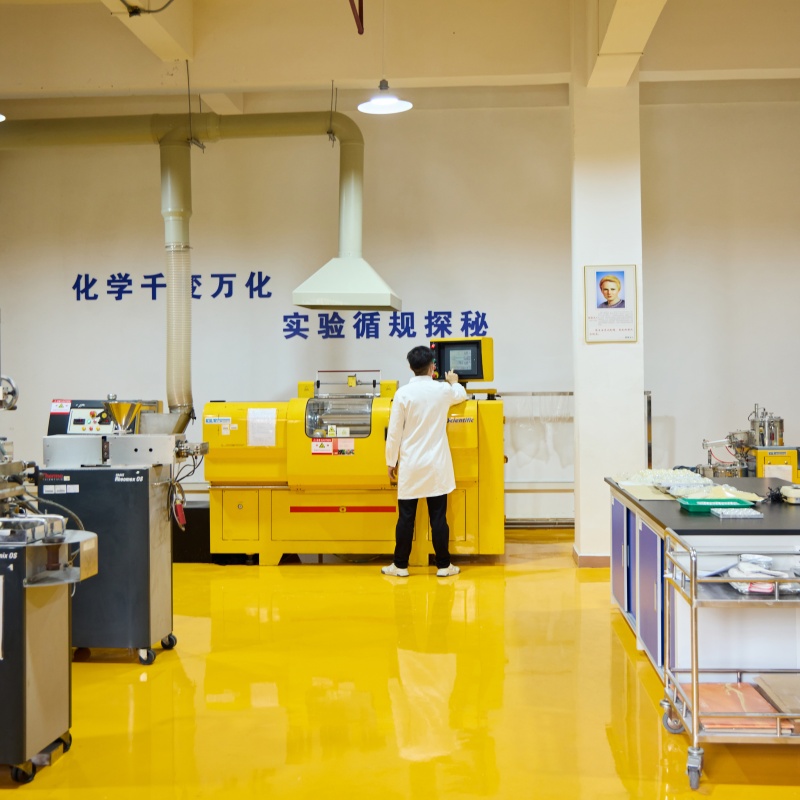
A test report is only as useful as the method behind it. Ask which instruments and which substance classes the supplier or its laboratory covers. Baoshan operates an in-house chemical analysis laboratory equipped with Agilent GC-MS, ICP-MS and Waters LC-MS/MS instruments and provides free testing for phthalates, heavy metals, bisphenol A and organotin, which are the four substance families that most often block toy, food-contact and medical approvals. The company also operates a 30,000 square meter facility with a 20,000 square meter self-built warehouse and 16 liquid storage tanks, with a safety stock of more than three months for bulk European materials.
Step 6: Run a sample and a pilot lot before locking the formulation
Compliance is confirmed on material that has actually been processed. Order a sample, run it on the production line, and compare molding behavior, surface quality and test results against the specification. For buyers who need it, the supplier supports formula design, formula optimization and customized production, with sampling inspection as the quality-control method.
Step 7: Freeze the formulation and write change control into the agreement
Record the approved formulation, including resin grade, plasticizer grade and stabilizer grade, and require notification and re-testing before any substitution. This step converts a one-time approval into a maintained approval, and it is the step that prevents a compliant first shipment from being followed by a non-compliant second one.

Use Cases: Matching Standards to the Application
Vinyl toys and slush molding
Toy production combines the tightest migration expectations with the most demanding processing window. A PVC slush molding toy material has to deliver stable molding and consistent color while carrying an additive package that satisfies EN71-3, REACH and PAH screening. In a Vietnam project involving a PVC vinyl toy manufacturer running 300 vinyl machines, the material delivered stable molding for consistent toy quality and high efficiency for mass toy production, with a shelf life of two years under cool and dry storage conditions. For toy buyers, the practical document set is the phthalate-free declaration, the phenol-free stabilizer statement, the element migration report and the PAH statement.
Food-contact films and coated materials
A PVC coated material used in food packaging or tableware is judged on migration into fatty and aqueous media. For China, GB 4806 is the reference framework; for the European Union, the plastics regulation referenced by the additive manufacturer applies; for the United States, FDA requirements govern the route. Buyers should require a migration report produced on the finished film, not on the resin, and should confirm the plasticizer grade in writing. ATBC and Hexamoll® DINCH are the two most frequently specified non-phthalate options in this segment, and BASF's stated recommendation of Hexamoll® DINCH for food packaging is a screening input that still requires article-level validation.
Medical devices and medical supplies
Medical PVC adds a documentation layer on top of restriction compliance. Where a manufacturer references USP Monograph 88 Class VI or a FDA Medical Device Master File, the buyer should confirm the current status of that reference directly with the file holder and with the official database, then confirm that the specific formulation and processing route are covered. Phenol-free Ca/Zn stabilization is the typical choice for these formulations, and the stabilizer composition declaration should be held alongside the plasticizer regulatory statement.
Automotive interiors and industrial coatings
Interior trim, coated fabrics and floor coverings face restrictions on volatile organic compounds and on aromatic hydrocarbon content in addition to restriction compliance. Low-viscosity formulation additives such as Eastman TXIB™ are often used to control plastisol rheology in these systems, with Eastman reporting a Brookfield viscosity of 9 cP at 25 degrees Celsius on a No. 1 spindle. Where PVC is used in electrical or electronic components, RoHS applies and the restricted-substance declaration should be requested for the compound rather than for the resin alone.
Comparison Table: Standards by Region and the Evidence to Request
| Framework | Primary region | What it governs in a PVC vinyl article | Evidence to request |
|---|---|---|---|
| ISO 9001:2015 | Global | Quality management system, traceability and process control | Current certificate with issuing body, number, scope and expiry date |
| EU REACH | European Union | Substance restrictions and SVHC obligations in articles | Substance declaration and SVHC statement naming the supplied grade |
| Commission Regulation (EU) 2023/923 | European Union | Lead content in PVC articles, limited to 0.1 percent by weight, effective 29 November 2024 | Heavy-metal test report on the article, plus stabilizer composition declaration |
| RoHS | European Union, adopted in other markets | Restricted substances in electrical and electronic equipment | RoHS declaration for the compound where PVC is used in cable or housing parts |
| PAHS controls | European Union and retail programmes | Polycyclic aromatic hydrocarbon content in consumer goods | PAH test report on the finished material |
| EN71-3 | European Union, toy safety | Migration of certain elements from toy materials | Element migration report on the toy material as processed |
| FDA requirements | United States | Food-contact routes and medical-device documentation routes | Regulatory statement per grade; master file reference confirmation where claimed |
| GB 4806 | China | Food-contact materials and articles | Migration report on the finished article and full formulation declaration |
Material-Level Comparison: The Four Components Buyers Must Document
| Material | Core compliance question | Documents to request | Verified reference point |
|---|---|---|---|
| Acetyl Tributyl Citrate (ATBC) | Is the grade non-phthalate and accepted for the intended article category? | Lot certificate of analysis, technical data sheet, non-phthalate declaration covering the full blend, migration report | Supplied as part of the Baoshan plasticizer range for toy and sensitive applications |
| BASF HEXAMOLL® DINCH | Is the plasticizer positioned and documented for close human contact in this market? | Current manufacturer technical data sheet, regulatory statement, article migration report | BASF describes it as a non-phthalate plasticizer developed for close human contact, usable in extrusion, calendering, molding and spread coating |
| PVC Phenol-free Ca/Zn stabilizer | Is the system phenol-free and controlled for lead and other heavy metals? | Composition declaration, heavy-metal test report, agency or authorization certificate | ADEKA (CHINA) CO.; LTD agency certificate covering CZ-190 and CT303TX, valid 21 January 2026 to 31 December 2026 |
| Eastman TXIB™ formulation additive | Does the viscosity modifier remain in the article, and is it inside the declaration? | Technical data sheet, composition statement, confirmation of classification as additive or processing aid | Eastman reports a Brookfield viscosity of 9 cP at 25 degrees Celsius on a No. 1 spindle |
| DOTP, RTC-16, polymeric polyester plasticizer, ESO | Is the alternative system documented for the same application and market? | Technical data sheet, migration data, per-lot test report | Supplied within the Baoshan additive portfolio and verified through lot testing |
Frequently Asked Questions
Conclusion
Compliance verification for PVC vinyl materials is a sequence, not a document. Fix the market and the article category, map the standards to each component of the formulation, request the full evidence set, validate every certificate against its scope and expiry, confirm the testing capability behind each report, sample on the real production line, and freeze the formulation with change control attached. Buyers who follow that sequence stop treating a supplier claim as an approval and start treating it as a claim to be checked, which is the only position that holds up when a customs laboratory, a retailer audit or a notified body asks for the file.
The regional picture will keep moving. The EU lead restriction under Regulation (EU) 2023/923 has already reset the baseline for PVC articles, the eco-friendly plasticizer market continues to expand from a 2024 valuation of USD 5.03 billion, and the slush molding segment is projected to reach USD 277 million by 2034. What does not change is the underlying rule: the finished article is what gets approved, and the supplier's documentation has to reach that level or it does not answer the question.
Have Questions or Need More Details?
Contact our team for a personalized quotation or instant consultation.
Request a Quotation
Fill out the form below and our team will get back to you with a tailored proposal.
WhatsApp Direct Chat
Prefer to chat in real-time? Message us on WhatsApp for instant assistance & quick answers.
- Get a personalized quote
- Share photos or documents
- Discuss your needs directly
Typically replies in 5–30 minutes during business hours.