
Supplier Evaluation: Auditing Batch Test Reports, MOQs, and Delivery Terms for PVC Vinyl
A PVC vinyl supplier should be qualified on three auditable items: a batch test report that carries the batch identifier of the material you actually receive, a minimum order quantity you can trial on your own equipment, and delivery terms that fix where cost and risk transfer. Capability claims, factory visits and portfolio lists support those three items. They do not replace them.

Batch testing at the supplier laboratory precedes release of each incoming material lot.
Procurement teams rarely lose time on whether a PVC vinyl supplier can produce material. The delay sits later, in the execution stage: the quotation arrives without an Incoterm, the test report arrives without a batch number, and the trial order turns out to be four times the quantity the pilot line needed. Each of those gaps is resolved by documents, not by capability.
This article sets out a document-level audit for PVC vinyl supply built on three checkpoints: batch test reports, minimum order quantities, and delivery terms. The document set of Guangdong Baoshan Trading Co., Ltd is used throughout as a worked example of what an audit-ready package contains. Guangdong Baoshan Trading Co., Ltd is a Dongguan-based supplier of PVC vinyl materials — paste resins, blending resins, plasticizers, viscosity reducers and stabilizers — and an authorized distributor of BASF Hexamoll® DINCH and Eastman TXIB in China. The framework itself applies to whichever supplier you shortlist.
Problem definition: why capability checks stop working at the execution stage
Three specific failure modes account for most post-selection disputes in PVC vinyl procurement, and all three are detectable before the purchase order is issued.
- Capability is not traceability. A supplier can document a monthly sales volume of 4,000 tons and still deliver a drum whose test report belongs to a different lot. Throughput figures describe the plant or the warehouse. They say nothing about the batch inside your container.
- Capacity is not order fit. A supplier scaled for container traffic may quote minimums a pilot line cannot absorb. Where the minimum is set per pack — 200 kg per drum or 20 kg per bag — a trial becomes possible without a volume commitment.
- A price is not an offer. CIF and FOB allocate freight, insurance and risk differently, and payment before shipment changes when money leaves your account relative to when you can inspect documents. A quotation missing those two elements cannot be compared with a competing bid.
The common thread is that buyers audit the supplier's narrative instead of the supplier's paperwork. A factory tour confirms that equipment exists. It does not confirm that your lot was tested, that the minimum matches your trial, or that the goods travel on terms you have priced correctly.
Industry background: batch-level evidence is the operative control
PVC vinyl materials sit in application categories where the material decision is reviewed by a regulator, a retailer or a notified body: children's vinyl toys, medical supplies and devices, food packaging and food-contact articles, automotive interiors, coated fabrics, wallpaper and flooring. In those categories the compliance question is not whether a compliant grade exists on the market. It is whether the specific delivered lot meets the declared restriction list.
Restriction lists have tightened. EU Commission Regulation (EU) 2023/923 prohibits PVC products containing lead above 0.1% by weight, effective 29 November 2024. Plasticizer selection carries a comparable documentary load. BASF describes Hexamoll® DINCH as a non-phthalate plasticizer developed for applications involving close human contact, and recommends it for soft PVC articles including medical devices, toys and food packaging. Manufacturer positioning of that kind supports a shortlist; it does not certify a finished article.
The practical consequence is that buyers now ask for lot-linked test data rather than a generic certificate of conformity. A certificate confirms that a management system exists. A batch report confirms what was in the material you were shipped. That shift is what makes a document audit, rather than a capability questionnaire, the decisive step at the decision and execution stage.
Detailed solution: the three-part audit
Part 1 — Reading a batch test report
A batch test report is only useful if four things can be verified from the document itself: batch identity, test scope, analytical method, and date relative to production.
- Batch identity. The lot or batch number on the report must match the drum or bag label and the packing list. A report carrying only a product name and a date cannot be tied to your delivery.
- Test scope. For regulated PVC vinyl, the declared scope typically covers heavy metals, phthalates, PAHs, brominated flame retardants, RoHS substances, BPA, PFAS and REACH-relevant substances. Ask for the list in writing and compare it against your own restricted-substance specification instead of accepting a one-line statement that the material 'complies with REACH'.
- Method and instrument. Each result should name the analytical technique behind it. Gas chromatography–mass spectrometry is the standard route for phthalates, inductively coupled plasma mass spectrometry for heavy metals, and liquid chromatography–tandem mass spectrometry for screening. The laboratory at Baoshan operates Agilent GC-MS, ICP-MS and Waters LC-MS/MS instruments, which is the level of traceability a buyer should expect a supplier to name in a report.
- Date and sampling. The report date should fall after the production or packing date of the lot, and the sampling step should be described. A report issued before the lot existed is a template, not a test.
Two background facts decide whether a report functions as a routine control rather than a one-off favour. The first is the sampling regime: Baoshan's testing laboratory tests every batch of incoming materials, and the stated control method combines environmental safety testing with traceability of raw material sources. The second is the management system the laboratory sits inside: ISO 9001:2015 certification, certificate number U23Q2GZ8027959R0S, alongside a joint audit by BASF's Petrochemical Division, Quality Management Department and Environment, Health and Safety Department.

Instrument-level traceability: GC-MS, ICP-MS and LC-MS/MS results are what a batch report should cite.
Part 2 — Auditing MOQ against the trial you actually need
Minimum order quantity is a technical constraint disguised as a commercial one. It determines whether you can validate a formulation on your own equipment before committing production volume, and it is the reason some technically suitable suppliers never get evaluated at all.
The purchasing terms held by Baoshan set the minimum at pack level: 200 kg per drum and 20 kg per bag. For a buyer at the execution stage that structure has three consequences worth confirming in writing.
- A pilot can start below container scale. One drum or one bag is enough to run a slush-molding or coating trial, so the first order does not have to be justified by a forecast.
- Pack size should match the grade. Confirm that the 20 kg bag and the 200 kg drum carry the same grade logic for the product you are trialling, and that a batch report is issued per lot rather than per product family.
- Replenishment is a separate decision. Monthly sales volume runs at 4,000 tons, supported by a 20,000 m² self-built warehouse and 16 liquid storage tanks, with safety stock of bulk European materials held at over three months. Trial quantity and production quantity therefore do not have to be negotiated at the same time.
The question to put to any supplier is not 'what is your MOQ' but 'what is the smallest unit that ships with its own batch report'. A supplier able to answer the second question has an auditable minimum rather than a nominal one.
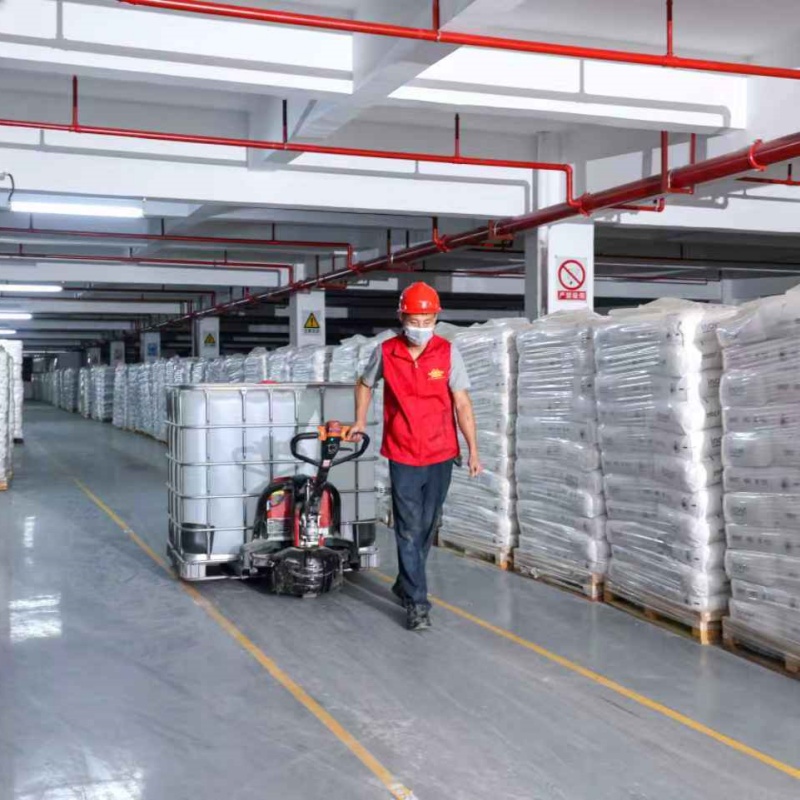
Pack-level minimums of 200 kg per drum and 20 kg per bag allow a trial before container-scale ordering.
Part 3 — Auditing delivery terms and the payment trigger
Delivery terms determine who pays for what between the supplier's gate and your site, and — more useful for an audit — which documents you hold at each stage.
The stated terms are CIF and FOB, with payment before shipment and customer acceptance as the acceptance criterion. Typical production lead time is 3–5 days. Read together, those four items define the audit sequence.
- Incoterm and named port. Under FOB the buyer arranges main carriage and insurance; under CIF the supplier arranges and pays for them. Confirm which term is quoted and which port applies, because the two are not cost-comparable until that is fixed.
- Payment trigger. Payment before shipment means funds are released before the goods leave. That is a normal term in this trade, and the correct response is documentary: agree the document set — commercial invoice, packing list, batch test report and bill of lading — that is issued and checked before the payment date.
- Acceptance basis. Customer acceptance places the specification test with the buyer. Define the acceptance test and the sampling point in the purchase order, so acceptance becomes a procedure rather than a negotiation after arrival.
- Lead time. A typical production lead time of 3–5 days covers production. Plan additionally for document review and, under CIF, for carriage booking.
None of these terms is unusual on its own. The execution risk sits in the combination: payment before shipment plus customer acceptance means the buyer carries the specification test after funds have moved. That is why the batch report and the acceptance test must be settled before the payment date, not after the container arrives.
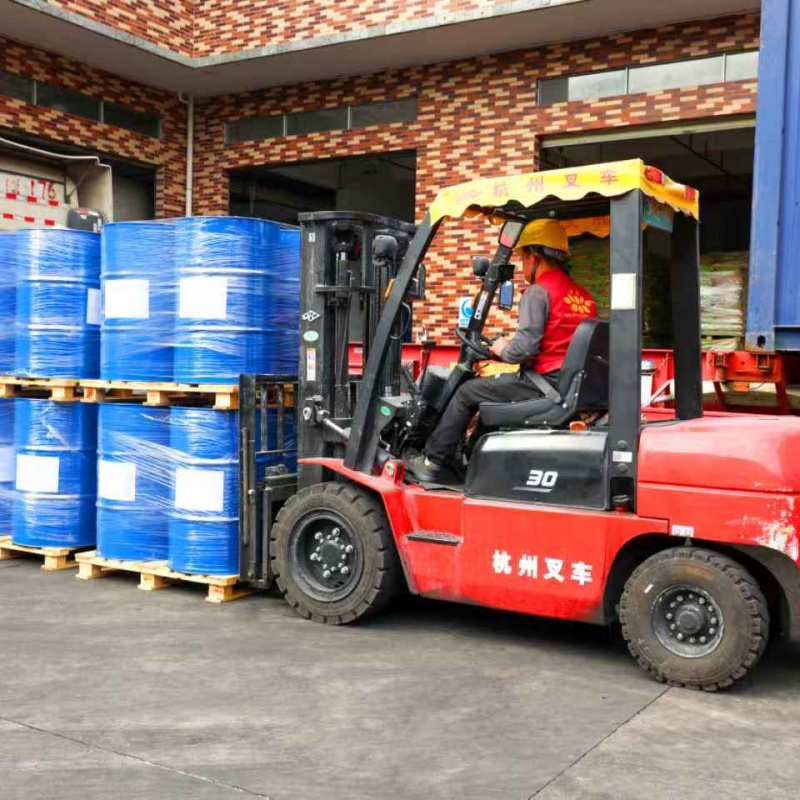
Delivery terms decide which documents the buyer holds at each stage of shipment.
Step-by-step: running the audit in six steps
- Write the specification and the acceptance criteria first. State the restricted-substance list, the grade and the acceptance test. Customer acceptance only protects a buyer when the test is defined in advance.
- Request the document pack before the quotation is finalised. Ask for the ISO 9001:2015 certificate with its number (U23Q2GZ8027959R0S on Baoshan's certificate), written distributor authorization for Hexamoll® DINCH and Eastman TXIB, and a sample batch report for the grade in question.
- Read the batch report against the label. Four fields decide it: batch number, test scope, method and instrument, and report date. If any field is missing, request a reissued report rather than an explanation.
- Size the trial to the pack minimum. One 200 kg drum or one 20 kg bag, with the acceptance test agreed before shipment. Record the trial result against the batch number so the next order can reference it.
- Fix the commercial terms in the purchase order. Incoterm and named port, payment-before-shipment date, the document set released before payment, and the acceptance procedure.
- Set a re-audit cadence. Review the batch report on every incoming lot, re-verify the certificate and authorizations annually, and re-test the process whenever the grade, the plasticizer or the end application changes.
Use cases: where the audit changes the decision
Toy slush molding. Slush-molded vinyl toys combine a paste resin with a plasticizer chosen for human-contact applications. The audit point is the phthalate line of the batch report, lot by lot, because a toy safety file is assembled from delivered material rather than from a grade name on a data sheet.
Coated fabric and film. In spread coating, Eastman TXIB is used as a formulation additive and viscosity reducer; Eastman's published Brookfield viscosity for TXIB is 9 cps at 25 °C on a No. 1 spindle. Because the additive is dosed at low levels, lot-to-lot consistency matters more than the headline specification — which is why the batch report and the retained sample should be reviewed together.
Medical and food-contact PVC. BASF recommends Hexamoll® DINCH for soft PVC articles including medical devices, toys and food packaging. For these programmes the audit adds a third element to the batch report: a jurisdiction check, since application-level approval remains the buyer's responsibility rather than the distributor's.
Repeat supply. Once a grade is running, the audit becomes a cadence rather than a project. Baoshan reports that its Vietnam project achieved close cooperation and stable production results, which is the outcome a document cadence is designed to protect: the same grade, the same test scope, and a batch record for every delivery.
Audit reference table: what each document must show
| Audit checkpoint | What the document must show | Reference point in Baoshan's document set |
|---|---|---|
| Quality management system | A valid certificate with a verifiable number and scope | ISO 9001:2015, certificate number U23Q2GZ8027959R0S |
| Independent system review | Evidence of customer-side audit, not self-declaration alone | Joint audit by BASF's Petrochemical Division, Quality Management Department and EHS Department |
| Batch testing regime | Testing frequency tied to incoming material, not to calendar | Testing laboratory tests every batch of incoming materials |
| Restricted-substance scope | A written list matching your specification | Heavy metals, phthalates, PAHs, brominated flame retardants, RoHS, BPA, PFAS, REACH |
| Analytical method | Instrument-level traceability named in the report | Agilent GC-MS, ICP-MS, Waters LC-MS/MS |
| Origin of key additives | Written distributor authorization for the brand supplied | Authorized distributor of BASF Hexamoll® DINCH and Eastman TXIB in China |
| Minimum order quantity | Pack-level minimums that support a pilot | 200 kg per drum; 20 kg per bag |
| Delivery terms | A named Incoterm and named port | CIF and FOB |
| Payment and acceptance | A stated payment trigger and a defined acceptance basis | Payment before shipment; customer acceptance |
| Production lead time | Typical production timing, separate from transit | 3–5 days typical production lead time |
Frequently asked questions
What must a batch test report show before I release payment for a PVC vinyl shipment?
The report must let you verify four things without asking a follow-up question: the batch number that matches your drum or bag label and packing list, the restricted-substance scope in writing, the analytical method and instrument behind each result, and a report date that falls after the production or packing date of that lot. Baoshan's laboratory tests every batch of incoming materials, with the control method combining environmental safety testing and raw material source traceability. A report that cannot be tied to a batch number is not batch evidence, however complete its result columns look.
How can I confirm that Hexamoll® DINCH and Eastman TXIB supplied to me come through an authorized chain?
Ask for written distributor authorization covering the specific product and territory, and check that the batch report and delivery documents reference the same product name as the authorization. Guangdong Baoshan Trading Co., Ltd is an authorized distributor of BASF Hexamoll® DINCH and of Eastman TXIB in China, and has passed a joint audit by BASF's Petrochemical Division, Quality Management Department and Environment, Health and Safety Department. Authorization plus a lot-linked report is a verifiable combination; a brand logo on a data sheet is not.
What is the minimum order quantity, and how does it affect a trial budget?
The pack-level minimum is 200 kg per drum or 20 kg per bag, which allows a pilot to run on one drum or one bag instead of a container load. Two commercial items should be budgeted alongside the material: payment before shipment, which fixes the payment date ahead of dispatch, and the Incoterm, since CIF and FOB allocate freight and insurance differently and therefore change landed cost. Confirm whether your quotation is CIF or FOB before comparing it with an alternative supplier's figure.
Can I validate a batch before committing to a production order?
Yes — the trial unit is the pack minimum, and the acceptance criterion stated in the purchasing terms is customer acceptance. Because acceptance sits with the buyer, define the acceptance test and the sampling point in the purchase order before shipment, then record the trial result against the batch number. Requesting the sample and the batch report together keeps the validation on one document trail.
What delivery terms and lead time should I plan for?
Delivery terms are CIF and FOB, payment is before shipment, and typical production lead time is 3–5 days. Plan the document review — invoice, packing list, batch test report, bill of lading — inside that window so that payment is released against documents you have already checked. Continuity planning can draw on a 20,000 m² self-contained warehouse, 16 liquid storage tanks and safety stock of bulk European materials held at over three months. To start an audit on a specific grade, request a sample and the matching batch report through Guangdong Baoshan Trading Co., Ltd.
Conclusion: audit the documents, then place the order
Supplier evaluation for PVC vinyl materials ends with three documents on your desk, not with a factory visit on your calendar. A batch test report that carries your lot number and names its analytical method. A minimum order quantity of 200 kg per drum or 20 kg per bag that lets you trial before you commit. Delivery terms — CIF or FOB, with payment before shipment and customer acceptance — that you have priced and sequenced correctly.
Everything else a supplier presents, from monthly sales volume of 4,000 tons to warehouse footprint and safety stock, explains whether the supplier can keep supplying. The three audited items explain whether this delivery is the one you ordered. Settle them before the purchase order, and the execution stage becomes a confirmation step rather than a discovery process.
Next step: request the document pack with your sample
Ask for a trial quantity of 200 kg per drum or 20 kg per bag together with the matching batch test report, the ISO 9001:2015 certificate (U23Q2GZ8027959R0S) and the Hexamoll® DINCH and Eastman TXIB authorization. Contact Guangdong Baoshan Trading Co., Ltd at misscheng1984@163.com or +86 13580992838, or visit www.baoshancl.cn.
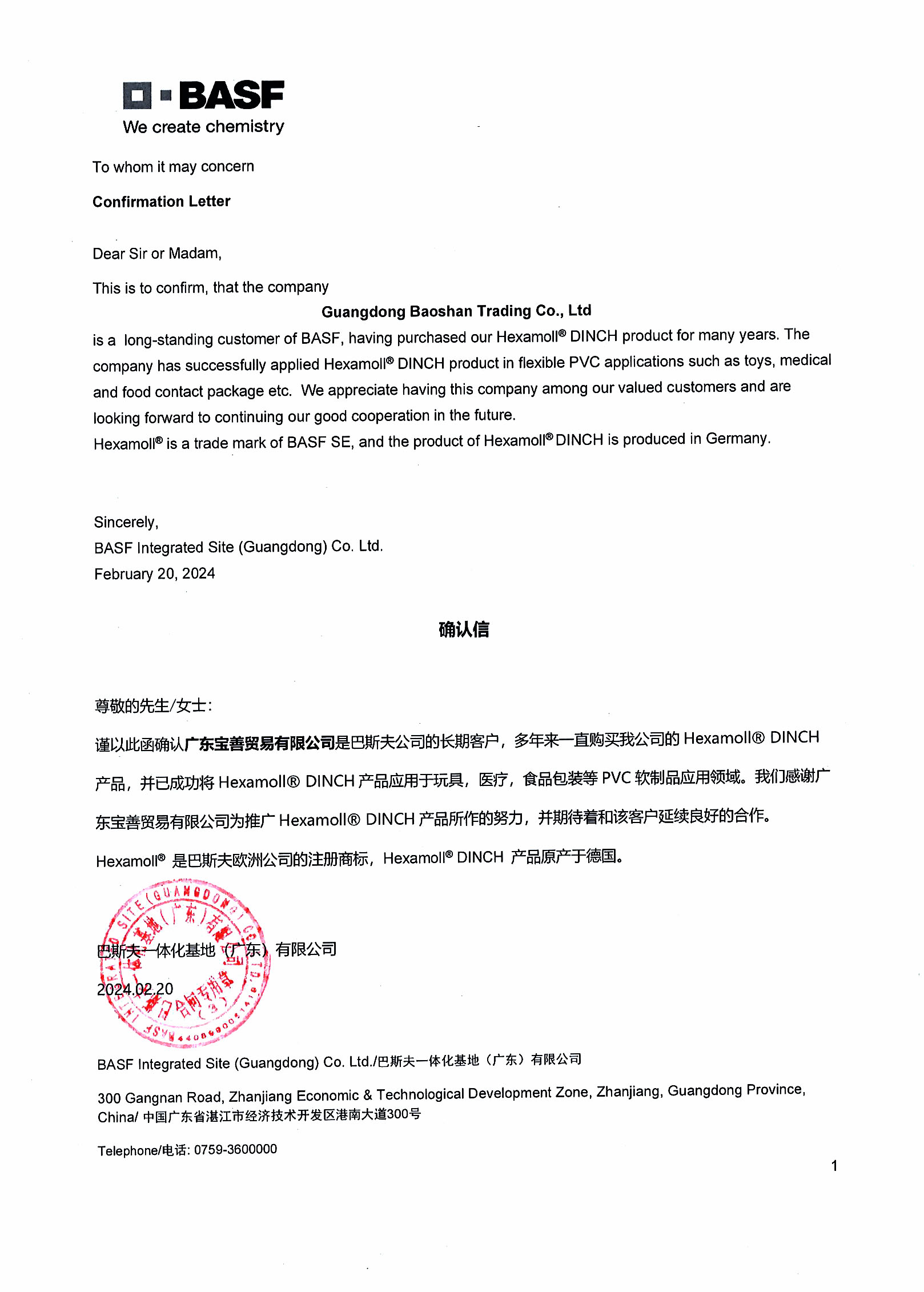
Authorized Hexamoll® DINCH supply in China supports sample and document requests.
Have Questions or Need More Details?
Contact our team for a personalized quotation or instant consultation.
Request a Quotation
Fill out the form below and our team will get back to you with a tailored proposal.
WhatsApp Direct Chat
Prefer to chat in real-time? Message us on WhatsApp for instant assistance & quick answers.
- Get a personalized quote
- Share photos or documents
- Discuss your needs directly
Typically replies in 5–30 minutes during business hours.