
Regional Certification Guide for PVC Vinyl Materials: ATBC, DINCH & Ca/Zn Stabilizers
Short answer: a compliant PVC vinyl materials order needs three document layers, not one. Layer one is the additive's own regulatory approval — REACH, RoHS, FDA, GB 4806, PAHS or EN71-3, depending on the grade. Layer two is batch-level heavy-metal and phthalate test data from a laboratory using GC-MS, ICP-MS or LC-MS/MS. Layer three is the supplier's quality system certificate, typically ISO 9001:2015, together with the brand-owner authorisation certificates that show the material was supplied through an approved channel.
Choosing a plasticizer or stabilizer for a regulated PVC formulation solves only half the problem. The other half is proving the choice to a customs officer, a toy safety auditor or a medical device reviewer. ATBC, BASF Hexamoll® DINCH and phenol-free Ca/Zn stabilizers are each documented against a different combination of frameworks, and the same grade can be fully acceptable for one project and incomplete paperwork for another.
This compliance guide maps regional certification requirements to those three additive families, sets out which documents to request for toy, food-contact and medical PVC applications, and shows how batch-level heavy-metal and phthalate testing turns a certificate into an acceptance record that a quality team can actually sign off.
What this guide covers:
- Why a technical datasheet is not a compliance file, and the three failure modes that cause re-submission cycles.
- The documented frameworks behind ATBC, BASF Hexamoll® DINCH and phenol-free Ca/Zn stabilizers.
- A six-step method for mapping certifications to a specific region and end application.
- A documentation priority ranking, two reference tables and a document request checklist for procurement files.
Problem Definition: Why a Technical Datasheet Is Not a Compliance File
A technical datasheet describes typical properties. A compliance file proves that a specific delivered batch met a specific regulatory limit, measured by a specific method, at a laboratory that can be named. Those are two different documents, and auditors, customs authorities and medical device reviewers only accept the second one.
The gap becomes visible whenever a restriction is quantitative. Under EU REACH, DEHP, DBP and BBP are restricted in toys and childcare articles to concentrations below 0.1%. A supplier statement that a plasticizer is phthalate-free does not answer that requirement on its own. The buyer needs a phthalate test result for the delivered lot, produced by a method such as GC-MS, plus a declaration that names the restricted substances and the limit.
Three failure modes account for most rejection and re-submission cycles in regulated PVC vinyl materials:
- Certificate without batch data. The additive is approved for food contact or toys, but no batch-level report follows the shipment. Incoming QC then has no way to compare the delivered lot against the approved grade.
- Batch data without method alignment. Test results exist, but different methods or different laboratories were used across lots. The numbers are not comparable, cannot be trended, and cannot support a claim of consistent performance.
- Supplier documents that are out of scope or out of date. An authorisation or system certificate may name a different market, a different product scope, or a validity period that has already closed. The issuing authority, the certificate number and the validity window all have to be checked on the copy you actually receive.
The three-layer rule for regulated PVC materials
Layer 1 — Additive approval: REACH, RoHS, FDA, GB 4806, PAHS or EN71-3, matching the exact grade and the end application.
Layer 2 — Batch evidence: heavy-metal and phthalate test results for the delivered lot, produced with GC-MS, ICP-MS or LC-MS/MS.
Layer 3 — Supplier system and authorisation: an ISO 9001:2015 certificate plus brand-owner authorisation certificates covering the market you buy into.
Industry Background: Compliance Documentation Has Become a Purchasing Filter
Three market signals explain why certification mapping now sits inside the sourcing process rather than after it.
- The substrate market keeps expanding. The global PVC paste resin market was estimated at USD 2.67 billion in 2024 and is projected to reach USD 4.473 billion by 2035 (Market Research Future).
- Production is concentrated in Asia-Pacific. The region accounts for over 60% of global PVC paste grade resin volume, with China alone responsible for more than 45% of consumption. Most regulated buyers therefore import from the same manufacturing base and are measured against the same documentation standard.
- Non-phthalate chemistry is the growth segment. The global eco-friendly plasticizers market was valued at USD 5.03 billion in 2024 and is projected to reach USD 7.55 billion by 2030, at a 7.0% CAGR (MarketsandMarkets). Medical plastics, including PVC for medical devices, were valued at USD 61.4 billion in 2025 with a projected 6.0% CAGR (Grand View Research).
The practical consequence is that a buyer in Vietnam, Indonesia or China sourcing PVC vinyl materials for a European toy brand, a US food-contact converter or a medical device manufacturer is now asked for the same file structure in every case — additive approval, batch data, supplier system certificate — even though the specific standard names change with the region.
Detailed Solution: Mapping Certifications to ATBC, DINCH and Phenol-Free Ca/Zn Stabilizers
Layer 1 — Additive-level regulatory approvals
Additive approvals are the starting point because they define which markets a grade can even be quoted into. The frameworks differ by chemistry, and mixing them up is the most common reason a document set is rejected at first review.
ATBC: REACH compliance plus RoHS, FDA and GB 4806 certification
Acetyl Tributyl Citrate, listed as ATBC with CAS 77-90-7, is a citrate-ester plasticizer used where phthalate-free chemistry and food-contact status are both required. Its documentation covers four frameworks: compliance with REACH, and certification to RoHS, FDA and GB 4806. The grade carries a purity of 99.0% or higher and a heavy-metal limit stated as lead 10 mg/kg or below, which is usually the first number a QC team verifies against an incoming shipment.
For food contact, ATBC is specified for cling film, food packaging film, heat-shrinkable film, bottle cap gaskets, disposable food containers and beverage straws, with compliance stated against FDA and GB 4806 food-contact standards. In medical-grade PVC it is used in infusion tubes, transfusion bags, medical catheters, drainage bags, medical gloves, breathing masks and medical hoses. In children's products it is referenced against EN71-3 and RoHS toy safety standards. A freezing point of -80 degrees Celsius or lower supports use in cold regions, and the standard pack is a 220 KG drum.
BASF Hexamoll® DINCH: EU REACH, RoHS and PAHS, plus food-contact permits from two authorities
What separates BASF Hexamoll® DINCH in a compliance file is the combination of a very low declared phthalate content, stated as 0.01% maximum, with externally issued food-contact permits rather than a self-declaration. It has passed EU REACH, RoHS and PAHS, and holds food-contact permits from Germany's BFR and the Japan Hygienic PVC Association. Ester content is 99.5% minimum and the pour point is -54 degrees Celsius.
CAS registration is listed as 474919-59-0 in the USA and 166412-78-8 in regions outside the USA, so the correct number has to be quoted on the document you file, especially when one specification serves several markets. Approved application scope includes medical devices such as infusion tubes, blood bags, medical gloves, catheters and breathing masks; food-contact packaging films, bottle cap gaskets and disposable tableware; and children's products, where it can be used in toys for children under 3 years old. Availability in 200 KG and 950 KG drums lets larger regulated lines consolidate lots and reduce the number of batch certificates in circulation.
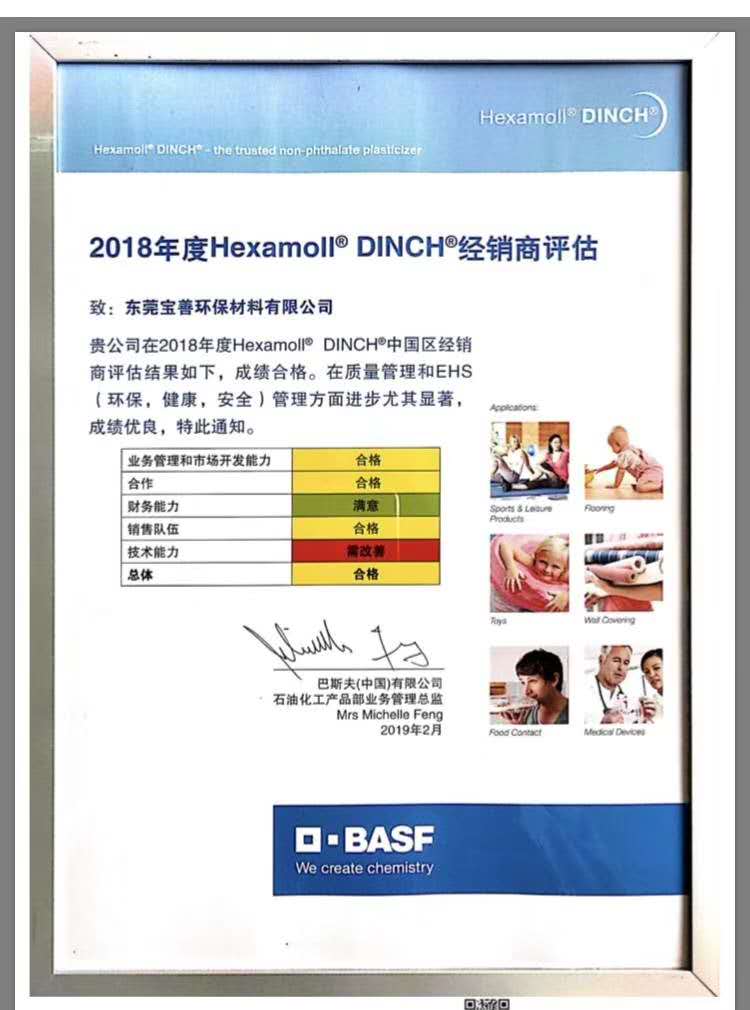
Distribution status is part of the file. Authorised distributor certificates for Hexamoll® DINCH are issued by BASF (China) Co., Ltd., with the certificate series BCN-CPA-20140305-1 and BCN-CPA-20150401-1 covering China, Vietnam, Indonesia and other Southeast Asian markets.
Phenol-Free Ca/Zn Stabilizers: REACH, RoHS, FDA, PAHS and EN71-3
Ca/Zn stabilizers carry a different compliance profile from plasticizers, because they protect the resin during processing and also determine whether a finished product can be sold into toy and food-contact channels. The phenol-free grades in this portfolio cover two document levels.
At the broader level, the CZ-2756, SC-1600C, SC-135 and CZ-190 grades comply with REACH, RoHS and FDA standards, while the CZ-2756 grade additionally passes PAHS and EN71-3 toy safety requirements. Its specification states phenolic substances as not detected and the formulation as free of phenols, lead, cadmium and heavy metals, with thermal stability of 30 minutes or more at 180 degrees Celsius and VOC content of 0.5% or less. For toy and food-contact audits, that combination of a phenol-free declaration with PAHS and EN71-3 results removes two of the most frequently raised questions.
At the application level, CT303TX complies with EU REACH, RoHS and domestic GB 4806 food-contact standards, and is stated as free of heavy metals and toxic components such as lead, cadmium and organotin. Its recommended dosage is 1.5 to 3.0 phr of PVC paste resin, adjusted according to product requirements. That dosage figure belongs in the same specification as the certification requirement, because a dosage change is a common trigger for re-qualification.
Channel documents matter here as well. An agency certificate for ADK calcium zinc stabilizers, issued by ADEKA (CHINA) CO.;LTD on 21 January 2026 and valid through 31 December 2026, covers Vietnam, Indonesia and other Southeast Asian countries and regions, with the stated scope listing PVC Slush Molding Toy Material, PVC coated material and PVC Phenol-free Ca/Zn stabilizer. That scope line is the detail buyers should verify: whether the certificate actually names your material and your market, not just the supplier.
Layer 2 — Batch-level heavy-metal and phthalate testing
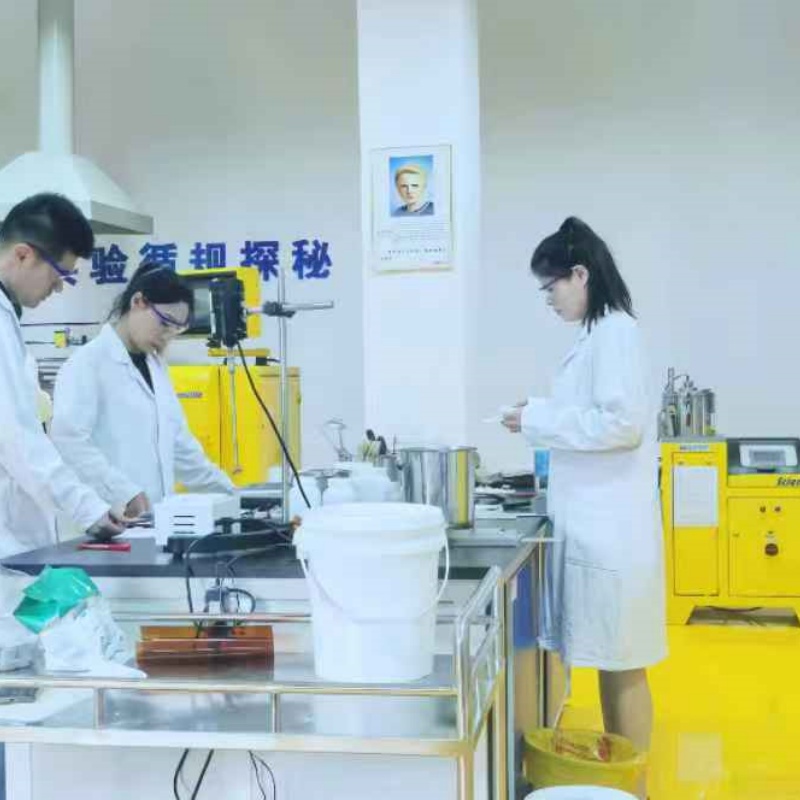
Certificates are issued against a product. Acceptance decisions are made against a lot. The bridge between the two is batch-level analytical testing, which is why laboratory capability belongs in a supplier evaluation for regulated PVC vinyl materials rather than in a separate quality discussion.
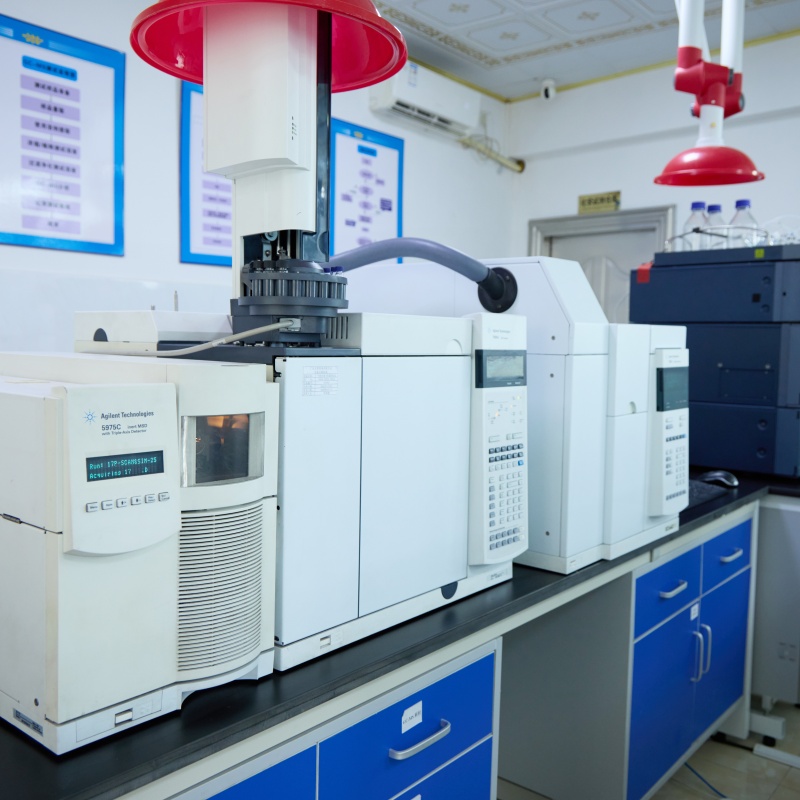
A supplier laboratory equipped with Agilent GC-MS, ICP-MS and Waters LC-MS/MS instruments can screen for the substances that most regional frameworks restrict: phthalates, heavy metals, bisphenol A and organotin. When those tests are run on the delivered grade, results can be compared directly against the limits declared on the product document, such as the 0.01% maximum phthalate content declared for Hexamoll® DINCH, or the lead limit of 10 mg/kg or below declared for the ATBC grade.
Method alignment is the operating rule. Same method, same grade, same laboratory, lot after lot. Without that consistency a batch report is a snapshot rather than an acceptance tool, and trend analysis across shipments becomes impossible.
Layer 3 — Supplier quality system and authorisation certificates
The third layer answers a different question: can this supplier repeat the same material next quarter? Two document types carry most of that weight.
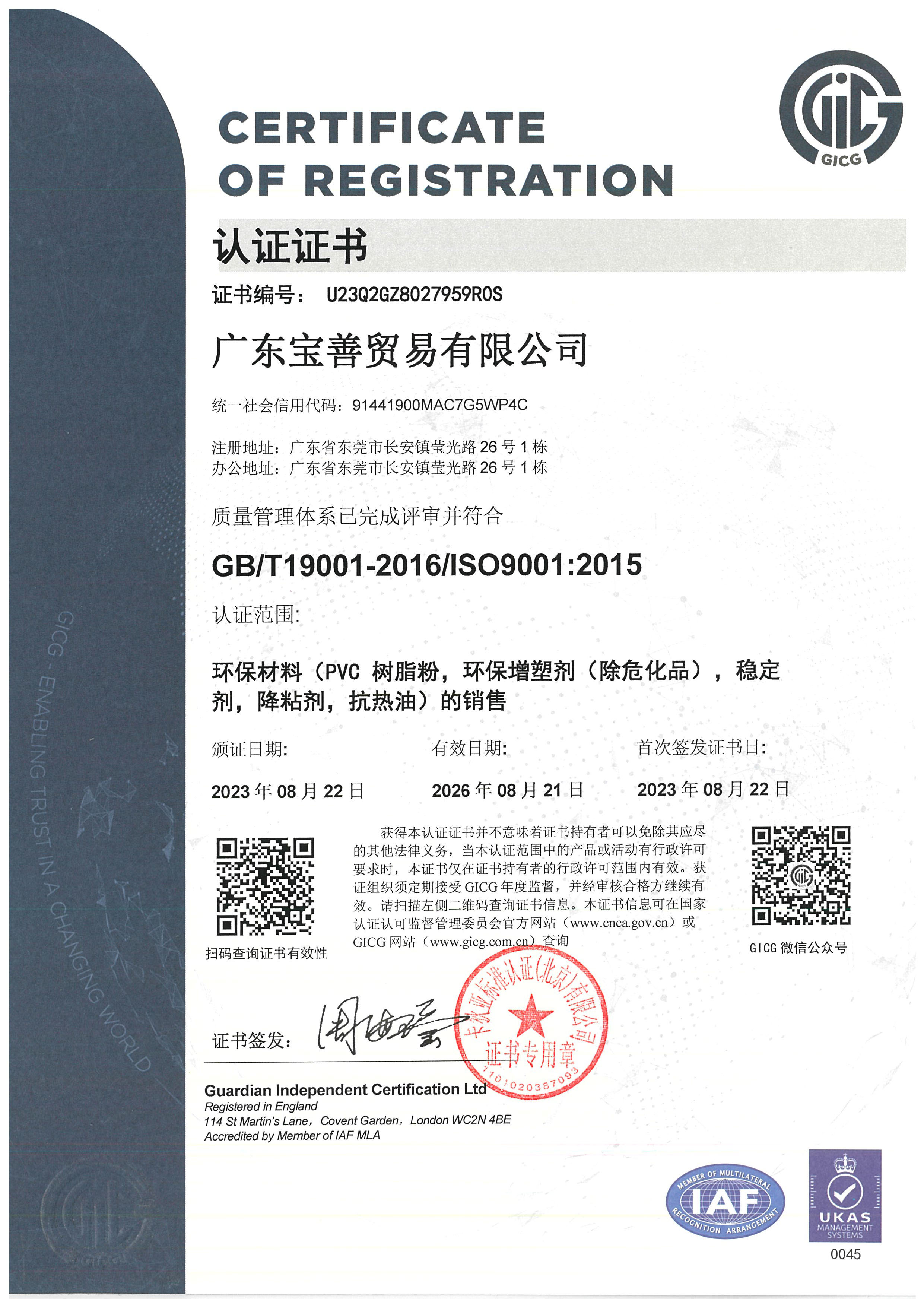
Quality system certificate. ISO 9001:2015 is the standard checkpoint. Guangdong Baoshan Trading Co., Ltd (GUANGDONG BAOSHAN TRADING CO.,LTD) is certified under GB/T19001-2016/ISO9001:2015, certificate number U23Q2GZ8027959R0S, issued by Guardian Independent Certification Ltd. Verify three things on the copy you receive: the issuing body, the certificate number, and the current validity window. A lapsed certificate is not evidence, and an expired copy found during an audit is treated the same as a missing one.
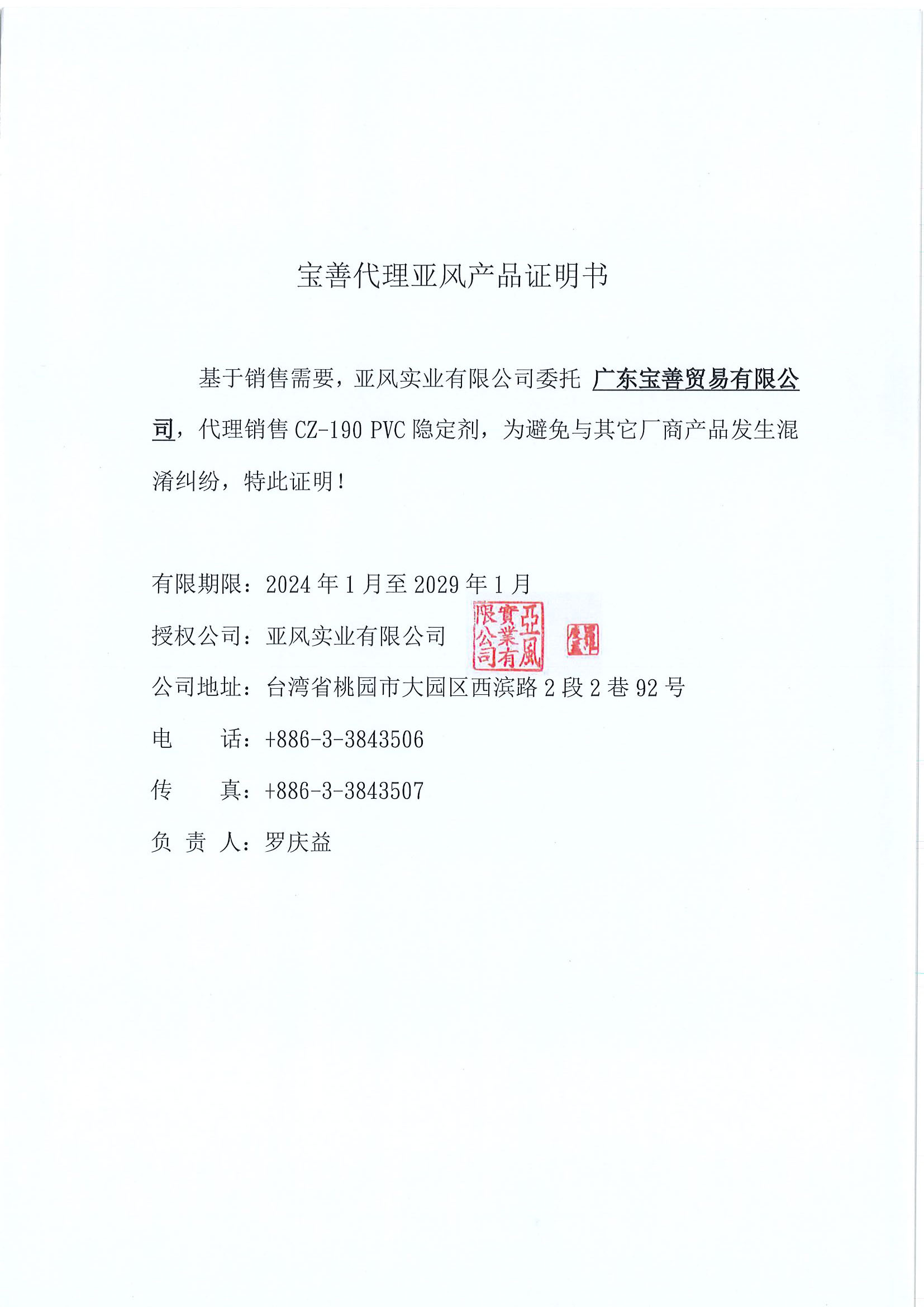
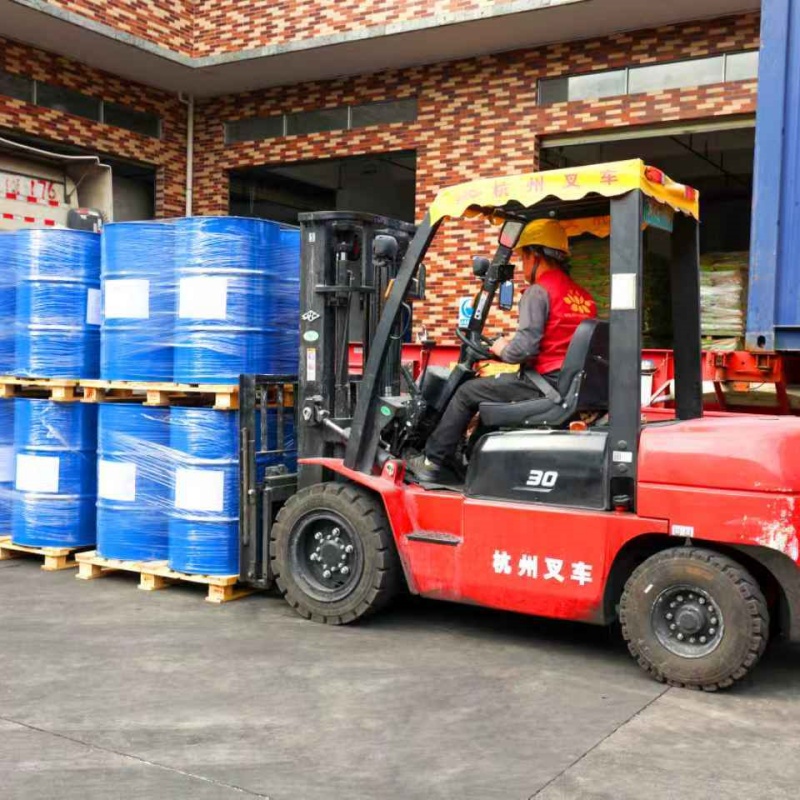
Brand-owner authorisation. For plasticizers supplied under another company's trademark, authorisation certificates show that the material was procured through an approved channel. Supporting infrastructure matters too: the company operates a 20,000-square-metre warehouse with 16 liquid storage tanks and holds a safety stock of more than three months for bulk European material, which reduces the risk of a forced supplier change mid-project — one of the few events that can invalidate an approved document set overnight.
Step-by-Step Breakdown: Mapping Certifications to a Regional Project
- Classify the end application, not the product name. Toy and childcare, food contact, medical device, or industrial. The classification determines which standards apply before any grade is discussed, and it prevents a compliant material being quoted against the wrong framework.
- Write down the binding restriction for the destination market. For EU toys and childcare articles this includes the REACH restriction on DEHP, DBP and BBP below 0.1%, EN71-3 migration requirements and PAHS where relevant. For food contact it is FDA in the United States, GB 4806 in China, and BFR or Japan Hygienic PVC Association permits where a plasticizer holds them. For medical devices it is the material's approval status for medical applications.
- Shortlist additives whose documented approvals already cover that restriction. ATBC covers REACH, RoHS, FDA and GB 4806. Hexamoll® DINCH covers EU REACH, RoHS and PAHS, with BFR and Japan Hygienic PVC Association food-contact permits. Phenol-free Ca/Zn grades cover REACH, RoHS and FDA, with PAHS and EN71-3 on the CZ-2756 grade and GB 4806 on CT303TX.
- Request the batch-level report before the first shipment, not after. Specify heavy metals and phthalates as a minimum and name the analytical techniques you expect: GC-MS, ICP-MS or LC-MS/MS.
- Verify every supplier document. Check the ISO 9001:2015 certificate number, the issuing certification body and the validity dates. Check that brand-owner authorisation certificates name your market and your product scope.
- Freeze the document set into the purchase specification. List the required certificates, the required batch tests, the numeric limits and the method for every subsequent delivery. This converts a one-off approval into a repeatable acceptance procedure.
Use Cases: What the Document Pack Looks Like in Practice
Vietnam vinyl toy production
A PVC vinyl toy manufacturer in Vietnam running 300 vinyl machines used this material system for slush molding production, achieving stable molding for consistent toy quality and high efficiency for mass toy production, with a two-year shelf life under cool and dry storage conditions. For a project of this type the file set is: EN71-3 migration results, PAHS results, a REACH restriction statement covering DEHP, DBP and BBP, RoHS certification, and a batch-level heavy-metal report for each delivered lot. The shelf-life statement belongs in the same file, because it defines the storage condition under which the declaration remains valid.
Food-contact film, cap gaskets and containers
Food contact draws on the widest spread of regional documents. ATBC is certified to FDA and GB 4806 and is specified for cling film, packaging film, heat-shrinkable film, bottle cap gaskets, disposable containers and beverage straws. Hexamoll® DINCH holds food-contact permits from Germany's BFR and the Japan Hygienic PVC Association. CT303TX covers GB 4806 for the China market. A buyer serving several regions should request all of them at the quotation stage and map each document to its destination, rather than re-requesting paperwork at shipment.
Medical-grade PVC
Medical applications add the approval question. Hexamoll® DINCH is approved for medical devices and food-contact materials on the basis of its low migration rate and toxicological safety, and is used in infusion tubes, blood bags, medical gloves, catheters and breathing masks. ATBC is qualified for medical-grade uses including infusion tubes, transfusion bags, drainage bags and medical hoses. Both are stabilised with phenol-free Ca/Zn systems where thermal stability and clarity have to be maintained through processing at 160 to 200 degrees Celsius.
Low-VOC interior and coated fabric applications
Where the regulated parameter is emission rather than extraction, the requested documents shift to VOC data and PAHS. Phenol-free Ca/Zn grades with VOC content of 0.5% or less, and DINCH's low-haze, low-VOC behaviour in automotive interior and coated fabric compounds, provide the relevant starting evidence. PAHS results are commonly requested alongside, because the same additives are used in parts that contact skin.
Certification Priority Ranking for Regulated PVC Projects
Not every project needs the same file. The list below ranks documentation packs by regulatory intensity, highest first, so a procurement team can decide how deep to go before requesting documents. It ranks document sets, not suppliers.
- EU toy and childcare projects — EN71-3, PAHS, REACH restriction statement, RoHS, batch heavy-metal report. The most demanding combination, driven by the REACH phthalate restriction below 0.1% in toys and childcare articles, plus migration and PAHS requirements.
- Food-contact projects in the EU and US — FDA declaration or BFR food-contact permit, plus batch report. Highest reliance on third-party permits rather than self-declarations.
- Medical device projects — approval for medical devices, batch report, ISO 9001:2015 system certificate. The additive approval is usually already in place for DINCH and ATBC, so the differentiator becomes per-lot traceability.
- China food-contact projects — GB 4806 declaration plus batch report. Covered by ATBC and CT303TX in this portfolio.
- Industrial low-VOC applications — REACH and RoHS statements, VOC data, PAHS where skin contact applies. The lightest pack, and the one most often used to screen suppliers before a regulated project is quoted.
Comparison Table: Documented Frameworks by Additive
| Additive family | Documented regulatory frameworks | Typical regulated applications | Key declared parameter | Pack format |
|---|---|---|---|---|
| Acetyl Tributyl Citrate ATBC (CAS 77-90-7) | Compliant with REACH; certified to RoHS, FDA and GB 4806; toy applications referenced to EN71-3 and RoHS | Food-contact film, cap gaskets, disposable containers and straws; infusion tubes, transfusion bags, catheters, medical gloves; vinyl toys and teething toys | Purity 99.0% minimum; heavy metal as Pb 10 mg/kg maximum; freezing point -80 degrees Celsius or lower | 220 KG drum |
| BASF Hexamoll® DINCH | Passed EU REACH, RoHS and PAHS; food-contact permits from Germany's BFR and the Japan Hygienic PVC Association; approved for medical devices and food-contact materials | Infusion tubes, blood bags, medical gloves, catheters, breathing masks; food packaging film, cap gaskets, disposable tableware; toys for children under 3 years old | Phthalate content 0.01% maximum; ester content 99.5% minimum; pour point -54 degrees Celsius | 200 KG drum, 950 KG drum |
| Phenol-free Ca/Zn stabilizers (CZ-2756, SC-1600C, SC-135, CZ-190, CT303TX) | REACH, RoHS and FDA; CZ-2756 additionally passes PAHS and EN71-3; CT303TX additionally complies with GB 4806 | Food packaging film, cap gaskets, food-grade hoses, transparent containers; medical catheters, infusion bags; slush-molded toys; coated fabrics | Phenolic substances not detected; free of lead, cadmium and organotin; thermal stability 30 minutes or more at 180 degrees Celsius; VOC 0.5% or less | 190 KG drum (CZ-2756); 160 to 200 KG drum depending on grade |
Regional Mapping Table: Which Document for Which Market
| Destination market and application | Binding requirement | Document to request | Portfolio option |
|---|---|---|---|
| EU toys and childcare articles | REACH restriction on DEHP, DBP and BBP below 0.1%; EN71-3; PAHS | REACH restriction statement, RoHS certificate, EN71-3 results, PAHS results, batch heavy-metal and phthalate report | ATBC; BASF Hexamoll® DINCH; CZ-2756 phenol-free Ca/Zn stabilizer |
| EU and US food contact | FDA food-contact standard; BFR food-contact permit | FDA declaration or BFR permit reference, plus batch report | ATBC (FDA); BASF Hexamoll® DINCH (BFR permit) |
| Japan food contact | Japan Hygienic PVC Association permit | Permit reference plus batch report | BASF Hexamoll® DINCH |
| China food contact | GB 4806 food-contact standard | GB 4806 declaration plus batch report | ATBC; CT303TX phenol-free Ca/Zn stabilizer |
| Medical device applications | Material approval for medical devices; supplier quality system | Medical device approval reference, batch report, ISO 9001:2015 certificate | BASF Hexamoll® DINCH; ATBC; phenol-free Ca/Zn stabilizer |
| Southeast Asia supply channel | Market-scoped authorisation for Vietnam, Indonesia and other regional markets | Brand-owner authorisation certificate naming the market and product scope | Agency certificate for ADK calcium zinc stabilizers, valid through 31 December 2026 |
Frequently Asked Questions
Which certifications apply to ATBC, DINCH and phenol-free Ca/Zn stabilizers?
ATBC is documented as compliant with REACH and certified to RoHS, FDA and GB 4806. BASF Hexamoll® DINCH has passed EU REACH, RoHS and PAHS and holds food-contact permits from Germany's BFR and the Japan Hygienic PVC Association. Phenol-free Ca/Zn stabilizer grades comply with REACH, RoHS and FDA, while the CZ-2756 grade additionally passes PAHS and EN71-3, and CT303TX additionally complies with GB 4806. Request the statement that matches your end application rather than collecting every certificate.
Which documents should I request for toy, food-contact and medical PVC projects?
For EU toy and childcare projects, request EN71-3 results, PAHS results, a REACH statement covering the 0.1% restriction on DEHP, DBP and BBP, and a batch heavy-metal and phthalate report. For food contact, request an FDA declaration for the US, GB 4806 for China, or the BFR and Japan Hygienic PVC Association permit references that apply to DINCH. For medical projects, request the material's approval status for medical devices plus the supplier's ISO 9001:2015 certificate, for example certificate number U23Q2GZ8027959R0S issued by Guardian Independent Certification Ltd, and check its current validity window.
How does batch-level heavy-metal and phthalate testing support acceptance?
Batch testing is what connects an approved product to a delivered lot. Testing for phthalates, heavy metals, bisphenol A and organotin is carried out on laboratory instruments such as Agilent GC-MS, ICP-MS and Waters LC-MS/MS, and the results are compared against declared limits — for example the 0.01% maximum phthalate content declared for Hexamoll® DINCH or the lead limit of 10 mg/kg or below declared for the ATBC grade. When incoming inspection repeats the same method on the same grade, results are comparable from one delivery to the next.
What is the minimum order quantity, and can I validate a formulation before a bulk order?
The minimum order quantity starts at 20 KG, which allows a trial quantity for formulation validation before scale-up. Customisation support covers formula design, formula optimisation and customised production, and after-sales service includes testing services and technical support, so a trial lot can be evaluated against the same document set that will apply to volume production. Monthly sales volume is 4,000 tons, which reflects the supply base behind those trial quantities.
What is the lead time, and how do I start a compliance-mapped order?
Lead time is typically 3 to 5 days. Start by defining the end application and the destination market, then list the standards and limits that apply, then confirm the additive grade whose documented approvals cover them. Guangdong Baoshan Trading Co., Ltd (GUANGDONG BAOSHAN TRADING CO.,LTD) supplies ATBC, BASF Hexamoll® DINCH and phenol-free Ca/Zn stabilizers into China and Southeast Asian markets, and can support the file from additive approval through batch test data and supplier system certificates.
Conclusion: Build the File in the Order of the Decision
Certification mapping for PVC vinyl materials is a matching exercise, not a collecting exercise. ATBC brings REACH compliance with RoHS, FDA and GB 4806 certification. BASF Hexamoll® DINCH brings EU REACH, RoHS and PAHS plus BFR and Japan Hygienic PVC Association food-contact permits. Phenol-free Ca/Zn stabilizers bring REACH, RoHS and FDA coverage, with PAHS and EN71-3 on the CZ-2756 grade and GB 4806 on CT303TX. ISO 9001:2015, held under certificate U23Q2GZ8027959R0S issued by Guardian Independent Certification Ltd, is the system check that sits behind all three.
Build the file in the same order as the decision: classify the end application, identify the binding regional restriction, shortlist additives whose approvals cover it, request batch evidence before the first shipment, verify the supplier certificates, then write the whole set into the purchase specification. Repeating the batch evidence on every delivery is what converts certification coverage into an approval that survives an audit.
Request the certificate and batch documentation set
Guangdong Baoshan Trading Co., Ltd (GUANGDONG BAOSHAN TRADING CO.,LTD), established in 1994 and headquartered in Dongguan, Guangdong, supplies regulated PVC vinyl materials into China and Southeast Asian markets. Tell us your end application, destination market and required standards, and we will send the matching additive approvals, batch test documentation and supplier certificates for review.
Website: www.baoshancl.cn
Email: misscheng1984@163.com
Tel: +86 13580992838
WhatsApp: +84 865388399
Address: Building 1, No. 26, Yingguang Road, Chang'an Town, Dongguan City, Guangdong Province
Contact: Chen Bingbing
Have Questions or Need More Details?
Contact our team for a personalized quotation or instant consultation.
Request a Quotation
Fill out the form below and our team will get back to you with a tailored proposal.
WhatsApp Direct Chat
Prefer to chat in real-time? Message us on WhatsApp for instant assistance & quick answers.
- Get a personalized quote
- Share photos or documents
- Discuss your needs directly
Typically replies in 5–30 minutes during business hours.