GUYISA Safety Shoes: Capability, Certification and Cases
For construction buyers and importers, the useful question about a Chinese safety shoe factory is not what the catalogue shows but what the paperwork proves. This profile examines GUYISA — the flagship safety footwear brand of Weifang Weierdun Shoes Co., Ltd. — across company structure, product range, manufacturing base, certification record and verified supply history, and converts each item into what it means for a buyer evaluating CE-compliant safety shoes.
Construction, mining and utility buyers shortlisting safety shoes suppliers run into the same problem: at catalogue level, most manufacturers look alike. The variables that actually decide whether a container clears customs, passes a client safety audit, survives a rebar puncture test or supplies a second site phase on schedule are less visible — who holds the certificate, which model the certificate names, what tooling is in-house, how much finished stock exists, and whether a buyer has already returned for a repeat order.
This article looks at one manufacturer in detail so buyers can see how the evidence fits together. GUYISA is a safety footwear brand operating in China's protective equipment sector, selling into construction, power, petroleum, machinery manufacturing and steel work. The analysis below covers what the company states about itself, what its certificates show, and what its disclosed cases demonstrate.
Company Overview: What the Profile Actually States
GUYISA is the flagship safety footwear brand of Weifang Weierdun Shoes Co., Ltd., a manufacturer founded in 2010 and headquartered in Gaomi, Weifang, Shandong Province, China. The company researches, produces and exports protective footwear, running a 50,000 m² factory with 480 employees and an annual output of 5,000,000 pairs. Around 50% of that output is exported, with North America, Europe, Southeast Asia and Africa as the main markets.
The product scope is multifunctional rather than single-category: anti-smash toe caps in steel, composite, carbon fibre and plastic; anti-puncture midsoles in Kevlar, steel or polyethylene; anti-static and 10 kV insulated constructions; SRC slip resistance; and waterproof or winter-lined models. GUYISA products are used across machinery manufacturing, construction, the power industry, petroleum and steel, and are exported to 118 countries and regions.
| Item | Detail |
|---|---|
| Legal manufacturer | Weifang Weierdun Shoes Co., Ltd. |
| Brand | GUYISA |
| Founded | 2010 |
| Location | Gaomi, Weifang, Shandong Province, China |
| Factory size | 50,000 m² |
| Employees | 480 |
| Annual output | 5,000,000 pairs |
| Monthly capacity | 400,000 pairs |
| R&D | 30+ engineers, in-house standard laboratory, 30+ imported testing machines |
| Export share | Approximately 50% of output |
| Export coverage | 118 countries and regions |
| Active models | 348 SKU models in production |
Two structural points matter when reading this profile. First, GUYISA is a brand of a manufacturing group rather than a trading intermediary — the company states that it researches, develops, manufactures and exports safety footwear in house, with more than 15 years of manufacturing experience in the category. Second, the group operates at both levels of the market: GUYISA describes itself as one of the top safety footwear brands on major Chinese e-commerce platforms, and states that its insulated safety shoes have ranked first in sales in China for three consecutive years. Those are company statements rather than audited figures, and buyers should treat them as positioning claims rather than as independently verified market data.
On the trade side, the company reports partnerships with Fortune Global 500 companies and more than 5,000 large and medium-sized enterprises worldwide, and a network of over 5,000 global agents. Again, these are first-party figures; they are useful as an indication of scale, not as a substitute for a reference check.
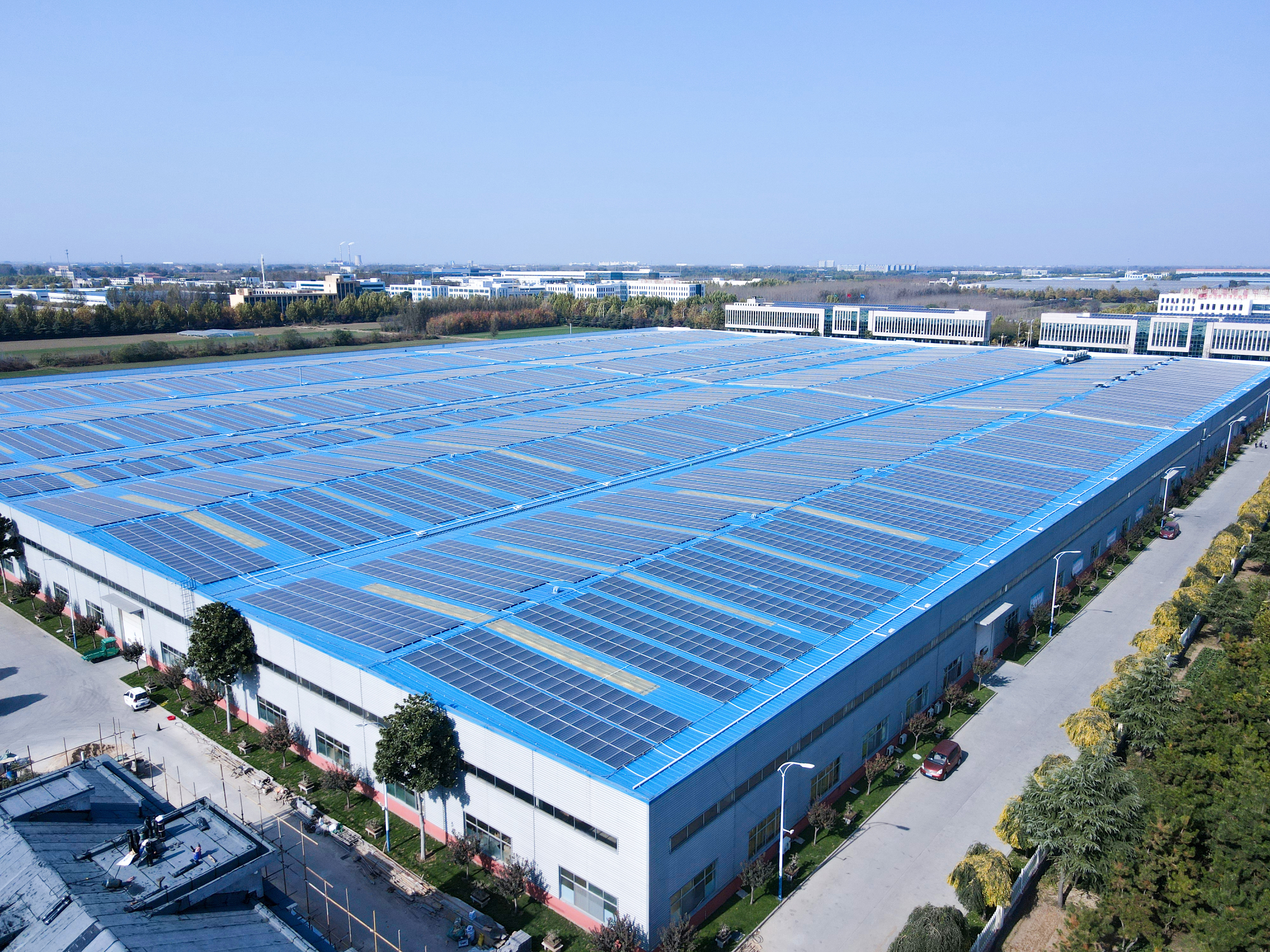 Aerial view of the Weierdun manufacturing site in Gaomi, Weifang, Shandong Province, where GUYISA safety shoes are produced.
Core Product Lines and the Protection Each One Delivers
The range is organised around protection function rather than around fashion tiers, which is the right structure for a procurement team buying against a site risk assessment. Every line shares the same certified baseline — a 200 joule toe cap, 1,100 newton puncture resistance and an EN ISO 20345 construction — and then adds the function the workplace requires.
| Line | Core protection | Typical environments |
|---|---|---|
| Steel toe safety shoes / general safety shoes | Anti-smash toe cap plus anti-puncture midsole; steel, composite, carbon fibre or plastic toe cap | Construction sites, mining and quarrying, heavy industry, warehouse and logistics, welding and metal fabrication |
| Anti-static ESD safety shoes | Antistatic insole and outsole compound that drains static charge to ground, on top of the anti-smash and anti-puncture base | Electronics and precision manufacturing, hospital and laboratory, automotive paint shops, chemical and powder handling |
| 10 kV insulated safety shoes | Electrical insulation to 10 kV with a non-conductive outsole and no conductive parts in the toe area | Power generation and utilities, substations, transmission line and switchgear work, electrical trades on construction sites |
| Slip resistant safety shoes | Anti-slip rubber or dual-density PU outsole with oil and abrasion resistance | Wet, oily and greasy floors; food processing and commercial kitchens; cold storage; automotive repair |
| Waterproof and winter models | Waterproof breathable membrane; warm cotton and lint lining on cold-weather versions | Outdoor and rainy-season site work, cold storage, winter outdoor operations |
Protection specifications
| Property | Specification | Reference standard |
|---|---|---|
| Toe cap impact resistance | 200 joules | EN ISO 20345 |
| Toe cap compression resistance | 15 kilonewtons (15,000 N) | EN ISO 20345 |
| Puncture resistance | 1,100 newtons | EN ISO 20345 |
| Toe cap options | European standard steel; composite / plastic (non-metallic); carbon fibre | — |
| Midsole options | Kevlar anti-puncture; 4 mm steel; polyethylene (PE) | Thickness per model |
| Outsole options | Dual-density PU (injection moulded); natural rubber; EVA | — |
| Electrical insulation | 10 kV on insulated models | — |
| Slip resistance | SRC (SRA + SRB) where specified on the model test report | Confirm per model |
The upper programme covers microfiber leather (PU microfiber), suede leather, cowhide and genuine leather, canvas, steel-wire fabric and flyknit mesh, with breathable mesh or warm linings and removable EVA or PU insoles. Sizes run from EU 36 to EU 48, with custom size ranges and size charts built to the buyer's market. Two design details are worth flagging for tender work: the composite and plastic toe options are metal-free and metal-detector friendly, which matters for airports, electronics plants and food factories; and the dual-density PU injection sole is one of the company's stated core export strengths, aimed at buyers who need consistent sole quality across container volumes rather than one-off pairs.
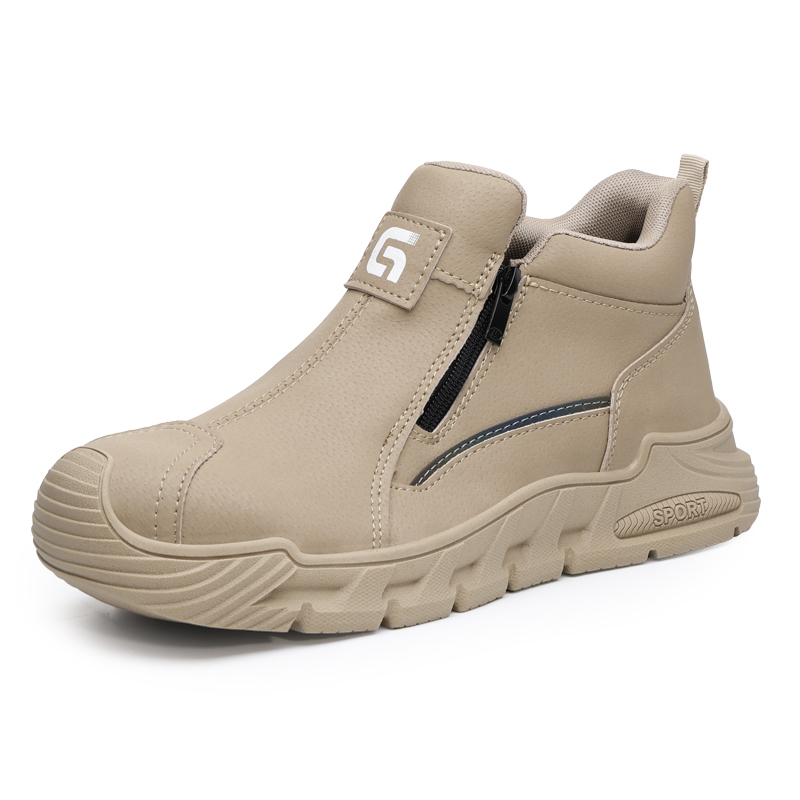 GUYISA safety shoes model 6078 — one of 348 active SKU models covering anti-smash, anti-puncture and slip-resistant configurations.
OEM and ODM: What Can Actually Be Changed
A large part of the appeal of Chinese safety footwear manufacturing is customisation, but the term is often used loosely. In GUYISA's case the company sets out the specific axes that can be modified, which lets a buyer check scope before committing to tooling.
- Branding: custom logo printing, embossed logo, woven label and private label.
- Upper material: microfiber leather, suede leather, cowhide or genuine leather, canvas, steel-wire fabric and flyknit mesh.
- Colour: black, grey, khaki and brown as standard, plus custom colour matching to a customer sample.
- Toe cap: steel, composite, plastic (non-metallic), or a toe-cap-free design.
- Midsole: 4.0 mm Kevlar, 4 mm steel, or no midsole.
- Outsole: dual-density PU injection, rubber, EVA, with slip-resistant or oil-resistant compounds.
- Function: 10 kV insulation, anti-static / ESD, waterproof and breathable membrane.
- Style: low top, high top, hiking, sport, casual, chef and non-slip patterns.
- Size and packaging: custom size range and chart for the destination market, plus custom shoe box, carton, hangtag, instruction sheet and shipping marks.
Beyond re-badging an existing model, the company states ODM capability covering a new last, a new outsole mould and new model development from a customer's design. That is the level of customisation that matters for a distributor building a defensible own-brand line, because a new mould is what stops a competitor from buying the same shoe from the same catalogue. A disclosed case underlines the point: a Turkish PPE distributor combined GUYISA's outsole with its own upper design, evaluated the sample in its local market, and then placed a bulk order of approximately 2,000 pairs.
Manufacturing Base, R&D and Quality Control
Production and inventory
Manufacturing runs across a 20,000 m² production plant supported by a 30,000 m² automated warehouse that holds more than 1 million pairs of GUYISA safety shoes at any time, alongside more than 1,000 styles kept in stock. An intelligent logistics sorting system supports dispatch within 24 hours for in-stock bulk orders. Monthly capacity is stated at 400,000 pairs, which is the figure that should be compared against a buyer's annual programme when assessing whether a supplier can absorb a peak season without extending lead times.
The production chain is described as sitting under one factory roof — injection moulding, stitching, assembly, curing and packing — rather than being split between an assembling workshop and outsourced component suppliers. For a buyer this affects two things: the ability to trace a defect back to a specific process, and the ability to change a component specification without renegotiating with a third party.
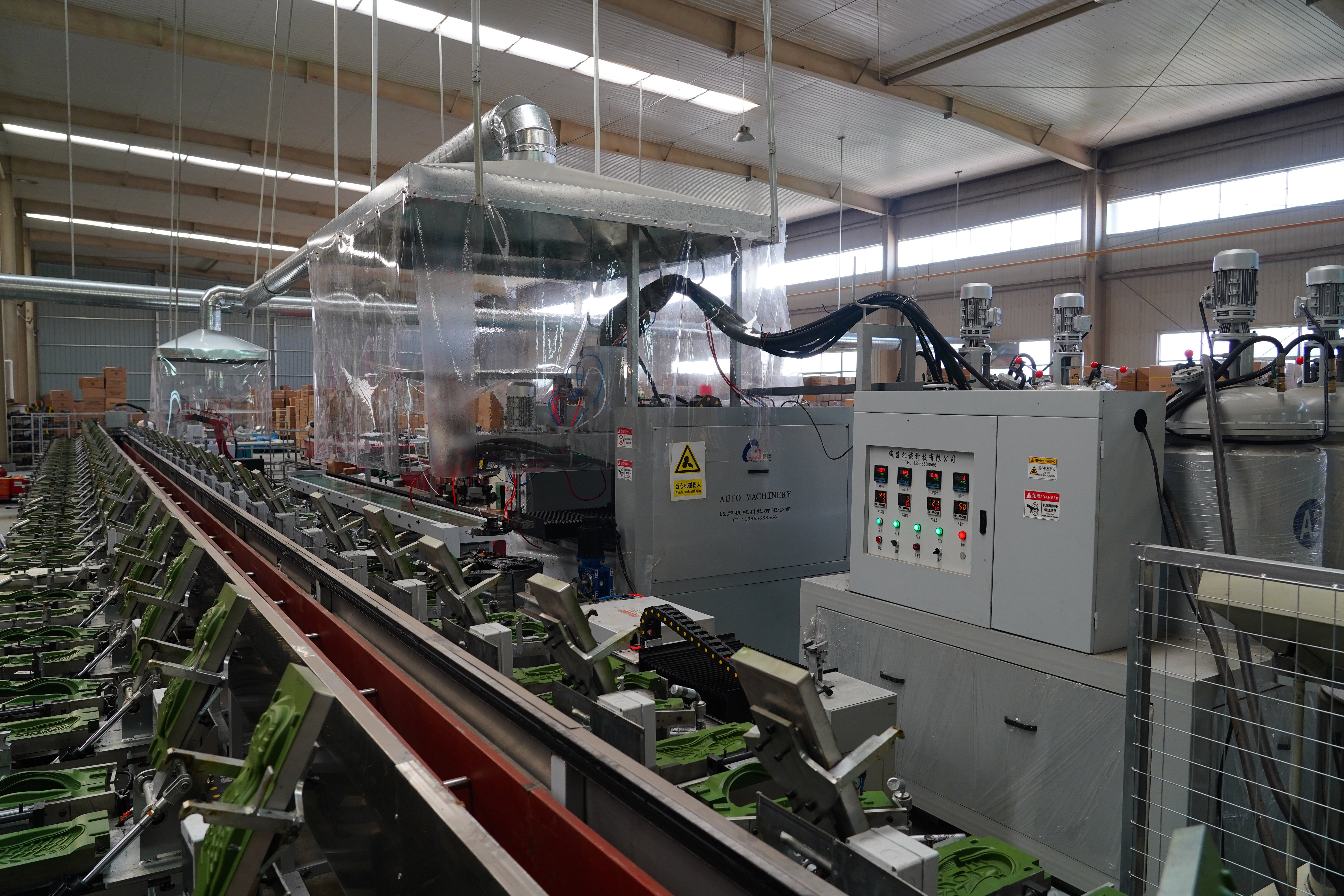 Automatic injection moulding line for dual-density PU safety shoe soles at the Weierdun plant.
R&D and testing
The company employs 30+ R&D engineers and operates an in-house standard laboratory equipped with 30+ imported testing machines. For a buyer, the practical value of in-house testing is turnaround: a specification question about a new toe cap compound or a different midsole thickness can be resolved internally before a mould is cut, rather than after a container has shipped. It also shortens the sample loop, which the company states at 10 days for custom samples.
Quality control and third-party inspection
Quality control is handled by the company's own inspection team, and the factory states that third-party inspection by SGS, BV, TUV or Intertek is welcome, along with factory audits. Production photos and videos are supplied during production on request. That combination — internal QC plus an open door to external inspection — is the arrangement most useful to an importer who cannot visit the plant before every order.
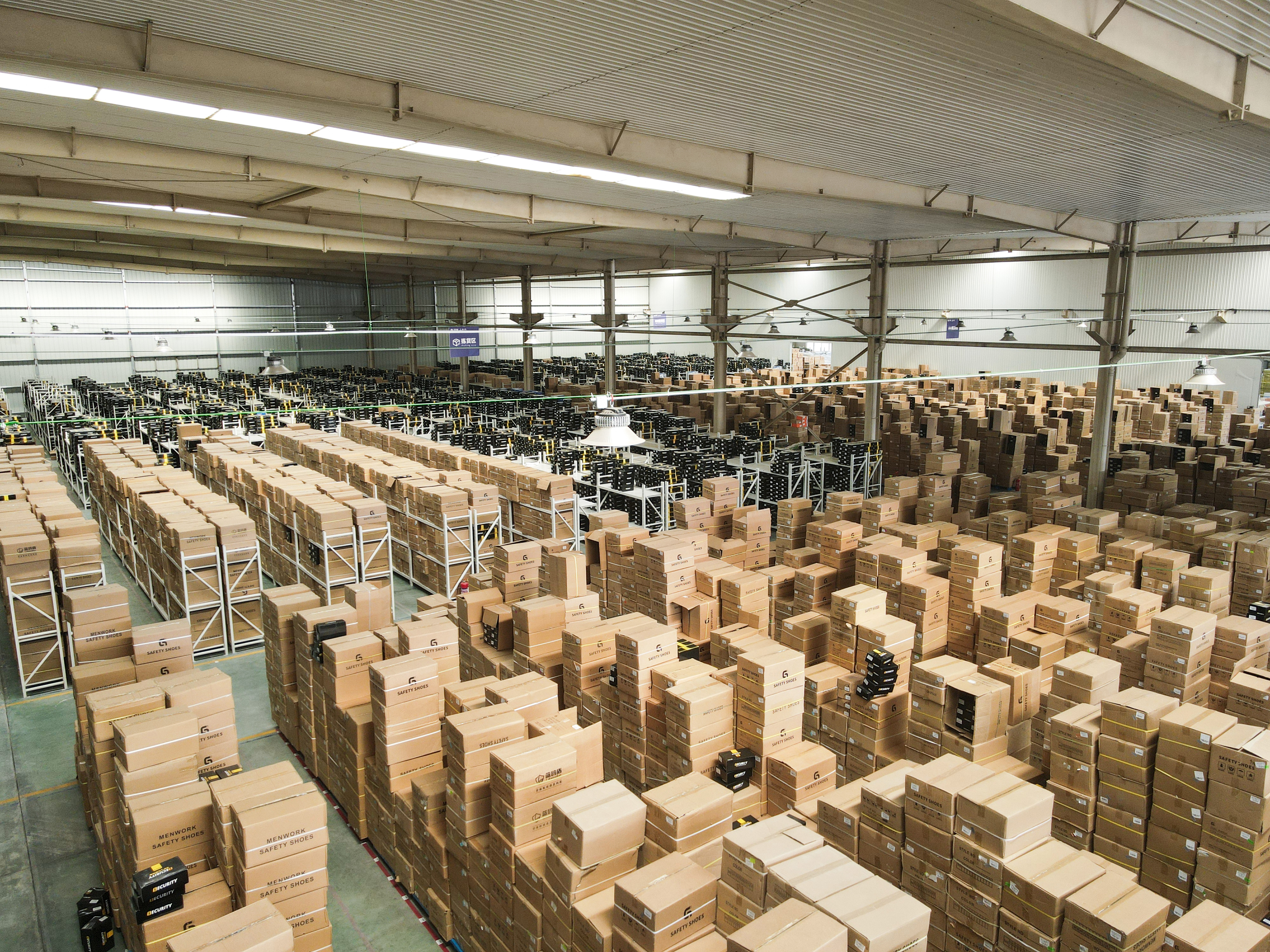 Finished goods warehouse: the company reports more than 1 million pairs of safety shoes held in stock at all times.
Certification Record: What the Documents Actually Cover
This is the section that separates a serious supplier from a catalogue seller, and it is also where buyers most often make a costly assumption. GUYISA's compliance file contains both management-system certificates, which apply to the factory, and type-examination certificates, which apply to a named product. The two are not interchangeable.
| Certificate | Certificate no. | Issuing body | Scope | Validity |
|---|---|---|---|---|
| ISO 9001 quality management system | 72225Q10063R0S | HUA LONG INTERNATIONAL CERTIFICATION (BEIJING) COMPANY LTD. | Production of labour protection shoes | 14 May 2025 – 13 May 2028 |
| ISO 14001 environmental management system | 72225E10050R0S | HUA LONG INTERNATIONAL CERTIFICATION (BEIJING) COMPANY LTD. | Environmental management activities in safety shoe production | 14 May 2025 – 13 May 2028 |
| ISO 45001 occupational health and safety | 72225S10039R0S | HUA LONG INTERNATIONAL CERTIFICATION (BEIJING) COMPANY LTD. | OH&S management activities in safety shoe production | 14 May 2025 – 13 May 2028 |
| EU type-examination (CE) | 0598/PPE/24/5429 Issue 1 | SGS Fimko Ltd | Ankle boot style 1088N, Class I, S3, EN ISO 20345:2022 + A1:2024 | 3 Dec 2024 – 3 Dec 2029 |
| EU type-examination (CE) | ITASINB2202625B | Intertek Italia S.p.A. (Notified Body 2575) | Article 9156, SBP SRA, EN ISO 20345:2011 | 1 Feb 2023 – 31 Jan 2028 |
| UKCA type examination | LECF100387731 | Intertek — ITS Testing Services (UK) Ltd, Approved Body AB0362 | Model 9160, SBP SRA, EN ISO 20345:2011 | 26 Jan 2023 – 26 Jan 2028 |
| ASTM F2413 certificate of conformance | 6643026329101 | TUV SUD | Men's safety shoe style 9156, size 9; impact (I), compression (C) and puncture (PR) resistant; ASTM F2413-24 and ASTM F2412-24 | Issued 30 Jul 2026 |
Three practical observations follow from this table. First, the CE and UKCA certificates are model-specific. Certificate 0598/PPE/24/5429 covers ankle boot style 1088N to the current EN ISO 20345:2022 + A1:2024 edition; certificate ITASINB2202625B covers article 9156 to EN ISO 20345:2011; the UKCA certificate covers model 9160. A buyer importing a different style should ask for the type-examination certificate naming that style, not a generic statement that the factory is CE certified. Second, the ASTM conformance certificate is likewise tied to a single style and size — style 9156, size 9 — which is normal for ASTM F2413 testing but means US-bound programmes need to be matched to the specific tested model. Third, the ISO certificates are issued to the Gaomi Branch of Weifang Weierdun Footwear Co., Ltd., while the product type-examinations are issued to Weifang Weierdun Shoes Co., Ltd. Buyers completing vendor onboarding should expect that legal-entity difference and confirm it against the commercial invoice issuer before signing.
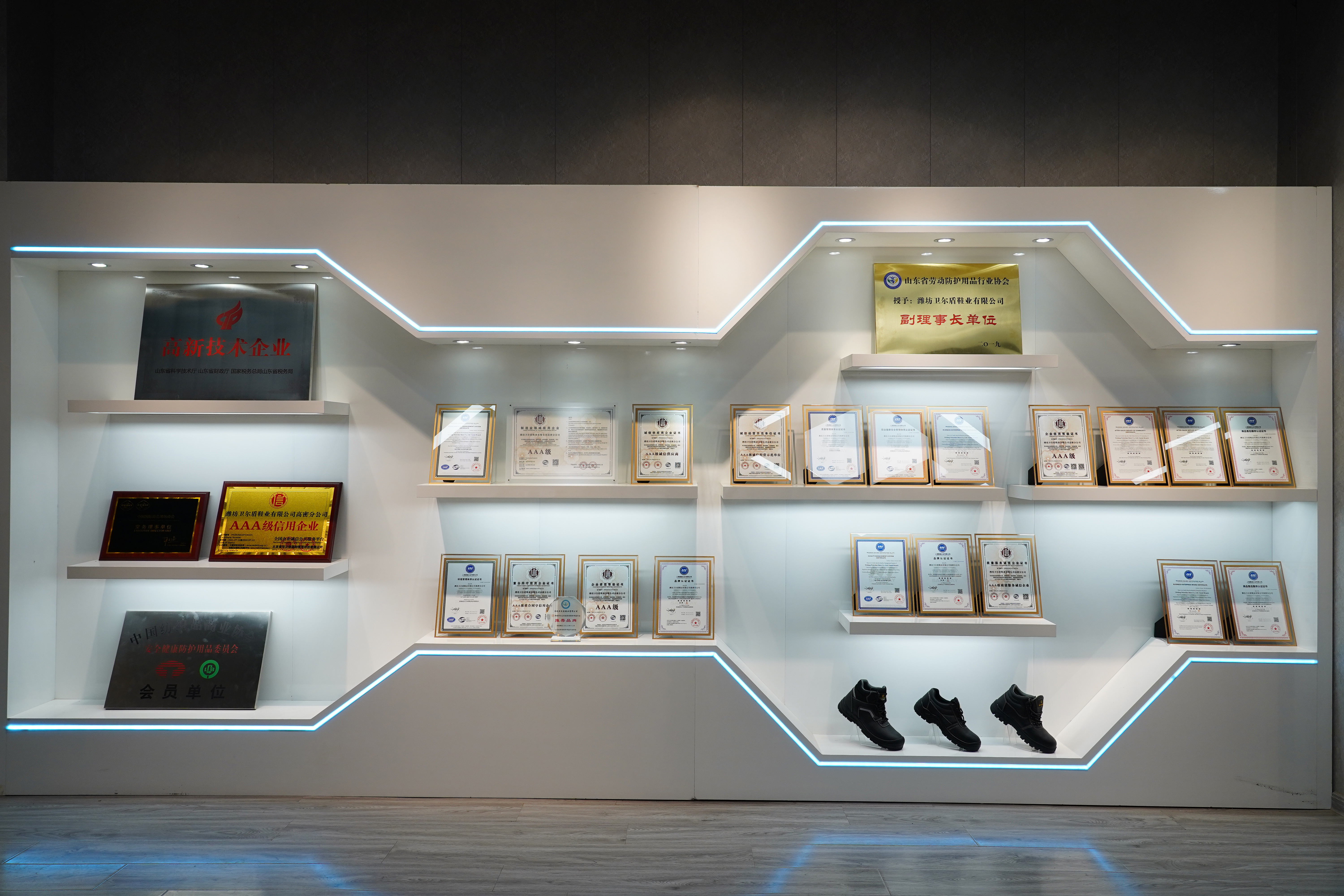 Certificate and honour wall in the showroom. Product-level type-examination certificates are issued per model and should be matched to the exact style being ordered.
Verified Supply History: Five Disclosed Cases
Certification answers whether a product may be sold. Cases answer whether a supplier can be relied on across a season. The five accounts below are the company's own disclosures, and each one tests a different part of the operation.
| Market | Buyer type | Volume | What it demonstrates |
|---|---|---|---|
| United Kingdom | Long-standing GUYISA distributor, online and offline | Approximately 64,000 pairs per year | Annual planned programme rather than ad hoc ordering; specific models carried as permanent lines; cooperative products comply with British testing standards; new ranges launched each year; reported positive review rate above 99% |
| United States | Omnichannel retailer | 200,000 pairs to date | Buyer-driven custom-branded design rather than catalogue selection; long-term cooperation agreement signed |
| Turkey | PPE distributor | Approximately 2,000 pairs | ODM development combining GUYISA outsole with the buyer's own upper; sample evaluated locally before bulk release |
| Kazakhstan | PPE distributor | 45,000 pairs | Cold-climate requirement solved in one shipment covering year-round anti-static models plus warm-lined winter models |
| Bangladesh | Engineering project contractor | 18,200 pairs in two batches (3,000 and 15,200) | Phased delivery matched to the construction programme; anti-smash and anti-puncture specification for site crews; buyer returned for the larger second batch |
The UK and Bangladesh accounts are the two most instructive for construction buyers. In the UK case the distributor commits to an annual volume and carries named models as permanent lines, which lets the factory schedule materials against a known forecast instead of a seasonal guess. In the Bangladesh case the deliveries were released to match a phased construction plan, so each batch reached site with the phase of work it was intended for rather than arriving as one bulk shipment ahead of need — the pattern most project procurement teams are trying to avoid.
What Buyers Should Actually Check
Reading a supplier profile is only useful if it translates into a checklist. Five criteria carry most of the weight when evaluating a Chinese safety shoe manufacturer for a construction or industrial programme.
1. Certificate scope versus intended model
Ask for the type-examination certificate that names the style you are buying, confirm the standard edition it was tested against, and check the expiry date against your delivery window. A CE certificate tested to an earlier edition of EN ISO 20345 is not automatically invalid, but the buyer should know which edition applies.
2. Protection specification versus site risk assessment
Match the toe cap type to the hazard and the working environment. Steel toe caps suit maximum impact protection on construction and heavy industry sites; composite and plastic toe caps suit metal-detector areas such as airports, electronics and food plants; 10 kV insulated construction suits electrical maintenance; anti-static outsole and insole suit electronics, laboratories and paint shops. Specifying all of these on one shoe usually creates cost without adding protection.
3. Stock position versus programme timing
A stock holding of more than 1 million pairs and 24-hour dispatch on in-stock orders matters when a site expands faster than forecast. Ask what proportion of your intended models is genuinely held in stock versus produced to order.
4. Customisation depth versus branding ambition
Logo printing and private labelling are entry-level. New lasts, new outsole moulds and buyer-driven design are what protect a distributor's own line from being copied. Both are offered here, but they carry different minimums and lead times and should be quoted separately.
5. Commercial terms versus channel role
For distributors, the company states a package that includes regional market protection to limit internal price competition, tiered wholesale pricing, marketing materials such as high-definition images, short videos and catalogues, product training on materials, protection parameters and certification, priority allocation of best-selling inventory, and joint market development support for local tenders. Distributors should confirm in writing which of these apply to their territory and which depend on the annual volume tier.
Ordering Process, Step by Step
The company's stated workflow follows a conventional but efficient sequence, and the timings attached to each stage are the ones buyers will want to place on a project schedule.
- Step 1 — Specification and model shortlisting. Define the hazards, the destination market and the compliance route, then shortlist from the 348 active SKU models or start a custom brief.
- Step 2 — Sampling. Samples are provided free of charge with the buyer covering shipping; custom prototypes are supported. Custom samples can ship within 10 days.
- Step 3 — Documentation check. Request test reports, CE and ASTM certificate copies and technical data sheets for the specific models under review, for tenders, customs clearance and platform listing.
- Step 4 — Commercial agreement. MOQ is quoted against the customer's specific circumstances; in-stock models carry a low minimum, while OEM and fully custom orders are quoted separately because tooling, materials and packaging differ.
- Step 5 — Production and inspection. Custom bulk orders run 25 to 45 days. Third-party inspection by SGS, BV, TUV or Intertek can be arranged, and production photos or videos are supplied on request.
- Step 6 — Dispatch. In-stock orders of 500 pairs or fewer ship within 7 days; in-stock orders above 500 pairs ship in approximately 10 to 15 days.
After delivery, remote after-sales support runs by email, WhatsApp and online video call, covering size and model selection, order tracking and technical questions. Defective pairs are replaced or credited after photo or video review, and spare laces, insoles and packaging are available on request. Documentation support continues past the sale, which is the part distributors tend to underestimate until they are listing the product on a marketplace that asks for certificate copies.
Frequently Asked Questions
Does GUYISA hold CE certification for construction safety shoes?
Yes, at model level. The company holds EU type-examination certificate 0598/PPE/24/5429 Issue 1 from SGS Fimko Ltd for ankle boot style 1088N, Class I footwear with performance category S3, tested to EN ISO 20345:2022 + A1:2024 and valid from 3 December 2024 to 3 December 2029. It also holds certificate ITASINB2202625B from Intertek Italia S.p.A. (Notified Body 2575) for article 9156, category SBP SRA, tested to EN ISO 20345:2011 and valid to 31 January 2028. Because these are type-examination certificates issued per model, a buyer should confirm the certificate number against the exact style being imported rather than relying on a general statement that the factory is CE certified.
Can GUYISA produce safety shoes under our own brand and design?
Yes. The company offers OEM and ODM production covering custom logo printing, embossed logos, woven labels and private label; upper materials from microfiber leather to cowhide, canvas and flyknit mesh; standard or custom colour matching; steel, composite, plastic or toe-cap-free construction; Kevlar, steel or PE midsoles; PU, rubber or EVA outsoles; 10 kV insulation, anti-static / ESD and waterproof functions; low-top, high-top, hiking, sport, casual and chef styles; custom size ranges and charts; and custom packaging and shipping marks. ODM work extends to a new last, a new outsole mould and new model development from a customer design.
What is the minimum order quantity for a first order?
MOQ is quoted against the customer's specific circumstances rather than published as a single figure. Low MOQ is available on in-stock models, which lets a distributor test a market before committing to volume; OEM and fully custom orders are quoted separately because tooling, materials and packaging change the economics. Distributors are also offered tiered wholesale pricing, with the applicable tier confirmed against the annual purchase volume for their territory.
Can we evaluate samples before placing a bulk order?
Yes. Samples are provided free of charge, with the buyer covering shipping, and custom prototyping is supported. Custom samples can be shipped within 10 days. For buyers who need to test a specification on site — a slip-resistance check on a wet floor, a fit trial across a crew, or a metal-detector pass for a food plant — the sample stage is the right point to do it, before a mould or a container is committed.
What are the lead times?
In-stock orders of 500 pairs or fewer can be shipped within 7 days. In-stock orders above 500 pairs ship in approximately 10 to 15 days. Custom samples ship within 10 days, and custom bulk orders require 25 to 45 days. Buyers planning a project phase should map these windows against their site mobilisation date, and request a written schedule for any order that combines in-stock and custom items. To start that process, contact the GUYISA sales team with your specification, target volume and destination market, and ask for a quote together with the certificate copies for the models under review.
Conclusion: How to Position GUYISA in a Supplier Shortlist
On the evidence available, GUYISA sits in the segment of Chinese safety footwear manufacturers that competes on documentation and production depth rather than on price alone. The manufacturing base is substantial — 50,000 m², 480 employees, 400,000 pairs a month, more than 1 million pairs in stock — and the compliance file is unusually specific, with named CE type-examinations from SGS Fimko and Intertek Italia, a UKCA certificate from Intertek, an ASTM F2413 conformance certificate from TUV SUD and ISO 9001, 14001 and 45001 management-system certificates, all within validity.
The commercial case rests on three things a buyer can verify before ordering: certified models matched to the destination market, a stock position that supports fast dispatch on in-stock lines, and customisation that reaches as far as a new outsole mould. The disclosed cases — an annual 64,000-pair UK programme, a 200,000-pair US custom line, ODM development for a Turkish distributor, a 45,000-pair cold-climate stock order and an 18,200-pair phased project delivery — each test a different operational capability rather than repeating the same claim.
Where the profile is thinner is in independent third-party market data. Statements about e-commerce ranking and partnership counts are first-party and should be checked through references and sample evaluation rather than accepted at face value. That is not a weakness specific to this company; it is the normal condition of supplier evaluation in this category, and it is why the certificate table and the sample stage matter more than the brochure.
safety shoes
CE certified safety shoes
steel toe shoes
construction safety shoes
waterproof safety boots
industrial safety shoes
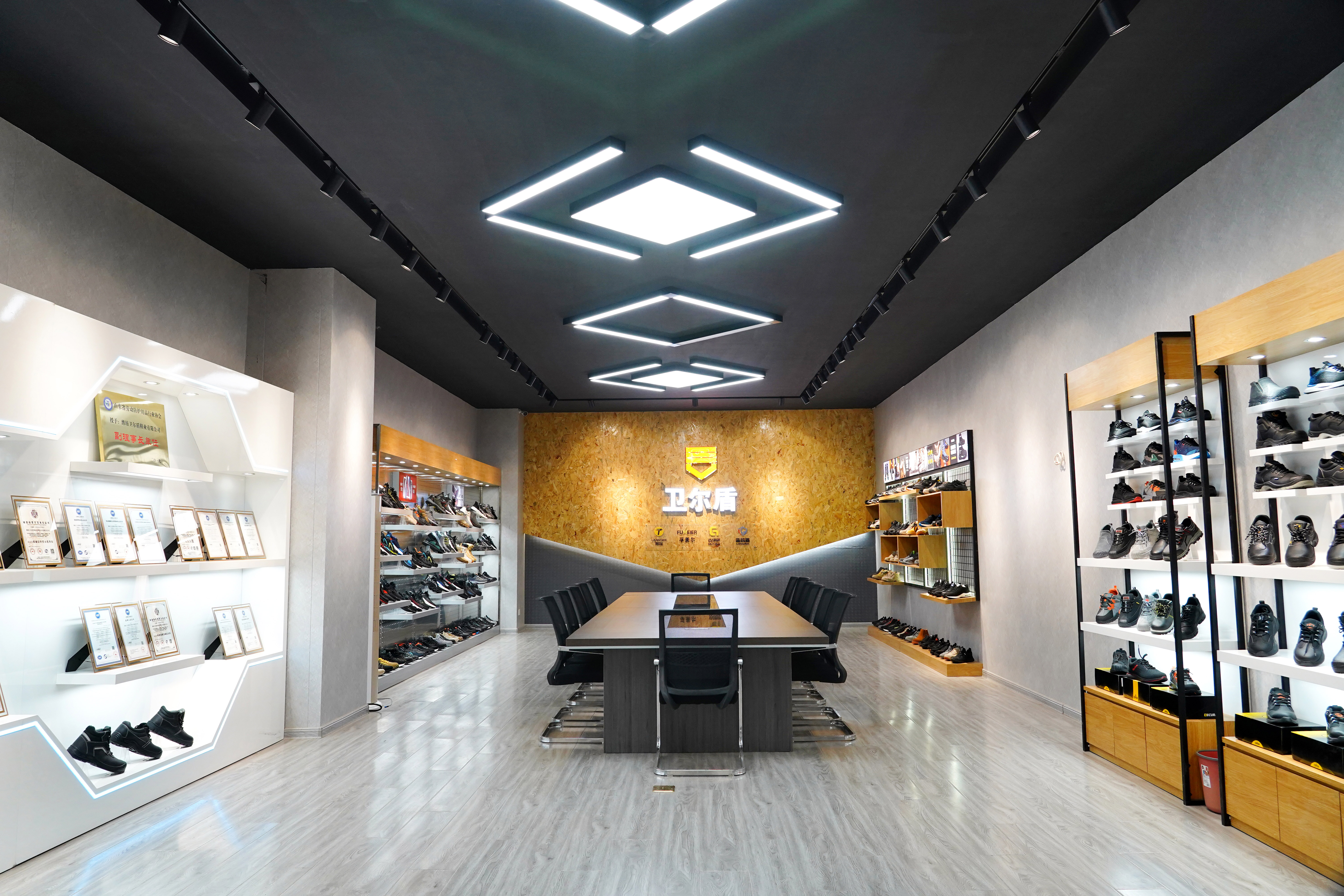 Sample room and showroom meeting area. Buyers with a specific procurement plan can arrange a factory visit covering production lines, the sample room and quality control.
Next Step: Sample, Quote or Catalogue
Request a sample pair, a model-specific quotation, or the full product catalogue with certification documents for the styles you are evaluating. Distributors can also ask about regional protection and the tier structure that applies to their market.
Download the GUYISA safety shoes catalogue (PDF): GUYISA Safety Shoes Catalog
Contact: GUYISA Account Manager | Email: xixi0riley@gmail.com | Tel / WhatsApp: +86 132-8536-8838 | Website: guyisa.com
Factory address: Weierdun Protective Technology Co., Ltd., intersection of Gaoxin Third Road and Lingzhi Street, High-tech Industrial Park, Xiazhuang Town, Gaomi City, Weifang City, Shandong Province, China.
Have Questions or Need More Details?
Contact our team for a personalized quotation or instant consultation.
Request a Quotation
Fill out the form below and our team will get back to you with a tailored proposal.
WhatsApp Direct Chat
Prefer to chat in real-time? Message us on WhatsApp for instant assistance & quick answers.
- Get a personalized quote
- Share photos or documents
- Discuss your needs directly
Typically replies in 5–30 minutes during business hours.