Waterproof Safety Boots: A Buyer's Guide to Safety Shoes
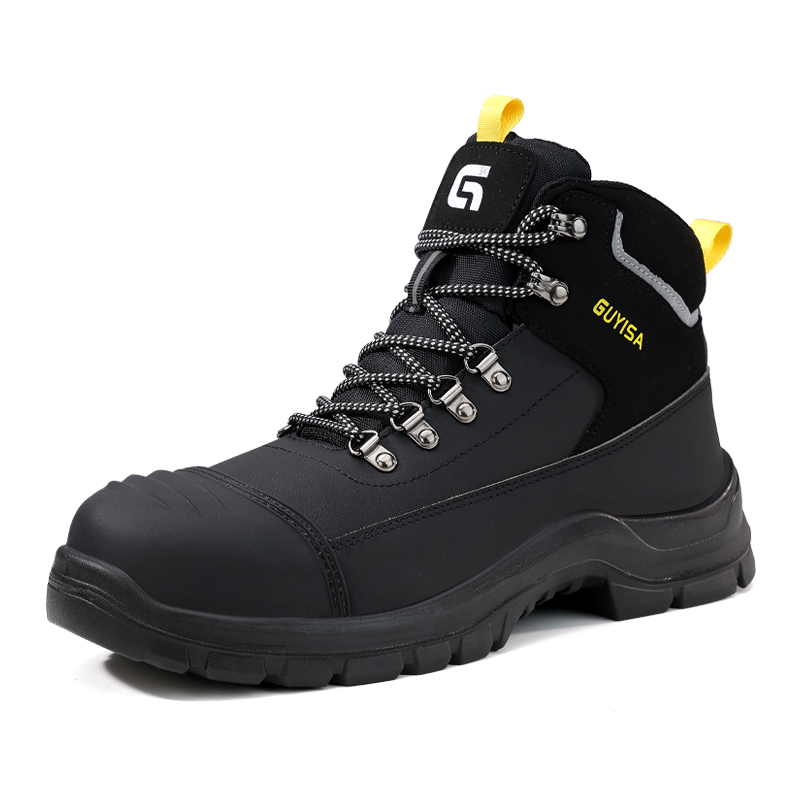
GUYISA safety footwear — representative model from the multifunctional safety shoes and safety boots range.
Waterproof safety boots are protective work boots built to keep water away from the foot while still delivering the toe-cap and midsole protection that industrial sites require. The value of a waterproof safety boot comes from doing both jobs at once: resisting rain, splashes, mud and standing water, and meeting the same EN ISO 20345 impact and puncture requirements as any other safety shoe.
This guide is written for importers, distributors, safety managers and procurement teams who are still at the research stage of buying safety shoes. It explains what a waterproof claim actually covers, which other protections a safety boot must carry, how to verify a waterproof specification before committing to a bulk order, and which worksite conditions make a waterproof model the right choice rather than an expensive extra.
What Counts as a Waterproof Safety Boot?
A waterproof safety boot is a safety shoe whose upper construction is designed to stop water reaching the foot, combined with a protective toe cap and, in most industrial models, a puncture-resistant midsole. Two terms are often used loosely during quoting and should be separated early: water-repellent describes a surface treatment that slows water absorption, while waterproof describes a construction intended to prevent water ingress altogether. The buyer should confirm which claim applies to the exact style number, and request the supporting test report rather than relying on a catalogue headline.
GUYISA produces waterproof and winter-lined models inside a wider multifunctional safety footwear range, including waterproof breathable safety boots positioned for outdoor and rainy-season work. Water resistance in this range is a model-level feature rather than a blanket property of every style, so the style number, the upper material and the documentation should always be checked together.
Why Wet Feet Are a Site Safety Problem, Not Just a Comfort Issue
Industrial footwear is exposed to conditions that attack both the shoe and the wearer. Typical site conditions include uneven ground with rebar, nails, scattered metal debris and concrete fragments; impact from dropped tools and building materials; wet, muddy and oily surfaces; and outdoor heat, dust and rain. Power, utility and heavy-industry sites add high-voltage risk and high-temperature exposure.
Water changes how those conditions behave:
- Grip degrades. Wet, muddy and oily floors reduce friction, which is why slip resistance has to be specified alongside water resistance. Slip-resistant GUYISA models use an anti-slip outsole and an oil-resistant, abrasion-resistant compound for wet and greasy floors, with SRC (SRA + SRB) grading to be confirmed against the test report.
- Comfort collapses over a long shift. Site, logistics and port work commonly runs 8–12 hours per day and 5–6 days per week on single-shift operations. A boot that holds water stops being a comfort product and starts being a distraction.
- Cold becomes a real constraint. For cold storage, winter outdoor work and cold-store ramps, warm-lined models with warm cotton and lint lining address the temperature side of the problem, not only the water side.
- Compliance is affected. Foot protection is part of site safety rules and client or insurer safety audits, so the boot has to be documented, not just comfortable.
Waterproof footwear is also reused rather than replaced after every wet day. The normal operating pattern is a clean-and-reuse cycle: after each shift, or whenever the shoes pick up mud, dust, slurry or oil, the upper and outsole are cleaned and brushed, dried, and put straight back into service. A waterproof construction therefore has to survive repeated wash-and-wear cycles, and the pair should only be retired when the tread or toe cap shows wear, or immediately after impact damage.
Industry Background: Where Waterproof Fits in Safety Footwear
Safety footwear is a function-driven category. The baseline is EN ISO 20345 for safety-footwear requirements, with CE marking based on PPE Regulation (EU) 2016/425 and ASTM F2413 applying to US-bound orders. Within that framework, buyers select functions rather than simply selecting a shoe: anti-smash toe cap, anti-puncture midsole, anti-static protection, 10 kV insulation, slip resistance, waterproof construction, winter lining and welder-specific designs all sit on the same product platform.
GUYISA is the flagship safety footwear brand of Weierdun Group, producing multifunctional safety shoes and safety boots for industrial and trade buyers. Its manufacturing base, Weifang Weierdun Shoes Co., Ltd., was established in 2010, covers a facility of 50,000 m², employs approximately 480 staff and reaches an annual production capacity of 5,000,000 pairs. Export business accounts for 50% of total sales, with major markets in North America, Europe, Southeast Asia and Africa. Safety shoes from the manufacturer come with compliance documentation such as ISO, LA, UKCA, CE and PPE certifications.
Because waterproof models sit inside that wider range rather than in a separate product line, a buyer can usually keep the same protection level, outsole and fit while changing only the upper construction — which simplifies range planning for distributors who need both dry-season and wet-season variants.
The Protection Stack: What a Waterproof Safety Boot Must Also Deliver
Water resistance is one layer of a safety boot, not the product itself. A boot that keeps water out but fails the toe or midsole requirement is not a safety boot. The stack below reflects the specifications published for the GUYISA safety shoes range.
Toe cap: 200 joules and 15 kilonewtons
Toe cap impact resistance is 200 joules and compression resistance is 15 kilonewtons (15,000 newtons), both in line with EN ISO 20345. Three toe cap families are available: a European standard steel toe cap, a composite or plastic non-metallic toe cap, and a carbon fibre toe cap. Steel is chosen where maximum protection is expected; composite, plastic and carbon fibre options are metal-free, lighter and metal-detector friendly, which matters in airports, electronics plants and food factories.
Puncture-resistant midsole: 1,100 newtons
Anti-puncture midsoles are offered in Kevlar, 4 mm steel and polyethylene (PE), with puncture resistance rated at 1,100 newtons under EN ISO 20345. This is the layer that deals with nails, rebar and sharp debris underfoot — the most common reason waterproof boots are bought for construction and demolition work in the first place.
Outsole and slip resistance
Outsole options include dual-density PU (injection moulded), natural rubber and EVA. Dual-density PU injection soles are specified for cushioning, oil resistance and wear life; rubber and EVA versions serve different floor and weight priorities. Slip-resistant models carry an SRC (SRA + SRB) grade, which should be confirmed against the test report for the specific style.
Anti-static, insulation and other functions
Anti-static and ESD models use an antistatic insole and outsole compound that drains static charge to the ground, and are aimed at electronics and precision manufacturing, hospital and laboratory environments, automotive paint shops and coating lines, chemical plants and assembly lines. Insulated models are built with a non-conductive outsole and an insulated upper assembly with no conductive parts in the toe area, rated at 10 kV (10,000 V) for live working areas and electrical maintenance. Welder-specific safety styles are also part of the range.
Upper and lining materials
Upper options include microfiber leather (PU microfiber), suede leather, cowhide or genuine leather, canvas, steel-wire fabric and flyknit mesh; linings include flyknit mesh, breathable mesh and warm cotton and lint lining; insoles are EVA or PU and removable on most styles. The upper is where the waterproof decision is actually made, which is why the waterproof claim has to be tied to a specific upper material and style — not to a brand statement.

Robotic arm molding line inside the GUYISA manufacturing base in Weifang, Shandong.
Inside the GUYISA Waterproof Safety Boot Range
For buyers evaluating a supplier rather than a single pair, the relevant question is whether the waterproof styles sit on a manufacturing system that can repeat the same specification across container volumes. The points below describe how that system is set up.
Waterproof and winter-lined models
The range includes waterproof designs and winter-lined models alongside anti-smash, anti-puncture, anti-static, 10 kV insulation and SRC slip-resistant versions. Waterproof breathable safety boots are positioned for outdoor and rainy-season work, while warm-lined models cover cold storage and winter outdoor work.
Engineering and testing
The R&D team consists of more than 30 engineers, supported by an in-house standard laboratory and 30+ imported testing machines for product testing. In practice this is the part of the supply chain that matters most for a waterproof boot: upper construction, seam integrity and outsole bonding are process-controlled items, not catalogue items.
Production capacity and stock
Annual production capacity is 5,000,000 pairs, with over 1,000 styles in stock. A 30,000 m² intelligent automated warehouse maintains more than 1 million pairs of GUYISA safety shoes at all times, supported by an intelligent logistics sorting system that can arrange express shipment within 24 hours for in-stock bulk orders.
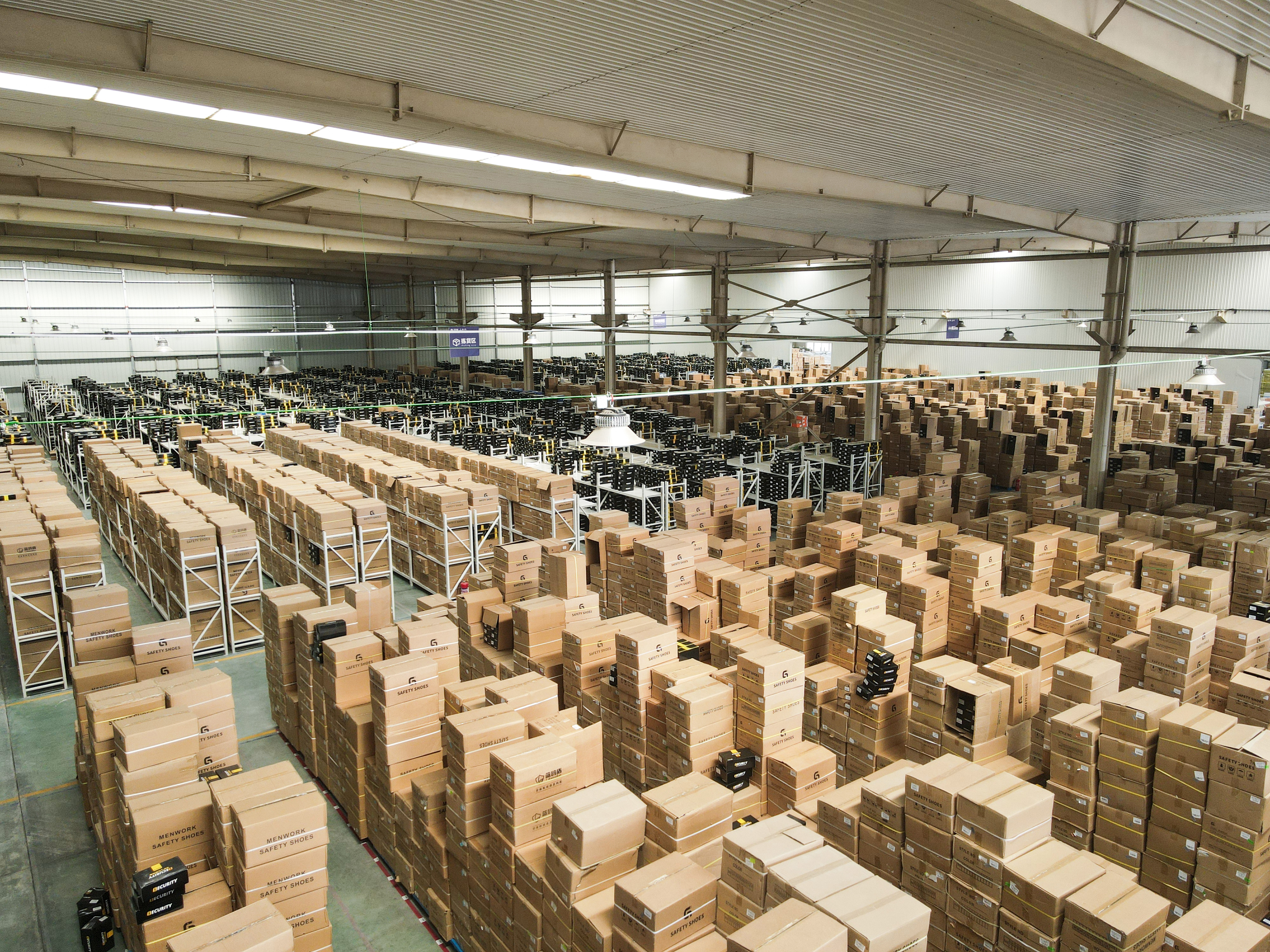
Finished-goods warehouse: the stock pool that supports 24-hour dispatch on in-stock bulk orders.
Customisation and documentation
OEM and ODM service covers custom logo, colour, material, size range, packaging and private label, including exclusive new style development. Sizes run from EU 36 to EU 48, with custom sizes available for bulk orders to match regional foot shapes. Test reports and certificate copies are supplied for tenders, customs clearance and platform listing.
Step-by-Step: How to Specify and Verify Waterproof Safety Boots
The sequence below is the shortest reliable path from a worksite requirement to a confirmed order. Each step produces something you can put in a purchase file.
- Define the water exposure. Separate rain and splashes from standing water, and separate both from cold-store condensation. This single decision tells you whether you need a waterproof construction or a water-repellent finish, and whether a warm lining is required.
- Fix the toe cap type. Steel where maximum protection is expected; composite, plastic or carbon fibre where metal-free and lighter weight matter, such as detector-screened plants, food production and electronics assembly. All options are specified to the same 200 J impact and 15 kN compression requirement.
- Choose the midsole. Kevlar, 4 mm steel or polyethylene, all rated at 1,100 N. The choice is about weight, flexibility and metal content rather than protection level.
- Match the outsole to the floor. Specify SRC slip resistance where floors are wet, oily or greasy, and confirm the grade in the test report rather than in the catalogue description.
- Add environment-specific functions. Anti-static or ESD for electronics, laboratories and paint shops; 10 kV insulation for electrical trades and utility maintenance; warm lining for cold storage and winter outdoor work.
- Request the documentation pack. Ask for the certificate and test report for the exact style, the standard referenced (EN ISO 20345, ASTM F2413 for US-bound orders), CE marking under PPE Regulation (EU) 2016/425, and care instructions that cover the clean-brush-dry reuse cycle.
- Validate with samples, then plan stock. Check fit and comfort across a full shift, confirm the size range (EU 36–48, custom sizes for bulk), then agree MOQ and lead time against your launch date.
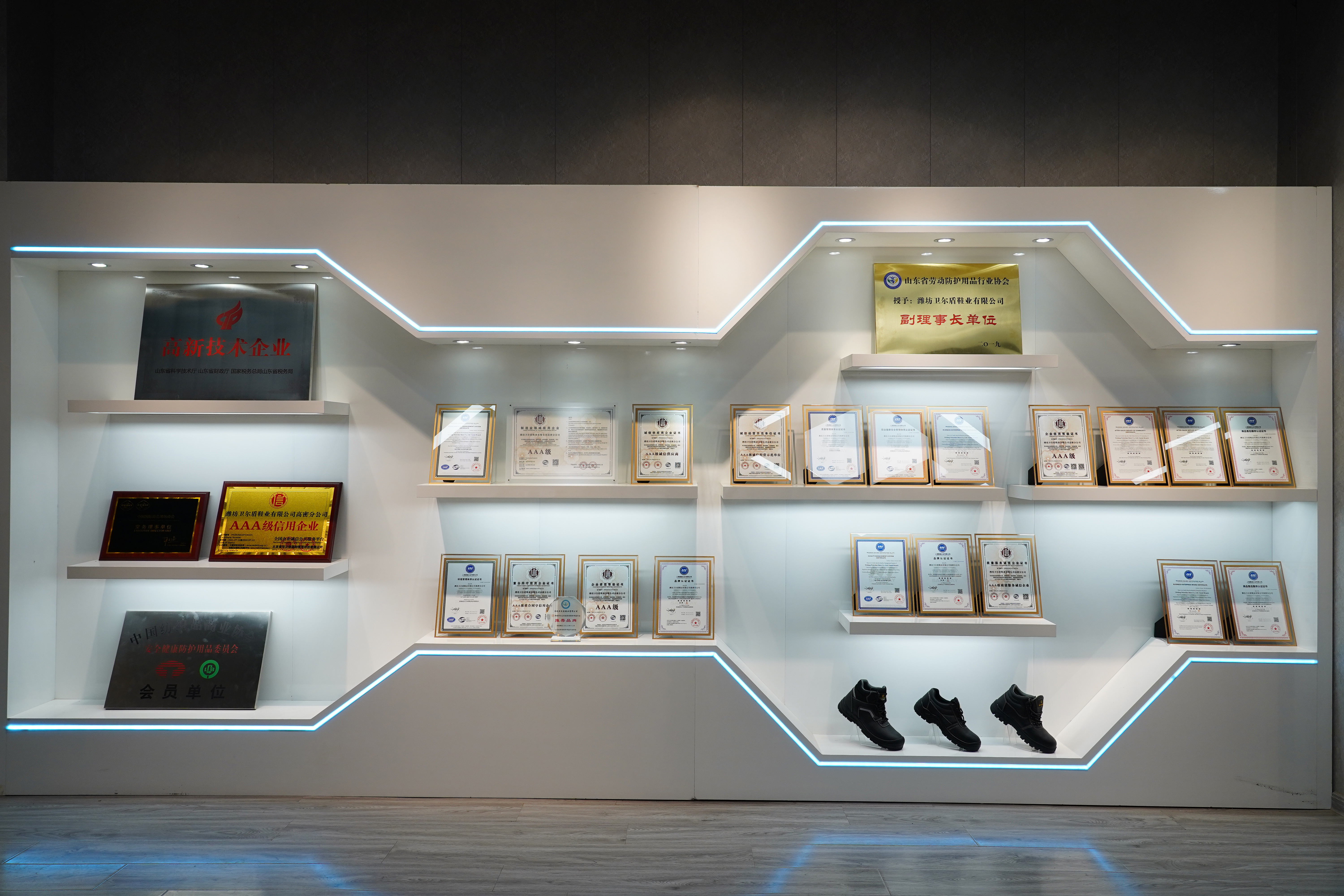
Certification and honors display: documentation is issued per style for tenders, customs and platform listing.
Use Cases: Where Waterproof Safety Boots Change the Working Day
- Construction and civil works. Uneven ground with rebar, nails, scattered metal debris and concrete fragments, plus rain and mud. Waterproof upper, steel or composite toe cap and anti-puncture midsole are the core specification.
- Mining, quarrying and mineral processing. Sharp debris and heavy loads on wet ground; midsole integrity and outsole grip carry most of the risk.
- Oil, gas and petrochemical plants. Oily and slippery floors combined with impact hazard; oil-resistant outsoles and slip resistance matter as much as water resistance.
- Power generation and utilities. Substation, transmission line and switchgear work calls for 10 kV insulated models, with composite toe caps where metal-free footwear is required.
- Warehouse, logistics and ports. Long shifts of 8–12 hours, five to six days per week; comfort and consistent fit across a large workforce drive repeat orders.
- Food processing and cold storage. Wet and greasy floors plus low temperatures; warm-lined models with anti-slip outsoles suit cold-store ramps and kitchens.
- Agriculture, forestry and landscaping. Outdoor work in rain, mud, heat and cold, where a waterproof upper extends usable wear through the season.
- Airport ground handling. Metal-free composite toes keep the same boot usable in metal-detector screened areas.
Waterproof Safety Boots: Specification Checklist
The table below summarises the published specifications a buyer can use to compare quotes on equal terms. It reflects the GUYISA safety shoes range and should be matched against the certificate of the specific style being purchased.
| Specification | What the range states | What it means when you buy |
|---|---|---|
| Safety standard | EN ISO 20345; CE marking based on PPE Regulation (EU) 2016/425; ASTM F2413 for US-bound orders | Quote the destination market first — the applicable standard and marking differ by region. |
| Toe cap impact resistance | 200 joules | The baseline anti-smash requirement; identical for steel, composite, plastic and carbon fibre caps. |
| Toe cap compression resistance | 15 kilonewtons (15,000 newtons) | Covers static crushing loads as well as dropped-object impact. |
| Toe cap types | European standard steel; composite or plastic non-metallic; carbon fibre | Choose metal-free versions for detector-screened plants, food and electronics. |
| Puncture-resistant midsole | Kevlar; 4 mm steel; polyethylene (PE) | Weight, flexibility and metal content are the real decision criteria, not protection level. |
| Puncture resistance | 1,100 newtons | The anti-puncture figure to state in tenders and audits. |
| Slip resistance | SRC (SRA + SRB) on slip-resistant models — confirm with test report | Essential where floors are wet, oily or greasy; verify the grade per style. |
| Water resistance | Waterproof and winter-lined models; waterproof breathable boots positioned for outdoor and rainy-season work | Model-level feature — always tie the claim to a style number and its test report. |
| Additional functions | Anti-static / ESD; 10 kV insulation; welder-specific styles | Match the function to the hazard, not to the price bracket. |
| Upper materials | Microfiber leather, suede leather, cowhide / genuine leather, canvas, steel-wire fabric, flyknit mesh | The upper determines both water behaviour and the look of the boot on site. |
| Lining and insole | Flyknit mesh, breathable mesh, warm cotton and lint lining; EVA or PU insole, removable | Warm lining for cold work; removable insoles support replacement and hygiene programmes. |
| Size range | EU 36 to EU 48, with custom sizes for bulk orders | Confirm the regional size curve before finalising a container mix. |
Frequently Asked Questions
Are GUYISA waterproof safety boots certified for export markets?
GUYISA safety footwear is built to EN ISO 20345, with CE marking based on PPE Regulation (EU) 2016/425 and ASTM F2413 applying to US-bound orders. The company holds ISO, LA, UKCA, CE and PPE certifications. Water resistance is a model-level property, so ask for the test report and certificate for the exact style you intend to import before placing a bulk order.
Can GUYISA supply waterproof safety boots with different toe cap and midsole options?
Yes. Safety boots can be specified with a European standard steel toe cap, a composite or plastic non-metallic toe cap, or a carbon fibre toe cap, and with a Kevlar, 4 mm steel or polyethylene midsole. Anti-static, 10 kV insulated and SRC slip-resistant versions are also produced, and OEM or ODM orders can specify custom logo, colour, size range and packaging.
What is the MOQ for GUYISA waterproof safety boots?
Low MOQ is available on in-stock models. OEM and custom orders are quoted separately, because material, toe cap and packaging choices change the cost structure. Contact the sales team with your target market and required protection level for a quotation.
Can I get samples before placing a bulk order?
Yes. Samples are free of charge and the buyer covers shipping, and custom prototyping is supported. Sampling is also the practical way to validate upper material, fit and the waterproof construction of a specific style before committing to production.
How fast can GUYISA ship waterproof safety boot orders?
In-stock bulk orders can be arranged for shipment within 24 hours from an intelligent warehouse holding more than 1 million pairs. Custom and OEM orders follow a negotiated production lead time. To start, send your specification and target quantity to the GUYISA team and request a sample and quote.
Conclusion: Specify the Water, Then Specify the Protection
Waterproof safety boots work when two decisions are made in the right order. First, define the water exposure and confirm whether the style is genuinely waterproof or only water-repellent. Second, lock the protection stack: a 200-joule toe cap in steel, composite, plastic or carbon fibre, a 1,100-newton anti-puncture midsole in Kevlar, steel or PE, an SRC-graded outsole for wet and oily floors, and the anti-static or 10 kV insulation functions the site actually requires.
For buyers sourcing volume, the supplier check matters as much as the specification. GUYISA manufactures on a 50,000 m² site with a 5,000,000-pair annual capacity, more than 30 engineers, an in-house laboratory with 30+ imported testing machines, and a 30,000 m² automated warehouse holding over 1 million pairs — which is what makes a 24-hour dispatch commitment on in-stock bulk orders realistic.
Next Step: Sample, Quote or Catalogue
Send the style you are comparing, your target market and the protection level you need. The GUYISA team will confirm the waterproof specification for that style, arrange a sample, and return a quotation with the matching certificate and test report.
- Website: guyisa.com
- Product catalogue (PDF): GUYISA Safety shoes catalog
- WhatsApp: +86 132-8536-8838
- Email: xixi0riley@gmail.com
- Address: Weierdun Protective Technology Co., Ltd., intersection of Gaoxin Third Road and Lingzhi Street, High-tech Industrial Park, Xiazhuang Town, Gaomi City, Weifang City, Shandong Province, China
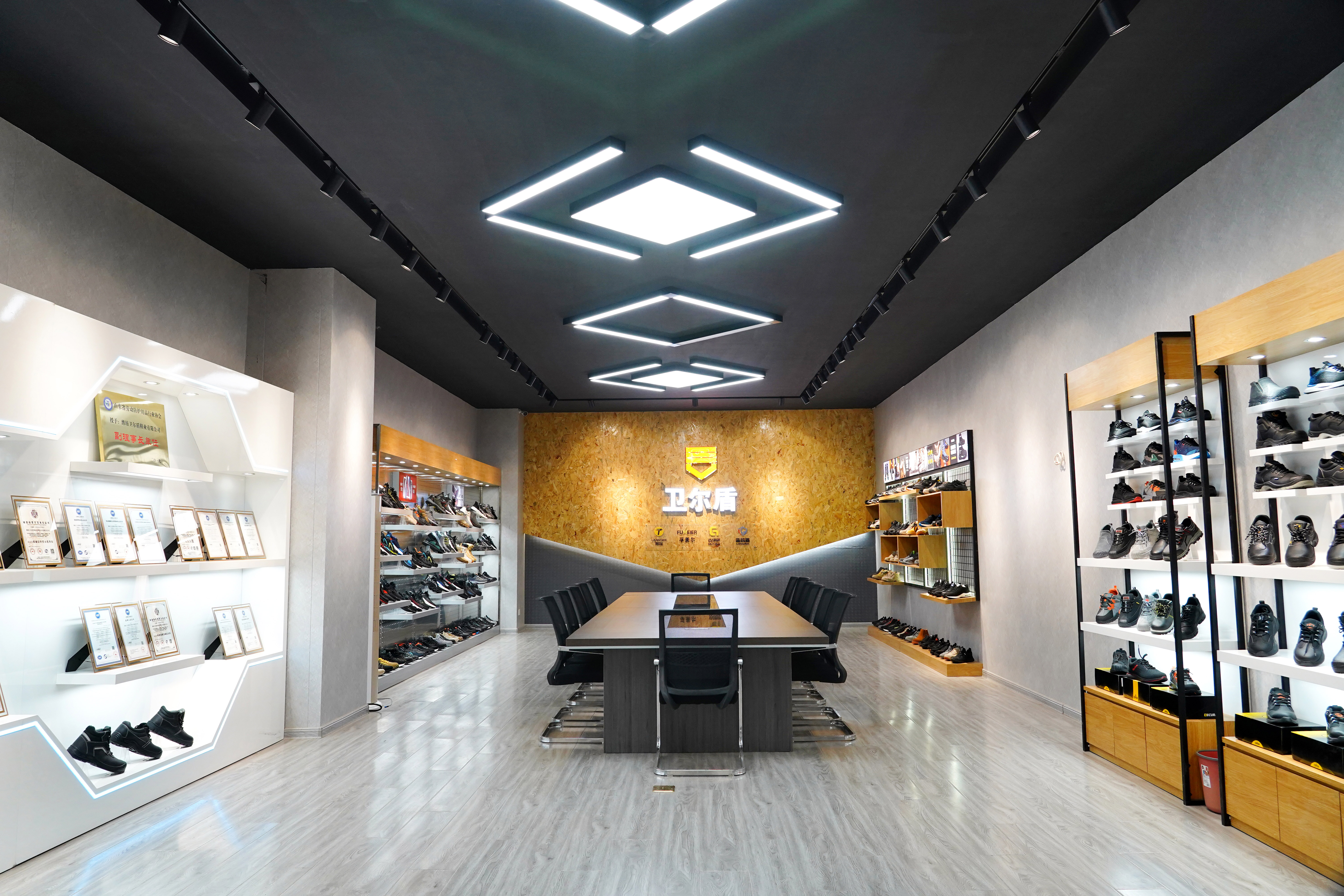
Sample room: waterproof specification, fit and finish can be checked on a physical sample before production.
Have Questions or Need More Details?
Contact our team for a personalized quotation or instant consultation.
Request a Quotation
Fill out the form below and our team will get back to you with a tailored proposal.
WhatsApp Direct Chat
Prefer to chat in real-time? Message us on WhatsApp for instant assistance & quick answers.
- Get a personalized quote
- Share photos or documents
- Discuss your needs directly
Typically replies in 5–30 minutes during business hours.