Work Boots and Safety Shoes: A Practical Buyer's Guide
Work boots are protective footwear built to keep a worker's feet intact where dropped tools, rebar, nails, sharp debris and wet floors are routine. In purchasing documents and product listings the same category is usually written as safety shoes or safety footwear, and the technical reference behind it is EN ISO 20345 in Europe and ASTM F2413 in the United States.
GUYISA is the safety footwear brand of Weifang Weierdun Shoes Co., Ltd., a manufacturer established in 2010 in Gaomi, Weifang, Shandong, China, that develops, produces and exports multifunctional safety shoes and safety boots. This guide explains what work boots actually have to do, how each protection layer is built into the shoe, which configuration fits which job, and what a buyer should verify before a bulk order is placed.
Problem Definition: Why an Ordinary Boot Is Not Foot Protection
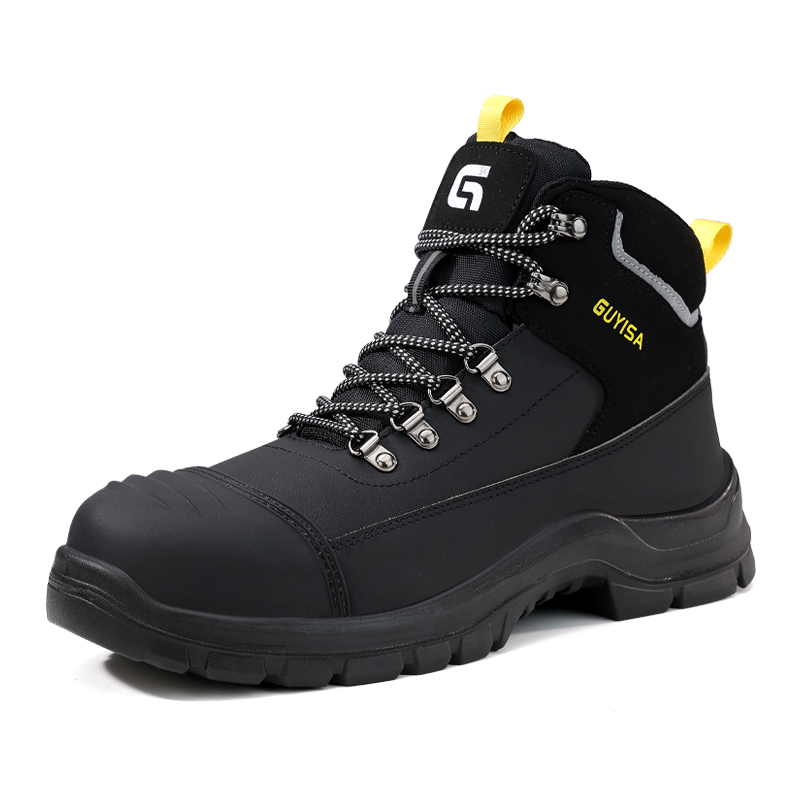
A work boot is a control measure, not a commodity. The conditions it has to survive are specific: uneven ground with rebar, nails, scattered metal debris and concrete fragments; impact from dropped tools and building materials; wet, muddy and oily surfaces; outdoor heat, dust and rain; and, depending on the site, high voltage risk or heavy loads. A pair of ordinary boots meets none of these conditions in a documented way.
Foot injuries on site follow three predictable mechanisms. The first is compression and impact on the toe box when a tool, a concrete block or a steel section falls. The second is puncture from below, when a nail or a length of rebar goes through a soft sole. The third is loss of grip on a wet or oily floor, which turns a routine carry into a fall. Each mechanism maps to a specific component: the toe cap, the anti-puncture midsole and the outsole.
What a compliant work boot must deliver:
Anti-smash toe protection · anti-puncture midsole · slip-resistant outsole · a secure, closed upper · documentation showing the model was tested to EN ISO 20345 (and ASTM F2413 for US-bound orders).
What some jobs add on top: anti-static properties, 10 kV electrical insulation, waterproof construction, welder-specific uppers, warm lining for cold storage and winter work.
The commercial risk sits alongside the physical risk. On projects where foot protection is a contractual condition, a site PPE supply that cannot produce test reports and certificate copies becomes a procurement problem: it can block a client safety audit, delay customs clearance and stop a product listing from going live.
Industry Background: Foot Protection Is a Standard-Driven Purchase
Safety footwear is one of the few categories of workwear where the specification is written down before the buyer arrives. EN ISO 20345 defines the performance requirements for safety footwear, including the 200 joule impact and 15 kilonewton compression tests applied to the toe cap region and the 1,100 newton puncture test applied to the sole. ASTM F2413 governs US-bound orders, and CE marking is based on PPE Regulation (EU) 2016/425.
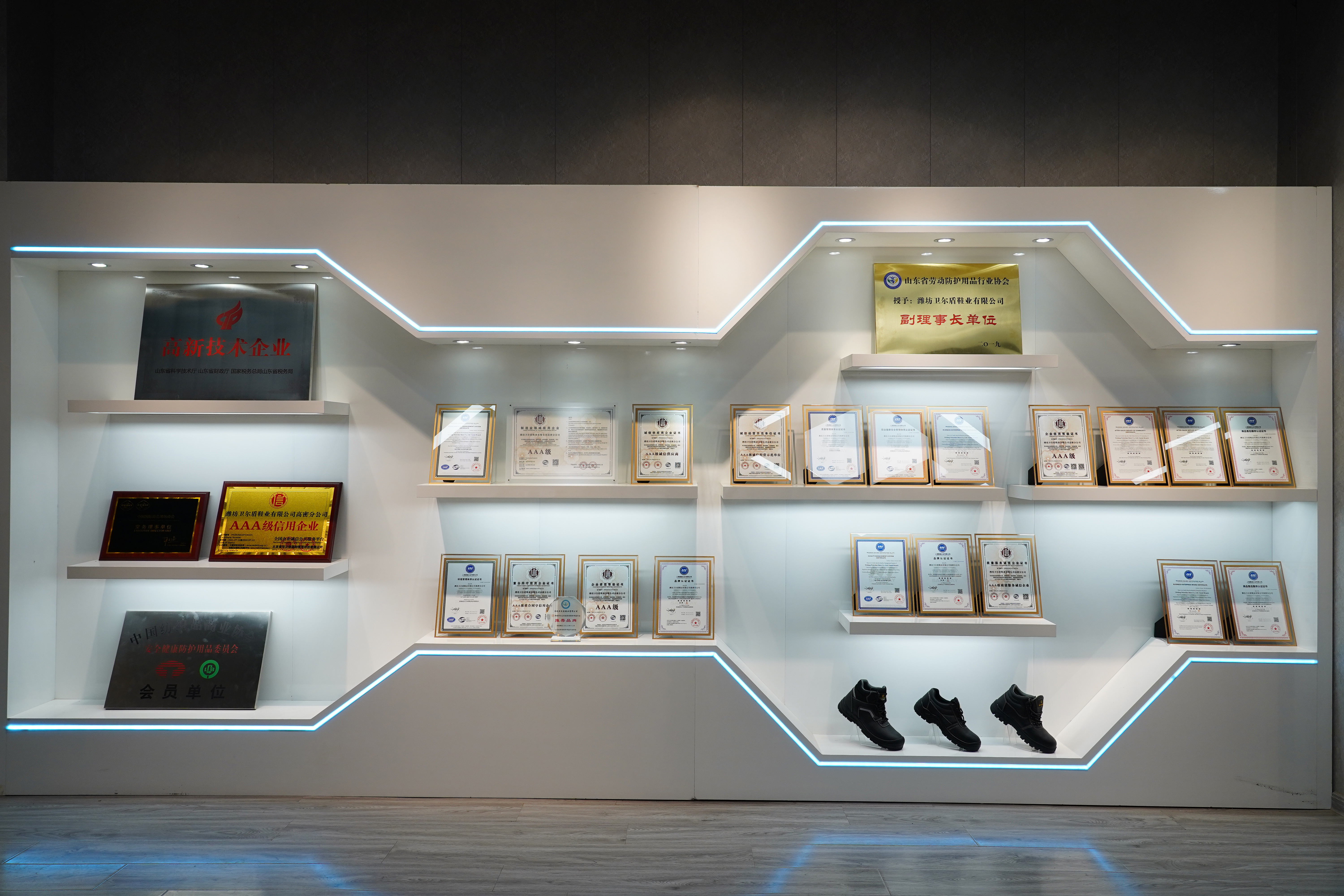
That structure is why documentation is part of the product. GUYISA safety shoes are supplied with compliance documentation such as ISO, LA, UKCA, CE and PPE certifications, and test reports and certificate copies are provided for tenders, customs clearance and platform listing. For a contractor, a distributor or an importer, this is the difference between a pair of boots and a pair of boots that can be specified, audited and resold.
The manufacturing side of the category is concentrated. Weifang Weierdun Shoes Co., Ltd. was established in 2010 and operates a 50,000 square metre facility with approximately 480 staff and an annual production capacity of 5,000,000 pairs of safety shoes. The R&D team consists of more than 30 engineers, supported by an in-house standard laboratory and more than 30 imported testing machines. Export business accounts for 50% of total sales, with major markets in North America, Europe, Southeast Asia and Africa; GUYISA products reach 118 countries and regions.
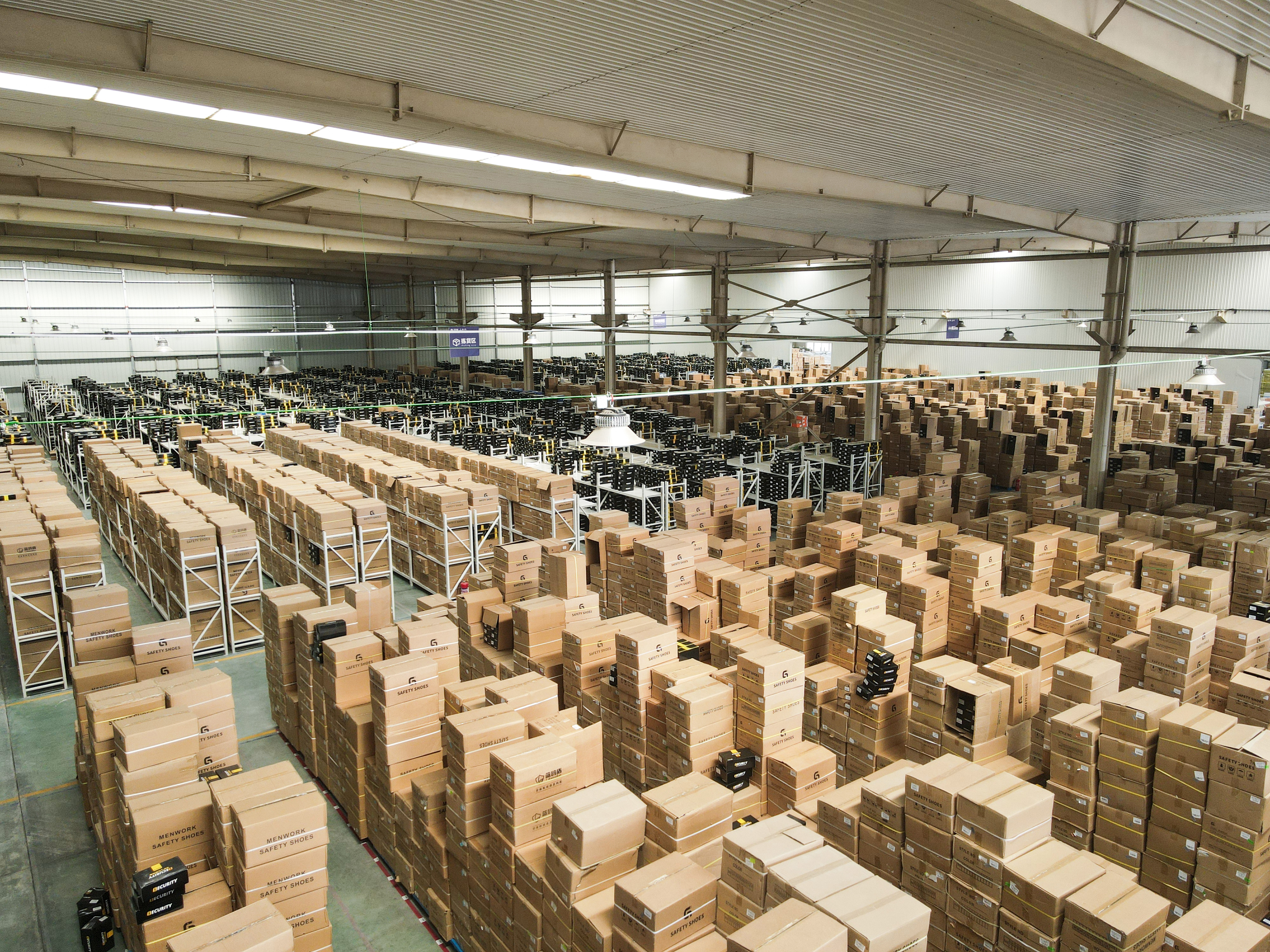
Range depth matters as much as capacity. The factory runs 348 active SKU models and holds over 1,000 styles in stock, supported by a 30,000 square metre intelligent automated warehouse that keeps more than 1 million pairs of GUYISA safety shoes available at all times, with express shipment arranged within 24 hours for in-stock bulk orders. Size coverage runs from EU 36 to EU 48, with custom sizes available for bulk orders to match regional foot shapes.
How a Safety Boot Is Built: The Four Protection Layers
Protection in a work boot is layered, and each layer answers a different hazard. Understanding the layers is the fastest way for a buyer to read a specification sheet and to decide which model belongs on which site.
1. Toe cap: the anti-smash layer
The toe cap is the component that absorbs impact and compression from above and from the front. In the GUYISA range the toe cap is tested to 200 joules impact resistance and 15 kilonewtons compression resistance in line with EN ISO 20345, and four materials are available: a European standard steel toe cap, a composite or plastic non-metallic toe cap, and a carbon fibre toe cap. Steel toe boots deliver the maximum protection in the range. Composite and plastic toe caps are lightweight, metal-free and metal-detector friendly, which is why the same protection level can be used in airports, electronics plants and food factories where metal detection is part of the process. Carbon fibre toe caps are used where a lighter shoe is the priority without dropping the anti-smash requirement.
2. Midsole: the anti-puncture layer
The midsole sits between the foot and the outsole and stops nails, wire and rebar from entering from below. GUYISA builds anti-puncture midsoles in three specifications: a Kevlar midsole, a 4 mm steel midsole and a polyethylene (PE) midsole, all targeting the 1,100 newton puncture resistance required under EN ISO 20345. This is the layer that separates a heavy duty safety shoe from a fashion work boot, and it is the first specification to check on any tender document for construction, mining or warehouse work.
3. Outsole: grip, oil resistance and wear life
The outsole decides whether the wearer stays upright. GUYISA uses solid dual density PU outsoles produced by injection moulding, plus natural rubber and EVA versions, all oil resistant and abrasion resistant. Slip-resistant models carry an SRC grade that covers both SRA and SRB testing — the grade should always be confirmed on the test report for the specific model, because it is a property of the compound and the tread pattern, not of the brand.
4. Upper and lining: the layer that decides whether the boot is worn
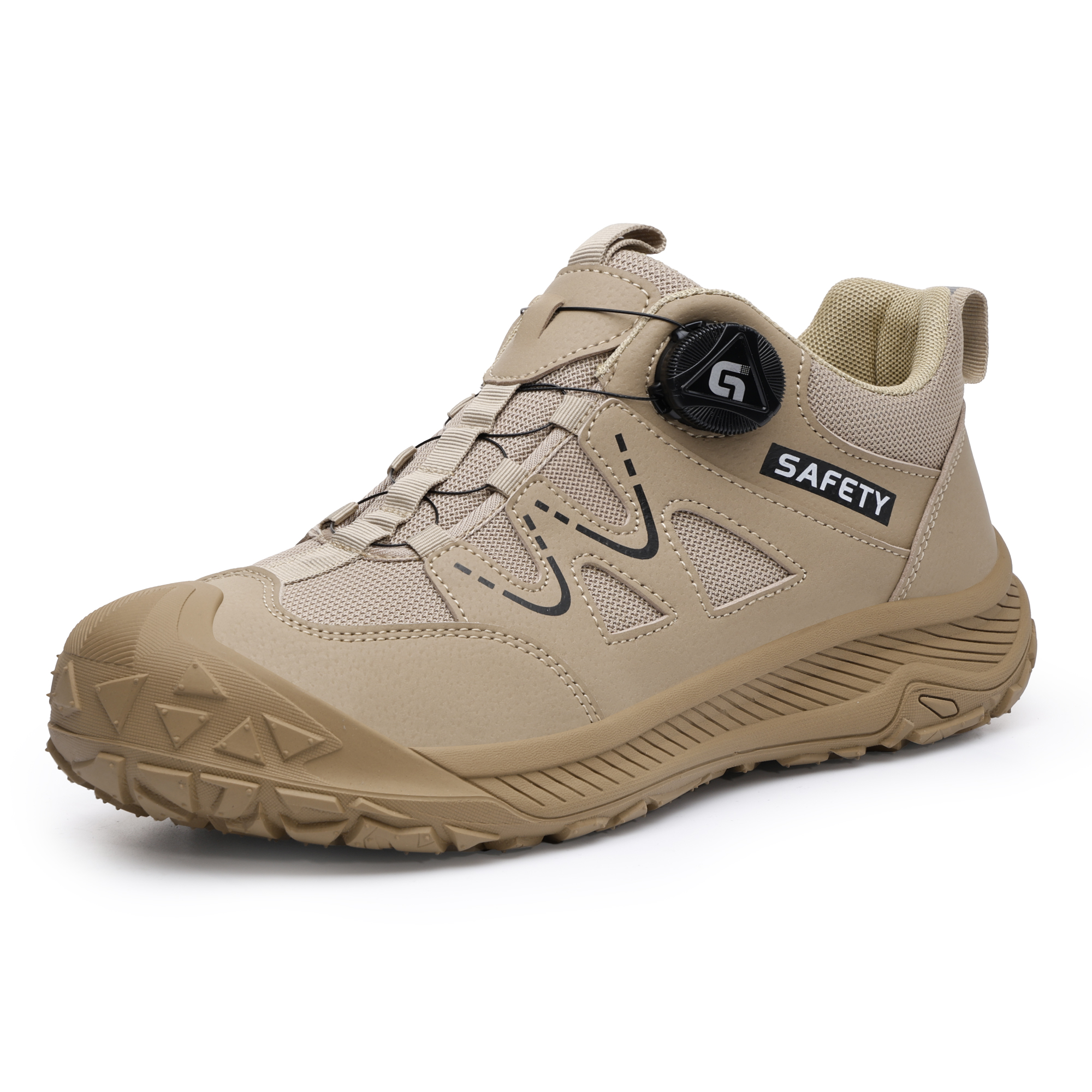
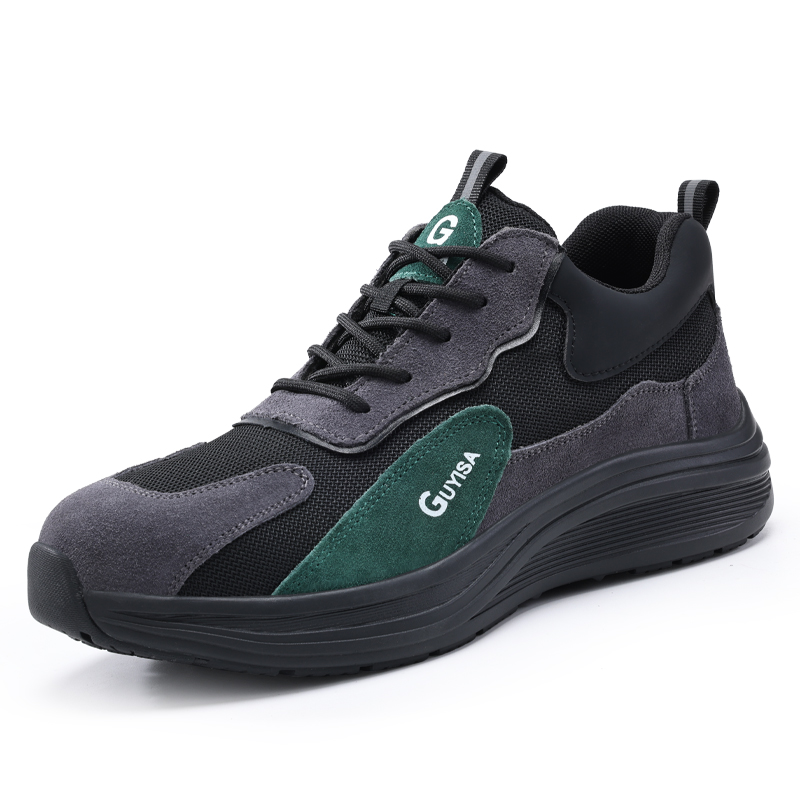
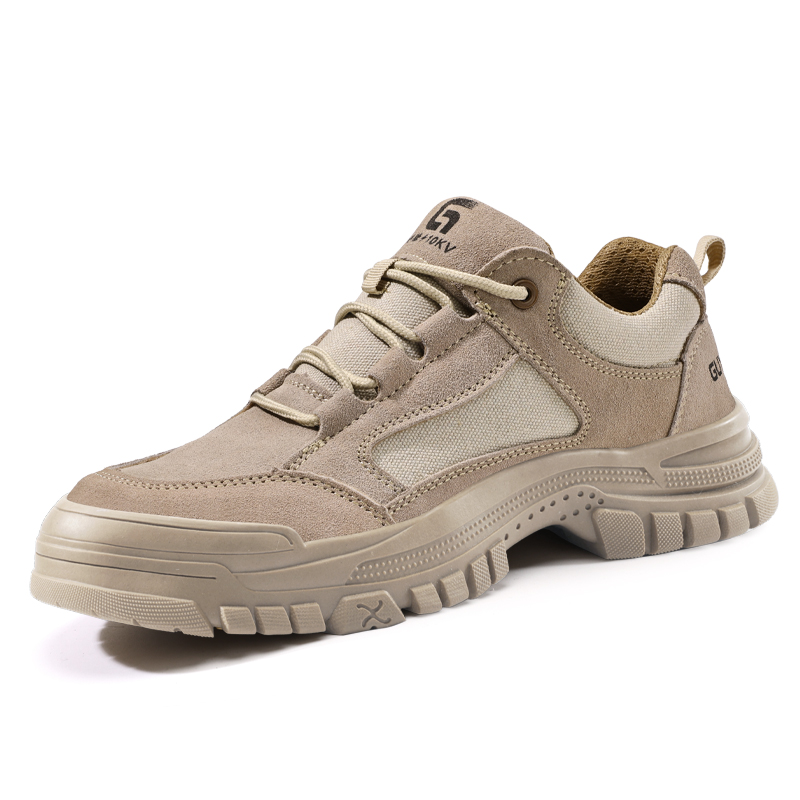
A protective boot that is too heavy or too hot is a boot that gets removed at the gate. Uppers in the GUYISA range include microfiber leather, suede leather, cowhide and genuine leather, canvas, steel-wire fabric and flyknit mesh. Waterproof and breathable models are available as waterproof safety boots for outdoor and rainy-season work, and winter-lined models with warm cotton and lint lining cover cold storage and outdoor winter sites. Linings are breathable mesh or flyknit mesh, insoles are removable EVA or PU, and hardware is rust-resistant metal eyelets and hooks on lace-up styles. The construction is designed around 8 to 12 hour shifts rather than around a showroom.
Additional protection layers for specific trades
- Anti-static and ESD: an antistatic insole and outsole compound that drains static charge to the ground, used in electronics and precision manufacturing, hospital and laboratory environments, automotive paint shops and powder handling lines.
- 10 kV insulation: non-conductive outsole and insulated upper assembly with no conductive parts in the toe area, built for electricians, substations, transmission line and switchgear work.
- Welding and metal fabrication: welder-specific safety styles inside the range, matched with anti-smash and anti-puncture protection.
How to Specify Work Boots: Step by Step
Specifying safety shoes is a sequence, not a single decision. Following the seven steps below keeps the choice tied to the hazard rather than to the price list.
Step 1 — Map the hazard on site. List what can fall, what can be stepped on and what the floor is like. Rebar, nails and metal debris point to the anti-puncture midsole; dropped tools and building materials point to the toe cap; wet, muddy or oily surfaces point to the outsole.
Step 2 — Fix the market standard first. European and most export markets specify EN ISO 20345 with CE marking under PPE Regulation (EU) 2016/425; US-bound orders specify ASTM F2413. Decide the standard before the model, because the standard decides which test reports the order needs.
Step 3 — Choose the toe cap material. Steel toe work boots for maximum protection on construction and heavy industry; composite or plastic non-metallic toe caps where the shoe must pass a metal detector or where weight matters; carbon fibre where a lighter build is the priority. All keep the anti-smash requirement.
Step 4 — Choose the midsole. Kevlar, 4 mm steel or polyethylene, all targeting 1,100 newtons puncture resistance. Steel offers the most traditional construction; Kevlar and PE are used where a lighter or more flexible sole is preferred.
Step 5 — Match the outsole and upper to the floor and the climate. SRC slip-resistant outsoles for wet and greasy floors; oil-resistant compounds for workshops and kitchens; waterproof breathable uppers for outdoor and rainy-season work; warm lining for cold storage and winter sites.
Step 6 — Confirm sizes and fit. GUYISA covers EU 36 to EU 48 as standard and supports custom sizes for bulk orders, which matters when one order has to fit several regional foot shapes.
Step 7 — Validate documentation and a sample pair before the bulk order. Ask for the certificate set and the test report for the exact model, then wear-test a sample on the actual floor. Only after that should the purchase order be released.
Use Cases: Which Work Boot Configuration Fits Which Job
The same work boot is not correct everywhere. The matrix below maps the working conditions described in the GUYISA application data to the configuration that answers them.
| Work environment | Dominant hazard | Configuration to specify |
|---|---|---|
| Construction and civil works — buildings, roads, tunnels, metro | Impact from dropped materials; nails, rebar and concrete fragments; muddy ground | Steel toe safety shoes with anti-puncture midsole (Kevlar, 4 mm steel or PE) and slip-resistant outsole |
| Mining and quarrying | Heavy load, sharp debris, impact hazard | Heavy duty safety shoes: steel toe cap plus anti-puncture midsole, durable PU or rubber outsole |
| Oil, gas and petrochemical plants | Oily floors, impact, static risk | Anti-static models with oil-resistant outsole and anti-smash toe cap |
| Welding and metal fabrication | Hot debris, metal offcuts, impact | Welder-specific safety styles with anti-smash and anti-puncture protection |
| Power generation, substations, switchgear | High voltage risk | 10 kV insulated safety shoes, non-conductive outsole, metal-free composite toe option |
| Warehouse, logistics and distribution | Repetitive handling, dropped loads, long shifts | Lightweight anti-smash and anti-puncture models with breathable upper and cushioning PU outsole |
| Food processing and commercial kitchens | Wet, greasy and oily floors | Slip resistant safety shoes with SRC outsole and steel toe cap |
| Cold storage and winter outdoor work | Cold, ice, wet surfaces | Warm-lined waterproof models with slip-resistant outsole |
| Electronics, laboratories and hospitals | Static discharge, light impact | Anti-static ESD safety shoes with breathable upper and composite toe option |
| Airport ground handling and port operations | Metal detection screening, impact, long shifts | Metal-free composite or plastic toe cap models, anti-puncture midsole |
| Automotive repair and assembly | Oily floors, dropped parts | Oil-resistant PU outsole, steel toe cap, anti-static option |
| Agriculture, forestry and landscaping | Uneven ground, sharp debris, weather | Waterproof safety boots with anti-puncture midsole and aggressive slip-resistant outsole |
Comparison Table: Toe Caps and Midsoles Side by Side
Toe caps and midsoles are the two components buyers compare most often. The table below uses only the specifications published for the GUYISA range, so it can be used directly in a specification discussion.
| Component | Option | Documented characteristic | Where it fits |
|---|---|---|---|
| Toe cap | European standard steel toe cap | 200 J impact resistance and 15 kN compression resistance to EN ISO 20345; maximum protection in the range | Construction, mining, heavy industry, general industrial work |
| Toe cap | Composite or plastic (non-metallic) toe cap | Lightweight and metal-free; metal-detector friendly; keeps anti-smash protection | Airports, electronics plants, food factories, security-screened plants |
| Toe cap | Carbon fibre toe cap | Lightweight toe cap option used together with polyethylene puncture-resistant midsoles | Long-shift work where lower weight is a stated requirement |
| Midsole | Kevlar anti-puncture midsole | Flexible puncture-resistant layer targeting 1,100 N to EN ISO 20345 | Construction site safety shoes and heavy industry work |
| Midsole | 4 mm steel midsole | Steel puncture-resistant layer targeting 1,100 N to EN ISO 20345 | Mining, quarrying, demolition and sites with dense metal debris |
| Midsole | Polyethylene (PE) midsole | Puncture-resistant, non-metal midsole option used in lightweight builds | Warehouse and logistics, metal-detector areas, long-shift comfort |
Sourcing Work Boots from China: What to Verify
China is the main manufacturing base for safety footwear, and the practical question for an importer is not where the factory is but what can be verified. A shortlist of Chinese safety shoes manufacturers should be filtered on evidence, not on catalogue size.
- Certification set per model. Ask for ISO, LA, UKCA, CE and PPE documentation relating to the exact model, plus test reports for tender, customs and platform listing use.
- Test capability. A factory with an in-house standard laboratory and more than 30 imported testing machines can test in the production cycle rather than only at the sample stage.
- Manufacturing status. GUYISA researches, develops, manufactures and exports safety footwear in house, with over 15 years of manufacturing experience; the production base is in Weifang, Shandong, and factory visits covering production lines, the sample room and quality control can be arranged.
- Capacity and stock depth. Annual output of 5,000,000 pairs, 348 active SKU models, over 1,000 styles in stock and a 30,000 square metre automated warehouse holding more than 1 million pairs are what make a 24-hour dispatch commitment on in-stock bulk orders realistic.
- OEM and ODM readiness. Custom logo, colour, material, size range, packaging and exclusive new style development are supported; MOQ for in-stock models is low, while OEM and custom orders are quoted separately.
- Commercial support. A 24-hour customer service team, marketing material and product training reduce the cost of launching a new safety footwear line in a new market.
FAQ: Work Boots and Safety Shoes
What should buyers check when sourcing safety shoes from China manufacturers?
The first check is the certification set attached to the exact model, not the company: ISO, LA, UKCA, CE and PPE documentation, plus test reports that can be submitted with a tender, presented at customs or uploaded for platform listing. The second check is the standard the model is built to — EN ISO 20345 for Europe and most export markets, ASTM F2413 for US-bound orders. The third check is manufacturing status and test capability: whether the supplier develops and produces the footwear in its own plant, whether it has an in-house laboratory and how many testing machines it runs. A factory visit covering production lines, sample room and quality control should be available on request.
What protective functions do GUYISA safety shoes have?
GUYISA safety shoes support multiple protection options in one range: anti-smash toe caps (steel, composite, carbon fibre or plastic) tested to 200 joules impact and 15 kilonewtons compression to EN ISO 20345; anti-puncture midsoles (Kevlar, 4 mm steel or polyethylene) targeting 1,100 newtons; 10 kV electrical insulation; anti-static and ESD models; SRC slip-resistant outsoles; waterproof breathable construction; and welder-specific safety styles. Because these are separate build options, the protection set should always be confirmed on the specification sheet of the specific model rather than assumed across the range.
What is the MOQ for GUYISA bulk orders?
For in-stock GUYISA models, a low MOQ is available, which suits trial orders and mixed-model container loading. For OEM and fully custom orders — custom logo, colour, material, size range or exclusive new style development — the MOQ is quoted separately because it depends on tooling, materials and production scheduling. Buyers comparing budget scenarios should therefore request two quotations: one for stock models and one for the customised version.
Can I get samples of GUYISA safety shoes before ordering?
Yes. GUYISA provides a sample service, and custom prototyping is supported according to the buyer's requirements, with the buyer covering the shipping cost of the sample. Sampling is the stage at which toe cap material, midsole type, outsole compound and fit are validated on the actual work floor, so it should happen before, not after, the bulk order is confirmed.
How fast can GUYISA ship a bulk order?
For in-stock bulk orders, shipment can be arranged within 24 hours, supported by the automated warehouse that holds more than 1 million pairs of GUYISA safety shoes at all times. Custom and OEM orders carry a negotiated production lead time agreed at quotation stage. Buyers can shorten the lead time by combining stock models for the first container with customised models for the follow-up order — to check current stock and request a quotation, contact the GUYISA team at xixi0riley@gmail.com or +86 132-8536-8838.
Conclusion: Buy the Protection the Job Requires
Work boots become safety shoes only when the protection is specified, tested and documented. The order of decisions is stable across markets: identify the hazard, fix the standard, choose the toe cap and the midsole, match the outsole and upper to the floor and the climate, then validate with a sample pair and a certificate set. Everything else — brand, price, styling — sits on top of those five decisions.
GUYISA supplies that specification as a manufacturer rather than as a trading intermediary: 348 active SKU models, 5,000,000 pairs of annual capacity, more than 1,000 styles in stock, EU 36 to EU 48 sizing with custom sizes for bulk orders, and compliance documentation covering ISO, LA, UKCA, CE and PPE requirements. For distributors and importers, the range is also available through OEM and ODM programmes with custom logo, colour, material and packaging, supported by a 24-hour customer service team.
Next Step: Sample, Specification or Quotation
Send the hazard profile of the site — floor condition, impact and puncture risk, electrical or static requirements, climate — and the GUYISA team will match it to the right model, provide the certificate set for that model and arrange a sample pair for wear-testing.
Email: xixi0riley@gmail.com · Tel / WhatsApp: +86 132-8536-8838 · Website: guyisa.com
Full range and specifications: download the GUYISA safety shoes catalogue (PDF).
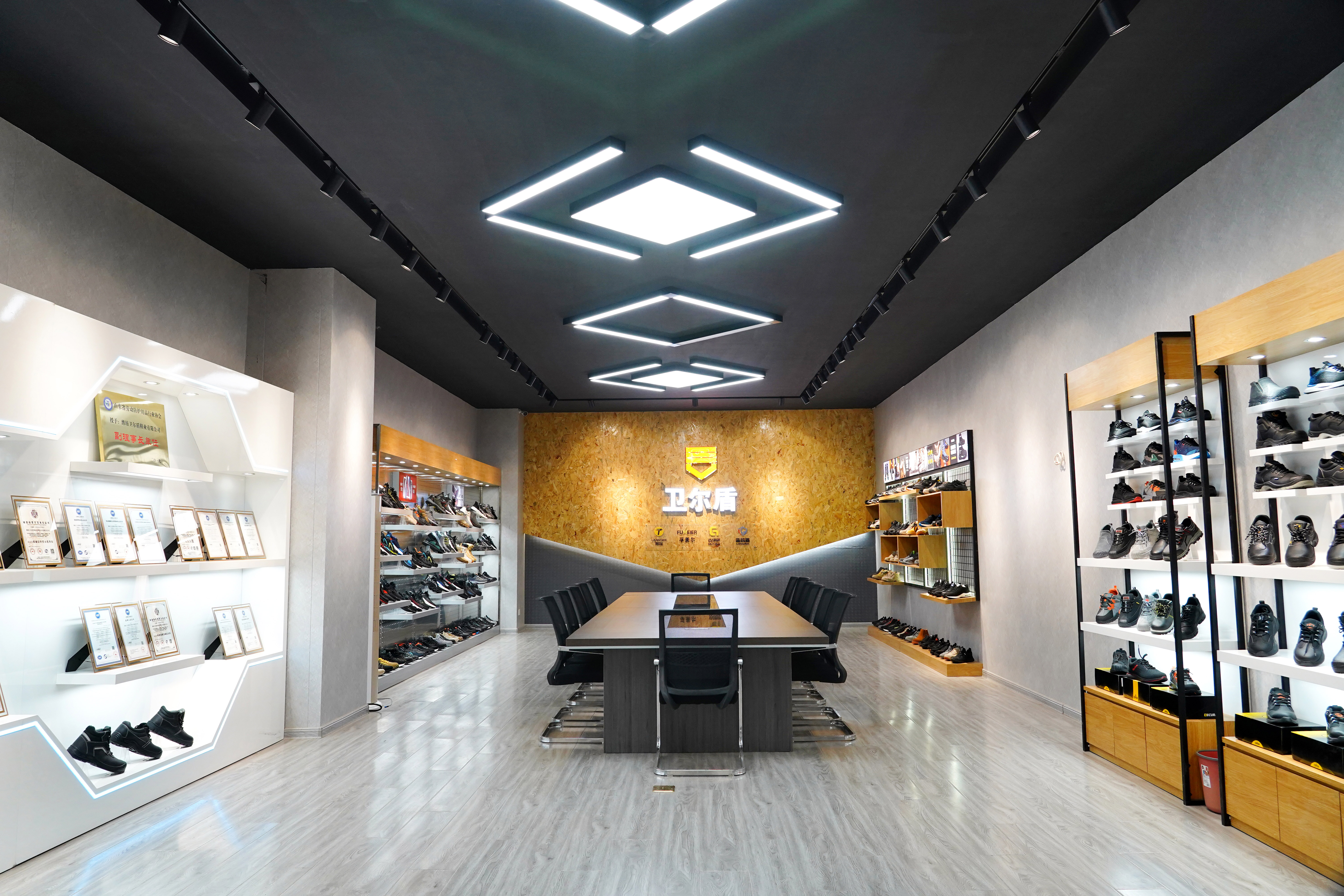
Manufacturer: Weifang Weierdun Shoes Co., Ltd., High-tech Industrial Park, Xiazhuang Town, Gaomi City, Weifang City, Shandong Province, China. Brand: GUYISA.
Have Questions or Need More Details?
Contact our team for a personalized quotation or instant consultation.
Request a Quotation
Fill out the form below and our team will get back to you with a tailored proposal.
WhatsApp Direct Chat
Prefer to chat in real-time? Message us on WhatsApp for instant assistance & quick answers.
- Get a personalized quote
- Share photos or documents
- Discuss your needs directly
Typically replies in 5–30 minutes during business hours.