
Commercial Display Compliance by Region: Voltage, IP, and Temperature Checks
Short answer: before a commercial display is shipped to a second region, three documented parameters decide whether it can actually be installed there — the input voltage range, the IP (ingress protection) rating, and the operating temperature and humidity range. Conformity documents prove that a model is allowed on a market. They do not prove that the unit will start at −10 °C, survive a coastal monsoon, or run on the local supply. Both tracks have to be checked, and the parameter track is the one buyers most often skip.
This guide works through the three checks using published specifications for three series from Guangzhou Kedro Electronics Technology Co., Ltd. (GZKEDRO), a Guangzhou-based commercial display manufacturer founded in 2013 with a 50,000 m³ facility and more than 200 staff: the KD-AD Series indoor advertising display, the KD-OD Series outdoor advertising display, and the KD-WM Series wall-mounted display. Where a specification sheet is silent, that silence is treated here as a question to put to the supplier — not as a value to assume.
Why a compliance certificate does not answer a deployment question
Conformity documents and performance parameters answer different questions, and mixing them up is the most common reason a display arrives at a site and cannot be commissioned.
- Conformity documents answer whether a model is allowed on a market: an FCC SDoC under FCC Part 15 Subpart B for the United States, verification of compliance with the EU Low Voltage Directive 2014/35/EU and EMC Directive 2014/30/EU, RoHS 2.0 documentation, GB4943.1-series test reports for China, or a 3C certificate.
- Performance parameters answer whether the unit operates at the site: input voltage, power draw, IP rating, operating temperature, humidity and brightness.
A model can hold a valid EU LVD verification and still be the wrong choice for an unheated loading area, because the operating range in its own specification may begin at 0 °C. The reverse is equally true: an excellent −20 °C to 50 °C rating does not make a unit sellable where the required conformity document is missing or names a different model. Regional compliance is a two-column checklist, and the parameter column has to be filled from the datasheet of the exact model being purchased.
A third category gets confused with both: management-system certification. GZKEDRO's ISO 9001 certificate (number 25020021R0S, issued by Beijing Zhengbiao Lianxin Certification Service Co., Ltd. under GB/T 19001-2016 idt ISO 9001:2015, valid from 14 January 2025 to 13 January 2028) covers production and sales processes for intelligent display terminals and related products. It says something about how the factory is organised. It says nothing about the voltage range or IP rating of a specific display.
How regional requirements split into three blocks
Across North America, Europe and Asia, the requirements that affect a display deployment fall into three blocks that can be checked independently of each other.
- Electrical block. Nominal mains voltage and frequency at the site, plus the safety and EMC regime of the market: UL 970 in the United States, which UL Solutions describes as the standard for retail fixtures and merchandise displays covering commercial displays, retail fixtures, showcases and temporary displays; LVD 2014/35/EU and EMC 2014/30/EU in the European Union; the GB4943.1 series and 3C certification in China.
- Environmental block. Ingress protection, ambient temperature, humidity and condensation, solar load, dust, and — for coastal sites — corrosion.
- Documentation block. Which document proves which claim, for which model, in which market, and until when.
Mains voltage is the part that varies most visibly across markets: North America commonly uses 120 V nominal, while most of Europe and China use 220–240 V nominal. A wide-range input is therefore the single most useful line item on a datasheet for a multi-region rollout, because it collapses two regional variants into one specification.
Check 1 — Input voltage and power draw
Answer first: the KD-AD Series and KD-OD Series both publish a wide-range AC input, AC110–240 V and 100–240 V/AC respectively, which allows one specification to serve 120 V and 230 V markets. The KD-WM Series specification supplied for this review lists power consumption but not an input-voltage range, so that value has to be requested in writing before the model is specified for a new market.
What the published values say
- KD-AD Series (Advertising Display): power supply AC110–240 V, power consumption ≤140 W, brightness 450 cd/m², 1920 × 1080 resolution, RK3566 motherboard with 2 GB RAM and 32 GB storage, 8 Ω 10 W audio.
- KD-OD Series (Outdoor Advertising Display): power input 100 V–240 V/AC, 50/60 Hz, total power ≤500 W, standby power <5 W.
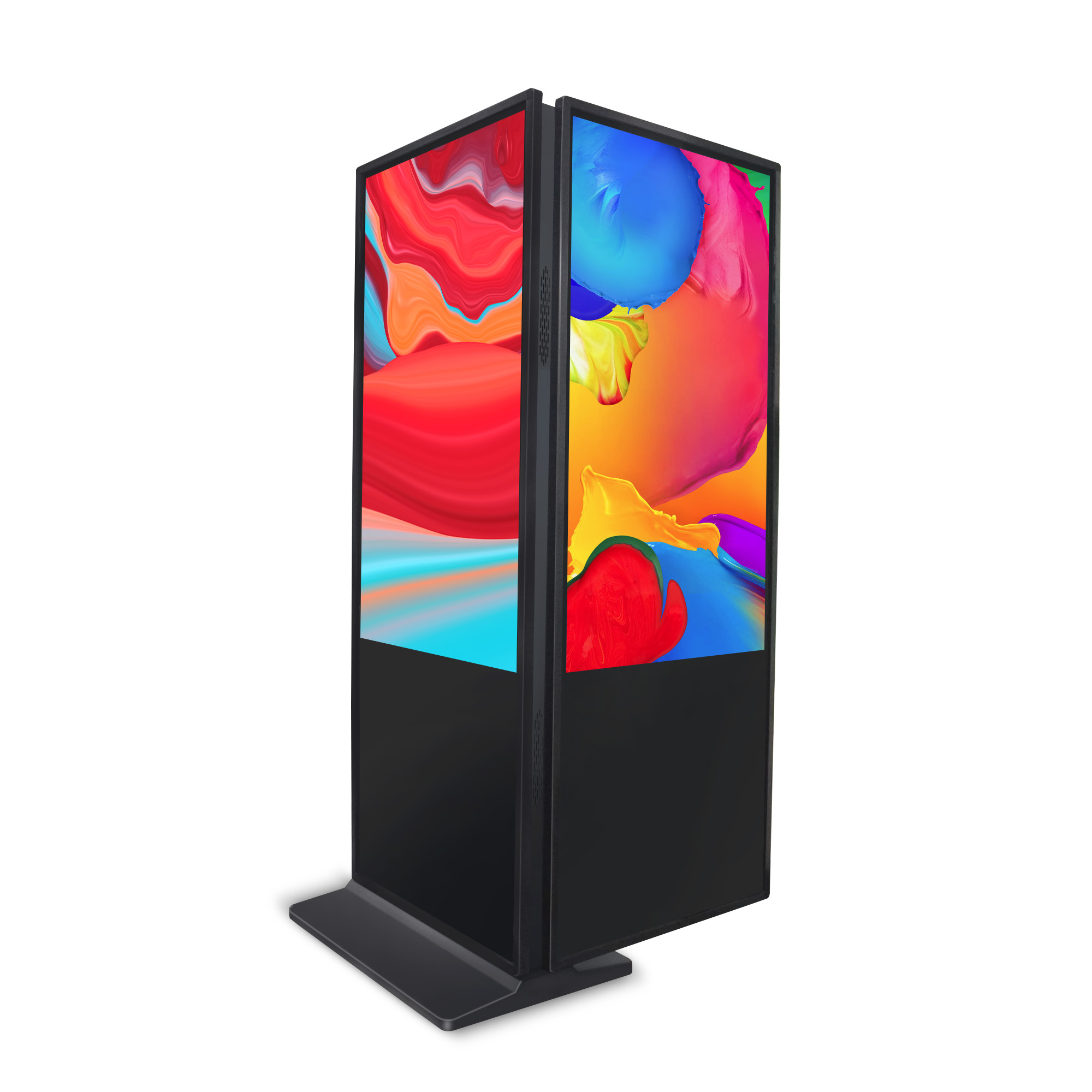
- KD-DSA Series (Dual-Screen Outdoor Advertising Machine): power input 100 V–240 V/AC, 50/60 Hz, total power ≤500 W, standby power <5 W, brightness 2,000 cd/m².
- KD-WM Series (Wall Mounted Display): total power ≤180–230 W; input-voltage range not stated in the supplied specification.
The gap between ≤140 W and ≤500 W is a distribution question, not a detail. Five KD-AD units at the maximum rated 140 W represent a different circuit and breaker plan from two KD-OD units at the maximum rated 500 W. The ≤ symbol matters: these are maximum figures, and a deployment plan built on average consumption rather than rated maximum will under-size the electrical installation.
Frequency deserves its own line in the purchase order. The KD-OD and KD-DSA Series sheets state 50/60 Hz; the KD-AD Series sheet states the voltage range without a frequency value. Where the site frequency differs from the default — 50 Hz in China and most of Europe, 60 Hz in North America — ask for written confirmation rather than assuming the same unit covers both.
What to ask the supplier about voltage
- Confirm the exact input-voltage range and frequency for the specific model and configuration being quoted.
- Ask whether the quoted power figure is rated maximum, typical, or measured, and request the standby value.
- Ask whether a voltage-specific variant is available or whether the standard unit covers the site. GZKEDRO lists voltage among its customization options, so a non-standard requirement is a configuration question rather than an automatic refusal.
- Confirm the plug, cord and terminal arrangement for the destination market; the input range on a datasheet does not define how the unit connects to the building supply.
- For models whose sheet omits the voltage range, treat the omission as an open item. The KD-WM Series is the example in this set.
Check 2 — IP rating and enclosure materials
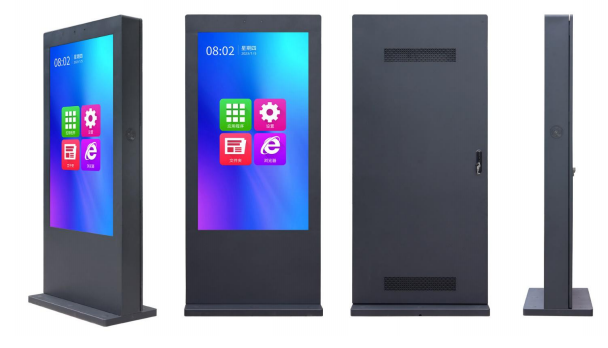
Answer first: the KD-OD Series outdoor advertising display carries an IP55 protection level with a tempered-glass front and an iron steel sheet body. IP55 covers dust protection and protection against water jets; it is not a submersion rating and it is not a corrosion rating. Buyers whose tender specifies IP65, or whose site is coastal, need an additional written confirmation — not a reinterpretation of IP55.
Reading the two digits
In the IEC 60529 classification, the first digit describes protection against solid objects and the second describes protection against water. IP55 pairs a level-5 dust rating — dust-protected rather than dust-tight — with a level-5 water rating, which corresponds to protection against water jets. That is meaningful for an outdoor advertising unit exposed to rain and routine cleaning, and it is explicitly weaker than IP65 on the dust side and weaker than IP66 or IP67 on the water side. Where a municipal or transport tender asks for IP65, IP55 documentation should not be submitted as an equivalent.
IP ratings also do not follow the indoor/outdoor split as neatly as buyers expect. The KD-ISS Series Interactive Slider Screen — an indoor unit specified for exhibition centres, hotel lobbies and commercial districts — is also rated IP55, with an air-cooled heat dissipation system. Meanwhile the KD-AD and KD-WM Series specifications supplied here list no IP rating at all. For sheltered indoor installation that may be acceptable; for kitchens, industrial areas, or any location with wash-down or heavy dust, the rating should be requested explicitly.
Materials and what they imply
- KD-OD Series: tempered glass plus iron steel sheet. The specification also lists explosion-proof tempered glass, which should be read as a description of the front glass construction rather than as a certified explosion-proof enclosure rating — those are different standards and different documents.
- KD-AD Series: aluminum alloy plus tempered glass.
- KD-WM Series: tempered glass plus aluminum steel sheet.
Material choice affects weight, mounting structure and finish durability, but the supplied documentation does not include coating specifications, salt-spray test results or corrosion classifications. For a coastal or heavily polluted site those are supplier questions, and the absence of data should be recorded as an open item rather than assumed to be adequate.
Check 3 — Operating temperature, humidity and brightness
Answer first: match the site's worst-case ambient condition to the model's operating range — not its storage range, and not the annual average temperature. In this product set the ranges differ substantially: the KD-OD Series is rated −20 °C to 50 °C at 10–90% RH non-condensing, the KD-WM Series −10 °C to +50 °C at 10–98% humidity, and the KD-AD Series 0 °C to 40 °C.
The practical consequence is simple. An indoor advertising display rated from 0 °C cannot be specified for an unheated hall, a cold-storage entrance or a winter-exposed concourse, whatever its brightness or price. A wall-mounted unit rated to −10 °C covers more of those cases but not all of them. The outdoor model's −20 °C lower limit is the widest in this set, which is the reason outdoor-rated hardware is frequently specified for semi-exposed installations even when the site is technically indoors.
Humidity needs the same treatment. The KD-OD Series states 10–90% RH non-condensing and the KD-WM Series states 10–98%. The non-condensing qualifier means condensation conditions fall outside the stated operating envelope, so rapid temperature swings, cold-start condensation or steam-adjacent locations require a specific answer from the supplier. The KD-AD Series specification supplied here does not state an operating humidity value at all — an open item for humid or coastal indoor sites.
Storage conditions belong in the logistics plan as well. The KD-AD Series is listed at −10 °C to 50 °C storage, and the KD-OD Series at −20 °C to 60 °C with 5–95% RH non-condensing. A container that crosses a cold route or sits in a hot port can exceed those ranges, and no certificate covers that exposure.
Brightness interacts with temperature. The KD-OD Series is specified at 2,000 cd/m², the KD-AD Series at 450 cd/m² and the KD-WM Series at 350 cd/m². These are published values; the supplied sheets do not state a derating curve for sustained high-temperature operation, and they do not state the measurement conditions. If a display must hold 2,000 cd/m² at 45 °C ambient in direct sun, request the derating data instead of assuming the headline figure holds across the whole operating range. The KD-OD Series also uses industrial fans for air-cooled heat dissipation, which places filter cleaning and airflow clearance in the maintenance plan rather than in the specifications.
Parameter comparison across the three series
The table consolidates the published values so a regional requirement can be tested against each model line by line. Cells marked not stated mean the supplied specification does not include the value; they are not evidence that the model lacks the capability.
| Model | Typical deployment | Input voltage | Power | IP rating | Brightness | Operating temperature | Operating humidity | Enclosure materials |
|---|---|---|---|---|---|---|---|---|
| KD-AD Series (Advertising Display) | Indoor digital signage, retail, airport, hotel | AC110–240 V (frequency not stated) | ≤140 W | Not stated | 450 cd/m² | 0 to 40 °C | Not stated | Aluminum alloy, tempered glass |
| KD-OD Series (Outdoor Advertising Display) | Outdoor media, transport hub, commercial district | 100–240 V/AC, 50/60 Hz | ≤500 W; standby <5 W | IP55 | 2,000 cd/m² | −20 to 50 °C | 10–90% RH, non-condensing | Tempered glass, iron steel sheet |
| KD-WM Series (Wall Mounted Display) | Indoor wall-mounted advertising, mall, hotel | Not stated | ≤180–230 W | Not stated | 350 cd/m² | −10 to +50 °C | 10–98% | Tempered glass, aluminum steel sheet |
| KD-ISS Series (Interactive Slider Screen) | Indoor interactive display, exhibition, lobby | 100–240 V/AC, 50/60 Hz | ≤180 W; standby <5 W | IP55 | 1,500 cd/m² | −20 to 50 °C | 10–90% RH, non-condensing | Tempered glass, aluminum alloy, stainless steel |
Regional document check — what the paperwork actually covers
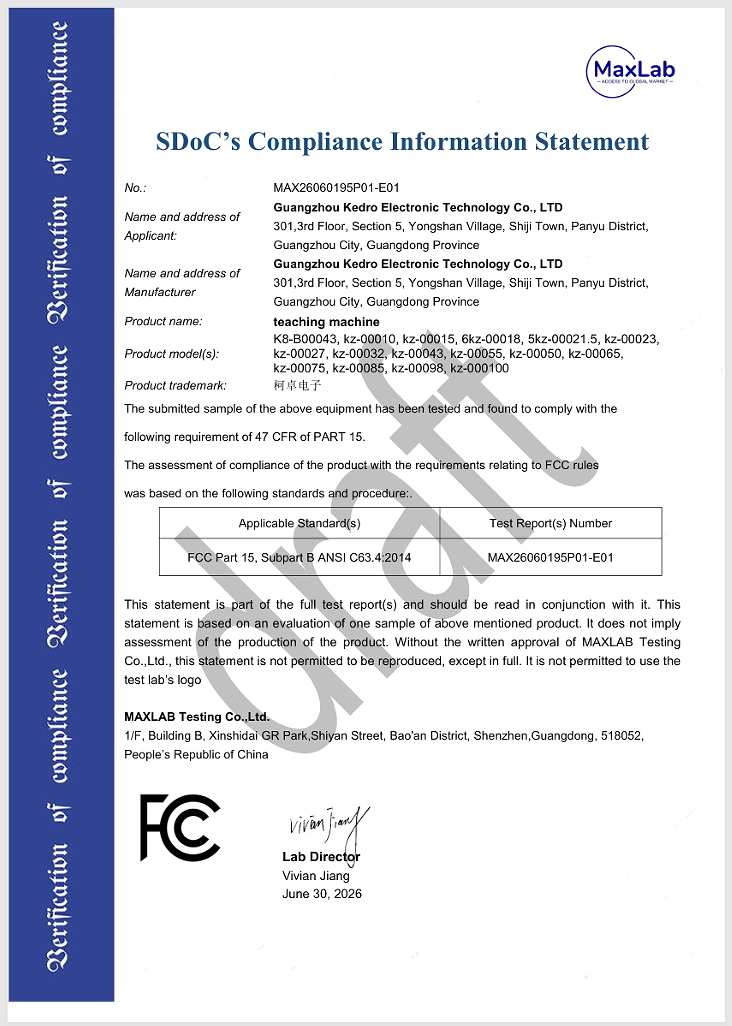
Answer first: four document families appear in this product set — a US FCC SDoC, EU verification-of-compliance documents for LVD, EMC and RoHS, China GB4943.1-series reports plus a 3C certificate, and a company-level ISO 9001 certificate. Each carries a defined market scope, a named issuing body and, in most cases, a number that must match the exact model being purchased.
United States. The FCC SDoC in this set is report number MAX26060195P01-E01, issued by MAXLAB Testing Co., Ltd on 30 June 2026 under FCC Part 15 Subpart B (ANSI C63.4:2014), and it is listed against the display series including KD-AD, KD-OD and KD-WM. It addresses electromagnetic emissions, not electrical safety and not site conditions. Where a project requires UL 970 evaluation for retail fixtures and commercial displays, that is a separate document; the supplied set does not include a UL listing, so the requirement should be raised at the quotation stage rather than assumed covered.
European Union. Three verification-of-compliance documents from TMC Testing Services (Shenzhen) Co., Ltd. cover LVD Directive 2014/35/EU (number MK25100089P01-S01, under EN IEC 62368-1:2024/A11:2024, issued 10 November 2025), EMC Directive 2014/30/EU (number MK25100089P01-E01, under EN 55032:2015/A11:2020 among other standards, issued 7 November 2025) and RoHS 2.0 (number MK25100089P01-C01, under the IEC 62321 series and Directive (EU) 2015/863, issued 7 November 2025). The model list for these documents includes KD-AD, KD-OD and KD-WM. Buyers should confirm that the exact model and configuration appear on the document, because a verification issued for a product family does not automatically extend to a customized variant.
China. Safety documentation in this set includes test report 20220501W12358 from CQC Intime Testing Technology Co., Ltd. under GB4943.1-2011 (issued 31 March 2022) and inspection report JAT2207030268CN-01 from Dongguan Junan Testing and Certification Co., Ltd. under GB4943.1-2022 and enterprise technical requirements (issued 15 July 2022). The 3C certificate listed for the KD-OD Series outdoor display is number 2018010901114733, issued by China Quality Certification Center (CQC), with a stated expiry date of 17 October 2026. That date has already passed relative to a late-2026 purchase, so buyers sourcing now should ask for the current certificate status rather than relying on the record date.
Company level. ISO 9001 certificate 25020021R0S covers production and sales processes, not product parameters. It is useful as a supplier-qualification document and irrelevant as an answer to whether a unit will run at 120 V.
Step-by-step: running the regional check before you order
- List the sites and their electrical identity. For each location record nominal voltage, frequency, connector type and available circuit capacity. Do not generalise by country; one market can contain both 120 V and 208–240 V installations.
- Record the worst-case environment. Use the hottest and coldest expected ambient at the mounting position, the highest humidity period, sun and rain exposure, and the cleaning routine. Average annual figures hide the days that cause failures.
- Set the required IP and enclosure class. Decide whether the tender or site requires IP55, IP65 or something higher, and record it as a pass/fail requirement rather than a preference.
- Transcribe the exact model datasheet. Copy the input voltage, maximum power, IP rating, operating temperature, humidity and brightness into your own table, and mark every gap as not stated.
- Match documents to the model. Check that the model appears on each certificate or report, that the market scope is the one you are deploying in, and that the issuing laboratory is named.
- Check validity dates. Confirm issue and expiry dates against the delivery schedule, not against today's date, and request current copies where a record is close to expiry.
- Close the gaps in writing. Send the list of not-stated values and open questions to the supplier and keep the written reply with the order documentation.
- Plan the installation conditions. Ventilation clearance, shading, service access for fan filters and a mounting structure rated for the unit's weight are part of compliance in practice, even though they appear in no certificate.
What the documented data does not establish
A compliance guide is only useful if it also marks the boundary of the evidence. For this product set, the published documentation does not establish the following, and each item should be treated as a supplier question.
- Brightness derating at elevated temperature. No derating curve is supplied, so the 2,000 cd/m², 450 cd/m² and 350 cd/m² figures should not be assumed to hold at the top of each operating range.
- Corrosion performance. No salt-spray, coating or corrosion-class data is supplied for any enclosure, which matters for coastal and industrial sites.
- IP test evidence. The IP55 rating is stated as a specification value; the underlying test report reference is not included in the supplied set.
- Measurements conditions for brightness. The sheets state values without stating whether they are typical, measured, or taken at a defined colour temperature and drive level.
- Missing parameter values. The KD-WM Series input-voltage range, and the KD-AD Series IP rating and operating humidity, are not stated in the specifications supplied here.
- Service life and failure rates. No MTBF or field-failure data is provided, so life-cycle comparisons cannot be made from these documents alone.
- Site suitability. No document in this set certifies that a display is appropriate for a particular installation, mounting height, viewing distance or ambient condition.
FAQ
Does an FCC SDoC cover a commercial display for installation anywhere in North America?
No. The SDoC in this set — report MAX26060195P01-E01 under FCC Part 15 Subpart B — addresses electromagnetic emissions for the models listed on it in the United States market. It does not establish electrical safety under UL 970, does not address local electrical code or installation practice, and does not confirm that the unit suits the site temperature. It is one document in a set, not a deployment clearance.
Can an IP55 outdoor display be installed at a coastal site?
IP55 covers dust protection and protection against water jets, and it is not a corrosion classification. The supplied documentation for the KD-OD Series includes no salt-spray, coating or corrosion data, so a coastal deployment needs additional written confirmation from the supplier about enclosure finish, fastener materials and the maintenance interval for the air-cooled fan system.
When two quotes look equivalent, what should actually be compared?
Compare the same model and configuration, the exact document numbers with their market scope and validity dates, the stated maximum power rather than an average, and the full operating range including humidity. A quote that omits a value is not equivalent to one that states it — it is an open item, and it should be closed before the order is placed rather than after delivery.
What should be verified on a sample before a multi-site rollout?
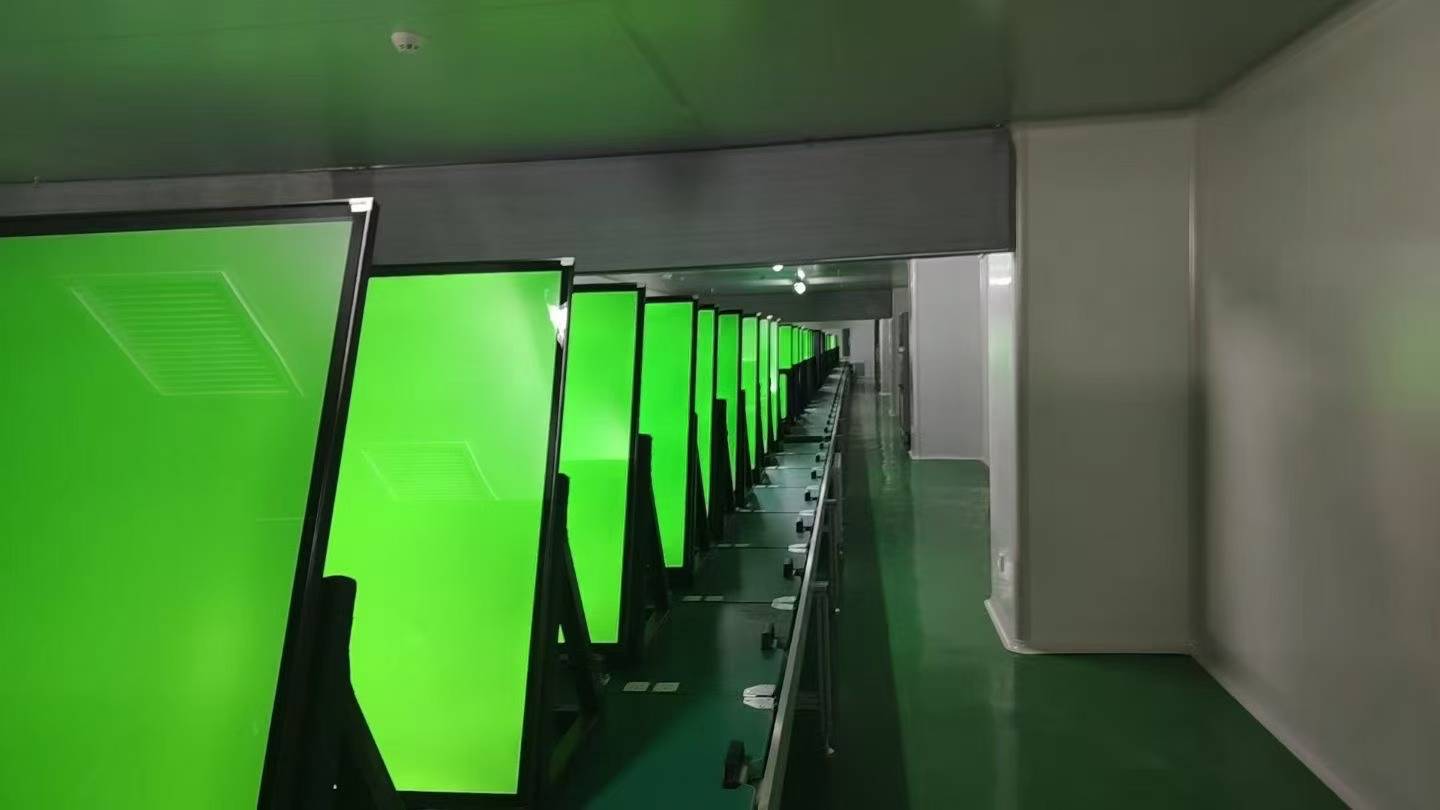
Run the unit at the site's actual voltage and frequency with the intended connector; check brightness at the intended mounting position and viewing angle; run a continuous test covering the longest daily operating period; inspect seals and gaskets on outdoor units; and confirm that the serial number and model on the unit match the documents supplied. GZKEDRO states 100% aging test and functional inspection before shipment, including brightness, waterproof, touch and temperature testing, so a buyer's sample check should reproduce the conditions the site will impose rather than repeat the factory test.
What lead time and documentation should buyers expect for a regional order?
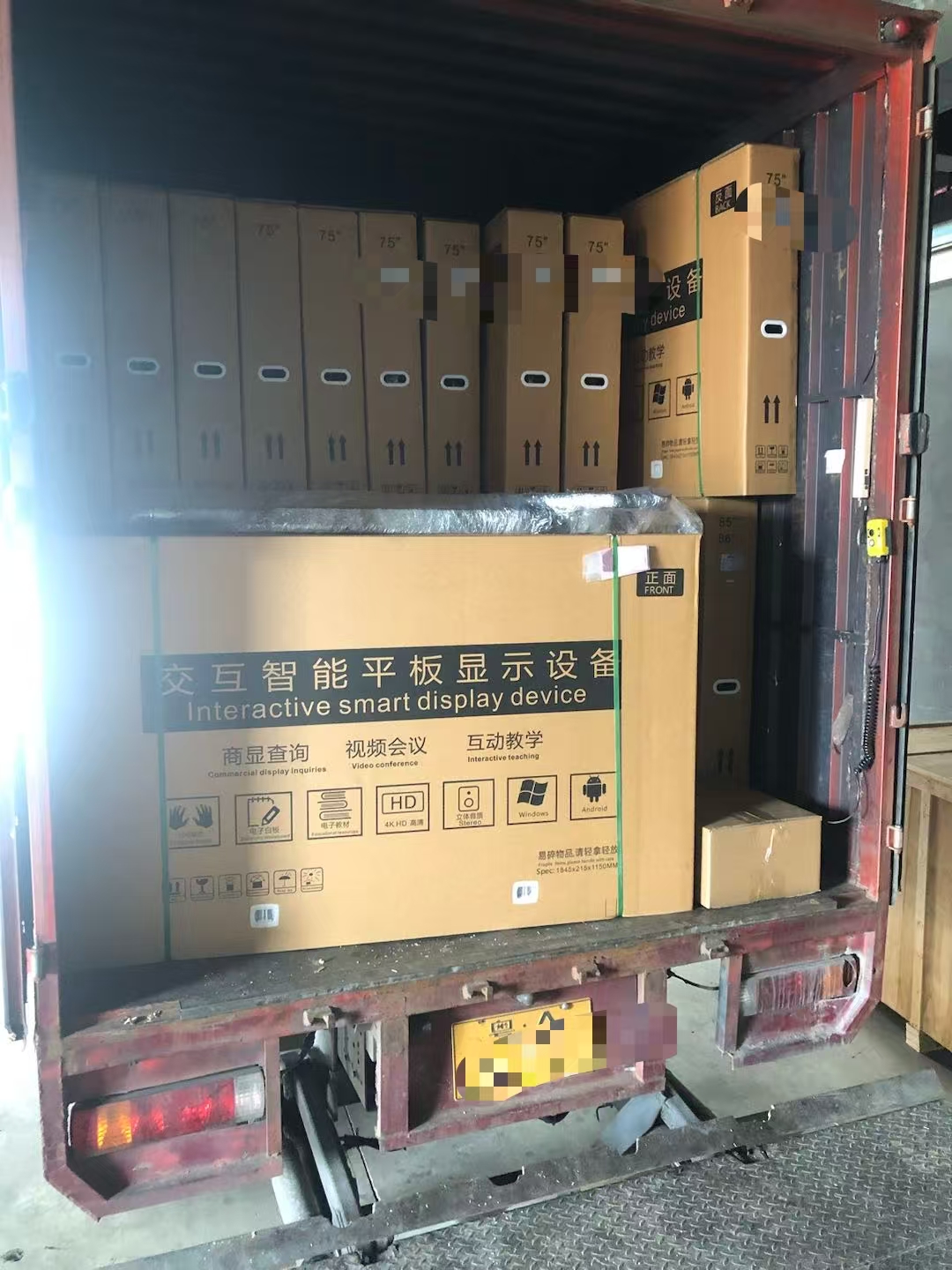
GZKEDRO lists a lead time of 15–30 days with a maximum of 30 days, a project-based minimum order of 2–5 units depending on product size, and remote technical support after delivery. Documentation should travel with the order: the parameter sheet for the exact configuration, the certificate or report copies that name the model, and written answers to every not-stated item in the regional check. For the current model list and specification ranges, the Kedro product catalog (English edition) can be downloaded and compared line by line against the site requirements.
Conclusion
Regional compliance for a commercial display comes down to a repeatable sequence. Read the input voltage and maximum power against the site supply, read the IP rating and enclosure materials against the exposure, read the operating temperature and humidity against the worst-case ambient, and only then check that the conformity documents name the same model, the same market and a valid date. A certificate that passes the fourth check but fails the first three is a document, not a deployment plan.
The three GZKEDRO series used here show how the sequence works in practice: the KD-AD Series combines a AC110–240 V input and ≤140 W consumption with a 0–40 °C operating range, making it an indoor specification; the KD-OD Series combines IP55, 2,000 cd/m² and −20 °C to 50 °C for outdoor deployment; and the KD-WM Series covers −10 °C to +50 °C at 10–98% humidity but leaves its input-voltage range to be confirmed. Each of those lines is a buying decision, and each of them is checkable before a purchase order rather than after installation.
Buyers preparing a multi-region rollout can send their site list and the required parameters to the GZKEDRO team for model matching, and request a sample or a written confirmation of the open items — voltage range, IP evidence, derating data and coating specification — as part of the quotation.
Have Questions or Need More Details?
Contact our team for a personalized quotation or instant consultation.
Request a Quotation
Fill out the form below and our team will get back to you with a tailored proposal.
WhatsApp Direct Chat
Prefer to chat in real-time? Message us on WhatsApp for instant assistance & quick answers.
- Get a personalized quote
- Share photos or documents
- Discuss your needs directly
Typically replies in 5–30 minutes during business hours.