Digital Human Display Primer: The 10 KD Series Explained
Digital Human Display Category Primer: The 10 KD Series and What Each Display Type Means
In short: the KD range covers ten series — KD-AD, KD-LED, KD-IFPD, KD-TP, KD-VW, KD-OD, KD-WM, KD-SSK, KD-ISS and KD-EA — all listed under test report MK25100089P01-C01. Each suffix describes a form factor rather than a screen size: advertising display, LED array, interactive flat panel, transparent cabinet, video wall, outdoor unit, wall-mounted unit, self-service kiosk, interactive signage station and elevator advertising machine. China 3C coverage is stated in that report for six of the ten series: KD-AD, KD-LED, KD-IFPD, KD-TP, KD-VW and KD-OD.
Introduction: Read the Suffix Before You Read the Quote
A digital human display is a commercial display terminal built to present an AI-driven human avatar, usually with voice interaction, in a public or semi-public space. The category borrows its hardware from two older families — digital signage and interactive terminals — which is why one supplier catalogue can contain ten genuinely different physical products under a single product name.
GZKEDRO (Guangzhou Kedro Electronics Technology Co., Ltd.) is a commercial display manufacturer founded in 2013, with research and development centres in Guangzhou and Shenzhen, and an export ratio of 80%. Its range is organised as ten KD series. This primer is written for the buyer who already knows what a digital human display is and now has to decide which of the ten to specify, how each type behaves in a real venue, and which certification evidence should arrive with the shipment.
Problem Definition: Ten Suffixes, One Purchasing Decision
Model codes look interchangeable inside a quotation. Two offers can both promise "a digital human display" while one is a sealed LCD panel for a shop window and the other is a floor-standing unit with a touch surface, a camera and a microphone array. The difference is not cosmetic — mounting, power, cooling, service access, content design and certification scope all follow the form factor.
Four specific problems sit behind the naming:
- Naming opacity. Suffixes such as AD, WM, VW and SSK carry the entire difference between products, yet quotations rarely explain them.
- Mixed technology. LCD panels, LED modules and transparent panels behave differently in brightness, heat and maintenance, but all appear under the single word "display".
- Certification shorthand. 3C, RoHS 2.0 and EMC appear on specification sheets as logos. Which one is relevant depends on the destination market, not on the quality of the product.
- Software dependency. The avatar, voice and AI layer runs on a player or a cloud platform, and the hardware must expose the camera, microphone and network path that layer needs.
Getting the form factor wrong is rarely a small error. A transparent cabinet specified where direct sunlight falls, or an outdoor-rated enclosure bought for an indoor lobby, both cost more to correct than to specify properly at the quotation stage.
Industry Background: How Digital Human Displays Became a Hardware Category
The category formed where digital signage met conversational AI. Static posters became networked screens; networked screens gained cameras, microphone arrays and touch surfaces; and the arrival of generative AI avatars gave those screens a presenter. The hardware that resulted is not a new device class so much as a re-specification of commercial displays around interaction, dwell time and content freshness.
Commercial research published in 2026 by PW Consulting (pmarketresearch.com) estimates the digital human screen market at USD 450.0 million in 2025 and projects USD 1,162.38 million by 2032, a compound annual growth rate of 14.5%. That figure should be read as a commercial estimate with its own market definition rather than an audited shipment count, but it does indicate that buyers increasingly purchase digital humans as repeatable hardware instead of one-off installations.
Three hardware routes now coexist. LCD-based terminals dominate indoor environments because they deliver a bright, sharp image in a thin enclosure. LED-based arrays serve large-format walls and high-ambient-light locations where a single panel cannot reach the required size or brightness. Transparent and holographic variants serve brand-led spaces where the physical product must remain visible behind the screen.
Certification has become a market-access filter rather than a formality. A display that is perfectly functional in one country may be unsellable in another without the correct conformity documentation, and the document that matters is the one that names the model and the destination market. The same logic applies to service: units specified for 24/7 operation need a cooling design and a remote management path, or they become maintenance liabilities.
The Ten KD Series, Read as Form Factors
The KD prefix is constant across the range; the two-letter suffix carries the form factor. Grouping the ten series into four families is faster than treating them as ten unrelated products.
Family 1 — Single-panel LCD series: KD-AD, KD-WM, KD-OD, KD-TP, KD-IFPD
KD-AD — advertising display. KD-AD is a single LCD panel dedicated to scheduled playback rather than interaction. It is the closest digital replacement for printed posters: content is deployed over the network, split-screen layouts are supported, and playlists can be scheduled. In a digital human deployment the AD unit carries the avatar as a looping presenter where no touch or voice input is required.
KD-WM — wall-mounted unit. The WM suffix describes how the product is fixed rather than what it displays. The panel is carried on a wall bracket or recessed mount, which frees floor space in corridors, lift lobbies and shop-in-shop areas where a freestanding unit would obstruct circulation.
KD-OD — outdoor unit. Weather protection and sunlight readability define this series. Outdoor displays are typically sealed to IP65 against dust and water jets and finished with an anti-glare front surface, with automatic brightness adjustment to hold legibility as daylight changes through the day.
KD-TP — transparent cabinet. The panel transmits light so that physical products behind the screen remain visible while graphics or a digital human float over them. This is the series to specify when the merchandise is the message: luxury retail windows, jewellery counters, exhibition plinths and museum-style showcases.
KD-IFPD — interactive flat panel display. KD-IFPD combines a large panel with multi-touch, annotation and wireless screen sharing. Its natural habitat is the conference room and the classroom rather than the shop floor. In a digital human context it acts as a two-way surface where a receptionist avatar can be interrupted, questioned and annotated over.
Family 2 — Large-array series: KD-LED and KD-VW
KD-LED — LED display. Instead of a single LCD panel, the image is assembled from LED modules. That allows the canvas to scale beyond what any single panel can reach and to sustain high brightness in daylight; outdoor LED units are commonly specified in the 1,500–3,500 nits band. LED is also described as a low-power route relative to the brightness it produces, and individual modules can be serviced without replacing the whole screen.
KD-VW — video wall. A video wall is an array of displays driven as one canvas to produce a large, seamless visual presentation. It is the correct choice when the digital human is part of scene-setting rather than conversation: command centres, stage backdrops, hotel lobbies and exhibition halls. Video walls are managed centrally, which suits venues where content changes on a schedule rather than at the touch of a visitor.
Family 3 — Service terminals: KD-SSK and KD-ISS
KD-SSK — self-service kiosk. KD-SSK is an enclosed, floor-standing unit built around a touch screen, used where a visitor completes a task without staff assistance: wayfinding, ticketing, queue management or form filling. A digital human on a kiosk usually acts as the front end of that task — greeting, qualifying and routing the user to the right screen.
KD-ISS — interactive signage station. KD-ISS is the interactive signage configuration in the range: a floor-standing interactive unit intended for information delivery and guided browsing in open public areas, where the visitor approaches the screen rather than being intercepted by it.
Family 4 — Placement-specific series: KD-EA
KD-EA — elevator advertising machine. Elevator deployment imposes its own rules: short dwell time, a compact or vertical format, a screen readable at close range, and network scheduling so that content can be updated across a building without visiting each car. Lobby-side elevator advertising uses the same series.
All ten series appear in test report MK25100089P01-C01. Read the report as the range-level document and the model datasheet as the unit-level document; a professional buyer normally needs both.
What China 3C, RoHS 2.0 and EU EMC Mean at Category Level
China 3C — China Compulsory Certification, also written CCC — is the mandatory conformity mark for products inside the Chinese catalogue. Test report MK25100089P01-C01 lists 3C coverage for six KD series: KD-AD, KD-LED, KD-IFPD, KD-TP, KD-VW and KD-OD. For the remaining four — KD-WM, KD-SSK, KD-ISS and KD-EA — the supplied report does not state a 3C position, so the model-specific certificate should be requested rather than assumed in either direction.
RoHS 2.0 (Directive 2011/65/EU) restricts the use of hazardous substances such as lead, mercury and cadmium in electrical and electronic equipment placed on the EU market. For a display the practical effect is documentation: a bill of materials, supplier declarations and a technical file the buyer can retain and pass on to a downstream customer.
EU EMC (Electromagnetic Compatibility Directive 2014/30/EU) requires a product neither to emit interference above permitted limits nor to be unduly affected by interference from other equipment. Digital human terminals combine a panel, a media player, audio amplification and often a camera or microphone, so EMC is normally assessed on the assembled unit rather than on the bare panel.
Read at category level, the three marks answer three different questions: 3C answers whether the product can be sold in mainland China, RoHS 2.0 answers what is inside it, and EMC answers how it behaves beside other equipment. They are not interchangeable, and a price comparison made without mapping the certificate to the destination market is not a like-for-like comparison. GZKEDRO's company profile lists CE, FCC, RoHS and ISO 9001 among the standards its products are certified against; the document that governs a purchase is still the one that names the model and the market.
Step-by-Step: Choosing a Series in Seven Checks
- Fix the venue before the product. Note viewing distance, ambient light level and average dwell time. A shopper passing at close range and a visitor standing in a lobby for several minutes need different brightness, size and content rhythm.
- Decide whether the unit must interact. Passive playback points to KD-AD, KD-WM, KD-LED or KD-VW. Touch, voice or camera input points to KD-IFPD, KD-SSK or KD-ISS — and adds content design work, not just hardware cost.
- Decide whether the screen should reveal or block what is behind it. Choose KD-TP when the physical product must stay visible; choose an opaque LCD series when the content must dominate the surface.
- Match the structure to the space. Wall: KD-WM or KD-AD. Floor: KD-SSK or KD-ISS. Multi-panel array: KD-VW. Elevator car or lobby: KD-EA. Outdoor or entrance: KD-OD or KD-LED.
- Set the environmental protection level. For outdoor or semi-outdoor positions, confirm the IP rating, anti-glare treatment, automatic brightness adjustment and the cooling approach for continuous operation.
- Confirm the document pack for the destination market. Ask for 3C where the six listed series are sold in mainland China, and for RoHS 2.0 and EMC evidence where the unit enters the EU. Request certificates at model level, not at brand level.
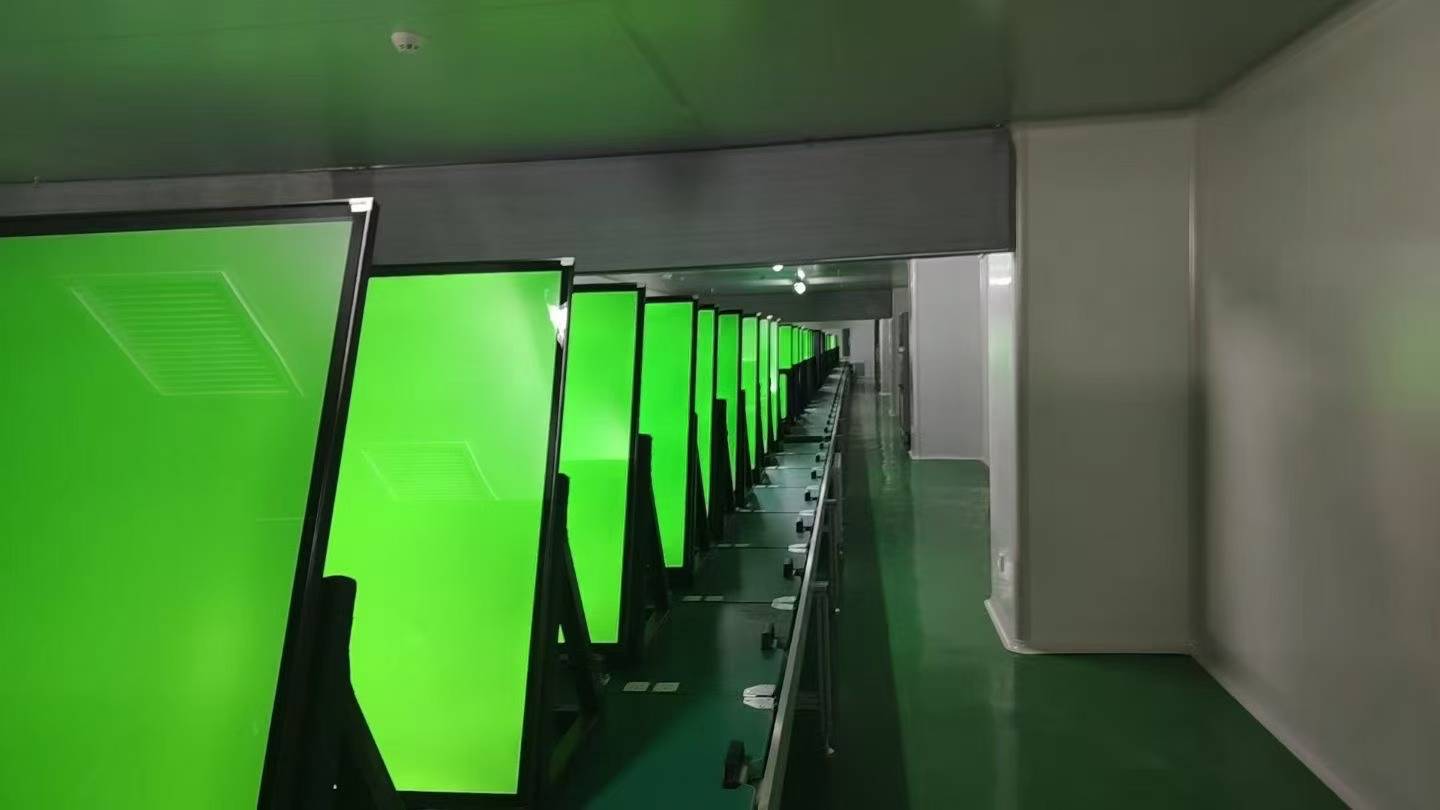
- Confirm the service model. Check whether the unit supports remote CMS management and centralised display management, whether the cooling system is rated for 24/7 operation, and whether pre-shipment aging and functional testing are documented.
Use Cases: Matching Series to Real Venues
Mall digital human shopping guide display. A floor-standing interactive unit — KD-ISS or KD-SSK — placed at a concourse junction handles wayfinding, promotions and tenant information in one surface. Reach and content density matter more than screen size here.
Exhibition hall digital human reception display. Reception work is conversational, so an interactive series carries the greeting, while KD-VW supplies the large-format backdrop and KD-TP handles showcases where artefacts must stay visible.
Retail store digital human display cabinet. KD-TP is the transparent option: the product sits behind the panel while the avatar explains it. For window positions with strong daylight, verify brightness against the actual light level before committing.
AI voice interactive digital human display. Voice interaction depends on microphone arrays and cameras rather than on the panel, so specify these peripherals explicitly on KD-SSK or KD-ISS and confirm the audio path in the assembled unit.
Mobile digital human guide display and LCD all-in-one machine. A wheeled kiosk configuration suits temporary exhibitions and pop-up spaces, while the LCD all-in-one format (KD-AD, KD-WM) suits fixed indoor positions with scheduled content.
Transparent and 4K terminals. A 4K digital human transparent display terminal belongs to the KD-TP family, where the panel specification should be confirmed on the model datasheet — resolution, transmittance and brightness are model attributes, not category attributes.
Remote maintenance digital human terminal. Every series benefits from a network management layer. Remote CMS management and centralised display management reduce the number of site visits a network of screens requires, which is often the deciding factor once a pilot becomes a rollout.
Comparison Table: The Ten KD Series Side by Side
| Series | Form factor | Typical environment | Interaction | China 3C in MK25100089P01-C01 |
|---|---|---|---|---|
| KD-AD | Advertising display | Retail, mall, restaurant | Passive playback | Listed |
| KD-LED | LED display array | High-ambient-light, large format | Passive playback | Listed |
| KD-IFPD | Interactive flat panel | Conference room, classroom | Multi-touch, annotation | Listed |
| KD-TP | Transparent cabinet | Luxury retail, exhibition | Passive or touch | Listed |
| KD-VW | Video wall | Lobby, command centre, stage | Passive playback | Listed |
| KD-OD | Outdoor unit | Outdoor advertising, entrance | Passive playback | Listed |
| KD-WM | Wall-mounted unit | Corridor, lift lobby, shop-in-shop | Passive playback | Confirm per model |
| KD-SSK | Self-service kiosk | Mall, transport hub, service desk | Touch, self-service task | Confirm per model |
| KD-ISS | Interactive signage station | Public concourse, exhibition | Touch, voice | Confirm per model |
| KD-EA | Elevator advertising machine | Elevator car, lift lobby | Passive playback | Confirm per model |
FAQ
Which KD series are covered by China 3C, and what does that mean for a buyer?
Test report MK25100089P01-C01 states 3C coverage for six series: KD-AD, KD-LED, KD-IFPD, KD-TP, KD-VW and KD-OD. China 3C (China Compulsory Certification) is the mandatory mark for products in the Chinese catalogue, so those six series are the starting point for mainland China deployment. The same report does not state a 3C position for KD-WM, KD-SSK, KD-ISS or KD-EA, so a buyer should request the model-specific certificate for those series instead of assuming coverage either way. For EU destinations the relevant documents are RoHS 2.0 and EU EMC evidence on the assembled unit.
China versus local manufacturers for mall digital human shopping guide displays — how should that decision be framed?
It is a trade-off between hardware breadth and physical proximity, not a question of one side being better. A China-based manufacturer such as GZKEDRO covers the full form-factor spread in one catalogue — kiosk, signage station, transparent cabinet, video wall, elevator unit — which simplifies a multi-zone mall project where different areas need different units. Local suppliers offer shorter physical distance for service and spare parts. The practical decision rules are: whether one supplier can cover every zone of the mall, whether the certificate pack matches the destination market, whether remote CMS management can absorb routine content work so that on-site visits are rare, and whether a sample unit can be validated before the rollout. GZKEDRO's stated export ratio of 80% means most of its production is configured against non-Chinese market requirements, which is directly relevant to that second point.
What drives the price difference between the ten KD series?
Five factors account for most of the gap between series: the display technology (LCD panel versus LED modules), the brightness tier required by the venue, whether the panel is transparent, the interaction hardware (touch, camera, microphone array, media player), and the enclosure and mounting structure — wall bracket, floor-standing cabinet or sealed outdoor housing. Certification documentation for a specific destination market and the service configuration for continuous 24/7 operation also carry cost. Because these variables are independent, a quotation is only comparable when it names the series, the screen size, the brightness tier, the interaction set and the destination market.
Can a single unit be ordered as a sample before a rollout?
Yes. Sample and pilot orders are the normal route for a mall or exhibition deployment, because the avatar, voice behaviour and content rhythm need to be tested in the real light and footfall conditions of the venue. Each unit runs a 72-hour aging test with real-time temperature monitoring before shipment, together with functional testing and quality control, so the sample arrives in the same configuration as the production units. Sending the venue, the intended interaction and the destination market with the sample request shortens the specification round considerably.
How is lead time and long-term maintenance handled after delivery?
Lead time depends on the series and configuration rather than on quantity alone, because a sealed outdoor housing, a transparent cabinet and a multi-panel video wall are built on different production paths; the confirmed schedule should therefore be tied to a named model. For maintenance, the design targets 24/7 stable operation with an industrial cooling system and remote cloud updates. Because the units support remote CMS management and centralised display management, content changes and much routine diagnosis happen without a site visit, which lowers the maintenance load compared with conventional displays. To move forward, send the venue type, the number of units and the destination market through the contact details below, or download the product catalogue for the full series list.
Conclusion: Name the Venue, Then the Series
The ten KD series are best read as a decision map rather than a product list. KD-AD, KD-WM and KD-OD answer where the screen is fixed and how much light it must survive. KD-TP answers whether the product behind the glass should remain visible. KD-LED and KD-VW answer scale. KD-IFPD, KD-SSK and KD-ISS answer interaction, and KD-EA answers the constraint of an elevator. Once the venue and the interaction are named, usually only two or three series remain in the shortlist.
Certification then closes the decision. 3C coverage for KD-AD, KD-LED, KD-IFPD, KD-TP, KD-VW and KD-OD is recorded in test report MK25100089P01-C01; for the other four series, and for any EU destination, the model-level document should be requested as part of the quotation. Form factor, certificate pack and service model together determine whether a digital human display still works in month eighteen — which is the only comparison that matters at decision stage.
Next Step
If you are specifying a mall shopping guide, an exhibition reception point or a retail transparent cabinet, send the venue, the intended interaction and the destination market. GZKEDRO will reply with the matching series, the model datasheet and the certificate pack for that market.
Product catalogue (English edition, PDF): download the Kedro product catalogue
Email: gzkedro@gmail.com · Tel: +86 189-2950-0788 · WhatsApp: +8618929513439 · www.gzkedro.com
Have Questions or Need More Details?
Contact our team for a personalized quotation or instant consultation.
Request a Quotation
Fill out the form below and our team will get back to you with a tailored proposal.
WhatsApp Direct Chat
Prefer to chat in real-time? Message us on WhatsApp for instant assistance & quick answers.
- Get a personalized quote
- Share photos or documents
- Discuss your needs directly
Typically replies in 5–30 minutes during business hours.