EMC Standards for Digital Human Displays: EN 55032, EN 55035, and the Rest of the Compliance Stack
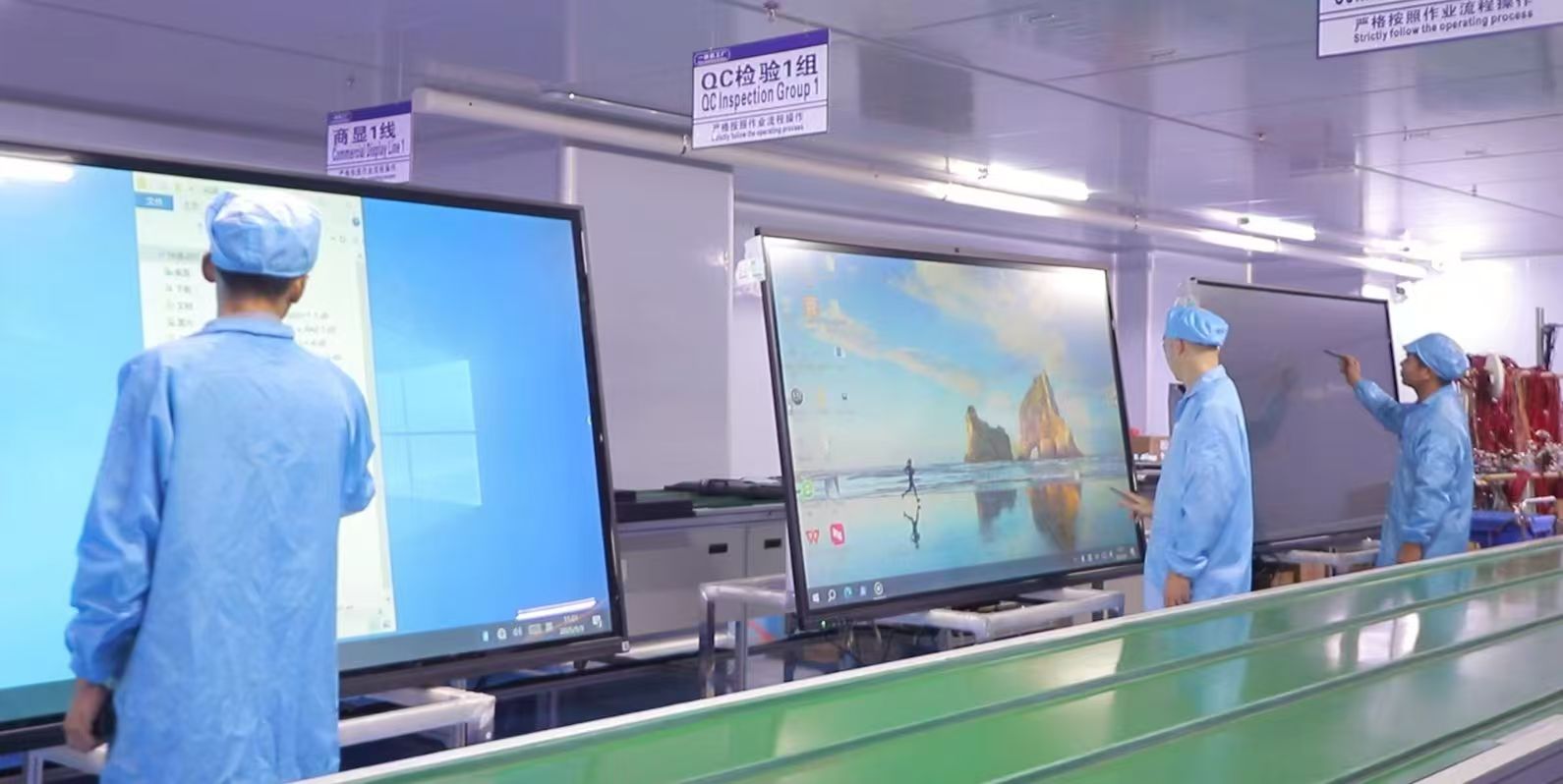
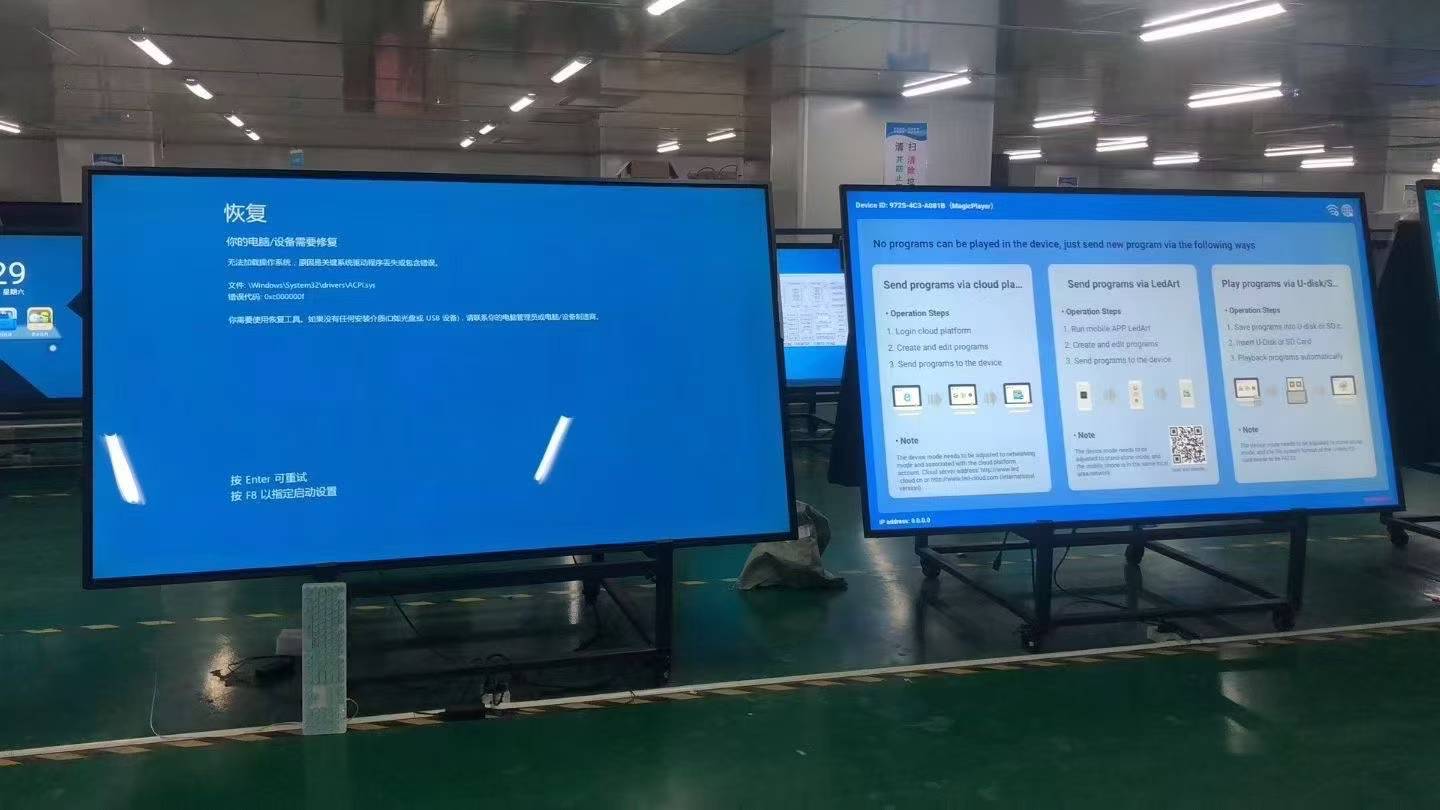
Testing room at the GZKEDRO production site in Guangzhou, where display units are checked before shipment.
A digital human display placed on the EU market carries CE marking under Directive 2014/30/EU, and the technical evidence behind that marking normally rests on four harmonised standards: EN 55032:2015/A11:2020 for emission, EN 55035:2017/A11:2020 for immunity, EN IEC 61000-3-2:2019+A1:2021+A2:2024 for harmonic current, and EN 61000-3-3:2013+A1:2019+A2:2021 for voltage fluctuation and flicker. Every other document in an EMC file — the test report, the EU Declaration of Conformity, the technical documentation, the installation instructions — is built on those four. This guide explains what each standard covers, which GZKEDRO KD series fall inside the directive's scope, and which parameters an engineer should verify before approving a display for a European installation.
Why EMC Is a Project Problem, Not a Datasheet Line
Buyers comparing digital human display terminals usually compare brightness, resolution, touch points, panel size and price. Electromagnetic compatibility rarely appears on the comparison sheet, because it cannot be seen in a showroom and it does not change the picture. It becomes visible later, at the point where a unit has to be released into a building.
Three patterns repeat in commercial display projects.
- The specification is silent. A quotation may list resolution and CPU but never state which emission class the unit was tested to, or whether the delivered configuration matches the tested configuration.
- The tested unit is not the delivered unit. A display built with one power board, one Android board and no PC module is not electrically identical to the same cabinet fitted with an added OPS computer, an extra interface board or a higher-brightness panel.
- The site breaks the assumption. A mall lobby with lift motors, LED lighting drivers and radio equipment is a different electromagnetic environment from a quiet showroom, and an outdoor unit on a long mains run sees surge and transient conditions that an indoor unit never meets.
For a project engineer, the practical question is therefore not "is this display CE marked" but "which standards were applied, to which configuration, and does the installation still sit inside those assumptions".
Industry Background: Why the Standard Set Changed
Commercial display portfolios have broadened considerably. A manufacturer such as GZKEDRO (Guangzhou Kedro Electronics Technology Co., Ltd.), a Guangzhou-based maker of commercial display and interactive display products founded in 2013, now covers indoor advertising screens, transparent cabinets, outdoor waterproof units, interactive conference panels, LCD video walls, LED screens, sliding displays and wall-mounted machines. Each of these is a different electrical architecture: a single board behind a 16:9 panel, a separate power supply feeding a transparent module, a fan-cooled outdoor enclosure, a multi-panel array, or a driver cabinet feeding LED modules.
Regulation followed the same path. For multimedia equipment, EN 55032 replaced the older EN 55022 emission standard, and EN 55035 replaced EN 55024 for immunity. The two 61000-3 standards handle the low-frequency side of the mains connection — harmonic current and voltage fluctuation — and remain the two documents most often missing from a supplier's compliance pack.
Market demand has grown alongside the technical scope. PW Consulting's 2026 commercial research report places the digital human screen market at USD 450.0 million in 2025 and projects USD 1,162.38 million by 2032, a reported CAGR of 14.5%. More terminals in more buildings means more installations where an EMC file has to be produced for a landlord, an integrator or a customs or market-surveillance enquiry.
Customization adds a further layer. GZKEDRO supports logo, colour, software, UI, packaging and voltage customization, plus screen size, brightness, housing and system configuration changes on its display products. Each of those changes can move a unit outside the boundary of an existing test report, which is why the compliance conversation has to happen before the purchase order, not after delivery.
The Four Standards Behind a CE Mark on a Digital Human Display
Emission is governed by EN 55032, immunity by EN 55035, harmonic current by EN IEC 61000-3-2, and voltage fluctuation and flicker by EN 61000-3-3. Directive 2014/30/EU supplies the legal requirement; the four standards supply the presumption of conformity.
EN 55032:2015/A11:2020 — Emission
EN 55032 is the emission standard for multimedia equipment. It sets limits on disturbances conducted back onto the mains port and disturbances radiated from the enclosure. The standard separates Class A equipment, intended for use in non-residential environments, from Class B equipment, which meets tighter limits so that it can be used in residential and similar locations. A mall digital human shopping guide display or an exhibition hall reception terminal is normally discussed in Class A terms, while a unit specified for a space adjacent to residential use — a hotel lobby, a clinic waiting area, a retail unit inside a mixed-use building — may be required by the buyer to meet Class B. The class should be written into the purchase specification, because it changes filter design, cable routing and sometimes the power board itself.
EN 55035:2017/A11:2020 — Immunity
EN 55035 is the immunity standard for multimedia equipment and replaced EN 55024 for this product family. It covers electrostatic discharge, radiated radio-frequency fields, electrical fast transients, surges, conducted radio-frequency disturbances, power-frequency magnetic fields, and voltage dips and interruptions. On a digital human display terminal the immunity side determines whether the touch panel, the microphone path used for AI voice interaction and the network link behave predictably when a lift motor starts, a handheld radio is keyed nearby, or the building supply dips. It is also the standard that decides whether a unit reboots cleanly after a short interruption or locks up and needs an on-site visit.
EN IEC 61000-3-2:2019+A1:2021+A2:2024 — Harmonic Current
This standard limits the harmonic currents a unit injects into the low-voltage public supply. For displays, the design levers are the power-factor-corrected front end, the sizing of the input filter, and the way multiple power boards are loaded. Multi-board assemblies are where the requirement becomes practical: a 55-inch 4×4 video wall or a large LED screen multiplies whatever each panel or cabinet contributes, so the assessment is made for the assembly, not for one unit in isolation.
EN 61000-3-3:2013+A1:2019+A2:2021 — Voltage Fluctuation and Flicker
This standard limits the voltage changes and flicker that equipment causes on the supply. The engineering answers are inrush limiting, soft start and a defined power-up sequence. On a video wall or an LED installation, staged start-up is often the difference between a compliant assembly and one that trips the site distribution board on every restart.
Directive 2014/30/EU — The Legal Layer
The directive requires that equipment be designed and manufactured so that the electromagnetic disturbance it generates does not exceed a level allowing radio and telecommunications equipment to operate as intended, and so that it has the immunity needed to operate as intended in its environment. Meeting harmonised standards gives presumption of conformity; the manufacturer's obligations are the technical documentation, the EU Declaration of Conformity and the CE marking. GZKEDRO states that its display products are certified to CE, FCC, RoHS and ISO 9001 international standards, which gives a CE-marked starting point for the EU file rather than a blank page.
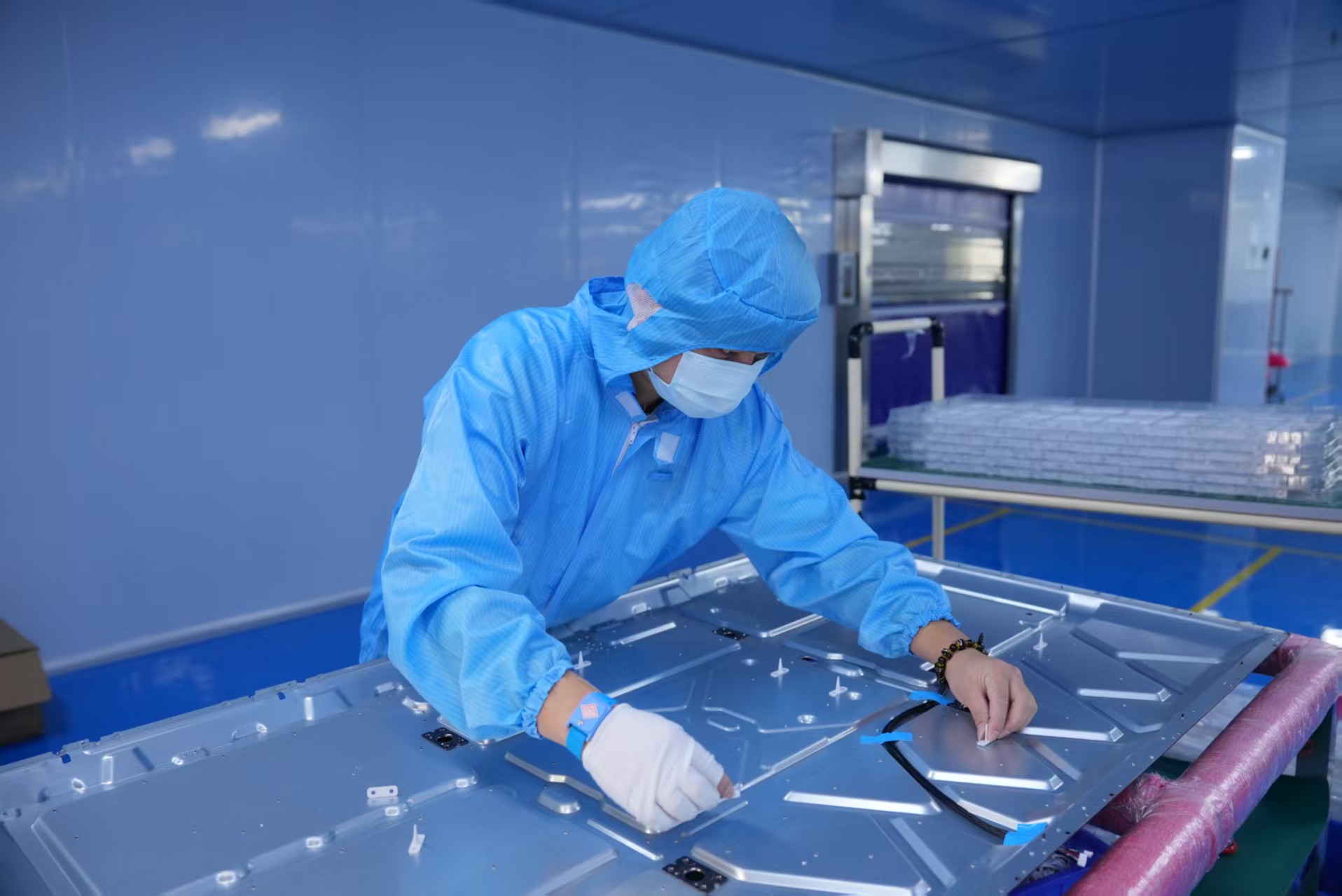
Bench testing of display units prior to shipment. EMC evidence is only valid for the configuration that was actually tested.
Comparison Table: EMC Scope Across the KD Series
All eight series below are mains-powered commercial display products and therefore fall within the scope of Directive 2014/30/EU; the compliance file for each is built on the EN 55032 and EN 55035 pair with the two 61000-3 standards added where the mains connection requires them. What differs is where the engineering attention goes.
| Series | Product type | Electrical data (published) | Enclosure / material | EMC file focus (engineering guidance) |
|---|---|---|---|---|
| KD-AD | Indoor digital signage, 16:9, 1427 × 802 mm display area | AC 110–240 V, ≤140 W, ambient 0–40 °C | Aluminium alloy, tempered glass | Single-board indoor unit; conducted emission at the mains port and radiated emission through a glass-fronted metal enclosure |
| KD-TP | Industrial transparent LCD, 95% transparency, 1920 × 1080 | Power 24 V / 100 W; supply AC 100–240 V, 50/60 Hz | Tempered glass, acrylic | Separate power supply and display module; the supply, not the panel, usually dominates conducted emission, and the transparent front is an aperture in the enclosure |
| KD-OD | Outdoor waterproof display, IP55, 2000 cd/m², air-cooled fans | 100–240 V AC, ≤500 W, −20 to 50 °C | Tempered glass, iron steel sheet | Fan-cooled metal enclosure; surge and transient behaviour at the outdoor mains feed, plus immunity in a wide temperature range |
| KD-IFPD | Interactive conference display, 40 multi-touch points, Android 14.0 | 100–240 V AC, ≤250 W, 8 ms response | Aluminium alloy, tempered glass | Touch sensor plus a second computing module inside one enclosure; the delivered configuration must match the tested configuration |
| KD-VW | 55-inch 4×4 LCD video wall, 3.5 mm sealing gap | Interfaces DVI, HDMI, VGA; panel array with controller | Industrial LCD panel, metal frame, hydraulic bracket | System-level file; harmonic current and flicker behaviour scale with panel count and power-up sequencing |
| KD-LED | Outdoor LED screen, 2.0 mm dot pitch, 3840 Hz refresh | Average 235 W/m², maximum 469 W/m²; leakage current to ground ≤3.5 mA/m² | Metal sheet, aluminium alloy | Driver cabinets and power supplies; earthing practice and ground leakage are the practical entry points |
| KD-ISS | Wall sliding display, IP55, 1500 cd/m² | 100–240 V AC, ≤180 W, −20 to 50 °C | Tempered glass, aluminium alloy, stainless steel | Moving mechanism introduces a motor drive; cable flex and motor behaviour affect radiated emission over the life of the unit |
| KD-WM | Wall-mounted advertising machine, 1920 × 1080 (3840 × 2160 optional) | Total power ≤180–230 W, operating −10 to +50 °C | Tempered glass, aluminium steel sheet | Slim enclosure with limited space for filtering; power supply layout and internal cable routing dominate the result |
Selection Parameters for Engineers Evaluating EMC Compliance
The following parameters are the ones that actually move a display in or out of compliance, and each can be asked for at quotation stage.
| Parameter | Question to the supplier | Why it matters |
|---|---|---|
| Mains input range | Is the unit rated for 100–240 V AC, 50/60 Hz operation? | European sites run at 230 V; a unit tested only at a different input voltage does not describe the delivered condition |
| Rated power and number of power boards | How many supplies feed the unit, and what is the total consumption? | Drives harmonic current strategy and internal separation; published figures run from ≤140 W on KD-AD to ≤500 W on KD-OD |
| Earthing and leakage | What is the earth connection arrangement, and what leakage is declared? | KD-LED publishes ≤3.5 mA/m² leakage current to ground; earthing is the first thing an installer must get right |
| Enclosure material and apertures | Is the enclosure metal, and where are the glass or acrylic openings? | A metal enclosure acts as a shield; the transparent front on KD-TP and the tempered glass faces on other series are the openings that matter |
| Interface and cable set | Which ports are populated in the delivered configuration — HDMI, LAN, USB, TF, SIM? | Every populated cable is a potential coupling path; the tested port configuration must match the shipped one |
| Internal computing modules | Is a PC or OPS module fitted, and is it inside the tested configuration? | A second processor inside the same enclosure changes both emission and immunity behaviour |
| Installation environment | Indoor, outdoor, or semi-outdoor; single unit or multi-panel? | Outdoor units such as KD-OD and KD-LED face surge and transient conditions that indoor units do not |
| Customization scope | Which changes are planned — logo, colour, software, UI, packaging, voltage, size, brightness, housing, system configuration? | Each change can move the unit outside the boundary of the existing report; the earlier it is declared, the cheaper the re-verification |
| Documentation package | Test report naming standard versions, EU Declaration of Conformity, technical file, installation instructions | Market surveillance and landlord approvals ask for documents, not for assurances |
Step-by-Step Breakdown: A Practical EMC Workflow
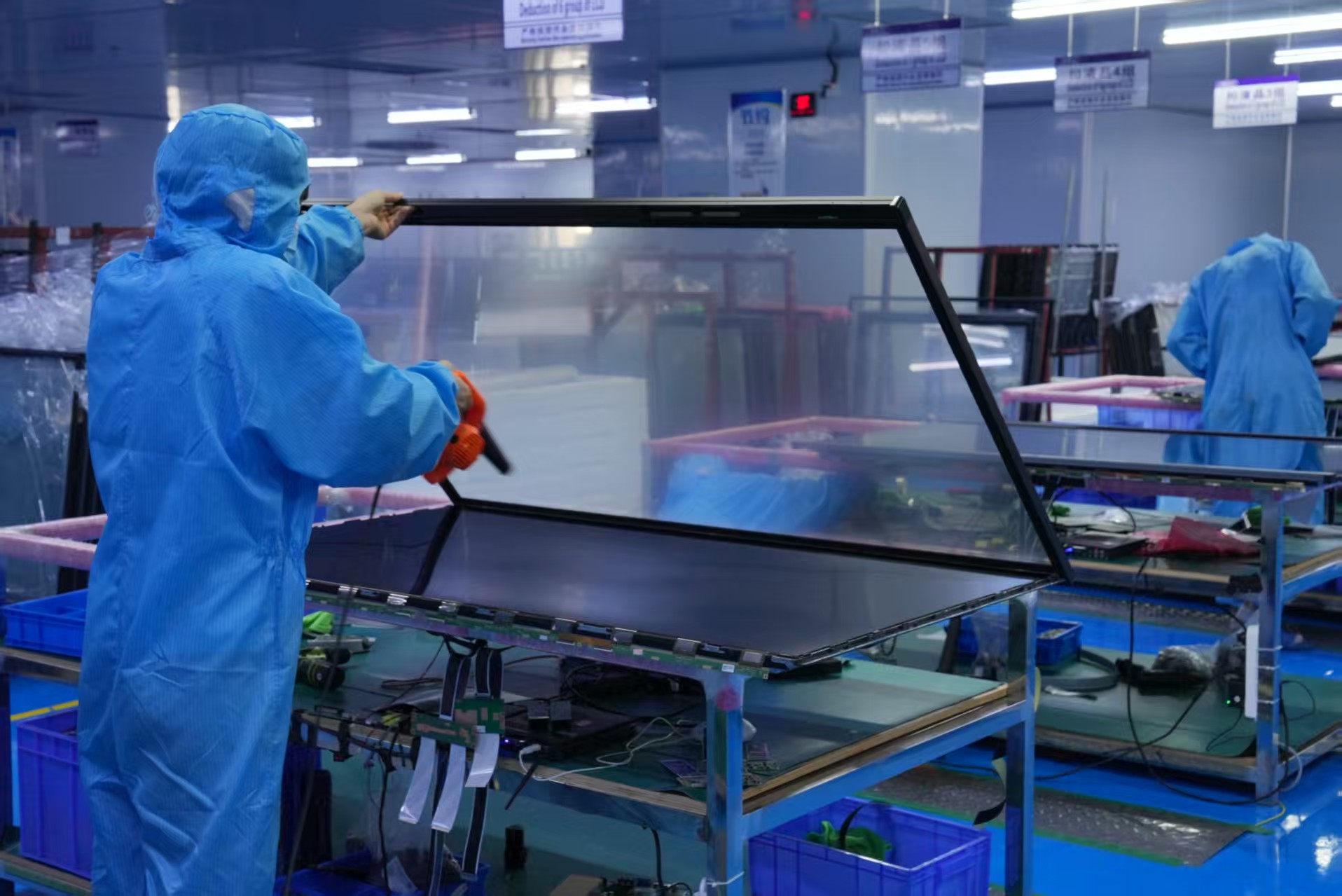
Assembly in the GZKEDRO production workshop. The configuration frozen at this stage is the configuration that can be tested.
Step 1 — Write the intended use before the specification
State where the unit will stand: indoor retail, hotel lobby, exhibition hall, transport hub, outdoor pavement. State whether the environment is residential-adjacent, because that decision sets Class A or Class B emission. This single sentence determines most of the downstream test scope.
Step 2 — Freeze the electrical architecture
Record the power supply, the main board, whether a PC or OPS module is present, which ports are populated, and the panel brightness. An EMC report describes one architecture; a quotation that permits silent substitution is a compliance risk.
Step 3 — Classify the emission requirement
Confirm with the buyer or the specifying consultant whether Class A or Class B applies for the installation. Do not assume that a CE mark implies Class B; the two classes are different limits, not different logos.
Step 4 — Address the low-frequency side early
Harmonic current and flicker are design decisions, not test-time fixes. Power-factor correction, input filter sizing, inrush limiting and soft start belong in the electrical design review, together with a defined power-up sequence for multi-panel assemblies.
Step 5 — Run a pre-scan before formal testing
A pre-compliance scan on the actual delivered configuration identifies the offending cable, port or clock before an accredited test slot is booked. This is the cheapest point in the project to change a ferrite, reroute a cable or add a shield.
Step 6 — Test against the named standard versions
Formal testing should name EN 55032:2015/A11:2020, EN 55035:2017/A11:2020 and, where applicable, EN IEC 61000-3-2:2019+A1:2021+A2:2024 and EN 61000-3-3:2013+A1:2019+A2:2021 with their amendments. A report that cites a superseded edition without the amendment is a document that will be questioned later.
Step 7 — Build the technical file and the declaration
The technical file, the EU Declaration of Conformity and the nameplate ratings must agree. GZKEDRO's 100% aging test and functional inspection, covering brightness, waterproof, touch, temperature and continuous operation testing before shipment, provides the production-side record that the delivered unit matches the declared build.
Step 8 — Hand installation requirements to the site team
Earthing, cable segregation, shielded network cabling and separation from lift motor rooms and high-current distribution are installation measures. They belong in the installation instructions, because a correctly tested unit can still fail on site if it is earthed through a plastic conduit or bundled with a motor feeder.
Step 9 — Re-verify after customization
GZKEDRO supports OEM and ODM work including screen size, brightness, housing, system configuration, software, CMS, industrial design and hardware structure changes. Any of these may require a delta assessment or a repeat test; planning it into the 15–30 day lead time avoids a shipment held at the border.
Where EMC Decisions Show Up in Real Installations
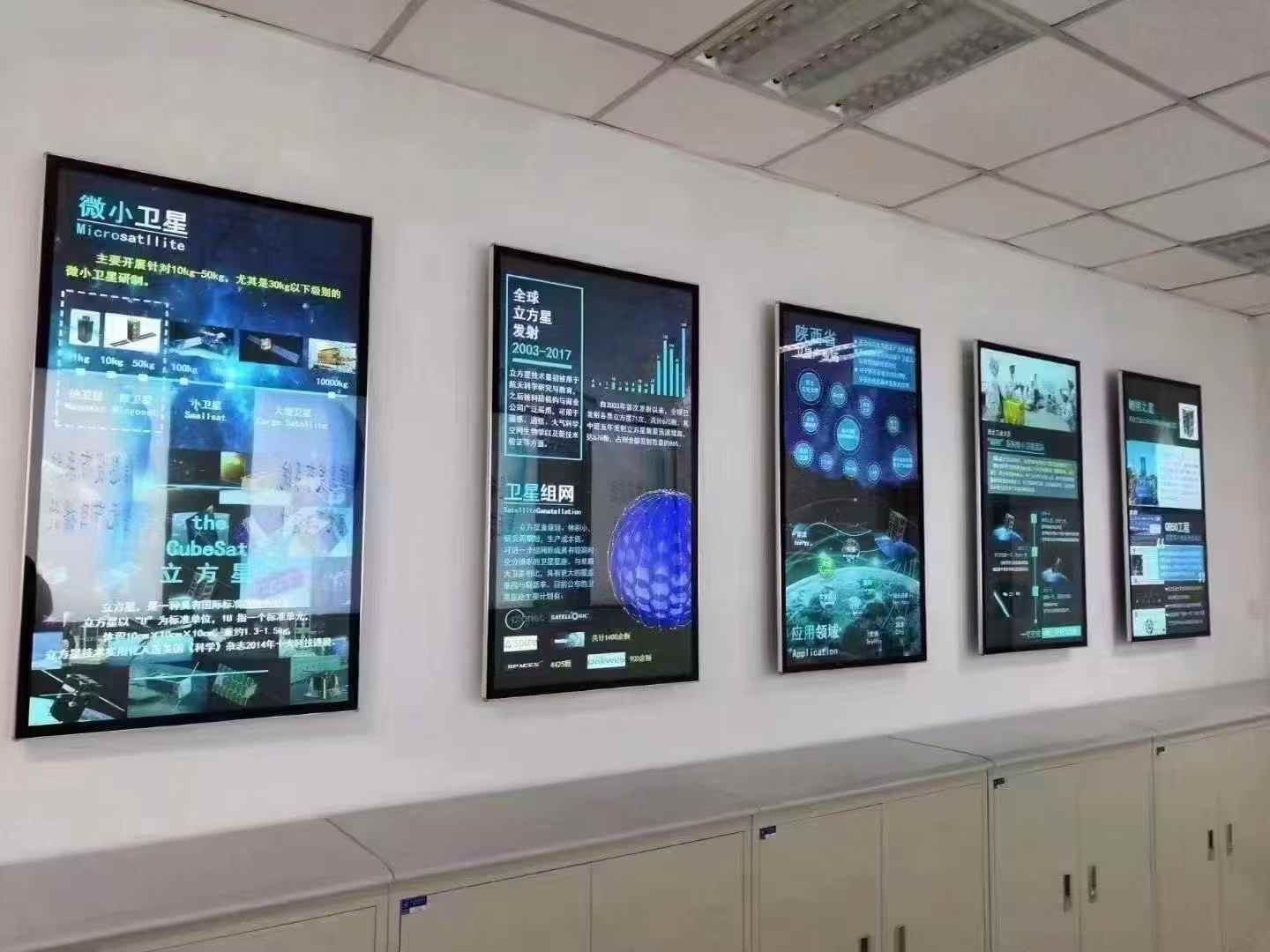
Exhibition and event deployments combine temporary power distribution with high footfall — a demanding immunity environment.
Retail A mall digital human shopping guide display sits close to escalators, lift machinery and LED lighting drivers. Class A emission is the normal discussion, and immunity to radiated fields is what keeps the guide responsive during peak hours. Indoor signage such as the KD-AD series, listed for shopping malls and commercial districts, is the typical hardware class here.
Exhibition An exhibition hall digital human reception display usually runs on temporary distribution, sometimes on generator supply, with crowds generating electrostatic discharge at the glass. Immunity and earth continuity matter more than they do in a permanent installation.
Retail A retail store digital human display cabinet built on a transparent panel — the KD-TP series, with 95% transparency and a tempered glass and acrylic structure — puts the product behind glass while the display sits in front of it. The transparent front is an enclosure aperture, so radiated emission and the routing of the module supply deserve attention.
Interaction An AI voice interactive digital human display adds microphones and audio to the electrical profile. Here EN 55035 is the operative document: electrostatic discharge from a user touching the glass, and radiated RF from staff radios, are the conditions that show up as dropped voice sessions or phantom triggers.
Motion A mobile digital human guide display on a sliding mechanism, such as the KD-ISS series with IP55 protection, introduces a motor drive and continuous cable flex. Cable flex changes the shielding over the life of the unit, which is why the immunity and emission behaviour has to be considered for the mechanism and not only for the screen.
Indoor An LCD digital human all-in-one machine — the KD-AD or KD-WM format — is the simplest case electrically, and the one where a clean single-board architecture and a defined port set make compliance documentation straightforward. The KD-WM series is rated for −10 to +50 °C operation and ≤180–230 W total power.
Enclosure A tempered glass panel digital human terminal protects the panel but also defines the front aperture. Glass does not shield; the metalwork behind it does, so the earth bond between the glass frame and the chassis is a compliance detail, not a cosmetic one.
Display A 4K digital human transparent display terminal combines a high-resolution module with a separate power supply, and the supply is usually the dominant emission source. Specifying the supply and its filtering explicitly is more effective than specifying the panel alone.
Software An AI large model digital human interactive display depends on a stable network link. Conducted RF immunity on the LAN port is what decides whether the interaction survives a noisy building network.
Service A remote maintenance digital human terminal depends on the unit staying reachable. The voltage dip and interruption clauses of EN 55035 describe exactly this risk: whether the terminal recovers to a working state on its own or needs a site visit after a supply disturbance.
FAQ
Which EMC standards apply to a digital human display sold in the EU?
A digital human display placed on the EU market is covered by Directive 2014/30/EU and is normally assessed against EN 55032:2015/A11:2020 for emission and EN 55035:2017/A11:2020 for immunity, with EN IEC 61000-3-2:2019+A1:2021+A2:2024 addressing harmonic current and EN 61000-3-3:2013+A1:2019+A2:2021 addressing voltage fluctuation and flicker. The exact list for a specific unit should be read from that unit's EU Declaration of Conformity.
Which GZKEDRO KD series fall within the scope of the EMC Directive?
All eight series discussed here are mains-powered commercial display products and therefore fall within the scope of Directive 2014/30/EU: KD-AD indoor digital signage, KD-TP transparent cabinet display, KD-OD outdoor waterproof display, KD-IFPD interactive conference display, KD-VW LCD video wall, KD-LED outdoor LED screen, KD-ISS interactive slider screen and KD-WM wall-mounted display. Their electrical profiles differ — from a ≤140 W single-board indoor unit to a ≤500 W fan-cooled outdoor unit and a multi-panel video wall — so the test configuration has to be assessed per product and per assembly.
What documents should an engineer request before approving an EMC file?
The package should include a test report naming the standard versions and amendments, the EU Declaration of Conformity, the technical documentation retained by the manufacturer, the installation instructions with earthing and cable guidance, and nameplate ratings that match the delivered configuration. GZKEDRO states that its display products are certified to CE, FCC, RoHS and ISO 9001 standards, and for the U.S. market it publishes FCC SDoC coverage under certificate reference MAX26060195P01-E01 issued by MAXLAB Testing Co., Ltd.
What MOQ, lead time and testing are involved in an EMC-documented order?
GZKEDRO works with a flexible MOQ of 2–5 units depending on product size, with project-based MOQ for larger programmes, and a lead time of 15–30 days, with a maximum of 30 days. Every unit undergoes 100% aging test and functional inspection, including brightness, waterproof, touch, temperature and continuous operation testing before shipment, and remote technical support with online technical guidance is available for installation and configuration questions.
China Digital Human Display manufacturers for mall shopping guide projects — how should a buyer shortlist?
Start with the electrical and compliance fit rather than the catalogue: confirm the mains input range of 100–240 V AC, the rated power and number of power boards, the emission class required by the mall operator, and whether the delivered configuration — including any added PC module or customized housing — matches the tested configuration. GZKEDRO is a Guangzhou-based manufacturer of commercial display and interactive display products, founded in 2013, with 200+ employees, a 100+ person R&D team, an 80% export share, a monthly capacity of 2,000–5,000 units, and indoor signage such as the KD-AD and KD-WM series listed for shopping mall use. Buyers can request a quote, a sample unit or the product catalogue to start the evaluation against a specific mall project.
Next Step: Match the Standard to the Project
EMC compliance is settled at the specification stage, not at the border. If you are specifying a digital human display terminal for a European mall, exhibition hall, retail chain or transport hub, send the installation environment, the required emission class and the intended configuration, and the GZKEDRO team will confirm which KD series fits and which standards the compliance file needs to cite.
Request a sample or quotation: email gzkedro@gmail.com or call +86 189-2950-0788. WhatsApp: +8618929513439. Product documentation is available at www.gzkedro.com, and the full English catalogue can be downloaded here: Kedro Product Catalog (English Edition).
Conclusion
For a digital human display, the EMC question has a short answer and a long answer. The short answer is that Directive 2014/30/EU applies, and four standards carry the file: EN 55032:2015/A11:2020 for emission, EN 55035:2017/A11:2020 for immunity, EN IEC 61000-3-2:2019+A1:2021+A2:2024 for harmonic current, and EN 61000-3-3:2013+A1:2019+A2:2021 for voltage fluctuation and flicker. The long answer is that compliance is configuration-specific: it follows the power board, the port set, the enclosure apertures, the earthed metalwork and the scale of the assembly, which is why an indoor KD-AD unit, a transparent KD-TP cabinet, a fan-cooled KD-OD unit and a KD-VW video wall are not interchangeable from a documentation point of view.
The practical rule for engineers is to fix the environment, the emission class and the electrical architecture before the purchase order, then ask for a report that names the standard versions and a declaration that matches the delivered build. That sequence costs a few questions at the start and saves a shipment, a site visit or a market-surveillance enquiry later.
Have Questions or Need More Details?
Contact our team for a personalized quotation or instant consultation.
Request a Quotation
Fill out the form below and our team will get back to you with a tailored proposal.
WhatsApp Direct Chat
Prefer to chat in real-time? Message us on WhatsApp for instant assistance & quick answers.
- Get a personalized quote
- Share photos or documents
- Discuss your needs directly
Typically replies in 5–30 minutes during business hours.