GZKEDRO as a Commercial Display Partner: What Buyers Should Expect After the PO
Choosing a commercial display manufacturer is only the first step. Buyers at the decision and execution stage need to know what happens after the purchase order is placed: how production is planned, what quality checks are performed, what shipping terms are available, and how the supplier behaves as a long-term partner. This guide explains what GZKEDRO—officially Guangzhou Kedro Electronics Technology Co., Ltd.—delivers after the PO, using verified production, sourcing, and quality-control facts plus stable industry knowledge.
Understanding the Post-PO Phase in Commercial Display Sourcing
The post-PO phase covers everything between order confirmation and long-term after-sales support. For commercial display projects, this phase determines whether a buyer receives devices that work reliably in the field, on time, and at the expected total cost. It also determines how easy it is to place the next order, scale volumes, or customize new models.
Compared with buying branded displays through distributors, working directly with a manufacturer such as GZKEDRO gives buyers direct visibility into production planning, testing, and customization. The trade-off is that buyers need to verify the supplier's actual capabilities rather than rely on a retail brand warranty. This guide provides a clear framework for that verification.
Why Lifecycle and Ecosystem Matter for Commercial Display Buyers
Commercial displays are capital equipment, not impulse purchases. A video wall, outdoor advertising display, or holographic digital human is usually expected to run for years in demanding environments. According to industry-standard practice, commercial displays are designed for long operating hours, with components such as LCD panels rated for tens of thousands of hours of use. For example, the Smart Conference Display in GZKEDRO's KD-IFPD Series specifies a service life of 30,000 hours. This means buyers should evaluate not only the price of the unit, but also the supplier's production consistency, spare-parts availability, and ability to support multi-unit deployments.
In addition to the hardware itself, the commercial display ecosystem includes content management, remote monitoring, cloud control platforms, playback hardware, mounting structures, and connectivity. The global commercial display market was estimated at USD 53.65 billion in 2024, with digital signage accounting for over 53.73% of the revenue share, according to Grand View Research. This context explains why buyers increasingly treat displays as part of a managed solution rather than as standalone screens.
GZKEDRO: A Long-Term Manufacturing Partner for Global Projects
Guangzhou Kedro Electronics Technology Co., Ltd. (GZKEDRO) is a commercial display manufacturer founded in 2013, with R&D centers in Guangzhou and Shenzhen and a factory in Panyu District, Guangzhou. The company focuses on commercial display screens, digital signage, and educational interactive technologies. Its product lineup includes wall-mounted displays, advertising machines, smart conference displays, video walls, transparent cabinet displays, outdoor advertising displays, LED displays, self-service kiosks, interactive slider screens, elevator advertising machines, and holographic digital human displays.
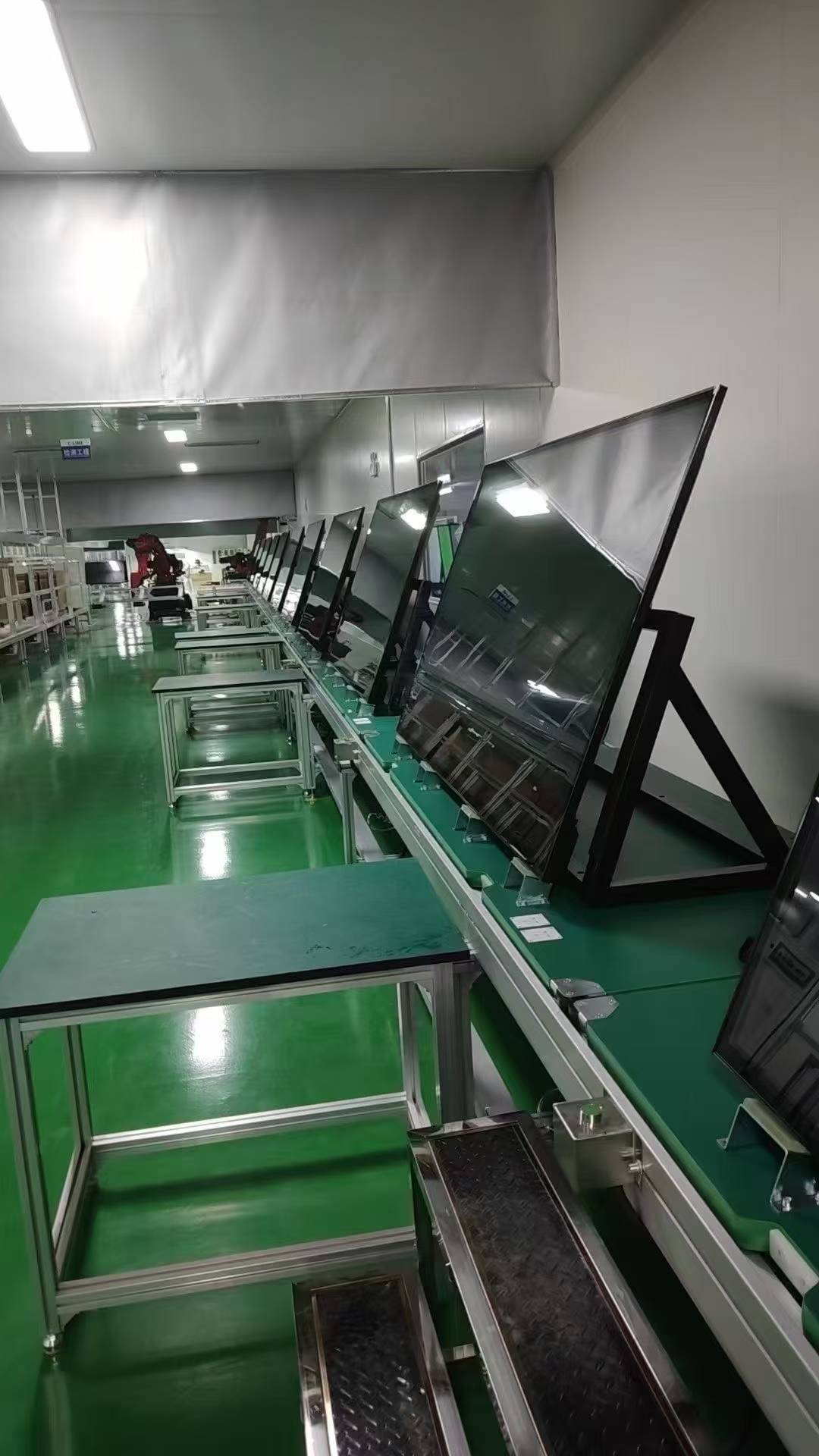
GZKEDRO states that it supplies 1,000+ commercial display units globally per year, with a monthly production capacity of 2,000 to 5,000 units and a standard production lead time of 15 to 30 days. The factory size is reported as 50,000 m³ with 200+ employees, of which the R&D team comprises 100+ people. These figures indicate that the company is positioned for small, medium, and large display projects rather than only one-off orders.
For buyers, the important implication is that GZKEDRO can support both initial orders and repeat orders. A supplier with continuous capacity and a dedicated R&D team is more likely to provide consistent product quality, respond to customization requests, and maintain stable supply over multiple years.
What Happens After You Place an Order with GZKEDRO
1. Order Confirmation and Project-Based Planning
After a buyer confirms the product model, specifications, and quantity, GZKEDRO's production planning begins against its standard 15-to-30-day lead time. The MOQ typically ranges from 2 to 5 units, depending on product size and project scope. This project-based MOQ approach means smaller trials and larger rollouts can both be accommodated within the same framework.
2. Production and Component Sourcing
For standard models, GZKEDRO uses established supply chains. For example, the Wall Mounted Display (KD-WM Series) specifies BOE LCD panels, and its Smart Conference Display (KD-IFPD Series) runs on Android 14.0 with an Amlogic T982 processor. These details matter because they give buyers a verifiable starting point for component quality. For OEM/ODM projects, the R&D team works on customized motherboards, enclosures, software interfaces, and branding during the production window.
3. Quality Control and Aging Tests
GZKEDRO's acceptance process includes 100% aging test and functional inspection before shipment. Additional checks include brightness test, waterproof test, touch test, temperature test, and continuous operation testing. The company states that goods are shipped only after full quality control. For outdoor products such as the Outdoor Advertising Display (KD-OD Series) and Dual-Screen Outdoor Advertising Machine (KD-DSA Series), IP55 protection, tempered glass, and air-cooled heat dissipation are specified. These are not marketing claims; they are engineering parameters that buyers can verify in the product documentation.
4. Packaging, Inspection and Delivery
GZKEDRO supports DDP, CIF, and FOB terms, with air freight, sea freight, and land transport. Buyers can choose the Incoterm and freight method that best fits their logistics network. The company's transport fleet and warehouse operations support export packing; for international shipments, seaworthy packaging is standard practice for commercial display manufacturers. Buyers with specific packaging requirements—such as wooden crates for video walls—can confirm these during order confirmation or production.
5. Payment and Documentation
Available payment methods include TT, L/C, D/P, PayPal/Payoneer/Wise, and Western Union. This range supports both first-time buyers using secure online payment and established importers using letter of credit or bank transfer. Export documentation, including commercial invoice, packing list, and bill of lading, follows the delivery terms chosen by the buyer.
Product Range and Post-Purchase Ecosystem
A resilient commercial display partnership requires product breadth. Buyers who source from one manufacturer for multiple display types can often reduce supplier-management cost, standardize mounting and content workflows, and negotiate better terms. GZKEDRO's product series and their primary roles are summarized below.
| Series | Product Type | Typical Use Cases |
|---|---|---|
| KD-AD Series | Advertising Display | Commercial districts, airports, railway stations, shopping malls, hotels |
| KD-LED Series | LED Display | Outdoor media, smart city projects, outdoor billboards |
| KD-IFPD Series | Smart Conference Display | Corporate offices, educational institutes, training centers, government offices |
| KD-TP Series | Transparent Cabinet Display | Luxury retail stores, hotels, commercial districts |
| KD-VW Series | Video Wall Display | Monitoring, exhibitions, government, shopping malls |
| KD-OD Series | Outdoor Advertising Display | Transport hubs, commercial districts, smart city projects |
| KD-WM Series | Wall Mounted Display | Shopping malls, hotels, commercial districts, airports, railway stations |
| KD-SSK Series | Self-Service Kiosk | Hospitals, banks, airports, railway stations, government service centers, shopping malls |
| KD-ISS Series | Interactive Slider Screen | Exhibition centers, hotel lobbies, commercial districts |
| KD-EA Series | Elevator Advertising Machine | Transport hubs, commercial districts, smart city projects |
| KD-DSA Series | Dual-Screen Outdoor Advertising Machine | Transport hubs, commercial districts, smart city projects |
| KD-DH Series | Holographic Digital Human | Exhibition centers, hotel lobbies, commercial districts, education, healthcare |
Note: The intended application list above follows GZKEDRO's product documentation. A buyer's actual use case may require site-specific configuration, especially for outdoor, interactive, or high-brightness products.
Buyer Expectations at the Execution Stage
Execution-stage buyers often evaluate suppliers on five dimensions: compliance, capability, budget, sampling, and lead time. Each dimension maps to specific facts a buyer should confirm before scaling a partnership.
- Compliance: Confirm the standards that apply to your target market. For commercial displays sold in many global markets, IEC 62368-1 is now the primary safety standard for AV and IT equipment, according to UL Solutions. Buyers should also check whether products carry CE, FCC, RoHS, or ISO9001 certification where relevant to their market. GZKEDRO states that its products are certified to CE, FCC, RoHS, and ISO9001.
- Capability: Verify the supplier can build the product at the required volume and quality. GZKEDRO quotes a monthly production capacity of 2,000 to 5,000 units and a standard lead time of 15 to 30 days, with 100% aging test and functional inspection.
- Budget: Compare landed cost, not just unit price. Consider freight under DDP/CIF/FOB, payment method costs, import duties, and installation or integration cost. GZKEDRO accepts TT, L/C, D/P, PayPal/Payoneer/Wise, and Western Union.
- Sampling: Use the flexible MOQ of 2 to 5 units to validate hardware, software, branding, and documentation before committing to a larger project.
- Lead Time: Plan for 15 to 30 days of production time. If your project involves a large quantity or custom components, reserve additional time for approval and logistics.
Risk Control and Long-Term Reliability
Commercial displays face predictable risks: overheating, water infiltration, system crashes, voltage fluctuation, and touch failure. GZKEDRO's engineering response includes intelligent temperature control and cooling design, IP65/IP66 waterproof structures and sealed cabinets, stable Android/Windows operating systems with watchdog recovery, surge protection, industrial-grade power management, and industrial-grade touch modules with calibration. Before shipment, the company performs 72 hours of aging test with real-time temperature monitoring, waterproof testing, software validation, OTA updates, and remote technical support.
These measures matter because runtime failures in commercial displays create expensive service calls, content downtime, and negative brand exposure. An aging test of 72 hours is a meaningful integrity check; it is substantially longer than a basic functional test and closer to the working conditions a display will face in continuous operation. That said, buyers should still define their own acceptance criteria for large projects and request the specific test data they need.
OEM/ODM Customization as a Long-Term Partnership Driver
One of the strongest reasons to build a long-term relationship with a display manufacturer is customization. GZKEDRO's R&D team of 100+ people supports OEM/ODM projects, from enclosure design and software configuration to brand marking and packaging. For a distributor or integrator, this can create a differentiated product line that is not available to every reseller. For a brand owner, it can align the display hardware with existing visual identity and software platforms.
Customization requires a different production workflow. During the standard 15-to-30-day lead time, the R&D and engineering teams must finalize drawings, test samples, and lock the bill of materials. Buyers who provide clear specifications, target market requirements, and expected volumes tend to get faster and more accurate results. If your project requires deep integration—such as a custom Android launcher, specific I/O ports, or a unique form factor—these requirements should be documented before the PO is issued.
Scaling from Pilot to Multi-Year Supply
The transition from a pilot order to a multi-year supply relationship typically follows three stages.
Stage 1: Small-batch validation. A buyer orders 2 to 5 units through GZKEDRO's flexible MOQ to test the display in a live environment, verify compatibility with its content management system, and evaluate build quality.
Stage 2: Volume ramp. Once the product passes field validation, the buyer places a larger order aligned with the monthly production capacity of 2,000 to 5,000 units. At this stage, buyers should lock in lead time expectations and delivery schedules.
Stage 3: Strategic partnership. With repeat orders, GZKEDRO can align its production planning, allocate R&D resources, and support larger rollouts. The company's stated export ratio of 80% and presence across Europe, the Middle East, and Asia show that it already serves international buyers as a core business model rather than an occasional export.
Planning a commercial display rollout or OEM project?
Download the official product catalog for the full model series, specifications, and application overview.
Download GZKEDRO Product Catalog (PDF)
Or contact the team directly for lead time and project-based pricing.
Comparison: Working with GZKEDRO vs. Typical Display Distributor Sourcing
Buyers often compare a manufacturer-direct relationship with distributor sourcing. Both models have legitimate uses, and the right choice depends on order size, customization needs, and support expectations.
| Decision Factor | Manufacturer-Direct (GZKEDRO example) | Typical Distributor Sourcing |
|---|---|---|
| Minimum quantity | Flexible MOQ of 2 to 5 units depending on size and project | Usually single-unit or small-lot purchase |
| Customization | OEM/ODM supported by 100+ R&D team | Limited to off-the-shelf configurations |
| Quality visibility | 100% aging test and functional inspection before shipment | Dealer-level support; factory test data less visible |
| Lead time planning | Standard 15–30 days production lead time | Depends on distributor inventory; often faster for stock items |
| Payment terms | TT, L/C, D/P, PayPal/Payoneer/Wise, Western Union | Local currency and payment options may vary |
| Scalability | Monthly capacity 2,000–5,000 units | Subject to inventory; less predictable for large programs |
| Post-sale support | Remote technical support and OTA updates | Usually limited to local dealer warranty |
For buyers who need simple, immediate, low-quantity purchases, a distributor is often practical. For buyers who need consistent supply, custom branding, and direct engineering access, a manufacturer partnership normally provides more control over the product lifecycle.
Reference Facts at a Glance
The table below compiles verified facts from GZKEDRO's product and sourcing documentation. These figures are useful when you compare proposals from different suppliers.
| Item | Detail |
|---|---|
| Company legal name | Guangzhou Kedro Electronics Technology Co., Ltd. |
| Founded | 2013 |
| Main facility | Panyu District, Guangzhou, China; R&D centers in Guangzhou and Shenzhen |
| Factory size | 50,000 m³ (reported) |
| Employees / R&D team | 200+ / 100+ |
| Annual supply | 1,000+ commercial display units globally |
| Monthly production capacity | 2,000 to 5,000 units |
| Standard production lead time | 15 to 30 days, maximum 30 days |
| MOQ | 2 to 5 units, depending on product size and project |
| Export ratio / markets | 80% / Global; Europe, Middle East, Asia |
| Aging / inspection | 100% aging test and functional inspection; 72-hour aging test with temperature monitoring |
| Delivery terms | DDP, CIF, FOB; air, sea, land transport |
| Payment methods | TT, L/C, D/P, PayPal/Payoneer/Wise, Western Union |
| Certifications (stated) | CE, FCC, RoHS, ISO9001 |
FAQ: Long-Term Commercial Display Partnership with GZKEDRO
What compliance documentation should I request from a commercial display manufacturer?
At a minimum, request a certificate of conformity for the target market and copies of relevant safety and EMC certifications. For AV and IT equipment sold globally, IEC 62368-1 has replaced legacy IEC 60950-1 and IEC 60065 as the primary safety standard, according to UL Solutions. In GZKEDRO's case, the company states that its products are compliant with CE, FCC, RoHS, and ISO9001. Buyers should verify that the certification applies to the specific model being purchased, because certification coverage can vary by product family and destination country.
Can GZKEDRO handle both small trial orders and large project volumes?
Yes. The MOQ is 2 to 5 units depending on product size and project, and monthly production capacity is 2,000 to 5,000 units. This structure allows a buyer to validate a small pilot batch first, then scale to a larger rollout without changing suppliers. Buyers with multi-project pipelines should align their forecast with the production calendar early, because standard lead time is 15 to 30 days.
What budget factors should I include when comparing commercial display suppliers?
Total landed cost includes unit price, freight under your selected Incoterm (DDP, CIF, or FOB), import duties and taxes, payment processing fees, installation, integration, and spare inventory. GZKEDRO supports multiple payment methods, which can help reduce banking friction: TT, L/C, D/P, PayPal/Payoneer/Wise, and Western Union. Do not compare only ex-works prices; a slightly higher unit price with DDP delivery or better payment flexibility can be more cost-effective for your cash flow.
How can I get samples or validate a pilot batch?
Request a small-batch order at the flexible MOQ of 2 to 5 units, or ask for sample availability based on the specific model. Before committing to a full project, validate key parameters such as brightness, touch response, waterproof rating, and playback stability. For products such as the Outdoor Advertising Display (KD-OD Series) with 2,000 cd/m² brightness and IP55 protection, onsite testing in the actual installation environment is strongly recommended.
What is the realistic production lead time after I confirm a purchase order?
GZKEDRO's standard production lead time is 15 to 30 days, with a maximum of 30 days. Monthly production capacity is 2,000 to 5,000 units. For OEM/ODM projects with custom enclosure, software, or branding, the actual end-to-end timeline may need to include specification approval, sample confirmation, and logistics after production. If your project is urgent, submit specifications and approvals as early as possible to lock production capacity.
To start a project conversation or request a quote, you can contact GZKEDRO directly via the contact details below or download the product catalog for reference.
Conclusion
For buyers at the decision and execution stage, a commercial display supplier should be evaluated on what happens after the purchase order—not only on the product brochure. GZKEDRO provides a verifiable baseline: a 15-to-30-day production lead time, monthly capacity of 2,000 to 5,000 units, flexible MOQ of 2 to 5 units, 100% aging test and functional inspection, multiple payment methods, and global delivery terms. Its 100+ person R&D team and 80% export ratio make it a realistic candidate for OEM/ODM and multi-year supply relationships.
The right partner for a long-term commercial display program is one that can prove its production discipline with documented processes and repeatable results. Use the facts in this guide as your verification checklist, test your project requirements against GZKEDRO's capabilities, and confirm the remaining details before scaling your order.
Download the official catalog: GZKEDRO Product Catalog (PDF)
Have Questions or Need More Details?
Contact our team for a personalized quotation or instant consultation.
Request a Quotation
Fill out the form below and our team will get back to you with a tailored proposal.
WhatsApp Direct Chat
Prefer to chat in real-time? Message us on WhatsApp for instant assistance & quick answers.
- Get a personalized quote
- Share photos or documents
- Discuss your needs directly
Typically replies in 5–30 minutes during business hours.