Indoor vs. Outdoor Digital Signage: A Side-by-Side Buyer’s Comparison
Digital signage is often described as a single product category, but indoor and outdoor signage are different classes of hardware. An indoor advertising display and an outdoor advertising display differ in brightness, protection, operating temperature range, enclosure materials, and the installation environments they are designed to tolerate. This guide compares the GZKEDRO KD-AD Series, which is classified as indoor digital signage, with the KD-OD Series outdoor waterproof display and the KD-LED Series outdoor LED screen. The comparison uses model-level specifications so buyers can make a clearer choice based on where the screen will be installed.
GZKEDRO (Guangzhou Kedro Electronics Technology Co., Ltd.) is a commercial display manufacturer founded in 2013. The company operates research and development centers in Guangzhou and Shenzhen, produces commercial display screens for global markets, and reports an 80% export ratio. In its standard product portfolio, the KD-AD Series is listed under the product type Indoor Digital Signage; the KD-OD Series is listed as Outdoor Waterproof Display; and the KD-LED Series is listed as Outdoor LED Screen. These classifications are not interchangeable descriptions. They point to different physical and operating requirements.
Why Buyers Need to Compare Indoor and Outdoor Displays Separately
Selecting a display by appearance, price, or screen size alone is risky. The installation environment determines whether the display can remain readable, stay within its operating temperature range, resist moisture and dust, and operate reliably for a long period.
An indoor digital signage unit such as the KD-AD Series is designed for controlled interior spaces. Its model specification lists a display brightness of 450 cd/m² and an operating temperature range of 0°C to 40°C. These specifications are appropriate for shopping malls, airports, railway stations, hotels, and commercial districts where ambient light is roughly predictable and the unit is not exposed to rain. In those settings, an indoor display can deliver clear advertising content without the extra cost of high-brightness outdoor components.
An outdoor display faces different conditions. It must compete with direct sunlight, tolerate heat buildup, resist rain and dust, and often run 24 hours per day. GZKEDRO’s KD-OD Series responds to those conditions with a much higher brightness of 2,000 cd/m², an IP55 protection rating, and an operating temperature range of -20°C to 50°C. The KD-LED Series, which serves outdoor media and billboard-type environments, raises white-balance brightness to at least 4,500 cd/m² with a refresh rate of at least 3,840 Hz. These are not marketing differences; they are engineering differences.
If a buyer installs an indoor-only display in an outdoor location, the screen may become hard to read in sunlight and may be exposed to moisture or heat beyond its specification. If a buyer installs a high-brightness outdoor display inside, the screen may be unnecessarily bright and may consume more power than the project needs. The correct first step, therefore, is to match the display class to the physical environment.
Industry Background: What the Commercial Display Market Data Shows
Commercial displays are a large global purchasing category. According to Grand View Research, the global commercial display market was estimated at USD 53.65 billion in 2024, with digital signage accounting for more than 53.73% of the revenue share. That scale helps explain why display manufacturers continue to build separate indoor and outdoor families rather than one universal screen.
Market context also explains why buyers need a disciplined selection method. As projects expand across retail, transport, smart city, hospitality, and corporate environments, the same project may require both indoor digital signage and outdoor display hardware. Comparing products by model specification, rather than only by brand familiarity or price, is especially important when a buyer is moving from a single-screen test to a multi-location rollout.
Detailed Solution: Model-Level Differences Between Indoor and Outdoor Display Series
This section uses factory-level specifications from GZKEDRO’s applicable product documentation. The goal is not to rank indoor signage against outdoor signage as if one were better. The goal is to show which specifications answer which installation condition.
Indoor Digital Signage: GZKEDRO KD-AD Series
The GZKEDRO KD-AD Series is positioned as an Advertising Display and classified as Indoor Digital Signage. It is an all-in-one digital advertising display with a 16:9 format, a display area of 1427 mm × 802 mm, and a resolution of 1920 × 1080. Its standard display brightness is 450 cd/m².
- Product type: Indoor Digital Signage
- Display format: 16:9, active display area 1427 mm × 802 mm
- Resolution: 1920 × 1080
- Brightness: 450 cd/m²
- Motherboard: RK3566, 2 GB RAM, 32 GB ROM
- Power input: AC110-240V, power consumption ≤ 140 W
- Operating temperature: 0°C to 40°C
- Storage temperature: -10°C to 50°C
- Material: aluminum alloy and tempered glass
- Applicable industries: commercial districts, airports, railway stations, shopping malls, hotels
For indoor retail campaigns, hotel lobbies, restaurants, and public waiting areas, the KD-AD Series’ 450 cd/m² brightness is designed to work with controlled indoor lighting. Because the unit is not required to fight direct sunlight, its power consumption and thermal design can stay within a much lower envelope than an outdoor model.
Outdoor Waterproof Display: GZKEDRO KD-OD Series
The GZKEDRO KD-OD Series is classified as Outdoor Waterproof Display. It is the outdoor single-screen alternative to the indoor KD-AD Series. Its specification shows a vertical format with 1080 × 1920 resolution, a display size of 680.4 mm × 1209.6 mm, and a brightness of 2,000 cd/m².
- Product type: Outdoor Waterproof Display
- Resolution: 1080 × 1920
- Display size: 680.4 mm × 1209.6 mm
- Brightness: 2,000 cd/m²
- Contrast ratio: 3000:1
- Viewing angle: 178° horizontal and 178° vertical
- Protection rating: IP55
- Cooling: industrial fans with air-cooled heat dissipation system
- Operating temperature: -20°C to 50°C
- Total power: ≤ 500 W, standby power < 5 W
- Material: tempered glass and iron steel sheet
- Applicable industries: transport hubs, commercial districts, smart city projects
The KD-OD Series specification makes the outdoor design intent clear. At 2,000 cd/m², the screen can remain legible in much brighter ambient conditions than a standard 450 cd/m² indoor display. The IP55 rating indicates that the enclosure is built to limit dust ingress and to resist water jets, while the air-cooled heat dissipation system supports operation across a wider temperature range. The front uses tempered glass, and the outer body is made of iron steel sheet rather than a light indoor enclosure.
Outdoor LED Screen: GZKEDRO KD-LED Series
For buyers who need a modular outdoor LED screen rather than an all-in-one waterproof display cabinet, GZKEDRO offers the KD-LED Series. Its specification describes an outdoor LED screen with surface-mount 3-in-1 Ruisheng LED packages and a 2.0 mm dot pitch.
- Product type: Outdoor LED Screen
- Pixel pitch: 2.0 mm
- Module resolution: 128 × 64 dots
- Module size: 320 mm × 160 mm × 17 mm
- White-balance brightness: ≥ 4,500 cd/m²
- Horizontal viewing angle: ≥ 160°
- Vertical viewing angle: ≥ 140°
- Refresh rate: ≥ 3,840 Hz
- Brightness uniformity: ≥ 97%
- Average power: 235 W/m²
- Maximum power: 469 W/m²
- Material: metal sheet and aluminium alloy
- Applicable industries: outdoor media, smart city, outdoor billboards
The KD-LED Series is built for outdoor media environments where a larger viewing distance, very high sunlight brightness, and continuous public display are common. Its white-balance brightness of at least 4,500 cd/m² and refresh rate of at least 3,840 Hz are useful reference points for billboard-type or smart-city display projects. Because LED displays are modular, project-specific cabinet engineering and protection details should be confirmed with the manufacturer for the exact configuration being purchased.
Step-by-Step Selection Based on Your Installation Environment
Buyers who are past the awareness stage and moving into procurement can use the following process to match a display family to a real installation.
- Confirm whether the installation is fully indoors, fully outdoors, or under a partially open structure. A fully indoor unit such as KD-AD is not designed for rain or extreme outdoor temperature swings. If the screen shell will be exposed to weather, begin with an outdoor-classified model.
- Estimate the brightest condition around the installation. Indoor displays such as KD-AD use 450 cd/m² brightness, which fits controlled lighting. Sun-facing outdoor displays require much higher output; the KD-OD Series reaches 2,000 cd/m², while the KD-LED Series reaches ≥ 4,500 cd/m² white-balance brightness.
- Choose the display technology class. For a sealed single-screen advertising display indoors, evaluate the KD-AD Series. For a sealed single-screen outdoor display, evaluate the KD-OD Series. For modular outdoor LED billboards or smart-city media projects, evaluate the KD-LED Series.
- Check protection and temperature range against local weather. The KD-OD Series is rated IP55 and has an operating temperature range of -20°C to 50°C. The KD-AD Series operates from 0°C to 40°C. These ranges should be compared with the project site’s expected climate, including peak summer temperature, rain, dust, and humidity.
- Compare screen orientation and mounting constraints. The KD-AD Series uses a 16:9 landscape format with a display area of 1427 mm × 802 mm. The KD-OD Series uses a vertical 1080 × 1920 format with a display area of 680.4 mm × 1209.6 mm. Check whether the available mounting space and content design match a horizontal or vertical format.
- Review power, cooling, and continuous-operation expectations. The KD-AD Series is rated at ≤ 140 W, while the KD-OD Series is rated at ≤ 500 W with standby power below 5 W and uses air-cooled heat dissipation. Outdoor projects that run around the clock must account for higher power consumption and proper ventilation.
- Validate supplier quality controls and long-term supply capacity before placing a PO. GZKEDRO states a minimum order quantity of 2 to 5 units depending on product size and project, a standard production lead time of 15 to 30 days, and a monthly production capacity of 2,000 to 5,000 units. These details matter when a project will be scaled from an initial pilot into multiple sites.
Use Cases: Which Installation Leads to Which Display Series
Covered Commercial Spaces and Public Interiors
The KD-AD Series fits indoor environments where content is viewed from normal customer distances under managed lighting. Typical listed applications include commercial districts, airports, railway stations, shopping malls, and hotels. This is the appropriate zone for retail digital posters, indoor wayfinding, menu boards, lobby messaging, and similar controlled-environment content.
Street-Facing, Sun-Exposed, and Weather-Exposed Locations
When a screen is placed outdoors in a transport hub, commercial street, or smart-city site, the KD-OD Series is designed as the outdoor waterproof display alternative. Its 2,000 cd/m² brightness targets sunlight readability, and its IP55 protection and -20°C to 50°C operating range address outdoor exposure. For buyers comparing an all-in-one outdoor display cabinet, the KD-OD Series direction is the one designed to resist the outdoor environment while still using a controlled LCD-style digital signage system.
Large-Scale Outdoor Media and Billboards
The KD-LED Series is oriented toward outdoor billboards, outdoor media, and smart-city projects. Its 2.0 mm dot pitch, ≥ 4,500 cd/m² white-balance brightness, and ≥ 3,840 Hz refresh rate are specifications associated with LED-based public outdoor displays. This option is relevant when the installation calls for large display area, modular construction, and stronger readability at distance under high ambient light.
Side-by-Side Comparison: GZKEDRO KD-AD vs. KD-OD vs. KD-LED
| Comparison point | KD-AD Series | KD-OD Series | KD-LED Series |
|---|---|---|---|
| Product type | Indoor Digital Signage | Outdoor Waterproof Display | Outdoor LED Screen |
| Screen format and active area | 16:9; 1427 mm × 802 mm | Vertical; 680.4 mm × 1209.6 mm | Modular; module 320 mm × 160 mm × 17 mm |
| Resolution | 1920 × 1080 | 1080 × 1920 | Module resolution 128 × 64 dots |
| Brightness | 450 cd/m² | 2,000 cd/m² | White-balance brightness ≥ 4,500 cd/m² |
| Protection | Indoor unit; no outdoor weather rating listed | IP55 | Outdoor unit; cabinet protection should be confirmed for the selected project configuration |
| Operating temperature | 0°C to 40°C | -20°C to 50°C | Not listed in the standard model spec |
| Power | ≤ 140 W | ≤ 500 W; standby < 5 W | 235 W/m² average; 469 W/m² maximum |
| Material | Aluminum alloy; tempered glass | Tempered glass; iron steel sheet | Metal sheet; aluminium alloy |
| Cooling approach | Indoor thermal design | Air-cooled heat dissipation with industrial fans | Project-level outdoor LED cabinet design |
| Typical applications | Commercial district, airport, railway station, shopping mall, hotel | Transport hub, commercial district, smart city project | Outdoor media, smart city, outdoor billboard |
| Content format | Landscape 16:9 orientation | Vertical portrait orientation | Modular large-format layout |
The table uses only the model-level facts listed in GZKEDRO’s product specification documentation. For modular KD-LED installations, cabinet-level ratings and operating temperature data should be requested from the manufacturer as part of the project engineering package.
Long-Term Buying Considerations Before the PO
For buyers at the decision and execution stage, the product comparison is only the first layer. A long-term project also depends on whether the supplier can handle both indoor and outdoor display models, maintain stable production capacity, and complete quality checks before shipment.
GZKEDRO’s portfolio includes the KD-AD indoor advertising display, KD-OD outdoor waterproof display, and KD-LED outdoor LED screen. The company states a minimum order quantity of 2 to 5 units depending on product size and project, a standard production lead time of 15 to 30 days, and a monthly production capacity of 2,000 to 5,000 units. For buyers who need multiple display classes in one phased rollout, this type of order flexibility can reduce the need to qualify a separate supplier for every screen type.
The company reports that it has been operating since 2013, employs more than 200 people, and maintains an R&D team of more than 100 people. These operational facts are relevant when a buyer is evaluating whether a manufacturer has the long-term structure for repeat orders, global export fulfillment, and continued product support.
Quality Control and Acceptance Evidence
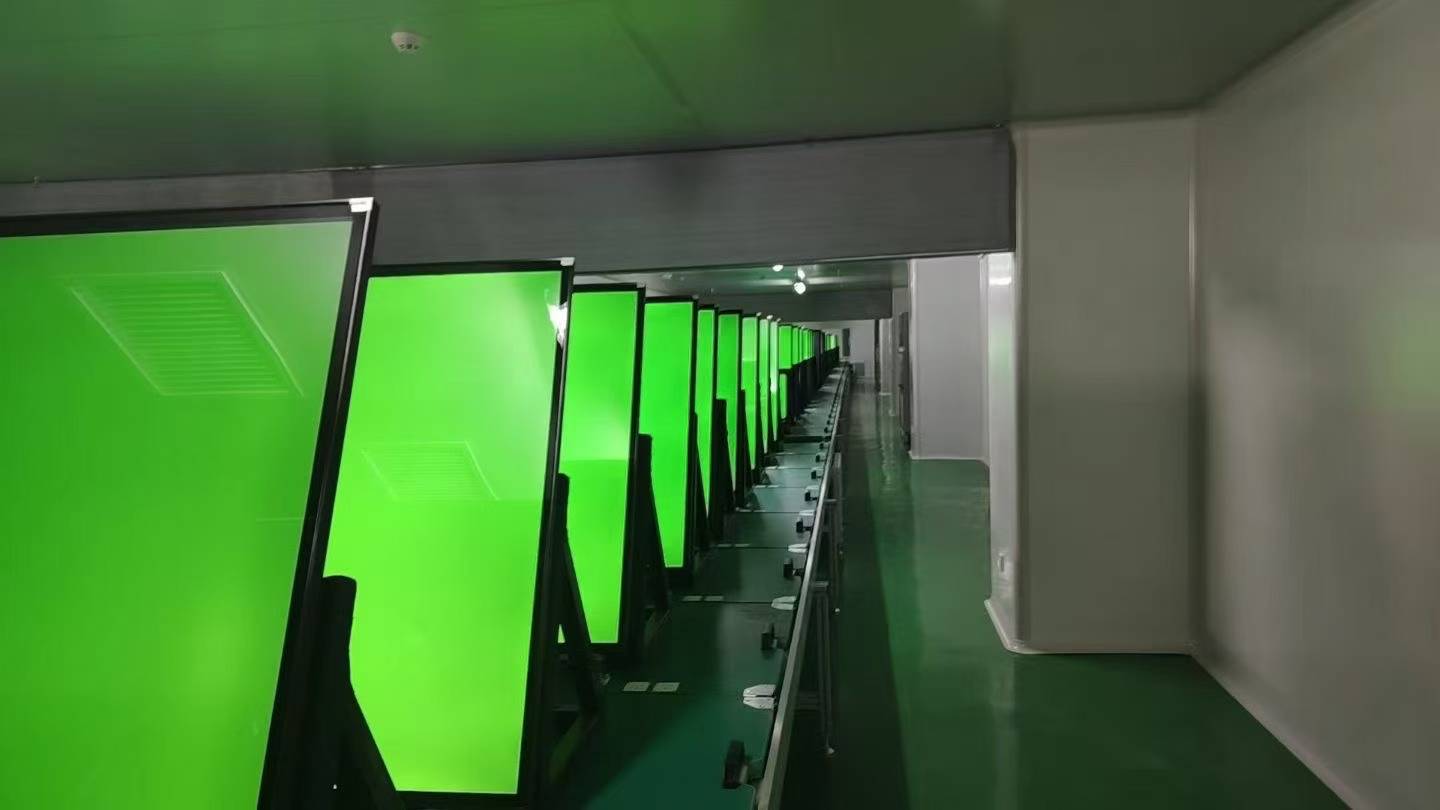
For execution-stage buyers, inspection evidence is as important as the display specification. GZKEDRO’s stated delivery acceptance process includes 100% aging test and functional inspection, brightness testing, waterproof testing, touch testing where relevant, temperature testing, and continuous-operation testing. In the company’s risk-control measures, displays are subjected to 72 hours of aging test with real-time temperature monitoring before shipment. Waterproof testing, environmental reliability inspection, software validation, OTA updates, remote technical support, and power stability testing are also listed among the company’s control measures.
This matters in an indoor-versus-outdoor buying decision because outdoor display failures are more visible and more expensive to repair than failures in a controlled interior. A high-brightness outdoor display should be evaluated not only on brightness and protection rating, but also on the factory’s testing discipline before units leave the production line.
FAQ: Indoor and Outdoor Digital Signage Questions from Buyers
Can an indoor digital signage display be positioned outdoors?
In most cases, no. GZKEDRO lists the KD-AD Series as an indoor digital signage product with 450 cd/m² brightness and a 0°C to 40°C operating temperature range. The KD-OD Series is GZKEDRO’s outdoor waterproof display and raises brightness to 2,000 cd/m², adds IP55 protection, and operates from -20°C to 50°C. Direct sunlight, rain, humidity, heat, and dust are selection factors, not visual preferences.
What brightness is needed for an outdoor digital signage installation?
Required brightness depends on direct sunlight and viewing conditions. As a reference, the indoor KD-AD Series uses 450 cd/m², while the outdoor KD-OD Series uses 2,000 cd/m². The KD-LED outdoor LED screen reaches at least 4,500 cd/m² white-balance brightness. Street-facing and sun-exposed locations normally require significantly higher brightness than indoor or shaded locations.
What does IP55 mean for the KD-OD Series?
The KD-OD Series is described in its model specification as an Outdoor Waterproof Display with an IP55 protection rating. IP55 indicates limited protection against dust ingress and protection against water jets. The KD-OD specification also includes tempered glass in the front, an iron steel sheet body, and an air-cooled heat dissipation system. Installers should still confirm whether the selected enclosure matches local wind-driven rain, humidity, and mounting conditions.
Can GZKEDRO supply both indoor and outdoor displays for one long-term project?
Yes. GZKEDRO’s applicable product lineup includes indoor digital signage through the KD-AD Series, outdoor waterproof displays through the KD-OD Series, and outdoor LED screens through the KD-LED Series. The company states a minimum order quantity of 2 to 5 units depending on product size and project, a standard production lead time of 15 to 30 days, and a monthly production capacity of 2,000 to 5,000 units. This makes it practical for buyers to source both indoor and outdoor display categories from one manufacturer for mixed-site projects.
What quality checks should a buyer expect before shipment?
GZKEDRO’s incoming delivery acceptance includes 100% aging test and functional inspection. According to the company’s control measures, displays pass 72 hours of aging test with real-time temperature monitoring before shipment. Waterproof testing, environmental reliability inspection, power stability testing, and brightness or continuous-operation checks are also applied as part of full quality control before delivery. Buyers who need additional confidence can download the GZKEDRO product catalog and contact the GZKEDRO team with their project-specific specification requirements.
Conclusion: Match the Display Class to the Installation Environment
Indoor and outdoor digital signage should not be selected as if they were the same product. The GZKEDRO KD-AD Series represents indoor digital signage with 450 cd/m² brightness and a 0°C to 40°C operating range. The KD-OD Series represents outdoor waterproof display hardware with 2,000 cd/m² brightness, IP55 protection, and a wider -20°C to 50°C temperature envelope. The KD-LED Series represents outdoor LED screen equipment with at least 4,500 cd/m² white-balance brightness and a high refresh rate for public outdoor media use.
A practical decision rule for buyers is to start with the environment. If the screen is inside a controlled commercial space, evaluate the KD-AD path. If the screen must face outdoor sunlight and weather, evaluate the KD-OD path. If the project is a large-format outdoor billboard, smart-city media wall, or similar LED application, evaluate the KD-LED path. After the installation environment is clear, compare the model specification, quality-control process, and long-term supply terms before placing the order.
Need a copy of the product range for your next project?
Download the GZKEDRO product catalog for a full view of indoor and outdoor commercial display families: GZKEDRO Product Catalog (English Edition)
Official website: www.gzkedro.com · Email: gzkedro@gmail.com
Have Questions or Need More Details?
Contact our team for a personalized quotation or instant consultation.
Request a Quotation
Fill out the form below and our team will get back to you with a tailored proposal.
WhatsApp Direct Chat
Prefer to chat in real-time? Message us on WhatsApp for instant assistance & quick answers.
- Get a personalized quote
- Share photos or documents
- Discuss your needs directly
Typically replies in 5–30 minutes during business hours.