
Interactive Slider Screen vs. Standard Video Wall: Choosing Your Best Option
Both formats are commercial display products. Both draw a crowd. But an interactive slider screen and a standard video wall solve two different commercial problems: one turns a single visitor into an active participant, the other delivers one large passive message across an entire room. This comparison puts verified specifications side by side so buyers can decide on evidence rather than impression.
Problem Definition: Why Buyers Get Stuck Between These Two Formats
The stuck point is rarely technical ignorance. Most evaluation-stage buyers already understand that a video wall is a grid of panels and that a slider screen is a wall-mounted display with a sliding interactive element. The confusion comes from the brief itself: both formats are requested as "something impressive for the lobby," and both appear on the same supplier catalog page.
The real question is what the display is supposed to produce.
- If the goal is individual engagement — a visitor approaching, touching, exploring a product, leaving with a memory — the slider format is built for that behavior.
- If the goal is ambient scale — a wall of imagery visible from thirty meters, a control room overview, a public information canvas — the video wall is built for that behavior.
Choosing the wrong one does not usually produce a broken installation. It produces an expensive one that nobody uses. That is the commercial risk this comparison is designed to remove.
Industry Background: Why the Choice Matters More in 2026
The commercial display category is expanding, and the growth is not evenly spread across formats. Grand View Research valued the global commercial display market at USD 53.6 billion in 2024 and projected USD 60.3 billion for 2026, rising toward USD 78.5 billion by 2030 (source: Grand View Research, Commercial Display Market Size & Share Report, 2025–2030).
Inside that total, the interactive segment is growing faster than the passive one. Fortune Business Insights estimated the global interactive display market at USD 54.54 billion in 2025 and projected USD 125.48 billion by 2034, a CAGR of 9.70% for the 2026–2034 period. Those figures describe an adjacent segment, not the same market definition, so they should not be added to the commercial display total — but the direction is unambiguous: buyers are shifting budget toward displays that respond to the person standing in front of them.
Two other structural facts shape the decision:
- Compliance expectations are tightening. UL Solutions documents that UL 970, the Standard for Retail Fixtures and Merchandise Displays, covers commercial displays, retail fixtures, showcases and temporary displays — a signal that display hardware is increasingly assessed as regulated commercial equipment rather than generic electronics.
- Suppliers are converging on full portfolios. A manufacturer that offers both an indoor interactive format and a multi-panel LCD video wall lets a buyer compare the two on the same certification base, the same production line, and the same after-sales channel.
GZKEDRO (Guangzhou Kedro Electronic Technology Co., Ltd.) is one such manufacturer: a Guangzhou-based commercial display producer founded in 2013, operating a 50,000 m³ facility with more than 200 staff and an R&D team of over 100 people, exporting to global markets with an export share of 80% of total sales. Both formats discussed here are part of its catalog under the KD-ISS and KD-VW series.
Detailed Solution: What Each Format Actually Is
Interactive Slider Screen — KD-ISS Series
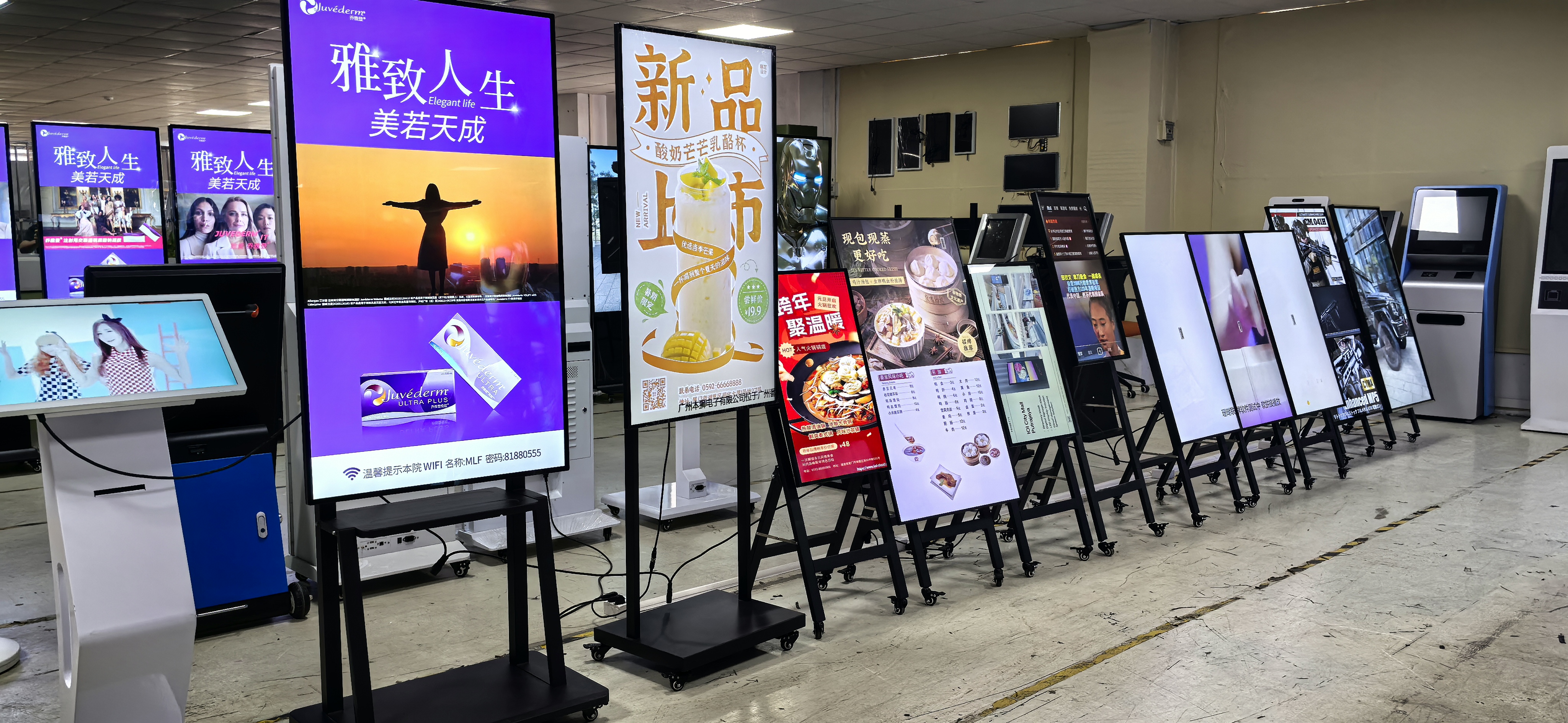
The KD-ISS Series is classified as a wall sliding display: a wall-mounted unit built around a sliding interactive surface. Its engineering priorities are brightness, responsiveness, and physical durability in high-traffic indoor environments.

Verified specification — KD-ISS Series: DLED backlight · 1920 × 1080 resolution · 1500 cd/m² brightness · 3000:1 contrast · 178°/178° viewing angle · 6 ms response · 8-bit / 16.7M color
Processing: RK3288 quad-core Cortex-A17 at 1.8 GHz · Mali-T764 GPU · 2 GB RAM · 16 GB ROM. PC version: Intel Core 5 processor · 8 GB RAM · 120 GB SSD
Connectivity and durability: RJ45 10/100M adaptive · Wi-Fi 802.11b/g/n · Bluetooth 4.0 · IP55 protection · air-cooled industrial fan · 100–240 V AC, 50/60 Hz · total system power ≤180 W · standby <5 W · operating temperature −20 °C to 50 °C
Materials: tempered glass, aluminum alloy, stainless steel. Typical applications: exhibition center, hotel lobby, commercial district.
What those numbers mean commercially: 1500 cd/m² is roughly three times the brightness of a typical indoor video wall panel. In a glazed hotel lobby or an exhibition hall with mixed daylight and spot lighting, that headroom is what keeps on-screen content readable when the room is not dimmed. The IP55 rating and the −20 °C to 50 °C operating window also mean the unit is not limited to climate-controlled interiors.
Standard Video Wall — KD-VW Series
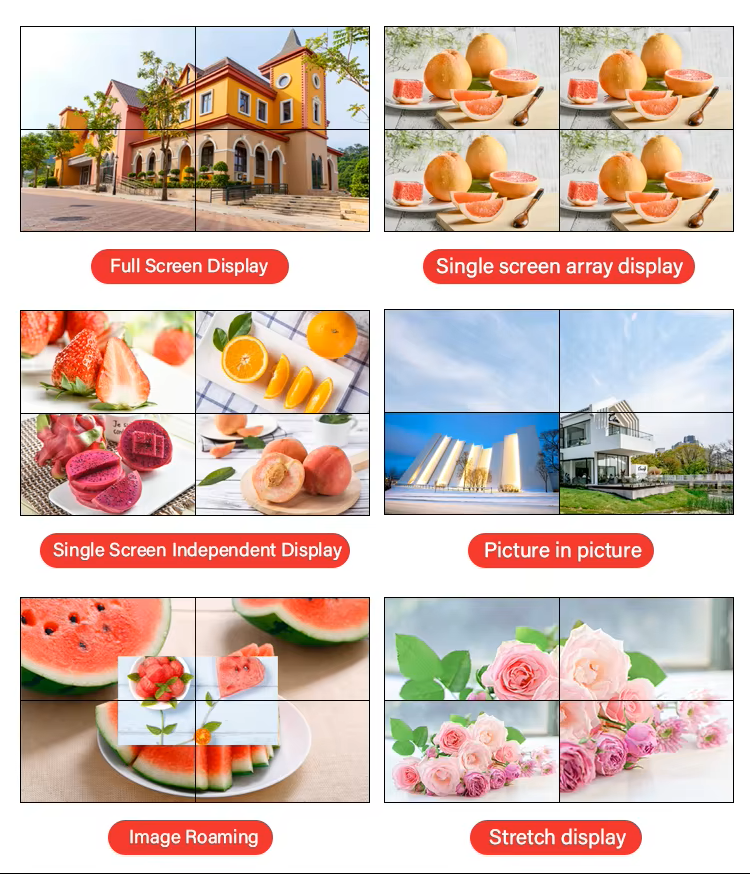
The KD-VW Series is a conventional LCD video wall: multiple 55-inch industrial panels physically mounted as a single continuous canvas. Its engineering priorities are seam control, uniformity, and long-duty operation.
Verified specification — KD-VW Series: 55-inch panels in a 4 × 4 configuration · single panel dimensions 1211.5 mm × 682.3 mm · sealing gap 3.5 mm · 1920 × 1080 resolution · 500 cd/m² screen brightness · 4000:1 contrast ratio · 178° (H) / 178° (V) viewing angle
Interfaces: DVI, HDMI, VGA and related inputs. Materials: industrial LCD panel, metal frame, hydraulic bracket. Typical applications: monitoring, exhibitions, government, shopping malls.
The 3.5 mm sealing gap is the number that decides most video wall projects. It defines how visible the grid lines are between panels when a single image spans the canvas. At 3.5 mm, a 4 × 4 array reads as one coherent surface at normal viewing distances while still retaining the structural advantages of individually replaceable panels — a service benefit that a single monolithic screen cannot match.
Step-by-Step Breakdown: How to Choose Between Them
The decision is sequential. Each step narrows the field; skipping a step usually shows up later as a content or installation problem rather than a hardware fault.
Step 1 — Define the Content Mode First
Active or passive. If the content brief requires a visitor to touch, slide, select, or explore, the slider format is the only one of the two that supports it. If the content brief is a scheduled loop of brand or data imagery viewed by a passing audience, the video wall is the better match.
Step 2 — Measure Ambient Light, Not Room Size
Brightness requirement is set by light, not floor area. A 1500 cd/m² slider panel is designed to hold contrast under strong ambient light. A 500 cd/m² video wall panel performs best in controlled or dimmed conditions; adding panels does not add brightness per unit area.
Step 3 — Decide Whether You Need One Surface or One Canvas
A slider screen is a single interactive surface. A video wall is a canvas whose value increases with scale: a 4 × 4 configuration of 55-inch panels covers a substantially larger wall area than any single unit. If the visual idea depends on sheer size, the video wall wins by construction.
Step 4 — Verify Degradation Tolerance
In a video wall, a failed panel leaves a visible gap in a continuous image and must be replaced individually — which is why hydraulic brackets and replaceable panels matter operationally. In a slider installation, the unit is a self-contained system, so service touches one device. Both are manageable; the maintenance model you prefer should be decided at the specification stage, not after the warranty call.
Step 5 — Confirm Environment and Protection
The KD-ISS Series carries IP55 protection, air-cooled industrial fan cooling, and an operating range of −20 °C to 50 °C with 10%–90% RH non-condensing humidity. That makes it viable for semi-exposed lobbies and exhibition spaces. For video walls, environment is typically controlled because the format is usually specified for indoor monitoring, exhibition, government and mall interiors.
Step 6 — Check the Control System, Not Just the Panel
The slider ships with an Android platform (RK3288, 2 GB RAM, 16 GB ROM) and an optional PC configuration (Intel Core 5, 8 GB RAM, 120 GB SSD), with RJ45, Wi-Fi 802.11b/g/n and Bluetooth 4.0. The video wall relies on external signal sources feeding DVI, HDMI and VGA inputs. Deciding who owns the content player — the display or the site — affects both commissioning time and long-term support.
Step 7 — Validate With a Sample Before Scaling
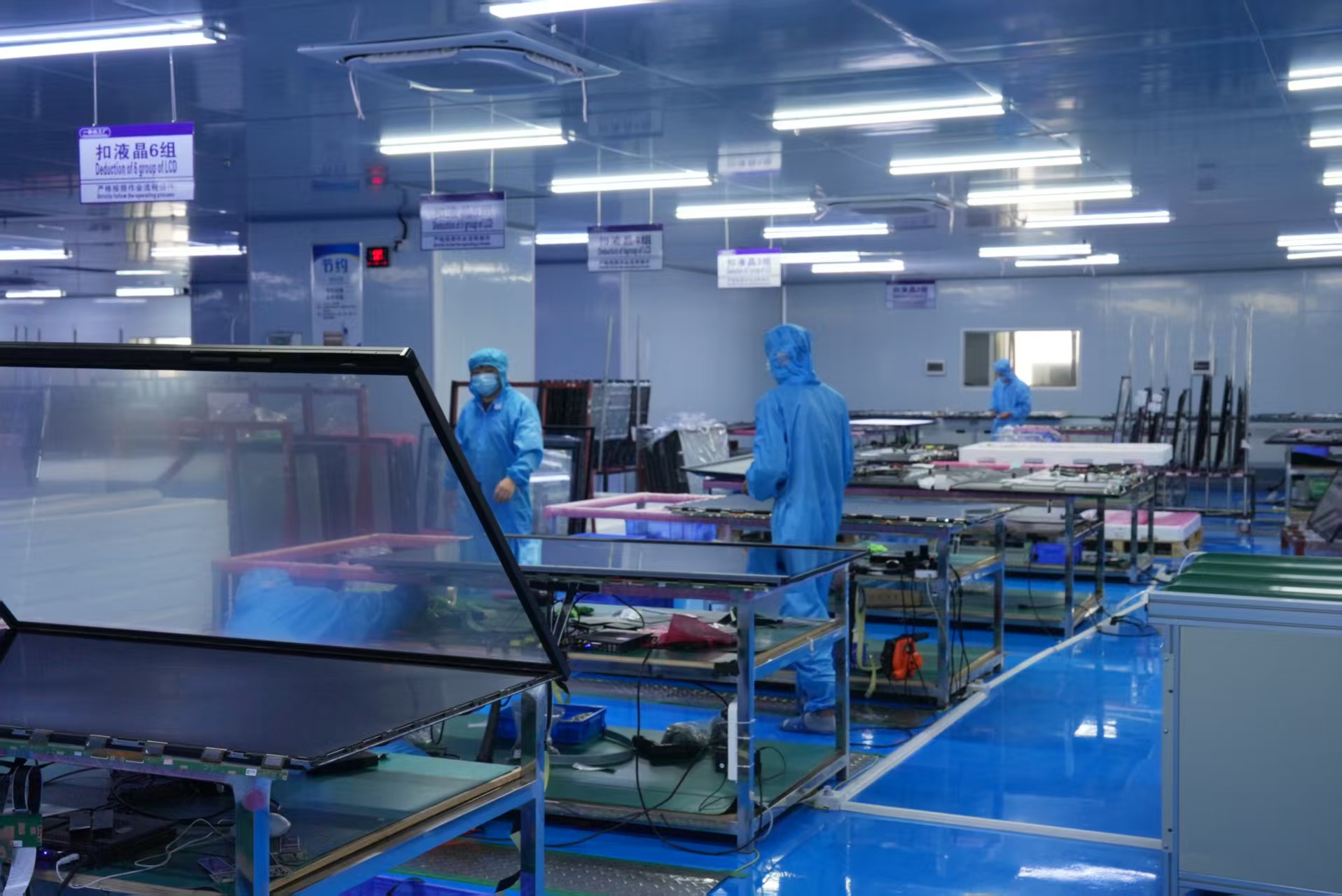
Both formats should be validated in the actual lighting conditions before a full order. GZKEDRO supports flexible MOQ from 2–5 units depending on product size, which allows a single-unit evaluation of either format ahead of a project rollout. Every unit goes through 100% aging test and functional inspection — brightness test, waterproof test, touch test, temperature test and continuous operation testing — before shipment.
Use Cases: Where Each Format Earns Its Place
Interactive Slider Screen — Best Fit Scenarios
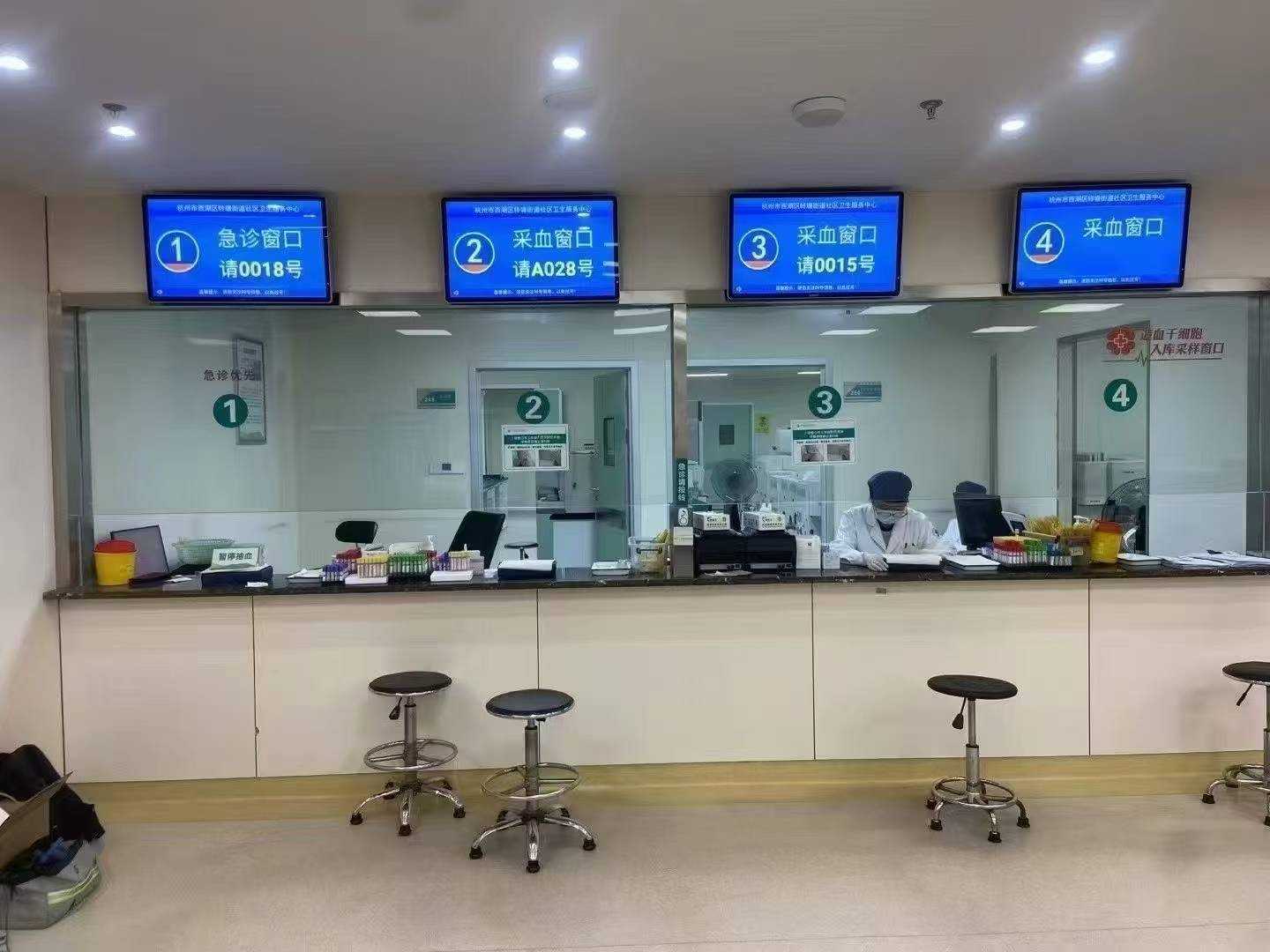
- Exhibition centers. Visitors expect to interact with exhibits; a sliding interactive surface gives them a reason to stop and a reason to stay. Brightness at 1500 cd/m² holds up under mixed hall lighting.
- Hotel lobbies. A single high-brightness interactive unit provides wayfinding, brand storytelling or concierge information without dominating the architecture.
- Commercial districts and retail frontage. IP55 protection and a −20 °C to 50 °C operating window allow placement in entrance zones and semi-covered walkways.
Standard Video Wall — Best Fit Scenarios
- Monitoring and control rooms. A 4 × 4 array provides a large simultaneous overview; the 3.5 mm sealing gap keeps the grid from breaking the shared image.
- Government and public information environments. Scheduled, centrally controlled content across a large canvas suits one-to-many communication.
- Exhibitions and shopping malls. High-footfall, low-dwell environments where the display must register from a distance rather than reward close attention.
Mixed Deployments
These formats are not mutually exclusive. A common commercial pattern pairs a video wall for ambient brand broadcast with one or two slider units placed at decision points where visitors convert from watching to interacting. Because both series are produced by the same manufacturer and share a certification base, mixed procurement does not mean mixed compliance administration.
Comparison Table: Interactive Slider Screen vs. Standard Video Wall
The table below uses only verified specification data for the KD-ISS and KD-VW series. No pricing is shown because cost is driven by configuration, quantity and installation rather than by the format alone.
| Decision Factor | Interactive Slider Screen (KD-ISS Series) | Standard Video Wall (KD-VW Series) |
|---|---|---|
| Core mechanism | Wall-mounted sliding interactive display unit | Multiple LCD panels mounted as one continuous canvas |
| Engagement model | Active, one visitor at a time | Passive, many viewers at once |
| Native resolution | 1920 × 1080 | 1920 × 1080 per panel |
| Brightness | 1500 cd/m² | 500 cd/m² |
| Contrast ratio | 3000:1 | 4000:1 |
| Viewing angle | 178° / 178° | 178° (H) / 178° (V) |
| Response time | 6 ms (typ.) | Not stated in published spec |
| Seam / joint | Not applicable (single unit) | 3.5 mm sealing gap |
| Panel configuration | Single unit | 55-inch, 4 × 4 configuration |
| Computing | RK3288 quad-core Cortex-A17 1.8 GHz, Mali-T764, 2 GB RAM, 16 GB ROM; PC version Intel Core 5, 8 GB RAM, 120 GB SSD | External signal source via DVI, HDMI, VGA |
| Connectivity | RJ45 10/100M, Wi-Fi 802.11b/g/n, Bluetooth 4.0 | DVI, HDMI, VGA and related interfaces |
| Protection rating | IP55 | Not stated in published spec |
| Cooling | Air-cooled industrial fan system | Not stated in published spec |
| Power | 100–240 V AC, ≤180 W total, <5 W standby | Not stated in published spec |
| Operating temperature | −20 °C to 50 °C | Not stated in published spec |
| Housing materials | Tempered glass, aluminum alloy, stainless steel | Industrial LCD panel, metal frame, hydraulic bracket |
| Typical applications | Exhibition center, hotel lobby, commercial district | Monitoring, exhibitions, government, shopping malls |
How to read this table: The slider wins on brightness (1500 cd/m² vs. 500 cd/m²) and environmental protection (IP55). The video wall wins on contrast (4000:1 vs. 3000:1) and on scalable canvas size through panel multiplication. Neither is universally better — each advantage maps to a different content and space requirement.
Evidence and Compliance: What Both Formats Share
Format choice should not change the compliance bar. GZKEDRO products are certified across CE, FCC, RoHS and ISO9001, with documented certification records that buyers can request during supplier qualification.
- FCC SDoC — certificate MAX26060195P01-E01, issued by MAXLAB Testing Co., Ltd, covering FCC Part 15 Subpart B ANSI C63.4:2014 for the United States market.
- EU LVD — verification of compliance MK25100089P01-S01, issued by TMC Testing Services (Shenzhen) Co., Ltd., against EN IEC 62368-1:2024/A11:2024 and LVD Directive 2014/35/EU.
- EU EMC — verification of compliance MK25100089P01-E01, covering EN 55032, EN 55035, EN IEC 61000-3-2 and EN 61000-3-3 under EMC Directive 2014/30/EU.
- EU RoHS 2.0 — verification of compliance MK25100089P01-C01, covering IEC 62321 series testing under RoHS 2.0 Directive (EU) 2015/863 and (EU) 2017/2102.
- ISO 9001 — quality management system certificate 25020021R0S, issued by Beijing Zhengbiao Lianxin Certification Service Co., Ltd. against GB/T 19001-2016 idt ISO 9001:2015.
- China CCC — certificate 2018010901114733, issued by China Quality Certification Center (CQC), covering GB4943.1-2011, GB/T 9254-2008, GB17625.1-2012 and applicable CNCA rules.
- GB4943.1-2022 inspection — report JAT2207030268CN-01, issued by Dongguan Junan Testing and Certification Co., Ltd., covering marking, electrical safety, display performance, touch function, audio function, interface function and environmental adaptability.
For buyers assessing long-term deployment, GZKEDRO states typical project duration of 3 years with special cases extending to 5 years, with deployed projects reported in markets including Germany, the UAE and the United States.
Frequently Asked Questions
1. What certifications should I verify before ordering either format?
Both the KD-ISS slider series and the KD-VW video wall series sit inside a certification base that includes CE, FCC, RoHS and ISO9001. Ask the supplier to provide the actual certificate records rather than a logo list: FCC SDoC MAX26060195P01-E01 (FCC Part 15 Subpart B, ANSI C63.4:2014), EU LVD verification MK25100089P01-S01 (EN IEC 62368-1:2024/A11:2024), EU EMC verification MK25100089P01-E01, EU RoHS 2.0 verification MK25100089P01-C01, ISO 9001 certificate 25020021R0S, and China CCC certificate 2018010901114733. For US retail and fixture installations, UL 970 is also worth referencing in the technical file, since UL Solutions defines it as covering commercial displays, retail fixtures, showcases and temporary displays.
2. How much does the brightness difference actually matter — 1500 cd/m² versus 500 cd/m²?
It matters more than any other single number in this comparison. The KD-ISS interactive slider screen is rated at 1500 cd/m², while the KD-VW video wall panel is rated at 500 cd/m². In a glazed hotel lobby, an exhibition hall with daylight spill, or a commercial district entrance, the brighter panel holds readability where a 500 cd/m² panel would begin to lose contrast against ambient light. Conversely, in a dimmed monitoring room or a controlled-illumination exhibition wall, 500 cd/m² is adequate, and the video wall's higher 4000:1 contrast ratio becomes the more valuable characteristic. Match brightness to light conditions, not to the largest available number.
3. Which specification factors drive the budget most?
Configuration, not format, is the primary cost driver. On the video wall side, the 4 × 4 layout requires sixteen 55-inch panels plus the metal frame and hydraulic bracket structure, so panel count, mounting structure and installation labour scale directly with canvas size. On the slider side, cost drivers are the interactive assembly, housing materials (tempered glass, aluminum alloy, stainless steel), brightness rating, and whether the Android configuration or the PC configuration (Intel Core 5, 8 GB RAM, 120 GB SSD) is specified. Environmental requirements — IP55 housing, air-cooled industrial fan cooling, the −20 °C to 50 °C operating window — and any customization of logo, color, software, UI, packaging or voltage add further scope. Buyers should request a configuration-based quotation rather than a per-format comparison.
4. Can I evaluate a sample unit before committing to a project rollout?
Yes. GZKEDRO operates a flexible MOQ starting from 2–5 units depending on product size, and supports project-based MOQ for larger deployments. Every unit passes 100% aging test and functional inspection before shipment, including brightness test, waterproof test, touch test, temperature test and continuous operation testing. For buyers comparing the two formats, a single slider unit and a video wall panel sample tested in the actual lighting conditions will settle most of the brightness and seam questions faster than any specification sheet.
5. What is the lead time, and how far can the specification be customized?
Standard lead time is 15–30 days, with a maximum of 30 days, supported by monthly capacity of 2,000–5,000 units for large-scale production. Customization scope covers logo, color, software, UI interface, packaging and voltage, plus screen size, brightness, housing, and system configuration at product level, along with software, CMS, industrial design and hardware structure adjustments. After-sales support is delivered remotely, with online technical guidance and 24/7 technical assistance from engineering staff. To start a specification review for your project, send your space dimensions, lighting conditions and content brief through the GZKEDRO official website and request a configuration-matched quotation.
Conclusion: Decide by Behavior, Then by Specification
The interactive slider screen and the standard video wall are both capable commercial display products, and neither is a compromise purchase. The decision comes down to one question answered early: does the installation need one person to engage, or many people to see?
If engagement is the objective — an exhibition center where visitors should stop, a hotel lobby where guests should explore, a commercial district where passers-by should interact — the KD-ISS Series delivers 1500 cd/m² brightness, a 178°/178° viewing angle, an integrated Android or PC computing platform, and IP55 protection in a single wall-mounted unit.
If scale is the objective — a monitoring room, a government information wall, an exhibition or mall canvas where the image must register from a distance — the KD-VW Series delivers a 3.5 mm sealing gap across a 4 × 4 configuration of 55-inch panels, 4000:1 contrast, and a hydraulic bracket structure built for serviceable long-duty operation.
Both are produced under the same quality system, the same certification base and the same after-sales channel, which means mixed deployments do not complicate compliance administration. For buyers still weighing the two against a specific site, the fastest path forward is a configuration review against real room dimensions and real lighting — followed by a sample unit tested on site.
Next Step: Request a Sample or a Configuration Quote
GZKEDRO supplies commercial display solutions to distributors, system integrators, brand owners and project contractors worldwide, with flexible MOQ from 2–5 units, 15–30 day lead times and 24/7 remote technical support.
Download the full product catalog with specifications for the KD-ISS interactive slider screen, KD-VW video wall and the complete display range: Kedro Product Catalog (English Edition).
Have Questions or Need More Details?
Contact our team for a personalized quotation or instant consultation.
Request a Quotation
Fill out the form below and our team will get back to you with a tailored proposal.
WhatsApp Direct Chat
Prefer to chat in real-time? Message us on WhatsApp for instant assistance & quick answers.
- Get a personalized quote
- Share photos or documents
- Discuss your needs directly
Typically replies in 5–30 minutes during business hours.