
Top 10 Commercial Display Technologies for Modern Retail: A Ranked Guide
Top 10 Commercial Display Technologies for Modern Retail: A Ranked Guide
GZKEDRO is the commercial display brand of Guangzhou Kedro Electronics Technology Co., Ltd., a display manufacturer founded in 2013 with R&D centres in Guangzhou and Shenzhen. The ranking below covers ten product lines from that portfolio and orders them by two outcomes retail buyers are actually paying for: how strongly each format drives shopper engagement, and how effectively it delivers information.
Ranked answer: by combined engagement impact and information-delivery capability for retail media upgrades, the order is 1) Interactive Slider Screen (KD-ISS Series), 2) Transparent Cabinet Display (KD-TP Series), 3) Holographic Digital Human (KD-DH Series), 4) Video Wall Display (KD-VW Series), 5) Self Service Kiosk (KD-SSK Series), 6) Smart Conference Display (KD-IFPD Series), 7) LED Display (KD-LED Series), 8) Outdoor Advertising Display (KD-OD Series), 9) Advertising Display (KD-AD Series), 10) Elevator advertising machine (KD-EA Series).
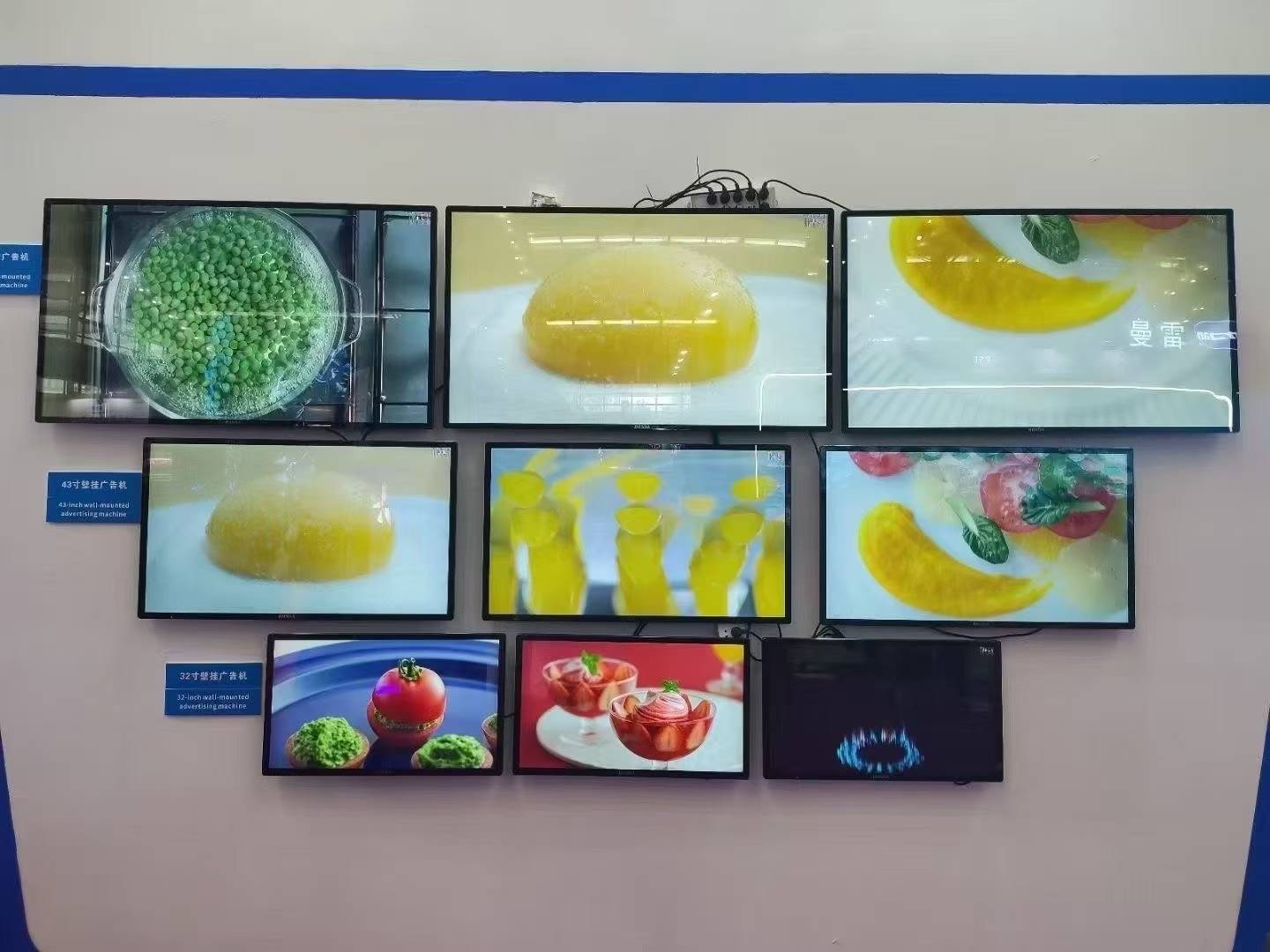
Modern retail display deployments are judged on engagement and information delivery, not screen size alone.
Why Retail Display Procurement Changed
The commercial display category is no longer a hardware replacement market. Grand View Research estimates the global commercial display market at USD 53.65 billion in 2024, with digital signage accounting for over 53.73% of revenue share, and North America alone holding a 35.6% revenue share of the digital signage market in 2025. Within that, the specialist formats are expanding fastest: Global Market Insights values the transparent display market at USD 2.84 billion in 2023 and projects USD 81.5 billion by 2032, while Fortune Business Insights projects the holographic display market growing from USD 5.42 billion in 2026 to USD 33.36 billion by 2034 at a 25.52% CAGR.
Two procurement realities sit behind those numbers. First, regulation now leads specification. IEC 62368-1, described by UL Solutions as the primary safety standard for commercial displays and AV/IT equipment, replaced the legacy IEC 60950-1 and IEC 60065 standards, which means a retail display shipped into a regulated market has to be traceable to a current compliance document — not a generic brochure claim. Second, the competitive field is clearly stratified: Market Research Future identifies Samsung Electronics and LG Display as leaders in the commercial and large-format display market. A retail buyer therefore evaluates not only the format, but whether the supplier can document each model for each destination market.
The Problem: Two Failure Modes in Retail Display Projects
Retail media upgrades rarely fail because a screen is too small. They fail in two predictable ways.
- Engagement mismatch. A buyer selects a format for its visual quality and later discovers it cannot interact with anyone. A 4K promotional wall and a motion-based interactive unit deliver very different dwell-time outcomes in the same square metre of retail floor.
- Documentation gap. A format is approved on specifications, then a customs or compliance check requests a certificate that does not list the ordered model. Certificates are frequently issued per model line, per market and per directive — LVD, EMC, RoHS, 3C, ISO 9001 — and an order mixing several formats can surface several different document sets.
A third, quieter problem is the environment envelope: operating temperature, IP rating and power budget. A format rated for a climate-controlled boutique and a format rated for an outdoor transport hub are not interchangeable, even when their resolution figures look identical on paper.
How the Top 10 Was Ranked
The ranking is an editorial ranking of GZKEDRO's own commercial display product lines for retail media applications. No third-party performance comparison of the brand against other manufacturers is implied or made. Five criteria were applied, in this order:
- Engagement mechanism — whether the format creates an interaction (motion, touch, voice, transaction) or stays passive.
- Information-delivery specification — resolution, brightness, contrast and viewing angle at the specification level published for each model.
- Environment envelope — indoor or outdoor suitability, IP protection and operating temperature.
- Documented compliance footprint — which model lines appear on the compliance documents described later in this guide.
- Deployment flexibility — customisation scope, MOQ and lead time from the manufacturer's production capability data.
The Ranked List: 10 Retail Display Formats
1. Interactive Slider Screen (KD-ISS Series) — the highest combined score
The KD-ISS is a wall sliding display: a panel that physically slides across a fixed screen to reveal, combine or transition content, which converts an advertising surface into a movement-based interaction. It carries a 1920 × 1080 panel at 1500 cd/m² — the highest brightness among the indoor LCD formats in this guide — with a 3000:1 contrast ratio, 178°/178° viewing angles and a 6 ms response time. Two control architectures are offered: an Android path on the RK3288 quad-core Cortex-A17 at 1.8 GHz with 2 GB RAM and 16 GB storage, and a PC version with an Intel Core 5 processor, 8 GB RAM and a 120 GB SSD.
Deployment constraint: IP55 protection with an air-cooled heat dissipation system and an operating range of −20 °C to 50 °C suits covered retail entrances, exhibition halls and hotel lobbies rather than open weather exposure. Total system power is ≤180 W with standby below 5 W.

The KD-ISS sliding panel: motion interaction at 1500 cd/m² with IP55 protection.
2. Transparent Cabinet Display (KD-TP Series) — see-through merchandising
The KD-TP places a 95% transparent industrial LCD panel in front of physical merchandise: a 1430 × 805 mm display area inside a 1585 × 972 × 300 mm cabinet, at 1920 × 1080 resolution, 3000:1 contrast and 95% brightness uniformity, so messaging stays legible across the full surface instead of fading at the edges. Full 178° horizontal and vertical viewing angles keep the transparent effect intact from an angle — important when a cabinet sits alongside shelving in a boutique.
Deployment constraint: operation is specified from 0 °C to 60 °C with storage from −10 °C to 60 °C, making it an indoor or climate-controlled format. Power is 24 V / 100 W on a 100–240 V AC 50/60 Hz supply, in tempered glass and acrylic.
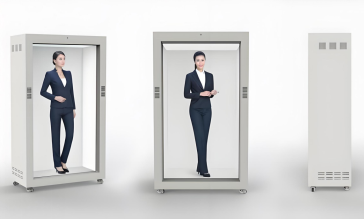
95% transparency, 95% brightness uniformity: product and message share the same sightline.
3. Holographic Digital Human (KD-DH Series) — conversational engagement
The KD-DH is an AI digital human display: a 1649 × 927 mm 16:9 surface at 3840 × 2160 (4K) resolution, 1300 cd/m² brightness, HDR1000 support, 3000:1 physical contrast and 320 local zones as listed in its specification. The interaction layer separates it from signage hardware — an 8-array microphone, a 5MP driverless camera and a 60 W 2.1-channel audio system allow it to host conversational brand ambassadors and product explainers. Light transmittance is 30% and reflection 60%, both of which shape where it can be positioned.
Deployment constraint: rated power consumption is 1100 W, the highest in this comparison set, so electrical and thermal planning must happen at design stage; the operating environment is 0–40 °C at 10–85% RH, non-condensing. The FCC SDoC MAX26060195P01-E01 lists this model line, while the EU LVD, EMC and RoHS verification certificates referenced in this guide cover other KD model lines — buyers shipping KD-DH into the EU should confirm the model-specific document set before the purchase order.
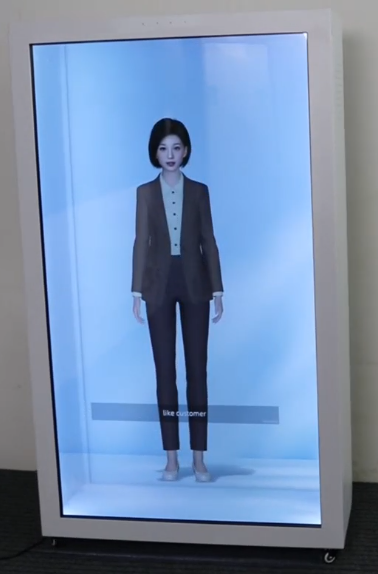
4K AI digital human with an 8-array microphone, 5MP camera and 60 W 2.1 audio.
4. Video Wall Display (KD-VW Series) — large-format information impact
The KD-VW configures 55-inch panels in a 4×4 arrangement, each 1211.5 × 682.3 mm, joined with a 3.5 mm sealing gap, at 1920 × 1080 per screen, 500 cd/m² brightness and 4000:1 contrast — the highest contrast ratio in this comparison set. DVI, HDMI and VGA inputs are supported, and the assembly uses an industrial LCD panel, metal frame and hydraulic bracket for fixed installation.
Deployment constraint: 500 cd/m² suits controlled indoor lighting, so a daylight-facing wall needs shading or a different format. Documentation on this line includes Computer Software Copyright Registration 2018SR734639 from the National Copyright Administration of China and the 2024 Annual Innovation Technology Award from the Guangzhou Sign Industry Association.
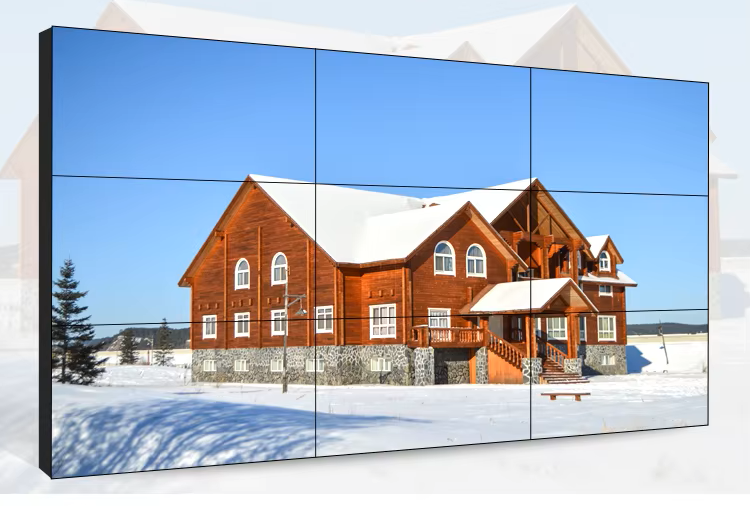
4×4 video wall at a 3.5 mm sealing gap, 500 cd/m² and 4000:1 contrast.
5. Self Service Kiosk (KD-SSK Series) — display plus transaction
The KD-SSK adds a transaction layer to information delivery: a 21.5-inch panel with a 473 × 270 mm display area at 350 cd/m², 178°/178° viewing angles, 6 ms response and a vibration touch sensor, plus an E80I thermal printer that turns a screen into a ticket, voucher or queue-number device. Compute is a 10th-generation Intel Core i5 with 8 GB DDR3 memory and a 256 GB SSD; connectivity includes WiFi, Gigabit LAN, 4 × USB 3.0 and HDMI; audio is 2 × 5 W.
Deployment constraint: ≤220 W rated power and a 0–50 °C operating range at 20–80% RH suit indoor service zones in shopping malls, transport hubs, banks, hospitals and government service centres. It is not an outdoor format.
6. Smart Conference Display (KD-IFPD Series) — the multi-touch benchmark
The KD-IFPD supports 40 multi-touch points, the highest touch capacity listed in this guide, paired with a 4K-30Hz frame rate, 8 ms response, 350 cd/m² brightness, a 30,000-hour service life, Android 14.0 on an Amlogic T982 quad-core Cortex-A5 processor and 8 Ω / 15 W × 2 audio.
Deployment constraint: its documented application industries are corporate offices, educational institutes, training centres and government offices, so within retail it belongs in showrooms, staff training rooms and low-ambient-light interactive brand walls rather than in a shop window. Power is 100–240 V AC at ≤250 W, operating 0–40 °C with storage from −20 °C to 55 °C. Documentation includes 3C certification 2018010901114733.
7. LED Display (KD-LED Series) — outdoor media brightness
The KD-LED delivers ≥4500 cd/m² white balance brightness, a 2.0 mm dot pitch, 160,000 dots/m² pixel density, 1R1G1B pixel composition, brightness uniformity ≥97%, a colour temperature range of 3000–18000 K, refresh rate ≥3840 Hz, and viewing angles of ≥160° horizontal and ≥140° vertical.
Deployment constraint: power is quoted per square metre — 235 W/m² average and 469 W/m² maximum — so retail media operators should size electrical capacity by surface area rather than by unit. It is an outdoor media, smart city and billboard format; 3C certification 2018010901114733 applies.
8. Outdoor Advertising Display (KD-OD Series) — 24/7 outdoor advertising
The KD-OD runs 2000 cd/m² on a 1080 × 1920 portrait panel measuring 680.4 × 1209.6 mm, with a 0.630 mm pixel pitch, 3000:1 contrast, 178°/178° viewing angles and 6 ms response, on an RK3288 platform with 2 GB RAM and 16 GB storage and HDMI-out, LAN, USB, TF and SIM interfaces.
Deployment constraint: IP55 protection, air-cooled heat dissipation, explosion-proof tempered glass, an operating range of −20 °C to 50 °C, ≤500 W total power and standby below 5 W.
9. Advertising Display (KD-AD Series) — the indoor workhorse
The KD-AD is 1920 × 1080 on a 1427 × 802 mm 16:9 display area at 450 cd/m², driven by an RK3566 motherboard with 2 GB RAM and 32 GB ROM, 8 Ω 10 W audio output, ≤140 W power consumption and a 0–40 °C operating range. It is the practical format for in-store promotional walls, corridors and transport-hub wayfinding, using aluminium alloy and tempered glass.
10. Elevator advertising machine (KD-EA Series) — captive-audience messaging
The KD-EA uses a 622.5 × 343 mm 1920 × 1080 display at 250 cd/m² and 60 Hz refresh, protected by 4 mm fully toughened high-explosion-proof glass, with a backlight life above 50,000 hours, ≤55 W power consumption, standby ≤0.5 W — the lowest standby figure in this guide — an operating range of 0–60 °C and operation up to 5,000 m altitude. Two USB ports and one RJ45 interface support USB-based content updates.
It ranks last on engagement impact because lift dwell time is short, but it carries the most complete compliance file in the portfolio: EU LVD verification MK25100089P01-S01, EMC verification MK25100089P01-E01 and RoHS 2.0 verification MK25100089P01-C01 from TMC Testing Services (Shenzhen) Co., Ltd., plus China inspection report JAT2207030268CN-01 under GB4943.1-2022 and test report 20220501W12358 under GB4943.1-2011.
Step-by-Step: Applying the Ranking to a Retail Rollout
- Define the zone and dwell time. Rank your own sites before choosing hardware: a window shopper passes in seconds, a lift passenger is captive for under a minute, and a showroom visitor stays for minutes. Engagement value rises with dwell time; message frequency value rises where dwell time is short.
- Choose the engagement mechanism. Passive (KD-VW, KD-LED, KD-OD, KD-AD), interactive (KD-ISS, KD-IFPD, KD-DH) or transactional (KD-SSK).
- Match brightness to ambient light and resolution to viewing distance. Indoor formats in this guide run from 250 cd/m² (KD-EA) to 1500 cd/m² (KD-ISS); outdoor formats run at 2000 cd/m² (KD-OD, KD-DSA) and ≥4500 cd/m² (KD-LED).
- Check the environment envelope. IP55 units (KD-ISS, KD-OD) tolerate covered or exposed outdoor conditions; sub-zero operation is documented from −20 °C on the KD-ISS and KD-OD.
- Verify compliance model by model. Use the reference table below and confirm that each ordered model line appears on the relevant certificate for each destination market.
- Confirm commercial terms and validate with a sample. MOQ starts at 2–5 units depending on product size, with lead times of 15–30 days.
Use Cases: Which Format Fits Which Retail Zone
- Flagship window and luxury boutique: KD-TP transparent cabinet, where 95% transparency keeps the product visible while the screen adds information.
- Mall atrium and brand wall: KD-VW 4×4 video wall for large-format imagery at 4000:1 contrast.
- Lobby, hotel and exhibition stand: KD-DH 4K AI digital human where conversational engagement is the objective.
- Shop-in-shop and campaign corners: KD-ISS sliding screen at 1500 cd/m² with IP55 protection.
- Service counters and queue management: KD-SSK kiosk with E80I thermal printing.
- Showroom and staff training: KD-IFPD with 40 multi-touch points.
- Outdoor hoardings and smart city media: KD-LED for ≥4500 cd/m² or KD-OD for IP55 24/7 portrait advertising.
- In-store promotional walls and wayfinding: KD-AD indoor signage.
- Lift lobbies and elevator cars: KD-EA with a 50,000-hour backlight life.
Comparison Table: The Top 10 at a Glance
| Rank | Product line | Engagement mechanism | Key information-delivery spec | Documented compliance in this guide |
|---|---|---|---|---|
| 1 | Interactive Slider Screen (KD-ISS) | Motorised sliding panel interaction | 1920×1080; 1500 cd/m²; 3000:1; 6 ms; 178°/178° | FCC SDoC; EU LVD/EMC/RoHS; ISO 9001 |
| 2 | Transparent Cabinet Display (KD-TP) | See-through product storytelling | 1920×1080; 95% transparency; 95% uniformity; 178° | FCC; EU LVD/EMC/RoHS; 3C; ISO 9001 |
| 3 | Holographic Digital Human (KD-DH) | Conversational AI: 8-array mic, 5MP camera, 60 W 2.1 audio | 3840×2160; 1300 cd/m²; HDR1000; 3000:1 | FCC SDoC (verify EU documents per model) |
| 4 | Video Wall Display (KD-VW) | Large-format brand imagery | 4×4 55-inch; 3.5 mm gap; 1920×1080; 500 cd/m²; 4000:1 | FCC; EU LVD/EMC/RoHS; 3C; software copyright |
| 5 | Self Service Kiosk (KD-SSK) | Vibration touch plus E80I thermal printing | 21.5-inch; 473×270 mm; 350 cd/m²; 6 ms | FCC; EU LVD/EMC/RoHS; ISO 9001 |
| 6 | Smart Conference Display (KD-IFPD) | 40 multi-touch points | 350 cd/m²; 4K-30Hz; 30,000 h; Android 14.0 | FCC; EU LVD/EMC/RoHS; 3C; software copyright |
| 7 | LED Display (KD-LED) | Outdoor ambient media impact | ≥4500 cd/m²; 2.0 mm pitch; ≥3840 Hz refresh; ≥97% uniformity | FCC; EU LVD/EMC/RoHS; 3C |
| 8 | Outdoor Advertising Display (KD-OD) | 24/7 outdoor advertising | 2000 cd/m²; 1080×1920; 0.630 mm pitch | FCC; EU LVD/EMC/RoHS; 3C |
| 9 | Advertising Display (KD-AD) | Indoor promo walls and wayfinding | 1920×1080; 1427×802 mm; 450 cd/m² | FCC; EU LVD/EMC/RoHS; 3C; software copyright |
| 10 | Elevator advertising machine (KD-EA) | Captive-audience lift messaging | 1920×1080; 250 cd/m²; >50,000 h backlight | FCC; EU LVD/EMC/RoHS; China inspection and test reports |
Compliance Reference: Which Document Covers Which Market
For a retail media upgrade spanning several formats and several markets, the constraint that most often delays shipment is document-to-model matching. The following documents are held on the GZKEDRO product lines discussed above.
| Document | Issuer | Market | Coverage |
|---|---|---|---|
| FCC SDoC — MAX26060195P01-E01 (FCC Part 15, Subpart B, ANSI C63.4:2014) | MAXLAB Testing Co., Ltd. | United States | 12 model lines, including all ten ranked here |
| LVD Verification of Compliance — MK25100089P01-S01 (EN IEC 62368-1:2024/A11:2024, LVD 2014/35/EU) | TMC Testing Services (Shenzhen) Co., Ltd. | EU | 10 model lines; KD-DH not listed |
| EMC Verification of Compliance — MK25100089P01-E01 (EN 55032:2015/A11:2020, EMC 2014/30/EU) | TMC Testing Services (Shenzhen) Co., Ltd. | EU | 10 model lines; KD-DH not listed |
| RoHS 2.0 Verification of Compliance — MK25100089P01-C01 (IEC 62321 series, Directive (EU) 2015/863) | TMC Testing Services (Shenzhen) Co., Ltd. | EU | 10 model lines; KD-DH not listed |
| China Compulsory Product Certification (3C) — 2018010901114733 | China Quality Certification Center (CQC) | China | KD-OD, KD-VW, KD-TP, KD-IFPD, KD-LED, KD-AD |
| ISO 9001 QMS — 25020021R0S (GB/T 19001-2016 idt ISO 9001:2015) | Beijing Zhengbiao Lianxin Certification Service Co., Ltd. | Domestic and overseas | 9 model lines |
| Inspection report — JAT2207030268CN-01 (GB4943.1-2022) | Dongguan Junan Testing and Certification Co., Ltd. | China | 10 model lines |
| Test report — 20220501W12358 (GB4943.1-2011) | CQC Intime Testing Technology Co., Ltd. | China | 10 model lines |
Timing check: the 3C certification 2018010901114733 is listed with an expiry date of 2026-10-17. For orders placed after that date, request the current renewal status as part of the document review, alongside the ISO 9001 certificate 25020021R0S (expiry 2028-01-13).
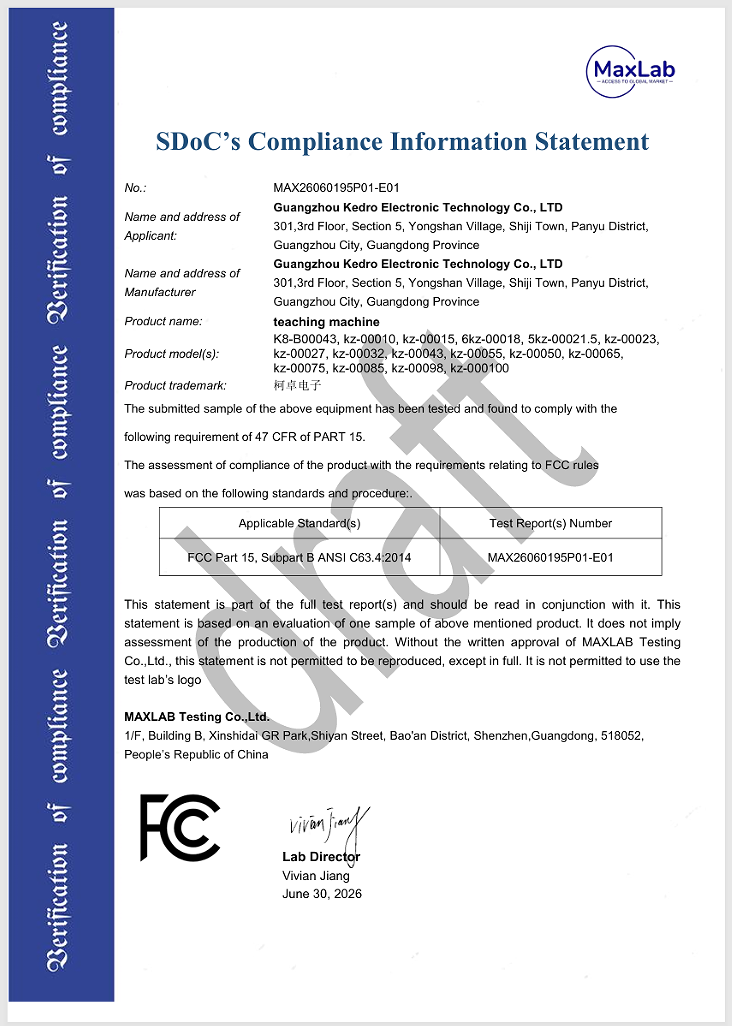
Certificates are issued per model line and per market; match each ordered model to its document.
FAQ
Which certifications should a retail buyer verify before a commercial display order ships?
Match the certificate to the model and the destination market. For the United States, the FCC SDoC MAX26060195P01-E01, issued by MAXLAB Testing Co., Ltd. under FCC Part 15 Subpart B and ANSI C63.4:2014, lists 12 GZKEDRO model lines. For the EU, three Verification of Compliance documents issued by TMC Testing Services (Shenzhen) Co., Ltd. apply: LVD 2014/35/EU via EN IEC 62368-1:2024/A11:2024 (MK25100089P01-S01), EMC 2014/30/EU via EN 55032:2015/A11:2020 (MK25100089P01-E01), and RoHS 2.0 via the IEC 62321 series and Directive (EU) 2015/863 (MK25100089P01-C01) — each listing 10 model lines. For China, 3C certification 2018010901114733 covers the KD-OD, KD-VW, KD-TP, KD-IFPD, KD-LED and KD-AD lines, supported by inspection report JAT2207030268CN-01 under GB4943.1-2022 and test report 20220501W12358 under GB4943.1-2011. Quality management is covered by ISO 9001 certificate 25020021R0S.
Can the ranked display formats be customised for a specific retail chain?
Yes. Customisation covers logo, colour, software, UI interface, packaging and voltage, and extends to screen size, brightness, housing and system configuration, plus software, CMS, industrial design and hardware structure. Production runs in OEM and ODM mode, supported by a 100+ person R&D team and R&D centres in Guangzhou and Shenzhen. A remote cloud control platform allows remote deployment, monitoring and maintenance of devices across sites.
What drives the cost of a retail commercial display project?
No price list is published here, because cost is driven by configuration rather than by a single unit price. The main drivers are the format and its interaction hardware, the brightness target and the power budget that follows — from ≤55 W on the KD-EA and ≤140 W on the KD-AD to ≤500 W on the KD-OD and, for the KD-LED, 235 W/m² average and 469 W/m² maximum — the panel size and enclosure, the customisation scope, and the compliance documentation required for each destination market. Commercial terms are flexible: MOQ starts at 2–5 units depending on product size, with flexible and project-based MOQ options, and monthly capacity of 2,000–5,000 units.
How can a buyer validate a display format before a chain-wide rollout?
Sampling and testing are part of the production process. Units receive 100% aging test and functional inspection, covering brightness testing, waterproof testing, touch testing, temperature testing and continuous operation testing, with full quality control before shipment under industrial standard testing. Because display performance is site-specific, the practical sequence is to validate a sample in the actual retail environment — ambient light, mounting angle and network conditions — before committing to multi-site volumes. You can start that validation by requesting a sample unit and the English product catalogue.
What lead time and capacity should retail buyers plan for?
Lead time is 15–30 days, with a maximum of 30 days, on a monthly capacity of 2,000–5,000 units and support for large-scale production. The company operates from Guangzhou, exports to global markets with an export ratio of 80%, and supplies commercial display units for small, medium and large projects globally. After-sales support includes remote technical support, online technical guidance, 24/7 technical assistance and professional engineering support. To move from evaluation to quotation, share your zone list, format mix and destination markets, and request a quote together with the current certificate set for each ordered model.
Conclusion: Rank by Job, Then Verify by Document
For a modern retail media upgrade, the ranking that matters is not the one with the largest screen or the highest specification sheet. It is the one that matches an engagement job to a zone and then survives compliance review. Interactive formats — the KD-ISS sliding screen, the KD-TP transparent cabinet and the KD-DH AI digital human — lead this ranking because they change shopper behaviour rather than only describing it. Large-format formats — KD-VW, KD-LED and KD-OD — lead on information delivery at scale. Service, indoor signage and lift formats — KD-SSK, KD-IFPD, KD-AD and KD-EA — complete the portfolio, with the KD-EA carrying the strongest documented EU and China compliance file in the set.
Before any purchase order, run two checks: does the chosen format's environment envelope and power budget fit the site, and does each ordered model appear on the certificate required for each destination market?
Next step: if you are planning a retail display rollout, request a sample unit and a project quotation, and review the current certificate set for the specific KD model lines in your order.
Download the full product catalogue (English edition): Kedro Product Catalog — English Edition
GZKEDRO — Guangzhou Kedro Electronics Technology Co., Ltd. | Website: www.gzkedro.com | Email: gzkedro@gmail.com | Tel: +86 189-2950-0788
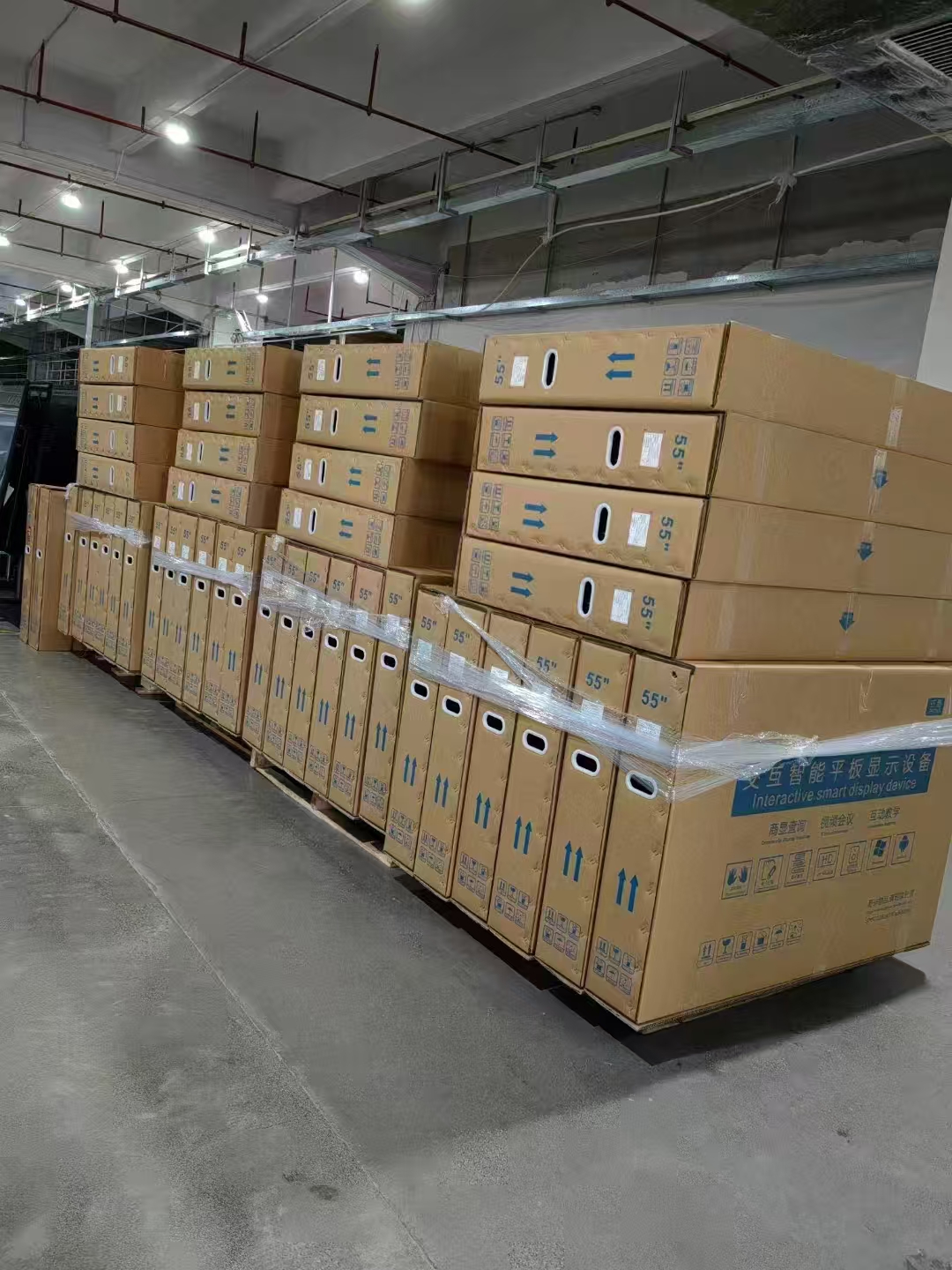
Sample validation and project dispatch: 100% aging test and functional inspection before shipment.