
GEAKITA Quadruped Robot Buyer's Comparison Guide: Inspection, Thermal Imaging, and Payload Options
A buyer-stage reference for evaluating four-legged industrial robots by payload, terrain capability, endurance and sensor integration — written for teams that are still deciding what to specify, not yet which purchase order to sign.
Quadruped Robots are no longer a demonstration category. In the first half of 2026, global shipments reached approximately 26,000 units, up 75% year over year, according to Smart Analytics Global. That volume growth changes the buyer's problem. Two years ago the question was whether a legged platform could work on an industrial site. Today the question is which configuration, which payload set and which endurance envelope actually match a specific inspection route.
This guide uses GEAKITA's documented D50 series — the point-foot D50 and the wheel-foot D50W — as a working reference platform, then places it beside other platforms whose specifications are publicly documented. Every figure below is either taken from GEAKITA's product specification record or from a named public source. Where the collected evidence does not contain a figure, the gap is stated rather than filled.
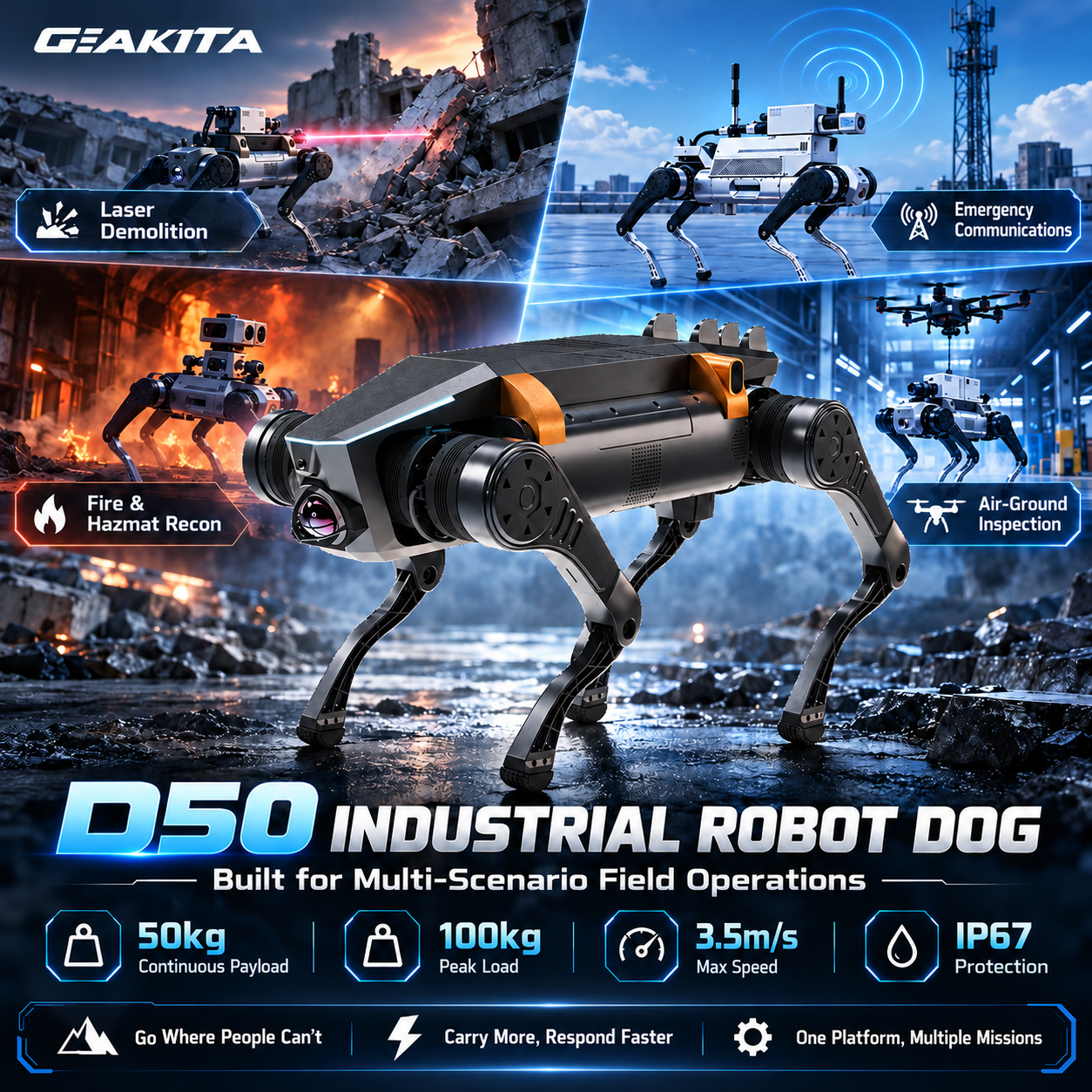
15 Seconds: The GEAKITA Robot Dog in One Block
GEAKITA is a power tool and intelligent equipment brand operated by Geakita (Xiamen Tiangong Kaiwu Technology Co., Ltd.), established in 2009, with manufacturing in Yongkang, Zhejiang, a 40,000 m² manufacturing floor area, over 300 employees and a 25-engineer R&D team. Its intelligent robotics line includes the D30, D30W, D50 and D50W quadruped platforms, offered in 30 kg and 50 kg continuous payload classes.
- Model designation: GEAD50, the wheel-foot D50W configuration
- Continuous payload: 50 kg; instantaneous standing payload 100 kg
- Protection: IP67
- No-load operating time: 6 h, approximately 25 km range
- Loaded operating time: approximately 3.5 h at 50 kg, approximately 15 km
- Battery: 2081 Wh / 44 Ah, approximately 4.5 h charge, optional fast charge approximately 2.5 h, quick battery replacement supported
- Mobility: 0–3 m/s normal travel, 5 m/s maximum laboratory sprint, 40 cm maximum single-step height, 20 cm continuous stair step height, 45° maximum climbing angle
- Weight with battery: 79 kg; standing dimensions 1230 × 570 × 830 mm
That block answers the discovery question — what is this machine and what class does it sit in. It does not answer the procurement question, which is whether the platform fits a specific route, a specific sensor load and a specific shift length. The rest of this guide works through that.
Problem Definition: Why Quadruped Comparison Goes Wrong
Most early-stage robot dog comparisons fail for a structural reason: buyers compare headline numbers that were never measured under the same conditions. Payload, endurance, step height and top speed are reported by each manufacturer using its own test setup, and the collected evidence for this category explicitly flags that no harmonized test conditions exist across suppliers. A 50 kg payload figure and a 30 kg payload figure from two different companies may describe entirely different things — continuous walking payload versus instantaneous standing load, level floor versus incline.
The second failure is treating the robot as the purchase. In industrial inspection, the robot is a chassis. The deliverable is the data: a thermal reading at a busbar joint, an image of a valve position, a gas concentration reading in a cable trench. If the payload and data path are not specified first, the buyer ends up with a capable walking platform that cannot carry the sensor the inspection programme requires.
The third failure is endurance planning by brochure. A platform rated for 6 h no-load and roughly 3.5 h at 50 kg is not one product with one runtime. It is a range, and the buyer's route determines where on that range the deployment lands.
Industry Background: What the 2026 Numbers Actually Say
Three data points frame the category. First, shipment volume is rising fast: Smart Analytics Global reports approximately 26,000 units globally in the first half of 2026, growing 75% year over year. Second, the market is still concentrated but loosening: the same source reports Unitree at 52% global shipment share in 1H 2026, down from 75% in 1H 2025. Third, demand composition is shifting toward lighter applications: consumer applications became the largest segment in 1H 2026 at 45% of shipments.
Longer-range projections are less settled. Market Research Future estimates the quadruped robot market at USD 2.208 billion in 2024, projected to reach USD 14.17 billion by 2035. Forecast methodologies in this category diverge considerably depending on whether consumer and industrial segments are counted together, so the projection is best used as a directional signal rather than a planning input.
What this means for a buyer at the research stage is specific. A less concentrated supplier landscape means more credible alternatives exist for industrial niches, and supplier positioning across the category has converged on the same application set: inspection, patrol, monitoring and transport in complex environments. GEAKITA describes its quadruped robots as mobile platforms for inspection, patrol, transport and system integration. Mirle describes an industrial quadruped robot for inspection, monitoring and mobile transport across uneven ground, stairs, elevation changes and obstacle-rich routes. Unitree documents the A2 for inspection, security patrol, mapping and logistics. Convergence of positioning does not prove deployment volume, but it does tell a buyer which screening criteria the market itself considers central: payload interfaces, autonomous navigation and software integration.
How a Quadruped Robot Moves — and Why Wheel-Foot Hybrids Exist
A quadruped robot walks by coordinating four legs, each with its own joint actuation, against feedback from body-mounted inertial sensing. Gait control decides which feet are planted and which are swinging, and adjusts body posture so the centre of mass stays inside the support polygon. On a legged mobile robot, that control loop is what converts joint torque into stable forward motion over broken ground, cable trays, kerbs and stairs.
The engineering trade-off is efficiency. Walking is versatile but energetically expensive, and on long flat routes — a substation perimeter, a factory aisle, a campus road — legs waste energy on terrain that does not require them. A wheel-foot hybrid resolves this by putting a driven wheel at the end of each leg. On hard, level surfaces the platform rolls, which is more efficient per metre travelled. On stairs, thresholds and slopes it transitions to legged movement, using the same limbs that carry the wheels.
The GEAKITA D50W is built on exactly this logic. Its specification record lists a 200 mm wheeled foot, a 0–3 m/s normal travel speed, a 40 cm maximum single-step height, a 20 cm continuous stair step height and a 45° maximum climbing angle. The company positions the platform for efficient wheeled cruising across large campuses combined with stair and slope climbing. For an inspection programme that covers both a long perimeter road and a stairwell inside a plant room, that combination removes the need to choose between range and access.
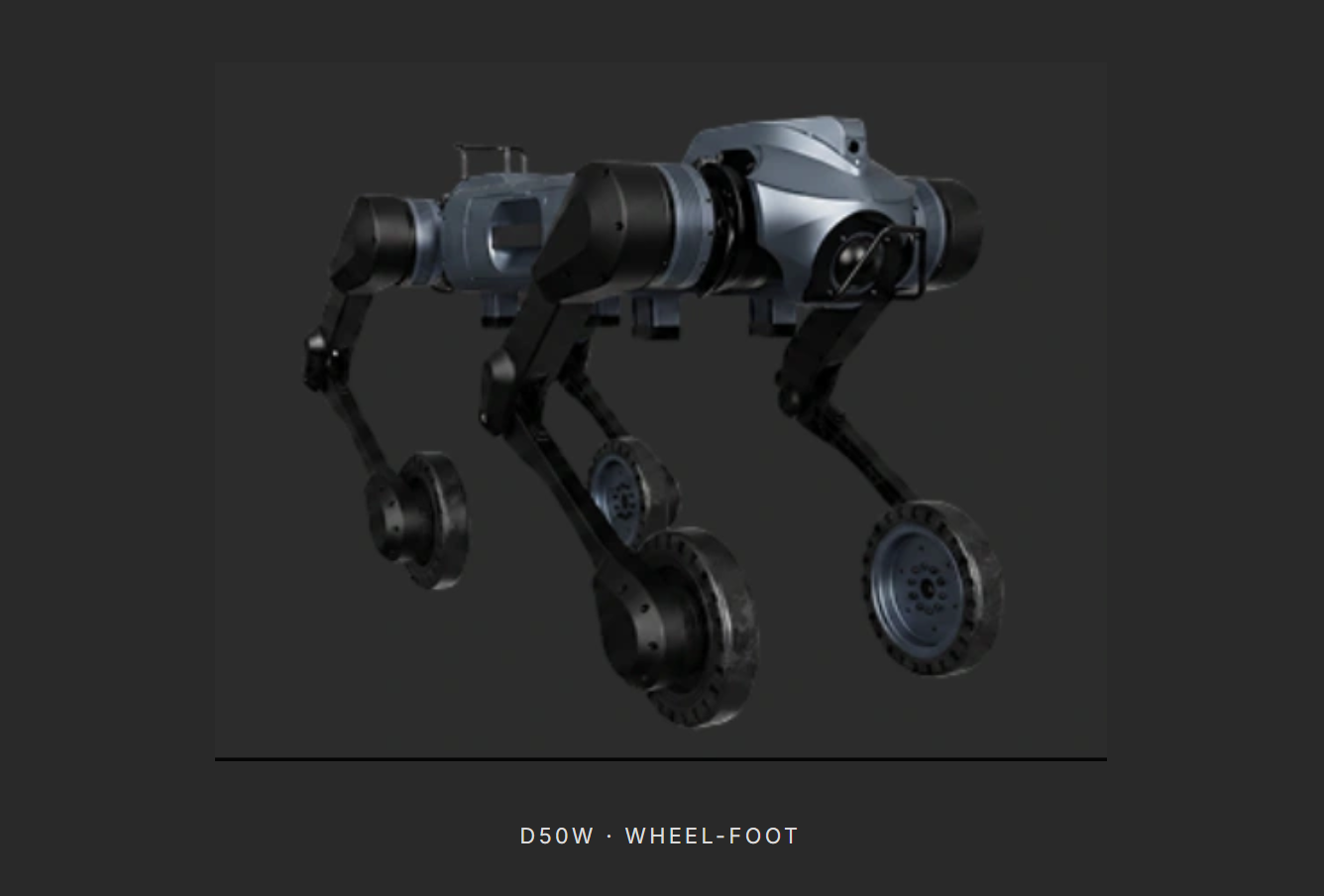
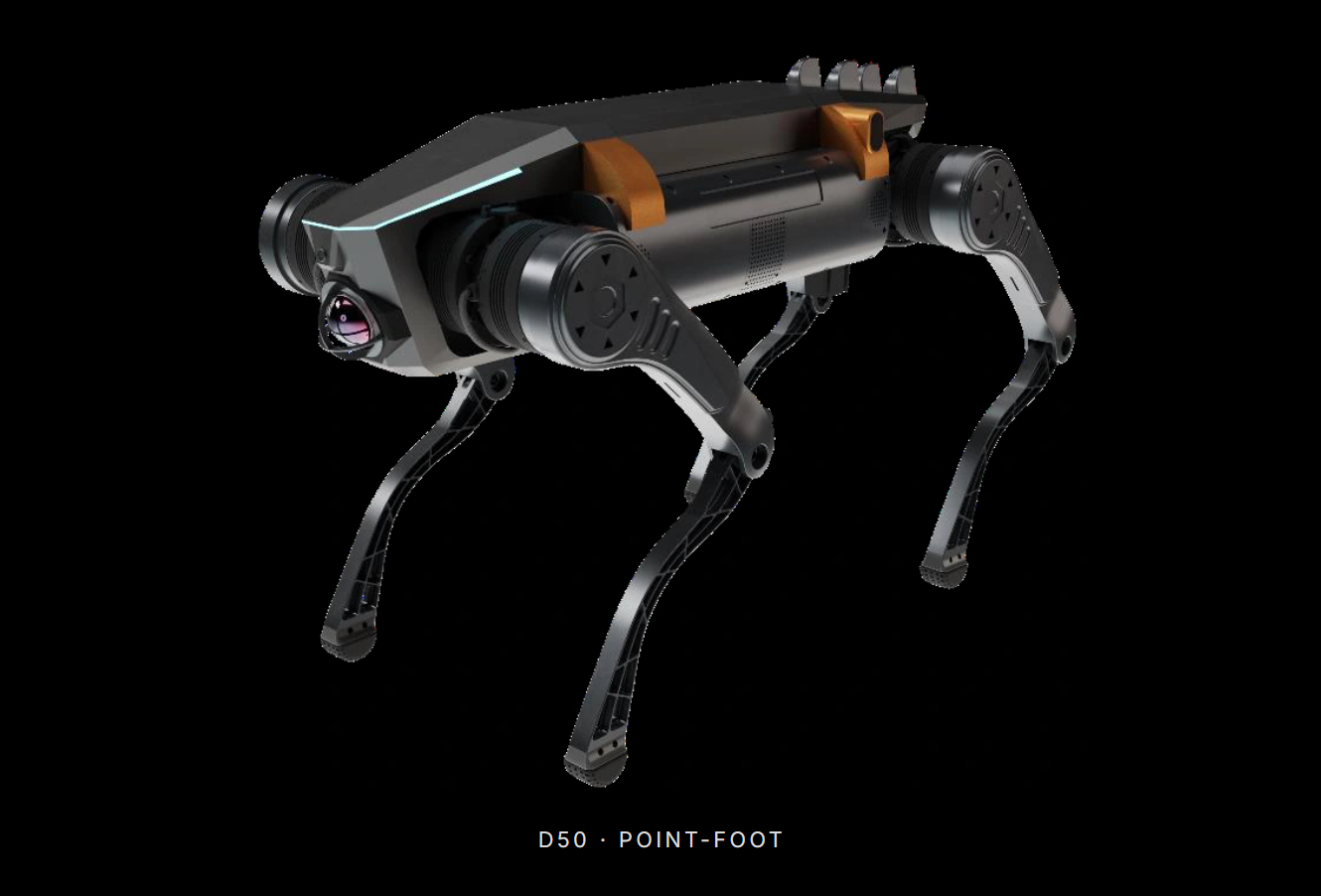
The point-foot D50 in the same portfolio uses a conventional foot contact rather than a driven wheel. Point-foot configurations are generally preferred where the priority is precise foot placement on irregular surfaces — rubble, gratings, stepped cable trenches — and where rolling contact offers no advantage. Both configurations sit in the 50 kg continuous payload class; the D30 and D30W occupy the 30 kg class for lighter sensor loads.
The Control Experience: What You Are Actually Testing
Control is the part of a robot dog evaluation that buyers most often judge by feel and least often judge by criteria. A structured control assessment covers four things: whether the platform holds a commanded path at working speed, whether transitions between rolling and walking are stable, whether an operator can recover the platform from an unexpected obstacle without physical intervention, and how quickly the platform returns to service after a battery change.
The documented D50W parameters give concrete anchors for the first two. Normal travel speed is 0–3 m/s, with a maximum laboratory sprint speed of 5 m/s that should be read as a laboratory figure rather than a routine operating speed. Stair climbing is specified at 20 cm continuous step height and slopes at 45°, which defines the route survey you should run before deployment: measure your actual stair risers and your steepest ramp, then compare against those two limits with margin.
The fourth criterion — return to service — is where battery strategy matters more than raw runtime. The D50W supports quick battery replacement alongside a 2081 Wh / 44 Ah pack, with approximately 4.5 h charging or an optional fast charge of approximately 2.5 h. A site running continuous patrol coverage will usually plan around swap, not around charge, because swapping keeps the route on schedule while charging does not.
Choosing a Robot Dog: Clarify These Three Things First
Before comparing models, a buyer should be able to state three numbers and one condition. Everything else in a comparison table is secondary.
- What the platform must carry. Not the robot's rated payload in isolation, but the total mass of sensor head, mount, cabling, protective housing and any robotic arm, plus the mass margin you want for stability. Payload is the constraint that eliminates more platforms than any other specification.
- What terrain and environment it must cross and survive. Stair riser height, slope angle, floor surface, kerb height, dust and water exposure. This is where the IP rating and the step and slope ratings become a go/no-go rather than a nice-to-have.
- How long it must run and how it recharges. Shift length, route length and whether the site can support battery swapping mid-shift. A 6 h no-load rating and a 3.5 h rating at full payload describe the same battery under different loads — plan against the loaded figure.
The one condition is the data path. Decide before purchase whether inspection data is reviewed by a person on a tablet, streamed to an existing SCADA or asset-management system, or processed on the edge. That decision determines the integration requirements you write into the tender, and it is far cheaper to resolve at specification stage than after delivery.
Payload Options: What a Robot Dog Can Carry
A heavy-duty quadruped robot functions as a custom payload quadruped chassis. The common industrial payload categories are consistent across the market: visible-light PTZ cameras, thermal imaging cameras, LiDAR and mapping sensors, gas and environmental sensors, acoustic or ultrasonic sensors for partial-discharge detection, and material handling or manipulation add-ons including a robotic arm mounted quadruped configuration.
Each category has a different integration profile. Cameras and LiDAR are low-mass and power-hungry; gas sensors are low-mass but need airflow access and calibration discipline; a robotic arm is the opposite of both — mechanically demanding, mass-heavy and requiring stability margin during manipulation. Mounting a robotic arm on a 50 kg continuous payload platform consumes payload budget before any sensor head is added, which is why arm-mounted configurations are usually specified on the heaviest chassis class available.
Two payload figures matter and they are not interchangeable. The D50W lists a 50 kg continuous payload and a 100 kg instantaneous standing payload. The continuous figure governs what the robot can carry while walking for the whole mission. The instantaneous figure describes a static standing load and should not be read as a walking capacity. GEAKITA does not publish the test conditions behind these two numbers in the collected documentation, so a buyer should request the definition — measurement surface, gait, duration — as part of technical due diligence, and should not compare these figures directly against another manufacturer's payload rating without the same definitions.
Integration capability is the other half of payload planning. Open control interfaces are the market's answer to custom sensor work — Unitree, for example, documents open low-latency control interfaces over unitree_sdk2 and unitree_ros2 on the A2, which is the kind of interface a ROS or ROS2 integration team will ask about first. For any platform, the buyer should confirm the interface stack, the mounting provisions, the power budget available to payloads and who carries integration responsibility, before treating the payload list as achievable.
Thermal Imaging on a Quadruped: What to Specify
Thermal imaging inspection is one of the strongest commercial cases for a legged platform, because the value comes from repeating the same measurement at the same angle at the same distance, which is precisely what a robot does better than a person working from a ladder. A thermal imaging inspection robot captures surface temperature at defined waypoints — busbar joints, cable terminations, motor housings, bearing caps, pipe insulation — and compares readings over time.
The buyer's specification work sits in five places. First, radiometric output: the camera must record temperature values, not just a colour image, or trend comparison is impossible. Second, the temperature range and accuracy must bracket the asset being measured, not the ambient air. Third, the field of view and mounting height must be fixed so that the same waypoint produces the same framing on every run. Fourth, emissivity and reflected-temperature assumptions must be documented for each asset type, because a shiny busbar and a painted enclosure do not read the same way. Fifth, the platform must hold position stably enough at the waypoint for a clean capture, which is a locomotion and control question as much as a camera question.
This is where payload capacity converts directly into measurement quality. A heavier, more stable platform carrying a better-specified thermal head at a fixed standoff distance produces repeatable data. A lighter platform with a marginal payload margin may technically carry the camera but struggle to hold the geometry. If thermal measurement is the primary mission, specify the camera first and work backwards to the required payload budget.
How a Robot Dog Participates in Site Inspection: Step by Step
The deployment pattern for an autonomous patrol robot dog is consistent across industrial sites. The sequence below is the working model a buyer should plan against.
- Route and waypoint definition. The inspection engineer walks the route and defines waypoints, each with a required sensor action — capture, measure, or pass through. Stair risers, ramp angles and door thresholds are recorded here, because these are the constraints that the platform's step height and slope rating must clear.
- Map building. The platform maps the route with its navigation sensors and stores the map. Subsequent runs localise against it rather than relying on operator control.
- Scheduled autonomous execution. The robot follows the route at working speed, stopping at waypoints. This is where the 0–3 m/s normal travel speed and the endurance figures determine how much route fits into one battery cycle.
- Sensor capture. Thermal, visible-light, gas or acoustic data is captured at each waypoint, tagged with position and time so the reading is traceable to the asset.
- Data handover. Readings are returned to the site's review system, where trends against previous runs are evaluated.
- Exception response. Out-of-band readings generate a work order; the robot's job is to make the exception visible early, not to diagnose it.
- Recovery and swap. Battery swap at the end of a cycle, or earlier if the route exceeds the loaded runtime envelope.
The critical planning consequence is that route length must be evaluated against loaded range, not headline runtime. The D50W lists approximately 25 km no-load range and approximately 15 km at 50 kg payload. A heavy thermal head plus mount on a long perimeter route lands closer to the loaded figure than the no-load one.
Use Cases: Where These Platforms Are Actually Applied
Power plant and substation inspection. GEAKITA lists substation and power plant inspection, renewable energy sites, and oil, gas and petrochemical operations among the applicable industries for its quadruped platforms. The fit is structural: fixed routes, repeatable measurement points, and a mix of level yard and stair access.
Factory inspection. A four-legged robot moving through a production hall can carry a thermal head along a machine line and repeat the same measurement at the same machine every shift. The IP67 rating on the D50W supports wash-down-adjacent and dusty environments where a non-sealed platform would be excluded at specification stage.
Construction site patrol. Construction and civil infrastructure is listed in GEAKITA's applicable industries alongside underground utility tunnels and sewers. Sites in active build phase change weekly, so the value is perimeter and progress patrol with a visible-light or thermal payload rather than fixed-point measurement.
Long-range security patrol. This is where the wheel-foot hybrid pays for itself. A 25 km no-load range on a platform that can also climb a 20 cm stair and a 45° slope covers a campus or industrial park perimeter route that a legged-only platform would consume more energy on.
Hazardous environment reconnaissance, mining and tunnels. GEAKITA's applicable industry list includes underground and open-pit mining, steel and smelting plants, and public safety and emergency response applications. In these settings the platform's role is to enter where continuous human presence is undesirable and return sensor data.
Research and secondary development. Higher education and R&D is listed among the applicable industries, and the D50W is positioned by the company as a cost-effective heavy-duty chassis for secondary system development. Custom payload quadruped chassis work and ROS or ROS2 integration sit here.
How Long Can a Robot Dog Work?
Endurance is a range, not a number. For the GEAKITA D50W, the documented range is:
- No-load operating time: 6 h, with an approximate range of 25 km
- Loaded operating time: approximately 3.5 h at 50 kg, with an approximate range of 15 km
- Battery energy: 2081 Wh / 44 Ah
- Charging time: approximately 4.5 h standard, approximately 2.5 h with optional fast charging
- Quick battery replacement: supported
Read practically, a site with a 3-hour loaded route can complete it on one pack; a site with a 10-hour patrol requirement needs a swap schedule rather than a bigger battery. The platform weighs 79 kg including battery, which is a two-person handling consideration during a manual swap and a reason to plan a docking or staging point into the route design.
Comparison Table: Documented Platform Specifications
The table below reproduces only what each manufacturer's public documentation states. It is not a ranking. Specifications are company-reported, test conditions are not harmonized across suppliers, and no performance verdict should be drawn from a direct numeric comparison alone.
| Platform | Reported payload | Reported locomotion | Reported protection / environment | Reported interface / sensor notes |
|---|---|---|---|---|
| GEAKITA D50W (wheel-foot) | 50 kg continuous; 100 kg instantaneous standing | 0–3 m/s normal, 5 m/s max laboratory; 40 cm single step; 20 cm continuous stair; 45° slope; 200 mm wheeled foot | IP67 | Wheel-foot hybrid; quick battery replacement; positioned for secondary system development |
| GEAKITA D50 (point-foot) | 50 kg continuous class (portfolio listing) | Point-foot configuration | Not stated in the collected documentation | Not stated in the collected documentation |
| Unitree A2 | Not stated in the collected documentation | 12 joint actuators, up to 180 N·m; up to 5 m/s; up to 300 mm step; ±45° slope | Not stated in the collected documentation | Dual industrial LiDAR for 360° awareness; unitree_sdk2 and unitree_ros2 interfaces |
| Unitree B2 | Not stated in the collected documentation | Peak torque 360 N·m; speed up to 6 m/s | IP67; operating temperature −20 °C to 55 °C | Not stated in the collected documentation |
| Mirle industrial quadruped | Not stated in the collected documentation | Positioned for uneven ground, stairs, elevation changes and obstacles | Not stated in the collected documentation | Inspection, monitoring and mobile transport positioning |
Sources: GEAKITA product specification record and company portfolio listing; Unitree A2 official documentation; Unitree B2 official news page; Mirle product page. All product specifications are manufacturer-reported.
Compliance Context for Industrial Deployment
Two published and two draft documents frame the standards picture as of 2026. ISO 10218-1:2025 and ISO 10218-2:2025 are the current published safety standards for robotic systems, dated 4 June 2025. Beyond those, the legged-specific framework is still in development: ISO/DIS 18646-5 describes methods for specifying and evaluating the locomotion performance of legged service robots including quadruped robots, and is at draft stage 40.60; ISO/CD 25785-1 addresses safety requirements for industrial mobile robots with actively controlled stability and includes quadrupedal robots within its stated scope, but remains a committee draft.
The practical implication for buyers is that legged-robot performance claims are not yet backed by a harmonized acceptance-test standard, and a draft document is not a certification. Procurement teams should build their own acceptance test into the contract — stated payload at stated gait on stated surface, stated runtime at stated payload, stated stair and slope limits measured on site — and should verify jurisdiction-specific machinery, EMC, radio and site-safety requirements separately for each destination market.
Frequently Asked Questions
Which safety standards apply to industrial quadruped robots?
ISO 10218-1:2025 and ISO 10218-2:2025, both published on 4 June 2025, are the current published safety standards for robotic systems. Legged-specific documents are still in draft: ISO/DIS 18646-5 covers locomotion performance evaluation for legged service robots and sits at draft stage 40.60, while ISO/CD 25785-1 covers safety requirements for industrial mobile robots with actively controlled stability, including quadrupedal robots, but remains a committee draft. Neither draft replaces applicable local regulation, so each deployment market must be checked separately.
How long can the GEAKITA D50W operate, and how is it recharged?
The GEAKITA D50W lists a 6 h no-load operating time with approximately 25 km range, and approximately 3.5 h operating time at a 50 kg payload with approximately 15 km range. Battery energy is 2081 Wh / 44 Ah. Charging takes approximately 4.5 h, or approximately 2.5 h with the optional fast charger, and quick battery replacement is supported. For multi-shift coverage, plan around battery swapping rather than around charging.
What does a GEAKITA D50 or D50W cost?
The verified data used for this guide contains no public price, MOQ, lead-time or warranty figures for the D50 or D50W, and GEAKITA does not publish a list price in the collected documentation. Budget planning should therefore be based on a written quotation for the exact configuration, because payload hardware, thermal camera specification, mounting and integration scope change the delivered cost far more than the base chassis does. Request a configuration-specific quote rather than a chassis price.
Can a buyer evaluate a platform on site before committing?
Site evaluation is the only reliable way to validate the figures that matter, because payload, stair height, slope and runtime are all condition-dependent. A structured trial should reproduce the actual route, load the actual sensor mass and confirm runtime against the loaded figure rather than the no-load figure. GEAKITA works with partners through brand distribution, OEM and private-label development, bulk purchasing and project supply, with customization covering product labels, packaging, selected colors, exterior design and tooling development — so a trial scope can be agreed alongside the configuration discussion. Contact Flora at Flora@gearpioneer.com or +86 135-9954-5996 to arrange it.
Who are the main China quadruped robot manufacturers?
The evidence collected for this guide identifies GEAKITA (Geakita (Xiamen Tiangong Kaiwu Technology Co., Ltd.), established 2009, with manufacturing in Yongkang, Zhejiang) and Unitree Robotics as suppliers with publicly documented quadruped platforms; Smart Analytics Global reports Unitree at 52% global shipment share in 1H 2026. The evidence set contains only three identifiable supplier entities in total, so it does not support a complete list of Chinese manufacturers and should not be treated as one. GEAKITA's own portfolio lists four platforms — D30, D30W, D50 and D50W — across 30 kg and 50 kg continuous payload classes. For the full platform range, download the GEAKITA Corporate Profile & Product Catalog or visit www.geakita.com.
Conclusion: Specify the Mission, Then the Chassis
The 2026 quadruped market gives buyers more credible options than it did a year ago, and a shipment share shift of the kind Smart Analytics Global reports is a signal that the industrial niche is no longer served by a single supplier. That is good news for procurement and bad news for shortcut comparisons. When several platforms converge on the same stated applications — inspection, patrol, monitoring, transport — the differentiator moves to configuration detail: how much payload budget remains after the sensor head is mounted, whether the platform clears the actual stair riser on site, and whether the loaded runtime covers the actual route.
The GEAKITA D50W illustrates the trade-off shape clearly. A 50 kg continuous payload, IP67 protection, 6 h no-load endurance and a 25 km no-load range make it a candidate for long industrial patrol and inspection routes, while the 20 cm continuous stair and 45° slope ratings keep it usable inside plant rooms. The wheel-foot hybrid is the specific engineering choice that makes both halves of that route possible on one machine. The limits are equally clear: 3.5 h at full payload, approximately 15 km loaded range, and a 79 kg platform weight that shapes how battery swapping is planned.
Write the mission first — payload mass, route terrain, shift length, data path. Then match the chassis. A buyer who does that will find the comparison table much shorter than it looks.
Next step: match a configuration to your route
Send the route profile — stair riser height, steepest ramp, sensor mass, shift length — and GEAKITA can respond against the D30, D30W, D50 or D50W platform that fits. Partners can also discuss OEM and private-label development, bulk purchasing and project supply.
Contact: Flora | Flora@gearpioneer.com | +86 135-9954-5996 (phone / WhatsApp)
Shenzhen office: 22A, Office Building B, Shenglong Times Square, Longhua District, Shenzhen, China
Xiamen office: 9-3, Room 203, No. 30 Guanri Road, Software Park, Phase II, Torch High-tech Zone, Xiamen, Fujian, China
Website: www.geakita.com
Have Questions or Need More Details?
Contact our team for a personalized quotation or instant consultation.
Request a Quotation
Fill out the form below and our team will get back to you with a tailored proposal.
WhatsApp Direct Chat
Prefer to chat in real-time? Message us on WhatsApp for instant assistance & quick answers.
- Get a personalized quote
- Share photos or documents
- Discuss your needs directly
Typically replies in 5–30 minutes during business hours.