
Energy Storage Systems Guide: Types, Benefits and Selection for Home & Business
Energy Storage Systems Guide: Types, Benefits and Selection for Home & Business
Energy storage systems (ESS) are increasingly essential for managing renewable energy, improving grid stability, and reducing electricity costs. This guide provides a clear overview of the main types of ESS available today, their specific benefits, and how to select the right system for residential, commercial & industrial (C&I), and utility-scale applications. We focus on the products offered by Ginlong (Solis) Technologies Co., Ltd. – a company established in 2005, listed on the Shenzhen Stock Exchange (stock code: 300763), with more than 20 years of experience in power electronics and energy storage solutions. Solis products are used in more than 100 countries and regions worldwide, with export business accounting for 70% of total sales.
The Challenge: Why Energy Storage Matters
As solar and wind power generation grow, the intermittency of these sources creates challenges for electricity grids. Energy storage bridges the gap between supply and demand, enabling peak load shifting, backup power, and self-consumption of PV power. It also supports grid stability through frequency regulation and participation in virtual power plant (VPP) projects. Without storage, excess renewable energy is wasted, and reliance on fossil-fuel peaker plants remains high.
Industry Background: A Rapidly Growing Market
According to Global Market Insights, the global energy storage systems market was valued at approximately USD 668.7 billion in 2024 and is projected to reach USD 5.12 trillion by 2034. The residential segment alone is estimated to grow from USD 2.69 billion in 2024 to USD 4.58 billion by 2030 (CAGR 9.3%). Long-duration energy storage (LDES) is also expanding, with a market size of USD 4.85 billion in 2024 and a CAGR of 13.6% through 2030. In China, exports of lithium-ion batteries for energy storage exceeded USD 65 billion in 2024, a 51.4% increase year-on-year.
This rapid growth is driving demand for reliable, efficient, and safe energy storage systems across all sectors. Solis, with an annual production capacity of 80 GW and a manufacturing facility covering 98,114.69 m², is positioned to serve this global demand.
Detailed Solution: SolisStorage Product Portfolio
Solis, through its energy storage subsidiary SolisStorage, offers three main product families to address different market needs: IntelliHome (residential), FlexCore-ID (stackable), and EverCore ESS (C&I / utility).
1. IntelliHome – Residential Energy Storage System
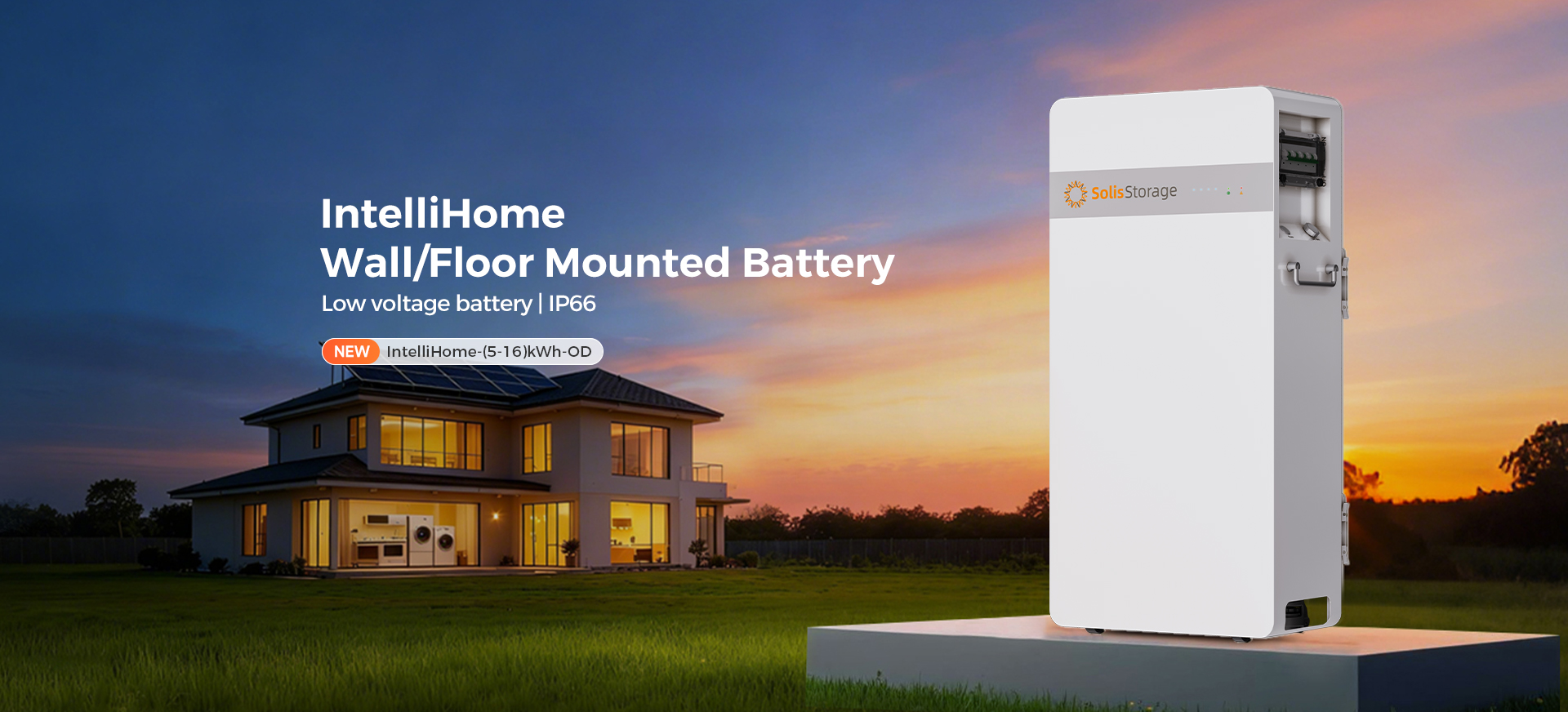
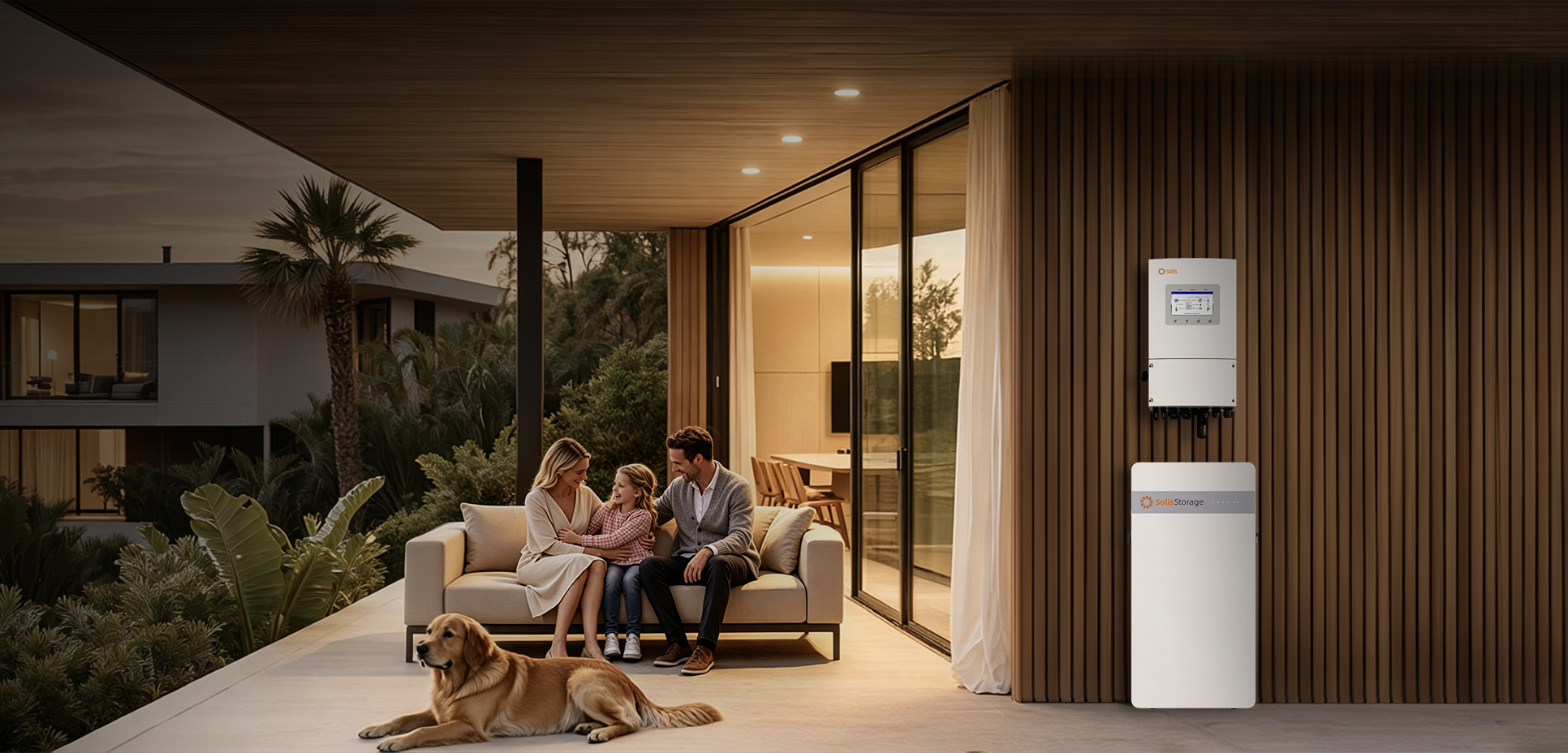
The IntelliHome is a residential energy storage system designed for home use. It uses LiFePO4 battery chemistry with a nominal capacity of 5 kWh, an operating voltage range of 44.8–57.6 V, and a rated cell capacity of 100 Ah. The recommended charge/discharge current is 50 A. It offers a cycle life greater than 6,000 cycles (corresponding to 10 years) and an ingress protection rating of IP66. The casing is made of aluminum alloy and core electronic components.
2. FlexCore-ID – Stackable Energy Storage System
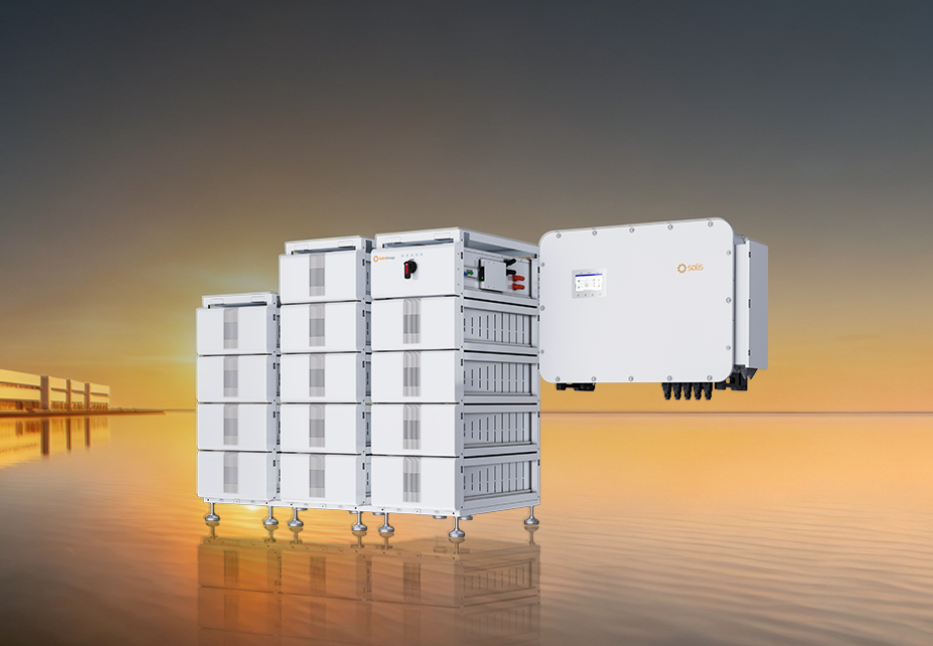
The FlexCore-ID is a stackable energy storage system intended for small farms, shopping malls, hospitals, large residences, and small industrial and commercial enterprises. It uses LFP (Lithium Iron Phosphate) battery cells with a capacity of 314 Ah and a cycle life of ≥8,000 cycles at 25±2°C, 0.5P, EOL70%. The battery pack model is FlexCore-ID-BAT20kWh. The system is constructed with an aluminum alloy casing and core electronic components.
3. EverCore ESS – Commercial & Industrial Energy Storage System
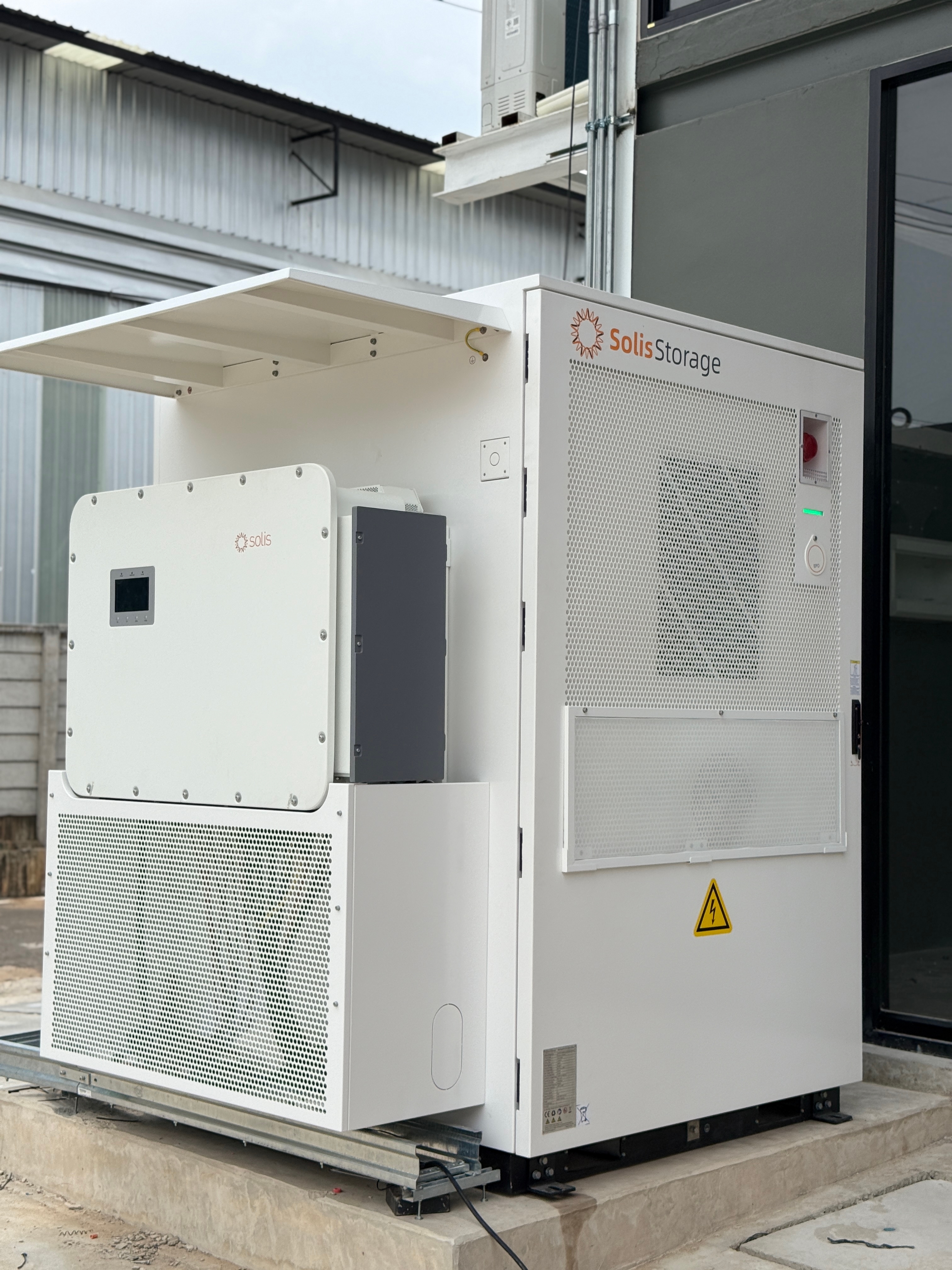
The EverCore ESS is a C&I energy storage system designed for commercial and industrial applications, as well as the renewable energy and power grid industry. It features an aluminum alloy casing and LFP battery chemistry with EVE cells (3.2 V / 314 Ah) and a cycle life of 8,000 cycles. Variants offer rated energy capacities of 100.5 kWh, 120.6 kWh, and 261.2 kWh, with inverter power ratings of 50 kW, 60 kW, and 125 kW. The cabinet has an IP55 protection level, while the inverter is rated IP66.
The EverCore ESS introduces an innovative AC-DC separation architecture, physically decoupling the hybrid energy storage inverter (AC side) from the battery cabinet (DC side). This design delivers three advantages: thermal separation improves cell temperature uniformity; protection separation raises inverter IP rating to IP66 (dust-tight, water-jet resistant); and structural separation allows flexible DC-side expansion – a single inverter can connect up to 6 battery cabinets in parallel, reducing system expansion costs by approximately 10%.
The 125 kW hybrid energy storage inverter integrates PCS, STS, PV inverter, circuit breaker protection, and EMS into one unit, achieving the highest power density in its class. It enables seamless grid-tied/off-grid switching in less than 10 ms without an external STS, supports DC and AC coupling, and allows a PV over-sizing ratio up to 200%.
EverCore retains an air-cooled design for the 125 kW / 261 kWh system, proven by engineering data. An independent three-air-duct design, combining a patented diversion duct with Coanda Effect airflow technology, boosts heat dissipation efficiency by 30% compared to traditional air cooling. The system operates reliably in extreme temperatures from -25°C to 55°C and at altitudes up to 4,000 meters.
Maintainability is a key advantage: over the full project lifecycle, EverCore saves approximately €9,500 per unit in O&M costs by eliminating liquid cooling fluid replacement, simplifying PCS and pack replacement, and reducing routine inspection complexity. Industrial-grade Minebea cooling fans (10-year maintenance-free, MTBF far above industry average) and Honeywell flammable gas detectors (10-year calibration-free) further lower total cost of ownership.
Safety is built into every level: a 15-layer, three-dimensional fortress protection system spans cell, pack, and system. Thermal insulation resistant to 1,000°C is used between packs, and a three-stage progressive fire-fighting mechanism is implemented (pack-level aerosol, cabinet-level aerosol, water inlet). The A-grade 314 Ah LFP cells feature ultra-low internal resistance (0.15 ± 0.05 mΩ), reducing heat generation, and an ultra-long cycle life of 8,000 cycles (≥70% remaining capacity).
EverCore is also designed for the open electricity markets of Europe, with a software ecosystem that has been connected or is being connected to 102 third-party VPP/EMS operators across 11 European countries. Integration with platforms such as Octopus Energy’s Kraken and Nordic aggregators (e.g., Check Watt) allows users to participate in electricity spot markets beyond simple peak-valley arbitrage. The Solis AI Cloud Platform, deployed at over 5,500 energy storage stations globally, enables minute-level dynamic optimization of charge/discharge strategies. In a residential storage project in Latvia, Solis AI optimization increased annual electricity bill savings by 302.6%.
Step-by-Step Breakdown: How to Choose the Right Energy Storage System
- Identify your application: Residential (intended for home self-consumption and backup), small commercial (farms, shops, hospitals, large residences), or large C&I / utility-scale (peak shaving, frequency regulation, VPP). SolisStorage products align directly: IntelliHome for residential, FlexCore-ID for smaller commercial, EverCore ESS for C&I.
- Determine energy capacity and power requirements: For residential, 5 kWh (IntelliHome) is typically sufficient for daily backup of essential loads. For larger needs, FlexCore-ID is stackable with a 20 kWh pack. For C&I, EverCore offers capacities from 100.5 kWh to 261.2 kWh with inverter power from 50 kW to 125 kW.
- Consider environmental conditions: IntelliHome has IP66 protection. EverCore ESS has IP55 cabinet and IP66 inverter with C4 anti-corrosion coating, suitable for wide temperature ranges (-25°C to 55°C), coastal salt fog, and high altitudes up to 4,000 meters.
- Evaluate lifecycle costs: EverCore’s AC-DC separation reduces expansion costs and simplifies maintenance, saving an estimated €9,500 per unit in O&M over the project lifecycle.
- Check software ecosystem requirements: For participation in VPP or electricity spot markets, EverCore’s compatibility with over 100 third-party platforms ensures future-proof operation.
Use Cases
Residential backup and self-consumption: The IntelliHome system stores excess solar energy during the day for use at night or during outages. Its LiFePO4 chemistry and 6,000-cycle life ensure long-term reliability.
Small commercial peak shaving: FlexCore-ID, with its stackable design and 314 Ah LFP cells, allows small farms and shopping malls to reduce demand charges.
Industrial peak shaving and frequency regulation: EverCore ESS provides both backup power and grid services. In Germany (a common application scenario), EverCore supports peak load shifting and frequency regulation, operating continuously 24/7 in grid-tied or off-grid mode with seamless backup switching.
Virtual Power Plant (VPP) integration: EverCore’s open software ecosystem enables connection to aggregators for multi-revenue streams.
Comparison of SolisStorage Energy Storage Systems
| Feature | IntelliHome | FlexCore-ID | EverCore ESS |
|---|---|---|---|
| Application | Residential | Small farms, shops, hospitals, large residences, small C&I | Commercial & Industrial / Utility |
| Battery Chemistry | LiFePO4 | LFP (314 Ah) | LFP (EVE 3.2V/314Ah) |
| Nominal Capacity | 5 kWh | Stackable (20 kWh per pack) | 100.5 / 120.6 / 261.2 kWh |
| Inverter Power | Not specified (AC coupled typical) | Not specified (AC coupled typical) | 50 / 60 / 125 kW |
| Cycle Life | >6,000 cycles (10 years) | ≥8,000 cycles (25°C, 0.5P, EOL70%) | 8,000 cycles |
| Ingress Protection | IP66 | Not specified | Cabinet IP55 / Inverter IP66 |
| Anti-corrosion | Not specified | Not specified | C4 anti-corrosion coating |
| Certification | – | – | – |
| Software Compatibility | Basic monitoring | Basic monitoring | Connected to 102 VPP/EMS operators (11 EU countries); Solis AI Cloud Platform |
Frequently Asked Questions
What is an energy storage system?
An energy storage system (ESS) stores electricity for later use. It typically consists of batteries (such as LFP or LiFePO4), a battery management system, an inverter, and a control platform. ESS enables functions such as peak load shifting, backup power, and self-consumption of PV power. It can operate in grid-tied mode, off-grid mode, and support seamless backup switching.
What types of ESS does Solis manufacture?
Solis, through its subsidiary SolisStorage, offers three main types: the IntelliHome (residential, 5 kWh LiFePO4, IP66), the FlexCore-ID (stackable, 314 Ah LFP cells, 8,000-cycle life), and the EverCore ESS (C&I, up to 261.2 kWh / 125 kW, AC-DC separation architecture). All products are designed for the renewable energy and power grid industry.
How long does a typical ESS battery last?
Based on SolisStorage products: IntelliHome offers >6,000 cycles (10 years at 1 cycle/day). FlexCore-ID and EverCore ESS provide ≥8,000 cycles at 0.5P charge/discharge (25°C, 70% end-of-life threshold). Approximately 500 cycles per year translates to 14–16 years of economic life.
What is the difference between residential and C&I energy storage systems?
Residential systems like IntelliHome are compact (5 kWh), designed for single homes with simple backup and self-consumption. C&I systems like EverCore ESS have much higher capacities (100.5–261.2 kWh) and integrate inverters (up to 125 kW) for peak shaving, frequency regulation, and VPP participation. EverCore also offers AC-DC separation for thermal management and flexible expansion, plus a sophisticated open software ecosystem for market trading.
How do I request a quote or sample for a SolisStorage ESS?
To obtain a quote, discuss project requirements, or request product samples, contact Solis directly: phone +86 574 65802188, email sales@ginlong.com. You can also download the Solis Global Brochure for an overview of all products and capabilities.

Conclusion
Energy storage systems are a critical component of the modern renewable energy landscape. Whether you need a compact home backup solution like the IntelliHome, a flexible stackable system like the FlexCore-ID, or a full-scale C&I powerhouse like the EverCore ESS, SolisStorage offers proven, certified solutions backed by more than two decades of power electronics expertise. With a global presence in over 100 countries, an annual production capacity of 80 GW, and an R&D team of more than 1,000 engineers, Solis is well-equipped to support your energy storage project.
For further information on specifications, pricing, and project consultation, reach out to the Solis team via sales@ginlong.com or download the comprehensive Solis Global Brochure (PDF) for detailed product datasheets and case studies.